For the first time ever, the World Health Organization (WHO) is providing recommendations for healthy and nutritious food in schools around the world.
Author: tio
-
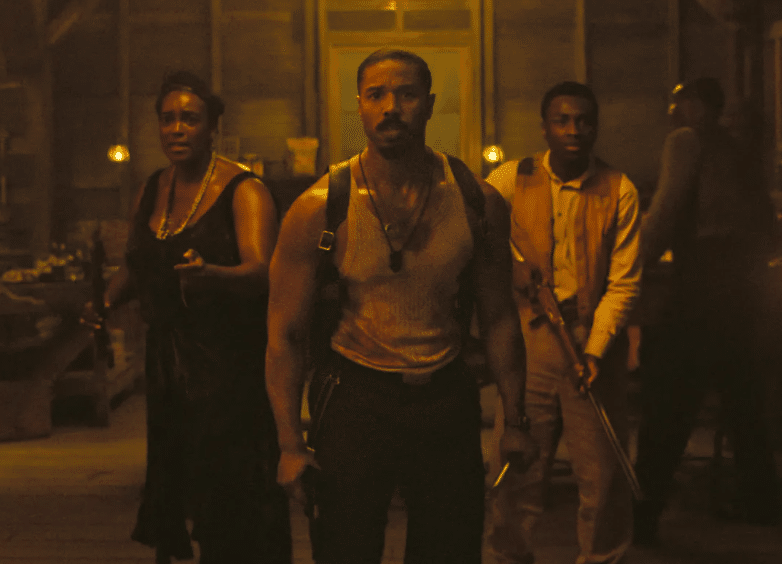
The Oscar Surge: ‘Sinners’ Piracy Triples Following Record-Breaking 16 Nominations
The Oscars remain the most anticipated movie awards show of the year, followed closely by hundreds of millions of film enthusiasts around the globe.
In March, the 98th Academy Awards ceremony will return to the Dolby Theatre in Los Angeles, where millions of fans will watch the crowning of this year’s “Best Picture”.
.
There are currently ten contenders in the race for the prestigious award. The nominees range from Hollywood heavyweights such as F1 and One Battle After Another, to international critical darlings such as Norway’s Sentimental Value and Brazil’s The Secret Agent.Sinners’ Oscar Nominations Record
While these are all serious contenders, Ryan Coogler’s Sinners clearly stands out. The movie received a record-breaking number of sixteen nominations last week, including one for the best picture category.
The record elevated the press attention for the film, which directly impacted legal demand. After the nominations, Sinners immediately shot back into the Top 10 on Max, while VOD sales on Prime Video and Apple TV also got a boost.
There is also a darker side to this increased exposure in the form of online piracy. Pirates are simply a subset of movie fans, and when legal demand increases, interest in pirate sites follows in the same direction.
We have reported on this phenomenon in the past, but this year offers one of the most clear examples.
Sinners’ Piracy Triples
By looking at the BitTorrent download estimates collected through a large sample of data, we can see the interest in Sinners tripling after the nominations were announced last Thursday.
Oscar Nominations Piracy (sample) 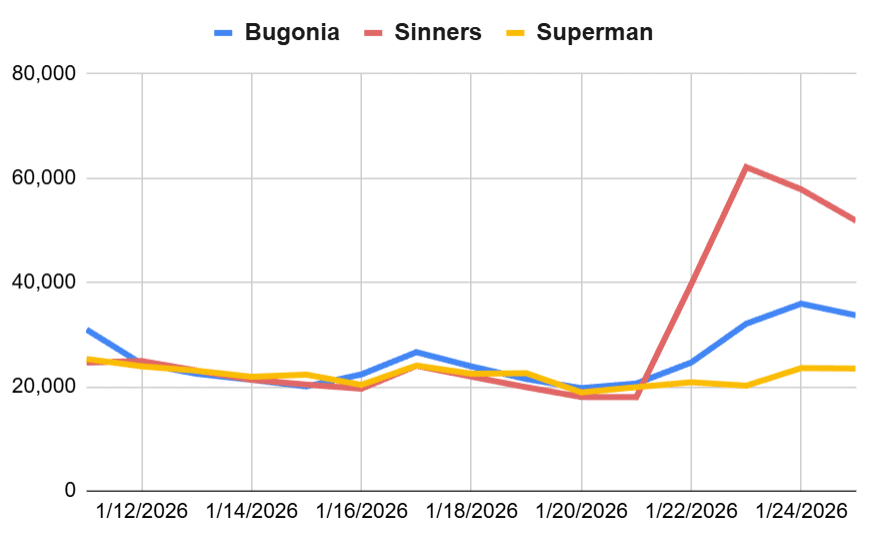
These data, collected with help from Iknow, also show a healthy 50% boost in downloads for Bugonia, another best picture nominee. However, that pales in comparison to the Sinners surge.
Meanwhile, the 2025 Superman release, which acts as a control group because it wasn’t nominated, saw no download boost at all. This confirms that the other observed increases are triggered by the Oscars nominations.
These findings once again show how the Oscar nominations can have a clear and direct effect on piracy numbers. And if Sinners can convert its record number of nominations into a record number of wins, we can expect an even bigger surge.
In closing, it is worth stressing that the download estimates reported here are based on a large sample of BitTorrent activity. This represents merely a fraction of the overall piracy interest, which also includes pirate streaming portals that are good for many millions of unauthorized views.
From: TF, for the latest news on copyright battles, piracy and more.
-
Large quantity of Mounjaro stolen from company
The weight loss drug is taken by thieves from Phoenix Healthcare Distribution in St Albans. -
EFF Statement on ICE and CBP Violence
Dangerously unchecked surveillance and rights violations have been a throughline of the Department of Homeland Security since the agency’s creation in the wake of the September 11th attacks. In particular, Immigration and Customs Enforcement (ICE) and Customs and Border Protection (CBP) have been responsible for countless civil liberties and digital rights violations since that time. In the past year, however, ICE and CBP have descended into utter lawlessness, repeatedly refusing to exercise or submit to the democratic accountability required by the Constitution and our system of laws.
The Trump Administration has made indiscriminate immigration enforcement and mass deportation a key feature of its agenda, with little to no accountability for illegal actions by agents and agency officials. Over the past year, we’ve seen massive ICE raids in cities from Los Angeles to Chicago to Minneapolis. Supercharged by an unprecedented funding increase, immigration enforcement agents haven’t been limited to boots on the ground: they’ve been scanning faces, tracking neighborhood cell phone activity, and amassing surveillance tools to monitor immigrants and U.S. citizens alike.
Congress must vote to reject any further funding of ICE and CBP
The latest enforcement actions in Minnesota have led to federal immigration agents killing Renee Good and Alex Pretti. Both were engaged in their First Amendment right to observe and record law enforcement when they were killed. And it’s only because others similarly exercised their right to record that these killings were documented and widely exposed, countering false narratives the Trump Administration promoted in an attempt to justify the unjustifiable.
These constitutional violations are systemic, not one-offs. Just last week, the Associated Press reported a leaked ICE memo that authorizes agents to enter homes solely based on “administrative” warrants—lacking any judicial involvement. This government policy is contrary to the “very core” of the Fourth Amendment, which protects us against unreasonable search and seizure, especially in our own homes.
These violations must stop now. ICE and CBP have grown so disdainful of the rule of law that reforms or guardrails cannot suffice. We join with many others in saying that Congress must vote to reject any further funding of ICE and CBP this week. But that is not enough. It’s time for Congress to do the real work of rebuilding our immigration enforcement system from the ground up, so that it respects human rights (including digital rights) and human dignity, with real accountability for individual officers, their leadership, and the agency as a whole.
-
Menopause linked to Alzheimer’s-like brain changesMenopause is linked to a loss of grey matter in regions involved with memory and emotion, study suggests.
-
NHS launches trailblazing AI and robot pilot to spot lung cancer sooner alongside screening programme set to tackle cancer inequalities
Patients facing suspected lung cancer could get answers sooner under a new NHS pilot using artificial intelligence and robotic technology to help doctors reach hard-to-detect cancers earlier, with fewer invasive tests. The new approach uses AI software to rapidly analyse lung scans and flag small lumps that are most likely to be cancerous, and a robotic camera is then used to […] -
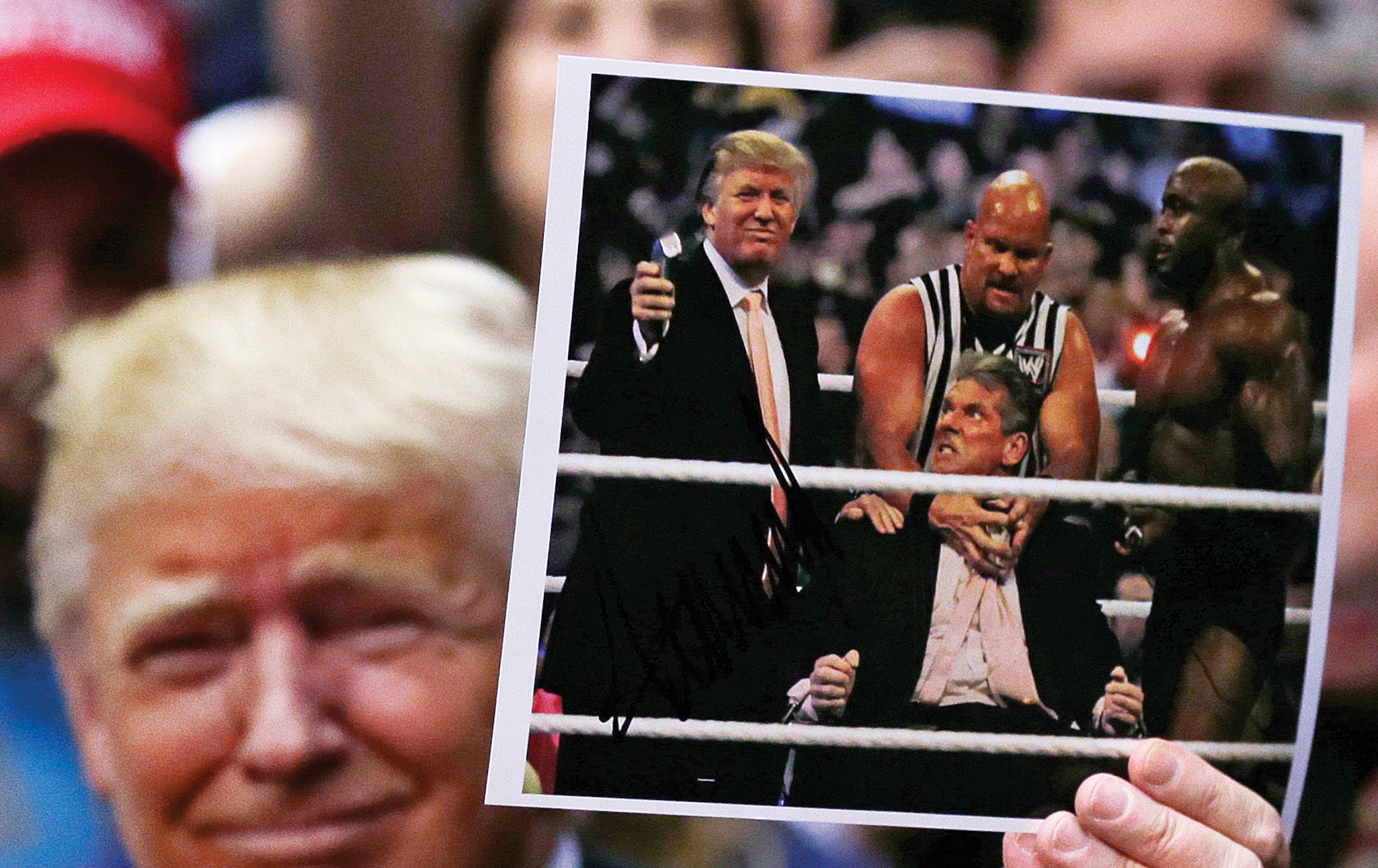
The Line Between Politics and Pro Wrestling Has Disappeared
Pro wrestling, for all its mass appeal, cultural influence, and undeniable profitability, is still dismissed as low-brow fare for the lumpen masses; another guilty pleasure to be shelved next to soap operas and true crime dreck. This elitist dismissal rests on a cartoonish assumption that wrestling fans are rubes, incapable of recognizing the staged spectacle in front of them. In reality, fans understand perfectly well that the fights are preordained. What bothers critics is that working-class audiences knowingly embrace a form of theater more honest than the “serious” news they consume.

-
Nepal Police Arrest Six in $20 Million Himalayan “Fake Rescue” Insurance Scam
A court in Kathmandu on Monday ordered a five-days custody for six executives from three prominent mountain rescue agencies who were arrested for allegedly orchestrating staged fake helicopter rescues of foreign tourists and siphoned off nearly $19.7 million through insurance fraud.
Tourism is a cornerstone of Nepal’s economy, drawing nearly 1.2 million visitors each year, with about 300,000 trekking in high-altitude regions including Everest, Annapurna, Langtang and Manaslu.
The Nepal Police said the suspects were arrested as part of an inquiry into what officials describe as a sophisticated racket that exploited Nepal’s multi-million-dollar trekking industry by arranging unnecessary helicopter evacuations from high-altitude regions and submitting forged medical and flight documents to justify the rescues that were later billed to foreign insurance companies.
“In our initial investigation, we found that these companies were involved in around 300 fake rescues,” Shiva Kumar Shrestha, a spokesman for the Central Investigation Bureau, told OCCRP on Monday.
Mr. Shrestha said the alleged fraud appeared to be systemic and extended well beyond the six executives now in custody. “Hospitals, helicopter operators, and guides are also linked in this chain; we are investigating this,” he added.
Prosecutors are pursuing charges for “offenses against the national interest,” a designation officials say reflects the reputational damage the scheme has inflicted on the country and its tourism sector.
The investigation draws on findings from a 2018 government probe that identified more than a dozen companies linked to fraudulent rescue operations, though no action was taken at the time. Police said the current case is based on those earlier findings combined with newly obtained evidence.
Industry officials say the arrests, while alarming, could help restore trust in a sector that depends heavily on foreign visitors.
“Nepal has an image of pure spirit and honest people, and some of these wrong practices weren’t giving a good image,” Deepak Raj Joshi, chief executive of the Nepal Tourism Board, told OCCRP. “If it is corrected now, in the long run, it will do good things. And if this is investigated, it will increase visitors’ confidence.”
-
South Korea Detains 55 Scam Ring Suspects Repatriated from Cambodia
South Korean police have arrested 55 of 73 online scam suspects repatriated from Cambodia last week, Yonhap News Agency reported on Monday, citing the national police. Prosecutors believe the suspects defrauded 869 victims of a total 48.6 billion won ($33.6 million) either by impersonating civil servants or engaging in romance scams. The 73 were flown back to South Korea on Friday in what Yonhap described as the country’s largest repatriation of criminal suspects from a single nation.
-
Slashed Subsidies and the Single-Payer Solution
Earlier this month, data from the Centers for Medicare and Medicaid Services revealed that enrollment in Obamacare has already dropped by 1.4 million this year after Congress failed to extend the enhanced subsidies at the center of last year’s government shutdown. In the coming months, this figure will likely climb further as enrollees whose plans were automatically renewed start to receive their first monthly bills, which are expected to double on average and in some cases jump by as much as 400%. Following years of progress in reducing the uninsured rate, millions are set to lose their health insurance, a reversal that will almost certainly increase the country’s already high toll of preventable deaths.
Most Americans understand that all of this could have been avoided had Republicans in Congress simply agreed to extend the enhanced subsidies; according to early polling, a majority will rightly blame Republicans for skyrocketing premiums heading into this year’s midterms. Yet as much as Republicans bear immediate responsibility, the current crisis also reflects the Democratic focus on preserving the status quo rather than confronting it.
Consider the subsidies themselves. First passed by Democrats in 2021, enhanced tax credits formed a pillar of President Joe Biden’s project to strengthen the Affordable Care Act and were developed in the aftermath of the 2020 election, when support for the more ambitious “Medicare for All” proposal had reached a high-water mark within the Democratic Party.
Biden’s victory in 2020 killed the momentum behind single-payer reform.
During the 2020 presidential primaries, Biden was one of the few Democratic candidates who adamantly opposed the single-payer reform then being championed by progressive candidates like Sen. Bernie Sanders and Sen. Elizabeth Warren. At one point, the former vice president even compared progressive calls for M4A to Republican calls to “scrap” the Affordable Care Act. Instead of overhauling the broken system, Biden suggested strengthening and “building on” Obamacare. In this context, the enhanced ACA subsidies must be understood as part of an overall effort by centrist Democrats to bolster the status quo and deflect demands for more radical policy solutions.
Biden’s victory in 2020 killed the momentum behind single-payer reform. As Meagan Day recently summarized in Jacobin, the proposal migrated “almost overnight from the center of the primary debate to the margins of respectable Democratic Party discourse.” For the rest of the Biden years it looked as if the push for single-payer reform had hit a dead end, which continued into the 2024 election. Though once a co-sponsor of Sanders’ Medicare for All bill in the Senate, Democratic candidate Kamala Harris more or less renounced her past support for the proposal as part of a broader shift to the center. With the prospect of a second Trump term, few progressives complained.
Barely more than a year later, however, the Biden-led effort to put Obamacare on a more solid footing now seems to be unraveling completely. Indeed, the expiration of the enhanced subsidies exposes the failure of the Affordable Care Act to make health care universal or even affordable.
One welcome consequence of the breakdown of Obamacare has been the resurgence of Medicare for All as a key issue in this year’s midterms. With the ACA’s flaws on full display, progressive candidates in several high-profile elections have placed Medicare for All at the center of their campaigns, much as Sanders did in 2016.
In response to this renewed push for M4A, opponents of single-payer have largely chosen to repeat their script from 2020: Adopt the banner of “universal health care” without actually backing proposals that would guarantee universal coverage. Most centrist counterproposals again focus on bolstering the ACA by extending enhanced subsidies and possibly introducing a public option to compete with private plans. Advocates of this approach have sold the public option as the “pragmatic” alternative to M4A that would guarantee near-universal coverage without upending the entire system.
Some members of the consultant class that once opposed a public option are now backing it as a compromise to demonstrate the party’s commitment to reform while mostly leaving the current system intact. Speaking to Politico last month, several consultants insisted that a public option was more “politically palatable,” pointing to polling that shows a majority of Americans to be “satisfied” with their current insurance plans.
“They don’t want the choice of which insurance corporation, but the choice of which provider.”
“People don’t love their insurance corporation — they love their doctor,” said Abdul El-Sayed, a former Senate candidate in Michigan and author of “Medicare for All: A Citizen’s Guide.” “They don’t want the choice of which insurance corporation, but the choice of which provider. Our current system restricts which doctors we can see — and a public option wouldn’t solve that. Medicare for All protects the choices we actually want while guaranteeing us the security of knowing that we won’t lose our coverage if we get married, get divorced, turn 26 or have a job transition.”
While acknowledging that a public option would be better than nothing, El-Sayed says it would fail to address the root problems with the current system, much like Obamacare and other half-measure policies like enhanced subsidies. “Where Medicare for All would end the arms race of billing and bureaucracy and push costs down, a public option would not.” It would also fail to “guarantee health care” or “address the power of major corporations in our bloated system,” he said.
Perhaps the greatest shortcoming of all is that a public option would not “empower government to negotiate prices down on our behalf,” which is a huge problem if the goal is to control costs and make health care more affordable. As of 2023, the United States spends nearly double what comparable countries spend per capita on health care. The key difference is that almost all of these countries have single-payer or public-managed health care systems where governments can control costs by reducing administrative waste and negotiating prices with private providers and drug companies.
On why Medicare for All is the policy solution that Democrats should rally behind going forward, El-Sayed explained that it is the only plan that would actually address the root causes of the current system’s mounting problems: “Medicare for All ensures that every American has health care coverage, with no premiums, co-pays or deductibles. It fixes the structural pitfalls of our profit-driven system to allow us to finally negotiate prices, lower costs and guarantee coverage for every American.”
Looking ahead to the midterms and the 2028 presidential election, supporters of Medicare for All have at least some cause for optimism. According to a recent poll from Data for Progress, public support for single-payer reform is currently near an all-time high, with roughly two-thirds of Americans and 8 in 10 Democrats backing the proposal. What’s more, that support is relatively stable even when respondents are provided with talking points against the plan — i.e., that it would raise taxes and give the government “too much control over health care.” In the past, negative talking points resulted in a significant drop-off in support, but in the latest survey nearly 6 in 10 continued to back the proposal anyway. Other polls have also found expanding support for universal health care and single-payer.
While these polls show the growing popular appeal of single-payer health care, public opinion has never been the main obstacle to reform. Throughout American history, attempts to overhaul the health care system have repeatedly run up against fierce opposition from powerful interests committed to preserving the status quo — interests that are, if anything, even more entrenched today. Out of all the proposed reforms, M4A is the greatest threat to the bottom line of private insurers, drug companies and the increasingly consolidated for-profit hospital chains. Naturally, these organizations will mobilize their considerable resources to derail a proposal as disruptive as M4A.
Public support for single-payer reform is currently near an all-time high.
This formidable opposition is one of the reasons most establishment Democrats continue to back incrementalist reforms. While many supporters of a public option might concede, if pressed, that Medicare for All is the superior policy solution, they continue to argue that it could never realistically overcome the powerful vested interests that oppose it. Hillary Clinton said this much in 2016 when she griped that people with health emergencies “can’t wait for us to have a theoretical debate about some better idea that will never, ever come to pass.”
This is defeatism disguised as pragmatism, but it also comes from a legitimate insight about the current state of democracy in America. The hard truth is that as long as corporate interests and billionaire donors dominate the political system, sweeping reforms like Medicare for All will indeed remain out of reach. “Establishing a guaranteed, single-payer health care system will require tackling the corrupting force of pharma money, insurance money and for-profit hospital money in our politics,” said El-Sayed. “We won’t achieve Medicare for All without taking on the Citizens United regime directly, banning corporate PAC influence and returning our politics to the hands of the people.”
As costs continue to rise, the sector’s biggest players only grow more powerful. As Helen Santoro and Joel Warner recently pointed out in The Lever, consumer spending on health care grew more than any other goods or services in the last quarter of 2025 and now accounts for nearly a fifth of the nation’s economic spending, up from just 5% in 1960. This is not only bad news for Americans currently struggling to afford care, but for the long-run possibility of fixing our broken system. “[A]s ever more of the country’s economy becomes tied to medical spending,” Santoro and Warner write, “it becomes increasingly difficult to challenge the corporations and reform the system that are consuming all of that money.” Eventually, they observe, the broken health care system could become “too big to heal.”
This makes the drive for real reform all the more urgent. As Democrats gear up for the midterms, the party’s so-called pragmatists will no doubt argue that the party should adopt a more “moderate” course on health care reform that stands a realistic chance at becoming law. But this is the very approach that got us into the current mess in the first place. As the window of opportunity for transformative reform narrows, Democrats cannot afford to make the same mistake.
“As candidates and elected officials, our job is to lead with clarity and confidence, and to make popular what is right,” El-Sayed said. “The choice is between patching up a system that costs more and delivers less, and finally guaranteeing health care as a right for every American.”
The post Slashed Subsidies and the Single-Payer Solution appeared first on Truthdig.