Author: tio

  • Old and new challenges for the Human Rights Council as it turns 20

    It’s 20 years to the day since the UN Human Rights Council began its work as the world’s principal forum tasked with promoting and defending fundamental rights everywhere, particularly the world’s most vulnerable people.
  • DR Congo: Efforts ramp up as Ebola outbreak accelerates beyond borders

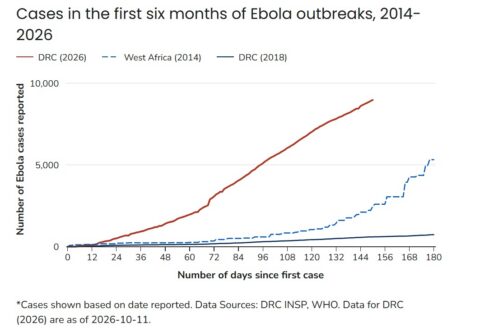
    The spread of Ebola is accelerating in the eastern Democratic Republic of the Congo (DRC) amid continued armed violence, posing a grave and growing risk to the region, UN agencies warned on Friday.
  • The UK’s New Under-16 Social Media Ban Will Cause More Harm Than It Prevents

    This week, politicians in the UK pushed forward with plans to eviscerate privacy and free speech on the internet by announcing a ban on social media for users under 16 that is set to take effect in Spring 2027. 

    The UK government continues to falsely characterize this policy as a necessary response to growing concerns about online harms for young people. In reality, much like the Online Safety Act, it will cause more harm than it will prevent. 

    Users of all ages are burdened with proving their age before accessing content, with social media platforms such as Snapchat, TikTok, YouTube, Instagram, Facebook, and X included in the ban. There remains no reliable, privacy-preserving method of verifying the age of every internet user and methods vary from one platform to the next.

    Young people will not simply be protected from being contacted by adults or endlessly scrolling—they’ll also lose access to educational videos on YouTube, local events on Facebook, and potentially cut off from distant friends and family. 

    Public policy must be effective, proportionate and respectful of fundamental rights. Young people deserve better than a policy built on panic, and all internet users deserve a safe and free internet. A social media ban generates headlines, but it will not solve the problem. 

    A Brief History of Age-Gating in the UK

    Age restriction proposals in the UK date back to a decade ago, when the proposed Digital Economy Bill was put forth to (among other things) restrict young people from accessing pornographic websites. While the Digital Economy Act of 2017 passed without age-based restrictions, it laid the groundwork for later age verification measures.

    Over the next few years, age checks for porn websites were announced then delayed several times. But it wasn’t until a consultation under the 2016-2019 May government and the 2020 publication of the Online Harms Whitepaper that age verification became a broader idea.

    In 2023, the UK passed the controversial Online Safety Act, establishing powers that could weaken privacy protections and freedom of expression for internet users worldwide. In July 2025, the government implemented age assurance measures on sites hosting “harmful” content. 

    And despite politicians affirming repeatedly that the Online Safety Act would solve all of the problems with online safety, this year they decided it in fact did not go far enough. American social psychologist and The Anxious Generation author Jonathan Haidt—who has called for age-related social media bans around the world, despite significant scientific doubt about his research—met with the UK Health Secretary in February to push for the ban.

    In March, politicians introduced plans for a social media ban into the Children’s Wellbeing and Schools Bill to “prevent children under the age of 16 from becoming or being users” of “all regulated user-to-user services,” to be implemented by “highly-effective age assurance measures”—effectively banning under-16s from social media. 

    When this proposal came before the House of Commons, MPs defeated and proposed their own amendment: enabling the Secretary of State to introduce provisions “requiring providers of specified internet services” to prevent access by children, under age 18 rather than 16, to specified internet services or to specified features; and to restrict access by children to specified internet services which ministers provide. 

    But the social media ban does not stop there. The provision also requires internet service providers to limit the time kids spend online, and has rules about who can contact them online. These extreme rules will take decisions about using technology away from families and put them in the hands of government regulators. 

    The history of this proposal shows that the UK government has repeatedly returned to the same flawed idea: restricting access to online services by requiring age checks for everyone. But the fundamental problems have not changed. There is still no widely available way to verify age online without compromising privacy—but even if there were, broad restrictions on social media will inevitably limit access to lawful speech, and valuable online communities, and arts and culture.

  • EFF Joins 60+ Groups Urging the UK to Halt Face Estimation at the Border

    This week, EFF joined Foxglove, Human Rights Watch, and 60 other organizations in writing to the UK’s Minister of State for Border Security and Asylum, Alex Norris, raising serious concern about the Home Office’s decision to deploy Facial Age Estimation (FAE) to assess asylum-seeking children from 2027. 

    The letter points to four key concerns:

    Discrimination 

    As with most face estimation and recognition tools, there is ongoing bias in the deployment of these technologies. With FAE, many have highlighted its baked-in failures and discrimination, particularly in relation to women and people of color. Evidence shows that FAE is most accurate for estimating the ages of Eastern European men, but even then it consistently produces errors. The Home Office itself noted “that FAE performance can vary depending on ethnicity” and skin tone. 

    Inaccuracy

    The Home Office has admitted that FAE systems are imprecise for analyzing 16-to 18-year-olds, with even the “top systems” having an “error margin of around 2.5 years here.” This is exactly the age range for which the Home Office has chosen to deploy this technology. And this error margin will be widened yet further because children seeking asylum often suffer from trauma-induced aging. 

    Lawfulness of Use of Children’s Data

    Major concerns exist around the lawful basis on which the Home Office, or its chosen third-party FAE vendors, could have sought consent to collect and process photographs or data from asylum-seeking children to train this system. Further, there is no clarity on the images and/or data that this technology has been trained on. 

    Lack of Necessary Disclosure 

    The Home Office claims “extensive testing has already been carried out across diverse groups, including different ethnicities, genders and age ranges, indicating promising performance and accuracy.” But these purported “promising” results have not been published, nor have any Equality or Data Protection Impact Assessments. 

    The letter continues by requesting clarification on several key questions regarding these concerns. EFF and partners have provided the UK government 21 days for a response, and we urge the Home Office to take on this uphill task in good faith and release the information.

    You can read the letter in full here

  • Trump-Loving Crypto Super PAC Finally Backs a Democrat: Ritchie Torres

    A crypto super PAC that has praised President Donald Trump and previously endorsed an all-Republican slate of candidates has finally found a Democrat it can get behind: New York Rep. Ritchie Torres.

    The Fellowship PAC dropped $300,000 on Monday to boost Torres in the final days of his reelection primary campaign, funneling its ad spend through a firm co-founded by Trump’s former top crypto adviser.

    The super PAC’s largest funder is Cantor Fitzgerald, the investment bank helmed by the sons of Commerce Secretary Howard Lutnick.


    Related

    Who’s Spending in Your Congressional Election? We Tracked the Front Groups Fueling the 2026 Midterms.


    Torres is not expected to face serious opposition in the June 23 primary in New York. The sole public poll of the race put him far ahead of his leading opponent, former Democratic National Committee vice chair Michael Blake.

    Torres, the Fellowship PAC, and Blake did not immediately respond to requests for comment.

    The spending is another sign of bond between crypto firms and Torres, a member of the key House Committee on Financial Services who has been one of the industry’s most vocal Democratic supporters. Torres was a co-founder of the Congressional Crypto Caucus.

    Still, the primary intervention still comes as something of a surprise given that, in the past, the Fellowship PAC only doled out campaign funds on behalf of Republicans. Reporting on its creation, the New York Times described the PAC as “more aligned with the Republican Party and President Trump than Fairshake, which is the dominant, pro-crypto super PAC.”

    The PAC signaled support for Trump in a press release announcing its creation in September, praising him for putting “America on the path to become the global crypto capital.” In the months since then, however, the odds that Republicans will control the House after the midterm elections have dimmed.

    The Fellowship PAC, which spends on ads rather than giving directly to campaigns, put Torres’s picture on its endorsement page in recent weeks, according to an archive of its website. Other candidates the group has endorsed include Sen. Lindsey Graham, R-S.C., and Texas Attorney General Ken Paxton, R-Texas, in their Senate races.

    Big Crypto Bucks for Shoo-in

    The Fellowship PAC is not the only crypto campaign organization spending on behalf of Torres. Protect Progress, which is affiliated with the juggernaut crypto super PAC Fairshake, buoyed the Bronx Democrat with nearly $1.4 million in advertising.

    The two super PACs are aligned with different factions of the crypto industry. The Fellowship PAC’s chair is the vice president of regulatory affairs for Tether, a massive stablecoin company that is trying to break into the U.S. market after years of scrutiny over its use by money launderers, including terror groups.

    Although Tether has not donated directly to the Fellowship PAC, the PAC received $10 million from the financial services firm Cantor Fitzgerald, which is the custodian of billions of dollars of U.S. Treasury bills on behalf of Tether. Lutnick, Trump’s commerce secretary, stepped down as the head of the banking firm and divested his assets to join the Cabinet.


    Related

    This Commission That Regulates Crypto Could Be Just One Guy: An Industry Lawyer


    The media buy on behalf of Torres was made through Nxum Group, which was co-founded by Bo Hines, a former Republican congressional candidate who served as the executive director of Trump’s Council of Advisers on Digital Assets last year. Hines is the CEO of Tether U.S., the American division of the El Salvador-based firm.

    Protect Progress and Fairshake, meanwhile, have been funded by the crypto exchange Coinbase and the venture capital firm Andreessen Horowitz. Fairshake and its affiliates have spent money on both sides of the aisle, although it was criticized in 2024 for helping tip the Senate in favor of Republicans.

    The post Trump-Loving Crypto Super PAC Finally Backs a Democrat: Ritchie Torres appeared first on The Intercept.

  • RFK Jr. is a Creepy Weirdo Obsessed with Teenager’s Sperm

    RFK Jr. is a Creepy Weirdo Obsessed with Teenager’s Sperm

    Kennedy’s sperm obsession combined with his desire for healthy “Trump babies” to serve in a military led by a White supremacist, whom he believes to be a divinely anointed, testosterone-filled übermensch can best be thought of a corollary to soft eugenics. I’ll call it soft Lebensborn.

    The post RFK Jr. is a Creepy Weirdo Obsessed with Teenager’s Sperm first appeared on Science-Based Medicine.

  • Five tips to keep your kids cool this weekend

    Temperatures are set to rise over the next few days, and children can be especially vulnerable – so read on for tips to protect them.
  • Canada Is Forging Ahead with Its Dangerous Surveillance Bill

    With no serious debate, including on proposed amendments, Canada is blazing full speed ahead with Bill C-22, which would threaten encryption and increase surveillance. Also known as the Lawful Access Bill, Bill C-22 is currently moving forward quickly to a vote despite the many, many criticisms civil liberty groups and the tech industry have hurled at it.

    As we’ve discussed before, Bill C-22 is dangerous on multiple levels. It pushes for requirements for metadata retention, expands information sharing with foreign governments, and establishes a mechanism that allows Canada’s Ministry of Public Safety to demand that companies create backdoors, effectively breaking encryption. That mechanism was a key facet of Part 2 in Bill C-22, and the government prevented it from being independently debated.

    In a deep analysis of the bill, Citizen Lab and the Canadian Civil Liberties Association detail every one of flaws of this proposal, concluding that most elements are unsalvageable. 

    A wide range of tech companies agree. Signal, Apple, Google, and several VPN providers oppose the bill, and some have said they’d likely be forced to either cut Canadians off from certain features or shut down services in Canada altogether.

    The Canadian government wants this dangerous, complicated, overreaching bill passed before June 19. Bill C-22 is riddled with privacy problems that affect millions of people. It should be debated and studied fully, not jammed through on an arbitrary deadline. 

    OpenMedia is offering a tool for Canadians to contact their elected representatives about the bill. Actions taken on OpenMedia’s website are governed by OpenMedia’s privacy policy, not EFF’s.

  • EFF Thanks SerpApi For Helping Us Protect Free Speech Online

    EFF is grateful for SerpApi’s generous support, helping us fight for your rights to speak and access information online. SerpApi has been giving to EFF every year since 2018, and alongside our 32,000 individual donors, their gift is critical to keeping up the fight.

    Whether in the courts, halls of power, or broader policy debates, we appreciate the work this support has made possible over the years. Some examples:

    • We sued the U.S. Department of Homeland Security and Department of State to stop an unconstitutional social media surveillance program to identify and punish individuals who express viewpoints the government disagrees with.
    • We helped develop the Santa Clara Principles, a framework to reign in overbroad content moderation so that all users are treated fairly and offered consistent tools for recourse if their speech is censored by tech companies.
    • In the whitepaper Unfiltered: How YouTube’s Content ID Discourages Fair Use and Dictates What We See Online, we pushed back on YouTube for silencing individual creators in the interest of protecting a small number of giant copyright holders.
    • We stood with whistleblowers and dissidents persecuted for their online speech.
    • We continued the fight to protect Section 230.

    We live in an era when lawful speech and the right to access information are being targeted by Big Tech and governments around the world that are hostile to dissent. Free speech online is core to EFF’s mission, and SerpApi’s support will help us continue the fight to protect everyone’s right to free expression.

  • Eel Smuggling Is The Organized Crime Racket You’ve Never Heard Of

    Eel Smuggling Is The Organized Crime Racket You’ve Never Heard Of

    Despite being the world’s most trafficked animal, the European eel receives surprisingly little sympathy. It lacks the mammalian charisma of the creatures whose plights dominate conservation campaigns; among them the shy, helpless pangolin and the stoically intelligent elephant. By contrast, the eel is viewed by many as a source of revulsion: a slimy, writhing reason to stay out of the water. Yet behind inscrutable eyes, it harbors many secrets. This is the story of how an elusive and often misunderstood fish found itself at the center of an international smuggling network.