More than a month since war erupted in the Middle East, UN agencies confirmed on Tuesday that huge numbers of people have returned to Syria from Lebanon “exhausted, traumatized and with very, very few belongings”. Meanwhile, the UN International Maritime Organization said that another vessel has been attacked in the Strait of Hormuz, increasing concerns of further delays in transporting lifesaving aid. The Security Council met in New York in emergency session on Lebanon. Stay with us for live updates. App users can follow coverage here
Author: tio
-
Lebanon at ‘breaking point’ as displacement soars and strikes intensify
The UN’s top humanitarian official warned the Security Council on Tuesday that Lebanon is facing one of its most dangerous moments in years, with escalating violence, mass displacement and deepening human suffering pushing the country to “breaking point”. -
Hotline to the Kremlin: How Hungary Colluded With Russia to Weaken EU Sanctions
An hour after Hungarian Foreign Minister Péter Szijjártó returned to Budapest from St. Petersburg on August 30, 2024, he received a phone call from his Russian counterpart, Sergei Lavrov.
Lavrov told Szijjártó he had been quoted all over the Russian media following his visit.
“Did I say something wrong?” Szijjártó asked.
“No, no, no.” Lavrov reassured him. “They were just saying that you are pragmatically fighting for the interests of your country.”
In fact, Lavrov was calling to make a request: The Russian oligarch Alisher Usmanov was looking to have his sister, Gulbahor Ismailova, removed from EU sanctions lists, and Szijjártó had promised to help.
“I’m calling on the request of Alisher and he just asked me to remind you that you were doing something about his sister,” Lavrov said.
“Yeah, absolutely,” Szijjártó answered. “The thing is the following: Together with the Slovaks we are submitting a proposal to the European Union to delist her. We will submit it next week, and as the new review period is going to be started, it’s gonna be put on the agenda and we will do our best in order to get her off.”
Lavrov expressed his appreciation for Szijjártó’s “support and … fight for equality in all fields.”
From there conversation proceeded to the two men’s shared disdain of the European Union and its officials. Before hanging up, the Hungarian praised the new Gazprom headquarters he’d visited in Russia. “I am always at your disposal,” he added.
Seven months later, Ismailova was removed from the EU sanctions list.
This call between the two foreign ministers was one of several that took place between 2023 and 2025. Audio recordings of Szijjártó’s conversations with Lavrov, as well as other Russian officials, were obtained by reporters from VSquare, FRONTSTORY, Delfi Estonia, The Insider, and the Investigative Center of Ján Kuciak (ICJK). Reporters confirmed the content independently with intelligence sources in multiple countries and consulted on the authenticity of the audio with external experts.
The calls highlight the exceeding comity between Szijjártó, who represents an EU and NATO member, and Lavrov, who represents a nation that has invaded a European country and sponsored acts of arson and sabotage against NATO’s eastern flank.
The two men’s conversations traffic in sensitive information about the internal deliberations of both Budapest and Brussels, which are doubtless of interest to the Kremlin. They also provide clearcut evidence of Russia’s role in prodding Hungary and Slovakia to soften EU sanctions against Russian individuals and entities.
In his exchanges with Lavrov, Szijjártó comes across as deferential, at times bordering on obsequious. “If you remove names and show these conversations to any case officer, he will swear that this is a transcript of an intelligence officer working his asset,” said a senior European intelligence officer after reviewing the transcripts.
Neither Lavrov nor Szijjártó replied to requests for comment. Usmanov’s German lawyer, Joachim Nikolaus Steinhöfel, declined to answer questions about the discussion between Lavrov and Szijjártó. He described EU sanctions against Usmanov and his relatives as “unjustified,” stressed his success as a businessman and philanthropist, and emphasized that Usmanov had won “over twenty court cases” against “media outlets, public figures, and politicians who disseminated various false statements about him … many of [which] echoed the very reasonings used for the EU sanctions.”
Szijjártó’s communications go far beyond Usmanov and his relatives. In a call with another Russian official, Deputy Energy Minister Pavel Sorokin, in the summer of 2025, Szijjártó not only says he has already diluted the EU’s 18th sanctions package, then under negotiation — he asks for additional talking points that would make his efforts appear to be in the interest of Hungary rather than Russia.
“I have already removed 72 [entities] from the list, but there were 128. I’m trying to continue, but I have to say that this is in the interest of Hungary,” Szijjártó says.
“If they [Sorokin’s staff] can help me identify the direct and negative effects on Hungary, I would be very grateful,” he adds, “because if I can show something like that, you would give me a completely different opportunity.”
Szijjártó’s willingness to act in Russia’s interests at the EU level helps explain why Moscow is investing significant effort in keeping Viktor Orbán and his pro-Kremlin Fidesz party in power in Hungary.
Independent polling suggests Orbán is trailing badly ahead of the April 12 parliamentary election, with the center-right Tisza party, led by challenger Péter Magyar, holding a strong lead.
As Orbán’s campaign struggles, Russia is reportedly stepping in to assist. As VSquare reported earlier this month, the Kremlin has assigned Sergey Kiriyenko — a deputy chief of staff to Putin and a key architect of Russia’s political influence operations — to covertly support Orbán’s campaign. Kiriyenko previously played an integral role in shaping election interference activities in Moldova.
At the same time, Orbán’s campaign has increasingly echoed Kremlin narratives, staging provocations against Ukraine and accusing opposition figures and critics of acting as Ukrainian proxies or spies while dismissing allegations of Orbán’s own ties to Russia.
The calls show that Szijjártó routinely kept Lavrov informed of supposedly confidential discussions by European diplomats.
For instance, in the same August 30, 2024 call with Lavrov, Szijjártó revealed details of a EU Foreign Affairs Council meeting that he had participated in the day before.
“That was crazy, you know, when [Lithuanian foreign minister Gabrielius] Landsbergis said that we contribute 12 percent of each rockets and missiles,” Szijjártó told Lavrov, referring to the minister’s argument that Hungarian and Slovak gas and oil payments were helping finance Russia’s war on Ukraine.
“I said, my friend, you are not right, because the Europeans contribute much more … it’s not only the Slovaks and us who are buying gas and oil from Russia directly but all of you who are buying the same from them through … India, Kazakhstan.”
When reached for comment, Landsbergis confirmed that this conversation had taken place.
“It seems that all this time Putin had, and still has, a mole in all European and NATO official meetings,” he said. “If the integrity of these meetings is to be maintained, it would be appropriate to ban Hungary from all of them.”
“Every generation has a Kim Philby,” Landsbergis said, referring to the notorious KGB spy in the British Secret Intelligence Service. “Apparently Péter Szijjártó is playing the role with enthusiasm.”
Hungary’s Leverage
While the EU has sanctioned some 2,700 Russian citizens and entities due to their role in enabling Russia’s war on Ukraine, the bloc must vote every six months on whether to extend those sanctions.
These decisions are made by consensus, meaning all 27 member states must agree.
RFE/RL reported in March 2025 that Hungary and Slovakia threatened to block the extension of EU sanctions that month unless certain names were removed. It wasn’t just Ismailova: Russian businessman Viatcheslav Moshe Kantor and the country’s sports minister, Mikhail Degtyaryov, were also unsanctioned during that round.
Speaking on condition of anonymity in order to be able to reveal inside details, a European diplomat closely involved in the negotiations said that Hungary and Slovakia usually begin with a lengthy list of Russian names they want delisted.
“They don’t use legal arguments,” the diplomat explained. “They just say they don’t want those people on the sanctions list for political reasons.”
As negotiations progress, Budapest and Bratislava usually whittle their list down to a handful of people, as was the case with Ismailova, Kantor, and Degtyaryov.
While it had long been suspected that Hungary and Slovakia leak the details of these negotiations to Moscow, the diplomat described newly obtained hard evidence as valuable: “Hungary is clearly fulfilling political orders from Russia,” they said when reporters showed them the transcripts.
‘No clear Hungarian interest’
Economic relief for individuals isn’t the only case in which Hungary secretly acted on the Kremlin’s behalf in Brussels.
In conversations with another high-ranking Russian official, Deputy Energy Minister Pavel Sorokin, Szijjártó said that he was doing his best to “repeal” a crucial EU sanctions package targeting Russia’s shadow fleet of oil tankers — the means by which Moscow evades Western energy sanctions.
In one conversation with Sorokin, Szijjártó offered to remove Russian banks proposed for designation by the EU. He even asked the Russian to provide him with arguments as to why doing so would be in Hungary’s interest.
In another call, Szijjártó complained that the EU refused to share with him documents related to the proposed sanctioning of 2Rivers, a Dubai-based company trading in Russian oil.
“They say that there is no clear Hungarian interest that they can identify, and therefore Hungary cannot legally ask them to be removed from the list,” Szijjártó said after Sorokin asked why Budapest had been cut out of the loop.
According to the EU, 2Rivers, formerly known as Coral Energy, has been a key player in selling Russian oil via its own shadow fleet of tankers and concealing the origin of crude from Russian state energy giant Rosneft, now under U.S. sanctions. 2Rivers then sells the crude above the internationally capped oil price and feeds Russia’s war machine with vital revenue. In December 2024, the UK sanctioned 2Rivers and its oil trading network.
It is unclear what interest Hungary — a landlocked country that receives oil through pipelines — could have in trying to preserve Russia’s shadow fleet operations. But the benefit to Russia is obvious.
After reporting that he was unsuccessful with 2Rivers, Szijjártó shared details with Sorokin about then-ongoing negotiations on the EU’s 18th sanctions package.
He explained that the vote was not yet on the agenda thanks to a postponement arranged by Hungary and Slovakia until the EU agreed to “make an exception” for those countries to “allow us to continue buying Russian gas and oil.”
The 18th sanctions package was proposed by the European Commission on June 10, 2025. Two weeks later, Szijjártó announced publicly that Hungary and Slovakia were blocking it “in response to European Union plans to phase out Russian energy imports.”
It was in a call with Sorokin a week later that Szijjártó asked for talking points about “negative effects on Hungary” to help him dilute the package.
Kinga Redłowska, a leading sanctions expert and the Head of CFS Europe at the London-based think tank RUSI, said Hungary’s approach serves a dual purpose.
“Domestically, it allows Viktor Orbán to reinforce an anti-Ukrainian narrative,” she said. “At the EU level, it provides leverage to extract concessions in unrelated areas, such as EU funding or rule-of-law disputes.”
But while this strategy may help Orbán’s government, enabling an aggressive neighbor to capture and hold more sovereign European land runs counter to Hungary’s national interest, she said: “Weakening sanctions risks bolstering Russia’s war economy, undermining the broader security interests of all EU member states, including Hungary itself.”
The conversations between Szijjártó and Sorokin also touched on Russian banks that were in the EU’s crosshairs.
“[S]hare the names of those banks with me, I can check if they are on the list or not, I’ll check the legal grounds and then I’ll do my best,” Szijjártó told Sorokin. “I know they want to put Sankt Petersburg Bank on the list, which I managed to remove; they also wanted to put another bank related to the Paks [nuclear power plant] project on the list, and I managed to remove it.”
After weeks of delays by Hungary and Slovakia, the European Union finally adopted the 18th sanctions package on July 18, 2025. 2Rivers was included on the list, prompting it to begin dissolving. The package also dealt a significant blow to Russia’s shadow fleet and its efforts to circumvent oil sanctions.
However, it remains unclear how much greater the impact might have been without Szijjártó’s efforts. By that time, his close relationship with Russia had already been made public.
In April 2025, the Polish weekly Polityka reported that Szijjártó was suspected of sharing written notes from EU ministerial meetings with Russia. Earlier this year, the Washington Post reported that Szijjártó has been regularly sharing information over the phone with Lavrov during breaks in EU talks. “Every single EU meeting for years has basically had Moscow behind the table,” a European security official told the Post.
Politico reported earlier this month that “the EU is limiting the flow of confidential material to Hungary and leaders are meeting in smaller groups.”
Hungary’s government dismissed such reports as “pro-Ukrainian propaganda,” while Szijjártó, while acknowledigng his frequent communication with Lavrov, called stories about his actions “fake news.”
This strategy appears to be backfiring. Szijjártó was recently booed by protesters, who shouted “traitor” and “Russian spy” at a campaign event.
Hungary’s interference in EU sanctions policy began within months of Russia’s full-scale invasion, hardening over the ensuing four years into a systematic lobbying effort for Kremlin-linked figures that was joined by Slovakia.
In June 2022, Hungary held up the entire sixth EU sanctions package — which included the landmark partial Russian oil embargo — until Patriarch Kirill, a former KGB agent and the head of the Russian Orthodox Church, was stripped from the list. Prime Minister Viktor Orbán personally intervened on the grounds of “religious freedom.”
In February 2025, Hungary extracted another Kirill exemption during negotiations on the 16th package, as well as saving the Russian Olympic Committee and two Russian football clubs.
In February 2026, Hungary vetoed the entire 20th sanctions package outright — the first time Budapest had gone that far — blocking new restrictive measures that had been intended to mark the fourth anniversary of the invasion, citing a dispute over oil flows through the Druzhba pipeline.
In March 2026, Slovakia threatened to veto the six-month renewal of the entire existing individual sanctions list unless Usmanov and another Russian oligarch, Mikhail Fridman, were immediately removed, before executing what EU diplomats called one of the strangest U-turns they had witnessed, backing down without securing either removal; Hungary likewise dropped its list of seven targets.
-
Nepal’s Top Court Keeps Ex-PM Oli in Custody Amid Protest Probe
Nepal’s Supreme Court on Monday declined to release former Prime Minister K.P. Sharma Oli and former Home Minister Ramesh Lekhak following two separate petitions alleging their detention was illegal.
The petitions were filed Sunday, claiming that the arrests were unlawful after police took the former ministers into custody from their homes on Saturday morning. They face criminal negligence charges related to the deadly crackdown on last year’s Gen Z protests.
Authorities said the arrests were carried out under emergency warrants issued by the government.
Supreme Court spokesperson Arjun Prasad Koirala told OCCRP that the court has ordered the government to submit a written response “explaining the circumstances and reasons for issuing an emergency arrest warrant within three days.”
Oli served as prime minister four times and is chair of the Communist Party of Nepal—Unified Marxist–Leninist (UML). Despite his government’s collapse following mass protests, he was elected in December to a third term as the party’s chair.
Hundreds of members of Oli’s party, along with its sister organizations and student wings, have staged regular protests in Kathmandu’s Maitighar-Babarmahal area following the arrests.
On Sunday, the Kathmandu District Court remanded Oli and Lekhak to judicial custody for five days. Meanwhile, the party’s district committees submitted memoranda to the government demanding their immediate release.
“What we have done so far is to implement various reports. Everything is in accordance with the law,” government spokesperson Sasmita Pokhrel told journalists after the cabinet meeting on Monday.
Last week, a high-level commission investigating the violent suppression of 2025’s Gen Z uprising recommended criminal prosecution against the former prime minister and top security officials.
Lekhak remains in police detention, while Oli has been admitted to the hospital due to heart issues.
The former prime minister also faces separate legal troubles regarding a corruption probe. Nepal’s Department of Money Laundering Investigation has launched an inquiry into three former prime ministers and two former ministers for alleged money laundering offenses.
“We have received some complaints against former prime ministers and are in the preliminary phase of inquiry,” Jitendra Adhikari, a director at the Department of Money Laundering Investigation, told OCCRP.
In addition to Oli, those under investigation include former prime ministers Sher Bahadur Deuba and Pushpa Kamal Dahal, as well as former ministers Arzu Rana Deuba and Deepak Khadka, the local newspaper Kathmandu Post reported. Nepali Police arrested Congress leader and former Energy Minister Deepak Khadka on Sunday.
“There are complaints concerning former prime ministers, and inquiries are ongoing. The Central Investigation Bureau (CIB) is providing operational and investigative support to the DMLI as required,” CIB chief Manoj Kumar K.C. told OCCRP.
The wave of arrests follows Friday’s inauguration of Balendra “Balen” Shah, a 35-year-old rapper, as Nepal’s new prime minister. The Shah administration has unveiled an ambitious 100-point work plan for effective governance.
According to the plan, a high-level Asset Investigation Committee will be established under the Office of the Prime Minister and Council of Ministers within 15 days. In its first phase, the committee will collect, verify, and investigate the asset details of major political figures and high-ranking officials who have held public office over the last 20 years.
Balendra Shah’s Rastriya Swotantra Party won a landslide victory in March over four-time Prime Minister Oli, months after anti-corruption protests toppled the previous government.
-
Pluralistic: State Dems must stop ICE from stealing the midterms (31 Mar 2026)
Today’s links
- State Dems must stop ICE from stealing the midterms: The literal least they can do.
- Hey look at this: Delights to delectate.
- Object permanence: Power-strip bug; “Peaceful Baghdad” was actually Istanbul; Disney pirates Disney font; AMC v day-and-date; SF growth chart; Cuba’s meritocratic free med schools; Trump strategist v Trump; Monopoly so fragile.
- Upcoming appearances: Montreal, London, Berlin, NYC, Hay-on-Wye, London.
- Recent appearances: Where I’ve been.
- Latest books: You keep readin’ em, I’ll keep writin’ ’em.
- Upcoming books: Like I said, I’ll keep writin’ ’em.
- Colophon: All the rest.
State Dems must stop ICE from stealing the midterms (permalink)
Donald Trump has announced his intention to steal the midterms with a voter suppression law that would ban the mail-in voting that he himself uses (which he claims is not fit for purpose).
This voter suppression campaign is Trump’s number one policy priority, and the Safeguard American Voter Eligibility (SAVE) Act that would accomplish this is behind the shutdown and aviation chaos that has hamstrung the country for weeks:
https://www.thenation.com/article/politics/save-act-voting-rights-congress/
SAVE requires voters to show up at the polls in possession of ID like birth certificates and passports, and it will fill our polling places with armed, masked ICE agents – you know, the guys who just randomly kidnap and murder people for having accents, speaking a language other than English, or being visibly brown.
During Trump’s aviation crisis, Trump heard about “Linda,” a woman who called into a far right talk-radio program to suggest that ICE be deployed to American airports to backstop the TSA agents who’d stopped showing up for work on the very reasonable grounds that they hadn’t been paid in a month:
https://www.thedailybeast.com/trump-may-have-got-his-ice-airport-idea-from-linda-from-arizona/
Trump loved the idea and the next thing you knew, ICE was at the airports, hanging around like a bad smell and being totally useless. It turns out that the TSA is a trained workforce, unlike ICE, who receive precisely 47 days of training as a kind of MAGA Kabbalah (Trump is the 47th president):
https://www.wired.com/story/ice-agents-frustrate-airport-employees-as-shutdown-drags-on/
ICE’s uselessness at the country’s airports was beyond farcical, though, as ever, The Onion found and nailed the farce in “How ICE is assisting TSA”:
https://theonion.com/how-ice-is-assisting-tsa/
Overseeing the removal of shoes, belts, and abuelas
Confiscating, then brandishing dangerous items
Assuming all milling-around duties
Culling weaker travelers when lines get too long
Commiserating about failing the police academy
Drinking any shampoo that exceeds the carry-on volume limit
Simplifying the customs interview to one question about skull size
But having ICE in the airports does serve one purpose. As Steve Bannon gloated on his podcast, ICE in the airports is a way to soften people up for ICE in the polling stations. He called it a “test run” for the midterms:
Writing for Jacobin, Eric Blanc points out that Democrats don’t have to sit by passively while Trump – who repeatedly promised that if you voted for him in 2024, “you won’t have to vote anymore” – steals an election:
https://jacobin.com/2026/03/ice-trump-election-theft-laws/
That’s because America has a federal system of government, and the administration of its elections is firmly, constitutionally, unarguably in the hands of the states, and the states have large collections of highly trained, highly armed officials who can enforce their laws.
On March 13, the New Mexico state legislature passed a law banning armed federal officials from showing their fascist asses anywhere within 50 feet of a polling place or ballot drop-box:
https://www.koat.com/article/new-mexico-prohibits-armed-agents-voting-sites/70729595
Other blue states like “California, Connecticut, Pennsylvania, Rhode Island, Virginia, and Washington” are contemplating similar laws.
It’s a start, but as Blanc says, what the fuck are the other blue statehouses waiting for? This is a white-hot, hair-on-fire emergency. There isn’t a moment to spare. This should be on the agenda for every union, at every demonstration, at every DSA and Democratic Club meeting. As Blanc says, if we wait until November to find out what Trump is going to do, it’ll be too late. The time to act is now.
This is – as Blanc says – a “concrete, winnable demand that unions, student organizations, and immigrant and democracy defense groups could organize around today.” And that organizing would “onboard and develop scores of new leaders in this fight nationwide.”
I know where we can start. Unions across America have called for a general strike on May Day (May 1), under the banner “No work, no school, no shopping.” As we rally on May Day, let defending our right to vote be at the top of our agenda. Mark your calendars:
(Image: Chad Davis, CC BY 4.0; Jami430, CC BY-SA 4.0; modified)
Hey look at this (permalink)

- Avi Lewis Is the New Leader of Canada’s NDP https://jacobin.com/2026/03/avi-lewis-canada-ndp-election/
-
A Political Instrument of the People https://lewisforleader.ca/ideas/party-renewal-full-plan
-
She Owed Her Insurer a Nickel, So It Canceled Her Coverage https://kffhealthnews.org/news/article/insurer-missed-payments-dropped-coverage-florida-bill-of-the-month-march-2026/
-
How the AI bubble bursts https://martinvol.pe/blog/2026/03/30/how-the-ai-bubble-bursts/
-
Fold Catastrophes https://tachyonpublications.com/product/fold-catastrophes/
Object permanence (permalink)
#25yrsago Gobler Toys https://web.archive.org/web/20010331150924/http://www.goblertoys.com/pages/goblertoys.html
#20yrsago Power-strip with hidden GSM hardware https://memex.craphound.com/2006/03/29/listening-bug-power-strip-with-hidden-gsm-phone-hardware/
#20yrsago I Hate DRM https://web.archive.org/web/20060406063345/https://www.ihatedrm.com/cs2/
#20yrsago GOP hopeful’s photo of “peaceful Baghdad” was really Istanbul https://web.archive.org/web/20060405225546/http://www.editorandpublisher.com/eandp/news/article_display.jsp?vnu_content_id=1002274257
#20yrsago Disney using freeware Disney-inspired font in its signs https://flickr.com/photos/mrg/sets/49427/
#20yrsago Yahoo could stay in China and stop sending its users to jail https://web.archive.org/web/20060411085309/http://rconversation.blogs.com/rconversation/2006/03/yahoo_abominati.html
#20yrsago AMC CEO: why we won’t show DVD simul-release movies https://web.archive.org/web/20060426042457/https://www.wired.com/wired/archive/14.04/start.html?pg=15
#15yrsago Canadian ISPs admit that their pricing is structured to discourage Internet use https://web.archive.org/web/20110401033318/https://www.michaelgeist.ca/content/view/5711/125/
#15yrsago Science fiction growth-chart takes your kid from Tribble to Vader https://web.archive.org/web/20110331134518/http://geeky-dad.tumblr.com/post/3869493918/my-daughter-is-turning-one-soon-and-i-decided-we
#15yrsago Open access legal scholarship is 50% more likely to be cited than material published in proprietary journals https://papers.ssrn.com/sol3/papers.cfm?abstract_id=1777090
#15yrsago Senior London cops lie to peaceful protestors, stage mass arrest https://www.theguardian.com/uk/2011/mar/28/cuts-protest-uk-uncut-fortnum
#10yrsago Cuba’s free med schools are the meritocratic institutions that America’s private system can’t match https://www.wired.com/2016/03/students-ditching-america-medical-school-cuba/
#10yrsago As criminal justice reform looms, private prison companies get into immigration detention, halfway houses, electronic monitoring, mental health https://web.archive.org/web/20160331101534/https://www.ozy.com/fast-forward/private-prisons-fight-back/66970
#10yrsago Surveillance has reversed the net’s capacity for social change https://web.archive.org/web/20160429233747/https://m.jmq.sagepub.com/content/early/2016/02/25/1077699016630255.full.pdf?ijkey=1jxrYu4cQPtA6&keytype=ref&siteid=spjmq
#10yrsago Top Trump strategist quits, writes an open letter warning America about him https://web.archive.org/web/20160330035435/http://www.xojane.com/issues/stephanie-cegielski-donald-trump-campaign-defector
#10yrsago Doctors who get pharma money prescribe brand-name drugs instead of generics https://www.propublica.org/article/doctors-who-take-company-cash-tend-to-prescribe-more-brand-name-drugs
#10yrsago GOP’s anti-abortion strategy could establish precedent for massive, corrupt regulation https://web.archive.org/web/20160329045614/http://www.theatlantic.com/politics/archive/2016/03/fans-of-economic-liberty-shouldnt-be-so-quick-to-regulate-abortion/475566/
#10yrsago Turkish government tells German ambassador to ban video satirizing president Erdoğan https://web.archive.org/web/20260316070423/https://www.spiegel.de/politik/ausland/tuerkei-verlangt-offenbar-das-extra-3-video-zu-loeschen-a-1084490.html
#5yrsago Past Performance is Not Indicative of Future Results https://pluralistic.net/2021/03/29/efficient-markets-hypothesis/#statistical-inference
#5yrsago Big Salmon’s aquaturf https://pluralistic.net/2021/03/29/efficient-markets-hypothesis/#aquaturf
#5yrsago Noble Lies https://pluralistic.net/2021/03/29/efficient-markets-hypothesis/#masks-and-trade
#5yrsago Monopoly so fragile https://pluralistic.net/2021/03/29/efficient-markets-hypothesis/#too-big-to-sail
#1yrago #RedForEd rides again in LA https://pluralistic.net/2025/03/29/jane-mcalevey/#trump-is-a-scab
Upcoming appearances (permalink)

- Montreal: Bronfman Lecture (McGill), Apr 10
https://www.eventbrite.ca/e/artificial-intelligence-the-ultimate-disrupter-tickets-1982706623885 -
Montreal: Drawn and Quarterly, Apr 10
https://mtl.drawnandquarterly.com/events/4863920260410 -
London: Resisting Big Tech Empires (LSBU), Apr 25
https://www.tickettailor.com/events/globaljusticenow/2042691 -
NYC: Enshittification at Commonweal Ventures, Apr 29
https://luma.com/ssgfvqz8 -
Berlin: Re:publica, May 18-20
https://re-publica.com/de/news/rp26-sprecher-cory-doctorow -
Berlin: Enshittification at Otherland Books, May 19
https://www.otherland-berlin.de/de/event-details/cory-doctorow.html -
Hay-on-Wye: HowTheLightGetsIn, May 22-25
https://howthelightgetsin.org/festivals/hay/big-ideas-2 -
SXSW London, Jun 2
https://www.sxswlondon.com/session/how-big-tech-broke-the-internet-b3c4a901
Recent appearances (permalink)
- Do you feel screwed over by big tech? (Ontario Today)
https://www.cbc.ca/listen/live-radio/1-45-ontario-today/clip/16203024-do-feel-screwed-big-tech -
Launch for Cindy’s Cohn’s “Privacy’s Defender” (City Lights)
https://www.youtube.com/watch?v=WuVCm2PUalU -
Chicken Mating Harnesses (This Week in Tech)
https://twit.tv/shows/this-week-in-tech/episodes/1074 -
The Virtual Jewel Box (U Utah)
https://tanner.utah.edu/podcast/enshittification-cory-doctorow-matthew-potolsky/ -
Tanner Humanities Lecture (U Utah)
https://www.youtube.com/watch?v=i6Yf1nSyekI
Latest books (permalink)
- “Canny Valley”: A limited edition collection of the collages I create for Pluralistic, self-published, September 2025 https://pluralistic.net/2025/09/04/illustrious/#chairman-bruce
-
“Enshittification: Why Everything Suddenly Got Worse and What to Do About It,” Farrar, Straus, Giroux, October 7 2025
https://us.macmillan.com/books/9780374619329/enshittification/ -
“Picks and Shovels”: a sequel to “Red Team Blues,” about the heroic era of the PC, Tor Books (US), Head of Zeus (UK), February 2025 (https://us.macmillan.com/books/9781250865908/picksandshovels).
-
“The Bezzle”: a sequel to “Red Team Blues,” about prison-tech and other grifts, Tor Books (US), Head of Zeus (UK), February 2024 (thebezzle.org).
-
“The Lost Cause:” a solarpunk novel of hope in the climate emergency, Tor Books (US), Head of Zeus (UK), November 2023 (http://lost-cause.org).
-
“The Internet Con”: A nonfiction book about interoperability and Big Tech (Verso) September 2023 (http://seizethemeansofcomputation.org). Signed copies at Book Soup (https://www.booksoup.com/book/9781804291245).
-
“Red Team Blues”: “A grabby, compulsive thriller that will leave you knowing more about how the world works than you did before.” Tor Books http://redteamblues.com.
-
“Chokepoint Capitalism: How to Beat Big Tech, Tame Big Content, and Get Artists Paid, with Rebecca Giblin”, on how to unrig the markets for creative labor, Beacon Press/Scribe 2022 https://chokepointcapitalism.com
Upcoming books (permalink)
- “The Reverse-Centaur’s Guide to AI,” a short book about being a better AI critic, Farrar, Straus and Giroux, June 2026 (https://us.macmillan.com/books/9780374621568/thereversecentaursguidetolifeafterai/)
-
“Enshittification, Why Everything Suddenly Got Worse and What to Do About It” (the graphic novel), Firstsecond, 2026
-
“The Post-American Internet,” a geopolitical sequel of sorts to Enshittification, Farrar, Straus and Giroux, 2027
-
“Unauthorized Bread”: a middle-grades graphic novel adapted from my novella about refugees, toasters and DRM, FirstSecond, 2027
-
“The Memex Method,” Farrar, Straus, Giroux, 2027
Colophon (permalink)
Today’s top sources:
Currently writing: “The Post-American Internet,” a sequel to “Enshittification,” about the better world the rest of us get to have now that Trump has torched America. First draft complete. Second draft underway.
- “The Reverse Centaur’s Guide to AI,” a short book for Farrar, Straus and Giroux about being an effective AI critic. LEGAL REVIEW AND COPYEDIT COMPLETE.
-
“The Post-American Internet,” a short book about internet policy in the age of Trumpism. PLANNING.
-
A Little Brother short story about DIY insulin PLANNING

This work – excluding any serialized fiction – is licensed under a Creative Commons Attribution 4.0 license. That means you can use it any way you like, including commercially, provided that you attribute it to me, Cory Doctorow, and include a link to pluralistic.net.
https://creativecommons.org/licenses/by/4.0/
Quotations and images are not included in this license; they are included either under a limitation or exception to copyright, or on the basis of a separate license. Please exercise caution.
How to get Pluralistic:
Blog (no ads, tracking, or data-collection):
Newsletter (no ads, tracking, or data-collection):
https://pluralistic.net/plura-list
Mastodon (no ads, tracking, or data-collection):
Bluesky (no ads, possible tracking and data-collection):
https://bsky.app/profile/doctorow.pluralistic.net
Medium (no ads, paywalled):
https://doctorow.medium.com/
https://twitter.com/doctorowTumblr (mass-scale, unrestricted, third-party surveillance and advertising):
https://mostlysignssomeportents.tumblr.com/tagged/pluralistic
“When life gives you SARS, you make sarsaparilla” -Joey “Accordion Guy” DeVilla
READ CAREFULLY: By reading this, you agree, on behalf of your employer, to release me from all obligations and waivers arising from any and all NON-NEGOTIATED agreements, licenses, terms-of-service, shrinkwrap, clickwrap, browsewrap, confidentiality, non-disclosure, non-compete and acceptable use policies (“BOGUS AGREEMENTS”) that I have entered into with your employer, its partners, licensors, agents and assigns, in perpetuity, without prejudice to my ongoing rights and privileges. You further represent that you have the authority to release me from any BOGUS AGREEMENTS on behalf of your employer.
ISSN: 3066-764X
-
Nigerian Authorities Missed Florida Properties When Seizing Assets From Former Education Ministry Official and Family
Nigerian authorities have seized extensive assets held by a former education ministry official and his close family members who are on trial in two separate corruption cases. But real estate records show the family still controls two properties in the U.S. that have not been seized.
Prosecutors allege that Dibu Ojerinde, 78, diverted at least $13.7 million from the education ministry’s National Examination Council, as well as the Joint Admission and Matriculation Board. He held positions in those bodies for almost two decades.
Included in the 2019 lost assets seized from Ojerinde and his family are a petrol station, schools, hotels, upscale properties in the nation’s capital Abuja, and shares in various companies.
However, property records obtained by Platform to Protect Whistleblowers in Africa (PPLAAF), Premium Times and OCCRP show two additional properties in Florida. The houses — valued at around $1.2 million combined — were not listed among the assets Nigerian authorities are seeking to confiscate in the case.
Ojerinde is facing an 18 count-charge of alleged diversion of public funds, abuse of office, and fraud-related offences, according to a 2021 indictment.
A separate 2023 indictment includes three of his children and his daughter-in-law, as well as six companies as defendants.
Trials for both cases are ongoing.
Ojerinde’s sons, Adedayo, Olumide and Oluwaseun, are charged with criminal conspiracy to deal with or conceal property that was the subject of a corruption offence.
Ojerinde’s daughter-in-law, Mary Funmilola Ojerinde, is facing two charges of concealing or managing property obtained through corrupt practices. Prosecutors allege she has taken control of corporate management and bank accounts that Ojerinde had owned and operated with false names.
Ojerinde did not respond to detailed questions submitted to his lawyer. His sons and his daughter-in-law did not reply to multiple requests for comment sent to email addresses listed as contacts in company filing in Nigeria.
Two of Ojerinde’s sons, as well as his daughter-in-law, purchased the U.S. properties that didn’t make it onto the list of assets to be seized.
Nigeria’s Independent Corrupt Practices and Other Related Offences Commission (ICPC) alleges that Ojerinde owned and managed companies and bank accounts using false identities. He allegedly used these identities to conceal his illicit financial activities while he was heading the two education bodies.
According to the 2023 indictment obtained by the reporters, Ojerinde allegedly “took measures to conceal his ownership and active participation in the management of some of these companies and assets acquired for his corrupt benefit, by using forged documents, stolen identities and synthetic names.”
The ICPC also alleges that Ojerinde transferred “administration and management of the two companies, as well as their bank accounts” to his daughter-in-law, Mary after Nigeria introduced an anti–money laundering measure requiring a unique biometric identifier for all bank account holders.
Less than a month later, in April 2015, Mary and her husband, Olumide, purchased their first property for $380,000 in Miramar, Florida.
A second property was purchased in June 2017 in Miami by Olumide and another son, Oluwaseun, for $300,000.
The investments have since proven profitable, as the value of the two homes increased considerably since the purchases.
In 2019, Ojerinde’s sons and daughter-in-law made moves to transfer ownership of the two properties into trusts, which are legal arrangements that are commonly used to shield the ultimate beneficiaries from public disclosure.
The Miramar house was transferred to an entity called Lenciaga Land Trust, while the Miami property was meant to be placed under the control of Venchy Land Trust.
However, the transfer of the Miami house did not succeed. Property registry documents obtained through a Freedom of Information request show that Miami-Dade County said it was unable to complete the title transfer, because the identity of the trustee responsible for managing the trust had not been specified.
Public records show no further filings for four years. Then, in April 2023, almost a month after the sons and daughter-in-law were indicted, their U.S. agent asked the county for assistance in correcting the filing.
However, according to public records, the Miami property still officially remains in the names of the two sons.
-
A Solomon Islands Police Officer Was Investigated for Dumping Meth in the Sea. Now He’s Poised to Become Commissioner.
One of the frontrunners to become Solomon Islands’ top police officer is under investigation for allegedly mishandling drug evidence in a case that has prompted whistleblower complaints, and caused ructions among the rank-and-file.
An internal memo obtained by OCCRP’s member center, In-depth Solomons, reveals that prosecutors last year recommended suspending and criminally charging Ian Vaevaso, deputy commissioner of the Royal Solomon Islands Police Force (RSIPF).
The recommendation followed an investigation alleging that Vaevaso improperly destroyed key drug evidence, intimidated officers who opposed him, and lied to investigators when confronted.
In June 2025, the country’s top prosecutor issued a report recommending that Vaevaso be interviewed before the formal filing of charges.
He has neither been suspended nor charged. The case has been stalled by a standoff between the prosecutor and a police commission tasked with oversight.
Vaevaso continues to be a leading candidate to become commissioner, overseeing the police department’s 3,000 officers.
Vaevaso declined to answer specific questions regarding the allegations sent by In-depth Solomons but confirmed there is an active inquiry.
“It would be inappropriate and potentially prejudicial for me to comment publicly while such processes remain active and before any formal findings or decisions have been concluded,” Vaevaso said.
“I wish to assure the public that I continue to cooperate fully with all lawful inquiries and respect the role of independent institutions tasked with examining these matters.”
In an interview, Director of Public Prosecutions Andrew Kelesi confirmed the authenticity of the memo, which was prepared by one of his senior legal officers.
The memo, from mid 2025, said that there was “sufficient evidence to establish the criminal offence of abuse of office.” It recommended that Vaevaso and two other officers be suspended pending criminal investigation, and that “we file the appropriate criminal charges against the officers before the end of the month of June 2025.”
Kelesi said he had followed the memo’s advice and recommended that Vaevaso and the other officers be suspended, but that the police chief at the time and a commission overseeing police and correctional officers had failed to respond to his request.
“We provided legal advice on the criminal aspects of this matter and recommended the suspension of the three concerned officers, as there is sufficient evidence based on exhibits and witness testimony,” he said in an interview.
“However, the decision to suspend lies entirely with the RSIPF and the Police and Prison Services Commission (PPSC).”
Kelesi said that the memo was not a final decision and that he wanted to hear Vaevaso’s side of the story before deciding whether to charge him. He asked for the PPSC to interview Vaevaso, but that request was also ignored.
“My request is a thing that should have been done in just a week,” Kelesi said. “Now it’s almost a year [later] with nothing coming forth.”
“This is simply unfair for the public.”
David Suinara, the PPSC’s deputy secretary, denied responsibility, arguing that only the police chief can suspend an officer and that the request to interview Vaevaso should have come from the police.
But Kelesi said he had the authority to make the request, which was done with the agreement of the police chief and internal investigators to avoid conflicts of interest. Moreover, the PPSC remains in possession of the investigative files required to suspend Vaevaso, he said.
Mostyn Mangau, who was police chief at the time, said he was aware of the case but effectively cut out of the process.
“The file is with the PPSC, and never reached my office,” he said. “That’s the only reason I never acted on the case. Just because I am no longer there doesn’t mean they can put a blame on me.”
The impasse means that Vaevaso could soon take charge of the department. On March 22, Prime Minister Jeremiah Manele said the next police chief had been chosen, and would soon be announced.
Dumping Drugs
The case comes amid a surge of drug trafficking across the Pacific.
Small island states have become midway points for narcotics bound for the wealthier shores of New Zealand and Australia. The influx of cheap methamphetamine is also driving an increase in local addiction in some Pacific island countries.
In the Solomon Islands, three so-called “narco subs” were discovered in the past two years.
The case that has entangled the frontrunner for the country’s top police position began in October and November 2023, when a pair of drug busts resulted in the seizure of unspecified amounts of ketamine and methamphetamine.
A few months later, in February 2024, police issued a press release with photos of the drugs apparently being dumped into the ocean.
The disposal of the drugs “generated significant concern within the RSIPF, with numerous officers questioning the legality and appropriateness of DC Vaevaso’s process,” according to a leaked report later written by Director of Public Prosecutions Kelesi.
That report was separate from the memo obtained by reporters, and was emailed to a handful of people, including In-depth Solomons.
Whistleblower Complaint
In August 2024, a whistleblower filed a complaint about Vaevaso with the Solomon Islands Independent Commission Against Corruption, which kicked off the probe into his actions
The commission referred the complaint to RSIPF’s Professional Standards and Internal Investigations Department for investigation, according to the public prosecutions report. Kelesi’s office was then tasked with offering legal advice.
Then, this February, an anonymous person claiming to represent RSIPF rank-and-file officers emailed leading members of parliament and the police to demand action in the case. Attached to the email — sent to In-depth Solomons and some anti-corruption organizations — was a partially redacted copy of the public prosecutions report that raised concerns about Vaevaso’s “process” of destroying drugs.
Among those who received the email was acting police commissioner Mathias Lenialu, who had only been sworn in a few weeks earlier. He responded directly to the email, calling the allegation “a one-sided story of the issue.”
“To our esteemed National Political Leaders and those copied in this email,” he wrote, “the RSIPF stands with DC Vaevaso and disassociate[s] itself from one or two police officers who are working hard to destroy the good reputation of DC Vaevaso with hidden interests and agendas.”
When questioned by In-depth Solomons, however, Lenialu said he wasn’t familiar with the case, couldn’t comment and referred questions to the Police and Prison Services Commission.
The public prosecutions report, which was submitted to the PPSC and police internal investigators on June 27, 2025, cites eight witnesses and six exhibits.
It alleged that Vaevaso had bypassed proper channels and broken protocol by insisting subordinates hand the drugs over to him. When some officers raised concerns, Vaevaso allegedly “responded with hostility” and “may have used words which threatened” one with disciplinary inaction for her resistance.
“This persistent acquisition of complete control over exhibits through multiple stages, conducted outside proper forensic oversight, demonstrates highly irregular and suspicious behavior,” the report continued.
Vaevaso then allegedly stored the drugs in his private office for nearly a month, which created “ample opportunity for interference, mishandling, or tampering with critical evidence,” according to the report.
The deputy commissioner personally oversaw the destruction of the drugs at sea in an allegedly “intentional, premeditated, and clandestine nature.”
The report concluded with the recommendation that Vaevaso be interviewed in anticipation of a formal criminal investigation. It did not go as far, however, as the earlier internal public prosecutions memo, which recommended that Vaevaso and two other officers be suspended and criminally charged.
Vaevaso declined to comment on the allegations citing, in part, his potential promotion.
“At this time, I am unable to provide substantive comment on the matters raised,” he said. “As you may be aware, I am currently a candidate for the position of Commissioner of Police.”
NOTE: OCCRP’s Pacific Editor Dan McGarry passed away during the reporting of this article. He is greatly missed.
-

Game Pirates Beat Denuvo with Hypervisor Bypasses — Irdeto Promises Countermeasure
For as long as protected computer games have existed, people have tried to break or bypass these digital locks with patches, loaders, and keygens.
With gaming as a multi-billion-dollar industry today, protecting games is more important than ever. Especially during the early release window when most sales are generated.
In the past decade, Denuvo has been the prime anti-piracy solution. The Irdeto-owned protection software managed to delay pirate releases seriously. Despite being a nuisance to many legitimate customers, gaming companies were pleased to pay for this first line of defense.
That is, until everything suddenly appeared to change a few weeks ago with the pirate leak of ‘Resident Evil Requiem,’ mere hours after its official release.
Hypervisor Bypasses Break Denuvo on Day Zero
The early leak was not a one-off. A wave of hypervisor-based Denuvo bypasses came out recently, including day-zero releases of major titles, including Crimson Desert and Life is Strange: Reunion. Meanwhile, long-protected titles like Assassin’s Creed Shadows also fell to the new method.
The speed and scale of the breaches, which also bypass other DRM software, are unprecedented. Where some reputable game crackers previously feared that Denuvo would effectively end game piracy, the tables have completely turned now.
Hypervisor leaks 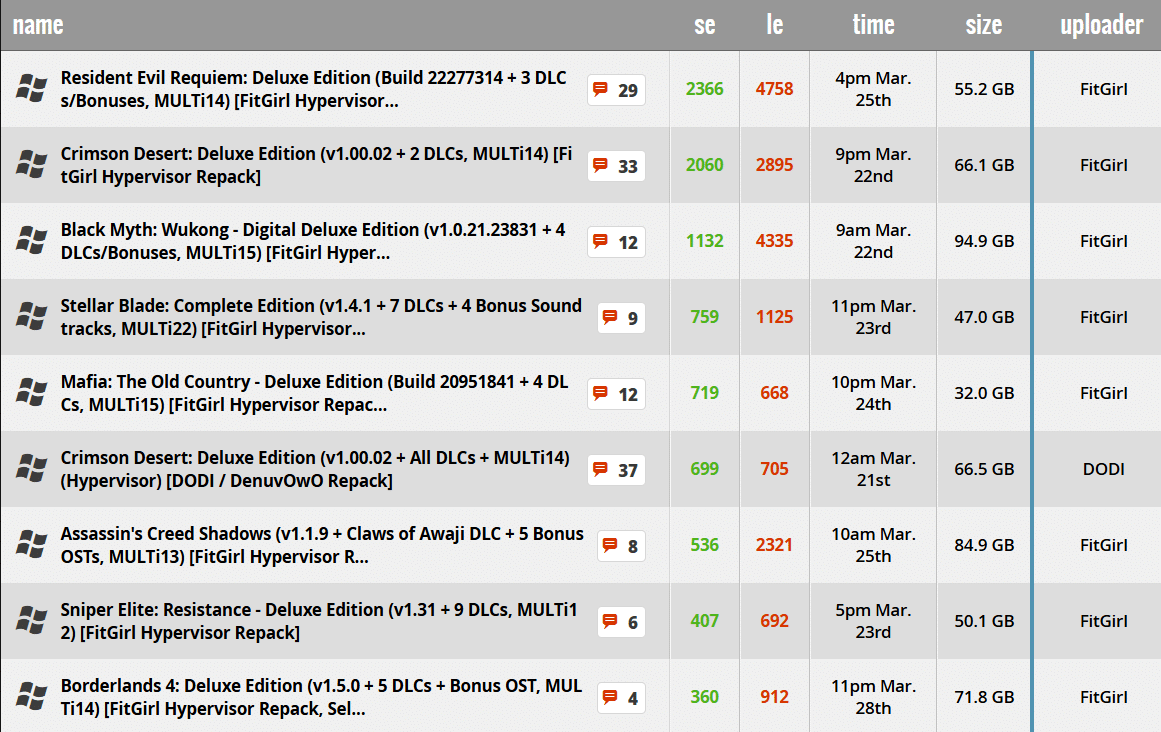
Traditionally, crackers were required to reverse engineer Denuvo’s DRM paths to patch the game, which is a labor-intensive process that could take months.
Hypervisor bypasses take a fundamentally different approach. They don’t interfere with the game directly, but they operate beneath the operating system’s standard security visibility level, in what security researchers call Ring -1.
At this fundamental level, with key security features disabled, the hypervisor bypasses can intercept Denuvo’s CPU instructions and feed back false data to make the game believe that the tampering protection is still in place.
Because these bypasses are much easier to develop, these new ‘cracks’ come out faster than ever. Where pirates previously had to wait for weeks, they can now play pirated games within hours. That’s unprecedented.
Security Concerns
The hypervisor bypasses are a breakthrough, but they are not without concern. Right off the bat, critics warned that for them to work, pirates essentially have to turn off a key protection layer on their computer.
The bypasses are also plagued by hardware-specific problems and limitations that make them far from a simple patch. AMD systems are currently more stable, while Intel users face significant performance and stability issues, leading to other dangerous “tweaks”.
This cracking approach is still relatively young, and new developments surface nearly daily, with the game piracy forum Steam Underground (CS.RIN.RU) being a central hub.
The forum does not only facilitate pirate releases; it also offers detailed educational resources on potential security issues, warning that there are serious risks involved.
“[E]ven if you trust the authors of the hypervisor driver and even compile it yourself from source, a serious vulnerability in its code could instantly provide maximum and undetectable access to your system,” forum administrator RessourectoR writes.
One of the many warnings 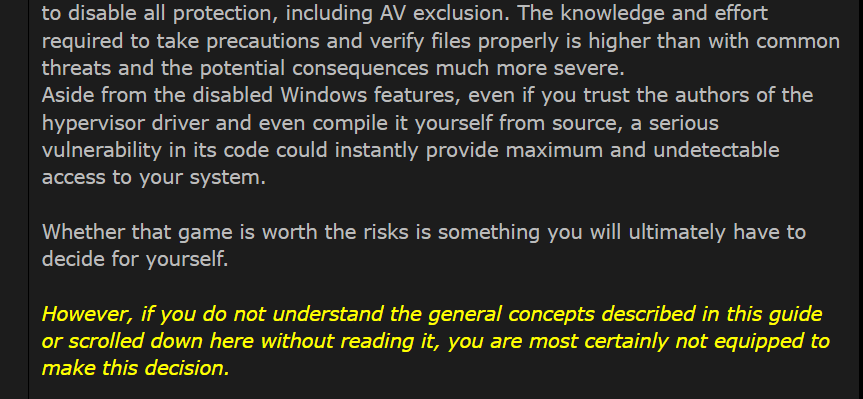
The question remains, of course, whether the average game pirate will read these warnings at all.
Denuvo’s Response
The scale of the bypasses has not gone unnoticed. While pirates try to navigate the security issues, Denuvo is working on an update that will counter the new hypervisor ‘cracks’.
Denuvo’s parent company, Irdeto, informs TorrentFreak that they are actively working on a countermeasure to address the Denuvo bypasses.
“We’re already working on updated security versions for games impacted by hypervisor bypasses. For players, performance will not be compromised by these strengthened security measures,” says Daniel Butschek, Irdeto’s head of communications.
Further details on these countermeasures will come out in due course. Some have speculated that to counter hypervisor cracks Denuvo would also has to operate in Ring -1, under the Windows kernel, but that is not the case.
“Addressing hypervisor-based workarounds will not require Denuvo to move into Ring -1 or deeper kernel level, and that is not the direction we’re pursuing,” Butschek says.
Denuvo 
Since people in the pirate ecosystem already warn about security issues, it is no surprise that Irdeto also highlights these concerns.
“Hypervisor‑based bypasses rely on installing a custom, self-signed hypervisor that operates below the Windows kernel, giving it far broader control than a normal driver,” Butschek notes, warning that this makes systems more vulnerable.
“To run, users must disable major Windows security protections such as Virtualization‑Based Security (VBS), Hypervisor‑Enforced Code Integrity (HVCI) and driver signature enforcement, which are designed to prevent kernel‑level malware, rootkits, and ransomware.”
FitGirl Embraces Hypervisor Bypasses
Initially, popular game repacker FitGirl was also rather cautious due to the widespread security concerns.
“You won’t see any HV-cracks repacks from me until you won’t need to actually disable security features,” FitGirl wrote in an early post, adding that no game is worth the potential irrecoverable damage it can do to one’s computer.
However, as bypass development by KiriGiri and the broader MKDEV team continued, the security situation improved. When the requirement to disable Secure Boot or use the EfiGuard tool was eliminated, FitGirl shifted their position, while recognizing the drawbacks.
FitGirl began publishing hypervisor repacks shortly after, tagging each one visibly with a HYPERVISOR label and committing to replace them with traditional cracks if and when those become available.
Speaking with TorrentFreak, FitGirl further pointed to the ongoing technical improvements, while remaining cautious.
“The team behind those cracks is now working on maturing both the VBS.cmd part and the cracks themselves,” they told us. “So I think that most of the issues coming from Intel or older CPU will be resolved shortly.”
“Caution is still needed with hypervisor bypasses. Mostly for what you download and run. But that is true for any download; it is not hypervisor-specific,” FitGirl adds.
Strict Rules
FitGirl notes that people should never run anything on their computer until they’ve verified that it’s from a trusted source. This raises the question of whether one can trust semi-anonymous pirate sources, but for now no major incidents have been reported linked to hypervisor bypasses.
What stands out is the high level of community rules and moderation. CS.RIN.RU has always been very strict, and with these hypervisor bypasses, forum administrator RessourectoR maintains oversight through detailed release requirements and best practices.
Release requirements 
According to FitGirl, these strict rules are reassuring. However, trust can always be broken in the future, and that’s also a risk here.
“Trust can be broken, yes, but we’re not there yet. And hope we won’t, considering how strict rules for publishing those cracks on CS.RIN.RU now are,” FitGirl tells us.
The Cat-and Mouse Game Continues
While Irdeto has several options to respond, the exact countermeasures remain a question for now. Denuvo could check if third-party hypervisors are running by checking CPUIDs or measuring CPU latency, for example.
FitGirl suggested that Irdeto can also respond by shifting to daily license ticket checks, but that would be a nuisance to legitimate players while it may also be bypassed. Alternatively, the company might ask Microsoft for help by restricting Driver Signature Enforcement (DSE) mode, but that doesn’t seem viable either.
One thing is for certain: Denuvo will try to tackle the problem as best as they can, continuing the seemingly endless cat-and-mouse game. While Irdeto knows that it can’t defeat piracy, it would like to go back to the situation where games remained crack-free for weeks.
For now, however, the hypervisor bypasses have made Day-0 pirate releases a reality. For those who are willing to take the risk.
From: TF, for the latest news on copyright battles, piracy and more.
-
Starmer gives doctors 48 hours to cancel strike or lose new jobs package
The prime minister says the NHS could lose 1,000 extra training places if resident doctors go ahead with a six-day strike next week.


