Author: tio

  • EFF to 9th Circuit (Again): App Stores Shouldn’t Be Liable for Processing Payments for User Content

    EFF filed an amicus brief for the second time in the U.S. Court of Appeals for the Ninth Circuit, arguing that allowing cases against the Apple, Google, and Facebook app stores to proceed could lead to greater censorship of users’ online speech.

    Our brief argues that the app stores should not lose Section 230 immunity for hosting “social casino” apps just because they process payments for virtual chips within those apps. Otherwise, all platforms that facilitate financial transactions for online content—beyond app stores and the apps and games they distribute—would be forced to censor user content to mitigate their legal exposure.

    Social casino apps are online games where users can buy virtual chips with real money but can’t ever cash out their winnings. The three cases against Apple, Google, and Facebook were brought by plaintiffs who spent large sums of money on virtual chips and even became addicted to these games. The plaintiffs argue that social casino apps violate various state gambling laws.

    At issue on appeal is the part of Section 230 that provides immunity to online platforms when they are sued for harmful content created by others—in this case, the social casino apps that plaintiffs downloaded from the various app stores and the virtual chips they bought within the apps.

    Section 230 is the foundational law that has, since 1996, created legal breathing room for internet intermediaries (and their users) to publish third-party content. Online speech is largely mediated by these private companies, allowing all of us to speak, access information, and engage in commerce online, without requiring that we have loads of money or technical skills.

    The lower court hearing the case ruled that the companies do not have Section 230 immunity because they allow the social casino apps to use the platforms’ payment processing services for the in-app purchasing of virtual chips.

    However, in our brief we urged the Ninth Circuit to reverse the district court and hold that Section 230 does apply to the app stores, even when they process payments for virtual chips within the social casino apps. The app stores would undeniably have Section 230 immunity if sued for simply hosting the allegedly illegal social casino apps in their respective stores. Congress made no distinction—and the court shouldn’t recognize one—between hosting third-party content and processing payments for the same third-party content. Both are editorial choices of the platforms that are protected by Section 230.

    We also argued that a rule that exposes internet intermediaries to potential liability for facilitating a financial transaction related to unlawful user content would have huge implications beyond the app stores. All platforms that facilitate financial transactions for third-party content would be forced to censor any user speech that may in any way risk legal exposure for the platform. This would harm the open internet—the unique ability of anyone with an internet connection to communicate with others around the world cheaply, easily, and quickly.

    The plaintiffs argue that the app stores could preserve their Section 230 immunity by simply refusing to process in-app purchases of virtual chips. But the plaintiffs’ position fails to recognize that other platforms don’t have such a choice. Etsy, for example, facilitates purchases of virtual art, while Patreon enables artists to be supported by memberships. Platforms like these would lose Section 230 immunity and be exposed to potential liability simply because they processed payments for user content that a plaintiff argues is illegal. That outcome would threaten the entire business models of these services, ultimately harming users’ ability to share and access online speech.

    The app stores should be protected by Section 230—a law that protects Americans’ freedom of expression online by protecting the intermediaries we all rely on—irrespective of their role as payment processors.

  • Speaking Freely: Lizzie O’Shea

    Lizzie O’Shea is an Australian lawyer, author, and the founder and chair of Digital Rights Watch, which advocates for freedom, fairness, and fundamental rights in the digital age. She sits on the board of Blueprint for Free Speech, and in 2019 was named a Human Rights Hero by Access Now.

    Interviewer: Jillian York

    Jillian York: Hi, good morning, or rather, good evening for you.

    Lizzie O’Shea: Hi Jillian, it’s great to be here. 

    JY: I’m going to start with asking a question that I try to kick off every interview with, which is, what does free speech or free expression mean to you?

    LO: Yes, so Digital Rights Watch, which is the organization I founded and I chair, is focused on fundamental rights and freedoms in the online world. And so freedom of speech is obviously a big part of that. It’s obviously a very vexed right, partly because of its heritage and interpretation in places like the United States, which sometimes sits in contrast culturally to other parts of the world. Certainly, if you ask Australians about it, they do not want to have a culture of free speech that looks like the United States. 

    Australians understand that freedom of expression is a really important component of democracy. So one of my jobs is to make the claim that curtailing freedom of speech, including in online settings, can have a real impact on democracy. And I think that’s fundamentally true, and you don’t want to wait until it’s too late to be able to make that argument, to ensure that the policies are in place to protect that freedom. So I think it’s a really important freedom. It’s got a vexed history and expression in the modern online world, but many people still instinctively understand that those in power see speech as something that is important to challenging their authority, and so it can be a really important place to fight back and protect democracy and other rights from being impacted by those who hold power at the moment.

    JY: I want to ask you about your book. You’re a critic of techno-utopianism. Your book, Future Histories, came out right before the pandemic, if I recall, and it looks to the past for lessons for our technological and cultural future. I really appreciated your take on Elon Musk. So I guess what I want to ask you about is two things. What, in your view, has changed since you wrote it?

    LO: Yeah, that’s a really interesting question. I must admit, I was thinking about it the other day whether some of what I wrote really holds up. And I think the fundamentals are still true, in the sense that I still believe that a lot of the discussions and debates we have about technology today are presented as fundamentally novel when they are very old, ancient discussions and debates about how power should be distributed through society, and how technology enables that kind of power distribution or works against it, right? So I feel like that fundamental analysis, whatever contribution to the field, is still valid, of course. In some ways though, those technical systems have become more opaque, like the artificial intelligence industry and how that’s been built off the back of years of exploitation of personal information and centralization of power in technology companies. Those things have become more powerful and concentrated and difficult to understand—if you’re not deep in the weeds—beyond an instinctive understanding that something’s going a bit wrong, perhaps. 

    So in some ways those trends have exacerbated things in ways that I think many other contributors, yourself included, have brought a really important set of analyses to these discussions. More generally, though, one of my fundamental understandings of how I frame some of these arguments is that there are two sources of power, right? Government power and corporate power that really shape how the online world is developing. And post-pandemic, there’s a lot greater skepticism, criticism, and outright distrust of government authorities seeking to do work to protect people from some of those corporate excesses. Now that’s obviously something that is much more part of American culture as opposed to European culture, and in Australia, we sit somewhere in between. But that skepticism and that mistrust of institutions, I don’t know that that serves us well. I’m somebody who does treat with criticism policies put forward by government, because I think it’s our job as civil society people, as people part of a social movement that want to have rights at the center of our society, to be critical of those in power and make sure that they’re being held accountable. But that mistrust has fundamentally shifted how possible it is to do that in an effective way. And I think that poses real challenges for people who want to see government policy look different to how it is and how you can bring people into a sense of trust, investing in a democratic rights based society, rather than rejection and cynicism being the overriding, overriding kind of factor in how they shape their political arguments. Which is a real challenge, I think, for people like us who rely on some of that mistrust and skepticism in order to fuel the fire of some of these campaigns, but do want to see people still invested in democratic processes.

    JY: Yeah, absolutely. So speaking of policies, you’re in Australia, where the government’s enacted some of the strictest social media laws for minors in the world, I would say. In one of our most recent interviews, which was with Jacob Mchangama, we talked about how the comparison of social media to Big Tobacco is spreading, and this idea that there’s no utility in social media for minors, that it’s a net harm. I’m curious what your thoughts are on that, and then we can dive into the more nitty gritty bits of the Australian law.

    LO: I think that’s a great place to start, because the overwhelming sense in how this policy was presented to the public in Australia is that this is a very dangerous place for young people to be, and that desperate times call for desperate measures. “We don’t have time to fix these spaces. We need to just restrict access.” It’s described as a delay. Many, including me, describe it as a ban for under 16 year olds. So what has been very interesting in this discussion is who’s been left out of the conversation. And if you talk to young people—and there are many organizations working with young people—and you talk to them about what they use social media for, they often say that they wish adults understood that they used it for different reasons, or they’re scared about different things than what adults think they might be scared of. And so that kind of fundamental failure of communication, which I suppose is not a surprise, when these people don’t actually have the power to vote, have the power to do things a normal legal person would do, is somewhat unsurprising.

    But when you’re making policy about these people, that can be quite impactful, it can have very detrimental impacts. And if you take a human rights approach, that is your job to think about the negative impact on human rights, and what you’re going to do about it, it’s not really good enough. And this has been an experiment that Australia has led on, very much, looking for headlines, for a perception of boldness. Some of that claim is legitimate in the sense that they want to be seen to be taking action, and a lot of people feel very concerned that governments aren’t prepared to take action against big tech companies. So, some of that is a valid feeling. But I think in this context, we lose so much when we don’t actually listen to the people affected, and listen to the myriad ways in which they use social media. Some things they’re concerned about, some things they find harmful, some things they’re really sick of. But there’s so many ways in which they use it to find a sense of community, to find a sense of empowerment, to talk to people they would never otherwise be able to access, sometimes because they’re isolated, socially, geographically, whatever it may be, and it’s so disappointing to me that that kind of part of the conversation was not had as we debated this particular policy.

    JY:  So, what do you think some of the harms are for youth who can’t access social media? What are young people losing out on? Who is harmed by these laws?

    LO:  It’s a great question. When we do a human rights analysis, we have to think about who’s harmed by a particular policy, even if we think it’s overall justified on a utilitarian ground, say it’s better off for everyone overall who’s harmed, is a really important question, and so much of that has been absent from this discussion. So it’s not just me. It’s like hundreds and hundreds of experts in Australia and organizations that represent many, many people, have provided commentary and input into this process and expressed many concerns about this policy, and there’s a few different ways in which people are harmed. 

    So the first thing, of course, is that if you require that age verification occur, you’re engaging in a privacy violation for many people, there are cyber security risks with collecting that kind of information. There’s deterrent effects and the like. Now that may not concern you, or you may think that’s a justifiable kind of infringement on privacy rights, but I think that’s worth mentioning. It is quite significant, especially in a world in which age verification doesn’t tend to work very well on any measure. There are very serious cybersecurity risks that have been associated with age verification processes and the like. So it’s certainly not nothing. The other set of people that are harmed are particularly vulnerable people. 

    There’s a variety of people who are still accessing social media. So it looks like about seven in ten of young people on the early data who had social media accounts are still accessing social media now. Now these are early figures, so there’s a lot to be said for looking at how this works in a year’s time, for example. But I think one of the interesting things to think about is when those people, young people, who are on still on social media—in breach of this ban or in defiance of this ban, however you want to put it—might need to engage in help seeking behavior, there may be a deterrent there, because they know that the law is they’re not supposed to be accessing social media. So that is a selection of young people that we’re particularly concerned about. And then, more generally, of course, there’s a whole cohort of people who are particularly vulnerable. Maybe they’re LGBTIQ, maybe they’re in an isolated geographic area, far away from a city. Maybe they’re experiencing harm at home and have no one to talk to about it. There’s all sorts of ways in which young people use social media to manage their own challenges, harms, difficulties, and very effectively. They find people to talk to about their problems when other people may not be available to them. And that is an issue that is hard to map, right? We know that there’s been an increase in calls to things like Kids Helpline, which does what it says on the tin. So those kinds of things have seen an increase. But I think that is something that is harder to map, but still very, very important, and may result in people going to other parts of the internet as well to seek help in different ways that might also not be very safe for them. 

    More generally it’s worth remembering that if platforms can say with some confidence, from a policy perspective, that young people are no longer on their platform, there is less incentive to design for them as well, which is another associated problem. Now, it remains unclear as to how platforms are dealing with that issue, especially in light of the most recent data, which suggests that a lot of young people remain on the platforms. But that’s an issue. Do we then allow platforms to no longer design in a way that respects the autonomy of young people, the safety of them, their security and the like, because they have special needs and interests and all those sorts of things. So that’s another problem. There’s lots of operational problems. There’s lots of conceptual ones. I don’t think many of these have been considered or accounted for in the process.

    JY: Absolutely, those are the same things that worry me as well. Okay, let’s talk about the campaign. So what has the pushback to this, to the law, looked like, and what changes were you calling for?

    LO: Well, if I can Jillian, what I might start with is where the push came from. Because I think that’s quite instructive. One of the key sets of institutions that were pushing for this ban were mainstream news organizations, and we’re learning a bit more about this over time, but the Murdoch press and other large news organizations in Australia—Australia has one of the most concentrated media environments in the world—were pushing for this ban. There was a petition run on one of their websites that was gathering tens of thousands of signatures. There were also others. Then there was a lot of advocacy towards specific kinds of political leaders in the country, and then a kind of competitive race to see who could be the most extreme in terms of putting forward a policy. But it’s certainly the case that this very powerful set of actors in our democracy, at least, were a key driver of this campaign for a social media ban for young people. Now, I think there’s a sense of moralism about it, a sense of desperation about it, tapping into genuine fears from parents, you know, and the like. And you know, The Anxious Generation, the book by Jonathan Haidt, has obviously been very influential with many people, but the research is still a bit unclear, right? About what this all means. And lots and lots of researchers will tell you that that book isn’t making a reasonable argument based on the data that we have, right? So, it’s a very febrile environment for this kind of discussion, and those kinds of institutional actors were incredibly important in getting this on the political agenda.

    We then had an electoral campaign, definitely a vision that conservative politics would push for this. So labor politics, you know, center left politics pushed for it, and won the election, right? Not on this issue alone, but it was in that environment in which this policy was developed. There was a very small amount of time for submissions, for policy discussion about it. Initially, the government had said they weren’t going to do it because they were concerned that the age verification technology wasn’t up to scratch. That changed very, very quickly, and then the policy was introduced. I think it was in six days, some very small amount of time. So many different child rights organizations, academics, institutions, filed policy submissions to discuss this, did a lot of advocacy work, but the passage of time between the announcement of the proposal and the passage of the legislation was extremely short, and what followed has been a year of discussion around whether this was a good thing, a year of testing age verification technology, often finding it wanting, but setting up a set of of preferred providers that platforms could use in order to satisfy the legislative requirements. A lot of lobbying from platforms as to whether they’re in or out. There was a big discussion about whether YouTube should be in or out. And a lot of back room dealing between relevant politicians and big tech companies. So the whole thing is very unseemly, and we’re now in the world where it’s been introduced, a lot of failure for it to actually operationalize now. Now, it may be that that changes over time, but that’s quite telling, right? 

    It’s telling also because I don’t think all parents particularly like this proposal either. It’s very popular, but there’s certainly a section of parents that are facilitating their children’s continued access to social media. And I think that’s interesting in itself. Part of what it is—something we were talking about actually earlier in our conversation—people don’t like governments telling them how to parent their children. That has taken some very negative expressions in parts of the world, you know, resistance to things like the availability of medicine and treatment for kids who might be trans. But in this context, it’s like, “I’m not going to let the government tell me that I can’t let my kid on social media.” So, I don’t think it’s clarified much in the debate in terms of understanding how platforms behave towards young people, what they could do better, of which there’s many things, and then how we get to the world in which children are able to be online but better protected. I’m not sure this proposal has contributed to that. It’s really muddied the waters about what the government is capable of doing, what it should be doing, and what platforms, you know, what should be the process that platforms go through when thinking about designing for children.

    JY: That’s such a great answer. Thank you. And actually, that brings me to another question, which is so in your ideal world, taking this law, being able to throw it out the window if you want…What would you what would you want to see, not just from social media, but from from the platforms, from governments, both for the sake of youth, but also, you know, for all of us.

    LO: I think that is the exact right question to be asking, and it’s a good time that we’ve managed to talk now, because actually, in the interim, what’s come out is at the first draft that we’ve got of a Children’s Online Privacy Code. And to me, that is really revealing, because it is designed to apply to all services that might be accessed by children, like all online services, and it has a really kind of sophisticated understanding of what consent might look like, where you need help with getting consent, when it comes to parents or adults that are supportive in your life. And then at different ages that might look a bit different, like you might get notified if consent has been refused by your caregiver, for example, if you’ve wanted to do something. So there’s a more sophisticated understanding of what consent looks like, and a range of different restrictions on when private, when personal information can be collected and used.

    It’s got things in it that I don’t particularly like. I would like to see a prohibition on the commercial exploitation of children’s personal information, because I don’t think any targeted advertising is justified, for example. And I think that kind of measure of that commercial exploitation is hugely problematic. I think we have to think about what deletion looks like. I think you should have a right to deletion, for example. But you know, we also have to respect that children grow into young adults, that making decisions at 16 might look quite different to when they’re three. So what you do with their personal information, how they carry that forward into their adult lives might be different depending on the age and so that kind of privacy reform actually is the fundamental thing. I’m sure your listeners don’t need reminding of this.

    That is my favorite right. Because I think restricting access to personal information is a rights-respecting way to improve the online environment for everybody. And what I think is really interesting about this Children’s Online Privacy Code that is still in draft form, is that all these things should be available to adults as well. Like adults in Australia don’t have the right to deletion at the moment. We don’t have a right to comprehensively know where our information has traveled and to delete it. You know, look, we have fewer rights than Californians, for example, certainly fewer rights than Europeans. What this code has highlighted is that, in fact, all people should be enjoying this kind of protection that comes from restricting access and use of personal information and giving people more control over that, because that personal information is the raw material of the business model, and it leads to a very loose approach to its collection and leads to many negative downstream consequences, I would argue, including business models that prioritize engagement, that prioritize and monetize polarizing, extremist content, mis- and disinformation.

    I think we could have a real crack at trying to ameliorate some of these problems, or certainly reduce their impact, if we started that fundamental raw material that fuels the business model. So that, I think, is a really telling alternative that we’re now considering as a society, and I like to think that people will come to an understanding that you can you can find ways to elevate improve the online world, particularly for young people, without restricting their access to that online world in a way that is empowering for them, rather than patronizing or infantilizing. 

    JY: I completely agree, and I think it’s funny that people often see privacy and expression at odds with each other, when actually I think privacy enhances expression.

    LO: I think it makes spaces safer, makes people freer to be able to say what they think, but also to have those discussions in ways that are more meaningful, that can help find connections, even across divisions, rather than exploiting that division for profit, which is so much of the current business model.

    JY: Are there any other things happening in Australia that EFF’s readers should know about?

    LO: Well, we’re about to go through the second tranche of our privacy reform. So we did engage in our first tranche of privacy reform. We have a Privacy Act that was passed in 1988 and hasn’t been meaningfully updated in the decades since. So we got a few small changes, which included the enabling provision to allow a Children’s Online Privacy Code to be developed, which is why we’re getting the benefit of that now. But we’re about to see a range of different privacy laws introduced. What the content is, of course, will be the subject of a lot of discussion and debate. We’re going to argue for the right to deletion, the right to a private right of action for privacy harms, better processes for consent, and improved definitions of personal information to really bring Australia in line with lots of other similar jurisdictions around the world. And we’re really keen to advance that for all the reasons that I just mentioned. 

    The other big change that I think is coming is that, you know, which is perhaps more on topic for this conversation, is that we’ve had this online safety policy that is constantly being touted as the first in the world, and world leading and this and that, and it’s really been a very flawed and vexed process working out how we could develop codes that were designed to govern how certain services were provided in the digital age, in line with safety expectations. There’s been a lot of focus on complaints and take down notices and things like that, there’s obviously been that vexed litigation with Elon Musk, trying to get him to take down a particular video, and ultimately, the failure of our regulators to succeed on that front, I think, probably correctly, because giving a regulator in Australia the right to take down content from anywhere in the world seems to me a very concerning development, if that was allowed to proceed. So this history of online safety, it’s been a big part of successive Australian governments’ identities. We’re about to see the introduction of a digital duty of care. So that’s certainly the stated position of government. What that looks like in practice, I think will be really interesting. 

    I like the idea of a digital duty of care. I like the idea of a flexible, overarching concept. What the content is, though, will be really important. So what I would like to see is proactive disclosure of harm or risk of harm, and then actions taken by platforms to do it. So more onus on platforms to provide transparency about what they know about how their online spaces are being used and what might be harmful. I mean, there’s a question around whether we’ll see an introduction of a civil right, something similar following from the litigation that’s taken place in California and New Mexico, and that is going to be leading, really, multiple claims that are being made all around the country in the US, against companies like Meta and Google and other social media platforms. So I think there may be a flow-on effect from that, as in, it might turn into a civil right to sue for failure to meet the requirements of digital duty of care. But I’m really interested to hear from any of your listeners, or anyone who’s working in this space about what the content should be of that digital duty of care, because there’s obviously limits as well. Like it can be not rights-respecting, and we’re interested in making sure that’s not the case. And I think there’s probably a range in which it could be more protective or less and working out how to do that—there are examples from around the world, but that’s going to be something I reckon we could use help with that we want to get right and make use of that opportunity as best we can. 

    The last thing I’ll say, I suppose, is that our government is always looking for ways to deal with mis- and disinformation, and that comes with real risks of censorship. And so, I think there’s a strong argument to focus on privacy reform, because it’s a rights-respecting reform as an antidote to mis- and disinformation. Greater transparency on platforms—I think about how they prioritize content in your feed, for example, can be useful, or reporting on what content is really popular, like ad libraries. There’s all sorts of ways in which we can introduce greater transparency, but I do worry that as governments around the world feel emboldened to do so, they might look for more ways to to remove content, to be more involved in content moderation policies that have the real potential to to become censorship if we’re not careful. So that’s the other abiding concern I’ve got about Australian policy at the moment.

    JY: One of my big concerns now too, is all of these authoritarian governments watching Australia, watching the UK, and enacting laws that are modeled on, but much more severe than than the ones in those places? Do you share that concern? 

    LO:  Yeah. I mean, the other way in which it’s come about in Australia, certainly like anti-doxxing laws, which, at the moment, we’ve got laws on our books that came about attached to a privacy reform. I’m hesitant to say it’s a privacy reform, because it’s not, but it’s very egregious. It’s a criminal offense to disclose basic details about someone online, if it’s done with a set of intents and the like, about their particular status as a group, and that, I think you could drive a truck through in terms of how you could interpret it, right? There’s such a wide variance, and bringing a proceeding against someone like prosecuting them for that is such a life altering experience. And I think if governments did want to focus on particular activists. And I’m particularly thinking of, you know, the way it was framed was certainly around the the discussion and debate about the genocide unfolding in Gaza. Like, I think, particularly about that movement, they’re very vulnerable to crackdowns by government for speech that is perceived to be unacceptable by government. 

    And I’m not even trying to debate it. I think there’s certainly antisemitic commentary occurring in Australia, and indeed, there have been some people, like genuine Nazis arrested, which, you know is, is a different kettle of fish. But I think progressive movements, not just the defense of Palestine movement, but lots of other progressive movements are a particular risk of those kinds of laws. But I think mis- and disinformation is the other vehicle. So we have to be very careful about giving platforms, giving regulators both the mandate and then the authority to police content based on particular criteria. And often what they talk about, or they talked about in proposals that have now died in Australia, were things like public health issues. So, you know, that’s a particular consent that drives a lot of people who are very concerned about the years of Covid up the wall. So it inspires a lot of reaction to it. But I think there’s lots of ways in which undermining political stability is put forward as a proposal, as a justification for removing content. That’s just so broad that I think you could really start to see censorship. It’s just not good enough. I just don’t think we can tolerate those kinds of proposals. I like to think that’s not the case in Australia, but I just think there’s a tendency among governments now to see this as an opportunity. It’s an anxiety lots people have about mis- and disinformation, and so they draw on that as a mandate to act. And I think we should be very cautious about those proposals.

    JY: Definitely. Okay, I’m going to ask the final question that I ask everyone. Who is your free speech or free expression hero? Or someone from history, or even someone personal who has influenced you?

    LO: There’s a chapter in my book where I talk about the Paris Commune, which happened a long time ago, but I still think it’s a really interesting experiment in applied democracy. This is when a bunch of communauts took over Paris and started doing things differently in a variety of different ways. Gustave Coubert is this artist who’s leading the artist collective during this time, and I always found him entertaining because he would paint things that weren’t expected. So, often, nudes that were considered quite scandalous because they were everyday women who weren’t angelic or Madonna-esque in their style, but he’s got a very famous painting of female genitalia—

    JY: Yes! Facebook took it down! [laughs]

    LO: Exactly. It’s always been a very confrontational image. People find it sexist sometimes, because they think it’s very pornographic. I understood it differently. It’s called “The Origin of the World,” so I sort of see it as a force of giving life. Interpret however you like, the point is that Facebook couldn’t tolerate it and took it down. There’s a nice little bit of litigation where a schoolteacher had a page where he was teaching people that art, and Facebook could just not tolerate this art. In my mind, it was so telling that a communaut from hundreds of years before was basically revealing, as an expert troll almost, how conservatives—someone like Mark Zuckerberg—view, and how he shapes these platforms. And how they subtly reshape what we think is appropriate, what we think is free, what we think is within the realms of good society. And that you really do need artists telling you that that might not be true, and they’re some of the most effective actors at revealing that about those who hold power, like reshaping our understanding about what acceptable debate is, and how we can show power to be exercised in our online world, where in other circumstances it might be quite okay.

    I love that story, and I love the communauts. There’s a lot of beautiful writing about them, there’s a beautiful book called Communal Luxury where they talk about all the different ways in which they were trying to reimagine their society and do it collectively, from things like having the first union of women but also having the design of clothes and furniture look different. I want to see a world in which people take that power in both the micro and macro and start to reshape their society in really creative ways. And I feel like digital technology has the real capability of allowing that to occur and I want to revive that sense of concrete democracy rather than just delegated democracy or deferred representative democracy where you tell someone else what you want but don’t have a say in a lot of decisions. And so, that really grassroots idea of democracy is something, and I think we’re in a world in which that could really occur with the assistance of digital technology. It’s a matter of working out how to bring it into being. And that’s what I see this movement as doing. People with digital rights as being their primary concern are trying to recreate that world so that there’s more communal, collective spaces for discussing what the future should look like.

  • In Praise of “Virtue Signaling”

    In Praise of “Virtue Signaling”

    A friend of mine on Facebook recently expressed his disapproval of non-Palestinians who wear keffiyehs. My friend said that this was a classic example of “virtue signaling”—an empty gesture that accomplishes nothing, but gives the person making the expression the warm satisfaction of being on the morally correct team. This friend would, presumably, prefer that these non-Palestinians not wear a Palestinian garment.

  • US Justice Department Moves to Seize Kurdish General’s Beverly Hills Mansion

    The U.S. Department of Justice filed a civil forfeiture complaint this week to seize Kurdish general Mansour Barzani’s Beverly Hills mansion, alleging he bought and renovated it with $30 million in proceeds from a scheme that defrauded the U.S. Department of Defense during its fight against the Islamic State. 

    OCCRP obtained the April 22 complaint, which identified the secluded house on the affluent, tree-lined residential street of Foothill Road. A realtor has advertised the property as Foothill Manor, a French-style villa with a theater, swimming pool, and European gardens. 

    The DoJ complaint alleged that Barzani, whose brother Masrour serves as prime minister of the semi-autonomous territory Iraqi Kurdistan, was paid bribes by a contractor based in the U.S. state of Virginia for exclusive access to deliver jet fuel at Kurdistan’s Erbil International Airport from 2016 to 2020.

    Erbil airport, controlled by Kurdish Peshmerga forces, was a delivery point for fuel used by the U.S. military in Iraq and Syria during its Operation Inherent Resolve. Between 2015 and 2023, the DoD’s Defense Logistics Agency (DLA) awarded contracts totaling more than $700 million to the Virginia-based contractor, said the complaint.

    Upon issuing the complaint, the DoJ released a press statement alleging that “officers of the contractor agreed to pay General Mansour Barzani, a senior Peshmerga official, a bribe of $0.25 per liter for exclusive access to deliver jet fuel in Kurdistan for the U.S. military and coalition forces and received hundreds of millions of dollars under DLA contracts.”

    The complaint did not directly name the company that allegedly bribed Barzani, calling it “Contractor 1.” However its case provides contract numbers, which identify the company as Virginia-based logistics company DGCI. 

    Separately, a 2017 Kurdish government memo decrees that the only companies approved to deliver fuel to the airport were DGCI, its Kurdish subcontractor Triple Arrow, and a third company based in Kurdistan named Rainfloods.

    With this exclusive access, DGCI was able to charge fees as high as $10 per gallon to the U.S. government for jet fuel. The standard price of jet fuel paid by the DoD between 2016 and 2020 ranged between $2.14 per gallon and $3.2 per gallon, according to its guidelines.

    “Pretty crazy that [Contractor 1] is delivering fuel in Syria and IRaq [sic] for over $10 per gallon. Can you imagine what [one competitor], [another competitor], and all these companies must be thinking,” said a contractor message cited in the court document.

    OCCRP sought comment from the Kurdistan Regional Government’s permanent representative in Washington, DC, and sent email requests for comment from Mansour Barzani and DGCI representatives. None answered OCCRP requests to comment by the time of publication.

    Both Mansour and Masrour are sons of Iraqi Kurdistan’s founding president, Masoud Barzani, who led Kurdish peshmerga fighters against Saddam Hussein’s government during the Iran-Iraq War in the 1980s.

    The luxurious Beverly Hills mansion is not the only property owned by their family in the U.S. An OCCRP investigation last year revealed that Gen. Mansour Barzani, his brother, Prime Minister Masrour Barzani, and their three other brothers used anonymous shell companies incorporated in Delaware and the British Virgin Islands to acquire over $100 million in U.S. properties, along with luxury goods and Arabian horses. 

    The investigation found that tens of millions of dollars used in those purchases were supplied by Kurdish conglomerates involved in oil and military contracting.

  • Romania’s Top Judge Cleared Man Linked to Family Deal

    As Romania’s top judge faces mounting public pressure over her alleged leniency toward organized crime, a new investigation has revealed that she presided over the 2013 acquittal of a convicted robber, while co-owning real estate with the man’s uncle.

    The findings by the RISE Project, an investigative journalism group and OCCRP partner in Romania, cast a harsh new light on Lia Savonea, who was appointed president of Romania’s High Court of Cassation and Justice in June 2025 and is a former president of the Superior Council of Magistracy and Bucharest Court of Appeal. Her elevation sparked widespread protests late last year, with demonstrators accusing her of shielding corrupt officials and crime syndicates.

    The 2013 case centered on Sorin Raiciu, who had been sentenced to seven years in prison for a brazen 2008 robbery. Prosecutors said Raiciu and accomplices ambushed a businessman outside his Bucharest home, fleeing in a black BMW with a briefcase containing the equivalent of $23,000. Investigators systematically dismantled his alibis, leading to his initial conviction.

    But upon appeal in December 2013, a judicial panel led by Savonea abruptly overturned the conviction, allowing Raiciu to walk free.

    According to property and court records reviewed by RISE, Savonea and her husband had financial ties to the defendant’s family at the time. In 2006, the couple purchased a 2,500-square-meter plot of land in Chiajna, a town near Bucharest, alongside Florian Purcel—one of Raiciu’s uncles. The co-ownership lasted until the property was sold in 2018, encompassing the entire period of the trial and the appeal.

    Another uncle of Raiciu, Marian Velicu, known locally as “Dede,” also featured prominently in the robbery case file. Investigators identified him as a conduit for messages meant to influence witnesses, RISE reported.

    Cristi Danileț, a former judge and former member of Romania’s Superior Council of Magistracy, told reporters that the revelation raises questions about impartiality. If a judge knew the people involved in a case and maintained financial ties to their family, Danileț said that that judge had a clear duty to recuse himself.

    Compounding the suspicions, reporters uncovered a bizarre administrative anomaly regarding the case: the acquittal exists in two entirely different versions. One version, featuring a specific set of legal reasoning, was logged into the court’s electronic system, while a substantially different version was placed in the physical case archive. Danileț and Daniela Panioglu, a former appellate judge, told RISE that such a discrepancy is virtually unprecedented and highly suspicious.

    Raiciu, the acquitted defendant, did not stay out of the justice system for long. In 2020, prosecutors charged him and several associates with attacking rivals with guns and machetes in broad daylight in Chiajna. He and other men are currently on trial for attempted murder.

    The RISE investigation adds fuel to a volatile political fire surrounding the nation’s judiciary. In November and December 2025, massive protests erupted in Bucharest and other Romanian cities, with demonstrators taking to the streets to explicitly oppose Savonea’s leadership of the High Court and denounce corruption within the judicial system.

    Savonea has categorically denied the allegations of protecting corrupt figures. Meanwhile, Romania’s Superior Council of Magistrates has rushed to her defense, condemning the public backlash as a dangerous attack on judicial independence.

    In a reply to the RISE Project, Lia Savonea dismissed all accusations against her and said that she acted according to the law.   “I categorically reject any insinuation regarding the existence of unlawful conduct or any personal interest in connection with the mentioned case,” she wrote.

  • The Bigotry of Sam Harris Continues to Hit New Lows

    The Bigotry of Sam Harris Continues to Hit New Lows

    Sam Harris, the rationalist and New Atheist, recently went on a rant against New York City Mayor Zohran Mamdani that offers one of the most vile, putrid displays of Islamophobic bigotry that I can recall ever seeing in my life. At its core is the belief that because Mamdani is a Muslim, he’s bad. You might think this is an exaggeration. But here’s what Harris said:

  • Almost Half of America’s Kids Are Breathing Toxic Air

    This article originally appeared on Inside Climate News, a nonprofit, nonpartisan news organization that covers climate, energy and the environment. Sign up for their newsletter here.

    Nearly half of the nation’s children live in places with dangerous levels of air pollution, according to a report released Wednesday by the American Lung Association.

    That’s 33.5 million children — 46% of the country’s kids — living in areas with failing grades for at least one measure of air pollution that is particularly harmful to developing lungs.

    The report also found that people of color are more than twice as likely as white people to live in a community with failing grades for all three measures. Latinos are more than three times as likely to live in such communities, unchanged from last year’s report.

    Since 2000, the ALA’s annual State of the Air reports have detailed the nation’s air quality, which improved for decades following the passage of the 1970 Clean Air Act. But in recent years, heat and wildfires worsened by climate change are reversing some of that progress. 

    Last year’s report, covering 2021 through 2023, showed worsening air pollution during a particularly rough period that included two severe wildfire seasons. Wednesday’s report, looking at air quality from 2022 through 2024, showed that the number of people living in highly polluted areas fell from the prior period but remained well above lows within the last decade. And for the second year in a row, heat-driven ozone pollution got worse. 

    The takeaway is that millions of Americans are at risk, said the ALA’s Will Barrett. 

    “Progress is fragile,” said Barrett, the group’s assistant vice president for nationwide clean air policy. “We have a lot of work left to do to make sure that every child in the United States grows up breathing healthy air.”

    Air pollution is a serious health hazard. Years of research have linked it to asthma, heart disease, dementia, cancer, low birth weight and more. It kills about 7 million people every year, the World Health Organization estimates. 

    Children, whose lungs are smaller and who often breathe more rapidly than adults, taking in more pollution relative to their body size, are especially susceptible to its health effects.

    The new ALA report analyzes three years of U.S. Environmental Protection Agency air monitoring data, ending in 2024, so it does not yet reflect any impacts from actions taken by President Donald Trump. But his administration has aggressively targeted clean-air protections to benefit polluting industries. 

    Since January 2025, the Trump administration has rolled back air quality standards, repealed the endangerment finding that allows the EPA to act on climate health threats, and granted widespread pollution exemptions to industrial facilities and power plants. It’s also reinvesting in coal. 

    Each move will harm health, experts warn. The ALA is calling on the public to pressure the EPA to reverse course. 

    “They are devaluing the health of our children by ignoring the costs of air pollution,” Barrett said. “In the years ahead, we will start to see the devastating effects of those decisions.” 

    In an emailed statement, an EPA spokesperson said the agency is continuing to regulate air pollution and that protecting human health and the environment remain its central goals. 

    The agency wrote that the ALA “gets lots of money from left-wing foundations,” and said “spreading lies” that the federal government is leaving pollution unchecked would be “grossly irresponsible.”  

    The ALA’s supporters include private foundations like the CVS Health Foundation as well as large corporations, including Pfizer, AstraZeneca and PayPal. Since Trump regained office, the EPA has frequently claimed that critics of its policies are left-wing radicals.

    “Each and every day, we have proven that we can BOTH protect the environment and grow the economy, and we won’t stop in our mission to make sure every American is healthier than ever and breathing clean, crisp air,” the agency wrote.

    Raising the alarm on pollution

    The ALA looks at three measures for air pollution: ground-level ozone — often called smog — and both daily and annual measures of particle pollution, all of which are harmful. The group found that 152 million people, or 44% of the U.S. population, live in areas with failing grades for at least one of those measures. 

    That’s about 4 million fewer than last year’s report. But it’s still 20 million more than the 2024 report. 

    About 62 million people live in counties with a failing grade for short-term particle pollution. That’s 15.6 million fewer than last year’s report, ending a seven-year streak of continuous increases. Still, the numbers are much higher than the historic low of 35 million in 2018. 


    What Is Ground-Level Ozone?

    Ground-level ozone is a pollutant created when nitrogen oxides and volatile organic compounds interact with sunlight, producing smog that makes it harder and more dangerous to breathe. That’s different from stratospheric ozone — the good kind — which occurs naturally in the upper atmosphere and helps cool the Earth’s surface by providing protection from the sun’s rays.

    Vehicles, power plants, oil production and other industrial sources contribute ingredients for the bad kind of ozone. Man-made emissions, meanwhile, are eroding the good kind of ozone, contributing to dangerous global heat that further ramps up smog.


    And like last year, smoke from wildfires fueled in part by climate change remains a significant driver of this pollution.

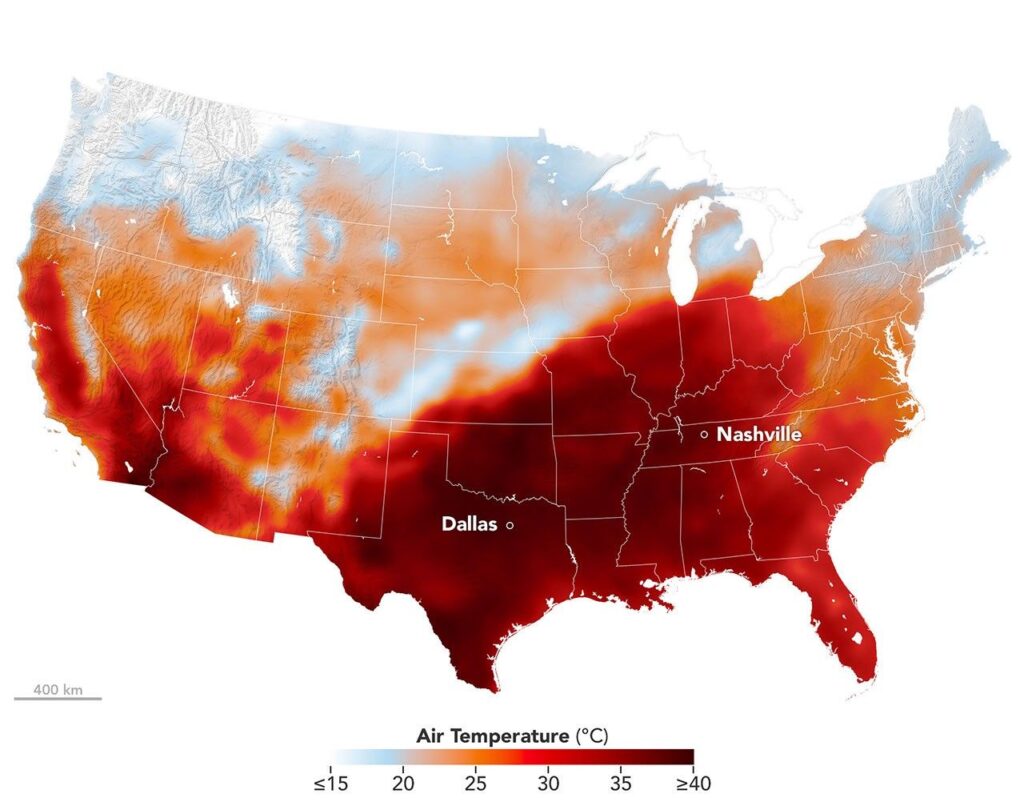
    Meanwhile, smog got worse. More than 129 million people are living in counties with failing grades for ground-level ozone pollution, a 4 million increase from last year’s report. The Southwest and Midwest regions are most affected by worsening ozone, the report found, likely driven by climate-related extreme heat, drought and wildfires. 

    Doctors often describe the effects of ozone pollution as “sunburn of the lungs” because it can cause intense inflammation. Shortness of breath, coughing, asthma, bronchitis and even premature death can follow.

    Mary Wagner lives in Las Vegas — one of the fastest-warming cities in the country — with her two sons. Her oldest, who is 15, has had asthma since he was very young. His attacks get worse during heat waves and when wildfire smoke blows in from California, she said. 

    The Nevada field organizer for Moms Clean Air Force, Wagner is angry that the federal government is abandoning policies put in place to protect families like hers from dirty air. 

    “As a citizen, I just feel like they have turned their backs on us,” she said. 

    Her son is one of about 4.7 million children living with asthma in the U.S. About half, like him, live in areas that received a failing grade for at least one pollutant. 


    What Is Particulate Pollution?

    Particulate matter pollution is a mix of solid particles and liquid droplets that range in size and can contain hundreds of different kinds of chemicals. Particle pollution less than 10 micrometers in diameter can get into human lungs and even the bloodstream, causing serious health harms.

    The American Lung Association report focuses on fine particulate matter — the most dangerous type — very tiny inhalable particles with diameters of 2.5 micrometers or less, known as PM 2.5. That pollution can cause heart attacks, aggravated asthma, decreased lung function and premature death.


    More than 530,000 children and over 2 million adults with asthma live in areas that fail on all three measures.

    For many children diagnosed with asthma, it can be a lifelong condition, said S. Christy Sadreameli, a pediatric pulmonologist at the Johns Hopkins Hospital and an ALA volunteer. 

    Sadreameli said her patients and their families have reported asthma flare-ups on days with extreme heat, and when wildfire smoke from Canada brought unusually acute air pollution to Baltimore and other parts of the East Coast in recent years.

    She has started counseling patients to check air quality on hot days and to be aware that their symptoms may worsen. Although poor air quality affects everyone’s health, people with existing lung conditions feel it more acutely, she said. 

    Liz Hurtado, senior manager of field engagement and partnerships at Moms Clean Air Force, has become increasingly conscious about the air’s impact on her four children. She now checks her air-quality app before sending them outside to play, she said. 

    “Those are things we shouldn’t have to do,” Hurtado said. 

    Hurtado also manages EcoMadres, the organization’s program dedicated to outreach and engagement with Latino communities. She wasn’t surprised to see how disproportionately burdened Latinos are, but the statistics were still “gut-wrenching.”

    The federal immigration crackdown has made some communities she works with more hesitant to advocate publicly for the government to step up for clean air, Hurtado said, adding to already existing fear and distrust. Still, she wants to motivate people to advocate for their health. She hopes the information in the report can be a galvanizing force.

    “The report is such a powerful resource to inform our community and at the same time use those resources, those statistics to take action,” Hurtado said. “We really look forward to this every year.”

    Calling for action against EPA rollbacks

    The ALA report is partially hamstrung every year by the dearth of air monitoring across many parts of the country. 

    More than 267 million people live in the 885 counties nationwide that have enough monitoring to be included in the report, the group says. But the majority of U.S. counties don’t have official monitors, leaving about 74 million people — largely in rural areas — in the dark about what kind of air they’re breathing.

    The report’s authors also warn that the artificial intelligence boom makes clean air regulations even more urgent. If left unchecked, rising energy demand and diesel-powered backup generators for a rapidly growing network of data centers will deliver more hazardous pollution, particularly in the communities closest to the facilities.

    Policies aimed at improving local air pollution can work, the report’s authors argued. For the second year in a row, Sacramento, California — one of the 25 most ozone-polluted metropolitan areas in the country — marked its fewest number of smog days in the report’s history. That’s due in part to significant local air-quality management, investments in zero-emission vehicles and efforts to boost cleaner transportation options like walking and biking, Barrett said. 

    The lung association’s report included a call to action for the public to push the EPA to reverse course on climate change and air pollution. Instead of weakening standards for vehicles and polluting industries and eliminating crucial health-related data collection, the agency should push to curb emissions and prioritize children’s well-being, Barrett said. 

    “We are calling on everyone to tell the EPA that our kids’ health counts,” he said. 

    The post Almost Half of America’s Kids Are Breathing Toxic Air appeared first on Truthdig.

  • The COVID Amnesia Project III:  The Plot to Erase Who Ordered Lockdowns in 2020

    Dr. Jay Bhattacharya is fully of contempt and vitriol for doctors who worked in hospitals, but he literally “loves” lockdowners.

    The post The COVID Amnesia Project III:  The Plot to Erase Who Ordered Lockdowns in 2020 first appeared on Science-Based Medicine.

  • Pluralistic: The (other) problem with automatic conversion of free software to proprietary software (23 Apr 2026)

    Today’s links


    The surface of Mars. In the foreground are a gnu and a giant pump-magazine killer robot whose head is being piloted by Tux the penguin. At their feet lies a dead robot, its head smashed in.

    The (other) problem with automatic conversion of free software to proprietary software (permalink)

    Here’s an interesting stunt: a project called Malus.sh will take your money, and in exchange, it will ingest any free/open source code you want, refactor that code using an LLM, and spit out a “clean room” version that is freed from all the obligations imposed by the original project’s software license:

    https://www.404media.co/this-ai-tool-rips-off-open-source-software-without-violating-copyright/?ref=daily-stories-newsletter

    Malus was co-created by Mike Nolan, who “researches the political economy of open source software and currently works for the United Nations.” Nolan told 404 Media’s Emanuel Maiberg that he shipped Malus as a real, live-fire business that will exchange money for an AI service that destroys the commons as a way to alert the free software movement to a serious danger.

    As Maiberg writes, Malus relies on a legal precedent set in 1982, in which IBM brought a copyright suit against a small upstart called Columbia Data Products for reverse-engineering an IBM software product. IBM’s argument was that Columbia must have copied its code – the copyrightable part of a work of software – in order to reimplement the functionality of that code. Functions aren’t copyrightable: copyright protects creative expressions, not the ideas that inspire those expressions. The idea of a computer program that performs a certain algorithm is not copyrightable, but the code that turns that idea into a computer program is copyrightable.

    Columbia’s successful defense against IBM involved using a “clean room” in which two isolated teams collaborated on the reimplementation. The first team examined the IBM program and wrote a specification for another program that would replicate its functionality. The second team received the specification and turned it into a computer program. The first team did handle IBM software, but they did not create a new work of software. The second team did create a new work of software, but they never handled any IBM code.

    This is the model for Malus: it pairs two LLMs, the first of which analyzes a free software program and prepares a specification for a program that performs the identical function. The second program receives that specification and writes a new program.

    The Malus FAQ performs a “be as evil as possible” explanation for the purpose of this exercise:

    Our proprietary AI robots independently recreate any open source project from scratch. The result? Legally distinct code with corporate-friendly licensing. No attribution. No copyleft. No problems.

    This business about “attribution” and “copyleft” is a reference to the terms imposed by some free software licenses. The purpose of free software is to create a commons of user-inspectable, user-modifiable software that anyone can use, improve, and distribute. To achieve this, many free software licenses impose obligations on the people who distribute their code: you are allowed to take the code, improve the code, give it away or sell it, but you have to let other people do the same.

    Typically, you have to inform people when there’s free software in a package you’ve distributed (attribution) and supply them with the “source code” (the part that humans read and write, which is then “compiled” into code that a computer can use) on demand, so they can make their own changes. This system of requiring other people to share the things they make out of the code you share with them is sometimes called “copyleft,” because it uses copyright, which is normally a system for restricting re-use to require people not to restrict that use.

    Companies love to use free software, but they don’t like to share free software. Companies like Vizio raid the commons for software that is collectively created and maintained, then simply refuse to live up to their end of the bargain, violating the license terms and (incorrectly) assuming no one will sue them:

    https://pluralistic.net/2021/10/20/vizio-vs-the-world/#dumbcast

    Malus’s promise, then, is that you can pay them to create fully functional reimplementations of any free/open source software package that your company can treat as proprietary, without any obligations to the commons. You won’t even have to attribute the original software project that you knocked off!

    This is the risk that Nolan and his partner are trying to awaken the free/open source community to: that our commons is about to be raided by selfish monsters who serve as gut-flora for the immortal colony organisms we call “limited liability corporations,” who will steal everything we’ve built and destroy the social contract we live by.

    This is a real problem, but not because of AI. We already have this situation, and it’s really bad. Most of the foundational free software projects were created under older licenses that did not contemplate cloud computing and software as a service. The “copyleft” obligations of these licenses are triggered by the distribution of the software – that is, when I send you a copy of the code.

    But cloud services don’t have to send you the code: when you run Adobe Creative Cloud or Google Docs, the most important code is all resident on corporate servers, and never sent to you, which means that you are not entitled to a copy of the new software that has been built atop of our commons. In other words, big companies have “software freedom” (the freedom to use, modify and improve software) and we’ve got “open source” (the impoverished right to look at the versions of these packages that are sitting on services like Github – itself a division of Microsoft):

    https://mako.cc/copyrighteous/libreplanet-2018-keynote

    Then there’s “tivoization,” a tactic for stealing from the commons that wasn’t quite invented by Tivo, though they were one of its most notorious abusers. Tivoization happens when you distribute free software as part of a hardware device, then use “digital locks” (sometimes called “technical protection measures”) to prevent the owner of this device from running a modified version of the code. With tivoization, I can sell you a device running free software and I can comply with the license by giving you the code, but if you change the code and try to get the device to run it, it will refuse. What’s more, “anti-circumention” laws like Section 1201 of the US Digital Millennium Copyright Act make it a felony to tamper with these digital locks, so it becomes a crime to use modified software on your own device:

    https://pluralistic.net/2026/03/16/whittle-a-webserver/#mere-ornaments

    There’s no question that the tech industry would devour the free software commons if they were allowed to, and the AI threat that Nolan raises with Malus seems alarming, but while there’s something to worry about there, I think the risk is being substantially overstated.

    That’s because copyleft licenses – and indeed, all software licenses – are copyright licenses, and software written by AI is not eligible for a copyright, because nothing made by AI is eligible for copyright:

    https://pluralistic.net/2026/03/03/its-a-trap-2/#inheres-at-the-moment-of-fixation

    Copyright is awarded solely to works of human authorship. This fact has been repeatedly affirmed by the US Copyright Office, which has fought appeals of this principle all the way to the Supreme Court, which declined to hear the case. That’s because the principle that copyright is strictly reserved for human creativity isn’t remotely controversial in legal circles. This is just how copyright works.

    Which means that the “be evil” version of Malus’s business model has a fatal flaw. While the code that Malus produces is indeed “legally distinct” with “no attribution” and “no copyleft,” it’s not true that there are “no problems.” That’s because Malus’s code doesn’t have “corporate-friendly licensing.” Far from it: Malus’s code has no licensing, because it is born in the public domain and cannot be copyrighted.

    In other words, if you’re a corporation hoping to use Malus to knock off a free software project so that you can adapt it and distribute it without having to make your modifications available, Malus’s code will not suit your needs. If you give me code that Malus produced, you can’t stop me from doing anything I want with it. I can sell it. I can give it away. I can make a competing product that reproduces all of your code and sell it at a 99% discount. There’s nothing you can do to stop me, any more than you could stop me from giving away the text of a Shakespeare play you sold me. You can’t stick a license agreement or terms of service between me and the product that binds me to pretend that your public domain software is copyrighted – that’s also not allowed under copyright.

    Does that mean that Malus is a meaningless stunt? No, because this automated reimplementation does create some risks to our software commons. A troll who doesn’t care about selling software could clone every popular free software project and make public domain versions that would be confusing and maybe demoralizing. Combining these clean-room reimplementations with cloud software or tivoization could create hybrid forms of commons-enclosure that are more virulent than the current strains.

    But reimplementation itself is not a risk to free software. Reimplementation is the bedrock of free software. GNU/Linux itself is a reimplementation of AT&T Unix. Free software authors re-implement each other’s code all the time, often because they think the license the original code was released under sucks. Literally the coolest free software thing I’ve seen in the past 12 months included a reimplementation of Raspberry Pi’s PIO module to escape from its bullshit patent encumbrances:

    https://youtu.be/BbWWGkyIBGM?si=vO5zLH3OG5JLW7OP&t=2253

    Reimplementation is good, actually. And honestly, if corporations are foolish enough to reimplement their code using an LLM, and in so doing, create a vast new commons of public domain software, well, that’s not exactly the freesoftwarepocalypse, is it?

    (Image: Muhammad Mahdi Karim, GNU FDL; modified)


    Hey look at this (permalink)


    A shelf of leatherbound history books with a gilt-stamped series title, 'The World's Famous Events.'

    Object permanence (permalink)

    #25yrsago PimpMySnack: homemade, gigantic versions of snack food https://web.archive.org/web/20060421034050/http://www.pimpmysnack.com/gallery.php

    #20yrsago Thieves discover abandoned Soviet missile silo full of cash https://web.archive.org/web/20060411021047/http://www.mosnews.com/news/2006/03/07/moneyfound.shtml

    #15yrsago Victorian house’s facade converted to a folding garage-door https://web.archive.org/web/20110423213819/https://www.blog.beausoleil-architects.com/2011/03/architectural-magic.html

    #15yrsago Xerox’s first successful copier burst into flame so often it came with a fire-extinguisher https://en.wikipedia.org/wiki/Xerox_914

    #15yrsago MPAA: “democratizing culture is not in our interest” https://torrentfreak.com/mpaa-democratizing-culture-is-not-in-our-interest-110420/

    #15yrsago Mail Rail: London’s long-lost underground postal railroad https://web.archive.org/web/20110805130854/http://www.silentuk.com/?p=2792

    #10yrsago Kindle Unlimited is being flooded with 3,000-page garbage books that suck money out of the system https://web.archive.org/web/20160421055052/https://consumerist.com/2016/04/20/amazon-unintentionally-paying-scammers-to-hand-you-1000-pages-of-crap-you-dont-read/

    #10yrsago America’s wealth gap has created an ever-increasing longevity gap https://www.counterpunch.org/2016/04/21/the-death-gap/

    #10yrsago Why is Congress so clueless about tech? Because they fired all their experts 20 years ago https://www.wired.com/2016/04/office-technology-assessment-congress-clueless-tech-killed-tutor/

    #10yrsago Why Internet voting is a terrible idea, explained in small words anyone can understand https://www.youtube.com/watch?v=abQCqIbBBeM

    #10yrsago VW offers to buy back 500K demon-haunted diesels https://www.reuters.com/article/us-volkswagen-emissions-usa-idUSKCN0XH2CX/?feedType=RSS&feedName=topNews

    #10yrsago Printer ink wars may make private property the exclusive domain of corporations https://www.eff.org/deeplinks/2016/04/eff-asks-supreme-court-overturn-dangerous-ruling-allowing-patent-owners-undermine

    #5yrsago Some thoughts on GWB’s call for truth in politics https://pluralistic.net/2021/04/21/re-identification/#seriously-fuck-that-guy

    #5yrsago What’s wrong with EU’s trustbusters https://pluralistic.net/2021/04/21/re-identification/#eu-antitrust

    #5yrsago Hawley and Taylor Greene faked their donor-surge https://pluralistic.net/2021/04/21/re-identification/#jan-6-fraud

    #5yrsago The Observatory of Anonymity https://pluralistic.net/2021/04/21/re-identification/#pseudonymity

    #1yrago Trump’s FTC opens the floodgates for tariff profiteering https://pluralistic.net/2025/04/21/trumpflation/#andrew-ferguson


    Upcoming appearances (permalink)

    A photo of me onstage, giving a speech, pounding the podium.


    A screenshot of me at my desk, doing a livecast.

    Recent appearances (permalink)


    A grid of my books with Will Stahle covers..

    Latest books (permalink)


    A cardboard book box with the Macmillan logo.

    Upcoming books (permalink)

    • “The Reverse-Centaur’s Guide to AI,” a short book about being a better AI critic, Farrar, Straus and Giroux, June 2026 (https://us.macmillan.com/books/9780374621568/thereversecentaursguidetolifeafterai/)
    • “Enshittification, Why Everything Suddenly Got Worse and What to Do About It” (the graphic novel), Firstsecond, 2026

    • “The Post-American Internet,” a geopolitical sequel of sorts to Enshittification, Farrar, Straus and Giroux, 2027

    • “Unauthorized Bread”: a middle-grades graphic novel adapted from my novella about refugees, toasters and DRM, FirstSecond, 2027

    • “The Memex Method,” Farrar, Straus, Giroux, 2027


    Colophon (permalink)

    Today’s top sources:

    Currently writing: “The Post-American Internet,” a sequel to “Enshittification,” about the better world the rest of us get to have now that Trump has torched America. Third draft completed. Submitted to editor.

    • “The Reverse Centaur’s Guide to AI,” a short book for Farrar, Straus and Giroux about being an effective AI critic. LEGAL REVIEW AND COPYEDIT COMPLETE.
    • “The Post-American Internet,” a short book about internet policy in the age of Trumpism. PLANNING.

    • A Little Brother short story about DIY insulin PLANNING


    This work – excluding any serialized fiction – is licensed under a Creative Commons Attribution 4.0 license. That means you can use it any way you like, including commercially, provided that you attribute it to me, Cory Doctorow, and include a link to pluralistic.net.

    https://creativecommons.org/licenses/by/4.0/

    Quotations and images are not included in this license; they are included either under a limitation or exception to copyright, or on the basis of a separate license. Please exercise caution.


    How to get Pluralistic:

    Blog (no ads, tracking, or data-collection):

    Pluralistic.net

    Newsletter (no ads, tracking, or data-collection):

    https://pluralistic.net/plura-list

    Mastodon (no ads, tracking, or data-collection):

    https://mamot.fr/@pluralistic

    Bluesky (no ads, possible tracking and data-collection):

    https://bsky.app/profile/doctorow.pluralistic.net

    Medium (no ads, paywalled):

    https://doctorow.medium.com/

    Tumblr (mass-scale, unrestricted, third-party surveillance and advertising):

    https://mostlysignssomeportents.tumblr.com/tagged/pluralistic

    When life gives you SARS, you make sarsaparilla” -Joey “Accordion Guy” DeVilla

    READ CAREFULLY: By reading this, you agree, on behalf of your employer, to release me from all obligations and waivers arising from any and all NON-NEGOTIATED agreements, licenses, terms-of-service, shrinkwrap, clickwrap, browsewrap, confidentiality, non-disclosure, non-compete and acceptable use policies (“BOGUS AGREEMENTS”) that I have entered into with your employer, its partners, licensors, agents and assigns, in perpetuity, without prejudice to my ongoing rights and privileges. You further represent that you have the authority to release me from any BOGUS AGREEMENTS on behalf of your employer.

    ISSN: 3066-764X

  • Introducing Vanishing Culture: A New Book on the Loss of Our Digital Memory

    Introducing Vanishing Culture: A New Book on the Loss of Our Digital Memory

    From disappearing news articles to lost films, music, and websites, a new book from the Internet Archive reveals how our shared digital record is eroding, and what it will take to preserve it.

    What does it mean to live in an era where culture can simply… disappear?

    Vanishing Culture: A Report on Our Fragile Cultural Record—a new book from the Internet Archive—brings together essays, research, and case studies that document a growing crisis: the erosion of access to the knowledge, media, and history that shape our collective memory. From journalism and government information to music, film, and the web itself, the shift from ownership to access—and from physical to digital—has made culture more vulnerable than many realize.

    This isn’t just about nostalgia. It’s about accountability, scholarship, and the public’s right to access information. When news articles are altered or removed, when public information is taken offline, or when creative works are locked behind shifting licenses, the historical record becomes incomplete. What disappears is not just content, but context.

    DOWNLOAD & READ Vanishing Culture for free at the Internet Archive. PURCHASE A PRINT COPY from Better World Books, or your local bookstore.

    Recent efforts by some publishers to block web archiving services like the Wayback Machine underscore how fragile access to digital history has become. When large portions of the web are intentionally excluded from preservation, gaps in our shared record are structural, not accidental.

    At the same time, libraries, archivists, and preservationists are working to push back against this loss. The Internet Archive and its partners continue to build a digital library for the web: capturing, preserving, and providing access to materials that might otherwise vanish.

    Vanishing Culture is both a warning and a call to action. It invites readers to reconsider what it means to preserve culture in a digital age, and to recognize that without intentional effort, much of what we create today may not be available tomorrow.

    Read the book, explore the essays, and join us in the work of preserving our digital past before more of it disappears.