
Author: tio

  • ‘Ripping’ Clips for YouTube Reaction Videos can Violate the DMCA, Court Rules

    ‘Ripping’ Clips for YouTube Reaction Videos can Violate the DMCA, Court Rules

    Downloading audio and video from YouTube is generally not allowed, which the video streaming service clearly states in its terms of service.

    Despite this explicit restriction, there are numerous ‘stream-ripping’ and “YouTube downloader” tools available on the web that do just that.

    These ripping tools can be used to convert YouTube music videos into MP3s for example. This is seen as a major problem by the music industry, which has and is taking legal steps in response.

    Specifically, music companies argue that using these stream-ripping tools violates the DMCA, as it circumvents YouTube’s copyright protection technology. This ‘rolling cipher’ can be bypassed relatively easily, but it prevents regular users from downloading videos from YouTube directly.

    Creator vs. Creator

    The ‘rolling cipher’ accusations are not limited to the music industry. They can also be used in other contexts, including a creator vs. creator battle. This is the case in Cordova v. Huneault, which revolved around the legality of “reaction” and “commentary” channels.

    The implications could be significant. Reaction and commentary videos have become a massive part of YouTube’s ecosystem, with countless creators building entire channels around responding to, critiquing, or mocking other people’s content.

    Many of these creators rely on downloading clips from other channels, often using third-party tools that bypass YouTube’s protections, to incorporate into their videos. While fair use is often cited as a defense, this case suggests that DMCA circumvention liability comes into play, regardless of whether their final use qualifies as fair.

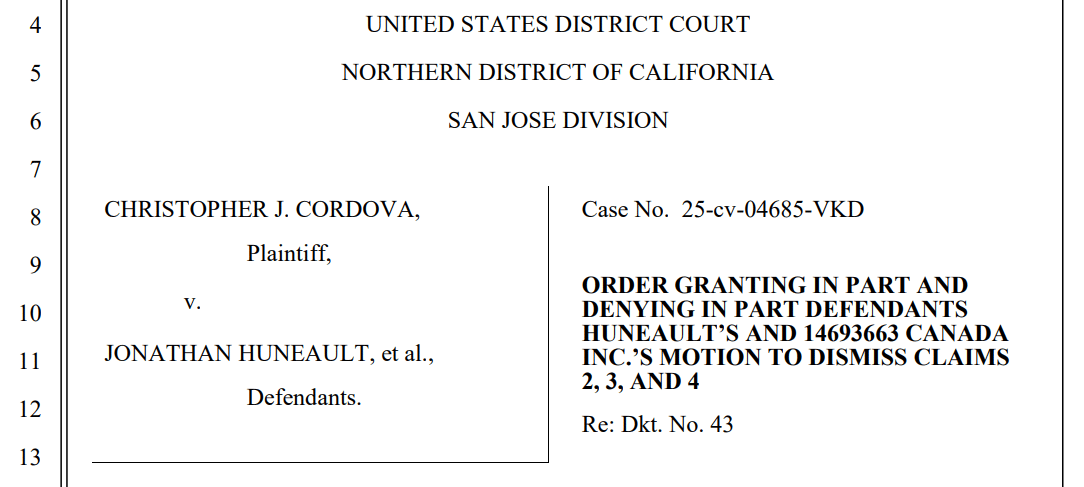
    Without going into the nature of the videos, the lawsuit pits Christopher Cordova (Denver Metro Audits) against Jonathan Huneault (Frauditor Troll Channel). Cordova alleged that Huneault didn’t just use his copyrighted footage without permission, but that he also used “ripping” tools to bypass YouTube’s technical protection to get it.

    The defense disagreed with this argument and requested dismissal. They argued that, because the videos are publicly viewable on YouTube, there is no “access control” to speak of. Additionally, the defense pointed out that there is no evidence that ripping tools were used, pointing out that the defendant and many others have used screen recording to copy content.
    rippinf

    After hearing both sides, U.S. Magistrate Judge Virginia K. DeMarchi denied the motion to dismiss the DMCA circumvention claims, allowing the case to move forward on that claim.

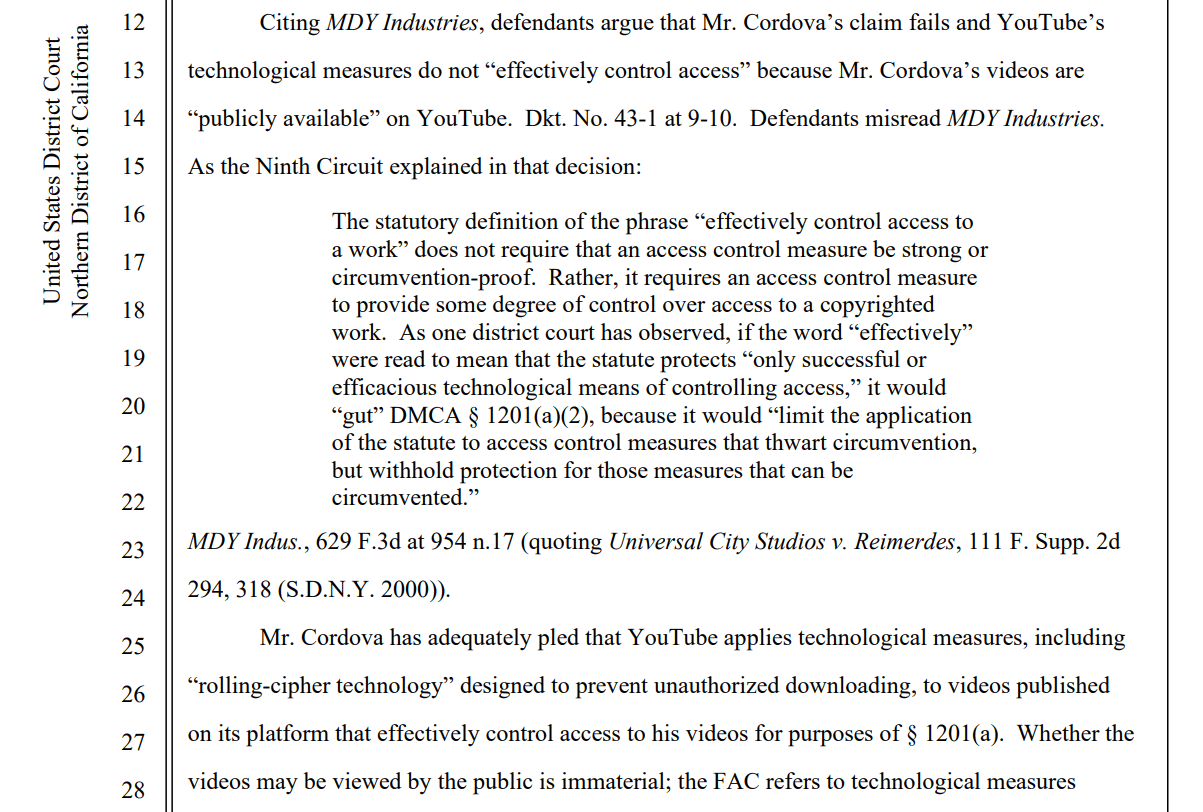
    “Mr. Cordova has adequately pled that YouTube applies technological measures, including ‘rolling-cipher technology’ designed to prevent unauthorized downloading, to videos published on its platform that effectively control access to his videos for purposes of § 1201(a).”

    “Whether the videos may be viewed by the public is immaterial; the [complaint] refers to technological measures intended to prevent unauthorized downloading,” Judge DeMarchi adds.
    From the order

    order

    Caution: Reaction Channels

    While the survival of the §1201 claim may seem like a mere technicality in a case that has yet to be fully litigated, it is rather significant. By accepting that the “rolling cipher” effectively controls access to the downloadable file, the court gives creators who want to sue rivals an option to sue for more than just simple copyright infringement.

    For years, reaction creators have operated under the assumption that, if their commentary is fair use, the way they acquired the footage doesn’t matter. However, Judge DeMarchi’s decision suggests otherwise.

    Essentially, it means that commentary and reaction channels, which are widespread, face potential liability for DMCA violations if they use ripping tools that bypass YouTube’s protections.

    “No Harm, No Foul”?

    The legal teams are now sharply divided on what the circumvention claims mean for the case going forward.

    In a statement to TorrentFreak, defense lawyer Steven C. Vondran dismisses the circumvention claims as a tactical maneuver that may eventually fall apart, as his client didn’t use a ripping tool. The attorney further argued that, if the “reaction” video of his client is fair use, there is no “injury” or harm.

    “If fair use rights apply, and if there is no cognizable injury, then what would be their grounds to have proper standing?” Vondran asked.

    “Plaintiff is arguing that Defendant used ripping tools to circumvent YouTube’s content protection technology to obtain video clips,” Vondran told us. “In fact, this was not the case, but it seems anyone can allege this in a lawsuit and be able to go through discovery to see if they can find the use of these tools.”

    The defense shifts the focus and counters that the plaintiff has no right to sue in the first place, because there is no harm. Vondran argues that if the final “reaction” video is fair use, then the original creator hasn’t been “injured” just because someone downloaded a clip.

    Plaintiff’s attorney Randall S. Newman hit back, telling TorrentFreak that circumventing copy protections under §1201 of the DMCA, is a separate violation that is unaffected by a fair use finding.

    “The injury flows from the act of bypassing technological protection measures themselves, not from the outcome of a fair-use defense asserted after the fact,” Newman says, adding that the question of whether a ripping tool was used will be answered during discovery.

    While the order of the motion to dismiss is significant, for this case it means little more than that the case can now move ahead to the discovery phase, after which it will be argued on its merits. The allegations that the defendant used ripping tools to download videos will have to be backed up by evidence then.

    A copy of the order handed down by U.S. Magistrate Judge Virginia K. DeMarchi of the Northern District of California last month is available here (pdf).

    From: TF, for the latest news on copyright battles, piracy and more.

  • ‘Depths of Wikipedia’ Creator Annie Rauwerda on ‘Fragile’ Internet Citations

    ‘Depths of Wikipedia’ Creator Annie Rauwerda on ‘Fragile’ Internet Citations

    Image credit: Annie Rauwerda, photographed by Ian Shiff, smiling in February 2023

    Annie Rauwerda can’t remember a world without Wikipedia. Born in 1999, just two years before the platform launched, she says it has been omnipresent in her life and a source of endless fascination.

    In the early days of the COVID-19 pandemic when she was a neuroscience student at the University of Michigan, Rauwerda said she spent a lot of time on Wikipedia and started posting quirky stories she found.

    “As I clicked around, there were so many things with goofy titles,” said the now 26-year-old. “I thought to myself: ‘This could be big.’”

    Making as many as five videos a day, Rauwerda indeed gained an audience with her off-beat discoveries — from stolen and missing moon rocks to the back story of people demonstrating “high fives.”  She created Depths of Wikipedia, a group of social media accounts and has more than 1.5 million followers on Instagram, 200,000 on TikTok, and 130,000 on BlueSky.  

    In 2022, Rauwerda was named the Media Contributor of the Year by the Wikimedia Foundation, the nonprofit that hosts Wikipedia.

    In October, Rauwerda was invited to present at the Internet Archive event in San Francisco celebrating the milestone of 1 trillion webpages saved. She brought a burst of energy and humor to the stage as she shared screenshots of some of her favorite Wikipedia articles.

    Watch Annie at Internet Archive’s 1 Trillion Web Page Celebration:

    Rauwerda calls herself an Internet Archive “super fan” and acknowledges its value in providing links to original sources.

    “If Wikipedia is worth anything at all, it’s because of the citations, and those citations are increasingly hard to access,” she said, noting that more than half of the community articles contain a dead link. “That’s not a concern, though, for us, because we have partnerships with the Internet Archive to make sure that those links are archived and can be clicked by anyone.”

    Professionally and personally, Rauwerda said she uses the Archive constantly as she looks for material, seeks out old blogs or edits Wikipedia pages.

    “It’s really hard for me to think of an organization that I’m more enthusiastic about,” Rauwerda said of the Internet Archive. “I just love everything about it.”

    What will matter most to future generations is hard to predict, Rauwerda said, so it’s crucial to save as much of the digital landscape as possible. “I’m thankful the Internet Archive exists,” she said, “especially given how fragile everything is online.”

    Rauwerda said she’s had a “simultaneous love affair with the Internet Archive and Wikipedia” — often toggling back and forth as she dives into topics. She said she embraces the spirit of the open web and the community of people who support this work.

    Beyond her social media presence, Rauwerda is writing a book about Wikipedia for Little Brown. The series of light-hearted essays about the off-beat people behind Wikipedia is slated for publication in the fall of 2026.

    Rauwerda also turned her discoveries into a comedy show, which she first performed at small clubs in New York. After landing an agent, she went on a multi-city tour of the U.S., customizing the material for each region. She has another round of shows booked for 2026.

    “It’s been so fun,” she said. “I’m gonna ride this while it lasts.”

  • UN lauds $6 billion US funding approval towards ending HIV/AIDS

    The UN agency leading the global effort to end HIV/AIDS worldwide welcomed legislative approval from the United States on Thursday for a $6 billion spending package to help tackle the disease, following nearly a year of sharp aid cuts.
  • ‘Human rights cannot wait’: Türk launches $400 million appeal for 2026

    UN High Commissioner for Human Rights Volker Türk launched a $400 million appeal on Thursday in Geneva, as his office (OHCHR) continues to operate “in survival mode”. 
  • Cuba: UN warns of possible humanitarian ‘collapse’, as oil supplies dwindle

    The UN on Wednesday warned of potential humanitarian “collapse” in Cuba, following Washington’s attempt to block oil supplies from reaching the island.
  • Fatwas, faith and fallacies: Myth-busting female genital mutilation in Africa

    Olivia Albert, 19, was subjected to female genital (FGM) mutilation when she was 14. She told the UN sexual and reproductive health agency (UNFPA) that she hid her pain because everyone around her said it was normal.
  • Chad: Africa’s refugee haven struggles with its own stark challenges

    Amid the ongoing war in Sudan, Chad, the country receiving the most refugees in Central Africa, saw slight improvements in its humanitarian situation last year, but as one of the most vulnerable nations on the African continent, it is still struggling to support four million people in need.
  • Child malnutrition hits catastrophic levels in parts of Sudan

    Acute malnutrition among children has reached catastrophic levels in parts of Sudan’s North Darfur and Greater Kordofan, UN-backed analysts warned on Thursday, as conflict, mass displacement and denials of aid push the country deeper into a famine-risk emergency.
  • 36 UK infants ill after drinking contaminated baby formula

    It comes after some batches made by Nestle and Danone were recalled after being contaminated with a toxin.
  • Early NHS preparation ‘paying off’ amid shorter ambulance handover times

    Ambulances handed over patients more than 2 minutes faster last month despite facing their busiest January since before COVID-19. Provisional figures out today show there were 420,324 ambulances handovers with known times in January, the highest number for the month since 2020 and a 5.2% increase compared to 399,415 in January last year. Despite this, […]