Air pollution remains a grave threat to human health, but MAHA is doing nothing about it.
The post The Health Effects of Air Pollution first appeared on Science-Based Medicine.
Air pollution remains a grave threat to human health, but MAHA is doing nothing about it.
The post The Health Effects of Air Pollution first appeared on Science-Based Medicine.

Njalla is the name for a traditional Sámi hut, specifically designed to function as a safe storage location, keeping food away from bears and other predators.
On the web, the Njalla name was adopted by a privacy-focused domain name service that helps to shield website operators from external threats, including takedown efforts and foreign court orders.
Earlier this month, this feature of Njalla was brought to the fore again in the lawsuit Spotify and several record labels filed against Anna’s Archive. Fearing the publication of millions of scraped tracks, the music companies obtained a preliminary injunction to shut off the archive’s domain names.
The case was filed under seal to prevent tipping off Anna’s Archive. This partially worked, as the suspension of the .ORG and .SE domain names came as a surprise. However, Anna’s Archive was certainly not planning to throw in the towel.
After the federal court in New York issued an ex parte temporary restraining order on January 2, the .ORG registry suspended the official annas-archive.org domain. Around the same time, Cloudflare also complied with the court order, disabling the nameservers for the targeted domains, including annas-archive.li.
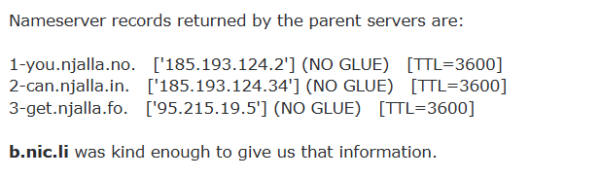
While these actions rendered several of Anna’s Archive unreachable, the .LI variant soon became accessible again. Instead of relying on Cloudflare’s nameservers, it switched to Njalla. The same also applies to the .PM and .IN domains, which were registered as a backup.
Spotify and the labels also noticed this switch to Njalla and, while the case was still under seal, they applied for a broad preliminary injunction to cover the new domains. This also included Njalla as a targeted intermediary, alongside hosting services, domain registrars, and registries.
This injunction, signed by U.S. District Court Judge Jed Rakoff on January 16, does not only cover existing domain names but also any domain names that will be registered in the future.
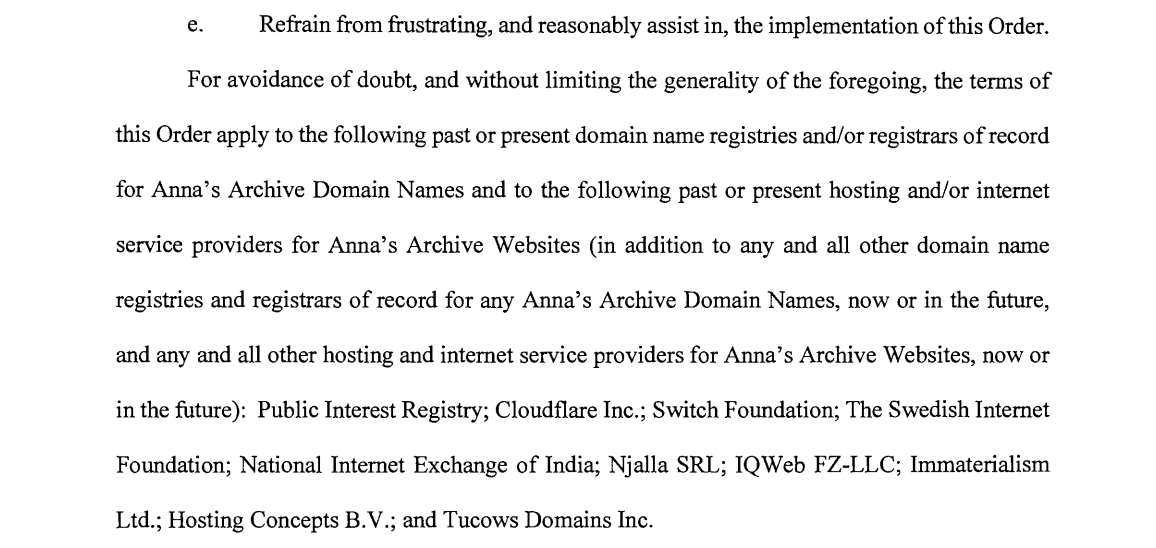
To get an idea of how these domains and services are connected, TorrentFreak compiled the following non-exhaustive and unverified overview. This also includes the new .in domain that was suspended by the National Internet Exchange of India.
| Domain Name | Registry | Registrar | Proxy / DNS |
|---|---|---|---|
| Public Interest Registry (PIR) | Tucows Domains Inc. | Unknown | |
| annas-archive.li | Switch Foundation | Immaterialism Ltd. | Njalla |
| The Swedish Internet Foundation | Hosting Concepts B.V. (Registrar.eu) | Cloudflare Inc. | |
| National Internet Exchange of India | Tucows Domains Inc. | Njalla; IQWeb FZ-LLC (DDoS-Guard) | |
| annas-archive.pm | Registry of record | Hosting Concepts B.V. (Openprovider) | Njalla; IQWeb FZ-LLC (DDoS-Guard) |
The U.S. court order spurred American organizations into action (.ORG registry and Cloudflare) and also helped to get the .IN domain offline. However, not all intermediaries were eager to respond. In fact, the .PM and .LI versions remain accessible today.
While none of the intermediaries would encourage piracy, it appears that they don’t automatically comply with foreign court orders either. Njalla, for example, is operated by Njalla.srl, which is based in Costa Rica, may require a local court order to take action.
We don’t know for certain that the music companies sent the injunction to all named intermediaries involved, but given the gravity of their concerns, that would make sense.
To get more clarity, we asked Njalla for a comment on the situation, but due to privacy issues, it could not share any further information at this stage. The company did note that, generally speaking, it’s not against sharing culture.
“Since we are privacy focused people it is not possible for us to comment on this. However, we can say that we in general think the world becomes a better place when people share what they have with each other, be it food, water, money or culture.”
We also contacted the Switzerland-based Switch Foundation, which is the registry for the .LI domain, but did not receive a reply.
Update: After publication, the Switch Foundation informed us that it has not been formally served with the preliminary injunction. If that happens in the future, Switch will assess its options accordingly.
“As a general matter, foreign court orders do not automatically have legal effect on Switch. Switch evaluates such matters solely in accordance with applicable local laws,” a Switch spokesperson says.
Spotify, which previously responded to our inquiries, has also stopped responding.
The AFNIC registry did respond to our request for clarification. The company is not mentioned in the injunction directly, but as the ‘registry of record’ for the .PM domain name, it should be covered.
AFNIC informs us that they have not received a request to comply with the injunction, nor have they been informed about the court order. However, even if it were to receive the U.S. injunction, AFNIC clarified that it would not comply.
“Decisions from U.S. courts are not directly applicable to Afnic regarding actions concerning .fr domain names or the French overseas extensions under its jurisdiction. To be enforceable, a foreign decision must be recognized by the French court,” an Afnic spokesperson informed us.
This effectively means that the plaintiffs must hire French counsel and petition a French court to recognize the U.S. judgment under Article 509 of the French Civil Code.
Whether Spotify and the music companies plan to go through this trouble is unknown. Anna’s Archive, meanwhile, has disabled the Spotify torrent downloads until further notice, which may have defused the situation somewhat.
That said, thus far the music industry’s enforcement efforts show that the reach of U.S. courts has its limitations. While it is possible to expand the scope through mutual legal assistance requests in foreign courts, these have yet to surface.
At this stage, the music industry doesn’t appear to know who is behind the site. The RIAA previously discovered that “Cyberdyne S.A.” was the registrant for the .se domain. However, that trace doesn’t appear to lead anywhere either.
“‘Cyberdyne’ is also the name of the fictional technology company in the ‘Terminator’ movie series behind the ‘Skynet’ artificial intelligence network that achieved super intelligence and self-awareness, leading to nuclear devastation,” RIAA’s content protection chief informed the court, noting that this may be a fabricated name.
—
Copies of the various unsealed court documents referenced in this article are available below.
– Temporary Restraining Order (TRO)
– Declaration of Mark McDevitt (RIAA)
– Reply memorandum requesting to expand the injunction
From: TF, for the latest news on copyright battles, piracy and more.
Just days after President Trump signed the Republicans’ budget reconciliation bill into law, Equifax’s CEO Mark Begor celebrated its passage on the company’s earnings call. The windfall he expected from the law was “just massive,” but he was not celebrating the bill’s lavish corporate tax breaks. He was applauding new rules that will make it harder for millions of eligible Americans to receive…
As Russia seeks to circumvent sanctions and sell its oil overseas, tankers have been hiding their routes in the Black Sea before stopping at ports in Georgia, according to a report by iFact.
Journalists with iFact, OCCRP’s Georgian member center, analyzed maritime traffic data from 2024 to 2026. They looked at 19 oil tankers that sailed from Russian ports and turned off their Automatic Identification Systems (AIS) in the open water.
International maritime law requires ships to maintain their AIS signal throughout a voyage. Turning off their transponders meant the Russian tankers’ routes across the Black Sea were unknown.
Oil tankers that are part of Russia’s “shadow fleet” often disable their AIS systems as one of several tactics to “avoid detection and enforcement” of sanctions, according to a report last year by the Royal United Services Institute, a U.K. security think tank.
Gocha Beridze, a former senior official with Georgia’s Border Police and Coast Guard who left the service in 2023, said he had documented numerous instances in which Georgian ports and waters were used “to evade sanctions through various tricks and means.”
“Vessels switch off AIS signals, falsify port data, and use various tactics to conceal their movements,” Beridze said.
He also described observing ships loitering off Georgia’s coastline — behavior that raised “great suspicion” of ship-to-ship oil transfers, a common method for skirting sanctions.
While they looked specifically at oil tankers, journalists were not able to confirm exactly what cargo eight of the ships were carrying. However, they did confirm that 11 tankers whose AIS signal consistently disappeared after departing Russia were carrying oil.
One of them, the Panama-flagged Waler, made at least two voyages shipping oil from Russian ports to Georgia’s Poti port in December 2024 and February 2025. The ship’s transponder was turned off during both trips.
In December 2025, Ukraine sanctioned the Waler, accusing the tanker of using “deceptive practices” to export Russian oil. Corporate records indicate that the vessel is operated by a Turkish company, which did not respond to iFact’s requests for comment.
Georgia has not joined the sanctions imposed by the European Union and G7 countries in response to Moscow’s February 2022 full-scale invasion of Ukraine. But Georgian officials have repeatedly insisted that sanctioned Russian oil and petroleum products are not transported through the country’s territory.
Most recently, Georgia’s Revenue Service said it had “strengthened controls within its remit to prevent any attempt to use Georgia’s customs territory to circumvent international sanctions.” The Revenue Service added that it works in coordination with the Georgian Maritime Transport Agency to inspect vessels and shipowners, and bar sanctioned ships from entering national ports.
The Maritime Transport Agency told iFact that all vessels entering Georgian ports are subject to “strict control, in full compliance with international law and national legislation.”
wanderer is a decentralized, self-hosted trail database. You can upload your recorded GPS tracks or create new ones and add various metadata to build an easily searchable catalogue.
The Digital Services Act (DSA) Human Rights Alliance has, since its founding by EFF and Access Now in 2021, works to ensure that the European Union follows a human rights-based approach to platform governance by integrating a wide range of voices and perspectives to contextualise DSA enforcement and examining the DSA’s effect on tech regulations around the world.
As the DSA moves from legislation to enforcement, it has become increasingly clear that its impact depends not only on the text of the Act but also how it’s interpreted and enforced in practice. This is why the Alliance has created a set of recommendations to include civil society organizations and rights-defending stakeholders in the enforcement process.
The Principles for a Human Rights-Centred Application of the DSA: A Global Perspective, a report published this week by the Alliance, outlines steps the European Commission, as the main DSA enforcer, as well as national policymakers and regulators, should take to bring diverse groups to the table as a means of ensuring that the implementation of the DSA is grounded in human rights standards.
The Principles also offer guidance for regulators outside the EU who look to the DSA as a reference framework and international bodies and global actors concerned with digital governance and the wider implications of the DSA. The Principles promote meaningful stakeholder engagement and emphasize the role of civil society organisations in providing expertise and acting as human rights watchdogs.
“Regulators and enforcers need input from civil society, researchers, and affected communities to understand the global dynamics of platform governance,” said EFF International Policy Director Christoph Schmon. “Non-EU-based civil society groups should be enabled to engage on equal footing with EU stakeholders on rights-focused elements of the DSA. This kind of robust engagement will help ensure that DSA enforcement serves the public interest and strengthens fundamental rights for everyone, especially marginalized and vulnerable groups.”
“As activists are increasingly intimidated, journalists silenced, and science and academic freedom attacked by those who claim to defend free speech, it is of utmost importance that the Digital Services Act’s enforcement is centered around the protection of fundamental rights, including the right to the freedom of expression,” said Marcel Kolaja, Policy & Advocacy Director—Europe at Access Now. “To do so effectively, the global perspective needs to be taken into account. The DSA Human Rights Principles provide this perspective and offer valuable guidance for the European Commission, policymakers, and regulators for implementation and enforcement of policies aiming at the protection of fundamental rights.”
“The Principles come at the crucial moment for the EU candidate countries, such as Serbia, that have been aligning their legislation with the EU acquis but still struggle with some of the basic rule of law and human rights standards,” said Ana Toskic Cvetinovic, Executive Director for Partners Serbia. “The DSA HR Alliance offers the opportunity for non-EU civil society to learn about the existing challenges of DSA implementation and design strategies for impacting national policy development in order to minimize any negative impact on human rights.”
The Principles call for:
◼ Empowering EU and non-EU Civil Society and Users to Pursue DSA Enforcement Actions
◼ Considering Extraterritorial and Cross-Border Effects of DSA Enforcement
◼ Promoting Cross-Regional Collaboration Among CSOs on Global Regulatory Issues
◼ Establishing Institutionalised Dialogue Between EU and Non-EU Stakeholders
◼ Upholding the Rule of Law and Fundamental Rights in DSA Enforcement, Free from Political Influence
◼ Considering Global Experiences with Trusted Flaggers and Avoid Enforcement Abuse
◼ Recognising the International Relevance of DSA Data Access and Transparency Provisions for Human Rights Monitoring
The Principles have been signed by 30 civil society organizations,researchers, and independent experts.
The DSA Human Right Alliance represents diverse communities across the globe to ensure that the DSA embraces a human rights-centered approach to platform governance and that EU lawmakers consider the global impacts of European legislation.