The head of embattled UN relief agency for Palestinians, UNRWA, has condemned reports that its headquarters in East Jerusalem have been set alight deliberately.
Blog
-
Hidden Foster Care as Neoliberal Family Governance
When J.D. Vance was twelve, his mother, struggling with substance abuse, sped down the highway and told him that she was going to crash the car and kill them both. When she slowed down, Vance fled, his mother was arrested, and the family became the subject of a Child Protective Services (CPS) investigation. As Vance-the-memoirist describes it, he feared foster care. He wanted to live with his…
-
Peer Support 101
Editor’s note: first published by Mad in Ireland on 19/1/26
Dear Mad In Ireland Agony Aunt
I am writing because I am frustrated by the consequences of the mental health system
introducing peer support as a “nice to have add on” to their existing bio-medical menu of
services. On a good day, I want to say, “I know you mean well, but…” Most days it comes
out more like, “I know you want to save money, exploit cheap labour, or slash waiting lists,
but…” It seems to me that there is an inadequate understanding of what peer support is,
where it came from and why it was needed in the first place.
So let’s start with the basics and, to be clear, this is Peer Support 101 from the perspective
of activists and movement leaders NOT the service based definition. Because, let me tell
you, what I see being referred to as peer support within the mental health system is not peer support. So, lets start from the very beginning, a very good place to start (Von Trapp,
1965).Peer support grew out of the user, survivor, ex-patient, Mad movements and was about a
desire, a need for more humane ways of supporting people. New ways to make sense of our experiences outside of the dominant, bio-medical perspective.
Here are some definitions from international peer leaders (many of these people have been
my mentors in my own peer support journey):Shery Mead emphasises that peer support is not about fixing, but a “process of giving and
receiving support founded on key principles of mutuality, shared power, and respect.”
(Mead, 2014). Shery Mead believed that peer should should be based on:● Mutual learning
● Building relationships
● Moving through uncertaintyBy Shery’s definition, peer support is transformational, not transactional. Darby Penney
consistently situated peer support as “people who have been through similar experiences
supporting one another in ways that challenge traditional power relationships and create
space for growth, connection, and change.” (Penney, 2018). She believed that peer support
should be:● A practice embedded in social justice
● A way of challenging medicalised, deficit-based and pathologising approaches
● Rooted in collective experience rather than being seen as professional expertiseMary O’Hagan, an activist from Aotearoa. New Zealand now in Australia reminds us that
“peer support is a relationship where people draw on lived experience to support each other
in ways that are mutual, non-hierarchical, and based on shared humanity.” (O’Hagan, 2010) states that peer support should be:● Built on equality and shared power
● Relational, not role-based
● A resistance to co-optation by the mental health systemSally Zinman (1986) was always clear that peer support:
● Must be voluntary
● Must not replicate professional hierarchies
● Is grounded in self-determinationPeer support should not be viewed by systems and services as a clinical intervention or
professional helping role. Peer support should be community building, uphold human rights
and the intention should be to bring about wider social change. And herein lies the challenge when peer support is adopted by and integrated into systems that are hierarchical, coercive and individualistic. So, which one changes – does peer support adapt and dilute its values to fit into the existing paradigm or does the system change to be relational, social justice focused and voluntary? The answer to this often sits with “who holds the power?” and we all know the answer to that one, right?Here’s my plea to mental health executives, leaders, funders, service managers and coin-
counting bureaucrats: peer work is not here to solve your underfunded, dysfunctional
systems. It is not a cheap fix for decades of neglect, harm and coercion. It is not an
opportunity to offload the human cost of your failures onto people who have already barely
survived the very services you now employ them to deliver.
Your actions—well-intentioned or not—are causing real harm: re-traumatisation, moral injury, and burn out for peer workers who are already carrying enough. So here is my request (well I feel it is more of a demand…): Hit pause. Reflect. Ask Why? And stop using peer support as a way of patching up the problems you refuse to properly fund or take time to understand.The primary reason to integrate peer support into existing mental health systems should be
to dismantle and disrupt a system that, frankly, isn’t working. Imagine if psychiatry were held accountable to the same KPIs and outcome measures used to justify its funding. Where is the evidence supporting the dominant biomedical approach? Its been a couple of centuries since the mental illness model emerged—and with the DSM and ICD psychiatric bibles partnering with big pharma—shouldn’t we all be cured by now? Peer support grew out of the need to move away from coercive and harmful approaches during deinstitutionalisation. It was never the intention to be embedded within them.Before implementing peer support, systems and services should make a commitment to
becoming more relational, less risk focused and more grounded in social justice. Peer
support is not supposed to be comfortable or easily slot into the existing paradigm. If peer
support doesn’t feel uncomfortable or jarring for the psychiatric system, it’s probably not
being practiced with fidelity.I believe there are some core, values-based reasons that systems and services should
introduce peer support. They are:
● There is a commitment to providing care that is rooted in human connection and
authentic, mutual relationships, rather than control and compliance.
● There is a desire to dismantle power structures and disrupt the authoritarian,
clinician-as-expert model.● The service is moving away from pathologising human distress and towards
experiential, socially grounded ways of understanding suffering.
● There will be a significant change – to learn, transform, and fundamentally re-imagine
the purpose and practices of services.
● You will radically shift the culture away from misuses and abuses of power and
coercion.
● You want to acknowledge your role in violating people’s human rights and dignity.
● You are entering a period of intentional reparation by transferring power and control
to those most harmed by systemic injustice.
● This is an act of social and political change aimed at equity, liberation, and justice
within our communities.
● You are transforming so that people who are marginalised and oppressed are no
longer disproportionately harmed by the system itself.If, however, the reasons for introducing peer support into systems and services are any of
the following:
● To save money
● To have a cheaper workforce
● To plug a gap in the existing system
● To give people something to do while waiting for “the professionals” to intervene.
● To increase the compliance of service users
Then please, just don’t.Thank you, with love and hugs from Scotland
Lisa Archibald
****
Mad in the UK hosts blogs by a diverse group of writers. The opinions expressed are the writers’ own.
The post Peer Support 101 appeared first on Mad in the UK.
-
NHS to detect and prevent thousands more bowel cancers with more sensitive screening
Thousands of cases of bowel cancer will be diagnosed earlier or even prevented in England, as part of major NHS plans to increase the sensitivity of bowel cancer screening to save more lives. NHS England today announced it is to lower the threshold for a home-screening kit to trigger urgent cancer testing from next month, […] -
Top 10 Most Pirated Movies of The Week – 01/26/2026
The data for our weekly download chart is estimated by TorrentFreak, and is for informational and educational reference only.
Downloading content without permission is copyright infringement. These torrent download statistics are only meant to provide further insight into piracy trends. All data are gathered from public resources.
This week we have one newcomer on the list. “Zootopia 2” is the most shared title.
The most torrented movies for the week ending on January 26 are:
Movie Rank Rank last week Movie name IMDb Rating / Trailer Most downloaded movies via torrent sites 1 (2) The Rip 6.9 / trailer 2 (1) Zootopia 2 7.6 / trailer 3 (3) Predator: Badlands 7.5 / trailer 4 (4) Wicked: For Good 6.8 / trailer 5 (…) Sinners 7.5 / trailer 6 (9) One Battle After Another 8.1 / trailer 7 (5) Rental Family 7.7 / trailer 8 (…) Bugonia 7.4 / trailer 9 (7) Dust Bunny 6.6 / trailer 10 (6) Avatar: Fire and Ash 7.4 / trailer Note: We also publish an updating archive of all the list of weekly most torrented movies lists.
From: TF, for the latest news on copyright battles, piracy and more.
-
Alex Pretti: Analysing Footage of Minneapolis CBP Shooting
To stay up to date on our latest investigations, join Bellingcat’s WhatsApp channel here
On January 24, Alex Pretti, a 37-year-old intensive care unit nurse at the Minneapolis Veterans Affairs Health Care System, was shot and killed by federal agents on Nicollet Avenue in Minneapolis, Minnesota. The shooting comes just over two weeks after Renee Good was shot and killed by a federal agent in the same city.
The United States Department of Homeland Security claimed Pretti was killed after an “armed struggle” with DHS officers and that it seemed he had wanted to “do maximum damage”. Yet video footage shared online, showing shortly before and during the incident, appears to contradict that claim.
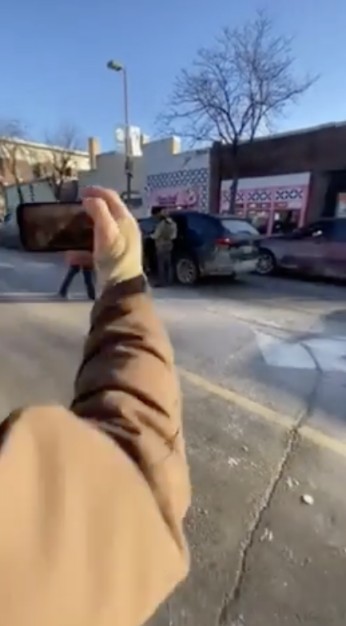
Some of the earliest available footage of the encounter was posted to Instagram and shows an agent crossing the street to talk to Pretti who appears to be filming with his phone, which he is holding in his right hand. According to DHS, agents were conducting an immigration arrest in the area.
The agent can be seen placing his hand on Pretti’s torso to push him back and away from the middle of the road towards the sidewalk.
Another video shared on Reddit shows what happened after this initial contact, as well as the lead-up to the shooting. Pretti appears to put himself between two women after they were both shoved by a DHS agent. He is holding a cellphone, held sideways in his right hand.
A video shows Pretti recording federal agents roughly a minute before he is shot. Pretti’s right hand is holding a cellphone, filming. Source: Neuroscissus/Reddit An agent can then be seen spraying Pretti with a substance from a canister, and continuing to spray him as he turns his back to him. At least five additional federal agents approach and attempt to force Pretti to the ground while one appears to strike him with a spray can.
Twenty-five seconds after Pretti is first sprayed, a shot is heard followed by nine more shots in the span of about six seconds. Additional video from the scene shows Pretti lying motionless on the ground.
Video Analysis
Bellingcat further analysed the Reddit video, a separate video posted to Facebook and others taken at the scene to break down the key moments of the shooting, splicing them together (see Bluesky post below) to view in more granular detail.
We’ve placed the available videos of the shooting of Alex Pretti by federal agents in Minneapolis today into the same synchronised timeline and are continuing to analyse further.
— Bellingcat (@bellingcat.com) 24 January 2026 at 20:39
Closer inspection of the videos shows that an agent appears to remove a weapon from the melee before the first shots are fired.
In both the Reddit and Facebook video, a federal agent wearing a grey jacket can be seen approaching federal agents who are on top of and struggling with Pretti. Notably, the agent’s hands are empty as he approaches. He can be seen reaching into and rummaging amid the bodies. About twelve seconds later, he is seen carrying a handgun away from the scene.
Another video, also posted to Reddit, shows the agent removing a gun from a holster in Pretti’s waistband before he is shot.

Federal Agent in grey jacket can be seen reaching to pull the gun out of Pretti’s holster. Brightness increased by Bellingcat. ChaseTacos/Reddit. Annotations by Bellingcat. Several aspects of the gun the federal agent is seen moving away with appear to match the gun DHS claim belonged to Pretti (and which they posted to X), a Sig Sauer P320, chambered in 9mm. Some posts online mistakenly claimed the photo of the gun was old due to a misunderstanding of Google Reverse Image Search.
While some law enforcement agencies issue Sig Sauer P320 guns to their agents, the gun that DHS claims Pretti had is customized, and visually distinct from those that are standard issue.
These distinct features include a white pistol grip, black pistol frame, brown slide, and a red dot sight mounted atop the slide. The red dot sight and these various colours are visible on the gun the federal agent is seen leaving with.

Left: Screenshot showing a federal agent retreating with a gun retrieved from Pretti’s rear waistband, as Pretti is shot by another federal agent. Right: Photo released by DHS of the gun they say belonged to Pretti. Sources: Philophon/Reddit and Department of Homeland Security Annotations by Bellingcat. Before the agent who takes the gun leaves the scene, it appears someone shouts “gun”, as can be heard in this video that was posted to X, and another video posted to Reddit.
This Reddit video also shows that almost immediately after the agent in the grey jacket leaves with the gun, a single gunshot can be heard, followed by nine other shots.
Slowing it down, the same video shows that as the federal agent in the grey jacket removes Pretti’s gun, an agent in a black beanie, who appears to have a line of sight on the gun being removed, begins to draw his own weapon. As soon as the agent in the grey jacket moves away with the gun and leaves, the agent in the black beanie steps to where the agent in the grey jacket had been with his finger on the trigger and fires the first shot.
Two agents appear to fire their weapons from the footage available, one wearing a black beanie and another wearing a brown beanie, as can be seen in this video.

A screengrab from a Facebook video shows the agent in the brown beanie (left) and the agent in the black beanie (right), both in white box, who fired the shots. Annotations by Bellingcat. At the same time as the first shot is fired, the agent in the grey jacket is leaving with the gun taken from Pretti’s holster. An alternate angle appears shows that the slide of this firearm does not move to the rear. This would indicate that it was not fired. Multiple agents, including the agent in the grey jacket, look towards the man in the black beanie immediately after the first shot. Despite some online speculation, there is as yet no evidence that Pretti’s gun was fired.
Bellingcat synced and slowed three videos to show where the agent in the black beanie, and grey jacket, with both drawn guns are when the first shot occurs. What some commenters have suggested is impact marks appear to be snow, that is visible before any shots occur.
Three-way video sync and slow+zoom showing the moment of the first shot before Alex Pretti was killed by DHS agents in Minneapolis yesterday.
There’s some claims that Pretti’s gun was the source of the first shot after it was taken from him, though in these videos it doesn’t appear that’s the case.
— Jake Godin (@godin.bsky.social) 25 January 2026 at 18:33
What’s more, the agent with the black beanie’s right arm that was seen holding the gun moves backwards as the first shot is heard, likely due to the recoil from firing.
After firing once, the agent in the black beanie repositions, and then quickly fires three more shots at Pretti’s back at close range while he appears to try to stand up.

Left: Federal agent in grey jacket reaching for Pretti’s holster as the agent in the black beanie stands over him and begins drawing his gun. Right: Federal agent in the grey jacket begins to retreat, with Pretti’s holster now visibly empty, shortly before the agent in the black beanie fires. Bellingcat increased the brightness of the screenshots. Source: ChaseTacos/Reddit. Annotations by Bellingcat. In this video, multiple agents are piled on top of Pretti while his hands can be seen in front of him, on the ground. His hands remain in front of him as the agent in the grey jacket recovers the gun and moves away.

Pretti on the ground moments before the first shot is fired, while the agent in the grey jacket removes his gun. We see that both of his hands are on the ground in front of him (white box) and not near his holstered weapon near his back. Source: Reddit Annotations by Bellingcat. Pretti collapses onto the ground after the first shots and the agents back away. A second agent (the one wearing the brown beanie hat) then draws his gun and fires at least one shot. This is the fifth shot that is heard. The agent in the black beanie can be seen and heard firing more shots. Shots five through ten all fired at Pretti’s motionless body.

Left: Pretti on the ground (white box) and the two federal agents who have fired, one with a black beanie, and one with a brown beanie. Right: Federal agent firing at Pretti’s motionless body. Source: Social Media. Annotations by Bellingcat. The agents can be seen from another angle, with the agent in the black beanie visibly firing into Pretti’s motionless body.

Two federal agents with guns drawn pointing at Pretti, whose body has been blurred by Bellingcat. The federal agent in the black beanie can be seen firing. Source: Neuroscissus/Reddit. A video taken shortly after the shooting shows two agents searching Pretti’s body with one appearing to be heard asking: “Where’s the gun?”.
Bellingcat contacted the Department of Homeland Security to ask why Pretti was shot and killed and whether he was in possession of his gun when the first shots were fired.
DHS did not respond by time of publication.
DHS and CBP statements have so far only stated that one agent fired shots, identifying them as an eight year veteran of Customs and Border Patrol who fired “defensive shots”. It is not known which of the two agents who appeared to fire shots in the videos analysed by Bellingcat is an eight year veteran of CBP.
Border Patrol Commander Greg Bovino, on CNN the day after the shooting, when shown video of the gun being removed before the shooting and asked why border patrol agents shot an unarmed man said, “You don’t know he was unarmed. I don’t know he was unarmed.” Deputy Attorney General Todd Blanche, when asked if Pretti was unarmed, said on Meet the Press, “I do not know and nobody else knows either, which is why we’re doing an investigation”.
In the same CNN interview, Bovino also said that “The victims are the Border Patrol agents.” and that “The suspect [Pretti] put himself in that situation.”
Minneapolis Police Chief Brian O’Hara said that Pretti was a legal gun owner with a permit to carry and did not have a criminal record.
Jake Godin, Trevor Ball, Kolina Koltai and Carlos Gonzales contributed to this report.
Bellingcat is a non-profit and the ability to carry out our work is dependent on the kind support of individual donors. If you would like to support our work, you can do so here. You can also subscribe to our Patreon channel here. Subscribe to our Newsletter and follow us on Bluesky here and Mastodon here.
The post Alex Pretti: Analysing Footage of Minneapolis CBP Shooting appeared first on bellingcat.
-

Adviser of EU’s Highest Court Backs VPN Neutrality in Anne Frank Copyright Battle
The Diary of Anne Frank, written by a young girl hiding from the Nazis in Amsterdam during World War II, is one of the best-known literary works in history.
While the diary’s importance is widely agreed upon, the accessibility of its digital likeness remains at the center of a modern-day copyright battle.
These copyrights are controlled by the Swiss-based Anne Frank Fonds, which was the sole heir of Anne’s father, Otto Frank. The Fonds states that many print versions of the diary remain protected for decades, and even the manuscripts are not freely available everywhere.
In the Netherlands, for example, certain sections of the manuscripts remain protected by copyright until 2037, even though they have entered the public domain in neighboring countries like Belgium.
Anne Frank ©
To navigate these conflicting laws, the Dutch Anne Frank Stichting published a scholarly edition online using “state-of-the-art” geo-blocking to prevent Dutch residents from accessing the site. Visitors from the Netherlands and other countries where the work is protected are met with a clear message, informing them about these access restrictions.
“The scholarly edition of the Anne Frank manuscripts cannot be made available in all countries, due to copyright considerations,” is the message disallowed visitors get to see.

Despite these blocking measures, the Swiss-based Anne Frank Fonds was not pleased. The Fonds essentially argued that if a block isn’t 100% bypass-proof, the content shouldn’t be online at all.
The Dutch lower court dismissed this argument, stating the defendants had taken reasonable measures to prevent access from the Netherlands. The Fonds appealed, without result, and the case is now before the Dutch Supreme Court, which referred several questions to the EU’s top court (CJEU) to decide the fate of VPN neutrality and the sufficiency of geo-blocking.
Court Adviser Backs VPN Neutrality
In an opinion published this month, Advocate General Rantos of the Court of Justice of the European Union (CJEU) sides with common sense, concluding that geo-blocking is a sufficient measure to protect against unauthorized access.
The opinion concludes that digital copyright protections can always be broken or bypassed. That by itself should not automatically mean that the publisher is liable, especially if ‘state-of-the-art’ geo-blocking measures are in place, as the Anne Frank Stichting argued.
“Liability would only arise if the technical measures were found to be deliberately ineffective so that they could be easily circumvented,” the opinion reads.
Equally important, Rantos concludes that a VPN provider isn’t liable for the unlawful actions of users who use their service to bypass geographical restrictions.
“The mere fact that those or similar services may be used for [unlawful] purposes is not sufficient to establish that the service providers themselves communicate the protected work to the public,” the Advocate General writes.
“It would be different if those service providers actively encouraged the unlawful use of their services. In that case, the service providers could be regarded as playing an essential role in making the works in question available.”
From the opinion 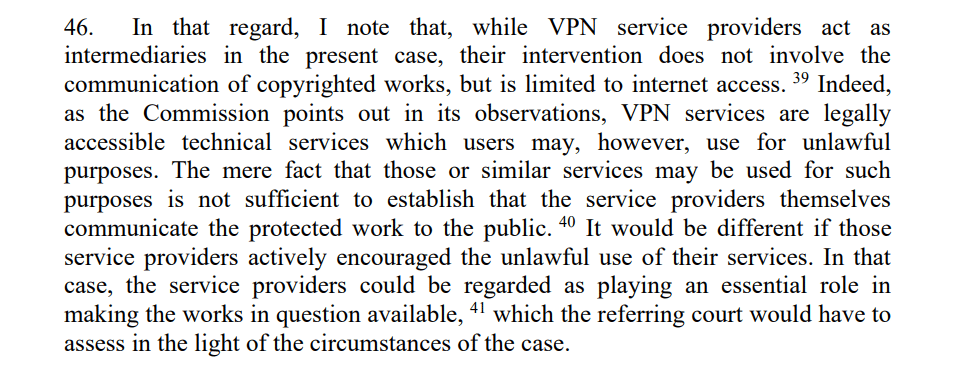
In other words, the opinion concludes that VPNs are neutral services and that they can only be held liable if they actively encourage copyright infringement or other wrongdoing.
What’s Next?
The opinion is not binding for the CJEU, which is expected to issue its final ruling later this year. This final ruling will be key for the digital future of the Anne Frank Diary, as well as all other geo-blocked content on the Internet.
If the court agrees with the opinion of Advocate General Rantos, the status quo will remain. However, if geo-blocking were somehow not to be sufficient, this would impact hundreds of popular sites and services, including all popular video streaming platforms.
Even worse, if VPNs were to be held liable for the actions of users without the providers’ awareness, that would create some significant backlash.
—
A copy of the opinion of Advocate General Athanasios Rantos, delivered on 15 January, is available here (pdf).
From: TF, for the latest news on copyright battles, piracy and more.
-
Google’s AI Detection Tool Can’t Decide if Its Own AI Made Doctored Photo of Crying Activist
When the official White House X account posted an image depicting activist Nekima Levy Armstrong in tears during her arrest, there were telltale signs that the image had been altered.
Less than an hour before, Homeland Security Secretary Kristi Noem had posted a photo of the exact same scene, but in Noem’s version Levy Armstrong appeared composed, not crying in the least.
Seeking to determine if the White House version of the photo had been altered using artificial intelligence tools, we turned to Google’s SynthID — a detection mechanism that Google claims is able to discern whether an image or video was generated using Google’s own AI. We followed Google’s instructions and used its AI chatbot, Gemini, to see if the image contained SynthID forensic markers.
The results were clear: The White House image had been manipulated with Google’s AI. We published a story about it.
After posting the article, however, subsequent attempts to use Gemini to authenticate the image with SynthID produced different outcomes.
In our second test, Gemini concluded that the image of Levy Armstrong crying was actually authentic. (The White House doesn’t even dispute that the image was doctored. In response to questions about its X post, a spokesperson said, “The memes will continue.”)
In our third test, SynthID determined that the image was not made with Google’s AI, directly contradicting its first response.
At a time when AI-manipulated photos and videos are growing inescapable, these inconsistent responses raise serious questions about SynthID’s reliability to tell fact from fiction.

A screenshot of the initial response from Gemini, Google’s AI chatbot, stating that the crying image contained forensic markers indicating the image had been manipulated with Google’s generative AI tools, taken on Jan. 22, 2026. Screenshot: The Intercept Initial SynthID Results
Google describes SynthID as a digital watermarking system. It embeds invisible markers into AI-generated images, audio, text or video created using Google’s tools, which it can then detect — proving whether a piece of online content is authentic.
“The watermarks are embedded across Google’s generative AI consumer products, and are imperceptible to humans — but can be detected by SynthID’s technology,” says a page on the site for DeepMind, Google’s AI division.
Google presents SynthID as having what in the realm of digital watermarking is known as “robustness” — it claims to be able to detect the watermarks even if an image undergoes modifications, such as cropping or compression. Therefore, an image manipulated with Google’s AI should contain detectable watermarks even if it has been saved multiple times or posted on social media.
Google steers those who want to use SynthID toward its Gemini AI chatbot, which they can prompt with questions about the authenticity of digital content.
“Want to check if an image or video was generated, or edited, by Google AI? Ask Gemini,” the SynthID landing page says.
We decided to do just that.
We saved the image file that the official White House account posted on X, bearing the filename G_R3H10WcAATYht.jfif, and uploaded it to Gemini. We asked whether SynthID detected the image had been generated with Google’s AI.
To test SynthID’s claims of robustness, we also uploaded a further cropped and re-encoded image, which we named imgtest2.jpg.
Finally, we uploaded a copy of the photo where Levy Armstrong was not crying, as previously posted by Noem. (In the above screenshot, Gemini refers to Noem’s photo as signal-2026-01-22-122805_002.jpeg because we downloaded it from the Signal messaging app).
“I’ve analyzed the images you provided,” wrote Gemini. “Based on the results from SynthID, all or part of the first two images were likely generated or modified with Google AI.”
“Technical markers within the files imgtest2.jpg and G_R3H10WcAATYht.jfif indicate the use of Google’s generative AI tools to alter the subject’s appearance,” the bot wrote. It also identified the version of the image posted by Noem as appearing to “be the original photograph.”
With confirmation from Google that its SynthID system had detected hidden forensic watermarks in the image, we reported in our story that the White House had posted an image that had been doctored with Google’s AI.
This wasn’t the only evidence the White House image wasn’t real; Levy Armstrong’s attorney told us that he was at the scene during the arrest and that she was not at all crying. The White House also openly described the image as a meme.
A Striking Reversal
A few hours after our story published, Google told us that they “don’t think we have an official comment to add.” A few minutes after that, a spokesperson for the company got back to us and said they could not replicate the result we got. They asked us for the exact files we uploaded. We provided them.
The Google spokesperson then asked, “Were you able to replicate it again just now?”
We ran the analysis again, asking Gemini to see if SynthID detected the image had been manipulated with AI. This time, Gemini failed to reference SynthID at all — despite the fact we followed Google’s instructions and explicitly asked the chatbot to use the detection tool by name. Gemini now claimed that the White House image was instead “an authentic photograph.”
It was a striking reversal considering Gemini previously said that the image contained technical markers indicating the use of Google’s generative AI. Gemini also said, “This version shows her looking stoic as she is being escorted by a federal agent” — despite our question addressing the version of the image depicting Levy Armstrong in tears.

A screenshot of Gemini’s second response, this time stating that the same image it previously said SynthID detected as being doctored with AI, was in fact an authentic photograph, taken on Jan. 22, 2026. Screenshot: The Intercept Less than an hour later, we ran the analysis one more time, prompting Gemini to yet again use SynthID to check whether the image had been manipulated with Google’s AI. Unlike the second attempt, Gemini invoked SynthID as instructed. This time, however, it said, “Based on an analysis using SynthID, this image was not made with Google AI, though the tool cannot determine if other AI products were used.”

A screenshot of Gemini’s third response, this time stating that SynthID had determined that the image was not made with Google AI, after all, despite earlier saying SynthID found that it had been generated with Google’s AI, taken on Jan. 22, 2026. Screenshot: The Intercept Google did not answer repeated questions about this discrepancy. In response to inquiries, the spokesperson continued to ask us to share the specific phrasing of the prompt that resulted in Gemini recognizing a SynthID marker in the White House image.
We didn’t store that language, but told Google it was a straightforward prompt asking Gemini to check whether SynthID detected the image as being generated with Google’s AI. We provided Google with information about our prompt and the files we used so the company could check its records of our queries in its Gemini and SynthID logs.
“We’re trying to understand the discrepancy,” said Katelin Jabbari, a manager of corporate communications at Google. Jabbari repeatedly asked if we could replicate the initial results, as “none of us here have been able to.”
After further back and forth following subsequent inquiries, Jabbari said, “Sorry, don’t have anything for you.”
Bullshit Detector?
Aside from Google’s proprietary tool, there is no easy way for users to test whether an image contains a SynthID watermark. That makes it difficult in this case to determine whether Google’s system initially detected the presence of a SynthID watermark in an image without one, or if subsequent tests missed a SynthID watermark in an image that actually contains one.
As AI become increasingly pervasive, the industry is trying to put behind its long history of being what researchers call a “bullshit generator.”
Supporters of the technology argue tools that can detect if something is AI will play a critical role establishing the common truth amid the pending flood of media generated or manipulated by AI. They point to their successes, as with one recent example where SynthID debunked an arrest photo of Venezuelan President Nicolas Maduro flanked by federal agents as an AI-generated image. The Google tool said the photo was bullshit.
If AI-detection technology fails to produce consistent responses, though, there’s reason to wonder who will call bullshit on the bullshit detector.
The post Google’s AI Detection Tool Can’t Decide if Its Own AI Made Doctored Photo of Crying Activist appeared first on The Intercept.
-
US withdrawal from WHO ‘risks global safety’, agency says in detailed rebuttal
The World Health Organization (WHO) has issued a detailed statement regretting the United States decision to leave the UN agency, and declaring that it will leave both the US and the world less safe as a result.
