Blog

  • West Africa Investigative Training and Reporting Fellowship

    Apply Now

    Why Apply?

    This one year program will be implemented by the Organized Crime and Corruption Reporting Project (OCCRP), along with Norbert Zongo Cell for Investigative Journalism in West Africa (CENOZO) and Tiger Eye Social Foundation (Tiger Eye). Fifteen selected journalists will be trained by investigative experts from CENOZO and Tiger Eye for three months to produce investigative stories on illicit financial flows and other related illicit activities. The five journalists with the strongest story proposals will be offered a six-month paid fellowship by OCCRP to work on investigations.

    The training focuses on the latest techniques, tools, and cross-border strategies used in investigations. You’ll learn how to:

    🔍 Follow the money

    🕵️ Track assets across borders

    🏢 Uncover hidden corporate ownership

    📊 Navigate and analyze complex datasets using Aleph Pro

    ⚖️ Handle data and sources in a legal and ethical way

    If you are an experienced investigative journalist interested in illicit financial flows, organized crime, and other related cross-border illicit activities, this program will sharpen your skills and expand your investigative toolkit. It is a training by doing program, designed to help you publish investigative stories in both your news outlet and OCCRP.

    Who Can Apply

    We are looking for journalists (freelancers are encouraged to apply) who meet the following criteria:

    Location: Applicants must be based in or professionally affiliated with news organizations in Ghana, Nigeria, Senegal, and Togo.

    Background: Applicants who have a strong background in investigative journalism, data journalism, and/or in-depth reporting. Previous participation in investigative projects will be considered a plus.

    ❗Please note that journalism students are NOT eligible unless otherwise indicated in your application (i.e., an experienced journalist seeking a higher degree, etc.).

    Inclusion: We actively encourage applications from individuals of all genders and from underrepresented communities to foster a diverse and inclusive network.

    Language Proficiency: Applicants should have conversational proficiency in English.

    What You’ll Need to Apply

    To complete your application, please submit:

    • A short statement of interest (100-150 words)

    • Your CV

    • Two pitches or brief story ideas on illicit financial flows and organized crime that you will work on during the program (200 words each)

    • 2-3 links to published work

    What You’ll Gain

    • Advanced investigative training: Participants will learn the latest techniques, technologies, and ethical considerations and have access to OCCRP’s resources, such as Aleph Pro and Investigative Dashboard.

    • Mentorship: Participants will receive guidance from CENOZO, Tiger Eye, and OCCRP’s global network of editors and reporters.

    • Fellowship: Participants with strongest story proposals will be offered a six-month paid fellowship by OCCRP to produce their investigative stories.

    • Networking: Participants will have access to a growing network of peers working on impactful stories around the world.

    Apply Now

    For questions, please contact africainfo@occrp.org. 

  • Airstrike on funeral underscores rising civilian toll in Sudan

    Fears are mounting for civilians caught up in Sudan’s deadly war between rival militaries as attacks intensify and humanitarian access shrinks, following a deadly airstrike on a funeral gathering in West Kordofan.
  • The image from Gaza that still haunts me: Palestine relief agency chief

    Asking the softly spoken, veteran humanitarian worker Philippe Lazzarini how he feels as he comes to the end of his second term as the head of the UN agency for Palestinians, UNRWA, is perhaps an unfair question. 
  • World News in Brief: Ukraine drone attacks, Afghan rights, Zero-Waste Day

    A night of drone attacks reportedly killed two people and injured 12 in the Ukrainian port city of Odesa, as a maternity hospital and three educational facilities were also damaged.
  • MIDDLE EAST LIVE 30 March: UN peacekeepers killed amid Israel-Hezbollah clashes

    Further attacks have been reported across the Middle East as the war enters a second month, with two more Indonesian peacekeepers killed in Southern Lebanon on Monday, following the death of a fellow ‘blue helmet’ a day earlier. On the diplomatic front, the UN has announced a taskforce to restore the flow of fertilizer and aid through the Strait of Hormuz, while the UN’s atomic watchdog confirms an attack on a heavy water facility at Khondab in Iran. Stay with us for live updates on this and UN agencies. App users can follow coverage here.
  • MIDDLE EAST LIVE 30 March: UN peacekeeper killed amid Israel-Hezbollah clashes

    Further attacks have been reported across the Middle East as the war enters a second month, with one UN peacekeeper killed in Lebanon on Sunday and another seriously injured. On the diplomatic front, the UN has announced a taskforce to restore the flow of fertilizer and aid through the Strait of Hormuz, while the UN’s atomic watchdog confirms an attack on a heavy water facility at Khondab in Iran. Stay with us for live updates on this and UN agencies. App users can follow coverage here.
  • Landlord Distress Isn’t Our Fault, But It Is Our Problem

    The rental housing market is facing financial distress, with landlords in all corners of the country scrambling to pay back their investors. Unable to realize enough profit from their portfolios to meet financial obligations, these landlords are deferring maintenance, going into foreclosure, and resorting to fire-sales of properties. But unless something changes, tenants will bear the brunt of…

    Source

  • Hong Kong Raids Target Triad Bid-Rigging in Building Contracts

    Hong Kong authorities have arrested 42 people in an anti-corruption sweep targeting suspected triad involvement in rigging lucrative building maintenance and fire safety contracts.

    The Independent Commission Against Corruption (ICAC) said a consultancy firm collaborated with triad-linked middlemen to manipulate public tenders through bribery. The alleged scheme affected at least three projects, including a $2.6 million maintenance contract on Hong Kong Island and a Kowloon fire safety project priced at roughly $180,000—double the standard market rate.

    Investigators said their early intervention likely prevented further corruption in two pending projects valued at over $20.4 million combined. The operation also uncovered potential safety violations connected to a previously completed contract.

  • Judge Allows BitTorrent Seeding Claims Against Meta, Despite Lawyers ‘Lame Excuses’

    Judge Allows BitTorrent Seeding Claims Against Meta, Despite Lawyers ‘Lame Excuses’

    Over the past two years, rightsholders of all kinds have filed lawsuits against companies that develop AI models.

    Most of these cases allege that AI developers used copyrighted works to train LLMs without first obtaining authorization.

    Meta is among a long list of companies now being sued for this allegedly infringing activity. This includes a class action lawsuit filed by authors including Richard Kadrey, Sarah Silverman, and Christopher Golden, which accused Meta of using libraries of pirated books as training material.

    Court Dismisses AI Training Claims

    Last summer, Meta scored a key victory in this case, as the court concluded that using pirated books to train its Llama LLM qualified as fair use, based on the arguments presented in this case. This was a bittersweet victory, however, as Meta remained on the hook for downloading and sharing the books via BitTorrent.

    By downloading books from shadow libraries such as Anna’s Archive, Meta relied on BitTorrent transfers. In addition to downloading content, these typically upload data to others as well. According to the authors, this means that Meta was engaged in widespread and direct copyright infringement.

    In recent months, the lawsuit continued based on this remaining direct copyright infringement claim. While this was unfolding, the authors’ legal team also ‘discovered’ a new claim

    Authors Pivot to Seeding Claim

    Last December, the authors, through their attorneys, requested leave to file a fourth amended complaint. Specifically, they want to add a contributory copyright infringement claim, alleging that Meta facilitated third-party copyright infringement by seeding pirated books to others.

    While the BitTorrent angle is not new, the authors previously only included a ‘distribution’ claim based on direct copyright infringement. This claim has a higher evidence standard, as it typically requires evidence that the infringer shares a whole work with a third party.

    Since BitTorrent transfers break up files into smaller chunks before they are shared, it might be difficult to prove that a whole work is shared. However, the same transfers can be evidence that an infringer facilitated torrent transfers to third parties.

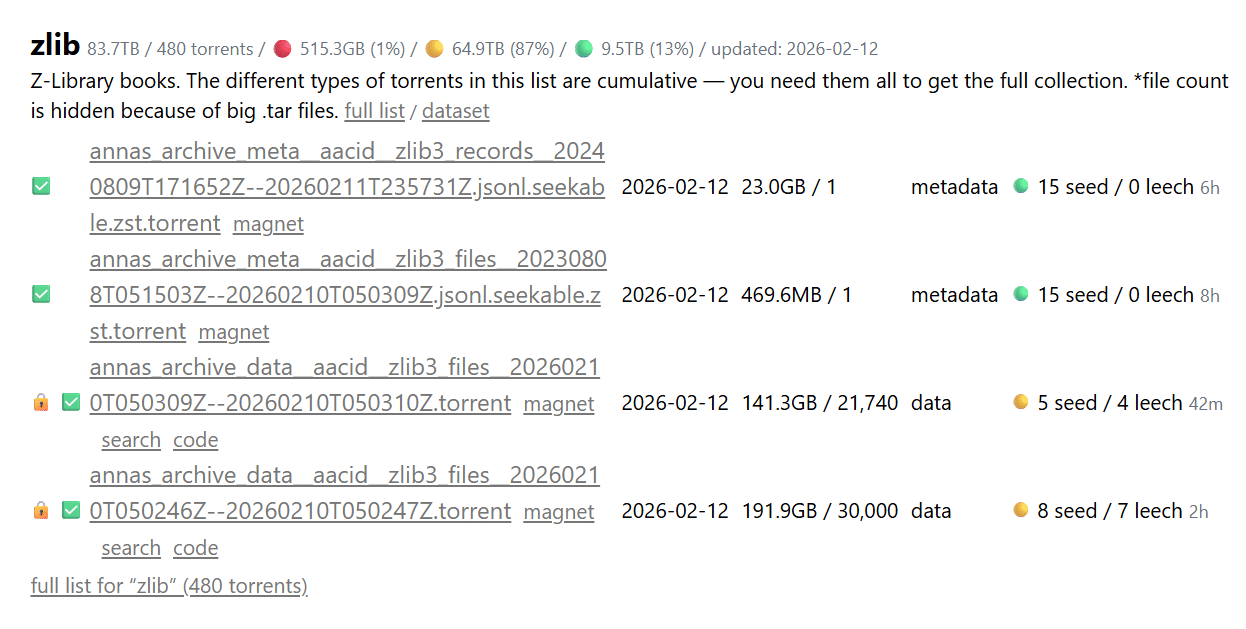
    Anna’s Archive torrents (illustrative)

    aa torrent

    Court Grants BitTorrent Pivot, Despite Doubletalk

    This week, U.S. District Court Judge Vince Chhabria granted the motion, but made little effort to hide his frustration with how plaintiffs’ counsel handled it.

    The judge acknowledged that the contributory infringement claim could and should have been added back in November 2024, when the authors amended their complaint to include the distribution claim. After all, both claims arise from the same factual allegations about Meta’s torrenting activity.

    “The lawyers for the named plaintiffs have no excuse for neglecting to add a contributory infringement claim based on these allegations back in November 2024,” Judge Chhabria wrote.

    The lawyers of the book authors claimed that the delay was the result of newly produced evidence that had “crystallized” their understanding of Meta’s uploading activity. However, that did not impress the judge.

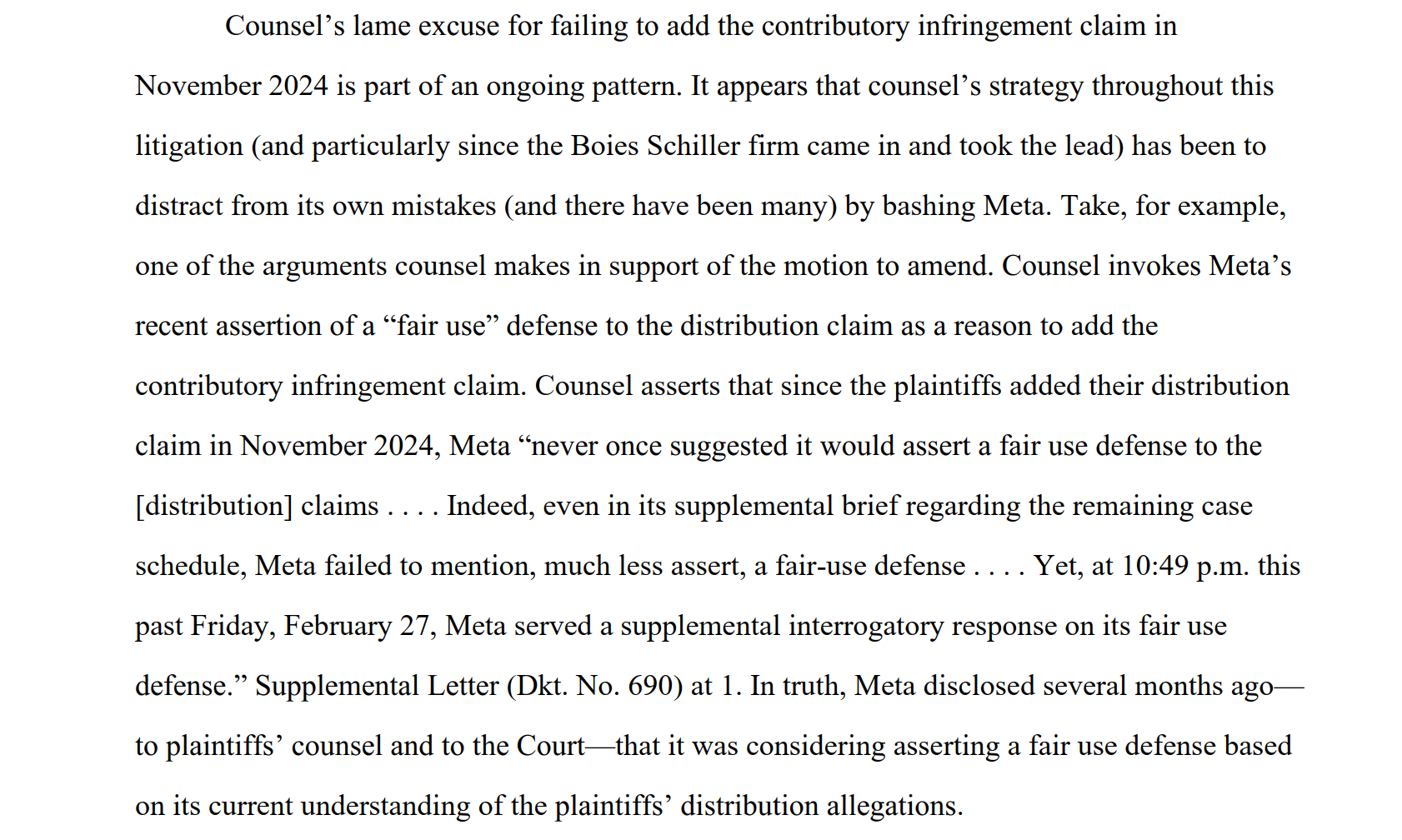
    He called it a “lame excuse” and “a bunch of doubletalk,” noting that if the missing discovery truly prevented the contributory claim from being added in November 2024, the same logic would have prevented the distribution claim from being added at that time as well.

    “Rather than blaming Meta for producing discovery late, the plaintiffs’ lawyers should have been candid with the Court, explaining that they missed an issue in a case of first impression..,” the order reads.

    Lame excuse…

    lame excuse

    Judge Chhabria went further, noting that the authors’ law firm, Boies Schiller, showed “an ongoing pattern” of distracting from its own mistakes by attacking Meta. He pointed specifically to the dispute over when Meta disclosed its fair use defense to the distribution claim, which we covered here recently, characterizing it as a false distraction.

    “The lawyers for the plaintiffs seem so intent on bashing Meta that they are unable to exercise proper judgment about how to represent the interests of their clients and the proposed class members,” the order reads.

    Counsel “Lucked Into” a Pass

    Despite the criticism, Chhabria granted the motion. The judge anticipated the obvious question from readers of his order.

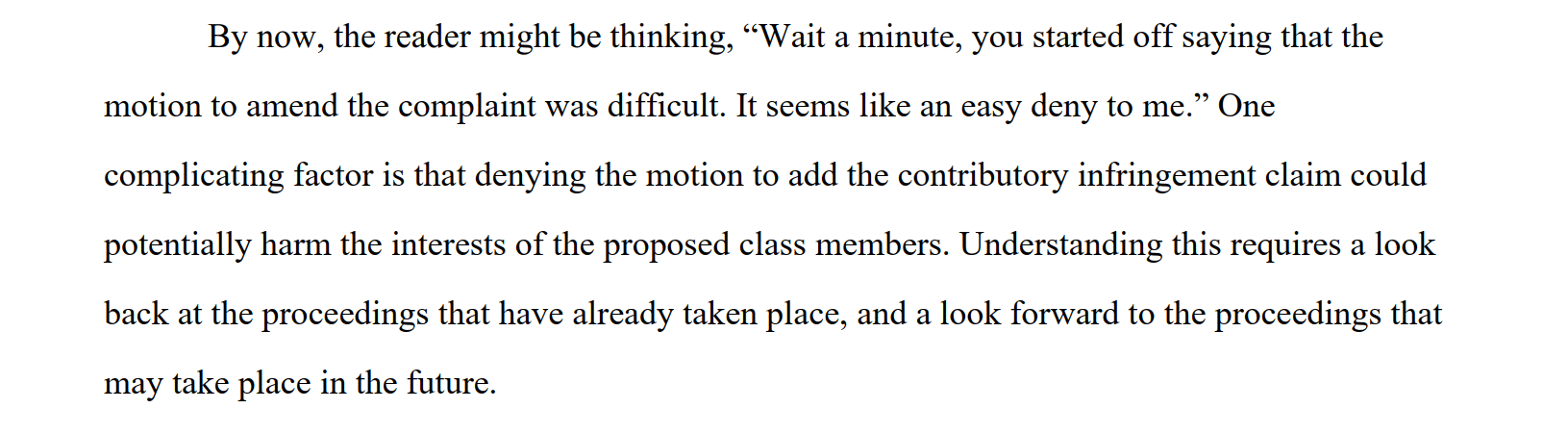
    “By now, the reader might be thinking, ‘Wait a minute, you started off saying that the motion to amend the complaint was difficult. It seems like an easy deny to me,’” Chhabria wrote.

    Wait a Minute…

    wait a minute

    The primary reason to grant the motion is the risk to the other potential members of the class action. If the contributory infringement claim were excluded and the class later lost on the distribution claim at trial, those class members could potentially be barred from ever bringing the contributory claim separately.

    A second factor also made the decision easier. Meta has separately requested the court to align the schedule in this case with a separate but similar lawsuit filed by Entrepreneur Media. This case covers a similar contributory infringement claim and shares discovery the authors’ lawsuit. Granting the motion to amend, therefore, adds little practical burden to Meta.

    However, the judge stresses that this is the result of luck, rather than the skill of the authors’ counsel.

    “Plaintiffs’ counsel has lucked into a situation where Meta will not be meaningfully prejudiced by the failure to add a contributory infringement claim back in November 2024,” Chhabria wrote.

    The authors’ motion to open the class discovery process was denied. That will only be considered if the named plaintiffs survive the next round of summary judgment on both the distribution and contributory infringement claims.

    For now, the case moves forward with a fourth amended complaint, three new loan-out companies added as named plaintiffs, and a growing list of BitTorrent-related claims for Judge Chhabria to resolve.

    A copy of the order, filed at the U.S. District Court for the Northern District of California, is available here (pdf).

    From: TF, for the latest news on copyright battles, piracy and more.

  • Former Trump Energy Official Settled ‘Conflict of Interest’ Probe with Payment but No Liability

    Before Andrew “Drew” Horn became a media fixture promoting the U.S. acquisition of Greenland’s critical minerals, he was an Energy Department official investigated for alleged misuse of his government position.

    In July 2025, the U.S. Department of Justice (DoJ) announced that Horn had agreed to pay $59,000 “to resolve allegations that he violated conflict-of-interest rules prior to his departure from the agency in 2021.”

    The DoJ noted that there was “no determination of liability.”

    Horn was alleged to have used his official position to drum up future business just before leaving the government at the end of the first administration of President Donald Trump in January 2021.

    The settlement agreement left key questions unanswered. What companies was Horn promoting, to whom, and what was he promising?

    Now, OCCRP has obtained documents and emails that provide answers. The documents include letters of interest written by Horn on government letterhead. These underpinned the Justice Department investigation, which alleged Horn participated in government matters involving a private company at the same time he was negotiating a private-sector role with them.

    Horn denied any wrongdoing and told reporters the settlement with the DoJ “resolved” those allegations.

    “It put the issue to bed so that it couldn’t be used as sort of an allegation that could be damaging from a business perspective,” Horn said in an interview in Copenhagen, later telling OCCRP he did not behave unethically.

    The settlement with the DoJ did not name the companies Horn allegedly sought to benefit from his government perch. The documents seen by OCCRP identify companies that correspond to the DoJ descriptions, while emails reveal the identities of individuals to whom Horn was pitching business opportunities.

    Horn said he “never violated any sort of ethical constraints or did anything that even constituted the start of a conflict of interest.”

    “I will say that there’s been various allegations made about me in part due to my past work and perceived, you know, closeness to President Trump,” he told the Danish newspaper Berlingske, OCCRP’s media partner.

    In the final settlement, the DoJ explicitly stipulated that the mutual agreement was not “a concession by the United States that its claims are not well founded.”

    Opportunity in Emergency

    Horn’s actions at the tail end of the first Trump presidency came amidst concerns that China’s control over much of the global critical minerals supply threatened U.S. national security.

    That security argument has carried over into the current Trump government, and Horn — now a private citizen — has been at the forefront of efforts to mine rare earth minerals in Greenland, and has spoken about it to the media.

    “Rare earth” deposits contain minerals essential for manufacturing some electronics, including for green energy and defense technology.

    OCCRP recently reported on GreenMet, which is part-owned and co-founded by Horn and has rare earth interests in Greenland. The company was created with the involvement of two men who previously worked with the Trump Organization: the company’s former executive vice president, George Sorial, and security chief Keith Schiller. Sorial and Schiller previously told OCCRP that they remain passive investors in GreenMet.

    Back in September 2020, the Trump administration issued an executive order declaring American reliance on Chinese minerals a national emergency. It directed the federal government to promote a domestic supply chain.

    In the waning weeks of the first Trump administration, from the end of 2020 into 2021, Horn drafted several official letters of interest. The letters expressed the government’s desire to support critical minerals projects needed for defense and green energy sectors.

    Horn signed three letters on the Department of Energy letterhead five days before he left his position in the Trump administration. One company is named in three letters of interest as VUONG Holdings.

    None of the companies named in the letters were accused of any wrongdoing, according to documents available to reporters.

    Details of VOUNG Holdings in the letters match the description of a firm referred to in the DoJ settlement with Horn as “Company 1.” It was described as “a privately owned company focused on investments concerning certain minerals critical for national security and economic stability.”

    The company was founded by Vinh Vuong, a Pennsylvania entrepreneur who knew Sorial. In a September 2020 Instagram post, Vuong described Sorial as his “dear friend and business partner.” The two also overlapped when they worked with the Washington D.C. lobbying firm Lucas Compton.

    A spokesperson for VOUNG Holdings told OCCRP that the company had “responded to any and all federal inquiries fully and completely.”

    At the same time Horn wrote letters of interest for VUONG Holdings, he “was also negotiating anticipated post-government employment with the Chief Executive Officer of Company 1,” the DoJ settlement said.  

    While Horn told reporters he could not discuss the specifics of the DoJ settlement, he said competitors had made “a lot of allegations that are outlandish” about him.

    “I will say I never violated any sort of ethical constraints or did anything that even constituted the start of a conflict of interest,” he added.

    In one of the letters of interest, Horn proposed a partnership between VUONG Holdings and another firm, which is referred to in the DoJ settlement as “Company 2.” That firm matches the description in the letter of interest of a firm called Grimstone Mining LLC.

    Grimstone said it was not investigated or contacted by any law enforcement body, and did not ask Horn to send any letter.

    Companies 1 and 2

    Incorporated in Delaware but doing business in West Virginia, Grimstone Mining specialized in extracting rare earth minerals from scrap, a mix of rock, toxic waste and low quality coal left over from mining. 

    In one of his letters of interest, Horn promoted a partnership between Grimstone and VUONG Holdings involving “mineral recovery effort.” That’s news to Grimstone.

    “There was no partnership, joint venture, or business agreement with VOUNG,” Frederic Mendelsohn, Grimstone’s attorney, told OCCRP. “Further, there is not and never has been direct contact between Grimstone and VUONG.”

    But VUONG Holdings told OCCRP a meeting  with Grimstone took place while Horn was still in his government position.

    “VUONG Holdings was approached about a potential investment in the Grimstone Mining LLC project. After due diligence, VUONG Holdings declined to move forward,” the company statement said.

    In a separate statement to OCCRP via a spokesperson, VUONG said that “Mr. Sorial introduced VUONG Holdings to Grimstone and Mr. Horn did participate in an introductory meeting. But VUONG added, “nothing came from it.”

    In the letter obtained by OCCRP dated January 15, 2021 — five days before the end of the first Trump term — Horn expressed the “official interest” of the U.S. government in purchasing 10 million tons of scrap from the “VUONG-Grimstone partnership” at $100 per ton, a deal that would total $1 billion.

    Analyses, he said, revealed Grimstone’s “stockpiles of coal inventory have a mineral value in excess of $3.5 billion.”

    In January 2021, just 10 days after Horn left the government following Trump’s defeat in the presidential election, he sent an email from his personal address to Sorial and Schiller — the former Trump Organization executives who would later join him in forming GreenMet, and pursuing mineral deals in Greenland. 

    Under the subject heading “New Firm,” he explained that he was looking at projects both domestically and in Greenland, and singled out Grimstone.”

    “The Grimstone opportunity looks great,” Horn told the two men in the email obtained by OCCRP. 

    Sorial and Schiller did not respond to a request for comment.

    Horn wrote that he could get a $500 million loan from financier Erik Bethel from his investment fund.

    Horn wrote that Bethel’s “viewpoint is that if we can secure Letters of Intent from the government for some of the larger projects, he can then lend the money from his private investment fund to get started.”  

    Shortly before that email, while still in government, Horn had written just such a letter of interest for Grimstone.

    Bethel told OCCRP he had never heard of Grimstone, and denied there was any arrangement for a loan. 

    “I don’t do business with Drew Horn and never have,” Bethel said.

    Horn declined to further discuss the case and referred future questions to his lawyer, whom he copied on the email.  

    Neither Horn nor his lawyer answered questions about his relationship with Bethel.

    Eva Jung of Berlingske contributed reporting.