Blog

  • RFK Jr. is definitely coming for your vaccines (part 10): An RFK Jr. ally tells us what’s coming next

    ICAN attorney and antivaxxer Aaron Siri recently petitioned HHS to add 300 “injuries” to the Vaccine Injury Table for the Vaccine Injury Compensation System. It’s all part of Robert F. Kennedy, Jr.’s plan to undermine and destroy the system, thus driving vaccine manufacturers out of the market.

    The post RFK Jr. is definitely coming for your vaccines (part 10): An RFK Jr. ally tells us what’s coming next first appeared on Science-Based Medicine.

  • Finding support outside ‘the system’

    Finding support outside ‘the system’

    Another blog from the author known as ‘White boy’

    This is the story of how a friend who wasn’t a mental health professional saved me from suicide by supporting me in a way my parents and the professionals hadn’t.

    I’ve survived. Now, I must recover.

    While I consider how I’m going to tackle this, I keep getting lost in the opening line of Philip Larkin’s poem, ‘They fuck you up, your mum and dad’. For the first time in my life I’m forced to consider that part of what I am is an uncomfortable heritage – the constraints of kin and religion. God knows how I’m held together, but I must get on with it. If I can’t understand it, I have to accept it – those are my options.

    Sadly, conventional therapy didn’t work for me.  There are others for whom it hasn’t worked and I hope my insights and thoughts might help them and their families and the professionals caring for them.

    Looking back, there are three things at the top of my list of things I wish I’d done earlier in life.  I wish (i) I’d read a lot more, for self-directed personal development and enlightenment (ii) I’d understood that anxiety has a natural purpose and that nature put the instrument inside me for a reason (iii) I’d learned more about humanity, its nature and its history.

    I’m still undecided what went wrong. I was there, it happened to me, but I’m not sure what the something was. I can’t even say that my memory is flooded by tears of nostalgia because my memory is non-existent below the age of 5 years and from 6 to 11 years it’s pretty vague. And, yet, I’m reliant on my memory to judge the veracity of my own memory, while the childhood I can’t fully remember clings to me. It’s no wonder some people hand the controls to God.

    What I do know, crystal clear, as if it were yesterday, one night a wave of sadness and anxious foreboding swept over me. It was a feeling I was not able to talk about or process. Before I knew it, I was in ‘The System’, at the age of 12. The system is a huge network of trained professionals who pride themselves on being experts in dealing with human distress – they are effectively ‘professional parents’. They have carved out a lucrative role for themselves by turning everyday human distress into mental illness – and people like me into vulnerable dependent clients.

    Over the next 30 years, I lost count of the number of therapists I moved between– it was endless. I experienced everything the system has to offer. No one seemed to acknowledge or appreciate how disgusted I was with myself, how stigmatised I felt and how I hated any reference to it. The professionals diagnosed me with six mental health disorders including ‘schizophrenia’, ‘bipolar’ and ‘ADHD’. They sectioned me and detained me against my will on three separate occasions.

    I was clueless to the fact that some of their actions were a violation of my dignity or that some of them had become conditioned by the unfavourable reactions of other clients’ parents. I now understand that the professionals know that the transparency of the truth often results in the parents taking their child elsewhere. Parents who don’t want to take responsibility for their failure hurl abuse at the therapist and therapists have a natural desire to avoid having their brains tortured and thus become conditioned to avoid the transparency of the truth.

    Knowing this is one reason my mind keeps floating back to: ‘They fuck you up, your mum and dad’. I had never before realised how common it is in society for couples to have a child to fix a relationship. I haven’t been raised with the heart to consider exploring this too much further. I didn’t realise that the choices our parents make influence us before we are born and we have zero control over them; I currently lack the capacity to process what might be true for me. I didn’t realise that there is a constant simmering battle for power between couples and that some children get screwed up in the middle. I don’t feel I’m yet ready to face my fears on this.

    In sharp focus is the knowledge that therapists like the ones I was taken to, are from homes like my own, from family backgrounds like mine, they have kids of their own (or they don’t). I’m no longer shocked or surprised when I read that ‘a therapist is on average more likely to fuck-up their child than a regular person’. It informs me that a therapist can only take a client to where they have reached in their own journey; they can only influence the client in the direction of their own experience and ideology. There is much that damages the integrity of the profession with therapists spanning the spectrum. Some seem to work to a sub-plot of ‘renounce your ignorance otherwise prepare for torture’, by which I mean, they are fed up of people like me, they consider me to be stupid and think they can fix me by shouting at me. While others were so hapless that they could barely repeat what they had learnt by rote on a training course. Others seemed to be in a competition to extract as much pain as possible from humdrum events of life – painting portraits of victimhood with the truth left on the wayside as ‘dry’ and ‘disappointing’.

    At my lowest point, fearing that I was about to succumb to my suicidal thoughts, I took a chance and reached out to someone I’d met, not a proper friend but someone I knew had the experience to judge my situation, without judging me. His day job is as a practising dentist. The impact the experience had on me was extraordinary. I was so deeply touched that I felt the need to make a record of it in the form of a book called Nosedive – An Unconventional Rescue as my contribution to helping others stuck in broken parts of the system.

    We might not have been friends but we did have a connection. He playfully referred to himself as ‘Brown boy’ and to me as ‘White boy’. He instantly felt that I was in a nosedive, and was reluctant to get involved. I believe I got lucky because after the experience he’s told me that at no time did he have the desire to save anyone from anything at any time.

    Brown boy wasn’t working to any science or any textbook – he was working from his heart based on his experiences. He was carrying his burdens on his head not in his head. He told me he was reading between the lines and that doing so was as dangerous as it was necessary. He also told me he couldn’t do ‘sympathetic’ performatively and that every human interaction on the planet is 100% projection, assumption, suggestion, and inference.

    There is no doubt in my mind that some people will throw scorn on Brown boy as the protagonist of provocative behaviour, while others, like me, will judge the results. He reached parts of me that the professionals never did – he saved me from suicide. The experience initiated my journey inwards and highlighted the deliberate obsolescence of the therapy industry and pointed out the heavenly deceptions concealed in religion.

    Crucially, my recovery was initiated during the Nosedive experience when ‘Brown boy’ kept insisting time and again (and again): ‘Anxiety is natural’ and ‘You’ve been spoilt’ and ‘Fear is normal’ and ‘Worry isn’t’.  He absolutely insisted that my life was supposed to have started with me understanding the nature of anxiety. And, that – it hadn’t. Time and again he told me that trying to keep the carefully crafted equilibrium of my early childhood undisturbed, is what tipped me into the shit heap in the first place. He explained that my insanity resulted from the attempted sanitation of my humanity and he seemed to mock me with statements like, ‘The bedlam (and, a few ounces of fifth) is a necessity’. The professionals call this

    The enlightenment wasn’t easy, nor was dealing with his confident manner. At first, I struggled with my ambivalence, he offended my civility, and his nonplussed expression was disrespectful.  I pushed his grand ‘executive summaries’ out of my mind as utter garbage and as a tantalisingly simple explanation for all the complex, distressing symptoms that had unfolded in my life. But the idea that anxiety had been transformed into an unnecessary, misleading, and confusing series of purported disorders kept whispering.

    I realised that there was a delineation between the trained mental health support professionals and Brown boy. While the professionals had been reluctant to engage in any awkward challenging discussions, Brown boy and I argued about things for a long time. We slogged it out – unrestrained as we were. The process opened up channels that hadn’t opened before. But, contrary to his belief, I wasn’t in denial, I was lost in ignorance. Or, perhaps I was mitigating my grief. He didn’t attempt to hold my attention with grace or authority. He didn’t need to; my desperation was enough.

    On occasions, I took great exception to some of the things he said. I wasn’t ready for them, I still don’t think I am now – they didn’t sound like the reality I was after. On some occasions I almost literally heard my mind sneer and snap shut. It pains me to confess that he was right though: rumour, misinformation and miscommunication within me was in the locality of paranoia, they were consistent with the logic of ‘Anxiety Dysfunction’, and they did operate in the vacuum created by the absence of an understanding of what nature intended the natural purpose of anxiety to be. I have now accepted what he shared with me that feeling unsure, uneasy, awkward, nervously intrigued is a natural part of being a free-standing, self-sustaining, self-regulating, self-governing animal. These are natural feelings that we all have from time to time, they never ever go away. They are viewed wrongly by some people like me as anxiety, and we are the same people who make statements like, “I’m not like other people, I don’t fit in”. Mental ‘Illness’ is the desire to be rid of these natural feelings by mistaking them as ‘symptoms’. Anxiety is whole different thing; it’s designed to protect us from danger. Anxiety ‘dysfunction’ is common across almost all diagnosed mental health disorders and may first occur when mum or dad or primary carers overextend on the natural desire to protect baby, they accidentally condition baby to avoid uncomfortable feelings. Remembering that anxiety is designed to protect baby from danger – it’s not designed to protect baby from discomfort. In situations where the parents neglect and/or abuse their children,  these undesirable approaches can also result in anxiety ‘dysfunction’ and once initiated can escalate and become the gateway to other ‘disorders’. Although, of course, this is not true for the small number of individuals who are born with a neurological defect.

    Brown boy told me unambiguously and without doubt that my only issue had been anxiety dysfunction and that because it had gone unresolved it had escalated into me displaying a host of behaviours which were indistinguishable from true neurological disorders. Thus, he explained, I had been diagnosed with disorders even though I wasn’t born with them.

    The experience redefined my earlier perceptions of sympathy, empathy, love, compassion and kindness; they are now less sentimental and more transactional. I no longer believe feelings of ‘personal warmth’ and love are the same things. I’ve also reframed my understating of key concepts like psychological safety and positive psychology – they are important, and I now use them to my favour. I’ve enjoyed some psychological satisfaction and thankfully most of the time I’m generally moving towards becoming more psychologically intact.

    During the experience I realised that people like me, whatever you wish to call us – ‘Aspergic’ ‘High-Functioning’ ‘Nerdy’ – need to read more, a lot more, for self-directed personal development and enlightenment. Then it dawned on me that perhaps all teenagers need to read more for self-directed personal development and enlightenment. I wonder if that’s the key to a society of empathic and compassionate amateurs like Brown boy who can make a real difference beyond ‘the system’.

    In fact, knowing what I now know Nosedive – An Unconventional Rescue is the kind of book I wish I’d been forced to read and discuss with my peers and with my teachers (and, perhaps, even with my parents). We need a system that champions prevention by encouraging us to discuss our anxious thoughts and the lows with other stumbling teenagers and delivers the information and knowledge through the formative years, as opposed to the current system which is failing to resolve issues retrospectively.

    Other books I’d strongly recommend…

    1. What Mental Illness Really Is… (And What It Isn’t) – by psychologist Dr Lucy Foulkes – talks about excessive labelling, over-diagnosing and reimagining anxiety.
    2. The Blank Slate – by Professor Steven Pinker. He discusses parenting styles by looking at the nature-nurture debate and how it’s been distorted.
    3. Good Reasons for Bad Feelings – Insights from the frontier of Evolutionary Psychiatry- by Randolph M. Nesse. The American Physician who with book Why We Get Sick, established the field of evolutionary medicine.
    4. The Chimp Paradox – by Professor Steve Peters – it’s an excellent book.
    5. An Intimate History of Humanity – by Theodore Zeldin. It helps you realise that: ‘there’s nothing new under the sun’, and it helps defeat the modern thought: ‘I can’t be right unless there’s something wrong with me’.
    6. Evolutionary Psychiatry – Current Perspectives on Evolution and Mental Health – by The Royal College of Psychiatrists, UK.
    7. George Kelly – The Psychology of Personal Constructs by Dr Trevor Butt.

    ****

    Mad in the UK hosts blogs by a diverse group of writers. The opinions expressed are the writers’ own.

    The post Finding support outside ‘the system’ appeared first on Mad in the UK.

  • Low-tech Magazine: The Uncompressed Book Series

    Low-tech Magazine: The Uncompressed Book Series

    Image: The redesigned and revised chronological book edition. Photo: Marie Verdeil.
  • Top 10 Most Pirated Movies of The Week – 03/30/2026

    Top 10 Most Pirated Movies of The Week – 03/30/2026

    The data for our weekly download chart is estimated by TorrentFreak, and is for informational and educational reference only.

    Downloading content without permission is copyright infringement. These torrent download statistics are only meant to provide further insight into piracy trends. All data are gathered from public resources.

    This week we have three newcomers on the list. “Hoppers” is the most shared title.

    The most torrented movies for the week ending on March 30 are:

    Movie Rank Rank last week Movie name IMDb Rating / Trailer
    Most downloaded movies via torrent sites
    1 (…) Hoppers 7.5 / trailer
    2 (1) Crime 101 7.0 / trailer
    3 (4) Peaky Blinders: The Immortal Man 6.9 / trailer
    4 (…) Send Help 7.0 / trailer
    5 (2) One Battle After Another 7.7 / trailer
    6 (3) Scream 7 5.7 / trailer
    7 (5) War Machine 6.5 / trailer
    8 (6) The Housemaid 6.9 / trailer
    9 (7) Marty Supreme 8.0 / trailer
    10 (…) Avatar 7.4 / trailer

    Note: We also publish an updating archive of all the list of weekly most torrented movies lists.

    From: TF, for the latest news on copyright battles, piracy and more.

  • Trial Begins in Paris for Alleged Mastermind of $230 Million Magnitsky Affair Fraud

    Almost two decades after a sprawling $230 million tax fraud involving Russian officials led to the imprisonment of a whistleblower, the Paris Judicial Tribunal convenes on Monday for the first hearing on criminal charges against the scheme’s alleged architect.

    Dmitry Klyuev, a Russian businessman who U.S. authorities have previously sanctioned as an alleged organized crime figure, faces charges of aggravated money laundering. French prosecutors describe Klyuev as “one of the primary organizers” of a vast conspiracy that siphoned hundreds of millions of dollars from the Russian Treasury through a labyrinth of offshore shell companies.

    The scandal gained global notoriety and was dubbed the “Magnitsky Affair.” It was uncovered by Russian tax lawyer Sergei Magnitsky, who died in a Moscow prison in 2009 after exposing the theft. His death prompted the U.S. to pass the Magnitsky Act, a landmark law that imposes visa bans and asset freezes on human rights abusers and corrupt officials worldwide. A coalition of other nations passed similar laws.

    While the fraud originated in Moscow, French prosecutors allege that the stolen funds financed a lavish lifestyle across Western Europe. According to the indictment, between April 2008 and October 2012, accounts allegedly controlled by Klyuev funneled more than 2.1 million euros ($2.42 million) into the French luxury sector.

    The spending spree included: 668,517 euros ($771,703) at a Parisian art and antique gallery; 696,015 euros ($803,445) across two high-end French women’s fashion brands; 96,814 euros ($111,757) at a luxury jewelry store in Courchevel, an exclusive ski resort in the French Alps; and 127,182 euros ($146,813) for a Courchevel tour package which, according to invoice and bank records reviewed by OCCRP, covered Russian Senator Dmitry Saveliev and his guests.

    Investigative outlet Important Stories previously reported that Saveliev’s company additionally received almost $8 million from the same entity that paid this invoice.

    Prosecutors allege these payments were routed through FBME Bank accounts held by two British Virgin Islands (BVI) companies: Altem Invest Limited and Zibar Management Inc. Although other individuals were listed as the beneficial owners, investigators allege Klyuev controlled the accounts. The paper trail includes incoming transfers from his personal Swiss bank account and outflows covering personal family expenses, such as tuition for his son’s boarding school in Switzerland.

    FBME Bank was ultimately taken over by Cypriot authorities in 2014 following U.S. allegations that it facilitated money laundering and illicit transactions. It entered liquidation proceedings in 2023.

    Klyuev did not respond to requests for comment and is being tried in absentia. If convicted and eventually arrested, he faces a maximum sentence of 10 years in prison.

    His physical absence from the courtroom highlights the enduring geopolitical friction surrounding the case. A European Arrest Warrant issued in March 2025 at the request of France’s financial prosecutor concluded that Klyuev likely resides in Russia, noting he “has probable links to organized crime” and “significant local support.”

    The warrant was deliberately not shared with Moscow. French law enforcement officials described Russia as a non-cooperative state, determining there were zero prospects for his extradition.

    The French investigation stems from a 2014 criminal complaint filed by Hermitage Capital Management Limited, the investment fund and asset management company that was originally targeted by the Russian tax fraud.

    For the firm’s founder, Bill Browder, who has spent the last 15 years spearheading the global campaign for Magnitsky sanctions, the Paris trial marks a critical milestone.

    “The Magnitsky investigation, which led to some of the biggest journalistic exposés of the past decade, revealed how Russian officials and criminals laundered millions through Western banks,” Browder told OCCRP.

    “With both French authorities and the U.S. Department of Justice identifying Dmitry Klyuev as the mastermind of the $230 million fraud, we are now seeing long-overdue justice being done,” he added.

    Beyond the French borders, the stolen funds have seeped into other global luxury markets. Previous reporting by OCCRP revealed that Klyuev’s other BVI-based companies — which received deposits from offshore firms linked by U.S. authorities to the tax fraud — were used to invest millions in a seaside resort in Cyprus and luxury real estate on Dubai’s exclusive Palm Jumeirah.

  • The Pirate Bay’s Oldest Torrent Turned 22….

    The Pirate Bay’s Oldest Torrent Turned 22….

    The Pirate Bay was once the leading pirate site, with a hubris matching its millions of monthly visitors.

    After the verdict that sent its founders to prison, the site slowly started to decay. The option to comment or register as a new user eventually broke down, and aside from promoting a fishy token, public outreach ground to a halt.

    Despite this downward spiral, the site continues to live up to its official tagline: the galaxy’s most resilient torrent site. Where TorrentSpy, Mininova, isoHunt, Torrentz, KickassTorrents, ExtraTorrent, RARBG and TorrentGalaxy all fell, The Pirate Bay continues to serve many millions of monthly users.

    The galaxy’s most resilient BitTorrent site

    galaxy

    It’s safe to say that The Pirate Bay witnessed quite a bit of change. When the site launched, roughly 10% of the world’s population was connected to the Internet, and in the United States, the majority of all ‘world wide web’ users were still using a dial-up connection.

    At the time, all popular entertainment was consumed offline. People interested in watching a movie could use the Internet to buy a DVD at one of the early webshops, or sign up with Netflix, which shipped discs through the mail. However, on-demand access was simply not a thing. At least, not legally.

    With enough patience, file-sharing software allowed people to share large video files, and BitTorrent excelled at this, as transfer speeds typically picked up with more demand. This is why torrent sites popularized the on-demand downloading of movies and TV-series for millions of people.

    Pirate Bay’s Oldest Torrent

    Today, most files shared on The Pirate Bay in the early years are no longer available. BitTorrent requires at least one person to share a full file copy, which is difficult to keep up for decades.

    Surprisingly, however, several torrents have managed to stand the test of time and remain actively shared. Earlier this week, the site’s longest surviving torrent turned 22 years old.

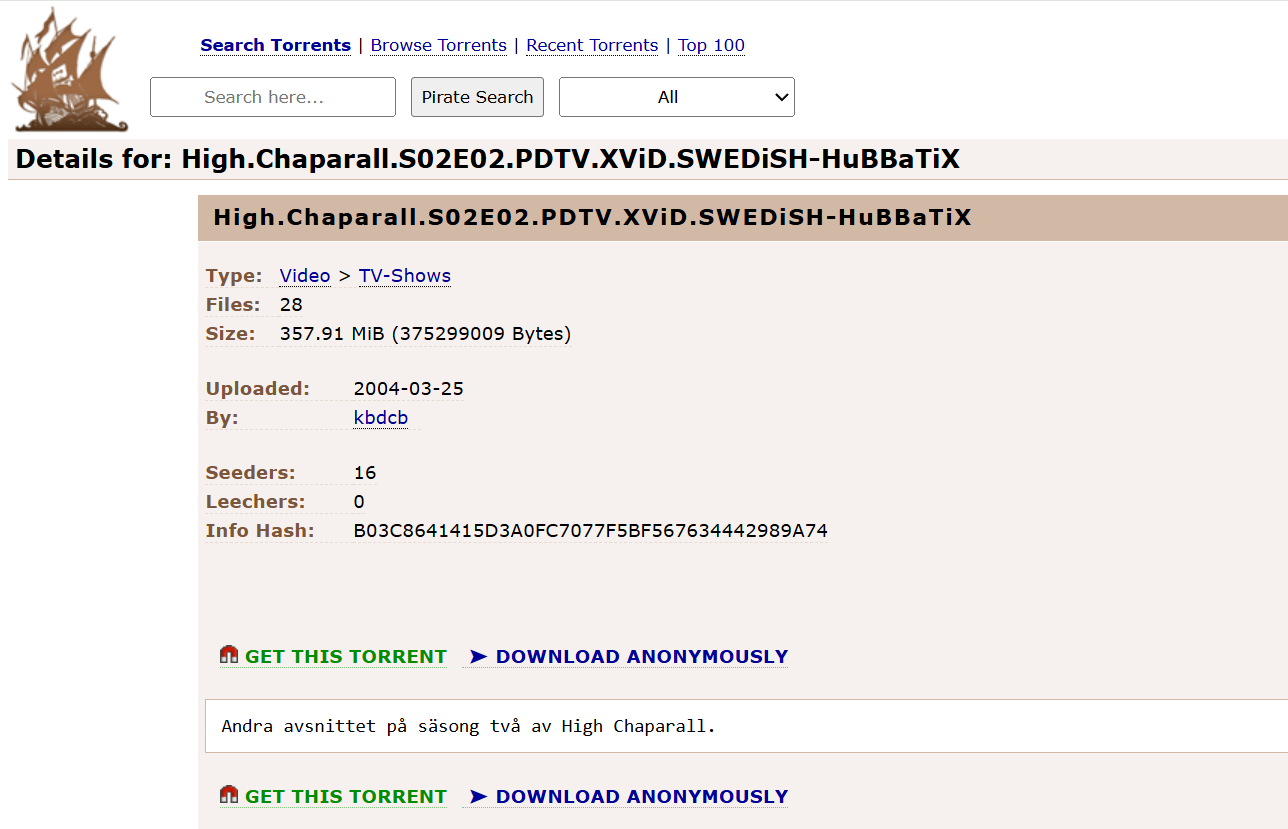
    While a few candidates have shown up over the years, we believe that an episode of “High Chaparral” featuring Uri Geller has the honor of being the oldest Pirate Bay torrent that’s still active today. The file was originally uploaded on March 25, 2004, and several people continue to share it today.

    22 Years Later

    chaparall

    At this point, the torrent in question appears to have reached a cult status, with pirates sharing the release simply because it is the oldest torrent on The Pirate Bay. Despite the record, however, the Swedish TV series is shared without permission of the creators.

    Revolution OS & The Fanimatrix

    There are also other pirate releases on The Pirate Bay that continue to thrive. On March 31, 2004, someone uploaded a pirated copy of the documentary “Revolution OS” to the site, which is alive and kicking today.

    “Revolution OS” covers the history of Linux, GNU, and the free software movement, which was a good fit for the early Pirate Bay crowd. Thirteen years ago, we spoke to director J.T.S. Moore, who wasn’t pleased that people were pirating the documentary but was nevertheless glad to see it hadn’t lost its appeal.

    Fast-forward to the present day, and Revolution OS still has plenty of interest, with more than 33 people actively seeding the torrent.

    While these torrents are certainly dated, they’re not the oldest active torrents available on the Internet. That honor goes to “The Fanimatrix”, which was created in September 2003 and, after being previously resurrected, continues to be available today with dozens of people seeding. We’ll check back in 2028 for its 25th anniversary.

    From: TF, for the latest news on copyright battles, piracy and more.

  • MapYourGrid

    We empower individuals, communities and nations around the world to map the electrical grid.

  • Our skin is falling off and no-one can tell us why

    People sharing pictures and accounts on socials of red, inflamed skin have triggered the first UK research into TSW.
  • ‘Mr. X’ Revealed: U.K. Freezes $108M in Properties Purchased by Wanted Chinese National

    A Chinese national wanted in his home country for allegedly running illegal gambling operations has had 85 luxury properties in London frozen by the U.K.’s Crown Prosecution Service. 

    The prosecution service, or CPS, announced on March 24 that it froze the assets after issuing Unexplained Wealth Orders and Interim Freezing Orders under the Proceeds of Crime Act. The announcement did not name the subject of the freezing orders, referring to him only as “Mr. X.”

    OCCRP and the Sunday Times have obtained corporate and property records showing that Mr. X is Su Jiangbo, who is wanted by Chinese law enforcement. He used a St. Kitts and Nevis ‘golden passport’ to create U.K. companies that bought up at least $108 million worth of London real estate.

    Su Jiangbo, 40, is featured on an arrest warrant list published by Datian county court in China’s southeast Fujian province, which describes him as a “fugitive criminal suspect.” The court did not respond to a request for comment on the case.

    The list included 38 individuals suspected of offenses including involvement in illegal gambling, fraud and cybercrime. The list of wanted men included their photos and home addresses, as well as a police hotline number. It was re-published in Chinese-language media from both China and Taiwan.

    Su Jiangbo did not respond to questions sent to his personal email, as well as addresses associated with companies he owns in Singapore, Cambodia, the U.K. and Hong Kong. Reporters were unable to reach him on phone numbers listed in different company registries, including a mobile phone number found in Singapore company filings.

    Just weeks before the wanted list was published on September 15, 2023, Su Jiangbo began his spending spree in London. He carried on buying until at least June 2025, according to property records.

    During that timeframe, companies owned by Su Jiangbo purchased at least 85 properties in new-build developments across central and south London. Among the purchases were a $13-million penthouse with a view overlooking St. Paul’s Cathedral, the Tate Modern art gallery, and the River Thames.

    Records show that properties owned by Su Jiangbo’s companies were hit with freezing orders on the same day the CPS says it froze “flats across central and south London” belonging to Mr. X.

    “The orders were granted against a Chinese national and associated U.K. companies, suspected of using money that has been illicitly obtained to purchase properties,” the CPS said in a statement.

    The prosecution service added that there is an “ongoing civil recovery investigation into whether they were purchased with the proceeds of unlawful conduct.”

    Su Jiangbo has not been charged or convicted of any criminal activity in the U.K. The CPS declined to comment further on the case.

    Golden Passports

    Records from the U.K., Hong Kong and Singapore company registries show that Su Jiangbo holds a passport from St Kitts and Nevis, the tiny Caribbean nation that sells passports for around $270,000, which give access to more than 150 countries without a visa. He is also a citizen of Cambodia. 

    So-called “golden passports,” which are purchased through citizen-by-investment schemes, should trigger “enhanced due diligence,” according to U.K. Money Laundering, Terrorist Financing and Transfer of Funds Regulations.

    “Unusually complex or unusually large” transactions should also raise red flags.  

    Su Jiangbo used his St. Kitts passport to create 12 firms, according to records from Companies House, the U.K. corporate registry. At least 10 of those U.K. firms were used to purchase London properties.

    Su Jinbao’s multiple passports and major transactions do not appear to have set off alarm bells at Triptych Bankside, a new-build by the developer JTRE London. He purchased 15 flats worth around $26.5 million, putting almost half that sum towards the 18th-floor penthouse overlooking St. Paul’s Cathedral, and the River Thames.

    A JTRE spokesman said the company “complied with all applicable legal and regulatory requirements.” 

    A person involved in the sale of the apartments at Triptych Bankside said Su Jiangbo’s purchases did not raise any red flags. 

    “From memory, it went through relatively straightforwardly,” said the individual, who requested anonymity as they were not authorised to speak to journalists.

    They said Su Jiangbo never visited the development, which boasts 169 apartments.

    “He had a certain amount of money he wanted to spend and he wanted a certain number of units,” the person said. “There was an opportunity to do a bulk deal, which obviously when you’re selling 169 apartments is very attractive, to say the least.” 

    The person noted that developers are not subject to any legal requirement to carry out anti-money laundering checks, adding: “We rely on the agents and the lawyers.” 

    Zhong Lun Law Firm, Riseam Sharples, and Ackroyd Legal LLP — law firms that records show represented Su Jiangbo’s companies in the conveyancing of his apartment purchases — did not respond to multiple requests for comment by email and phone. There is no suggestion that these firms didn’t carry out required anti-money laundering checks. 

    “The anti-money laundering legislation that the agents and the solicitors have to go through is pretty strenuous,” said the person involved in the Triptych Bankside purchases. “We lost three or four deals because certain purchases couldn’t pass some of the anti-money laundering checks that are required.” 

    New builds can be especially attractive to people looking to launder money through real estate, according to Ben Cowdock of the Transparency International’s U.K. chapter, which assisted OCCRP in acquiring conveyancing documents.

    “Criminals can buy from developers off-plan and in bulk, often with fewer questions asked than in the resale market, and then generate apparently legitimate rental income,” said Cowdock, who was speaking generally and not about Su Jiangbo. 

    “A targeted programme of enhanced guidance and enforcement is needed to ensure that solicitors handling new-build sales are conducting robust checks,” he said. 

    The person involved in Su Jiangbo’s purchases at Triptych Bankside agreed that the regulations are not precise enough to ensure thoroughness in all cases.

    “If you don’t ask the right questions — about multiple nationalities for instance — people aren’t necessarily going to volunteer that info, particularly if they’re malevolent,” they said. 

    Unexplained Wealth Orders

    As part of an attempt to halt suspicious funds flowing into U.K. real estate, the Conservative government led by Prime Minister Theresa May introduced Unexplained Wealth Orders, which came into force in 2018.

    Alicia Kearns, an MP with the Conservative Party, now in opposition, said the orders were intended to “target and hunt down criminal money launderers and protect our markets.”

    “These powers must be used to their full extent — including the seizure of criminal assets,” she added.

    While anti-corruption advocates applauded the U.K. for introducing Unexplained Wealth Orders, they are not a silver bullet, as OCCRP has reported

    The orders enable authorities to investigate the provenance of a person’s assets. But even if the owner fails to satisfactorily explain how they acquired an asset, there’s no guarantee it will end up being confiscated. Prosecutors might begin civil recovery proceedings in the High Court to seize it, but the owner can still contest the proposed forfeiture before a judge, and appeal if things don’t go their way.

    In Su Jiangbo’s case, the High Court issued the orders on his properties on 18 March. He will have three months to prove that the money used to purchase the properties was lawfully obtained, or he could risk having them seized. 

  • Serbia’s Ruling Party Deploys Millions and ‘Phantom’ Monitors for Local Elections

    Serbian independent watchdogs are sounding the alarm ahead of Sunday’s local elections, warning that the ruling party has transformed small municipal races into a heavily funded national battleground plagued by massive, opaque spending and the deployment of American ultra-right “phantom” election monitors.

    Fewer than 250,000 voters across 10 municipalities will head to the polls this weekend. Yet, for President Aleksandar Vučić and his ruling Serbian Progressive Party (SNS), the stakes extend far beyond local governance. 

    Vučić recently headlined a massive pre-election rally in Belgrade, effectively turning Sunday’s vote into a dress rehearsal for national polls expected by 2027, amid ongoing student protests demanding snap elections.

    Against this tense backdrop, the SNS is pouring vast resources into small towns like Aranđelovac and Majdanpek. According to preliminary reports analyzed by the watchdog group Transparency Serbia (Transparentnost), the ruling party transferred 35.2 million dinars ($344,982) from its main account specifically to bankroll its local campaigns, alongside an 11.8 million dinar ($115,647) advance for national television ads.

    This partisan financial muscle dwarfs the 10 municipalities’ combined public campaign subsidy of just 10.7 million dinars ($104,859). 

    The official figures only show a fraction of the real money at play. Nemanja Nenadić, program director at Transparency Serbia, told OCCRP that the exact amount spent is unknown because “only a small part of the money passes through legal channels.”

    “There are very serious suspicions that a significant part of the campaign is not financed in any way that complies with the law,” said Nenadić. He dismissed the preliminary financial reports as “quite useless” for omitting the final weeks of the race and hiding unpaid debts. Instead, he noted, the true costs are quietly buried in public budgets and the misuse of state personnel.

    Yet, the most alarming anomaly of Sunday’s vote will likely unfold inside the polling stations. The electoral landscape has been flooded with foreign observers. In the lead-up to the vote, Serbian authorities rapidly approved monitoring missions from three U.S. organizations tied to the MAGA movement of President Donald Trump, including the America First Policy Institute.

    “The appearance of foreign quasi-observers is a step further in destroying the integrity of the elections,” Raša Nedeljkov, program director at the Center for Research, Transparency and Accountability (CRTA), told OCCRP. Instead of observing neutrally, he said, they act as “supervisors” for ruling party polling chiefs, even utilizing an SNS lawmaker as a translator.

    This strategy directly mirrors a playbook used during local elections in Georgia last October. With independent watchdogs crippled by the state, Georgia brought in a network of 29 foreign “fake observers,” according to the European Platform for Democratic Elections.

    That network included right-wing American operatives Jake Hoffman, an executive with the Florida Young Republicans, and Jay Patel. Both men, affiliated with the Hungary-based Center for Fundamental Rights, publicly praised Georgia’s heavily criticized elections. Now, local media reports indicate Hoffman and Patel are slated to monitor Sunday’s vote in Serbia.

    State-aligned organizations are aggressively defending the American presence. The Center for Social Stability (CZDS) confirmed its partnership with the America First Policy Institute. Bizarrely tying Balkan municipal races to American culture wars, CZDS claimed that criticism of the monitors was an attack on “patriotism, tradition, a healthy family and sovereignty.” The group explicitly referenced conservative U.S. activist Charlie Kirk and past efforts to build a “Trump Tower” in Belgrade.

    The manipulation appears to extend to the ballots themselves. Of the 50 registered electoral lists, CRTA suspects 19 are “phantom” groups deliberately designed to confuse voters and dilute genuine opposition.

    The ruling party, however, routinely dismisses allegations of financial and electoral malpractice. Responding to recent undercover media reports that the SNS paid citizens to attend Vučić’s Belgrade rally, Parliament Speaker and party top official Ana Brnabić called the accusations “nonsense..” As reported by the Tanjug news agency, Brnabić also lashed out at CRTA, labeling the watchdog’s previous reports of electoral coercion as “monstrosities.”

    These heavy-handed tactics echo recent history. The Center for Investigative Journalism of Serbia (CINS) reported that during November 2025 local elections in several other municipalities, the ruling party spent triple the amount of previous cycles. Those elections were marred by severe violence, with masked men and unmarked cars terrorizing polling stations in full view of the police.