The walkout over jobs and pay is one of the longest yet in the dispute, and will begin on 7 April in England.
Blog
-

Supreme Court Wipes Out Record Labels’ $1 Billion Piracy Judgment Against Cox
When a Virginia jury ordered internet provider Cox to pay $1 billion in damages for failing to take appropriate actions against pirating subscribers, shockwaves rippled through the ISP industry.
The verdict, in favor of major record labels including Sony and Universal, was a catalyst for many other ‘repeat infringer’ lawsuits. This resulted in yet more multi-million dollar claims and awards, with many still in the pipeline today.
Meanwhile, Cox did everything it could to fight the verdict, all the way up to the Supreme Court, which formally heard the case last December. The panel had to decide whether an ISP can be held liable for not taking any action in response to piracy notices, which the Court answered today with a clear no.
Supreme Court Reverses: Knowledge is Not Intent
In a 7-2 decision handed down this morning, the Court reversed the Fourth Circuit decision, ruling that Cox is not contributorily liable for the infringing actions of its pirating subscribers. The opinion was written by Justice Thomas and is joined by six other justices. Justices Sotomayor and Jackson concurred, but disagreed sharply with the majority’s reasoning.
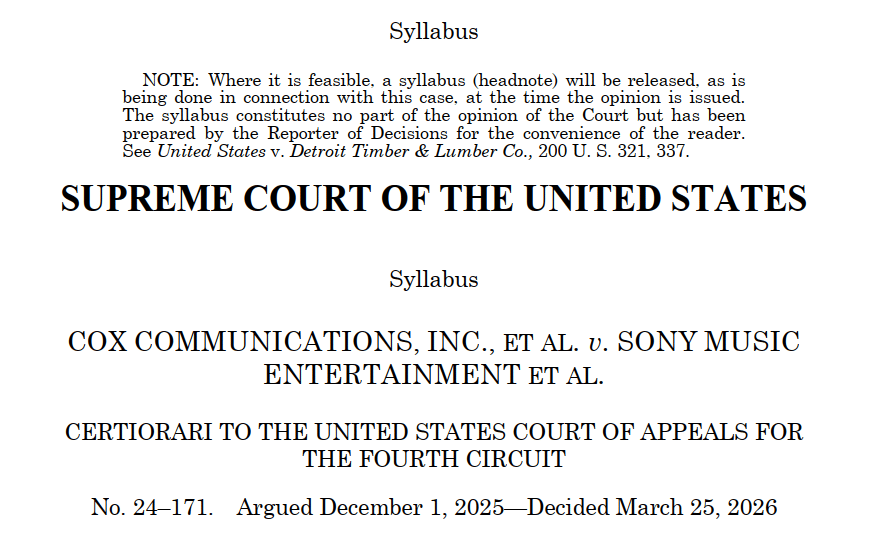
The opinion states that contributory liability requires proof that the provider intended its service to be used for infringement. That intent can only be shown in one of two ways. Either the provider actively induced infringement, or the service is one that has no substantial non-infringing uses.
In the present case, Cox met neither test. It never encouraged its subscribers to pirate anything. And internet access, as the Court noted, is used for countless lawful purposes.
“Under our precedents, a company is not liable as a copyright infringer for merely providing a service to the general public with knowledge that it will be used by some to infringe copyrights. Accordingly, we reverse,” Justice Thomas writes.
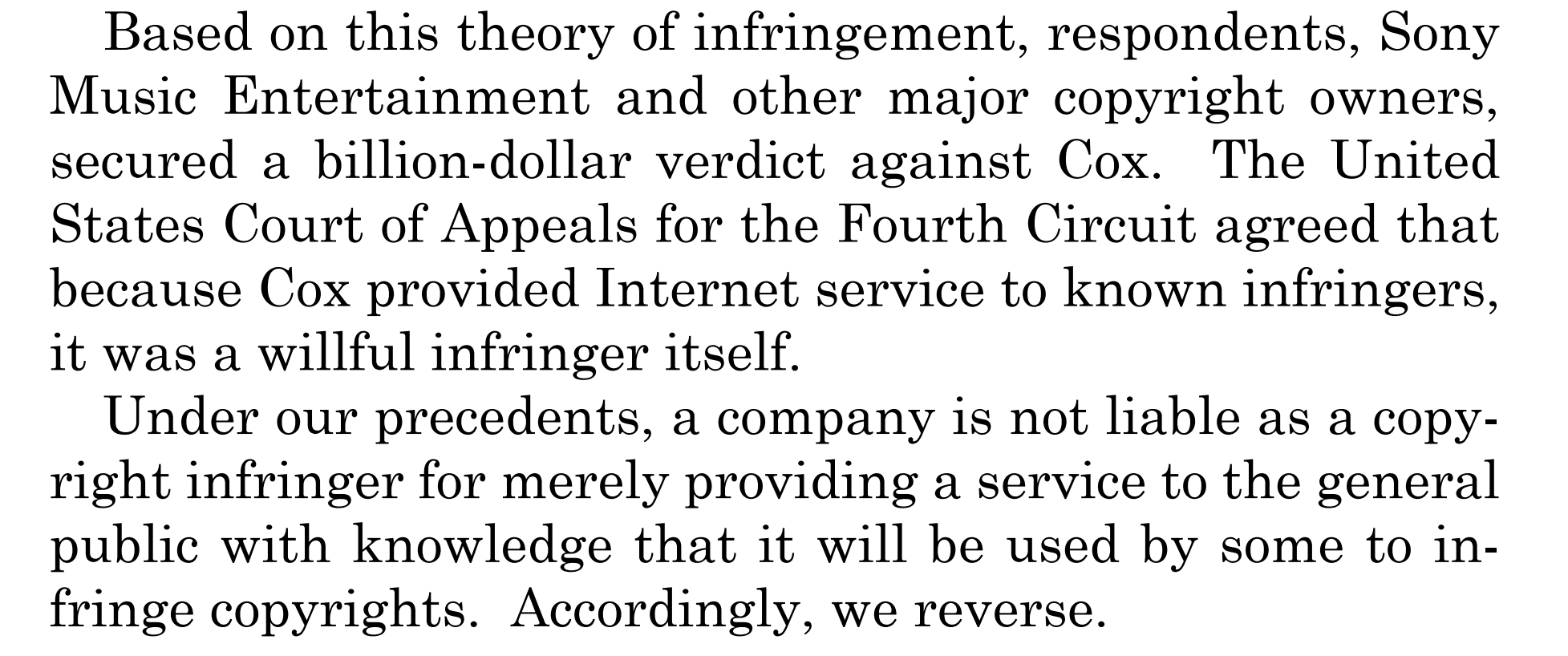
The Court also directly countered the Fourth Circuit’s reasoning, which held that supplying a product with “knowledge” of future infringement was enough to establish liability. The Supreme Court called this an improper expansion of copyright law that conflicted with decades of precedent.
This means that Cox may have known about the infringing activity of its subscribers, but that they are not liable for not taking action in response.
The “IP Address” Problem
In a concurring opinion, Justice Sotomayor agreed that Cox shouldn’t be held liable, but for a more practical reason. Under the common-law aiding-and-abetting doctrine, which she argued the majority should have applied, liability requires proof that a defendant intended to help a specific wrongful act succeed.
Sotomayor noted that when the anti-piracy tracking company MarkMonitor flagged an infringing IP address, it only identified a connection, not an individual. Whether the infringer was a specific account holder, a roommate, or a neighbor stealing Wi-Fi remained a mystery.
Without knowing who was actually infringing, Sotomayor argued, it is impossible to prove Cox intended to help that specific person succeed in their “wrongful act”.
Is the DMCA Safe Harbor Now “Obsolete”?
The ruling leaves a massive question mark over the future of the Digital Millennium Copyright Act (DMCA). Sony argued that the DMCA’s “safe harbor” provisions, which require ISPs to terminate “repeat infringers”, would be meaningless if ISPs weren’t already liable for serving those infringers in the first place.
Justice Sotomayor went even further, warning that the majority’s new rule “consigns the safe harbor provision to obsolescence”, adding that ISPs now have little incentive to take any action against online pirates.
“The majority’s decision thus permits ISPs to sell an internet connection to every single infringer who wants one without fear of liability and without lifting a finger to prevent infringement,” she notes.
What Happens Next
With today’s opinion, the verdict is reversed and remanded to the Fourth Circuit for further proceedings. Whether the music labels will pursue further litigation on remand, and what that would look like, remains to be seen.
For rightsholders, the ruling removes the primary legal tool they have used to pressure ISPs to terminate infringers more aggressively. For ISPs, however, it resolves years of uncertainty about how far they have to go in response to copyright infringement notices. Whether that means that they will indeed take less action has yet to be seen.
—
A copy of the Supreme Court’s opinion is available here (pdf). This is a developing story; more quotes, comments, and notes may be added later.
From: TF, for the latest news on copyright battles, piracy and more.
-
EU Faces Pressure to Close Irish Alumina Loophole After Russian Arms Link
The Belgian government is pressing the European Union to close a glaring sanctions loophole after OCCRP and partners revealed that raw materials from an Irish refinery are feeding into a supply chain that ultimately provides aluminum to EU sanctioned Russian weapons manufacturers.
Maxime Prévot, Belgium’s foreign minister, described the findings as “extremely disturbing.” Through a spokesperson, Prévot announced to OCCRP’s partner “De Tijd” that Belgium would lobby the European bloc to expand its sanctions regime to ensure that E.U.-produced raw materials cannot be repurposed for the Russian war effort.
The diplomatic push follows a report by OCCRP detailing the supply chain of Aughinish Alumina, Europe’s largest alumina refinery. The investigation found that since 2023, the Irish facility has sent more than half of its alumina exports to Russian smelters owned by its parent company, the Russian aluminum giant Rusal.
Because EU sanctions currently ban the import of Russian aluminum but do not restrict the export of alumina to Russia, the shipments remain entirely legal.
According to the investigation, the Russian smelters subsequently sold more than $650 million worth of aluminum to a Moscow-based trader. That trader, in turn, supplied more than 40 Russian arms companies that are currently under EU sanctions. The volume of the trade is vast: in 2024 alone, the Aughinish refinery sent approximately half of its total alumina production — worth roughly $400 million — to just two smelters in Siberia.
In Dublin, the revelations prompted immediate political fallout. A government spokesperson said to OCCRP’s partner Irish Times authorities were “aware of reports relating to Aughinish Alumina,” were taking them “very seriously,” and were actively examining the issues raised.
In a parliamentary debate on March 24, Prime Minister Micheál Martin expressed concern over the findings. While noting that the investigation alleged a supply chain routed “through intermediaries” rather than a direct link, he assured lawmakers that the matter would be reviewed.
Martin also cautioned that the refinery holds significant economic importance, serving as a major employer in Ireland and a critical node in broader European supply chains. Nevertheless, he told parliament that the reported diversion of materials into Russian armaments “is a concern.”
Opposition lawmakers in Ireland responded with sharper condemnation. Ivana Bacik, the leader of the Labour Party, said she was “shocked,” calling it “horrific” if Irish-made alumina was being utilized to manufacture weapons that are killing Ukrainian children. Ged Nash, the party’s finance spokesman, characterized the government as “rather incurious” and suggested Dublin must revisit the scope of sanctions at the European level.
Paul Murphy, a lawmaker with the People Before Profit party, accused the government of shielding the interests of an oligarch, while Jennifer Whitmore of the Social Democrats said the shipments demand immediate, intensive scrutiny.
The controversy has reverberated beyond Ireland, highlighting what critics describe as severe structural flaws in the European Union’s economic blockade of Moscow.
During a recent session of Ireland’s foreign affairs committee, Oleksandr Merezhko, a Ukrainian lawmaker, argued that it is unacceptable for Western companies to help Moscow circumvent restrictions. Russia, he said, “should be totally isolated, economically, politically.” Anton Gerashchenko, a former Ukrainian deputy interior minister, echoed the sentiment, expressing hope that the investigation would prompt official action.
The Ukrainian Embassy to Ireland says the investigation raises “serious and legitimate concerns.” This case, the Embassy spokesperson says, illustrates the growing challenge of preventing dual-use and other materials from entering Russian military supply chains.
In Brussels, Thijs Reuten, a Dutch member of the European Parliament, cited the case as glaring proof that EU sanctions require urgent tightening and stricter enforcement. Reuten emphasized that companies bear a fundamental responsibility to vet their trading partners, even when a specific trade flow technically circumvents the letter of the sanctions law.
Calling it “incomprehensible” that an EU-based company could export virtually its entire production of a sensitive metal to Russia without obstruction, Reuten warned that the resulting weapons “wreak death and destruction in Ukraine.”
“The game of hide-and-seek by companies and member states must end,” Reuten said, adding that such regulatory blind spots not only cost Ukrainian lives but fundamentally undermine Europe’s own security.
The EU’s sanctions envoy, David O’Sullivan, says that sanctions have decreased EU-Russia trade significantly. He says the information provided “if accurate, is worrying” and promises that the EU Commission will continue to act in order to undermine Russia’s ability to wage its war.
Experts in international relations and anti-corruption advocates echoed the call for reform. John O’Brennan, a professor of Irish politics, said the findings exposed “significant gaps in EU sanctions” and urged the bloc to fully sanction the alumina sector. Alexander Pomazuev, of Russia’s Anti-Corruption Foundation, described the current regulatory framework allowing the exports as a “glaring loophole.”
-
Philippine Vice President Faces Impeachment Over Corruption and Assassination Threats
Philippine lawmakers on Wednesday opened formal impeachment hearings against Vice President Sara Duterte, initiating a high-stakes political showdown fueled by accusations of massive corruption and extraordinary threats to assassinate President Ferdinand Marcos Jr.
The proceedings represent a stunning rupture between the country’s two top leaders. Duterte, 47, faces a litany of severe charges, most notably the alleged embezzlement of 612.5 million pesos (about $10.19 million) in confidential government funds during her first 18 months in power.
According to reporting by OCCRP’s media partner in the Philippines, Rappler, the sweeping complaints transmitted to the House of Representatives include financial fraud, corruption and violent threats. Duterte is said to have fabricated official submissions to the Commission on Audit to conceal the misuse of public funds, bribed education officials and accumulated unexplained wealth and issued violent threats against the lives of President Marcos and his family.
Duterte, who remains in the country, refused to attend Wednesday’s inaugural hearing, arguing that she was under no legal obligation to appear in person. Instead, she took to social media to dismiss the proceedings as a politically motivated “fishing expedition” orchestrated by the House of Representatives.
“The invitation to attend the hearing of the Committee on Justice is being used to create a media narrative that there will be a ‘mini-trial,’ based on the alleged non-response and non-attendance,” she wrote in a statement posted to Facebook.
Displaying her trademark defiance, the vice president demanded that lawmakers abandon the inquiry entirely. “The Committee has no choice but to dismiss the complaints due to the clear lack of evidence,” she stated.
The relationship between Duterte and Marcos has deteriorated from an electoral alliance of powerful dynastic families into open, visceral hostility.
The feud reached a fever pitch in November 2024 when the vice president publicly claimed she had hired an assassin to kill the president if she were to be assassinated first. In another macabre outburst, she reportedly threatened to exhume the remains of the president’s father — the late dictator Ferdinand Marcos — and hurl them into the sea.
This week’s hearings represent the second attempt by Congress to oust Duterte. Lawmakers previously voted to impeach her in February 2025 over similar allegations of corruption and threats against the president. However, the Philippine Supreme Court blocked that bid six months later, ruling that the vote violated a constitutional ban on initiating multiple impeachment proceedings within a single year.
The current political crisis unfolds under the heavy shadow of Duterte’s family legacy. Her father, former President Rodrigo Duterte, was arrested last year and remains in the custody of the International Criminal Court in The Hague. He is facing allegations of crimes against humanity tied to the brutal, extrajudicial anti-drug campaign that defined his presidency.
If convicted by the Senate, Sara Duterte would be stripped of the vice presidency and permanently barred from holding public office. The House Committee on Justice now has a maximum of 60 session days to conclude its investigation into the four complaints and decide whether to formally send the articles of impeachment to the Senate for trial, Rappler reported.
-
👓 Who’s Really Watching What Smartglasses See? | EFFector 38.6
After years of tech industry experiments, smartglasses with embedded cameras and microphones have finally gone mainstream. And, disturbingly, sometimes it’s not just their owners who are watching what these devices record. In this week’s EFFector newsletter, we’re taking a closer look at the privacy implications of Meta Ray-Bans, and sharing all the latest in the fight for privacy and free speech online.
For over 35 years, EFFector has been your guide to understanding the intersection of technology, civil liberties, and the law. This week’s issue covers EFF’s new executive director; how publishers blocking the Internet Archive threaten the web’s historical record; and why you should think twice before buying or using Meta’s Ray-Bans.
Prefer to listen in? EFFector is now available on all major podcast platforms. This week, we’re chatting with EFF Security and Privacy Activist Thorin Klosowski about smartglasses and privacy. And don’t miss the EFFector news quiz. You can find the episode and subscribe on your podcast platform of choice:




Want to stay in the fight for privacy and free speech online? Sign up for EFF’s EFFector newsletter for updates, ways to take action, and new merch drops. You can also fuel the fight against online surveillance when you support EFF today!
-
Trump’s Bizarre $1 Billion Payoff to Halt Offshore Wind
This story was originally published by Grist. Sign up for Grist’s weekly newsletter here.
On Monday, President Donald Trump’s Department of the Interior announced that it will refund almost $1 billion to a French multinational oil company.
The company, TotalEnergies, had spent that amount during the Biden administration to secure two leases allowing it to build offshore wind farms in the Atlantic Ocean. The Trump administration, which has taken every step possible to block offshore wind development, is so opposed to this possibility that it’s paying Total to give up those leases — which the company wasn’t even using — in exchange for a promise that Total will invest the money in oil and gas projects off the U.S. Gulf Coast — which it was already doing.
“This is a backdoor deal done with zero transparency, no public process, and no consideration of the impacts to ratepayers in states that had been planning on that offshore wind to meet their energy needs,” said Elizabeth Klein, who led the federal Interior Department’s Bureau of Ocean Energy Management under former President Joe Biden.
“This is a backdoor deal done with zero transparency.”
The administration may have been trying to buy Total off to avoid litigation, according to Hannes Pfeifenberger, principal at the economic consulting firm the Brattle Group. The French company purchased its offshore wind lease in the coastal area known as the New York-New Jersey Bight for a historically high amount, paying around four times the typical per-acre rate for such leases. Were the administration to attempt to block development, Total might have sued to avoid losing its entire investment.
“[Trump’s Interior Department] might have been responsible for damages if the offshore wind developers sued the government for selling them leases and then basically making permitting impossible,” said Pfeifenberger, adding that other developers who purchased leases in the same auction might now look to take the same path out.
But Klein and other industry experts also noted that the settlement does not deal a permanent blow to offshore wind development, beyond moves the Trump administration had already taken: Trump has already frozen all offshore wind lease auctions and vowed to oppose any new wind farm construction. At worst, the settlement will just set the timeline on new offshore wind development back by a few more years. Though Total’s ocean rights will return to the government for now, a future president could lease them out to another energy company.
“Obviously no one expects this administration to be conducting any offshore wind lease sales, but future administrations will,” said Klein.
There are other ways that the settlement may be less significant than it seems. Industry experts say most companies that hold ocean leases are looking to offload them or let them sit undeveloped until Trump is out of office. Even before this payoff, most experts believed that wind companies would not return to the Atlantic without legislative reform to protect approved permits from executive interference.
The oil side of the settlement is even more confusing. The Interior Department’s announcement says that TotalEnergies will “invest approximately $1 billion — the value of its renounced offshore wind leases — in oil and natural gas,” including offshore oil platforms in the Gulf of Mexico and a liquefied natural gas (LNG) facility in Texas. But the company is already plowing billions of dollars into new offshore platforms, and it made a “final investment decision” on an expansion of its Texas LNG facility last year. The lease refund would only go to offset these existing investments, not to generate new infrastructure the company hadn’t already planned.
A statement from TotalEnergies CEO Patrick Pouyanné announcing the deal contained multiple grammatical errors, and it ended on a humdrum note, with the executive saying “we believe this is a more efficient use of capital.”
The administration may have been trying to buy Total off to avoid litigation.
As for the debate in the U.S. Senate around so-called permitting reform legislation to secure energy projects from cancellation, the settlement with Total has done nothing to disrupt negotiations. That’s in stark contrast to what happened after the administration’s previous stop-work order on five under-construction wind farms in December, which caused bipartisan congressional negotiations to collapse. Speaking to reporters last Friday, Sen. Sheldon Whitehouse, D-R.I., said that permitting reform talks are proceeding apace despite the new settlement.
“So far, so good, with respect to addressing substantive issues,” said Whitehouse, who is known for his leadership on climate and energy issues. He noted that the Trump administration has declined to appeal any of the court injunctions against its actions targeting the five active wind farms.
“At the moment, I think they’re getting a strong signal from Republicans and Democrats in the Senate: Knock it off, cut out the nonsense,” he said.
The post Trump’s Bizarre $1 Billion Payoff to Halt Offshore Wind appeared first on Truthdig.
-
Investigative Journalism Game Jam Opens: Floodlight Gaming Invites Developers to Transform High-Stakes Reporting into Interactive Experiences
Floodlight Gaming today opened applications for its second international Investigative Journalism Game Jam, which challenges game developers to transform reporting into interactive experiences.
A new approach to storytelling, Floodlight Gaming is an initiative of the Organized Crime and Corruption Reporting Project (OCCRP) and the Gabo Foundation, in partnership with Anima Interactive and V-Ventures.
“Investigative reporters understand the world of crime and corruption weaved around us in unique and profound ways,” said Floodlight Gaming and OCCRP Co-Founder Paul Radu. “Floodlight Gaming sees a huge opportunity in working with developers to help create the next generation of investigators.”
Developers will gain exclusive access to the Floodlight Gaming Stories Catalog containing in-depth investigative reports from OCCRP’s global network and beyond. Topics include: the manipulation of a high-stakes Nigerian election; a transnational network smuggling looted Egyptian antiquities into global museums; and a Paraguayan community’s landmark legal battle against a foreign-backed crypto operation.
During the month-long jam (April 6–May 7), developers will be able to ask questions to the journalists behind these stories. This collaboration ensures that while developers enjoy full creative freedom, the resulting games remain grounded in the integrity of the original reporting.
Floodlight Gaming will announce the winner of the Investigative Journalism Game Jam live on stage June 2nd at the INDIGO festival in The Netherlands. The winning team will receive $5,000 and a place in Spielfabrique’s Launchpad program, which provides mentorship and networking opportunities. The event will also feature game highlights from the finalists as well as lively discussions between game developers and investigative journalists about storytelling and the crossover between the two industries.
The inaugural Floodlight Gaming Investigative Journalism Game Jam was successfully piloted last year. The top prize went to “Hunting the Hunter,” developed by Berlin-based Greenwave Games. The game was inspired by investigative journalist Anas Aremeyaw Anas’ reporting on cocoa smuggling networks in Ghana and placed players in the role of a journalist uncovering a criminal ring. Floodlight Gaming is also co-developing “Dark Money,” a game by Polyvale Studios based on OCCRP’s Laundromat investigations by hundreds of investigative reporters across OCCRP’s global network.
Other Floodlight Gaming partners include the Pulitzer Center, ZAM, INDIGO, Good Game Generation, Games for Change, International Game Developers Association, and Global Game Jam.
Learn more and apply at: https://www.floodlightproject.org/floodlight-gaming/
For more information, contact: gaming@floodlightproject.org
About Floodlight: Floodlight is the bridge between hard-hitting investigative journalism and the global entertainment industry. Created by OCCRP and the Gabo Foundation, Floodlight curates riveting investigations and collaborates with filmmakers, television series creators, and game developers to ensure that the most important stories of our time reach the widest possible audience.
-
Zoonotic Spillover Is A Problem
Recently I gave the latest update on the origins of SARS-CoV-2 – bottom line, it was very likely a zoonotic spillover event and not a lab leak. Following that, I interviewed a researcher, Dr. Andersen, who is an expert on the origins of epidemics/pandemics and has researched this very question. He reinforced the spillover hypothesis, indicated he had considered the lab leak […]
The post Zoonotic Spillover Is A Problem first appeared on Science-Based Medicine.
-
How to Keep ICE Agents Out of Your Devices at Airports
With Immigration and Customs Enforcement agents deployed to more than a dozen airports across the U.S. and border device searches growing increasingly common, it’s more important than ever to consider your digital security before you travel.
The risks are real. Customs and Border Protection agents have the authority to examine travelers’ devices. In June, for instance, federal agents denied a Norwegian tourist entry to the U.S. after looking through his phone. (Authorities claim they turned him away for admitted drug use; he says it was over a meme depicting Vice President JD Vance as a bald baby.)
Immigration and Customs Enforcement have already started targeting travelers, with agents in plain clothes forcefully detaining a mother in front of her young daughter at San Francisco International Airport on Sunday after a tip from the Transportation Security Administration.
If you’re flying, take these steps to reduce the likelihood that your sensitive information is compromised at the airport.
Don’t Bring Your Usual Devices
The only surefire way to keep your devices from being searched and seized is to simply not bring them with you on your trip. If you can’t leave them at home, consider mailing them to and from your destination.
Another option is to leave devices that contain sensitive information at home and instead bring throwaway travel devices you’re willing to have searched or confiscated. This doesn’t need to be an expensive proposition. You can reformat and repurpose an old phone or tablet, or purchase refurbished older models that are comparatively cheap. Then buy a temporary SIM card or eSIM so that you’re not using your usual number. Remember to let contacts know that for the duration of your trip you’ll be reachable at a different number.
Create a travel account for these devices. You can do so by starting a fresh account in the App Store or Google Play. This should ensure that if you’re forced to log into your device by authorities at the airport, the only information they’ll find is data you’ve put on this specific piece of hardware. CBP agents are supposed to only be able to look at data that’s local on the phone.
If you have anything sensitive in your accounts (say, emails from confidential sources) or anything you believe federal agents could consider damning (such as party pics or memes), be sure not to sync your apps, files, and settings onto your travel devices.
Disable Biometrics and Power Off
Regardless of whether you opt to bring your usual devices or specialized travel burners, take these steps to lock down your devices.
First and foremost, disable any biometrics, like using your face or fingerprint, to unlock your phone. Instead, set up a unique and random alphanumeric passcode; eight characters consisting of random digits and numbers is a good start. Be cautious of entering your passcode in open view of surveillance cameras. Use one hand to shield your screen, and the thumb of your other hand to put in your passcode. Consider using privacy screens on your devices to further diminish the chance of wandering eyes noticing things that are none of their business.
Be cautious of entering your passcode in open view of surveillance cameras.
When going through security checkpoints, turn your devices completely off. Don’t just put them to sleep — fully shut them down. Though having a locked device is better than having it be unlocked, turning it off is best, as this makes it much harder for data to be forensically recovered from your devices.
That means you’ll need to print out paper copies of boarding passes, rather than rely on digital versions stored in a device wallet or via your airline’s app.
If you’re asked to unlock your devices, you can say “no.” But doing say may result in being delayed and hassled, and your device could be confiscated. You should receive paperwork attesting to the confiscation and establishing chain of custody (this is called CBP Form 6051D, or a custody receipt for detained property). As the Electronic Frontier Foundation points out, it may be months before your devices are returned — or even for an indefinite period of time if agents believe there is evidence of a crime.
Delete Files and Log Out
To practice what’s known in security circles as “defense in depth,” it’s best to think of your digital security as an onion: If an outer layer is peeled off, you want there to be a good second layer to minimize the damage to the core. To that end, assume that even if you have a strong passphrase and have powered off your device, someone may still be able to find a way in. Your travel devices should, therefore, minimize the amount of sensitive information they store. In that case, even if someone manages to break through the outer layer, the information exposed would be trivial.
If you use a password manager — a specialized app that securely stores your passwords — put it into a “travel mode,” limiting the passwords it will reveal for the duration of your trip. Remove access to sensitive accounts that you very likely won’t have a reason to need to access during your travels; for example, removing your work email if you’re going on vacation, or leaving and deleting and sensitive Signal chats, like local ICE watch groups.
Log out of or delete apps you won’t need while traveling. You can reinstall and log back in when you are safely away from the airport. Remember to remove them once again when you’re on your way back — and keep in mind that this may lead to some apps deleting your history.
Finally, be sure to prune your contacts to remove any that are sensitive, such as sources, if you’re a journalist. If you have sensitive materials on your devices that you’ll need to access during your travels, use a tool like Cryptomator to encrypt them and upload them to a cloud drive, then delete the files from your devices. You can download them when you reach your destination.
These extra steps are undoubtedly a bit of a pain, but any inconvenience would pale in comparison to the potential damage if sensitive information is disclosed during your time in the airport.
The post How to Keep ICE Agents Out of Your Devices at Airports appeared first on The Intercept.
-
Gulf war ‘out of control’, Guterres warns, as UN appoints envoy to push for peace
UN Secretary-General António Guterres has warned that the escalating Gulf war is “out of control”, urging all sides to step back from the brink and allow diplomacy to prevail, as he announced the appointment of a senior envoy to spearhead peace efforts.
