Blog

  • Kyrgyzstan Releases Prominent Investigative Journalist Pending Retrial

    A court in Kyrgyzstan released prominent investigative journalist Makhabat Tazhibek kyzy from custody on Monday, placing her under travel restrictions pending a new trial after she spent 18 months behind bars.

    The decision by the Lenin District Court followed a ruling earlier this month by the Kyrgyz Supreme Court, which overturned the journalist’s six-year prison sentence and ordered a retrial.

    Bolot Temirov, her husband and the editor-in-chief of the investigative outlet Temirov Live, confirmed her release on Facebook.

    “Makhabat’s preventive measure was changed to a travel ban. … Good news!” Temirov wrote.

    However, the court refused to dismiss the criminal case or exclude the conclusions of a forensic linguistic analysis from the case files as evidence of a violation of the law.

    Tazhibek kyzy was the last of her colleagues to be released after police detained them during mass raids in January 2024. Authorities accused the group of inciting and organizing mass riots.

    She was sentenced to six years in prison in October 2024. Of the 11 journalists originally detained, her colleague Azamat Ishenbekov was sentenced to five years but was later pardoned by the president. Two others, Aktilek Kaparov and Aike Beishekeeva, were released on probation, while the remaining journalists were acquitted due to a lack of evidence.

    The mass arrests and subsequent trials drew widespread international condemnation. Groups including Amnesty International, Human Rights Watch and Reporters Without Borders accused Kyrgyzstan of a concerted effort to muzzle free speech.

    The Supreme Court decided to review the case and overturn Tazhibek kyzy’s sentence after a U.N. working group publicly called for the journalist’s release. Temirov believes this international advocacy was a key reason for his wife’s release.

    “Thanks to international pressure, this became possible,” the journalist emphasized. “But there is still a fight ahead for the full vindication of her and others too.”

  • Meningitis outbreak passes peak, says health agency

    “We could still see cases continuing to come in, we need to keep an eye on those, the UKHSA says.
  • Report: Turkey Shuts Public Out of Trial for Erdogan’s Chief Rival

    An Istanbul court has restricted public and media access to the mass corruption trial of Mayor Ekrem Imamoglu, a move a prominent rights group said violates Turkish and European law.

    Imamoglu, seen as the leading political rival to President Tayyip Erdogan, has been on trial since March 9 alongside 406 municipal officials and others on corruption charges that critics describe as politically motivated.

    Human Rights Watch (HRW) said the court at the Silivri complex, west of Istanbul, has arbitrarily limited entry for observers, opposition lawmakers, and relatives following a series of tense disputes over seating. Reporters have been relegated to a back corner of the courtroom where they cannot adequately see or hear the proceedings.

    The rights group warned that shutting the public out of the hearings violates Turkish constitutional protections and Article 6 of the European Convention on Human Rights. Limiting scrutiny, HRW added, further erodes confidence in a trial already viewed with deep suspicion by the opposition.

  • UN calls for solidarity and political will to stamp out racial discrimination

    Nearly 70 years after South African police fired upon peaceful demonstrators in Sharpeville protesting apartheid-era laws, killing 69, the UN renewed the commitment to work for justice and equality on Monday, marking the International Day for the Elimination of Racial Discrimination. 
  • MIDDLE EAST LIVE 23 March: Civilians bear brunt of ongoing war

    The war in the Middle East is well into its fourth week and the humanitarian emergency it has sparked continues to be the focus of international attention, along with the energy crisis caused by attacks on shipping in key Strait of Hormuz and other oil and gas infrastructure in the Gulf region. Stay with us for live updates from across the UN system. App users can follow coverage here.
  • Of LPE and Legislative Supremacy

    I don’t agree with anyone all the way, if I can avoid it. (Not even myself over time.) But I can’t find anything wrong with Beau Baumann’s call for a new “constitutional politics” of legislative supremacy. As a fellow traveler in the crusade against juristocracy and presidentialism, I write only to express a few small worries — first about how Beau might have chosen a misleading name for his…

    Source

  • Mad in South Asia hosts Spring Series of Events: Mar 28th Lucy Johnstone

    Mad in South Asia hosts Spring Series of Events: Mar 28th Lucy Johnstone

    Event 1 (Upcoming)

    Beyond Diagnosis: An Introduction to the Power–Threat–Meaning Framework
    Speaker: Dr. Lucy Johnstone
    March 28, 2026
    7:30 PM IST | 2:00 PM London | 9:00 AM EST

    The Power–Threat–Meaning Framework (PTMF) offers an alternative to traditional psychiatric diagnosis by asking different questions about distress: What has happened to you? How did it affect you? What sense did you make of it? What did you have to do to survive?

    In this seminar, Dr. Lucy Johnstone, a leading clinical psychologist and co-author of the PTMF, will introduce the framework and discuss how it reframes mental health difficulties in terms of power, threat, meaning, and survival, opening possibilities for more contextual and humane understandings of distress.

    You can learn more about seminar 1 or REGISTER HERE for seminar 1.

    Event 2

    Beyond Individual Compassion: Mad Experience & Disability Justice
    Speaker: Hel Spandler
    April 25, 2026
    7:30 PM IST | 2:00 PM London | 9:00 AM EST

    Event 3

    Lived Experience, Survival & Thriving Beyond Psychiatry
    Panel featuring: Karin Jervert, Alan Robinson, Laura López-Aybar, Pranami Tamuli
    📅 May 30, 2026
    🕢 7:30 PM IST | 2:00 PM London | 9:00 AM EST

    Themes across the series:
    • Psychiatric harm and adverse effects
    • Structural inequality and epistemic injustice
    • Mad knowledge and disability rights
    • Arts, spirituality, and collective care
    • Global solidarity and survivor-led knowledge

    Registration and event details: https://madinsouthasia.org/misa-spring-seminar-series/

    The post Mad in South Asia hosts Spring Series of Events: Mar 28th Lucy Johnstone appeared first on Mad in the UK.

  • Cloudflare Reports Surge in Geo-Blocked Pirate Site Domains

    Cloudflare Reports Surge in Geo-Blocked Pirate Site Domains

    As one of the leading Internet infrastructure companies, Cloudflare finds itself at the center of various copyright disputes.

    The American company says it powers nearly 20% of the web. This includes several Fortune 500 companies, but also many pirate sites and services.

    For years, rightsholders have urged Cloudflare to do something about these pirate sites. However, the company typically doesn’t take action against customers that use its ‘pass-through’ CDN services. Instead, it simply forwards takedown notices to their respective hosting services.

    According to some rightsholders forwarding is not enough. To compel Cloudflare to take action against pirate sites, they requested formal blocking orders in France, Spain, South Korea, and elsewhere.

    Cloudflare Adds 2,791 Geoblocked Domain Names

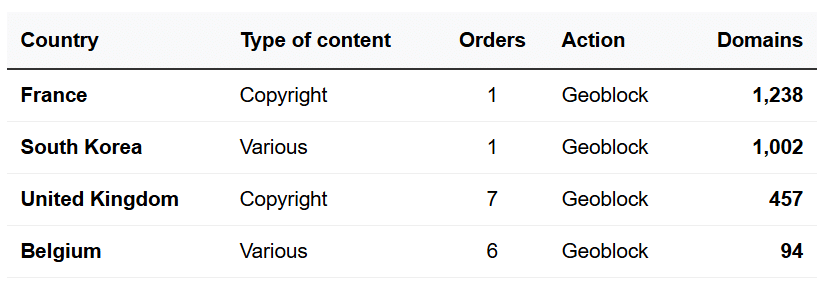
    Cloudflare’s latest transparency report, covering the second half of 2025, shows that 2,791 domain names that use its pass-through services were geoblocked. This means that these sites of Cloudflare customers are effectively rendered inaccessible in these countries.

    Nearly 2,800 is a significant increase compared to the same period a year earlier, when 308 domain names were geo-blocked.

    From Cloudflare H2 2025 Transparency Report

    table cloudflare

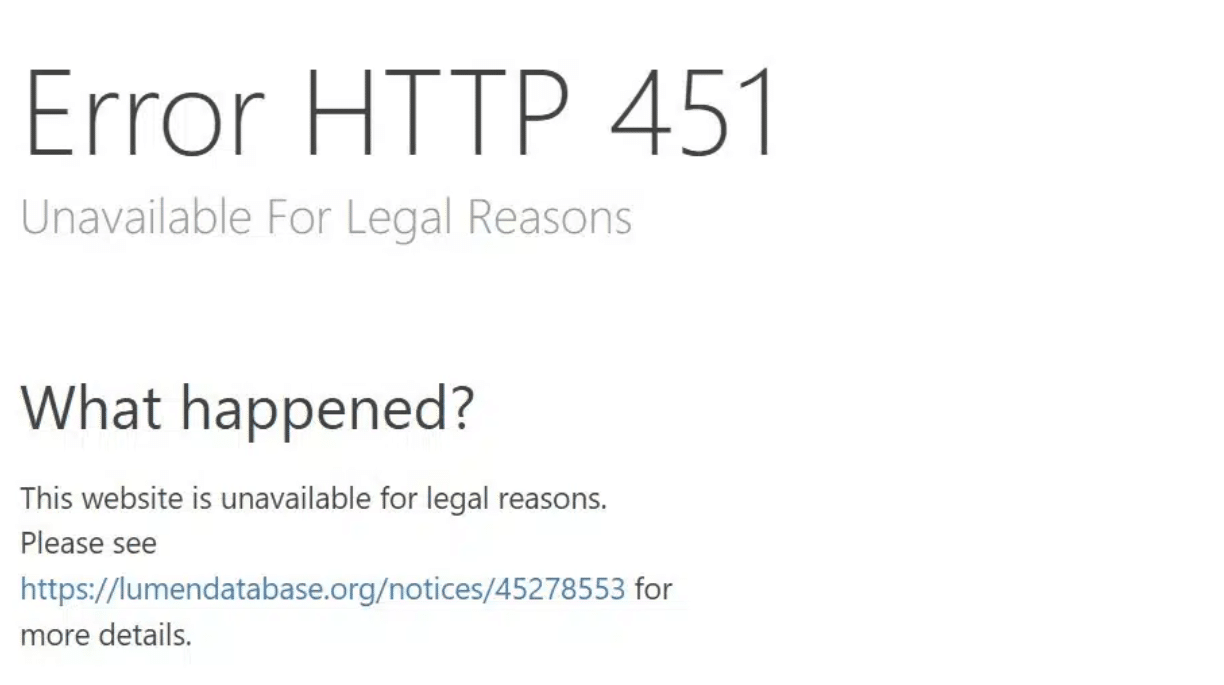
    When Cloudflare geoblocks a domain, the company posts an interstitial page linking to the relevant order so that visitors can see why access has been restricted.

    Error 451

    error 451

    It’s worth noting that not all geo-blocks are equal. In the UK, for example, Cloudflare is taking action voluntarily based on an older High Court order against ISPs, to which it is not a party. This is similar to the voluntary blocking approach Google takes.

    In Belgium and France, Cloudflare does respond to orders where it is named. These predominantly cover pirate sites, but in Belgium Cloudflare is also compelled to geo-block several illegal gambling sites.

    In Korea, a new law requires CDN providers, including Cloudflare, to implement a government-mandated blocklist. This prohibits the CDNs from facilitating access to these sites through servers in South Korea, which resulted in hundreds of blocks in the second half of 2025.

    Cloudflare clarifies that these South Korean sites are not “blocked” in the traditional sense. Instead, they are restricted from being served through equipment located physically in South Korea.

    DNS Blocking

    Interestingly, these geo-blocking measures are sometimes also used by Cloudflare to comply with DNS (1.1.1.1) blocking orders. If the sites are geo-blocked, Cloudflare doesn’t have to block these through its DNS.

    “Cloudflare has sometimes taken action to geoblock access to websites through Cloudflare’s pass-through CDN and security services, in response to orders directing Cloudflare to block through its public DNS resolver,” the transparency report reads.

    As in previous transparency reports, Cloudflare separately confirms that it “has not blocked content through the 1.1.1.1 Public DNS Resolver.”

    Automated Hosting Takedowns

    In addition to blocking domains for which Cloudflare acts as a CDN or pass-through, the company also takes more direct action if it is hosting sites. In the second half of 2025, rightsholders sent 121,681 copyright infringement reports, with Cloudflare taking action in 67,941 instances.

    Notably, these removals are mostly the result of automatic processes, which were put in place last year.

    “In H2 2025, Cloudflare used automated means to action 64,161 of the 67,941 copyright infringement reports actioned,” the company reports in a footnote, adding that it also terminated 59,843 accounts of R2 storage services.

    Italy’s €14 Million Fine

    The transparency report makes no mention of the recently appealed €14,247,698 fine that was imposed on Cloudflare in January by Italy’s communications regulator, AGCOM. Cloudflare received this fine as it refused to implement blocking measures through its 1.1.1.1 DNS resolver under Italy’s Piracy Shield measures.

    AGCOM concluded that Cloudflare’s cooperation is “essential” for the enforcement of Italian anti-piracy laws, as its services allow pirate sites to evade standard blocking measures.

    In response to the fine, Cloudflare’s CEO Matthew Prince considered pulling out of Italy entirely. While that hasn’t happened yet, Cloudflare firmly draws a line at their public DNS resolver, and it recently appealed AGCOM’s fine in court.

    A copy of Cloudflare’s H2 2025 Transparency Report (Abuse Processes) is available here (pdf).

    From: TF, for the latest news on copyright battles, piracy and more.

  • Supported Living – We Were Not a Mental Health Service

    Supported Living – We Were Not a Mental Health Service

    Supported living is a type of social care designed for people with different needs, such as autism, learning disabilities, mental health conditions and physical disabilities. Residents typically live in their own flats or shared houses, with support staff available to help them live independently in the community. People are usually referred to this service through local authorities, who assess their needs and help them find a care provider. Some may only require this support for a short period of time, while others stay for years, even decades. The process is individual and intended to offer autonomy while also providing support when needed.

    When I began working in this field, I understood my role in rather straightforward terms. I was meant to support with daily tasks and routines, navigate appointments and build stability. It was about practical support, community interaction and day-to-day life. It was emphasised to me by seniors that we were not a “mental health service”; instead, our remit was neurodivergence and learning disabilities.

    As I began to learn more about the lived experiences of those I supported, I quickly realised that this statement was false. Many people relayed experiences of growing up in a society that stigmatised and ostracised them. Some had been sectioned and stripped of their agency. It was difficult to find a resident who had not experienced some form of psychological distress, and this was understandable. They had lived lives that were not easy, experienced adversity and had been pathologised accordingly.

    Officially, we were not there to provide mental health care. In practice, distress shaped almost everything.

    People expressed their distress in different ways. Some experienced suicidal thoughts and tried to act on them. Others stopped taking their medication and began to hear voices. Soon we were in contact with crisis teams, psychiatrists and the wider mental health system. While we waited for resources to become available, we were managing emotional crises without adequate training or emotional support.

    Distress was documented thoroughly, risk was constantly assessed, and people were regularly checked on. The underlying experiences and trauma often seemed to be overlooked. Instead, the narrative was frequently individualised and surface-level, focusing heavily on diagnosis and symptoms and too little on the external factors that contributed to a decline in wellbeing.

    I remember one resident I supported early in my role who was extremely isolated. He barely saw his family; his friends from school had moved away and started their lives, and he had no clear sense of purpose. Yet when I finally managed to sit with him and engage, he opened up about his passions and dreams. He loved music and spoke about wanting to craft songs; he also had a deep affection for the 90s because it reminded him of his childhood. We tried to help him reconnect with a sense of community and spend more time outdoors.

    Yet it often felt as though some just saw a complex diagnosis. Support became inconsistent, and sustained engagement wasn’t there. When he pushed support away, some interpreted it as resistance rather than discouragement. I felt that if he had been able to reconnect with his passions consistently, we might have made a positive change. Instead, he gradually deteriorated, stopped taking his medication and began hearing voices. He was taken away by ambulance, and I never saw him again.

    Seeing him get sectioned left me feeling uncomfortable and resentful. He was going away to receive treatment. But would he truly be better? His symptoms may have reduced, and his voices may have quietened, but what had been done to address his circumstances? The isolation, the broken family relationships, the absence of meaningful community resources. If those systems remained untouched, what exactly was the hospital treating?

    After these experiences, I began to view supported living as occupying a strange in-between space. We were not a mental health service, but we were expected to manage a crisis. We were not nurses, yet medication adherence was essential. Our role was, in many ways, to occupy a space that other services were unable to fulfil. Yet instead of distinguishing ourselves from those services, it often felt as though we mirrored them. There was pressure to uphold the status quo of “stability”, something that looked good on paper but did not reflect complex realities.

    Stability became a measure of success. Fewer incidents meant fewer safeguarding referrals, fewer crisis calls and fewer admissions. On paper, it made the service appear effective. But stability did not mean that somebody felt less alone, less judged or more hopeful. It meant that distress had been managed, contained and documented.

    Many of us tried to be more holistic, focusing on community engagement and helping people rebuild connections. Much of this was overshadowed by financial constraints, administrative demands and safeguarding concerns. Did this person’s support hours align with the event they wanted to attend? How much would a taxi cost if no driver was on shift? Had risk been assessed, and was the outing financially viable?

    A missed community group could mean further isolation. A cancelled outing reinforced the sense that autonomy was conditional, dependent on budgets and rotas. Despite empowering language in care plans and official documents, the reality often remained restrictive. While some of us pushed and made it work, others could not, and residents continued to feel isolated. Once again, they were facing another external source of distress, this time shaped by administrative limitations.

    In this sense, supported living was not just responding to distress; it was inadvertently reproducing it. When suffering re-emerged under these conditions, it was interpreted clinically. The constraints themselves were rarely addressed.

    Addressing this would require more than papering over cracks. It would mean questioning the kind of environment we are fostering and how we expect people to be truly “well” within it.

    Supported living was designed as an alternative to institutional care. In many ways, it offers that. But when stability becomes the primary marker of success and autonomy is conditional, are we truly moving on from those dynamics?

    Saying we are not a “mental health service” may protect organisational boundaries. But it disregards how we continue to mirror psychiatric narratives while overlooking social and relational causes of suffering.

    Steering away from the psychiatric narrative is about more than changing language in care plans. It would mean centring external and relational factors alongside symptom management. It would mean changing the questions we ask: instead of “What is wrong with someone?”, we might ask, “What does this person want, and what is worsening their distress?”

    It is easier to view distress as the result of an illness because it offers the promise of a simple solution. A more holistic approach requires greater effort. It means getting to know someone on an individual basis, listening to them, and allowing them to lead where possible. It means fighting to secure additional funding for community activities and spaces. It means greater coordination between siloed medical teams to build collaborative, well-rounded support for the future.

    It is too easy to fall into power imbalances that mirror clinical relationships. Yet when we ask the right questions, we often find that people have the self-knowledge to move towards a way forward that aligns with their values. In time, they may tell us what they are missing, and in that admission, we can find solutions that are far more meaningful than surface-level symptom management.

    ****

    Mad in the UK hosts blogs by a diverse group of writers. The opinions expressed are the writers’ own

    The post Supported Living – We Were Not a Mental Health Service appeared first on Mad in the UK.
  • RFK Jr. is definitely coming for your vaccines (part 9): ProPublica reports, and a bump in the road to remaking ACIP

    A judge recently ruled that HHS Secretary Robert F. Kennedy Jr. went too far in his drive to turn ACIP into a an antivax committee. Meanwhile, ProPublica reports on where we are heading; it’s not good.

    The post RFK Jr. is definitely coming for your vaccines (part 9): ProPublica reports, and a bump in the road to remaking ACIP first appeared on Science-Based Medicine.