Blog

  • Bankruptcy Court Clears Path for $100 Million Sale of Redbox’s Piracy Lawsuit Rights

    Bankruptcy Court Clears Path for $100 Million Sale of Redbox’s Piracy Lawsuit Rights

    In 2024, the video rental and streaming company Redbox shut down its service and filed for bankruptcy.

    The service, owned by Chicken Soup for the Soul Entertainment (now CSS Entertainment), was running hundreds of millions in losses per year and no longer saw a path to profitability.

    With hundreds of filings, the bankruptcy case is a complex one. While these types of proceedings typically don’t have much news value, a rather intriguing piracy-related filing caught our eye last fall.

    Court Clears Path for $100 Million Piracy Litigation Deal

    Last October, it was reported that a company called Grove Street Partners was offering at least $100 million for the copyright litigation rights of Redbox‘ bankrupt parent company.

    However, before any deal could be signed and executed, the Delaware bankruptcy court first had to approve the sharing agreement that dictates how the proceeds of an eventual sale are shared. This happened earlier this month, when the agreement was formally approved by Judge Mary F. Walrath.

    With the paperwork sorted, the rights to pursue copyright infringement claims of media titles once owned or controlled by CSS Entertainment and its subsidiaries, including Screen Media Ventures, can now be sold.

    Grove Street remains the key candidate to take over the rights, which would allow the company to file lawsuits against Internet providers for turning a blind eye to piracy. This can potentially lead to hundreds of millions of dollars in damages, which would provide a decent return on investment.

    Piracy lawsuits are familiar territory for Grove Street. In 2023, before Redbox went bankrupt, it announced a partnership with American Films and its subsidiary FACTERRA, to “provide data monitoring and record evidence” supporting copyright infringement cases.

    Future ISP Piracy Lawsuits & the Supreme Court

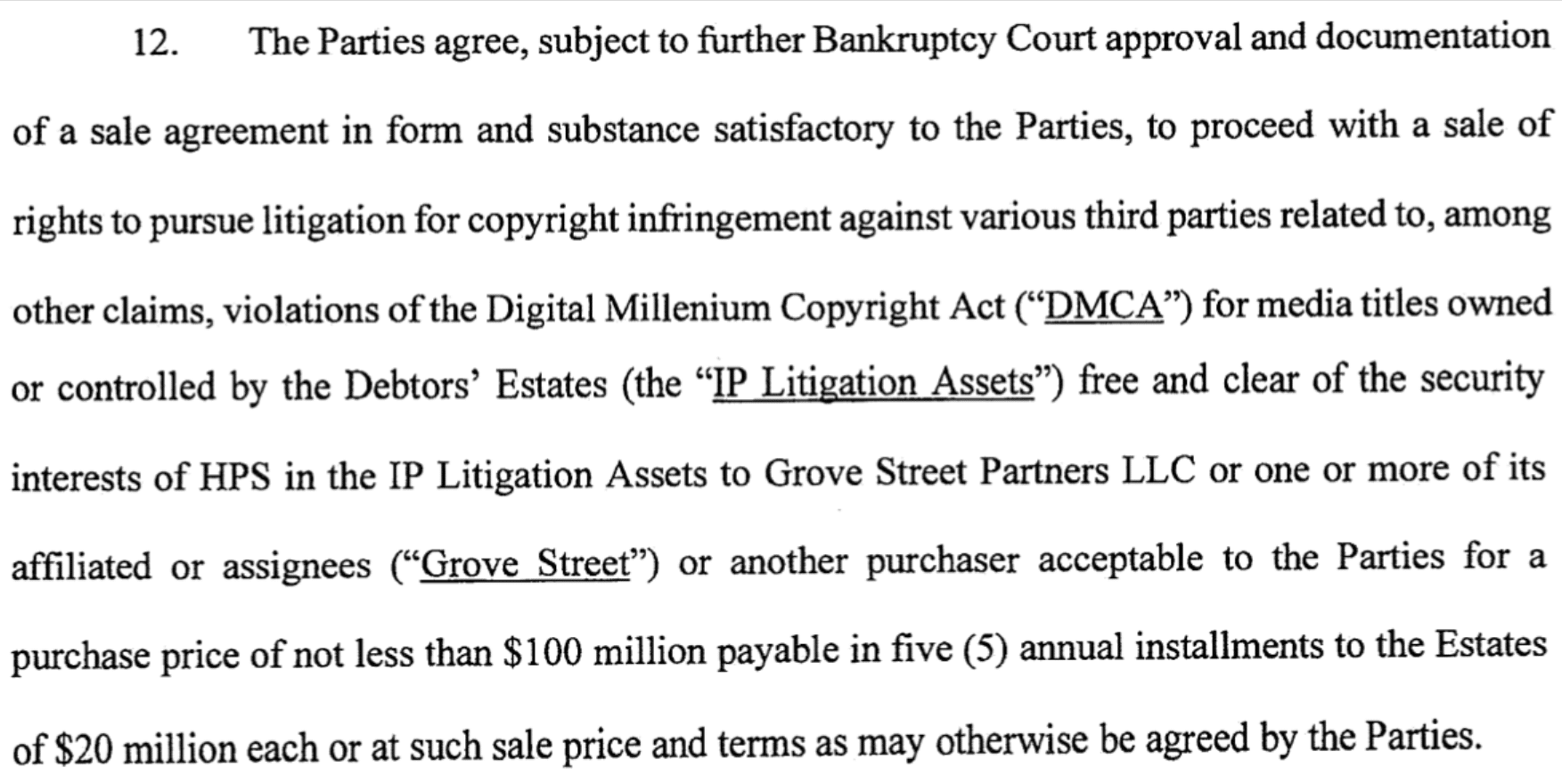
    During a hearing at the bankruptcy court a few days ago, the trustee confirmed that while they have reached an “agreement in principle” with Grove Street, the formal purchase agreement is still being drafted and has not been executed. This means that there is no final price tag, although $100 million has been cited as the minimum.

    From the sharing agreement

    agreement

    $100 million is a substantial amount, especially considering that these litigation rights don’t guarantee success in court. In fact, the value of those rights largely depends on a case currently before the U.S. Supreme Court.

    This case, Cox Communications v. Sony Music Entertainment, asks the Court to define when an ISP can be held liable for the infringement of its subscribers.

    Cox was previously hit with a $1 billion jury verdict for failing to terminate repeat infringers despite receiving millions of DMCA notices. This led to several appeals and eventually ended up at the Supreme Court, where the Internet provider found the U.S. government on its side.

    The Supreme Court heard oral arguments in December 2025, and a final decision is expected to come in later this year. That decision could either cement the value of the rights at stake here, or make it much more challenging to recoup the investment.

    Private Lenders Get Most Money

    The approved sharing agreement governs how proceeds will be divided between the trustee, George L. Miller, and HPS Investment Partners, the primary secured lender owed at least $500 million in principal alone.

    Under the terms of the deal, the buyer of the rights will pay at least $100 million in five annual installments of $20 million each. After the trustee’s administrative costs are covered, the first $100 million in net proceeds splits 80% to the lenders and 20% to the estate. Above $100 million, the lenders’ share increases to 85%, with the estate receiving 15%

    During the proceedings, a secondary lender, MidCap Financial Trust, was added as a party by the court order, and it will receive a pro-rata share of the lender share, alongside HPS.

    The court also specifically preserved the rights of unions, including DGA, SAG-AFTRA, and WGA West, to ensure their outstanding payment claims remain active. However, with various parties seeking hundreds of millions in secured debt, it seems unlikely that everyone is made whole.

    A Web of Legal Troubles

    Speaking with TorrentFreak, Grove Street CEO Thomas Murphy confirmed that the external funds to acquire the rights are still in place, without mentioning any financial partners by name. First, however, a purchase agreement must be finalized.

    This agreement is also key for a separate lawsuit that was filed against the company by a former executive. As highlighted last October, Jamie Warren, the former CFO of both American Films and Grove Street Funding (which is linked to Grove Street Partners), sued both companies over unpaid salary in 2024.

    In May, 2025, a Texas federal court entered a final judgment in favor of the former employee, granting her $525,000, plus attorneys fees and costs. Thus far, the judgment has not been paid, but that could change soon.

    A day after the bankruptcy court approved the sale of litigation rights, Murphy informed the Texas court that a first payment toward the outstanding judgment will follow shortly, adding that the CSS deal is ‘the only way that reasonably happens.’

    Whether the sale will eventually go through has yet to be seen, but it is clear that a lot is riding on it: for Grove Street, its former CFO, Internet providers, lawyers, movie producers, and all the claim holders in the bankruptcy proceeding.

    And even if the sale goes through, the profitability of the deal will depend, in no small part, on what the Supreme Court decides in the Cox case in the months ahead.

    A copy of the order of the Delaware Bankruptcy Court, approving the sharing agreement (pdf) that effectively greenlights the deal, is available here (pdf).

    From: TF, for the latest news on copyright battles, piracy and more.

  • My impulsive father, and the hidden psychiatric side effects of dopamine-agonist drugs

    My impulsive father, and the hidden psychiatric side effects of dopamine-agonist drugs

    My Dad was Captain Sensible. Logical, frugal, sceptical and risk-averse. A classic ‘Acts of Service’ father – struggled to talk about emotions but would happily pick me and my mates up from a nightclub at 3am. We always knew there was nothing he wouldn’t do for us.

    He retired early in 2008, aged 54, after being diagnosed with Progressive Supranuclear Palsy (PSP). A year later his diagnosis was changed to Parkinson’s Disease. And for six years life was as good as it could be. He took the condition in his stride, kept active and socialising, and laughed at himself through his rigid face. He remained a protective and devoted father, helping care for my brother who was recovering from a traumatic brain injury.

    Everything changed in 2015 when he was prescribed a dopamine-agonist called Rotigotine. Dopamine-agonists are a family of drugs that work by activating your brain’s dopamine receptors.

    But he wasn’t told about the severe psychiatric side-effects – that 1 in 6 (some studies up to 1 in 3) Parkinson’s sufferers prescribed these drugs will develop an ‘Impulse Control Disorder’ (ICD), or what this means in practice. He wasn’t given the warnings academics have implored drug companies to provide for decades.

    In 2016 I got the shock of my life. Dad was skint. Actually, he was more than skint. He’d lost his life-savings of £250k and about £50k of credit card debts. It had been ‘invested’ into gold and property in Ghana, on the orders of his ‘girlfriend’, ‘Sandy’. Sadly and obviously, all bogus. Captain Sensible had fallen for a romance scam.

    I immediately took Dad to his GP. He tested for dementia, which Dad aced – slurring his reverse seven times tables perfectly. It would be a further two months of carnage before we made the connection with his medication. Lying, stealing, car-crashing, with a cold contempt that was just unrecognisable. It was like looking after his evil twin.

    I wondered if this was some sort of breakdown, or a secret side of him finally revealing itself, but when he compromised my brother’s health, it was clear to me this was way outside of what could ever be naturally occurring behaviour.

    Searching for answers, I opened his medication packet, unfolded the pamphlet, put on my reading glasses and went through the list of over 50 side-effects. Everything was there – weight loss, weight gain, high blood pressure, low blood pressure, insomnia, hypersomnia. Etc, etc, etc. Then ‘Impulse Control Disorder’. Once I Googled what this meant, it all made sense.

    We take for granted our ability to assess, filter and reject the thousands of thoughts and impulses that enter our minds every day. People don’t realise you can lose that. That’s what impulsiveness looks like. You think it, you do it.

    As I unravelled the scam, traced the communications and observed Dad in action, I realised he had absolutely no defence, no restraint. The impulsiveness, leading to hypersexuality, made Dad a romance scammer’s match made in heaven.

    He was immediately taken off Rotigotine and put onto his old medication, and gratefully without changes to his physical symptoms. The side-effects subsided, mostly. The hypersexually left, which made life a lot easier! The impulsiveness remained but to a far lesser extent. But he was a shadow of himself for the next six years, until his death in 2022.

    Sadly, my father’s story is far from unique.

    Around 1.5 million people are prescribed dopamine-agonist medication each year in the UK alone – for Parkinson’s Disease, Restless Leg Syndrome, and other conditions. Globally, it’s about 10-12 million. Given the estimated prevalence rates, over a million people will experience an ICD each year, and the drugs have been prescribed for decades.

    For patients on dopamine-agonist drugs, ICDs have led to porn and sex addictions, uncontrollable spending, pathological gambling. Often with disastrous consequences – relationship breakdown, financial ruin, homelessness, criminality, sexual violence (as offender and victim), suicide.

    Researchers and whistle-blowers have long told the drug companies the likelihood and severity of these side-effects are significantly underestimated. Cases first go undetected as the drugs impair judgement. And many cases go unreported – due to the extraordinary stifling power of shame and embarrassment, and stigma around mental health and sex – particularly among the elderly.

    And if you’re not sure about that, I want you to imagine how eager your parents might be to tell you about their sudden surge in libido, and how comfortable you might be in hearing that.

    In the US, researchers urged drug companies to provide a ‘black box’ warning on all packaging, like you see on a packet of cigarettes. But these calls were rejected. The drug companies claim they are now being honest and transparent with patients. But I argue the current guidance is wholly inadequate.

    When impulsiveness is listed amongst over 50 other side-effects, it reduces salience. It’s straightforward ‘information overload’, well understood to impair decision-making and increase deference to authorities. It means doctors and patients can’t prioritise, manage risks and make fully-informed decisions. Many practitioners just won’t raise these at all. It encourages the approach many take to medication of ‘well anything can happen here, so let’s just try and see how it goes, then we can always come off them’. But this strategy can completely fall apart when you are talking about addictive drugs with severe psychiatric side-effects that impair your judgement.

    Whilst not providing prevalence rates, the drug companies do promote so-called risk factors – groups of people they say are more at risk – e.g., young men with a history of addiction. But the data just doesn’t stand up to scrutiny. Whilst these groups may be more likely to report impulsive behaviour, this doesn’t correspond to being more likely to experience it. Thought experiment – do you think women in their 80s are more or less likely to admit they’ve been watching porn all day than men in their 20s?

    But the behavioural science is clear. People who fall outside these risk factors (the vast majority of patients) feel reassured, and downgrade and dismiss the risks. Even told not to worry. We are naturally wired to believe that bad things happen to other people, never us. The prospect of losing ourselves is an uncomfortable feeling. We look for reasons to disbelieve it. And it is human nature to favour information that makes us feel safe. The guidance plays on basic human normalcy, optimism and confirmation biases. This is behavioural science 101.

    The simple truth is these side-effects happen to anyone, and do, frequently. But this isn’t made explicit.

    But I’m hopeful awareness of these drugs will soon improve. And this is why I took part in the BBC4 docuseries, “Impulsive”, also available on Spotify, talking candidly about my father’s raging libido and terrible financial decisions. I want to help prevent these kinds of disasters going forward and help people join the dots of the past.

    In the week after the podcast, hundreds of people have contacted the BBC to say ‘that’s me’ and ‘that’s my loved one’. Thousands more won’t have got in contact but would have thankfully made the connection. I expect this to continue, once the lid has been taken off and people realise their actions weren’t their fault, that there is nothing to be embarrassed about, that there is safety now in coming forward and talking about these things.

    And hopefully this will lead to change in the future – honest information, stronger warnings, fit-for-purpose safeguarding and monitoring. But it may also help to reframe so many confusing and painful memories. I’ve read comments of ‘well that explains Mum’s behaviour before she died’, and many similar. I understand the pain of wondering who our loved ones really are, what this makes ourselves. I hope further awareness can bring some relief and solace to people.

    I recommend giving the podcast a listen. And if considering these medications, please discuss specifically with your doctor and ask them for further information on the risks and approaches to monitoring and safeguarding

    Thanks for reading.

    ****

    Mad in the UK hosts blogs by a diverse group of writers. The opinions expressed are the writers’ own.

    The post My impulsive father, and the hidden psychiatric side effects of dopamine-agonist drugs appeared first on Mad in the UK.

  • Using alternative medicine to treat cancer, even alongside conventional therapies, is still a bad idea

    With the MAHA movement poised to introduce a lot more “integrative” or “complementary and alternative” treatments into oncology (and medicine in general), a new study shows the likely result.

    The post Using alternative medicine to treat cancer, even alongside conventional therapies, is still a bad idea first appeared on Science-Based Medicine.

  • Fears of two-tier health system as more turn to private care, says watchdog

    The patient watchdog warns of two-tier service as polling shows numbers paying for care is on the rise.
  • People turn to private health care to beat NHS waits, says watchdog

    The patient watchdog warns of two-tier service as polling shows numbers paying for care is on the rise.
  • Top 10 Most Pirated Movies of The Week – 03/16/2026

    Top 10 Most Pirated Movies of The Week – 03/16/2026

    The data for our weekly download chart is estimated by TorrentFreak, and is for informational and educational reference only.

    Downloading content without permission is copyright infringement. These torrent download statistics are only meant to provide further insight into piracy trends. All data are gathered from public resources.

    This week we have two newcomers on the list. “Crime 101” is the most shared title.

    The most torrented movies for the week ending on March 16 are:

    Movie Rank Rank last week Movie name IMDb Rating / Trailer
    Most downloaded movies via torrent sites
    1 (…) Crime 101 7.0 / trailer
    2 (3) War Machine 6.5 / trailer
    3 (2) Mercy 6.1 / trailer
    4 (1) Marty Supreme 8.0 / trailer
    5 (4) The Housemaid 6.9 / trailer
    6 (9) Cold Storage 6.2 / trailer
    7 (5) Shelter 6.2 / trailer
    8 (back) One Battle After Another 7.7 / trailer
    9 (6) 28 Years Later: The Bone Temple 7.5 / trailer
    10 (7) Zootopia 2 7.6 / trailer

    Note: We also publish an updating archive of all the list of weekly most torrented movies lists.

    From: TF, for the latest news on copyright battles, piracy and more.

  • Uni student among two dead in Kent meningitis outbreak

    Eleven people in the Canterbury area are also seriously ill in hospital, the BBC understands.
  • The Foilies 2026

    Recognizing the Worst in Government Transparency 

    The Foilies were written by EFF’s Beryl Lipton, Dave Maass and Aaron Mackey and MuckRock’s  Dillon Bergin, Kelly Kauffman and Anna Massoglia. 

    For the last six years, a class of journalism students at the University of Nevada, Reno, has kicked off each semester by filing their first Freedom of Information Act (FOIA) requests.

    The assignment: Request copies of complaints sent to the Federal Communications Commission (FCC) about their favorite TV show, a local radio station, or a major broadcast event, such as the Grammys or the Super Bowl halftime show. The students are learning that the federal government and every state have laws establishing the public’s right to request and receive public records. It’s a bedrock principle of democracy: If a government belongs to the people, so do its documents. 

    In the past, the FCC always provided records within a few weeks, if not days. But that changed in September when students requested consumer complaints filed against NPR and PBS stations to see if there was absolutely anything at all to merit defunding public media. Seven months later — crickets. 

    Now the students are learning to persevere even when public officials demonstrate an utter disdain for transparency. And The Foilies are here for it. 

    Established in 2015, The Foilies are an annual project by the Electronic Frontier Foundation and MuckRock to recognize the agencies, officials and contractors that thwart the public’s right to know. We give out these tongue-in-cheek “awards” during Sunshine Week (March 15-21), a collective effort by media and advocacy organizations to highlight the importance of open government.  

    This year, we’ve got a few “winners” whose behavior defies belief. 

    But it’s not all negative. Those same Reno students are also assigned to file public records requests for restaurant health inspections. This semester, the records started to show up in their inboxes within 20 minutes. 

    If every agency followed Northern Nevada Public Health’s example, we could sunset this Sunshine Week project. 

    Quick links:

    The Love Letters Award – Gov. Greg Abbott 

    Last spring, the office of Texas Gov. Greg Abbott withheld communications between himself and one of the state’s most powerful business figures, Elon Musk. The office claimed that the communications were exempt from public records law because they would reveal confidential legal and policy discussions, including how the state entices private companies to do business in Texas, or “intimate and embarrassing” information.

    The claims were unelaborated boilerplate language based on exemptions in Texas’ public records law. But if you’re wondering what “intimate” and “embarrassing” exchanges Abbott and Elon Musk shared over email, you may be waiting a while. 

    Last fall, the Office of the Texas Attorney General ordered Texas Gov. Greg Abbott’s office to release nearly 1,400 pages of communications between Abbott and Musk. About 1,200 of those pages were fully redacted–just sheets of gray obscuration. The records that were released don’t reveal much more than an invitation to a happy hour or a reminder of the next SpaceX launch.

    The Surcharge, Eh? Award – Vancouver, B.C. 

    Vancouver residents must now pay twice for public records. Despite taxes already funding the creation and storage of government records, the City Council approved charging people $10 Canadian (about $7.33 in the United States) every time they ask for “non-personal” public records.

    Officials claim the fee is necessary to deter misuse and cover some administrative costs. The only people abusing anything, however, are the officials who imposed this tax on the public. The message Vancouver is sending is as crisp as a newly minted $10 note: Secrecy is a higher priority than public accountability.

    The Shady Screenshot Award – Department of Homeland Security 

    The Department of Homeland Security’s banner year of lawlessness included backsliding on its transparency obligations.

    In response to a request from the nonprofit American Oversight, DHS stated that it was no longer automatically archiving text messages sent between officials. The department clarified that it had a new, and much worse, records retention policy. Instead of archiving officials’ text messages as the agency had done before, DHS now asks officials to take screenshots of any text messages conducting government business on their work phones. 

    It’s hard to see the change as anything more than a giant middle finger to the public, especially because the Federal Records Act requires agencies to retain all records officials create while conducting their public duties, regardless of format. We won’t hold our breath waiting on DHS officials to dutifully press the volume and power button on their phones to record every text message they send and receive. 

    The Discardment of Government Efficiency Award – DOGE 

    As the Trump administration took over last year, there was a looming threat over government transparency: the so-called Department of Government Efficiency, also known as DOGE. 

    Billionaire Elon Musk, soon to be the de facto leader of DOGE, proudly claimed “there should be no need for FOIA requests” and “all government data should be default public for maximum transparency.” What quickly became apparent was there may be no need for FOIA requests, because there may be no FOIA officers to fulfill those requests.

    DOGE quickly went to work slashing through the federal government, including seizing control of the U.S. Institute of Peace. Part of the takeover included restricting access to the agency’s FOIA system and firing the employees responsible for fulfilling FOIA requests, according to a letter sent to Bloomberg reporter Jason Leopold. Meanwhile, when CNN filed a FOIA request with the Office of Personnel Management (OPM) for information about Musk and DOGE’s security clearance, they were told: “Good luck with that,” because the FOIA officers had been fired. 

    DOGE also argued that its own records are exempt from FOIA under the Presidential Records Act, meaning records cannot be accessed until five years after President Donald Trump is out of office. 

    While DOGE “doesn’t exist” anymore according to the OPM, there remains a lasting dark mark on the state of FOIA and records management. 

    The Secret Eyes in the Sky Award – Chula Vista Police Department, Calif.

    An illustration of a quadrotor drone with an eye and a badge.

    In 2021, Arturo Castañares at La Prensa San Diego filed a request with the Chula Vista Police Department for copies of videos taken by drones responding to 911 calls as part of the city’s “drone as first responder” program. One of the goals was to evaluate the technology’s efficacy and risks to civil liberties. 

    The city worked overtime to maintain the secrecy of the footage at the same time officials publicly touted the drones as a revolution in policing. That’s some impressive trust-us-but-don’t-verify chutzpah.

    The city argued that every second of every video recorded by its drones was categorically off limits because they were law enforcement investigative records. They even got a trial court to initially buy the argument.

    But an appellate court ruled that the investigatory records exemption is more limited, shielding only drone footage that is part of a criminal investigation or evidence of a suspected crime. Footage of wildfires, car wrecks, wild animal sightings and the like are not criminal investigations and must be disclosed.

    The California Supreme Court rejected both of CVPD’s appeals and a trial court bench slapped the city for inaccurate and incomplete court filings. In the end, the city had to shell out north of $400,000 to its outside lawyers, and then paid Castañares’ lawyers more than $500,000 when he prevailed. 

    So what were Chula Vista police hiding? A bunch of routine service calls, such as unverified reports of a vehicle fire and a vehicle collision.

    Now, according to La Prensa’s reporting, officials are trying to raid a public safety fund created by voters to reimburse the city for the cost of its ill-advised secrecy. 

    The City of Darkness Award – Richmond, Va. 

    Richmond’s creation of a new FOIA Library may seem like a step toward transparency, but there are questions about the city’s commitment after it left the same officials subject to records requests in charge of curating which records might be released.

    Faced with a plan to post all of the city’s eligible public records released under Virginia’s “sunshine” law, the Richmond City Council instead opted to go with the mayor’s alternative proposal. That plan lets the mayor’s administration — the same one that might be the subject of those records — decide what’s worth posting to the library.

    Instead of providing access to all public records that the city released under the Virginia Freedom of Information Act, the library will only contain a subset that officials believe meet certain criteria, including records that the administration deems “relevant” to city business or that would aid “accountability.” The city cites concerns that “transparency without context” might be too confusing for the average citizen. Forgive us for having more faith in Richmond residents than its leaders do.

    The city’s secrecy shenanigans extend beyond the FOIA library.

    In an ongoing legal battle, attorneys representing Richmond asked a judge to prohibit former city FOIA officer Connie Clay from filing FOIA requests seeking information about her firing, and sought a gag order to prevent her from talking about the case. Clay alleges she was fired for insisting the city comply with public records law, describing what she calls a “chaotic and mismanaged” and illegal FOIA request process. Rather than agree to a $250,000 settlement, Richmond has spent more than $633,000 in taxpayer funds on legal costs. The trial and the FOIA library launch are both slated for the summer of 2026. 

    The Flock You Awards – Multiple Winners

     A police officer with dollar-sign sunglasses holding his hand out for money.

    If you live in one of the 5,000 cities where surveillance vendor Flock Safety claims to have established relationships with local cops, you may have noticed the sudden installation of little black cameras on poles by the side of the road or at intersections. These are automated license plate readers (ALPRs), which document every vehicle that passes within view, including the license plate, color, make, model and other distinguishing characteristics. The images are fed to Flock’s servers, and the company encourages police to share the images collected locally with law enforcement throughout the country. Each year, law enforcement agencies across the country conduct tens of millions of searches of each other’s databases. 

    In 2025, journalists and privacy advocates started filing public records requests with agencies to get spreadsheets called a “Network Audit,” which shows every search, including who ran it and why. Accessing these audits uncovered abuse of the system including: investigating a woman who received an abortion, targeting immigrants, surveilling protesters, and running racist searches targeting Roma people

    In response, some cities have terminated their contracts with Flock Safety. Other law enforcement agencies, and Flock itself, have gone a different direction: 

    Taunton Police Department, Mass.: The police department told the ACLU of Massachusetts to cough up $1.8 million if the organization wanted its network audit logs–the highest public records fee we documented this year. The civil liberties group filed requests with agencies throughout the state for the audits, and most agencies handed over the spreadsheets for free and with little fanfare. Taunton, however, said it would take 20,000 hours to process the request, at $86.57 an hour. 

    Orange County Sheriff’s Department, Calif.: The Orange County Sheriff gave a number of reasons it wouldn’t release the network audit logs in response to a public records request. The most inane (and misspelled one): It would “disincentive law enforcement from conducting such research.” Aren’t cops the ones who say if you’re not doing anything wrong, you’ve got nothing to hide? Well, well, well, how the tables have turned.

    Flock Safety: The company responded to criticisms of its ALPR network by sending legal threats aimed at trying to silence its critics. First, the company used a bogus trademark claim to threaten DeFlock.me–a crowdsourced map of ALPR. (EFF represented its creator.) Then it hired a company to try to get the hosts of HaveIBeenFlocked.com, which hosts an interface for searching these network audits, to remove the site from the internet. 

    The Database Deletion Award – Muneeb and Sohaib Akhter, formerly of Opexus

    Brothers Muneeb and Sohaib Akhter are accused of essentially hitting delete on government data, destroying access to information contained in millions of records. 

    The government hired a federal contractor called Opexus, which hosts data and provides services to dozens of federal agencies. The company employed the Akhter siblings, though in February 2025, Opexus learned about the brothers’ previous convictions for wire fraud and obstructing justice. Soon after, the company fired the pair. But, according to prosecutors, the two decided to double down on being wildly unsuited for administrative access to government records systems. 

    The Akhters immediately turned around and retaliated “by accessing computers without authorization, issuing commands to prevent others from modifying the databases before deletion, deleting databases, stealing information, and destroying evidence of their unlawful activities,” according to the U.S. Department of Justice.

    The two have been accused of deleting 96 government databases, many of which contained FOIA records and sensitive investigative files. Their indictment alleges that a minute later, one brother queried an artificial intelligence tool for “how to clear system logs following the deletion of databases.” The brothers are also charged with stealing government records and conspiracy to commit computer fraud. 

    The Brothers Akhter allegedly took mere moments to destroy untold amounts of information that belonged to the public. Though they could face decades in prison, the public may never know the extent of the damage.

    Want more FOIA horror stories? Check out The Foilies archives!

  • Rightsholders Crowdsource Piracy Link Reporting With ‘Online Hunter’ Game

    Rightsholders Crowdsource Piracy Link Reporting With ‘Online Hunter’ Game

    Anti-piracy reporting tools have existed for years, but generally speaking, there is little interest from the public to expose pirates.

    The Business Software Alliance previously offered people hard cash in exchange for tips, which helped, but there are other potential reward options too.

    Online Pirate Hunters

    The Czech anti-piracy company Warezio, which works for various international rightsholders, believes that it can motivate people to report pirate streaming links through a gamified experience. The company recently launched a new platform, inviting the public to help spot links to pirated content.

    The ‘Online Hunter’ portal effectively turns people into pirate ‘hunters.’ As the name suggests, users of the site can report pirate links on various platforms and earn points when these are reviewed and approved.

    There’s a wide variety of content that users can report, ranging from blockbuster movies to current live streaming events.

    Report a Link

    report

    Newly discovered live streaming links have the most value, while previously reported content doesn’t bring in many points. With sufficient points, users can then buy vouchers for online streaming services such as Netflix, HBO, or Oktagon MMA, which is an official partner.

    The new portal has not been widely promoted because Warezio prefers a soft launch. However, the first links have already been submitted. This is in part due to targeted promotion, which showed a banner to a select group of Oktagon streamers during the last event.

    Banner for ‘Online Hunters’

    banner

    ‘Online Hunter’ is currently targeted at countries in Eastern and Central Europe, but Warezio’s Jakub Hájek informs TorrentFreak that he hopes to expand it to Western Europe in the near future. That might also open the door to more rightsholders, he says, as “reporting to the authorities” is generally frowned upon in Eastern Europe.

    Pirates Knock Out?

    At the moment, Oktagon MMA is the only named partner. The MMA organization operates based on a pay-per-view model, which makes it more vulnerable to piracy than traditional VOD platforms.

    “The financial damages caused by piracy are noticeable,” Oktagon’s Martin Šteso tells TorrentFreak

    Šteso explains that the company previously relied on its social media team to track down infringing streams. However, that approach had significant limits in scale and reach, especially when dealing with a range of semi-private communities on services such as Discord.

    By crowdsourcing detection of piracy threats that automated tools typically miss, Oktagon hopes to fight back against pirate streaming.

    “The main goal is to uncover piracy groups, particularly those operating on platforms like Discord, that are otherwise incredibly difficult to detect. Because many of these communities are private and restricted to smaller circles, manual detection is nearly impossible,” Šteso notes.

    Points, Levels and Leaderboards

    ‘Online Hunter’ currently supports reporting links on nine platforms: Discord, Telegram, Facebook, Instagram, Reddit, TikTok, Twitter/X, YouTube, and ok.ru. As users report more links, they can reach new levels and climb the public leaderboard as their approved points increase.

    Whether this gamified approach will appeal to the public at large has yet to be seen. Currently, there are just a few active flaggers on the platform, according to the leaderboard.

    The Leaderboard

    leaderboard

    Warezio certainly believes in the project, and the company informs us that more rightsholders are welcome to get in touch if they actively would like to participate.

    Oktagon MMA hopes that ‘Online Hunter’ will ultimately become a household tool to identify hidden pirate communities. Thus far, the MMA organization has promoted ‘Online Hunter’ to a select group of users, but a broader promotion is also being considered.

    Whether crowdsourced human intelligence is a durable addition to automated anti-piracy tools remains to be seen, but a project like Online Hunters will certainly get people talking.

    From: TF, for the latest news on copyright battles, piracy and more.

  • Middle East crisis: UN health agency releases emergency funds for Lebanon, Iraq, Syria

    The UN World Health Organization (WHO) is releasing another $2 million in emergency funds to support health systems in Lebanon, Iraq and Syria as strikes against Iran by the US and Israeli continue amid counterstrikes across the Gulf and wider region by Tehran.