Blog

  • Pluralistic: Cindy Cohn’s “Privacy’s Defender” (09 Apr 2026)

    Today’s links


    Cindy Cohn’s “Privacy’s Defender” (permalink)

    I’ve known EFF executive director Cindy Cohn for 27 years. I met her when I needed cyberlaw advice for a startup I’d helped found. We got along so well that I ended up quitting the startup and going to work at EFF. Now, Cindy’s memoir, Privacy’s Defender, is on the shelves:

    https://mitpress.mit.edu/9780262051248/privacys-defender/

    I’m hardly a disinterested party here, obviously. I was at Cindy’s wedding, I’ve danced with her at Burning Man, and I’ve worked with her for most of my adult life. What’s more, I was present for many of the pivotal moments she recounts in this book. But still: this is a great book that I found utterly captivating.

    Cohn’s been with EFF since its earliest days, when she litigated one of the most important cases in computing history, the Bernstein case, which legalized civilian access to encryption technology and changed the world:

    https://www.eff.org/deeplinks/2015/04/remembering-case-established-code-speech

    Cryptographers had been arguing with the US government over the ban on working encryption technology for years before Cohn joined the fight, and they’d tried all manner of arguments to overturn the ban: technical arguments, political arguments, financial arguments. All of these efforts failed – they didn’t even make a dent.

    Cohn’s genius was the way she formulated a free speech argument about the ban on encryption: arguing that computer code was a form of expressive speech, entitled to protection under the First Amendment. While she didn’t come up with this idea, it was her gift for assembling a narrative and a cadre of unimpeachable experts that carried the day.

    In this age of bad faith right-wing trolling about “free speech” and “cancel culture,” it’s easy to forget how central free speech cases and causes have been for the advancement of human rights and human thriving. Free speech cases gave us the nation’s first privacy protections, protection for unions, and protection for civil rights organizers.

    Cohn never forgets this. Her decades with EFF are a history of the fight for speech rights (and thus privacy rights) on the internet. After the US government seized on the 9/11 attacks as a pretext to dismantle privacy and turn the internet into a system of ubiquitous surveillance, Cohn (along with EFF, of course!) was at the center of the fight for digital rights. The same prescience and strategic brilliance that led her to take up the Bernstein case and win it were with her through those millennial years, and her description of our cases, campaigns and fights in those years vividly foreshadows the moment we are in today.

    The same goes for her “three letter agency” chapter, which takes up our fights against the NSA and other US agencies in the wake of whistleblower disclosures by Mark Klein and Edward Snowden. These accounts are one part master class in legal tactics; one part battle cry for a global pushback against the transformation of the internet into the perfect surveillance and control machine, and one part personal memoir of a tactician, finding ways to leverage a righteous cause to raise a guerrilla army of experts, co-counsel, amici, and champions who carried our message to the world.

    All of this is connected back to her other legal career, as a human rights defender litigating on behalf of the survivors of a massacre perpetrated by a death squad working on behalf of Chevron in Nigeria. Cohn skilfully connects these very concrete, visible human rights struggles to the invisible – and no less important – human rights work she carried out for EFF.

    I didn’t just have a front-row seat for this stuff – I had backstage passes for a lot of it (though not the juiciest national security cases, which required EFF lawyers to maintain total secrecy from colleagues, spouses, even our board, on pain of a long prison sentence for disclosing classified information). Even so, Cohn’s pacey, smart retelling of these events brought them to life for me, and of course, there’s a coherence that you get after the fact that is missing when you’re living through it in a moment.

    But what really enlivened this delightful book were the personal details that Cohn weaves into the story. I’ve always known that she was an adoptee (and I even have a small, strange, coincidental connection to her birth family), but Cohn’s intimate, personal, frank memoir of her early family life, and her bittersweet connection to her birth family were so intimate and well-told that I felt like I was getting to know my dear friend all over again.

    Cindy is retiring from EFF (but not the law) in a couple of months. This book is a beautiful capstone to a brilliant career that defined the fight for cyber rights, and a deep, accessible dive into the defining tech and human rights battles of this century.


    Hey look at this (permalink)


    A shelf of leatherbound history books with a gilt-stamped series title, 'The World's Famous Events.'

    Object permanence (permalink)

    #15yrsago Advanced office-supply sculpture: paperclip dodecahedron https://web.archive.org/web/20171122055732/https://makezine.com/2011/04/07/paperclip-snub-dodecahedron/

    #15yrsago World Bank: gold farming (etc) paid poor countries $3B in 2009 https://web.archive.org/web/20110410134037/http://www.infodev.org/en/Publication.1056.html

    #15yrsago Class war comics: Scrap Iron Man versus international capital https://web.archive.org/web/20110410215907/https://www.chinamieville.net/post/4406165249/rejected-pitch

    #15yrsago Colombian Justice Minister ramming through extremist copyright legislation without public consultation https://web.archive.org/web/20110707053554/http://karisma.org.co/?p=667

    #15yrsago Glenn Beck’s brain https://www.motherjones.com/politics/2011/03/glenn-beck-fox-news-brain-chart/

    #10yrsago Why 40 years of official nutritional guidelines prescribed a low-fat diet that promoted heart disease https://www.theguardian.com/society/2016/apr/07/the-sugar-conspiracy-robert-lustig-john-yudkin

    #10yrsago Fearing the Pirate Party, Iceland’s government scrambles to avoid elections https://web.archive.org/web/20160407183022/https://theintercept.com/2016/04/07/icelands-government-tries-cling-protesters-pirates-gates/

    #10yrsago The price of stealing an identity is crashing, with no bottom in sight https://qz.com/656459/its-never-been-cheaper-to-steal-someones-digital-identity-on-the-internet

    #10yrsago Bernie Sanders can only win if nonvoters turn out at the polls, and they almost never do https://web.archive.org/web/20160408145116/https://www.vox.com/2016/4/6/11373862/bernie-sanders-voter-lists

    #10yrsago To understand the link between corporations and Hillary Clinton, look at philosophy, not history https://web.archive.org/web/20160406223353/https://www.thenation.com/article/the-problem-with-hillary-clinton-isnt-just-her-corporate-cash-its-her-corporate-worldview/

    #10yrsago The US Government’s domestic spy-planes take weekends and holidays off https://www.buzzfeednews.com/article/peteraldhous/spies-in-the-skies

    #10yrsago A perfect storm of broken business and busted FLOSS backdoors everything, so who needs the NSA? https://www.youtube.com/watch?v=fwcl17Q0bpk

    #5yrsago Door Dashers organize app-defeating solidarity https://pluralistic.net/2021/04/07/cruelty-by-design/#declinenow

    #5yrsago Leaked NYPD “goon squad” manual https://pluralistic.net/2021/04/07/cruelty-by-design/#blam-blam-blam

    #1yrago Tariffs and monopolies https://pluralistic.net/2025/04/07/it-matters-how-you-slice-it/#too-big-to-care


    Upcoming appearances (permalink)

    A photo of me onstage, giving a speech, pounding the podium.


    A screenshot of me at my desk, doing a livecast.

    Recent appearances (permalink)


    A grid of my books with Will Stahle covers..

    Latest books (permalink)


    A cardboard book box with the Macmillan logo.

    Upcoming books (permalink)

    • “The Reverse-Centaur’s Guide to AI,” a short book about being a better AI critic, Farrar, Straus and Giroux, June 2026 (https://us.macmillan.com/books/9780374621568/thereversecentaursguidetolifeafterai/)
    • “Enshittification, Why Everything Suddenly Got Worse and What to Do About It” (the graphic novel), Firstsecond, 2026

    • “The Post-American Internet,” a geopolitical sequel of sorts to Enshittification, Farrar, Straus and Giroux, 2027

    • “Unauthorized Bread”: a middle-grades graphic novel adapted from my novella about refugees, toasters and DRM, FirstSecond, 2027

    • “The Memex Method,” Farrar, Straus, Giroux, 2027


    Colophon (permalink)

    Today’s top sources:

    Currently writing: “The Post-American Internet,” a sequel to “Enshittification,” about the better world the rest of us get to have now that Trump has torched America. First draft complete. Second draft underway.

    • “The Reverse Centaur’s Guide to AI,” a short book for Farrar, Straus and Giroux about being an effective AI critic. LEGAL REVIEW AND COPYEDIT COMPLETE.
    • “The Post-American Internet,” a short book about internet policy in the age of Trumpism. PLANNING.

    • A Little Brother short story about DIY insulin PLANNING


    This work – excluding any serialized fiction – is licensed under a Creative Commons Attribution 4.0 license. That means you can use it any way you like, including commercially, provided that you attribute it to me, Cory Doctorow, and include a link to pluralistic.net.

    https://creativecommons.org/licenses/by/4.0/

    Quotations and images are not included in this license; they are included either under a limitation or exception to copyright, or on the basis of a separate license. Please exercise caution.


    How to get Pluralistic:

    Blog (no ads, tracking, or data-collection):

    Pluralistic.net

    Newsletter (no ads, tracking, or data-collection):

    https://pluralistic.net/plura-list

    Mastodon (no ads, tracking, or data-collection):

    https://mamot.fr/@pluralistic

    Bluesky (no ads, possible tracking and data-collection):

    https://bsky.app/profile/doctorow.pluralistic.net

    Medium (no ads, paywalled):

    https://doctorow.medium.com/

    Tumblr (mass-scale, unrestricted, third-party surveillance and advertising):

    https://mostlysignssomeportents.tumblr.com/tagged/pluralistic

    When life gives you SARS, you make sarsaparilla” -Joey “Accordion Guy” DeVilla

    READ CAREFULLY: By reading this, you agree, on behalf of your employer, to release me from all obligations and waivers arising from any and all NON-NEGOTIATED agreements, licenses, terms-of-service, shrinkwrap, clickwrap, browsewrap, confidentiality, non-disclosure, non-compete and acceptable use policies (“BOGUS AGREEMENTS”) that I have entered into with your employer, its partners, licensors, agents and assigns, in perpetuity, without prejudice to my ongoing rights and privileges. You further represent that you have the authority to release me from any BOGUS AGREEMENTS on behalf of your employer.

    ISSN: 3066-764X

  • Do our mitochondria need support?

    Many products have claims to to “support” your mitochondria. For healthy adults, these claims remain largely speculative and unproven.

    The post Do our mitochondria need support? first appeared on Science-Based Medicine.

  • Kocowa Secures Win Against Dramacool Pirates, U.S. Court Grants Domain Takeovers

    Kocowa Secures Win Against Dramacool Pirates, U.S. Court Grants Domain Takeovers

    Pirate streaming network Dramacool and several associated sites shut down in November 2024, citing legal pressure from copyright holders.

    The operators of the Asian drama and anime portal never revealed who was behind that pressure, but court records later showed it was Wavve Americas Inc., the parent company of legal Korean streaming service Kocowa.

    Wavve had filed a copyright lawsuit in Arizona federal court against the unknown operators of multiple Dramacool domains, hoping to take the associated sites offline permanently.

    Defendants Go Silent

    When Wavve eventually identified the defendants, they were scattered across Thailand, Vietnam, Pakistan, the Netherlands, and New Jersey.

    Kocowa identified domain operators in Thailand, Vietnam, Pakistan, the Netherlands, and New Jersey. The amended complaint named Asian C, Tommy USA, Najeeb Ullah Mirani, Baidar Bakhtand, and Dorothy Bradshaw, none appeared in court to answer the complaint.

    Meanwhile, some Dramacool domains remained operational. While these may include copycat sites unrelated to the original operation, the ongoing copyright infringement is a serious problem for Kocowa.

    To break this impasse, Wavve filed a motion for default judgment in September 2025, noting that some defendants had not only ignored the litigation but expanded their operations to new domains while the case was pending.

    The company did not seek any monetary compensation but simply requested an order that would allow the company to take over the Dramacool domain names.

    Default Judgment Entered

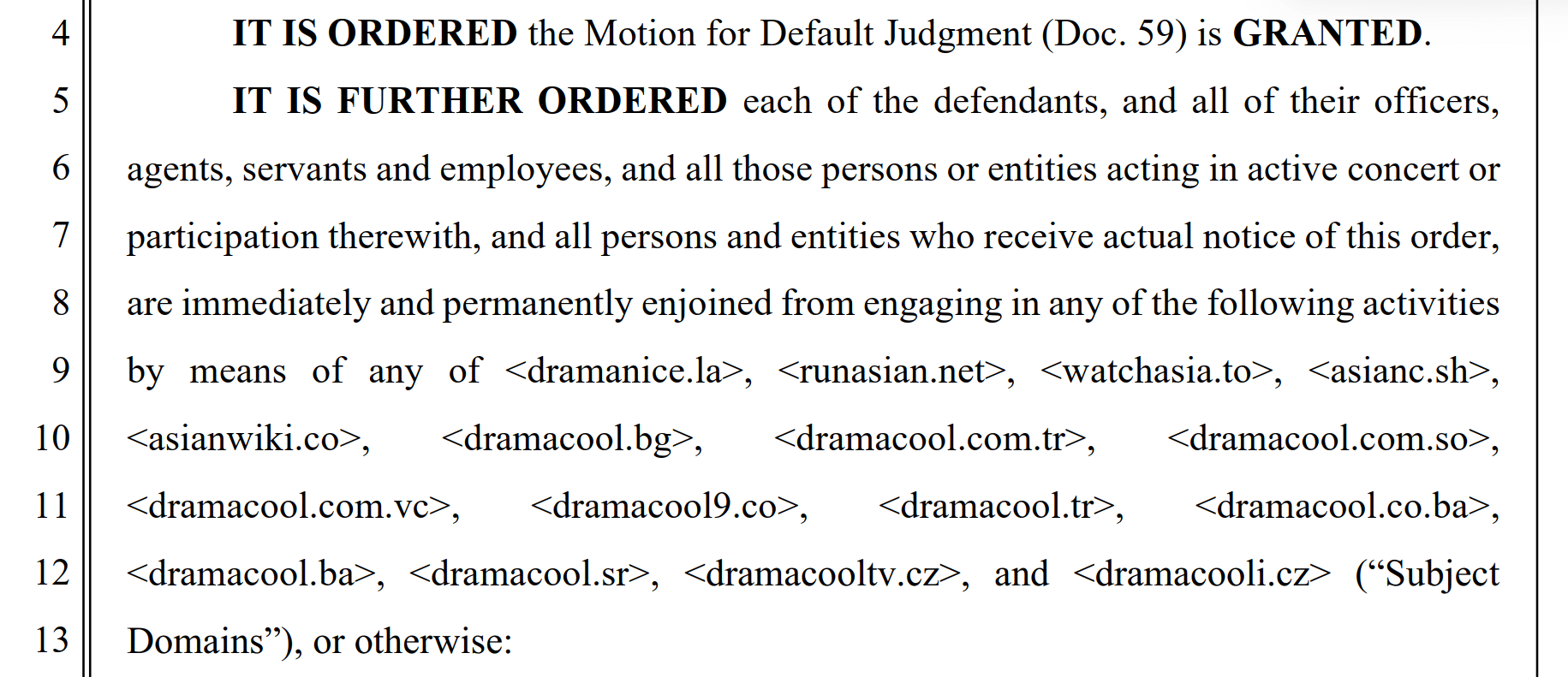
    Earlier this week, U.S. District Judge Krissa M. Lanham granted the motion for a default judgment in full. The court found the requested injunction proportional and appropriate.

    “Requiring defendants stop their infringing activities will not cause any legitimate hardship. And the public interest is served in enforcing copyright law. A permanent injunction prohibiting defendants from continuing their activities is appropriate,” the order reads.

    The order prohibits all defendants from operating the sixteen named domain names, including watchasia.to and asianwiki.co, and also bars them from registering or owning any new piracy-linked domain names.

    Default Judgment

    default

    Wavve had acknowledged that an award for monetary damages would be meaningless, as the foreign pirate site operators are unresponsive. Therefore, they set all their hopes on a domain transfer order, which the court granted as well.

    Domain Transfers Granted

    In the order, Judge Lanham acknowledged that domain transfers are legally contested territory in copyright cases. The standard trademark statute that typically enables such transfers does not apply here, as the lawsuit did not include trademark claims.

    However, since none of the defendants put up a defense and because several of the associated sites remain online, the transfers were granted. This was in part justified by judgments in a number of other courts, which approved domain transfers in similar copyright cases.

    The order notes that domain transfers can be an appropriate remedy when there are indications that the defendants will not comply with an injunction. That is the case here, Judge Lanham concluded.

    “Here, defendants concealed their identities, ignored this litigation, and have an ‘established practice of evading copyright enforcement by moving their operation to new domains, even after having a judgment rendered against them’,” the order reads,

    “Wavve is entitled to an order transferring the domain names,” Judge Lanham adds.

    Dramacool Domains Still Online

    Whether Wavve can actually take control of all 16 domains remains to be seen, as not all registrars and registries may comply with U.S. court orders.

    Several of the original Dramacool-operated domains, including dramanice.la, runasian.net, watchasia.to, asianc.sh, and asianwiki.co, have been offline since the November 2024 shutdown.

    However, at least three of the named domains are still actively serving pirated content several days after the judgment was entered. Dramacool.bg, dramacool.com.tr, and dramacool.ba all remain online, redirecting visitors to functional streaming sites with full drama libraries.

    In closing, it is worth stressing that the permanent injunction prevents the defendants from registering new domain names for infringing purposes. However, the domain transfer order targeted at registrars and registries, is limited to the sixteen named domain names.

    A copy of the default judgment order, issued by U.S. District Judge Krissa M. Lanham, is available here (pdf). The clerk’s entry of default judgment is available here (pdf).

    From: TF, for the latest news on copyright battles, piracy and more.

  • America Has Long Targeted Muslims, But Today’s Hatred is Different

    America Has Long Targeted Muslims, But Today’s Hatred is Different

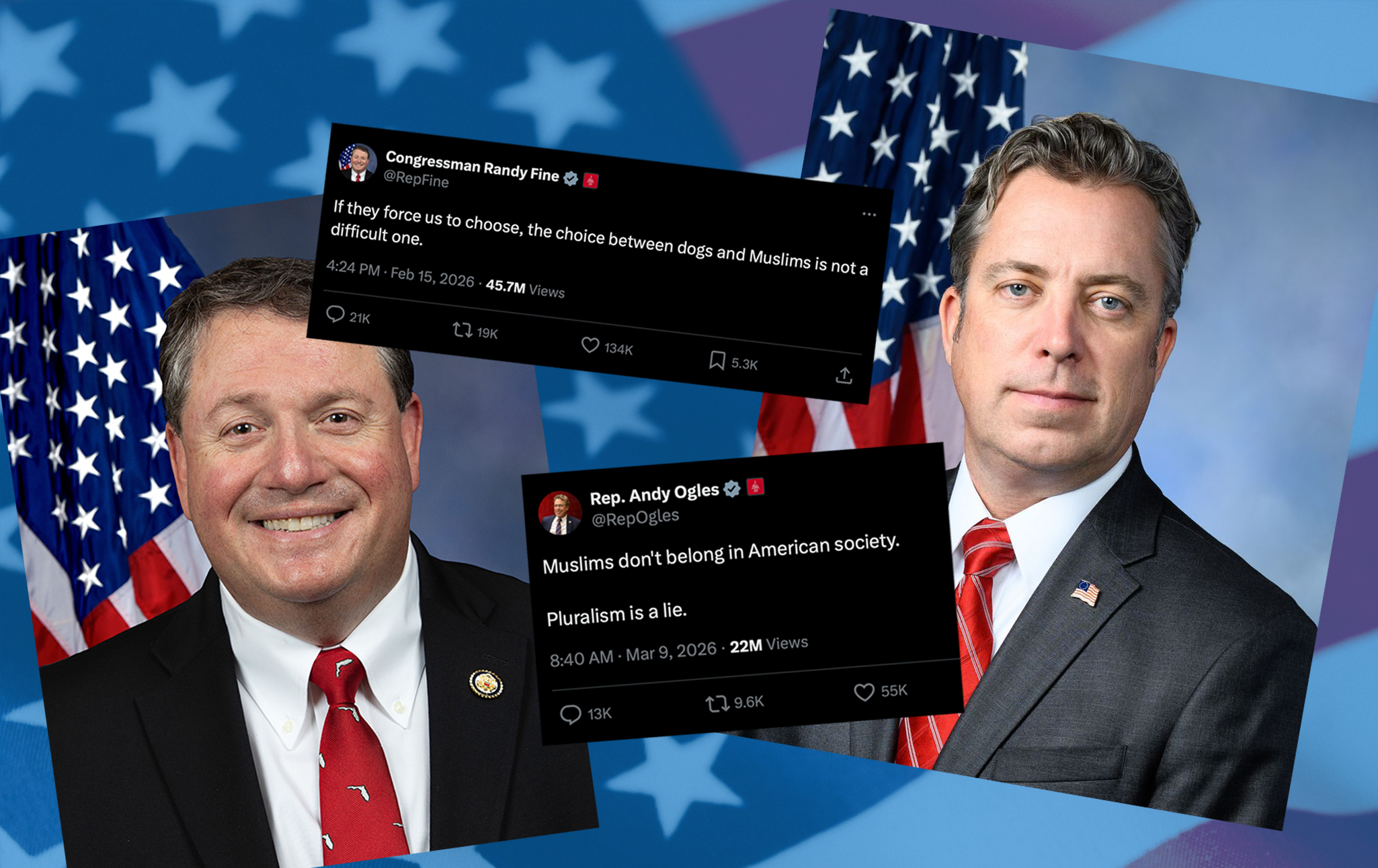
    Within the past month alone in New York City, a muggertargeted a Muslim woman on the subway, calling her a “terrorist” and saying that Mayor Zohran Mamdani “can’t help you now”; a man smeared feceson a mosque after tearing pages from the Quran on the doorstep; and a member of a pro-Israel terror group was exposed for planning to assassinate a Palestinian-American woman and movement leader.

  • Banning New Foreign Routers Mistargets Products to Fix Real Problem

    On March 23, the FCC issued an update to their Covered List, a list of equipment banned from obtaining regulatory approval necessary for U.S. sale (and thus effectively a ban on sale of new devices), to include all new routers produced in foreign countries unless they are specifically given an exception by the Department of Defense (DoD) or DHS. The Commission cited “security gaps in foreign-made routers” leading to widespread cyberattacks as justification for the ban, mentioning the high-profile attacks by Chinese advanced persistent threat actors Volt, Flax, and Salt Typhoon. Although the stated intention is to stem the very real threat of domestic residential routers being commandeered to initiate attacks and act as residential proxies, this sweeping move serves as a blunt instrument that will impact many harmless products. In addition to being far too broad, it won’t even affect many vulnerable devices that are most active in these types of attacks: IoT and connected smart home devices.

    Previously, the FCC had changed the Covered List to ban hardware by specific vendors, such as telecom equipment produced by companies Huawei and Hytera in 2021. This new blanket ban, in contrast, affects the importation and sale of almost all new consumer routers. It does not affect consumer routers produced in the United States, like Starlink in Texas. While some of the affected routers will be vulnerable to compromises that hijack the devices and use them for cybercrime and attacks, this ban does not distinguish between companies with a track-record of producing vulnerable products and those without. As a result, instead of incentivizing security-minded production, this will only limit the options consumers have to US-based manufacturers not affected by the ban—even those that lack stellar security reputations themselves.

    While the sale of vulnerable routers in the U.S. will not stop, the announcement quoted an Executive Branch determination that foreign produced routers introduce “a supply chain vulnerability that could disrupt the U.S. economy, critical infrastructure, and national defense.” Yet this move does nothing to address the growing number of connected devices involved in the attacks this ban aims to address. As we have previously pointed out, supply chain attacks have resulted in no-name Android TV boxes preloaded with malware, sold by retail giants like Amazon, fuelling the massive Kimwolf and BADBOX 2 fraud and residential proxy botnets. Banning the specific models and manufacturers we know produce dangerous devices putting its purchasers at risk, rather than issuing blanket bans punishing reputable brands that do better, should be the priority.

    With the FCCs top commissioner appointed by the President, this ban comes as other parts of the administration impose tariffs and issue dozens of trade-related executive orders aimed at foreign goods. A few larger companies with pockets deep enough to invest in manufacturing plants within the U.S. may see this as an opportune moment, while others not as well poised to begin U.S. operations may attempt to curry enough favor to be added to the DoD or DHS exception lists. At best, this will result in the immediate effect of an ill-targeted policy that does little to improve domestic cybersecurity posture. At worst, it entrenches existing players and deepens problematic quid-pro-quo arrangements.

    American consumers deserve better. They deserve the assurance that the devices they use, whether routers or other connected smart home devices, are built to withstand attacks that put themselves and others at risk, no matter where they are manufactured. For this, a nuanced, careful consideration of products (such as was part of the FCC’s 2023-proposed U.S. Cyber Trust Mark) is necessary, rather than blanket bans.

  • Relicensing versus license compatibility

    Relicensing and license compatibility are two important aspects of how
    licensing works in the free software community. This article explains
    both concepts, what they have in common, and how they differ.

  • Another Court Rules Copyright Can’t Stop People From Reading and Speaking the Law

    Another court has ruled that copyright can’t be used to keep our laws behind a paywall. The U.S. Court of Appeals for the Third Circuit upheld a lower court’s ruling that it is fair use to copy and disseminate building codes that have been incorporated into federal and state law, even though those codes are developed by private parties who claim copyright in them. The court followed the suggestions EFF and others presented in an amicus brief, and joined a growing list of courts that have placed public access to the law over private copyright holders’ desire for control.

    UpCodes created a database of building codes—like the National Electrical Code—that includes codes incorporated by reference into law. ASTM, a private organization that coordinated the development of some of those codes, insists that it retains copyright in them even after they have been adopted into law, and therefore has the right to control how the public accesses and shares them. Fortunately, neither the Constitution nor the Copyright Act support that theory. Faced with similar claims, some courts, including the Fifth Circuit Court of Appeals, have held that the codes lose copyright protection when they are incorporated into law. Others, like the D.C. Circuit Court of Appeals in a case EFF defended on behalf of Public.Resource.Org, have held that, whether or not the legal status of the standards changes once they are incorporated into law, making them fully accessible and usable online is a lawful fair use.

    In this case, the Third Circuit found that UpCodes’s copying of the codes was a fair use, in a decision closely following the D.C. Circuit’s reasoning. Fair use turns on four factors listed in the Copyright Act, and the court found that all four favored UpCodes to some degree.

    On the first factor, the purpose and character of the use, the court found that UpCodes’s use was “transformative” because it had a separate and distinct purpose from ASTM—informing people about the law, rather than just best practices in the building industry. No matter that UpCodes was copying and disseminating entire safety codes verbatim—using the codes for a different purpose was enough. And UpCodes being a commercial venture didn’t change the outcome either, because UpCodes wasn’t charging for access to the codes.

    On the second factor, the nature of the copyrighted work, the Third Circuit joined other appeals courts in finding that laws are facts, and stand at “the periphery of copyright’s core protection.” And this included codes that were “indirectly” incorporated—meaning that they were incorporated into other codes that were themselves incorporated into law.

    The third factor looks at the amount and substantiality of the material used. The court said that UpCodes could not have accomplished its purpose—providing access to the current binding laws governing building construction—without copying entire codes, so the copying was justified. Importantly, the court noted that UpCodes was justified in copying optional parts of the codes as well as “mandatory” sections because both help people understand what the law is.

    Finally, the fourth factor looks at potential harm to the market for the original work, balanced against the public interest in allowing the challenged use. The court rejected an argument frequently raised by copyright holders—that harm can be assumed any time materials are posted to the internet for all to access. Instead, the court held that when a use is transformative, a rightsholder has to bring evidence of harm, and that harm will be balanced against the public benefit. Because “enhanced public access to the law is a clear and significant public benefit,” and ASTM hadn’t shown significant evidence that UpCodes had meaningfully reduced ASTM’s revenues, the fourth factor was at least neutral. It didn’t matter to the court that ASTM offered to provide copies of legally binding standards to the public on request, because “the mere possibility of obtaining a free technical standard does not nullify the public benefits associated with enhanced access to law.”

    This is a good result that will expand the public’s access to the laws that bind us—something that’s more important than ever given recent assaults on the rule of law. In the future, we hope that courts will recognize that codes and standards lose copyright when they are incorporated into law, so that people don’t have to spend years and legal fees litigating fair use just to exercise their rights.

  • 👁 Selling Mass Surveillance | EFFector 38.7

    Time and time again, we’ve seen police surveillance suffer from ‘mission creep’—technology sold as a way to prevent heinous crimes ends up enforcing traffic violations, tracking protestors, and more. In our latest EFFector newsletter, we’re diving into this troubling pattern and sharing all the latest in the fight for privacy and free speech online.

    JOIN OUR NEWSLETTER

    For over 35 years, EFFector has been your guide to understanding the intersection of technology, civil liberties, and the law. This week’s issue covers the urgent need to reform NSA spying; a victory for internet access in the Supreme Court; and how license plate readers are normalizing mass surveillance.

    Prefer to listen in? EFFector is now available on all major podcast platforms. This time, we’re chatting with EFF Privacy Litigation Director Adam Schwartz about some of the recent technologies we’ve seen suffer from “mission creep.” And don’t miss the EFFector news quiz! You can find the episode and subscribe on your podcast platform of choice

    Privacy info.
    This embed will serve content from simplecast.com

    Listen on Spotify Podcasts Badge Listen on Apple Podcasts Badge  Subscribe via RSS badge

    Want to help us push back against mass surveillance? Sign up for EFF’s EFFector newsletter for updates, ways to take action, and new merch drops. You can also fuel the fight for privacy and free speech online when you support EFF today!

  • New light shed on who benefits most from weight-loss jabs

    People who carry variations in two genes linked to appetite and digestion can lose more weight when taking drugs to treat obesity, research suggests.
  • Pluralistic: Process knowledge (08 Apr 2026)

    Today’s links


    A woman washing dishes by hand in a rural, early 20th century shack. In the foreground is a jumble of tortured golgothan skeletons ganked from a Dore Old Testament engraving. Through the window in the back of the shack, we see a detail from another Dore Old Testament engraving: bodies escaping The Flood.

    Process knowledge (permalink)

    “Intellectual property” was once an obscure legal backwater. Today, it is the dominant area of political economy, the organizing regime for almost all of our tech regulation, and the most valuable – and most controversial – aspect of global trade policy:

    https://pluralistic.net/2026/04/01/minilateralism/#own-goal

    Despite (or perhaps because of) its centrality, “intellectual property” is one of those maddeningly vague terms that applies to many different legal doctrines, as well as a set of nebulous, abstract thought-objects that do not qualify for legal protection. “IP” doesn’t just refer to copyright, trademark and patent – though these “core three” systems are so heterogeneous in basis, scope and enforcement that the act of lumping them together into a single category confuses more than it clarifies.

    Beyond the “core three” of copyright, patent and trademark, “IP” also refers to a patchwork of “neighboring rights” that only exist to varying degrees around the world, like “anticircumvention rights,” “database rights” and “personality rights.” Then there are doctrines that have come to be thought of as IP, even though they were long considered separate: confidentiality, noncompete and nondisparagement.

    Finally, there are those “nebulous, abstract thought-objects” that get labeled “IP,” even if no one can really define what they are – for example, the “format” deals that TV shows like Love Island or The Traitors make around the world, which really amount to consulting deals to help other TV networks create a local version of a popular show, but which are treated as the sale of some (nonexistent) exclusive right.

    It’s hard to find a commonality amongst all these wildly different concepts, but a couple years ago, I hit on a working definition of “IP” that seems to cover all the bases: I say that “IP” means “any rule, law or policy that allows a company to exert control over its critics, competitors or customers”:

    https://locusmag.com/2020/09/cory-doctorow-ip/

    Put that way, it’s easy to see why “IP” would be such a central organizing principle in a modern, end-stage capitalist world. But even though “IP” is treated as a firm’s most important asset, it’s actually far less important than another intangible: process knowledge.

    I first came across the concept of “process knowledge” in Dan Wang’s Breakneck, a very good book about the rise and rise of Chinese manufacturing, industrialization and global dominance:

    https://danwang.co/breakneck/

    I picked up Breakneck after reading other writers whom I admire who singled out the book’s treatment of process knowledge for praise and further discussion. The political scientist Henry Farrell called process knowledge the key to economic development:

    https://www.programmablemutter.com/p/process-knowledge-is-crucial-to-economic

    While Dan Davies – a superb writer about organizations and their management – used England’s Brompton Bicycles to make the abstract concept of process knowledge very concrete indeed:

    https://backofmind.substack.com/p/the-brompton-ness-of-it-all

    So what is process knowledge? It’s all the knowledge that workers collectively carry around in their heads – hard-won lessons that span firms and divisions, that can never be adequately captured through documentation. Think of a worker at a chip fab who finds themself with a load of microprocessors that have failed QA because they become unreliable when they’re run above a certain clockspeed. If that worker knows enough about the downstream customers’ processes, they can contact one of those customers and offer the chips for use in a lower-end product, which can save the fab millions and make millions more for the customer.

    This just happened to Apple, who seized upon a lot of “binned” microprocessors that were headed to the landfill and designed the Macbook Neo (a new, cheap, low-end laptop) around them, salvaging the defective chips by running them at lower speeds. The result? Apple’s most successful laptop in years, which has now sold so well that Apple has exhausted the supply of defective chips and is scrambling to fill orders:

    https://www.macrumors.com/2026/04/07/macbook-neo-massive-dilemma/

    Process knowledge is squishy, contingent, and wildly important in a world filled with entropy-stricken, off-spec, and stubbornly physical things. Work with a particular machine long enough and you will develop a Fingerspitzengefühl (fingertip feeling) for the optimal rate to introduce a new load of feedstock to it after it runs dry. Even more importantly: if you work with that machine long enough, you’ll have the mobile phone number of the retired person who knows how to un-jam it if you try to reload it too fast on your usual technician’s day off. This kind of knowledge can mean the difference between profitability and bankruptcy.

    So why isn’t process knowledge given the centrality in our conceptions of what makes a corporation valuable?

    After reading Wang, Farrell and Davies, I formulated a theory: we ignore process knowledge for the same reason we exalt “IP,” because process knowledge can’t be bought or sold, can’t be reflected on a balance-sheet, and can’t be controlled, and because “IP” can. Process knowledge is far more important than “IP” (just try creating a vaccine from a set of instructions without the skilled technicians who have already spent years executing similar projects), but process knowledge is spread out amongst workers and can’t be abstracted away by their bosses. Your boss can make you sign a contract assigning all your copyrights and patents to the business, but if you and your team quit your job, all that “IP” will plummet in value without the people who know how to mobilize it:

    https://pluralistic.net/2025/09/08/process-knowledge/#dance-monkey-dance

    “IP” isn’t just a case of “you treasure what you measure” – it’s also a case of “you measure what you treasure.”

    Recently, I hit on a positively delightful Tumblr post that illustrated the importance of process knowledge, and the way that bosses systematically undervalue it:

    https://www.tumblr.com/explorerrowan/813098951730479104

    This post is one of those glorious internet documents, a novel literary form for which we have no accepted term. It’s composed of four major sections: a screenshotted impromptu Twitter thread made in reply to a throwaway post; a lengthy Tumblr reply to the screenshots; a second Tumblr reply to the first one; and then a chorus of more than 38,000 notes, replies, and hashtags added to it. I have no idea what to call this kind of document, in which some people are reacting to others without the others ever knowing about it, but also which is also written by so many authors, many of whom are explicitly interacting with one another. It’s a “hypertext,” sure, but what kind of hypertext?

    Whatever you call it, it’s amazing. As noted, it opens with a Twitter exchange. The first tweet comes from an online dating influencer, “TheEcho13”:

    I interviewed a gen z girlie 6 months ago and in the interview she told me that she does not like a challenge, has no interest in career progression, prefers to just do repetitive tasks and will never complain about being bored.

    I hired her.

    https://xcancel.com/TheEcho13/status/1948951885693813135#m

    In response, Viveros (a content creator from Alberta and one of the 4m people who saw the original tweet), replied with a short thread about the value of people like this, who “keep the lights on and the business functioning at everything from restaurants to post offices but now nobody’s interested in hiring them”:

    https://xcancel.com/TheViveros/status/1949149720406110382#m

    These are the “lifer[s] who can teach new people how everything works, who knows what’s up in the system, who knows what the obscure solutions are, and who can help calm down the asshole regulars because they know them more personally.” In other words, the keepers of the process knowledge.

    When this screenshotted exchange was posted to Tumblr, it prompted Blinkpatch, who describes themself as a “genderfluid,” “ancient” “drifter” who pines for “solar-punk flavored revolution” to reply with a brilliant anecdote about their stint working as a dishwasher:

    https://weaselle.tumblr.com/post/790895560390492160/whenever-i-think-about-the-value-of-something

    At 16, Blinkpatch was hired as a restaurant dishwasher under the tutelage of Claudio, a 60-year old “career dish pit man.” Claudio had washed dishes for his whole life, reveling in the fact that he could get work in any city, at any time.

    When Claudio realized that Blinkpatch was taking the job seriously, the training began in earnest. Claudio asked Blinkpatch if they wanted to be able to clock off at midnight at the end of each shift, and when Blinkpatch said they did, Claudio laid a lot of process knowledge on them:

    This machine takes two full minutes to run a cycle. We are on the clock for 8 hours. That means we have a maximum of 240 times we can run this machine. If you want to wash all those dishes, clean your station, mop, and clock off by midnight? This machine has to be on and running every second of the shift.

    If you don’t have a full load of dishes collected, scraped, rinsed, stacked, and ready to go into the dishwasher the second it’s done every single time? You can’t do it. If, over the course of 8 hours, you let this machine lay idle for just one minute in between finishing each load and being turned on again? Instead of 240 loads, you’ll do 160 loads.

    These are the parameters, the kind of thing any Taylorist with a stopwatch could tell you. But Claudio went on to explain how that extra idle minute would translate to chaos in the kitchen, as the cooks ran out of pots and the servers ran out of plates, and how they would take out their frustrations on the dishwasher. To optimize that dishwasher, Blinkpatch would need to have a reserve of bulky, machine-filling items that could be run through the machine any time a load finished before there was a sufficient supply of smaller items. If they failed at this, Blinkpatch would be washing dishes until 2AM, rather than clocking out at midnight.

    Blinkpatch’s takeaway was that dishwashing was the bottleneck the whole restaurant ran through – and how that meant that Claudio, who was “unambitious” by conventional standards, had the best understanding of the restaurant’s overall operations of anyone on site. He was the keeper of the process knowledge

    This reply prompted another response, from “Marisol,” a “haunted house actress and accidental IT person” who told the story of her time working at a medical office that specialized in mental health and addiction recovery:

    https://www.tumblr.com/marisolinspades/790960414106304512/all-of-this-disaster-befalls-any-company-that

    The company was in the midst of standing up its own purpose-built facility, and the CEO was working intensively with the architect to design this new building. When Marisol – the receptionist – happened to be consulted on the near-final design plan, “it took all of three seconds for two major issues to jump out.”

    First: “The receptionist can’t see the waiting room from her desk with this layout. It’s around the corner and blocked by a wall.” This meant that she couldn’t “keep track of the patients who are waiting.”

    The architect and CEO wanted to know why she couldn’t use the sign-in sheet to manage this. She explained that not everyone signs in – people who are there for a check-in or group therapy need to be directed to the other side of the building, while “some people are painfully shy and if I don’t appear warm and inviting they won’t approach.”

    The CEO and architect asked whether this happened often, and she replied “every day.” They didn’t believe her. Nor did they believe her when she said that the receptionists needed to have continuous access to the chart room throughout the day – they insisted that since charts for the day’s patients were pulled in the morning, it would be OK to house them through two sets of locked doors, a five-minute walk away (that way, workers wouldn’t be tempted to “goof off” in the room). They wanted to keep the chart room locked, with the key entrusted to the CEO, who would supervise every entry.

    Marisol explained that charts were pulled continuously, any time there was a crisis or a patient had a question for a nurse, or when a patient came in due to a cancellation. All told, reception went into the chart room 20-30 times/day. The “goofing off” they thought workers got up to in the chart room was “when we got news that a patient had died and we were crying. And even then, we filed charts as we sobbed because no one in this office has free time.”

    The CEO and architect were still disbelieving, so Marisol had them sit with her for an hour. They didn’t last an hour – they left, taking the blueprints with them.

    The punchline: Marisol bemoans the fact that she wasn’t given more time with those blueprints, because then she might have spotted that they’d forgotten to include any closets, including closets for the janitors. As a result, all their cleaning supplies and holiday decorations were stolen from the cabinets in the bathrooms that they were forced to stash them in.

    Marisol blames this on a “CEO who had never worked a lower level job in his life wasn’t convinced closets were worth it.”

    This is doubtless true – but we can generalize this, to “a CEO who didn’t appreciate process knowledge.”

    I’ve come to believe that process knowledge is the most undervalued part of our society. So undervalued that business geniuses like Elon Musk think you can fire skilled lifers from key government agencies and simply hire new ones if turns out you cut too deep. So undervalued that Trump thinks that you can simply stand up new factories in response to tariffs, and that “training” will somehow allow people to go to work making things that haven’t been produced onshore in a generation.

    And of course, the people who value process knowledge the least are the AI bros who think you can replace skilled workers with a chatbot trained on the things they say and write down, as though that somehow captured everything they know.


    Hey look at this (permalink)


    A shelf of leatherbound history books with a gilt-stamped series title, 'The World's Famous Events.'

    Object permanence (permalink)

    #15yrsago Chicken Little: what do you sell to an immortal, vat-bound quadrillionaire? https://web.archive.org/web/20110408210327/http://www.tor.com/stories/2011/04/chicken-little

    #15yrsago Anya’s Ghost: sweet and scary ghost story about identity https://memex.craphound.com/2011/04/06/anyas-ghost-sweet-and-scary-ghost-story-about-identity/

    #10yrsago The UK government’s voice-over-IP standard is designed to be backdoored https://discovery.ucl.ac.uk/id/eprint/1476827/

    #5yrsago Ad-tech’s algorithmic cruelty https://pluralistic.net/2021/04/06/digital-phrenology/#weaponized-nostalgia

    #5yrsago The real cancel culture https://pluralistic.net/2021/04/06/digital-phrenology/#digital-phrenology


    Upcoming appearances (permalink)

    A photo of me onstage, giving a speech, pounding the podium.


    A screenshot of me at my desk, doing a livecast.

    Recent appearances (permalink)


    A grid of my books with Will Stahle covers..

    Latest books (permalink)


    A cardboard book box with the Macmillan logo.

    Upcoming books (permalink)

    • “The Reverse-Centaur’s Guide to AI,” a short book about being a better AI critic, Farrar, Straus and Giroux, June 2026 (https://us.macmillan.com/books/9780374621568/thereversecentaursguidetolifeafterai/)
    • “Enshittification, Why Everything Suddenly Got Worse and What to Do About It” (the graphic novel), Firstsecond, 2026

    • “The Post-American Internet,” a geopolitical sequel of sorts to Enshittification, Farrar, Straus and Giroux, 2027

    • “Unauthorized Bread”: a middle-grades graphic novel adapted from my novella about refugees, toasters and DRM, FirstSecond, 2027

    • “The Memex Method,” Farrar, Straus, Giroux, 2027


    Colophon (permalink)

    Today’s top sources:

    Currently writing: “The Post-American Internet,” a sequel to “Enshittification,” about the better world the rest of us get to have now that Trump has torched America. First draft complete. Second draft underway.

    • “The Reverse Centaur’s Guide to AI,” a short book for Farrar, Straus and Giroux about being an effective AI critic. LEGAL REVIEW AND COPYEDIT COMPLETE.
    • “The Post-American Internet,” a short book about internet policy in the age of Trumpism. PLANNING.

    • A Little Brother short story about DIY insulin PLANNING


    This work – excluding any serialized fiction – is licensed under a Creative Commons Attribution 4.0 license. That means you can use it any way you like, including commercially, provided that you attribute it to me, Cory Doctorow, and include a link to pluralistic.net.

    https://creativecommons.org/licenses/by/4.0/

    Quotations and images are not included in this license; they are included either under a limitation or exception to copyright, or on the basis of a separate license. Please exercise caution.


    How to get Pluralistic:

    Blog (no ads, tracking, or data-collection):

    Pluralistic.net

    Newsletter (no ads, tracking, or data-collection):

    https://pluralistic.net/plura-list

    Mastodon (no ads, tracking, or data-collection):

    https://mamot.fr/@pluralistic

    Bluesky (no ads, possible tracking and data-collection):

    https://bsky.app/profile/doctorow.pluralistic.net

    Medium (no ads, paywalled):

    https://doctorow.medium.com/

    Tumblr (mass-scale, unrestricted, third-party surveillance and advertising):

    https://mostlysignssomeportents.tumblr.com/tagged/pluralistic

    When life gives you SARS, you make sarsaparilla” -Joey “Accordion Guy” DeVilla

    READ CAREFULLY: By reading this, you agree, on behalf of your employer, to release me from all obligations and waivers arising from any and all NON-NEGOTIATED agreements, licenses, terms-of-service, shrinkwrap, clickwrap, browsewrap, confidentiality, non-disclosure, non-compete and acceptable use policies (“BOGUS AGREEMENTS”) that I have entered into with your employer, its partners, licensors, agents and assigns, in perpetuity, without prejudice to my ongoing rights and privileges. You further represent that you have the authority to release me from any BOGUS AGREEMENTS on behalf of your employer.

    ISSN: 3066-764X