Blog

  • San Jose Can Protect Immigrants by Ending Flock Surveillance System

    (This appeared as an op-ed published February 12, 2026 in the San Jose Spotlight, written by Huy Tran (SIREN), Jeffrey Wang (CAIR-SFBA), and Jennifer Pinsof.)

    As ICE and other federal agencies continue their assault on civil liberties, local leaders are stepping up to protect their communities. This includes pushing back against automated license plate readers, or ALPRs, which are tools of mass surveillance that can be weaponized against immigrants, political dissidents and other targets.

    In recent weeks, Mountain View, Los Altos Hills, Santa Cruz, East Palo Alto and Santa Clara County have begun reconsidering their ALPR programs. San Jose should join them. This dangerous technology poses an unacceptable risk to the safety of immigrants and other vulnerable populations.

    ALPRs are marketed to promote public safety. But their utility is debatable and they come with significant drawbacks. They don’t just track “criminals.” They track everyone, all the time. Your vehicle’s movements can reveal where you work, worship and obtain medical care. ALPR vendors like Flock Safety put the location information of millions of drivers into databases, allowing anyone with access to instantly reconstruct the public’s movements.

    But “anyone with access” is far broader than just local police. Some California law enforcement agencies have used ALPR networks to run searches related to immigration enforcement. In other situations, purported issues with the system’s software have enabled federal agencies to directly access California ALPR data. This is despite the promises of ALPR vendors and clear legal prohibitions.

    Communities are saying enough is enough. Just last week, police in Mountain View decided to turn off all of the city’s Flock cameras, following revelations that federal and other unauthorized agencies had accessed their network. The cameras will remain inactive until the City Council provides further direction.

    Other localities have shut off the cameras for good. In January, Los Altos Hills terminated its contract with Flock following concerns about ICE. Santa Cruz severed relations with Flock, citing rising tensions with ICE. Most recently, East Palo Alto and Santa Clara County are reconsidering whether to continue their relationships with Flock, given heightened concern for the safety of immigrant communities.

    California law prohibits local police from disclosing ALPR data to out-of-state or federal agencies. But at least 75 California police agencies were sharing these records out-of-state as recently as 2023. Just last year, San Francisco police allowed access to out-of-state agencies and 19 searches were related to ICE.

    Even without direct access, ICE can exploit local ALPR systems. One investigation found more than 4,000 cases where police had made searches on behalf of federal law enforcement, including for immigration investigations.

    Increasing the risk is that law enforcement routinely searches these networks without first obtaining a warrant. In San Jose, police aren’t required to have any suspicion of wrongdoing before searching ALPR databases, which contain a year’s worth of data representing hundreds of millions of records. In a little over a year, San Jose police logged more than 261,000 ALPR searches, or nearly 700 searches a day, all without a warrant.

    Two nonprofit organizations, SIREN and CAIR California, represented by Electronic Frontier Foundation and the ACLU of Northern California, are currently suing to stop San Jose’s warrantless searches of ALPR data. But this is only the first step. A better solution is to simply turn these cameras off.

    San Jose cannot afford delay. Each day these cameras remain active, they collect sensitive location data that can be misused to target immigrant families and violate fundamental freedoms. It is a risk materializing across California. City leaders must act now to shut down ALPR systems and make clear that public safety will not come at the expense of privacy, human dignity or community trust.


  • Cyprus Court Acquits Ex-Parliament President, MP in Golden Passport Case

    A criminal court in Nicosia on Tuesday acquitted two former senior Cypriot politicians accused of having improperly intervened in citizenship applications under the country’s now-defunct “golden passport” program, ruling that prosecutors had failed to present sufficient evidence. 

    The defendants, Demetris Syllouris, a former parliament president, and Christakis Giovanis, a former lawmaker, had denied wrongdoing. In a 170-page judgment, the court said key witnesses did not appear and had not been summoned, a lapse judges described as decisive in dismissing the case.

    Speaking after the verdict, Syllouris said he had been vindicated. “I was clean and remained clean,” he said, rejecting allegations of corruption and criticizing what he called attempts to politicize the proceedings.

    The case stemmed from a scandal that erupted after an undercover investigation by Al Jazeera in 2020 exposed apparent willingness by officials to help a fictitious Chinese businessman with a criminal record obtain Cyprus citizenship. The report, titled The Cyprus Papers Undercover, prompted both men to resign almost immediately and intensified scrutiny of the investment-for-citizenship scheme.

    An independent investigation chaired by former Supreme Court judge Myron Nicolatos examined the legality of massive naturalisations granted under the Citizenship by Investment Program, and concluded in its 2021 report that the scheme had been applied unlawfully in a significant number of cases.

    The government abolished the program later that year after mounting criticism over abuses.

    Criminal proceedings formally began in 2022 and were marked by suspensions, re-filings and the dismissal of co-defendants, gradually narrowing to the two politicians. The trial concluded in December 2025, with the verdict delivered Tuesday.

    It was the third first-instance criminal case linked to the program. Defendants in two earlier cases were also acquitted, though those rulings are under appeal, and a fourth case involving a former minister is still pending.

    In its 2025 rule-of-law assessment, the European Commission said further steps were needed to ensure effective investigation and prosecution of corruption cases, warning that tackling graft remained essential to maintaining public trust in state institutions.

  • New Report Helps Journalists Dig Deeper Into Police Surveillance Technology

    Report from EFF, Center for Just Journalism, and IPVM Helps Cut Through Sales Hype

    SAN FRANCISCO — A new report released today offers journalists tips on cutting through the sales hype about police surveillance technology and report accurately on costs, benefits, privacy, and accountability as these invasive and often ineffective tools come to communities across the nation. 

    The “Selling Safety” report is a joint project of the Electronic Frontier Foundation (EFF), the Center for Just Journalism (CJJ), and IPVM. 

    Police technology is often sold as a silver bullet: a way to modernize departments, make communities safer, and eliminate human bias from policing with algorithmic objectivity. Behind the slick marketing is a sprawling, under-scrutinized industry that relies on manufacturing the appearance of effectiveness, not measuring it. The cost of blindly deferring to advertising can be high in tax dollars, privacy, and civil liberties. 

    “Selling Safety” helps journalists see through the spin. It breaks down how policing technology companies market their tools, and how those sales claims — which are often misleading — get recycled into media coverage. It offers tools for asking better questions, understanding incentives, and finding local accountability stories. 

    “The industry that provides technology to law enforcement is one of the most unregulated, unexamined, and consequential in the United States,” said EFF Senior Policy Analyst Matthew Guariglia. “Most Americans would rightfully be horrified to know how many decisions about policing are made: not by public employees, but by multi-billion-dollar surveillance tech companies who have an insatiable profit motive to market their technology as the silver bullet that will stop crime. Lawmakers often are too eager to seem ‘tough on crime’ and journalists too often see an easy story in publishing law enforcement press releases about new technology. This report offers a glimpse into how the police-tech sausage gets made so reporters and lawmakers can recognize the tactics of glossy marketing pitches, manufactured effectiveness numbers, and chumminess between companies and police.” 

    “Surveillance and other police technologies are spreading faster than public understanding or oversight, leaving journalists to do critical accountability work in real time. We hope this report helps make that work easier,” said Hannah Riley Fernandez, CJJ’s Director of Programming. 

    “The surveillance technology industry has a documented pattern of making unsubstantiated claims about technology,” said Conor Healy, IPVM’s Director of Government Research. “Marketing is not a substitute for evidence. Journalists who go beyond press releases to critically examine vendor claims will often find solutions are not as magical as they may seem. In doing so, they perform essential accountability work that protects both taxpayer dollars and civil liberties.” 

    EFF also maintains resources for understanding various police technologies and mapping those technologies in communities across the United States. 

    For the “Selling Safety” report:  https://www.eff.org/document/selling-safety-journalists-guide-covering-police-technology

    For EFF’s Street-Level Surveillance hub: https://sls.eff.org/ 

    For EFF’s Atlas of Surveillance: https://www.atlasofsurveillance.org/ 

    Contact: 
    Beryl
    Lipton
    Senior Investigative Researcher
  • A Massive Climate Resilience Project Escapes Florida’s DOGE Purge

    This story was originally published by Grist. Sign up for Grist’s weekly newsletter here.

    When it comes to government spending, Florida Gov. Ron DeSantis is taking a cue from the Trump administration.

    As his second term nears its end, DeSantis is spearheading a campaign to slash property taxes, which provide around 30% of local government revenue. He’s also looking to dramatically pare down state-funded programs, and he’s commissioned a state-level version of Elon Musk’s “Department of Government Efficiency” to do so. DeSantis’ DOGE will be run by his hand-picked chief financial officer, the creator of a YouTube show called “Government Gone Wild.” In a signal of his seriousness about cutting spending, the governor’s proposed budget for this year is 10% lower than his 2019 budget in inflation-adjusted and per-capita terms.

    To make these cuts happen, the Sunshine State’s climate programs are in the crosshairs.

    The DOGE report that the governor’s office published last month singled out local efforts to confront climate change as examples of the “irresponsible spending” that Florida must end. The state task force targeted Jacksonville’s efforts to purchase electric vehicles, St. Petersburg’s hiring of a “sustainability and resilience officer,” and Miami’s efforts to build out buses and rail systems. The report directed specific ire at Palm Beach County’s Office of Resilience, which had a mandate to “reduce resident, business, and natural resource vulnerability” to disasters that “include flooding, more frequent and intense storms, extreme heat, [and] saltwater intrusion.”

    The Resilient Florida program has become one of the country’s most robust climate adaptation programs.

    DeSantis’ DOGE justified this criticism by appealing to a controversial report from the federal Department of Energy, which concluded that “scientific evidence does not support claims of a long-term increase in so-called ‘extreme’ weather events, including hurricanes, tornadoes, [and] floods.” Yet laws signed by DeSantis himself take the opposite view — and, perhaps as a result, the state’s largest climate resilience program is proving itself immune to the governor’s purge. 

    During his first term as governor, DeSantis inaugurated a grant program known as Resilient Florida, which doles out millions of dollars a year to ward off flooding and sea level rise. The statute authorizing the program even “recognizes that the state is particularly vulnerable to adverse impacts from flooding resulting from increases in frequency and duration of rainfall events, storm surge from more frequent and severe weather systems, and sea level rise.” It requires that the state conduct a regular assessment of these threats.

    In the five years since its inception, the Resilient Florida program has become one of the country’s most robust climate adaptation programs — rivaling not only those of any other state but also federal resilience efforts spearheaded by the Federal Emergency Management Agency. Florida has distributed well over $1 billion in resilience money to local governments who then match the funding. By comparison, FEMA’s Building Resilient Infrastructure and Communities program has distributed around $5 billion to the entire country.

    Resilient Florida has funded the construction of “living shorelines” to prevent erosion at the U.S. Navy base in Pensacola and the relocation of an island wastewater treatment plant in Fort Pierce to prevent flooding during high tide events. Palm Beach County, the same jurisdiction that Florida’s DOGE singled out for criticism, has received tens of millions of dollars in state funding. That money has helped raise an island park to protect against sea level rise and has funded the construction of a $30 million storm drain system on a major road that’s seen routine flooding. (However, DeSantis vetoed an additional tranche of money for that project last summer.)

    Jim Mooney, a Republican state legislator representing the Florida Keys, said the program represents an example of smart state spending. Local governments must match each dollar of state grants, and Mooney said he believes the arrangement is a wise use of local property tax dollars.

    “The idea is you need to have shovel-ready projects, because getting these grants is hard,” said Mooney, one of the leading supporters of Resilient Florida. “That’s what you’re collecting people’s property taxes for, to some extent — to get that stuff done.” In Mooney’s island district, Resilient Florida has funded subterranean drainage pipes that reduce residential flooding from high tides.

    Resilient Florida was originally set to expire in 2025, but the state Legislature renewed it last year without any controversy; the bill that reauthorized the program passed both legislative chambers in less than a month and without any “nay” votes. Even as DeSantis is proposing to shrink the state budget by about 10%, his administration has firmed up the revenue source for Resilient Florida. The program will now draw its funding from the state’s Seminole gaming compact, an agreement with the Seminole tribe that governs the distribution of revenue from online sports betting in the state. It will be funded next year at $150 million. This time, it does not have an expiration date.

    “I think it would’ve continued to be funded [without the gaming revenue], it would’ve just been more of a roller coaster ride,” said Mooney. “There was really no thought that it wasn’t going to move forward.”

    Resilient Florida has funded the construction of “living shorelines” to prevent erosion.

    Such programs are facing challenges in other parts of the country. The Trump administration has sought to terminate a key federal resilience grant program, and the Department of Homeland Security has paused almost all FEMA hazard mitigation spending. In Louisiana, which has long led the nation on state-level adaptation to climate change, a new governor, Jeff Landry, has halted efforts to fight sea-level rise and prevent coastal erosion. Landry last year canceled a massive sediment diversion project that would have built new coastal land, and the Republican has also meddled with governance for the landmark levee system that protects New Orleans. 

    Mathew Sanders, a policy expert at the Pew Charitable Trusts who helps states plan for disaster resilience, says the Resilient Florida’s durability comes down to economics. The Sunshine State’s coastline is an integral part of the state’s economy, and future growth depends on functional roads and sewage plants in beachfront towns. Even if the state wanted to cut Resilient Florida spending, it probably couldn’t afford to.

    “There’s a direct connection in Florida between the ecological health of the coastline and their ability to generate revenue,” said Sanders. “It’s so reliant on ecotourism, the pure beautiful beaches and the Everglades. The calculus is just different.”

    The post A Massive Climate Resilience Project Escapes Florida’s DOGE Purge appeared first on Truthdig.

  • ACE Targets Pirate Streaming Site ‘HDFull’ Through Cloudflare and Discord Subpoenas

    ACE Targets Pirate Streaming Site ‘HDFull’ Through Cloudflare and Discord Subpoenas

    HDFull is a pirate streaming portal that has served Spanish-speaking audiences for years, offering a massive library of movies and TV shows.

    Despite being the target of court-ordered ISP blocks in Spain going back to 2018, the site has proven remarkably resilient, hopping from domain to domain to stay accessible.

    The site also maintained an active Discord community, “HDFull Oficial,” with roughly 33,000 members. However, while the main site remained operating, the Discord server abruptly disappeared last week.

    On February 11, HDFull’s official X account posted a message informing users that there was an ‘issue’ with the original Discord community, directing them to a newly created replacement server.

    HDFull’s message (translated)

    hdfullnew

    The admins and moderators of the site and Discord server didn’t go into detail on this apparent ‘issue,’ but it didn’t take long before the culprit was identified. As it turns out, anti-piracy group ACE requested Discord to take action.

    DMCA Subpoena Targets Discord

    On February 13, the MPA filed a request for a DMCA subpoena at the U.S. District Court for the Northern District of California, targeting Discord. On behalf of ACE members Warner Bros. and Universal, MPA asked the company to identify two key users who operated the HDFull Oficial server.

    The targeted accounts belong to the Discord user “hdfull”, who appears to be the server owner and primary moderator, and “xenus9999”, a moderator with “Mod” and “Uploaders” roles.

    The filing includes a DMCA notice sent to Discord on February 9, two days before the server went dark. This notice explicitly asks Discord to disable the HDFull server, which is precisely what happened.

    The notice came with a 23-page exhibit documenting the server’s activities in detail. Screenshots show the “hdfull” account sharing direct links to infringing streams of Warner Bros.’ The Batman and It Chapter Two on the HDFull website. The “xenus9999” account allegedly posted links to The Batman and Universal’s Furious 7.

    Batman link.. (click to enlarge)

    batman

    Through the DMCA subpoena, ACE asks Discord to hand over names, physical addresses, IP addresses, telephone numbers, and email addresses for the individuals behind both accounts.

    Cloudflare Subpoena Targets 19 Domains

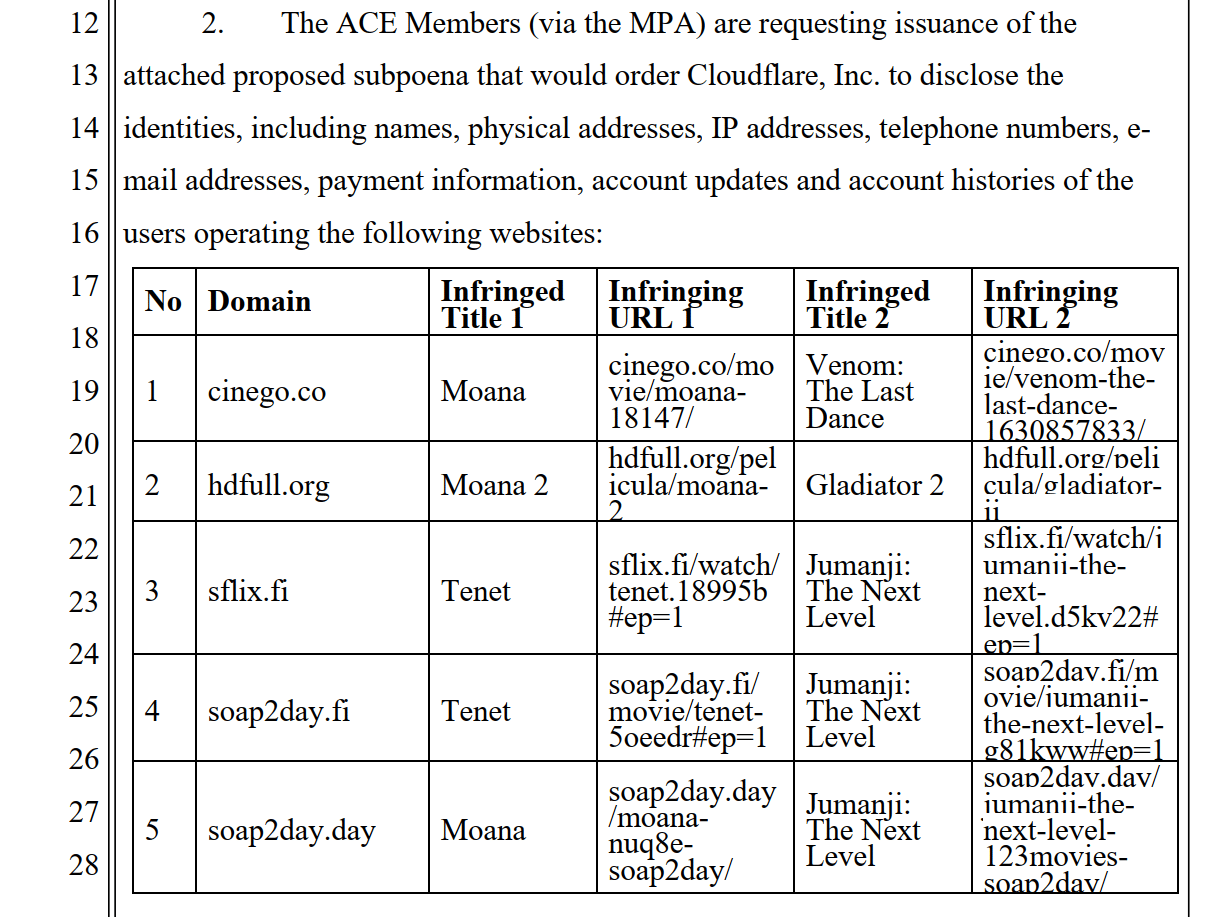
    The Discord subpoena was not the only filing submitted by MPA and ACE last Friday. They filed a separate DMCA subpoena at the Central District of California Court, targeting Cloudflare. This subpoena seeks to unmask the operators of 19 pirate streaming domains, including HDFull.org.

    Cloudflare is asked to identify the customers connected to the pirate site accounts, with the MPA citing various copyright-infringing links that appear on these platforms.

    Cloudflare subpoena

    subpoena

    The 19 targeted domains are noticeably diverse, covering multiple languages and regions. For example, in addition to English portals, they include the German streaming veteran kinox.to, mirrors of Spanish-language site Pelisflix, Turkish streaming sites, and an Arabic anime portal, among others.

    Cloudflare domains targeted: cinego.co, hdfull.org, sflix.fi, soap2day.fi, soap2day.day, kinox.to, pelisflix1.help, pelisflix1.best, pelisflix1.club, anime4up.rest, motchiill.la, motchillk.la, motchillk.ac, 456movie.net, hdfilmcehennemi.nl, vduapk.com, dizigom104.com, pstream.mov, streamingunity.tv

    The pirated titles range from recent blockbusters like Moana 2, Gladiator 2, Nobody 2, and Venom: The Last Dance, to older catalog titles including Tenet, Frozen II, The Lion King, and Tangled.

    For all 19 domains, Cloudflare is asked to provide names, physical addresses, IP addresses, telephone numbers, email addresses, payment information, account updates, and account histories. While many pirate sites are known to share false data, ACE hopes to find sufficient information to expose some of the operations.

    HDFull’s Long and Resilient History

    HDFull has been a thorn in Hollywood’s side for the better part of a decade. In 2018, following complaints from Disney, Fox, Paramount, Sony, Universal, and Warner, a court in Barcelona ordered Spanish ISPs including Telefónica, Vodafone, and Orange to block the site along with fellow pirate portal Repelis.tv.

    The site responded by doing what many pirate sites do: going on a domain hopping spree.

    The court filing’s exhibit documents this in vivid detail. Screenshots from the Discord server show the “hdfull” account periodically posting updated lists of working domains for its users. An October 2025 screenshot shows at least 13 active mirror domains, from hdfull.org and hdfull.one to hdfull.love, hdfull.monster, and hdfull.buzz.

    Presented evidence

    hdfull

    The Discord server, in other words, helped to evade the very ISP blocks that courts had ordered. Other messages also recommend Spanish users install Cloudflare’s WARP VPN to circumvent blocks imposed by their internet providers.
    This dual role, as both a community hub and an anti-blocking tool, likely made the Discord server a key target for ACE.

    What Happens Next?

    Both subpoenas have yet to be signed off on by a court clerk. Interestingly, the Discord subpoena requires a response by February 27, “2025” rather than 2026. The request for subpoena and the declaration were also signed and dated February 13, 2025, suggesting that the MPA is struggling to adapt to the new year. These errors will have to be corrected.

    Wrong date

    wrong date

    Whether Cloudflare and Discord will comply without resistance remains to be seen, but both companies are usually responsive to valid subpoenas issued by a U.S. court.

    ACE has used this playbook before. Late last year, the MPA filed a similar DMCA subpoena targeting Discord over pirate streaming site OnionPlay, successfully getting the server shut down while seeking to unmask its operator.

    For HDFull’s operators, being targeted from multiple directions at once likely puts them on high alert. For now, however, the site remains online, with over a dozen operational backup domains in place. In addition, the team has set up a new Discord server to replace the one that was taken down.

    A copy of the Discord DMCA subpoena request, filed at the U.S. District Court for the Northern District of California, is available here (pdf). The Cloudflare DMCA subpoena request, filed at the Central District of California, is available here (pdf).

    From: TF, for the latest news on copyright battles, piracy and more.

  • World News in Brief: Madagascar cyclone response, Gaza medical evacuations, remembering civil rights icon Jesse Jackson

    At least 52 people have died after Tropical Cyclone Gezani made landfall on the eastern coast of Madagascar on 10 February, the UN Office for the Coordination of Humanitarian Affairs (OCHA) said on Tuesday, citing the authorities.
  • Migrants and refugees in Libya subjected to ‘systematic’ abuse: UN report

    Migrants, refugees and asylum-seekers in Libya are enduring ruthless and systematic human rights violations, including killings, torture, sexual violence and trafficking, according to a new report published today by the UN human rights office, OHCHR.   
  • Epstein files: ‘No one is too wealthy or too powerful to be above the law’; rights experts demand accountability

    The large-scale disclosure of materials known as the “Epstein Files” has revealed “disturbing and credible evidence” of what independent human rights experts describe as a possible global criminal enterprise involving systematic sexual abuse, trafficking and exploitation of women and girls.
  • Maternal deaths spike during war and instability, new report warns

    Nearly two thirds of all maternal deaths worldwide occur in countries marked by conflict or fragility, according to a report released on Tuesday by the World Health Organization (WHO) and partners.