Blog

  • Palantir Gets Millions of Dollars From New York City’s Public Hospitals

    New York City’s public hospital system is paying millions to Palantir, the controversial ICE and military contractor, according to documents obtained by The Intercept.

    Since 2023, the New York City Health and Hospitals Corporation has paid Palantir nearly $4 million to improve its ability to track down payment for the services provided at its hospitals and medical clinics. Palantir, a data analysis firm that’s now a Wall Street giant thanks to its lucrative work with the Pentagon and U.S. intelligence community, deploys its software to make more efficient the billing of Medicaid and other public benefits. That includes automated scanning of patient health notes to “Increase charges captured from missed opportunities,” contract materials reviewed by The Intercept show.

    Palantir’s administrative involvement in the business of healing people stands in contrast to its longtime role helping facilitate warfare, mass deportations, and dragnet surveillance.

    In 2016, The Intercept revealed Palantir’s role behind XKEYSCORE, a secret NSA bulk surveillance program revealed by the whistleblower Edward Snowden that allowed the U.S. and its allies to search the unfathomably large volumes of data they collect. The company has also attracted global scrutiny and criticism for its “strategic partnership” with the Israeli military while it was leveling Gaza.


    Related

    Peter Thiel’s Palantir Was Used to Bust Relatives of Migrant Children, New Documents Show


    But it’s Palantir’s work with U.S. Immigration and Customs Enforcement that is drawing the most protest today. The company provides a variety of services to help the federal government find and deport immigrants. ICE’s Palantir-furnished case management software, for example, “plays a critical role in supporting the daily operations of ICE, ensuring critical mission success,” according to federal contracting documents.

    “It’s unacceptable that the same company that is targeting our neighbors for deportation and providing tools to the Israeli military is also providing software for our hospitals,” said Kenny Morris, an organizer with the American Friend Service Committee, which shared the contract documents with The Intercept.

    Established by the state legislature, New York City Health and Hospitals is the nation’s biggest municipal health care system, administering over 70 facilities throughout New York City, including Bellevue Hospital, and providing care for over 1 million New Yorkers annually.

    New York City Health and Hospitals spokesperson Adam Shrier did not respond to multiple requests to discuss the contract’s details. Palantir spokesperson Drew Messing said the company does not use or share hospital data outside the bounds of its contract.

    Palantir’s contract with New York’s public health care system allows the company to work with patients’ protected health information, or PHI. With permission from New York City Health and Hospitals, Palantir can “de-identify PHI and utilize de-identified PHI for purposes other than research,” the contract states. De-identification generally involves the stripping of certain revealing information, such as names, Social Security numbers, and birthdays. Such provisions are common in contracts involving health data.

    Activists who oppose Palantir’s involvement in New York point to a large body of research that indicates re-identifying personal data, including in medial contexts, is often trivial.

    “Any contract that shares any of New Yorkers’ highly personal data from NYC Health & Hospital’s with Palantir, a key player in the Trump administration’s mass deportation effort, is reckless and puts countless lives at risk,” said Beth Haroules of the New York Civil Liberties Union. “Every New Yorker, without exception, has a right to quality healthcare and city services. New Yorkers must be able to seek healthcare without fear that their intimate medical information, or immigration status, will be delivered to the federal government on a silver platter.”

    Palantir has long provided similar services to the U.K. National Health Service, a business relationship that today has an increasing number of detractors. Palantir “has absolutely no place in the NHS, looking after patients’ personal data,” Green Party leader Zack Polanski recently stated in a letter to the U.K. health secretary.

    “Palantir is targeting the exact patients that NYCHH is looking to serve.”

    Some New York-based groups feel similarly out of distrust for what the firm could do with troves of sensitive personal data.

    “Palantir is targeting the exact patients that NYCHH is looking to serve,” said Jonathan Westin of the Brooklyn-based organization Climate Organizing Hub. “They should immediately sever their contract with Palantir and stand with the millions of immigrant New Yorkers that are being targeted by ICE in this moment.”

    “The chaos Palantir is inflicting through its technology is not just limited to the kidnapping of our immigrant neighbors and the murder of heroes like our fellow nurse, Alex Pretti,” said Hannah Drummond, an Asheville, North Carolina-based nurse and organizer with National Nurses United, a nursing union. “As a nurse and patient advocate, I don’t want anything having to do with Palantir in my hospital — and neither should any elected leader who claims to represent nurses.”

    Palantir’s vocally right-wing CEO Alex Karp has been a frequent critic of New York City’s newly inaugurated democratic socialist Mayor Zohran Mamdani. Health and Hospitals operates as a public benefit corporation, but the mayor can exert considerable influence over the network, for instance through the appointment of its board of directors. Its president, Dr. Mitchell Katz, was renominated by Mamdani, then the mayor-elect, late last year.

    The mayor’s office did not respond in time for publication when asked about its stance on the contract.

    The post Palantir Gets Millions of Dollars From New York City’s Public Hospitals appeared first on The Intercept.

  • Death of the sex drive – and the great debate over whether testosterone can help get it back

    Can boosting testosterone improve libido, or is much of the attention solely hype, profit, and placebo?
  • New recombinant mpox strain detected in UK and India, WHO urges continued monitoring

    The detection of a newly identified recombinant mpox virus containing genetic material from two known strains underscores the need for continued genomic surveillance, the UN World Health Organization (WHO) said on Saturday, as the overall global public health risk assessment remains unchanged.
  • South Korea Seeks Multilingual Talent to Hunt Down K-Content Piracy

    South Korea Seeks Multilingual Talent to Hunt Down K-Content Piracy

    Like most other countries, South Korea has a persistent piracy problem. Online streaming platforms in particular have flourished in recent years.

    While several large piracy platforms such as Noonoo and TVWIKI have been shut down, new threats continue to emerge.

    To deal with this problem, Korean rightsholders use advanced OSINT tools to track down offenders and hold them responsible. In addition, dedicated anti-piracy groups deployed advanced AI monitoring systems.

    While anti-piracy efforts increasingly turn into an AI-assisted arms race, human involvement remains valuable too. In fact, the Korea Copyright Protection Agency (KCOPA) is actively recruiting more people to help monitor foreign language pirate sites.

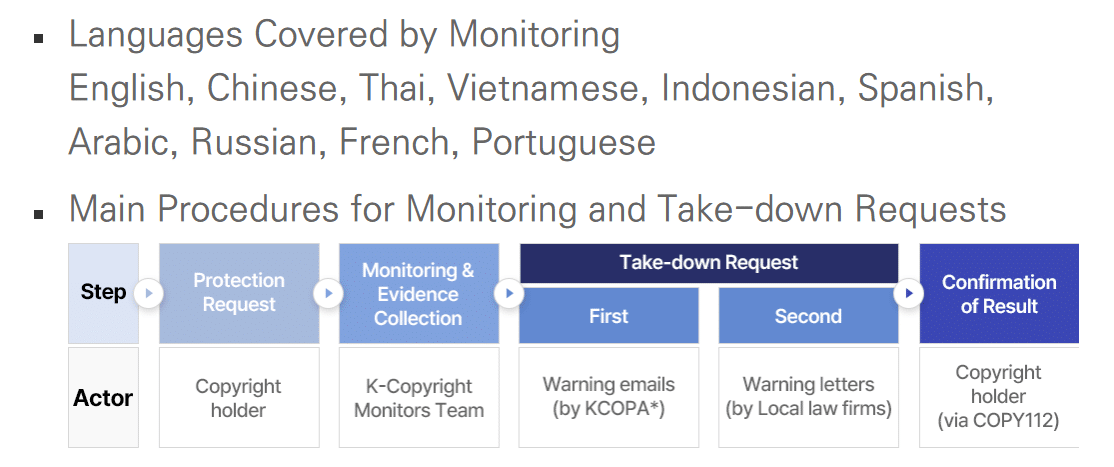
    In the current application round, KCOPA is hoping to add 25 people. These ‘K-Copyright Monitors,’ as they are called, will be paired with the agency’s automated detection systems to track down pirated Korean content overseas. The initiative, now in its fourth year, helps to flag foreign pirate sites early.

    K-Copyright Monitors

    dejtookrjob

    The full recruitment notice, published by the Korea Software Copyright Association on behalf of the KCOPA, notes that ten languages are targeted: Chinese, English, Thai, Vietnamese, Spanish, Indonesian, Arabic, Russian, Portuguese, and French.

    Malware, Viruses & Minimum Wage

    While foreign applicants are welcome, the job application is in Korean and targeted locally, which isn’t likely to invite many outsiders. The job starts next month and runs until November 27, and applicants are required to work from a registered home address.

    Prospective applicants must currently be unemployed and should not expect a high salary. The hourly rate is 10,320 won, or roughly $7.50, which is South Korea’s minimum wage.

    From the application

    copy monitor

    The day-to-day work involves scanning overseas websites for pirated copies of Korean films, dramas, web novels, webtoons, music, and published works, then collecting infringement data and evidence. The KCOPA shares this data with rights holders and also uses it for enforcement purposes.

    One detail that stands out is that applicants must be prepared to deal with “viruses and ransomware” that can occasionally be found on pirate sites. For this reason, they may want to set up a virtual machine for the piracy monitoring job.

    Why Humans Still Matter

    In response to questions from TorrentFreak, KCOPA explained why it continues to rely on human monitors alongside its automated systems. The agency said that while AI-based detection is effective at identifying large volumes of infringing content, the techniques used to distribute pirated material are also evolving rapidly.

    Human monitors can identify new patterns of infringement that automated systems struggle to detect, and can make more flexible judgments about whether content actually constitutes a violation, the agency said.

    The experience of human monitors with analyzing pirate sites across different language regions helps to improve the automated system’s accuracy over time.

    “For repetitive and standardized types of infringement, we actively utilize automated systems,” KCOPA senior official Park So-yeon told TorrentFreak, translated from Korean. “At the same time, we use human monitoring to compensate for the limitations of automated systems and to verify the accuracy of detection results.”

    240,000 Links Deleted

    The ten languages are picked based on survey data, identifying the foreign languages where Korean Wave content is most prevalent. According to KCOPA, the K-Copyright Monitors have been quite effective over the years.

    Since the program started, link deletions have increased every year. In 2025 alone, approximately 240,000 pirated links were removed, KCOPA notes in a press release this week.

    “To recognize the fair value of K-content in the global market, an immediate and systematic response to illegal distribution is essential,” KCOPA Director Park Jung-ryeol said, translated from Korean. “Through the operation of K-Copyright Monitors, we will closely analyze overseas infringement situations and respond immediately.”

    —-

    https://cm.asiae.co.kr/en/article/2026020909455719985

    https://www.kcopa.or.kr/eng/index.do

    https://www.kcopa.or.kr/eng/lay1/S120T436C508/contents.do

    https://m.blog.naver.com/kcopastory/221883080121

    https://m.blog.naver.com/PostView.naver?blogId=kcopastory&logNo=224156143734&navType=by

    https://www.asiae.co.kr/article/life-general/2026020909455719985

    https://www.spc.or.kr/ko/notification/noti/sw_sub411?no=1420

    From: TF, for the latest news on copyright battles, piracy and more.

  • Stroke survivors trial new at-home tech: ‘It’s given me my freedom back’

    Participants in the NHS ‘Triceps’ trial wear a device in their ear which emits electrical pulses while they do rehab.
  • Thousands recruited for “new era” severe mental illness study

    Thousands of people living with schizophrenia and severe depression are being recruited by the NHS for a major new study which could unlock a “new era” of personalised treatment for severe mental illness. As part of the world’s largest mental health study, researchers will analyse the DNA of thousands of people alongside detailed questionnaires to […]
  • Seven Billion Reasons for Facebook to Abandon its Face Recognition Plans

    The New York Times reported that Meta is considering adding face recognition technology to its smart glasses. According to an internal Meta document, the company may launch the product “during a dynamic political environment where many civil society groups that we would expect to attack us would have their resources focused on other concerns.” 

    This is a bad idea that Meta should abandon. If adopted and released to the public, it would violate the privacy rights of millions of people and cost the company billions of dollars in legal battles.   

    Your biometric data, such as your faceprint, are some of the most sensitive pieces of data that a company can collect. Associated risks include mass surveillance, data breach, and discrimination. Adding this technology to glasses on the street also raises safety concerns.  

     This kind of face recognition feature would require the company to collect a faceprint from every person who steps into view of the camera-equipped glasses to find a match. Meta cannot possibly obtain consent from everyone—especially bystanders who are not Meta users.  

    Dozens of state laws consider biometric information to be sensitive and require companies to implement strict protections to collect and process it, including affirmative consent.  

    Meta Should Know the Privacy and Legal Risks  

    Meta should already know the privacy risks of face recognition technology, after abandoning related technology and paying nearly $7 billion in settlements a few years ago.  

    In November 2021, Meta announced that it would shut down its tool that scanned the face of every person in photos posted on the platform. At the time, Meta also announced that it would delete more than a billion face templates. 

    Two years before that in July 2019, Facebook settled a sweeping privacy investigation with the Federal Trade Commission for $5 billion. This included allegations that Facebook’s face recognition settings were confusing and deceptive. At the time, the company agreed to obtain consent before running face recognition on users in the future.   

    In March 2021, the company agreed to a $650 million class action settlement brought by Illinois consumers under the state’s strong biometric privacy law. 

    And most recently, in July 2024, Meta agreed to pay $1.4 billion to settle claims that its defunct face recognition system violated Texas law.  

     Privacy Advocates Will Continue to Focus our Resources on Meta  

     Meta’s conclusion that it can avoid scrutiny by releasing a privacy invasive product during a time of political crisis is craven and morally bankrupt. It is also dead wrong.  

    Now more than ever, people have seen the real-world risk of invasive technology. The public has recoiled at masked immigration agents roving cities with phones equipped with a face recognition app called Mobile Fortify. And Amazon Ring just experienced a huge backlash when people realized that a feature marketed for finding lost dogs could one day be repurposed for mass biometric surveillance.  

    The public will continue to resist these privacy invasive features. And EFF, other civil liberties groups, and plaintiffs’ attorneys will be here to help. We urge privacy regulators and attorneys general to step up to investigate as well.  

  • Abigail Thorn of Philosophy Tube is Bringing Parasocial Obsession to the Stage

    Abigail Thorn of Philosophy Tube is Bringing Parasocial Obsession to the Stage

    Abigail thorn is one of the most popular people talking about ideas on the internet today. As the creator of the Philosophy Tube YouTube channel, where she discusses everything from colonialism to Nietzsche, she’s gained more than 1.6 million subscribers. She’s also an actress, appearing in big TV series like Star Wars: The Acolyte and House of the Dragon, along with independent dramas on the streaming service Nebula. Her latest project is a new production of Phil Porter’s Blink, a prescient play about how human relationships can become strange and obsessive when digital technology enters the mix. She told Current Affairs editor-in-chief Nathan J. Robinson all about it. 


    Nathan J. Robinson

    Okay, I want to hear about this play because the premise sounds fascinating. Unfortunately, not being in Britain, I have not had the opportunity to see it yet. But the other cool thing about it is that this play was written a while ago but has themes that have become newly relevant in 2026. So introduce us to this piece of work.

  • “Powerful” Epstein Accomplices Named by Congressmen Appear To Be Ordinary New Yorkers

    Three people identified by U.S. congressional leaders as “powerful” accomplices of infamous financier Jeffrey Epstein appear to be ordinary New York area residents who said they’ve never met or worked with Epstein or his network.

    The three have spoken to OCCRP and partners. They live and or work in the New York City area, and were publicly identified earlier this week when the two congressional leaders who fought to make the Epstein files public went to see the unredacted files held at the U.S. Justice Department.

    Speaking on the floor of the House of Representatives on Wednesday, Rep. Ro Khanna, a California Democrat, said Justice Department officials had improperly redacted names of six individuals. The officials, he said, “had acknowledged their mistake and now they have revealed the identity of these six powerful men.”

    While two of the six men identified by Khanna and Kentucky Republican Rep. Thomas Massie were in fact powerful figures, they were already widely named in the documents and known to be associates of Epstein. One, Sultan Ahmed bin Sulayem, resigned abruptly on Friday as chairman of Dubai-based DP World, the global ports and logistics giant. 

    But several others men appear far from powerful and influential. Three of them identified by OCCRP and partners are a home improvement specialist, a systems engineer, and a mechanic, all without a record of serious crimes or involvement in major lawsuits.

    “I watched a congressman’s speech where my surname and first name were mentioned. Although there are 10 people with my name and surname, someone posted a photo somewhere, and that makes it more complicated,” said Zurab Mikeladze, one of the men publicly named by Massie and Khanna, who has had his photograph widely disseminated online since the congressmen made their announcement.

    “That photo was taken recently. The T-shirt is mine, the sweater is mine, it’s not Photoshopped or anything. But I don’t understand how that photo ended up there.”

    An immigrant from the South Caucasus nation of Georgia, Mikeladze told OCCRP and its reporting partner, Georgian media outlet Monitori, that he had been a car mechanic in the U.S. for the past 27 years.

    “Many things could be said about me except pedophilia,” he said, “I can’t imagine it.” 

    His name appears just once in New York court records, as a plaintiff in a minor insurance case in 2001.

    A headshot of Mikeladze appears in the Epstein files as part of a largely redacted document. While confirming that he was depicted in the photograph, he said he had no idea who had taken it or how it ended up in the files,

    “I’m looking into it. I’ve never heard anything like this about this person, Epstein. I’ve never met him. I just found out that they found him dead in prison,” Mikeladze said.

    Another of the men, Leonid Leonov, appears in the same document, although the congressmen wrongly identified him as Leonic Leonov.

    Reached by reporters, Leonov also expressed surprise and concern about being identified as a powerful person protected by redaction in the Epstein files. Leonov’s LinkedIn profile says he is an information technology professional, and he did not respond to follow-up requests for more information.

    A third man identified by the congressmen, Salvatore Nuara, has an Instagram page showing he runs or ran a small home improvements business in Ozone Park, a working-class neighborhood in the borough of Queens. He too expressed surprise at being identified as a powerful person in the Epstein files.

    The files contain several versions of the same document featuring the New York men, redacted to varying degrees. They were matched with their dates of birth in the documents, helping to mitigate the chance of mistaking them for someone with the same name.

    OCCRP and partners reached out to Massie and Khanna, asking why these men were publicly named as “powerful” people protected by the Justice Department.

    Massie’s office referred one of the collaborating reporters to a post he made earlier on the social media platform X, defending his identification of a fourth person, Nicola Caputo, who shares a name with a European politician. (That Nicola Caputa posted on X this week that he was aghast at having been associated with Epstein. “I categorically deny ever having had any type of contact with Mr. Epstein and or with his circle,” he wrote.) 

    “Inevitably, people who are not in the Epstein files will share names with people who are in the Epstein files,” Massie posted on February 12. “I have good reason to believe the Nicola Caputo in (file number) EFTA00077895 is NOT the same Nicola Caputo who served as a Member of European Parliament from Italy.”

    His office did not respond to specific questions about the others identified.

    Khanna’s office also did not respond to questions from OCCRP. Instead he referred reporters to a post on his social media account on X soon afterwards, defending the identification of the six men, which include the former owner of retailer Victoria’s Secret, Leslie Wexner, and Sultan Ahmed bin Sulayem, chairman of maritime and logistics giant DP World.

    “The other men I mentioned should not have been redacted, and, while there is speculation, we do not know who they are or their background,” Khanna posted on Friday morning. “But there should be transparency, no redactions except to protect survivors.”

    The release of a huge trove of some 3.5 million Epstein documents on January 30 came after years of civil lawsuits, a law passed by Congress, and campaign promises by President Donald J. Trump. But critics in Congress have seized on the large amount of redacted information in the files, while the Justice Department has defended the redactions as necessary to protect victims, or to avoid adversely affecting ongoing litigation. 

    Epstein was arrested in July 2019 by federal authorities on allegations that he had run a sex trafficking network. He died the following month in a New York jail awaiting trial in what a coroner’s report called suicide by hanging. 

    Paper Trail Media, the Times of London, The Guardian, and Le Monde contributed reporting.

  • High Court dismisses challenge to single-sex toilet guidance

    Campaigners claimed the guidance for employers, such as hospitals, shops and restaurants, was “legally flawed” and “overly simplistic”.