Blog

  • Pluralistic: EU ready to cave to Trump on tech (04 Apr 2026)

    Today’s links

    • EU ready to cave to Trump on tech: Surrendermonkeys ahoy.
    • Hey look at this: Delights to delectate.
    • Object permanence: “Among a Thousand Fireflies”; “fiscal” not “physical”; Ontario’s pusher premiere can’t distribute vaccines; You need your head examined (if you trust an AI therapist); Women tell Pence about their periods; Zombie economy and digital arm-breakers; The trouble with tariffs.
    • Upcoming appearances: Toronto, Montreal, Toronto, San Francisco, London, Berlin, NYC, Hay-on-Wye, London.
    • Recent appearances: Where I’ve been.
    • Latest books: You keep readin’ em, I’ll keep writin’ ’em.
    • Upcoming books: Like I said, I’ll keep writin’ ’em.
    • Colophon: All the rest.


    The EU flag. The field has been turned from blue to orange. In the center of the circle of stars is Trump's open, hooting gob. Behind the orange field we see the faded traces of a printed circuit board.

    EU ready to cave to Trump on tech (permalink)

    Crises precipitate change. That’s no reason to induce a crisis, but you’d be a fool to let a crisis go to waste. Donald Trump is the greatest crisis of our young century, and the EU looks set to squander the opportunity, to its own terrible detriment.

    For more than a decade, it’s been clear that the American internet was not fit for purpose. The whistleblowers Mark Klein and Edward Snowden revealed that the US had weaponized its status as the world’s transoceanic fiber-optic hub to spy on the entire planet:

    https://doctorow.medium.com/https-pluralistic-net-2025-11-26-difficult-multipolarism-eurostack-5a527c32f149

    US tech giants flouted privacy laws, gleefully plundering the world’s cash and data with products that they remorselessly enshittified:

    https://pluralistic.net/2026/01/30/zucksauce/#gandersauce

    American companies repurposed their over-the-air software update capabilities to remotely brick expensive machinery in service to geopolitical priorities:

    https://pluralistic.net/2022/05/08/about-those-kill-switched-ukrainian-tractors/

    Then Trump and his tech companies started attacking key public institutions around the world, shutting down access for senior judges who attempted to hold Trump’s international authoritarian allies to account for their crimes:

    https://pluralistic.net/2025/10/20/post-american-internet/#huawei-with-american-characteristics

    If Trump wants to steal Greenland, he doesn’t need tanks or missiles. He can just tell Microsoft and Oracle to brick the entire Danish state and all of its key firms, blocking their access to their email archives, files, databases, and other key administrative tools. If Denmark still holds out, Trump can brick all their tractors, smart speakers, and phones. If Denmark still won’t give up Greenland, Trump could blackhole all Danish IP addresses for the world’s majority of transoceanic fiber. At the click of a mouse, Trump could shut down the world’s supply of Lego, Ozempic, and delicious, lethally strong black licorice.

    Now, these latent offensive capabilities were obvious long before Trump, but the presidents who weaponized them in the pre-Trump era did so in subtle and deniable ways, or under a state of exception (e.g. in response to spectacular terrorist attacks or in the immediate aftermath of the Russian invasion of Ukraine) that let bystanders assure themselves that this wouldn’t become a routine policy.

    After all, America profited so much from the status quo in which America and its trading partners all pretended that US tech wouldn’t be weaponized for geopolitical aims, so a US president would be a fool to shatter the illusion. And even if the president was so emotionally incontinent that he demanded the naked weaponization of America’s defective, boobytrapped tech exports, the power blocs that the president relies on would stop him, because they are so marinated in the rich broth that America drained from the world using Big Tech.

    This is “status quo bias” in action. No one wants to let go of the vine they’re swinging from until they have a new vine firmly in their grasp – but you can’t reach the next vine unless you release your death-grip on your current one. So it was that, year after year, the world allowed itself to become more dependent on America’s easily weaponizable tech, making the tech both more dangerous and harder to escape.

    Enter Trump (a crisis) (and crises precipitate change). Under Trump, the illusion of a safe interdependence crumbled. Every day, in new and increasingly alarming ways, Trump makes it clear that America doesn’t have allies or trading partners, only adversaries and rivals. Every day, Trump proves to the world that American tech isn’t merely untrustworthy – it’s a live, dire, urgent danger to your state, your companies, and your people. The best time to get shut of the American internet was 15 years ago. The second best time is right fucking now.

    NOW!

    The result is the burgeoning movement to build a “post-American internet.” In Canada, PM Mark Carney’s announcement of a “rupture” has the country rethinking its deep connections to the American internet and asking what it could do to escape it:

    https://pluralistic.net/2026/01/27/i-want-to-do-it/#now-make-me-do-it

    Europe, meanwhile, has multiple, advanced, well-funded initiatives to leave the American internet behind and migrate to a post-American internet, like “Eurostack” and the European Digital Infrastructure Consortium:

    https://digital-strategy.ec.europa.eu/en/policies/edic

    But status quo bias exerts a powerful gravity. A reactionary counterrevolution is being waged in the European Commission – the permanent bureaucracy that executes Europe’s laws and regulations. Within the EC, an ascendant faction has announced plans for a “dialogue” with representatives from the Trump regime to let them direct the enforcement of the Digital Markets Act (DMA) and Digital Services Act (DSA), Europe’s landmark 2024 anti-Big Tech regulations:

    https://www.politico.eu/article/fatal-decision-eu-slammed-for-caving-to-us-pressure-on-digital-rules/

    The DMA and DSA require America’s tech giants to open up their platforms in ways that would halt the plunder of Europeans’ private data and cash. US tech giants have flatly refused to comply with these rules, relying on Trump to get them out of any obligations under EU law:

    https://pluralistic.net/2025/09/26/empty-threats/#500-million-affluent-consumers

    That’s a sound bet. After all, the last thing Trump did before his inauguration was publicly announce his intention to destroy any country that attempted to enforce these laws:

    https://www.nytimes.com/2025/01/23/us/politics/trump-davos-europe-tariffs.html

    He’s making good on his threats. He’s already sanctioned a group of officials who helped draft the DSA:

    https://www.npr.org/2025/12/24/nx-s1-5655855/trump-administration-bars-5-europeans-from-entry-to-the-u-s-over-alleged-censorship

    And he’s ordered his tech companies to turn over the private emails and messages of other European officials, so he can identify the ones most dangerous to US tech plunder and sanction them, too:

    https://www.politico.eu/article/us-congress-judiciary-committee-big-tech-private-communication-eu-officials/

    The quislings and appeasers in the Commission who’ve been spooked by Trump’s belligerence (or tempted by offers of cushy jobs in Big Tech after they leave public service) are selling out the EU’s future. Caving to Trump won’t make him more favorably disposed to Europe or Europeans. Trump treats every capitulation as a sign of weakness that signals that he can safely ignore his end of the bargain and demand twice as much. For Trump, the “art of the deal” can be summed up in one word: reneging.

    Within the EU, there’s fury at the Commission’s announcement of “dialogue.” As Politico‘s Milena Wälde reports, lawmakers like Alexandra Geese (Greens) say that this is a move that eliminates the “sovereign path for Europe” by letting tech giants “grade their own homework.” She calls it a “fatal decision for our companies and our democracy.”

    Moving to the post-American internet is hard – but it will only get harder. Sure, Europe could wait for the next crisis to let go of the Big Tech vine and grab the Eurostack one, but that next crisis will be far, far worse. The EU can’t afford to wait for Trump to brick one or more of its member states to (finally, at long last) take this threat seriously:

    https://pluralistic.net/2026/01/01/39c3/#the-new-coalition


    Hey look at this (permalink)


    A shelf of leatherbound history books with a gilt-stamped series title, 'The World's Famous Events.'

    Object permanence (permalink)

    #10yrsago Among a Thousand Fireflies: children’s book shows the sweet, alien love stories unfolding in our own backyards https://memex.craphound.com/2016/04/01/among-a-thousand-fireflies-childrens-book-shows-the-sweet-alien-love-stories-unfolding-in-our-own-backyards/

    #10yrsago After biggest bribery scandal in history, police raids and investigations https://www.smh.com.au/business/police-raids-and-more-revelations-the-fallout-of-the-unaoil-scandal-20160401-gnw9mx.html

    #10yrsago Bernie Sanders’ South Bronx rally, featuring Rosario Dawson, Spike Lee, and Residente https://www.c-span.org/program/campaign-2016/senator-bernie-sanders-campaign-rally-in-south-bronx/437114

    #10yrsago Freshman Missouri Rep almost made it 3 months before introducing bill urging members to say “fiscal,” not “physical” https://www.washingtonpost.com/news/the-fix/wp/2016/03/31/hero-lawmaker-urges-colleagues-to-stop-saying-physical-when-they-mean-fiscal/

    #10yrsago Indiana women phone the governor’s office to tell him about their periods https://web.archive.org/web/20160401170206/https://fusion.net/story/286941/periods-for-pence-indiana-women-calling-governor/

    #10yrsago United pilot orders Arab-American family off his flight for “safety” https://www.nbcchicago.com/news/national-international/united-airlines-arab-american-plane/58370/

    #10yrsago 33 state Democratic parties launder $26M from millionaires for Hillary https://www.counterpunch.org/2016/04/01/how-hillary-clinton-bought-the-loyalty-of-33-state-democratic-parties/

    #10yrsago White SC cops pull black passenger out of car, take turns publicly cavity-searching him https://www.washingtonpost.com/news/the-watch/wp/2016/04/01/video-shows-white-cops-performing-roadside-cavity-search-of-black-man/

    #5yrsago The zombie economy and digital arm-breakers https://pluralistic.net/2021/04/02/innovation-unlocks-markets/#digital-arm-breakers

    #5yrsago Ontario’s drug-dealer premier is shockingly bad at distributing vaccines https://pluralistic.net/2021/04/01/incompetent-drug-dealer/#what-a-dope

    #5yrsago The zombie economy and digital arm-breakers https://pluralistic.net/2021/04/02/innovation-unlocks-markets/#digital-arm-breakers

    #1yrago What’s wrong with tariffs https://pluralistic.net/2025/04/02/me-or-your-lying-eyes/#spherical-cows-on-frictionless-surfaces

    #1yrago What’s wrong with tariffs https://pluralistic.net/2025/04/02/me-or-your-lying-eyes/#spherical-cows-on-frictionless-surfaces

    #1yrago Anyone who trusts an AI therapist needs their head examined https://pluralistic.net/2025/04/01/doctor-robo-blabbermouth/#fool-me-once-etc-etc


    Upcoming appearances (permalink)

    A photo of me onstage, giving a speech, pounding the podium.


    A screenshot of me at my desk, doing a livecast.

    Recent appearances (permalink)


    A grid of my books with Will Stahle covers..

    Latest books (permalink)


    A cardboard book box with the Macmillan logo.

    Upcoming books (permalink)

    • “The Reverse-Centaur’s Guide to AI,” a short book about being a better AI critic, Farrar, Straus and Giroux, June 2026 (https://us.macmillan.com/books/9780374621568/thereversecentaursguidetolifeafterai/)
    • “Enshittification, Why Everything Suddenly Got Worse and What to Do About It” (the graphic novel), Firstsecond, 2026

    • “The Post-American Internet,” a geopolitical sequel of sorts to Enshittification, Farrar, Straus and Giroux, 2027

    • “Unauthorized Bread”: a middle-grades graphic novel adapted from my novella about refugees, toasters and DRM, FirstSecond, 2027

    • “The Memex Method,” Farrar, Straus, Giroux, 2027


    Colophon (permalink)

    Today’s top sources:

    Currently writing: “The Post-American Internet,” a sequel to “Enshittification,” about the better world the rest of us get to have now that Trump has torched America. First draft complete. Second draft underway.

    • “The Reverse Centaur’s Guide to AI,” a short book for Farrar, Straus and Giroux about being an effective AI critic. LEGAL REVIEW AND COPYEDIT COMPLETE.
    • “The Post-American Internet,” a short book about internet policy in the age of Trumpism. PLANNING.

    • A Little Brother short story about DIY insulin PLANNING


    This work – excluding any serialized fiction – is licensed under a Creative Commons Attribution 4.0 license. That means you can use it any way you like, including commercially, provided that you attribute it to me, Cory Doctorow, and include a link to pluralistic.net.

    https://creativecommons.org/licenses/by/4.0/

    Quotations and images are not included in this license; they are included either under a limitation or exception to copyright, or on the basis of a separate license. Please exercise caution.


    How to get Pluralistic:

    Blog (no ads, tracking, or data-collection):

    Pluralistic.net

    Newsletter (no ads, tracking, or data-collection):

    https://pluralistic.net/plura-list

    Mastodon (no ads, tracking, or data-collection):

    https://mamot.fr/@pluralistic

    Bluesky (no ads, possible tracking and data-collection):

    https://bsky.app/profile/doctorow.pluralistic.net

    Medium (no ads, paywalled):

    https://doctorow.medium.com/

    Tumblr (mass-scale, unrestricted, third-party surveillance and advertising):

    https://mostlysignssomeportents.tumblr.com/tagged/pluralistic

    When life gives you SARS, you make sarsaparilla” -Joey “Accordion Guy” DeVilla

    READ CAREFULLY: By reading this, you agree, on behalf of your employer, to release me from all obligations and waivers arising from any and all NON-NEGOTIATED agreements, licenses, terms-of-service, shrinkwrap, clickwrap, browsewrap, confidentiality, non-disclosure, non-compete and acceptable use policies (“BOGUS AGREEMENTS”) that I have entered into with your employer, its partners, licensors, agents and assigns, in perpetuity, without prejudice to my ongoing rights and privileges. You further represent that you have the authority to release me from any BOGUS AGREEMENTS on behalf of your employer.

    ISSN: 3066-764X

  • Triple Header for Privacy’s Defender in New York

    You’re invited on a journey inside the privacy battles that shaped the internet. EFF’s Executive Director Cindy Cohn has tangled with the feds, fought for your data security, and argued before judges to protect our access to science and knowledge on the internet.

    Join Cindy at three events in New York discussing her bestselling new book: Privacy’s Defender: My Thirty-Year Fight Against Digital Surveillance, on sale now. All proceeds from the book benefit EFF. Find the full event details below, and RSVP to let us know if you can make it.

    April 20 – With Women in Security and Privacy (WISP)

    Join Women in Security and Privacy (WISP) and EFF for a conversation featuring American University Senior Professorial Lecturer Chelsea Horne and EFF Executive Director Cindy Cohn as they dive into data security, Federal access to data, and your digital rights.

    Privacy’s Defender with WISP
    Kennedys
    22 Vanderbilt Avenue, Suite 2400, New York, NY 10017
    Monday, April 20, 2026
    6:00 pm to 8:00 pm
    REGISTER NOW

    April 21 – With Julie Samuels at Civic Hall

    Join Tech:NYC President and CEO Julie Samuels, in conversation with EFF Executive Director Cindy Cohn for a discussion about Cindy’s work, her new book, and what we’re all wondering: Can have private conversations if we live our lives online?

    Privacy’s Defender at Civic Hall
    Civic Hall
    124 E 14th St, New York, NY 10003
    Tuesday, April 21, 2026
    6:00 pm to 9:00 pm
    REGISTER NOW

    April 23 – With Anil Dash at Brooklyn Public Library

    Join antitech Principal & Cofounder Anil Dash, in conversation with EFF Executive Director Cindy Cohn to discuss Cindy’s new book: Privacy’s Defender: My Thirty-Year Fight Against Digital Surveillance.

    Privacy’s Defender at Brooklyn Public Library
    Brooklyn Public Library – Central Library, Info Commons Lab
    10 Grand Army Plz 1st floor, Brooklyn, NY 11238
    Thursday, April 23, 2026
    6:00 pm to 7:30 pm
    REGISTER NOW

    “Privacy’s Defender is a compelling account of a life well lived and an inspiring call to action for the next generation of civil liberties champions.”
    ~Edward Snowden, whistleblower; author of Permanent Record

    Can’t make it? Look for Cindy at a city (or web connection) near you! Find the latest tour dates on the Privacy’s Defender hub or follow EFF for more.

    Part memoir and part legal history for the general reader, Privacy’s Defender is a compelling testament to just how much privacy and free expression matter in our efforts to combat authoritarianism, grow democracy, and strengthen human rights. Thank you for being a part of that fight.

    Want to support the cause and get a copy of the new book? New or renewing EFF members can preorder one as their annual gift!

  • A Revolutionary’s Warning on Iran

    A Revolutionary’s Warning on Iran

    Afshin Matin-Asgari has spent decades studying the long, fraught history between Iran and the United States—and as a former participant in the 1979 revolution, who opposed both the Shah and the Islamic Republic that replaced him, his perspective is shaped by direct experience as much as scholarship.

    The historian and author of Axis of Empire: A History of Iran–US Relations joined Current Affairs to discuss what history can tell us about the present crisis: from the lasting effects of the 1953 Iranian coup d’état to the myths surrounding Iranian politics and nuclear ambitions.

    As calls for regime change grow louder in Washington D.C. and Tel Aviv, Matin-Asgari insists that the future of Iran must be determined not by bombs or sanctions, but by the Iranian people themselves.

  • The FAA’s “Temporary” Flight Restriction for Drones is a Blatant Attempt to Criminalize Filming ICE

    Legal intern Raj Gambhir was the principal author of this post.

    The Trump administration has restricted the First Amendment right to record law enforcement by issuing an unprecedented nationwide flight restriction preventing private drone operators, including professional and citizen journalists, from flying drones within half a mile of any ICE or CBP vehicle.

    In January, EFF and media organizations including The New York Times and The Washington Post responded to this blatant infringement of the First Amendment by demanding that the FAA lift this flight restriction. Over two months later, we’re still waiting for the FAA to respond to our letter.

    The First Amendment guarantees the right to record law enforcement. As we have seen with the extrajudicial killings of George Floyd, Renée Good, and Alex Pretti, capturing law enforcement on camera can drive accountability and raise awareness of police misconduct.

    A 21-Month Long “Temporary” Flight Restriction?

    The FAA regularly issues temporary flight restrictions (TFRs) to prevent people from flying into designated airspace. TFRs are usually issued during natural disasters, or to protect major sporting events and government officials like the president, and in most cases last mere hours.

    Not so with the restriction numbered FDC 6/4375, which started on January 16, 2026. This TFR lasts for 21 months—until October 29, 2027—and covers the entire nation. It prevents any person from flying any unmanned aircraft (i.e., a drone) within 3000 feet, measured horizontally, of any of the “facilities and mobile assets,” including “ground vehicle convoys and their associated escorts,” of the Departments of Defense, Energy, Justice, and Homeland Security. Violators can be subject to criminal and civil penalties, and risk having their drones seized or destroyed.

    In practical terms, this TFR means that anyone flying their drone within a half mile of an ICE or CBP agent’s car (a DHS “mobile asset”) is liable to face criminal charges and have their drone shot down. The practical unfairness of this TFR is underscored by the fact that immigration agents often use unmarked rental cars, use cars without license plates, or switch the license plates of their cars to carry out their operations. Nor do they provide prior warning of those operations.

    The TFR is an Unconstitutional Infringement of Free Speech

    While the FAA asserts that the TFR is grounded in its lawful authority, the flight restriction not only violates multiple constitutional rights, but also the agency’s own regulations.

    First Amendment violation. As we highlighted in the letter, nearly every federal appeals court has recognized the First Amendment right of Americans to record law enforcement officers performing their official duties. By subjecting drone operators to criminal and civil penalties, along with the potential destruction or seizure of their drone, the TFR punishes—without the required justifications—lawful recording of law enforcement officers, including immigration agents.  

    Fifth Amendment violation. The Fifth Amendment guarantees the right to due process, which includes being given fair notice before being deprived of liberty or property by the government. Under the flight restriction, advanced notice isn’t even possible. As discussed above, drone operators can’t know whether they are within 3000 horizontal feet of unmarked DHS vehicles. Yet the TFR allows the government to capture or even shoot down a drone if it flies within the TFR radius, and to impose criminal and civil penalties on the operator.

    Violations of FAA regulations. In issuing a TFR, the FAA’s own regulations require the agency to “specify[] the hazard or condition requiring” the restriction. Furthermore, the FAA must provide accredited news representatives with a point of contact to obtain permission to fly drones within the restricted area. The FAA has satisfied neither of these requirements in issuing its nationwide ban on drones getting near government vehicles.

    EFF Demands Rescission of the TFR

    We don’t believe it’s a coincidence that the TFR was put in place in January 2026, at the height of the Minneapolis anti-ICE protests, shortly after the killing of Renée Good and shortly before the shooting of Alex Pretti. After both of those tragedies, civilian recordings played a vital role in contradicting the government’s false account of the events.

    By punishing civilians for recording federal law enforcement officers, the TFR helps to shield ICE and other immigration agents from scrutiny and accountability. It also discourages the exercise of a key First Amendment right. EFF has long advocated for the right to record the police, and exercising that right today is more important than ever.

    Finally, while recording law enforcement is protected by the First Amendment, be aware that officers may retaliate against you for exercising this right. Please refer to our guidance on safely recording law enforcement activities.

  • Gavin Newsom Is a Hollow Man in a Hurry

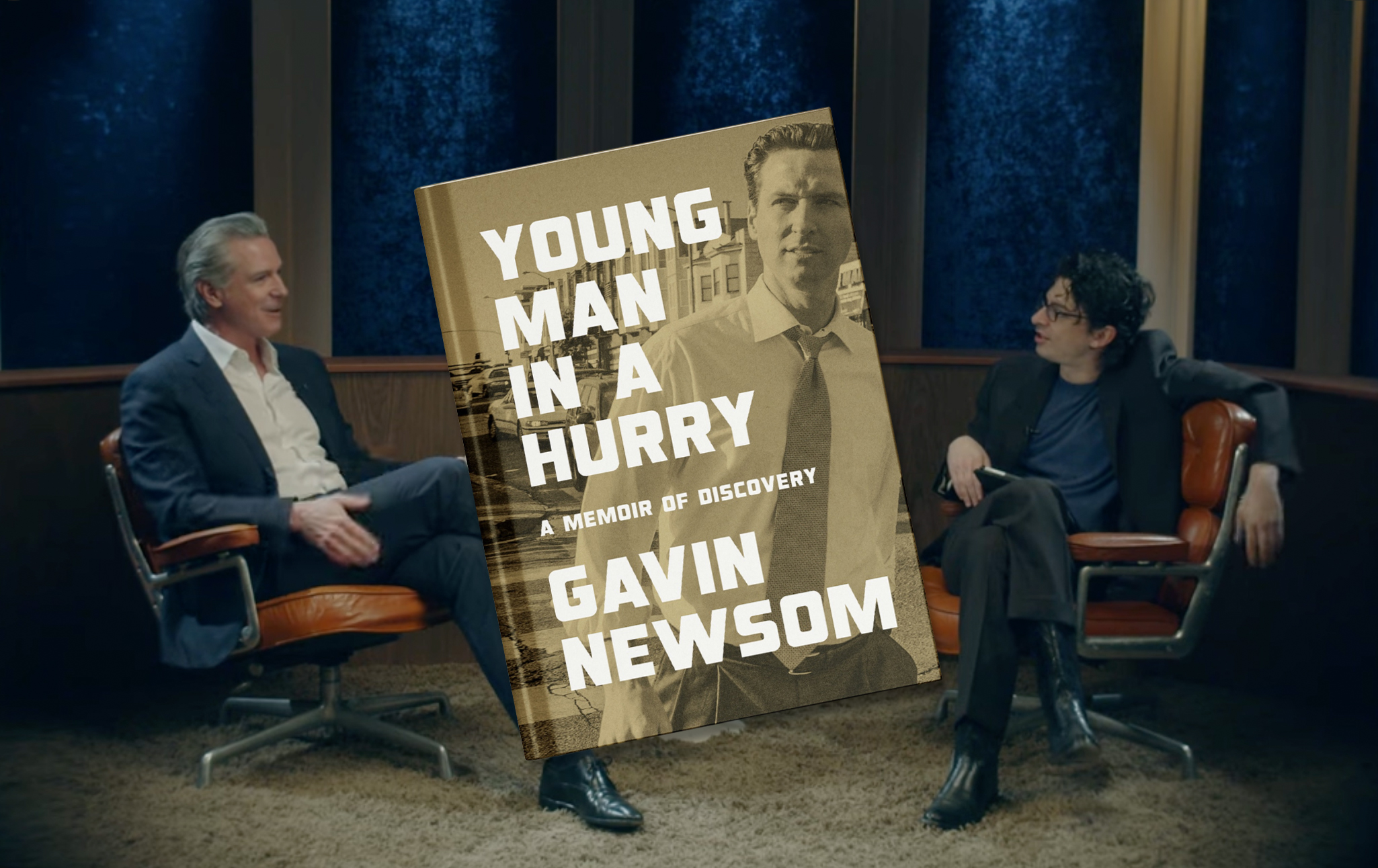
    Gavin Newsom Is a Hollow Man in a Hurry

    Political memoirs written by ambitious politicians are rarely written to tell the truth about a life. Instead, they are written to correct the public record before someone else does. By the time a politician sits down to write a first draft, the story of their career has already been told through newspaper profiles, investigative reporting, and the occasional scandal. A memoir offers the chance to rewrite that story from the inside: to smooth out the contradictions, elevate the moments of principle, and quietly explain away the advantages that made the whole thing possible.

  • Tech Nonprofits to Feds: Don’t Weaponize Procurement to Undermine AI Trust and Safety

    While the very public fight continues between the Department of Defense and Anthropic over whether the government can punish a company for refusing to allow its technology to be used for mass surveillance, another branch of the U.S. government is quietly working to ensure that this dispute will never happen again. How? By rewriting government procurement rules.

    Using procurement — meaning, the processes by which governments acquire goods and services– to accomplish policy goals is a time-honored and often appropriate strategy. The government literally expresses its politics and priorities by deciding where and how it spends its money. To that end, governments can and should give our tax dollars to companies and projects that serve the public interest, such as open-source software development, interoperability, or right to repair. And they should withhold those dollars from those that don’t, like shady contractors with inadequate security systems .

    New proposed rules from the principal agency in charge of acquiring goods, property and services for the federal government, the General Services Administration, are supposed to be primarily an effort to implement one policy priority: promoting steering government funds toward “ideologically neutral” American AI innovation But the new guidelines do far more than that.

    As explained in comments filed today with our partners at the Center for Democracy and Technology, the Protect Democracy Project, and the Electronic Privacy Information Center, the GSA’s guidelines include broad provisions that would make AI tools less safe and less useful. If finally adopted, these provisions would become standard components of every federal contract. You can read the full comments here.

    The most egregious example is a requirement that contractors and government service providers must license their AI systems to the government for “all lawful purposes.” Given the government’s loose interpretations of the law, ability to find loopholes to surveil you, and willingness to do illegal spying, we need serious and proactive legal restrictions to prevent it from gobbling up all the personally data it can acquire and using even routine bureaucratic data for punitive ends.

    Relatedly, the draft rules require that “AI System(s) must not refuse to produce data outputs or conduct analyses based on the Contractor’s or Service Provider’s discretionary policies.” In other words, if a company’s safety guardrails might prevent responding to a government request, the company must disable those guardrails. Given widespread public concerns about AI safety, it seems misguided, at best, to limit safeguards a company deems necessary.

    There are myriad other problems with the draft rules, such as technologically incoherent “anti-Woke” requirements. But the overarching problem is clear: much of this proposal would not serve the overall public interest in using American tax dollars to promote privacy, safety, and responsible technological innovation. The GSA should start over.

    Note they are also about implementing “anti-woke” tech which is even more stupid. I rewrote to allude to it but really that’s a whole other blog post

  • Double Shot of Privacy’s Defender in D.C.

    You’re invited on a journey inside the privacy battles that shaped the internet. EFF’s Executive Director Cindy Cohn has tangled with the feds, fought for your data security, and argued before judges to protect our access to science and knowledge on the internet.

    Join Cindy at two events in Washingtion, D.C. on April 13 and 14 discussing her new book: Privacy’s Defender: My Thirty-Year Fight Against Digital Surveillance, on sale now. All proceeds from the book benefit EFF. Find the full event details below, and RSVP to let us know if you can make it.

    April 13 – With Gigi Sohn at Busboys & Poets

    Join American Association of Public Broadband (AAPB) Executive Director Gigi Sohn, in conversation with EFF Executive Director Cindy Cohn for a discussion about Cindy’s work, her new book, and what we’re all wondering: Can have private conversations if we live our lives online?

    Privacy’s Defender at Busboys & Poets
    Busboys & Poets – 14th & V
    2021 14th St NW, Washington, DC 20009
    Monday, April 13, 2026
    6:30 pm to 8:30 pm

    Register Now

    April 14 – With Women in Security and Privacy (WISP)

    Join Women in Security and Privacy (WISP) and EFF for a conversation featuring American University Senior Professorial Lecturer Chelsea Horne and EFF Executive Director Cindy Cohn as they dive into data security, Federal access to data, and your digital rights. 

    Privacy’s Defender with WISP
    True Reformer Building – Lankford Auditorium
    1200 U St NW, Washington, DC 20009
    Tuesday, April 14, 2026
    6:00 pm to 8:30 pm

    REGISTER NOW

    “Privacy’s Defender is a compelling account of a life well lived and an inspiring call to action for the next generation of civil liberties champions.”

    ~Edward Snowden, whistleblower; author of Permanent Record

    Can’t make it? Look for Cindy at a city (or web connection) near you! Find the latest tour dates on the Privacy’s Defender hub or follow EFF for more.

    Part memoir and part legal history for the general reader, Privacy’s Defender is a compelling testament to just how much privacy and free expression matter in our efforts to combat authoritarianism, grow democracy, and strengthen human rights. Thank you for being a part of that fight.

    Want to support the cause and get a copy of the new book? New or renewing EFF members can preorder one as their annual gift!

  • Palantir’s ‘Workflow’ of AI-Directed Death

    The following story is co-published with Matt Bivens’ Substack newsletter, The 100 Days.

    In the brief video below, a Pentagon official shows off the government’s fancy new AI-guided target-and-destroy computer program.

    “This is Maven Smart System,” says the Pentagon’s chief artificial intelligence officer, “Palantir’s software-as-a-service product that we are deploying across the entire Department [of War].”

    “As you can see, it’s not just one data feed, it’s multiple,” he continues. “The single visualization tool allows you to select-deselect different types of data, look at different approaches to data, but more importantly — action, from the same system that you’re trying to develop your workflows around. Once you have a detection that you want to actually move into a targeting workflow, this is what we do: left click, right click, left click .…”

    Eventually, a nominated target (“a detection”) gets moved to a new “workflow” called CoA (for course of action) generation, in which the AI helps choose the best available weapon. From there “we can move directly into ‘how do we action that target?’,” i.e., how do we blow it up or kill it.

    An image from the Pentagon’s March 12 video demonstration about the course-of-action generation choices.

    “So, we’ve gone from identifying the target, to now coming up with a course of action, to now actioning that target — all from one system. This is revolutionary. [Before,] we were having this done in about eight or nine systems, where humans were literally moving ‘detections’ left and right in order to get to our desired end state, in this case, actually closing a kill chain.”

    Before Maven, humans were doing too much of the mental lifting. Now, Maven is doing more of that, which means a contemplated killing can be more briskly accomplished.

    Perhaps the humans will eventually be taken out of these workflows, and the computer itself could “close a kill chain.”

    But not quite yet. “There’s always a human in the loop, so there is always a human that makes the ultimate decision,” Palantir’s head of U.K. and European operations reassured the BBC. “That’s the current setup.”

    The current setup. Right.

    Eight years ago, Google bailed out of Project Maven. Thousands of its employees had threatened to resign at the very idea of creating a “GoogleEarth for War” — a zoom-in-or-out video-and-satellite feed that could, with just a few mouse clicks, destroy or kill what it sees.

    Just several weeks ago, Anthropic, another tech company with halfhearted “Don’t Be Evil” pretensions, got into a similar public row with the Pentagon. Anthropic said it did not want the government to use its Claude AI for “mass surveillance” and “fully autonomous weapons.”

    The company expressed fear that the Pentagon’s planned AI system might indeed end up off the leash, out there making its own decisions about whom to target, or when and how to kill them.

    Given the rapidly accumulating warning signs about rogue AI, this seems like a legitimate question, and one worthy of careful consideration and debate. But it was instead shut down instantly by our U.S. president — who reacted as if the asking of such questions represented a personal betrayal of his own awesomeness. Donald Trump banned the company from all federal contracts, and went on a Truth Social freakout in which he threatened “criminal consequences” for the “Leftwing nut jobs at Anthropic”.

    The president’s Truth Social post. The author posts these screenshots often because Truth Social is not searchable and Trump’s posts sometimes mysteriously just disappear.

    One day later, the United States and Israel launched our sneak-attack assassination of the Iranian leadership in a massive bombing campaign that also accidentally killed about 175 people, most of them children, at an elementary school.

    Days later, Project Maven — brought to us by the tough-talking, CIA-seed-money-funded sociopaths at Palantir — was publicly embraced by both the Pentagon and then by all of NATO. We’re told that the Maven Smart System was involved in many of the thousands of missile strikes visited on Iran during our month-old war there.

    No one will say if Maven was involved in the school strike itself — which pretty much tells you right there that it was. Otherwise, they’d deny it. So, when that undeclared war opened with more than 1,000 bombs dropped in a single day, an elementary school was likely nominated as a detection on the Maven dashboard, then left click, right click, left clicked into a workflow, then actioned to an ultimately undesired end state.

    The post Palantir’s ‘Workflow’ of AI-Directed Death appeared first on Truthdig.

  • Yout.com Hopes Supreme Court’s Cox Ruling Helps Its Case; RIAA Disagrees

    Yout.com Hopes Supreme Court’s Cox Ruling Helps Its Case; RIAA Disagrees

    YouTube downloaders and other nifty tools are seen as a major piracy threat by the music industry.

    To curb this trend, music companies have taken legal action against various stream-ripping services. This includes Yout.com, which is operated by the American developer Johnathan Nader.

    Nader is not easily defeated, however. In 2020 he took the RIAA to court in an attempt to have the site declared legal.

    Appeal Pending

    At the end of 2022, the district court handed a win to the RIAA and dismissed the matter at an early stage. Judge Stefan Underhill concluded that Yout had failed to show that it doesn’t circumvent YouTube’s technological protection measures. As such, it could be breaking the law. That wasn’t the end though.

    Yout’s operator opted to appeal at the Court of Appeals for the Second Circuit, asking it to reverse the lower court’s decision. The stream-ripper’s arguments are partly supported by amicus briefs from GitHub and the EFF, both of which joined the case.

    On the other side of the aisle, the RIAA dug in its heels. The music group saw no reason to doubt the lower court’s position and, in its response to the appeal, found the Copyright Alliance at its side.

    Yout Flags Cox Supreme Court Precedent

    The Second Circuit appeal has been pending for a while, but some fresh arguments appeared this week, after the Supreme Court issued its ruling in Cox v. Sony, reversing a billion-dollar verdict against the internet service provider and narrowing the standard for contributory copyright liability.

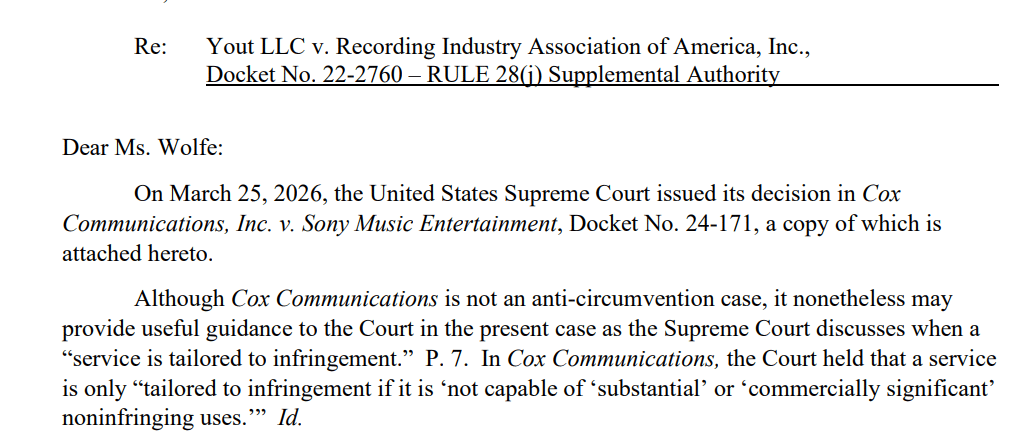
    Yout’s lawyers were quick to flag the decision to the Second Circuit via a supplemental authority letter. They argued that the Supreme Court’s discussion of when a service is ‘tailored to infringement’ has bearing on Yout’s own situation.

    “Although Cox Communications is not an anti-circumvention case, it nonetheless may provide useful guidance to the Court in the present case as the Supreme Court discusses when a ‘service is tailored to infringement’,” Yout’s counsel wrote.

    From the letter

    letter

    The Supreme Court held that a service that has noninfringing uses cannot be held liable, even if the operator knows that the service may be used for copyright infringement. Yout suggests the same logic should apply in its case.

    RIAA: Cox Does Not Apply

    Shortly after Yout informed the court, the RIAA sent a direct response.

    “Yout’s letter is not helpful to the resolution of this case,” RIAA writes. “The Cox decision addresses common law contributory liability for infringement. Yout’s complaint involves statutory anti-circumvention claims.”

    The distinction matters according to the RIAA, as the anti-circumvention of the DMCA (Section 1201) operates independently of the contributory liability doctrine. This means that a technology with noninfringing uses can still be prohibited under Section 1201, if it meets one of three criteria.

    Under 17 U.S.C. §§ 1201(a)(2) and 1201(b)(1), liability for trafficking exists if a technology or service meets any one of these three disjunctive criteria:

    • It is primarily designed to circumvent technological measures that effectively control access to copyrighted works.
    • It has only limited commercially significant purposes other than to circumvent.
    • It is marketed as circumvention tool.

    RIAA argues that all these criteria are met here, as Yout is designed to let users save local copies of YouTube content, its revenue model depends on that downloading functionality, and it markets itself explicitly as a stream recording tool, while borrowing the first four letters of YouTube’s name.

    Whether this exchange of opinions will influence the Second Circuit’s eventual decision has yet to be seen. The key issue on appeal remains whether YouTube’s rolling cipher qualifies as a technological protection measure under Section 1201 of the DMCA, and whether Yout circumvents it.

    A copy of Yout’s Rule 28(j) letter is available here (pdf). The RIAA’s response can be found here (pdf).

    From: TF, for the latest news on copyright battles, piracy and more.

  • ‘We watched them die before our eyes’: Sudan health workers helpless amid medical shortages

    As violence forces tens of thousands to flee Sudan’s South Kordofan state, doctors in a key maternity hospital are facing impossible choices – with too few supplies, too many patients, and lives slipping away.