Blog

  • NVIDIA: Contact With Anna’s Archive Doesn’t Prove Copyright Infringement

    NVIDIA: Contact With Anna’s Archive Doesn’t Prove Copyright Infringement

    Last month, we reported on an expanded class-action lawsuit in which several authors accused NVIDIA of using millions of pirated books to train its AI models.

    The complaint cited internal emails showing that NVIDIA contacted Anna’s Archive seeking “high-speed access” to the shadow library’s massive collection. After being warned about the illegal nature of the materials, NVIDIA executives allegedly gave the “green light” to proceed.

    Now, NVIDIA has fired back with a comprehensive motion to dismiss, calling the authors’ allegations speculative, vague, and legally insufficient.

    Contact With ‘Anna’ Isn’t Enough

    At the California federal court, NVIDIA argues that the authors’ complaint is built on speculation rather than facts.

    While the complaint shows evidence suggesting that NVIDIA contacted Anna’s Archive about potentially accessing “millions of pirated materials,” NVIDIA points out a crucial gap: the authors never actually allege that NVIDIA downloaded their specific books from the shadow library.

    “The only plausible facts alleged about Anna’s Archive are that NVIDIA ‘contacted Anna’s Archive’ about unspecified data, Anna’s Archive asked NVIDIA to confirm, and
    NVIDIA gave the “green light” to ‘proceed’.”

    “The mere fact that NVIDIA was in contact with representatives from Anna’s Archive does not mean that NVIDIA obtained Plaintiffs’ works from Anna’s Archive. It’s equally plausible NVIDIA did not,” the motion states.
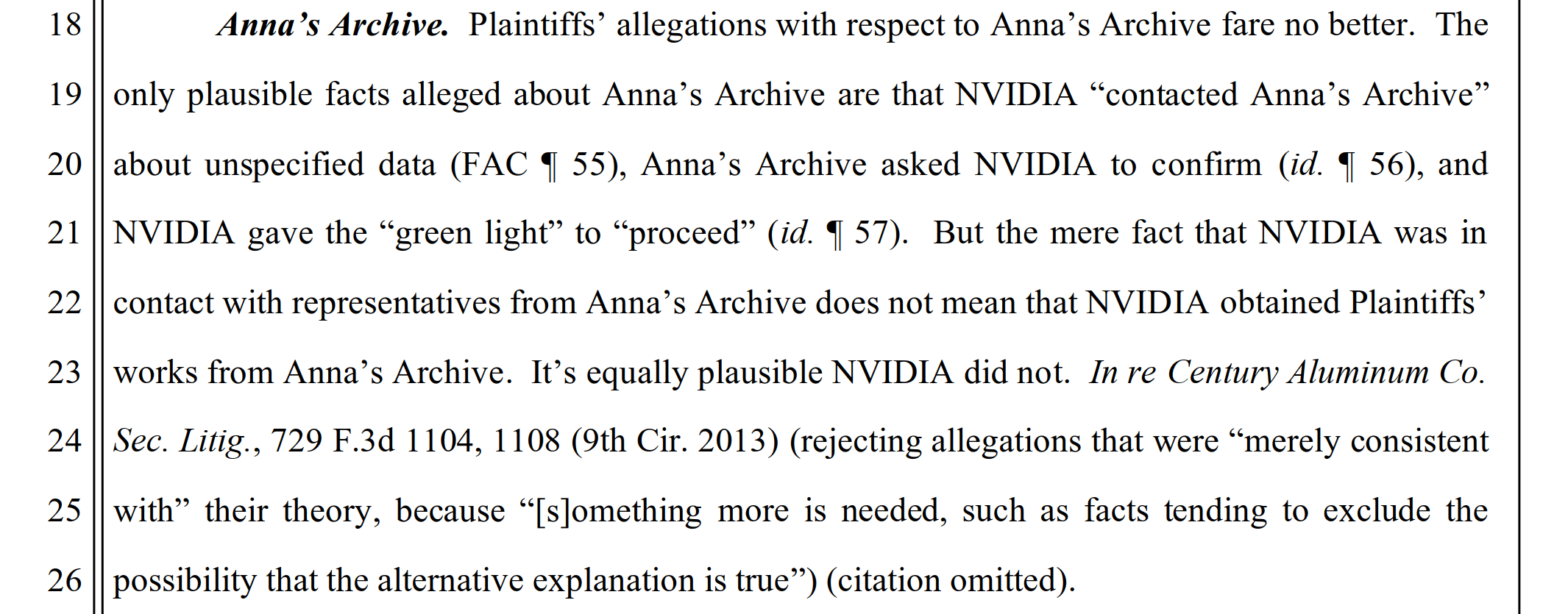
    Not Enough

    annagreen

    The chip giant notes that the authors rely heavily on allegations made “upon information and belief”. This is a legal phrase that essentially means that it is an educated guess, rather than a statement that can be backed up with evidence.

    Anna’s Archive ‘Backs’ NVIDIA

    It’s worth noting that after our original coverage, AnnaArchivist weighed in on Reddit, stating they have not been in direct contact, suggesting the company may have used an intermediary.

    “We’ve never dealt with Nvidia directly, so they likely used an intermediate party to avoid legal issues. But if Nvidia were to contact us directly, we’d happily provide them with high speed access in exchange for a donation,” the site’s representative wrote.
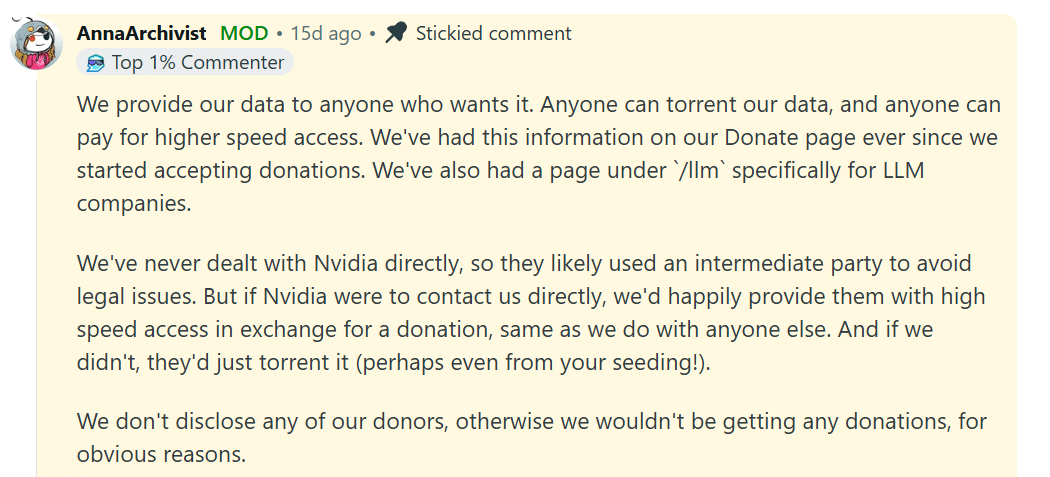
    AnnaArchivist’s comment

    anna

    Whether this clarification helps or hurts the authors’ case remains to be seen. In any case, NVIDIA does not mention it in its motion to dismiss.

    Catch-All Fishing Expedition

    Aside from the Anna’s Archive rebuttal, NVIDIA describes the amended complaint as a fishing expedition that includes “improper catch-all allegations” that target virtually every AI model and dataset the company has ever worked with.

    The original complaint focused narrowly on the NeMo Megatron model family and the Books3 dataset. But the amended version now references unidentified “NVIDIA LLMs,” unnamed “internal models,” undefined “NextLargeLLM” models, and unspecified “other shadow libraries.”

    Shortly after filing their updated complaint, the authors sent new discovery requests targeting these new models and datasets.

    “Plaintiffs’ bid for limitless discovery is confirmed by the blizzard of discovery requests they served after filing,” NVIDIA writes, as further evidence for the alleged fishing expedition.

    No Proof Books Were Actually Used

    In addition to Anna’s Archive, the amended complaint also adds various other shadow libraries, including Bibliotik, LibGen, Sci-Hub, Z-Library, and Pirate Library Mirror.

    However, according to NVIDIA, the complaint lacks proof that the company downloaded the authors’ books. Similarly, it argued that there is no evidence that specific books or datasets were used to train LLMs.

    For example, for the Nemotron-4 models, the authors simply speculated that because the training dataset was large and contained books, it must have included their works. NVIDIA dismissed this line of reasoning, noting that speculation is not enough.

    “[T]he absence of factual allegations that the data used to train Nemotron-4 15B and Nemotron-4 340B included Plaintiffs’ works requires dismissal as to those models,” the motion to dismiss reads.

    Secondary Infringement Claims Fail

    The amended complaint added two new legal theories: contributory and vicarious copyright infringement. Both claims allege that NVIDIA helped customers infringe by providing tools to download ‘The Pile’ dataset.

    NVIDIA argues these claims fail from the start. Both require an underlying act of direct infringement by a third party, but the authors only speculate “on information and belief” that NVIDIA’s customers downloaded and used The Pile.

    The complaint names three purported NVIDIA customers but “does not identify any customer alleged to have downloaded or used The Pile,” the motion states.

    Even if third-party infringement occurred, NVIDIA argues the authors fail to show the company had knowledge of specific infringing acts or materially contributed to them. The NeMo framework provides optional tools that customers can choose to use with any dataset—including licensed or public domain materials.

    “The NeMo framework is capable of substantial non-infringing uses,” NVIDIA writes, citing legal precedent that bars liability when products have legitimate purposes.

    NVIDIA Requests Dismissal

    All in all, NVIDIA wants the court to dismiss all the expanded claims, including the addition of the new models, the new shadow libraries, and the alleged communication with Anna’s Archive.

    The company further argues that the contributory and vicarious copyright infringement claims should be dismissed completely, as there is no evidence that specific books were pirated.
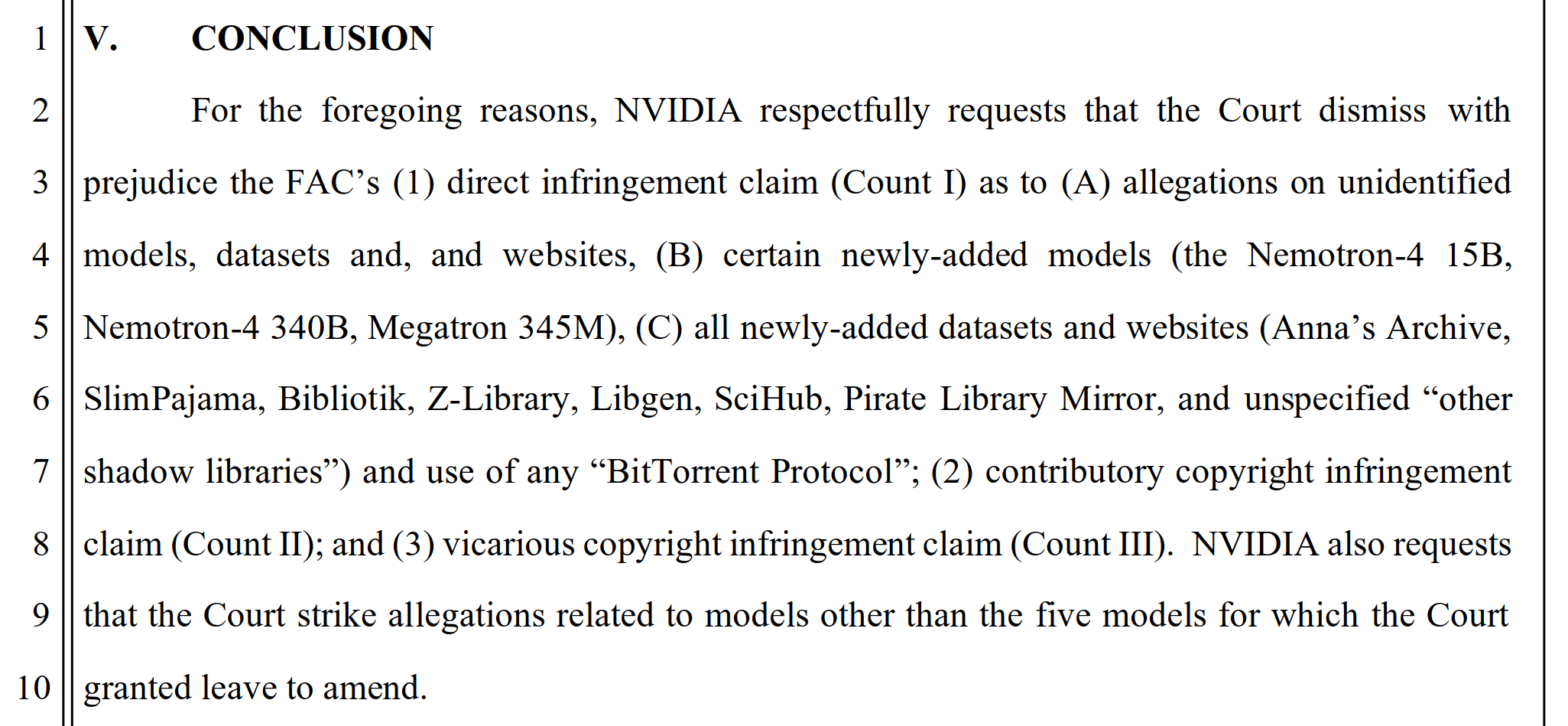
    Dismiss

    dismiss

    Notably, the direct copyright infringement claim, which alleges that NVIDIA used the Books3 database to train its NeMo model, is not covered by the motion. NVIDIA plans to defeat that during trial or on summary judgment, likely through a defense that relies heavily on fair use.

    A copy of NVIDIA’s motion to dismiss is available here (pdf). It is scheduled for a hearing on April 2, 2026, before Judge Jon S. Tigar in Oakland, California.

    From: TF, for the latest news on copyright battles, piracy and more.

  • Recording Now Available from “Protect Our Future Memory” Webinar

    Last week, Internet Archive welcomed more than 150 attendees to the webinar, “Protect Our Future Memory: Join the Call for Library Digital Rights.” Held on January 27, the event brought together legal experts, library leaders, and advocates to talk about Our Future Memory and the global coalition working to secure the protections that memory institutions need in our increasingly digital and networked world.

    Watch the session recording:

    The webinar opened with a stark reality check: For generations, libraries, archives, museums, and other memory institutions have relied on social and legal norms that allow them to collect, preserve, and lend materials. But nowadays, digital content is increasingly being controlled by restrictive licenses on gated, paywalled platforms. This new distribution stream prohibits memory institutions from doing what they’ve historically been able to do in the physical world, curtailing their essential functions of preserving and providing long-term access to knowledge.

    Webinar attendees heard from recent signatories Charlie Barlow, Executive Director of the Boston Library Consortium, and John Chrastka, Executive Director of the EveryLibrary Institute. Their participation highlighted the crisis facing memory institutions—and the demands necessary to overcome it.

    “When we have publishers or vendors coming in and saying that we can’t do something that we perceive as foundational and essential,” said Barlow, “we’re in real trouble.” 

    Chrastka added, “We’ve got gases, solids, liquids, plasma, and ebooks! Seriously, when you think about it, I can’t own it unless the IP owner wants to distribute that right to us. It’s a violation, in some ways, of a natural order.”

    To combat this dire situation, Our Future Memory is building consensus around the Statement on Digital Rights for Protecting Memory Institutions Online. Originating from discussions at the Library Leaders Forum and first endorsed by the National Library of Aruba in 2024, the Statement proposes the simple solution of letting memory institutions do what they were always able to do before the digital age. Specifically, they need the legal rights and practical ability to:

    • Collect digital materials
    • Preserve digital collections
    • Provide controlled digital access
    • Cooperate across institutions

    The Statement’s focus on foundational norms is what compelled the Boston Library Consortium to join the coalition, and Barlow emphasized its value as a tool for asserting that traditional library functions must not be treated as negotiable. 

    “We chose to sign this one because for us, it really established a clear, public baseline that we can point to when long-standing library rights are being treated as optional or the exception,” he explained. “It really is about making those foundational rights visible and shared and harder to dismiss.”

    For Chrastka and the EveryLibrary Institute, endorsing the Statement was a necessary step toward building the political momentum required to change the status quo.

    “We haven’t been necessarily talking as a sector out loud together as frequently and as vociferously as we need to about what this should all look like,” Chrastka said. “We want to lean into this conversation.”

    How can organizations participate?

    It is because memory institutions speak louder when they stand together that Our Future Memory is actively accepting signatures from institutions, organizations, and government entities. If you are ready to stand with a global community committed to protecting the past to power the future, here is how you can join:

    1. Download the Statement from ourfuturememory.org (or email campaigns@internetarchive.eu for a copy).
    2. Sign the document (either by hand or using an electronic signature tool).
    3. Send the signed document back to campaigns@internetarchive.eu.

    Once received, your organization will be added to the list of signatories.

    Want to learn more? If you missed the live event, you can watch the full recording or visit the Our Future Memory website for resources to help you advocate for these rights in your own community.

  • No-one knows what to expect when you’re dying – but hospices helped me

    Hospices caring for people at the end of their lives are at risk because funding is “unsustainable”.
  • Government pledges 10,000 new foster care places in England

    Rule changes aim to create thousands of new foster places and help full-time workers.
  • Three quarters will survive cancer by 2035, government promises

    There are plans for earlier diagnosis and faster treatment in England but experts worry about lack of staff.
  • The Obscure Law Destroying Black Homeownership in America

    The Obscure Law Destroying Black Homeownership in America

    Across the historic corridors of the American South and in urban centers from Chicago to Philadelphia, a quiet crisis is hollowing out the foundation of Black generational wealth: the ability to own a home. It does not always arrive with the loud rumble of a bulldozer or the sudden shock of an eviction notice. More often, it arrives as a silent legal technicality known as “Heirs’ Property.”

  • Seven million cancers a year are preventable, says report

    Scientists say there is a powerful opportunity to save lives because nearly 40% of cancers are preventable.
  • U.S. Rightsholders Applaud India’s “Lock and Suspend” Piracy Blockades

    U.S. Rightsholders Applaud India’s “Lock and Suspend” Piracy Blockades

    Pirate sites and services can be a real challenge for rightsholders to deal with. In India, however, recent court orders have proven to be quite effective.

    Indian courts have issued pirate site blocking orders for over a decade. Initially, these orders were relatively basic, requiring local Internet providers to block specific domain names. However, these early orders have evolved quite a bit since then.

    In 2023, several Hollywood studios obtained a seminal court order that significantly expanded the scope. In addition to requesting Indian Internet providers to block pirate sites, it also required domain registrars to “lock and suspend” the domain names while sharing registrant data with the rightsholders.

    This broad Delhi court order became a new standard going forward. American rightsholders used it against a wide variety of pirate sites and, through this Indian route, they targeted American domain registrars such as Namecheap and Porkbun. Effectively, the Delhi High Court now has the power to take domains offline worldwide.

    U.S. Rightsholders Praise Indian Model

    Thus far, U.S. rightsholders have not commented in great detail on these Indian efforts. However, the International Intellectual Property Alliance (IIPA), which represents the interests of prominent rightsholder groups, including the MPA and RIAA, recently highlighted it.

    IIPA makes its remarks in its annual “Special 301” recommendation to the U.S. Trade Representative (USTR). This inquiry allows rightsholders to flag shortcomings and concerns in foreign countries.

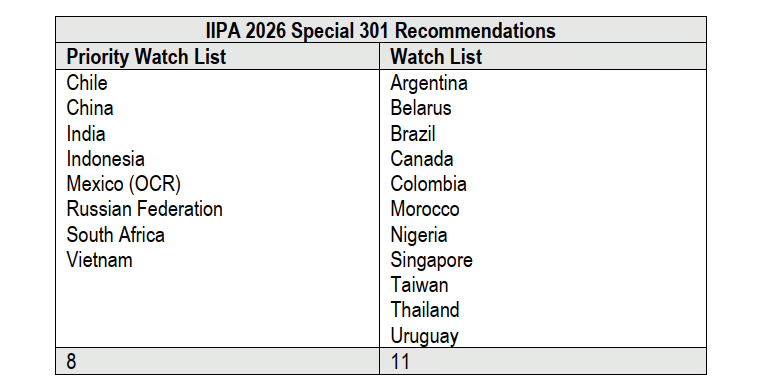
    recomm

    The IIPA traditionally sees India as a problematic country, and this year it also recommends the USTR put it on the Priority Watch List. However, there is praise too, especially for the site-blocking efforts.

    The “lock and suspend” orders, in particular, have helped to (temporarily) take out hundreds of pirate sites. This includes targets such as Animeflix, Vegamovies Fmovies, SFlix, VidSrc, and many others.

    “To date, more than 400 piracy domains have been completely wiped from the Internet, representing billions of global piracy visits,” IIPA writes.

    “Rights holders are encouraged by the Delhi High Court’s progressive understanding of the technologies involved in modern digital piracy and its resolve to grant creative relief to truly tackle piracy on a global scale.”

    Effective Disruption

    IIPA notes that these court orders are “unusually disruptive for pirate operators”. This is in part because they target domain names through U.S. domain registrars. This means that the impact of these court orders is felt globally.

    Also, since the domain registrars are required to share the personal details of the domain registrants, these orders can help with follow-up enforcement actions.

    These Delhi High Court orders have helped to tackle movie and TV-show piracy, and IIPA suggests that this is also showing in the numbers. Anime and manga are now the dominant piracy categories, with less than 30% of the top pirate sites (ex. music) focused on U.S. movies and TV content.

    “This can be said to be at least in part attributable to the consistent orders being made by the Delhi High Court to disable access to all the top pirate film, TV, and streaming sites,” IIPA writes.

    Additionally, IIPA highlights enforcement achievements by the local authorities. For example, the high-profile action against the alleged operator of the streaming platform iBomma, who was arrested soon after he landed at Hyderabad Airport.

    More Can Be Done

    Of course, IIPA’s report isn’t just a summary of positive notes. After all, the group lists India as a high-priority threat, so there is plenty of room for improvement.

    “While these promising developments raise hopes that concerted actions can have a positive impact to disrupt the piracy ecosystem, more needs to be done to ensure deterrence becomes the norm to drive would-be pirates from these damaging activities,” IIPA writes.

    For example, IIPA complains that some Indian Internet Service Providers (ISPs) are slow to implement the blocking orders passed by the Delhi High Court and calls for tighter timelines.

    In addition, not all foreign domain name registrars are complying with the Indian court orders. This means that the global reach of these orders remains limited.

    Finally, since broad blocking orders are limited to the Delhi Court, rightsholders recommend replicating these state-level blocking successes nationally across all Indian states.

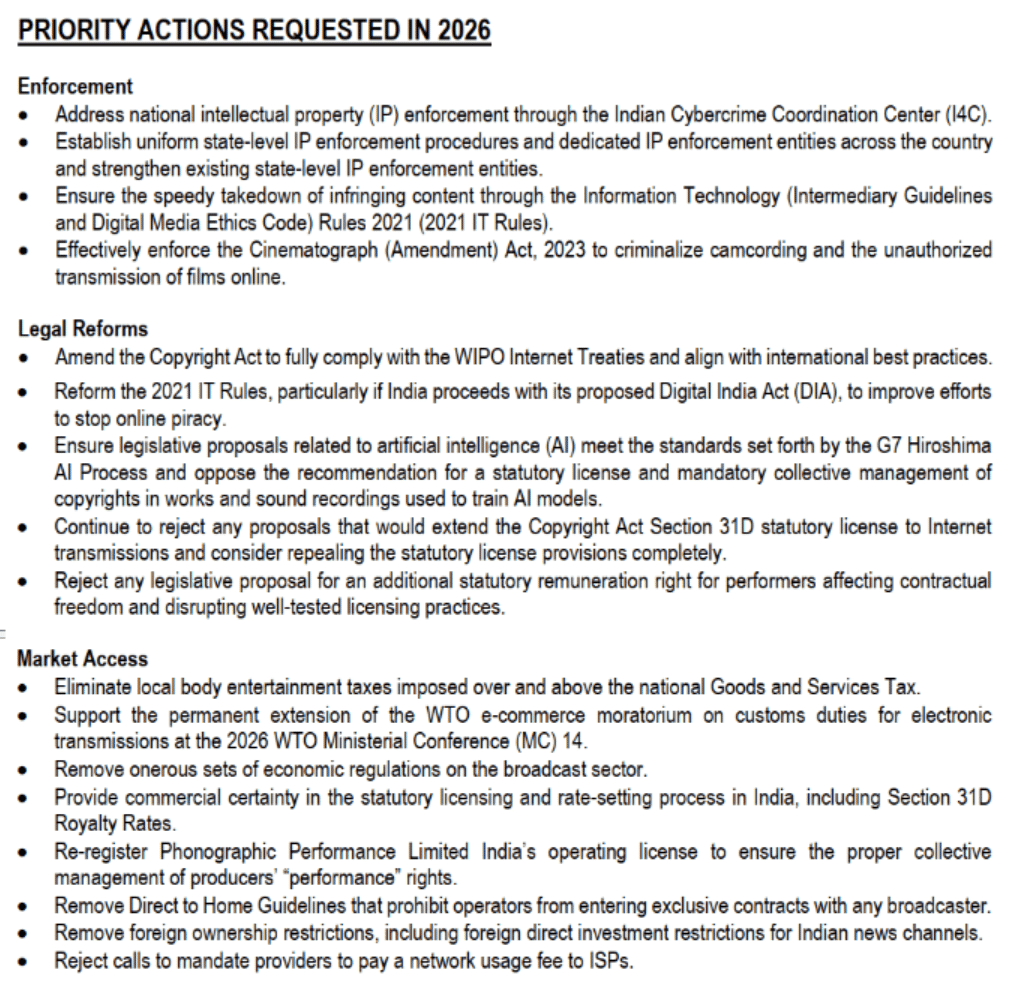
    The site-blocking recommendations are just the tip of the iceberg, however. The IIPA recommends India to undertake a long list of actions, ranging from taking action against illegal camcording in movie theaters to improving the proposed Digital India Act by adding anti-piracy measures.

    IIPA’s suggested priority actions for India

    prio

    IIPA’s conclusion is that India deserves to be called out on the USTR’s “Priority Watch List” in the upcoming Special 301 Review. Whether the U.S. government agrees has yet to be seen, but it wouldn’t be a surprise, as India has consistently been marked as a priority threat in recent years.

    IIPA’s 2026 Special 301 Report on Copyright Protection and Enforcement, which includes all India references, is available here (pdf).

    From: TF, for the latest news on copyright battles, piracy and more.

  • Pluralistic: Michael Swanwick’s “The Universe Box” (03 Feb 2026)

    Today’s links


    The Tachyon Books cover for Michael Swanwick's 'The Universe Box.'

    Michael Swanwick’s “The Universe Box” (permalink)

    No one writes short stories like Michael Swanwick, the five-time Hugo-winning master of science fiction. To prove it, you need only pick up The Universe Box, Swanwick’s just-published short story collection, a book representing one of the field’s greatest writers at the absolute pinnacle of his game:

    https://tachyonpublications.com/product/the-universe-box/

    Science fiction has a long and honorable history with the short story. Sf is a pulp literature that was born in the pages of magazines specializing in short fiction and serials, and long after other genres had given up the ghost, sf remained steadfastly rooted in short form fiction. There are still, to this day, multiple sf magazines that publish short stories every month, on paper, and pay for it. I started my career as a short story writer, and continue to dabble in the form, but I have mostly moved onto novels.

    That’s a pretty common trajectory in sf, where – notwithstanding the field’s status as a haven for the short story – the reach (and money) come from novels. But sf has always had a cohort of short fiction writers who are staunchly committed to the form: Harlan Ellison, Martha Soukup, Martha Wells, Ray Bradbury, Ted Chiang, James Tiptree Jr, Theodore Sturgeon, and, of course, Michael Swanwick.

    It’s a little weird, how sf serves as a powerful redoubt for short fiction. After all, sf is a genre in which everything is up for grabs: the reader can’t assume anything about the story’s setting, its era, the species of its characters. Time can run forwards, backwards, or in a loop. There can be gods and teleporters, faster-than-light drives and superintelligent machines. There can be aliens and space colonies.

    All of that has to be established in the story. The most straightforward way to do this is, of course, through exposition. There’s a commonplace (and wrong) notion that exposition is bad (“show, don’t tell”). It’s fairer to say that exposition is hard – dramatization is, well, dramatic, which makes it easier to engage the reader’s attention. But great exposition is great and sf is a genre that celebrates exposition, done well:

    https://maryrobinettekowal.com/journal/my-favorite-bit/my-favorite-bit-cory-doctorow-talks-about-the-bezzle/

    The opposite of exposition is what Jo Walton calls “incluing,” “the process of scattering information seamlessly through the text, as opposed to stopping the story to impart the information”:

    https://web.archive.org/web/20111119145140/http:/papersky.livejournal.com/324603.html

    Incluing is a beautiful prose technique, but it makes the reader work. You have to pay close attention to all these subtle clues and build a web of inferences about the kind of world you’ve been plunged into. Incluing turns a story into a (wonderful and engaging) puzzle. It makes the aesthetic affect of short sf into something that’s not so much a reverie as a high-engagement activity, a mystery whose solution is totally unbounded.

    This is a terrific experience, but it is also work. Doing that kind of work as part of the process of consuming a 300-page novel is one thing, but trying to get the reader up to speed in a 7,000 word story and still have room left over for the story part is a big lift, and even the best writers end up asking a lot of the reader in their short stories. Sf shorts can be the “difficult jazz” of literature, a form and genre that requires – and rewards – very active attention.

    (Incidentally, my favorite incluing example is Mark Twain’s classic comedic short, “The Petrified Man”:)

    https://americanliterature.com/author/mark-twain/short-story/the-petrified-man/

    But here’s the thing. None of this applies to Swanwick. His stories use a mix of (impeccable) exposition and (subtle) incluing, and yet, there’s never a moment in reading a Swanwick story where it feels like work. It’s not merely that he’s a gorgeous prose-smith whose sentences are each more surpassingly lovely than the last (though he is). Nor does he lack ambition: each of these stories has a more embroidered and outlandish premise than the last.

    Somehow, though, he just slides these stories into your brain.

    And what stories they are! They are, by turns, individually and in combination, slapstick, grave, horny, hilarious, surreal, disturbing and heartwarming. They have surprise endings and surprise middles and sometimes surprise beginnings (Swanwick does an opening paragraph like no one else).

    This is what it means to read a short story collection from an absolute master at the absolute peak of his powers. He can slide you frictionlessly between Icelandic troll tragedies to lethal drone-leopard romantic agonies to battles of the gods and the cigar box that has the universe inside of it. All with the lyricism of Bradbury, the madcap wit of Sturgeon, the unrelenting weirdness of Dick, the heart of Tiptree and the precision of Chiang.

    This is a book of worlds that each exist for just a handful of pages but occupy more space than those pages could possibly contain. It’s a series of cigar boxes, each with the universe inside of it.


    Hey look at this (permalink)


    A shelf of leatherbound history books with a gilt-stamped series title, 'The World's Famous Events.'

    Object permanence (permalink)

    #20yrsago Sony CD spyware vendor caves to EFF demands https://web.archive.org/web/20060208033113/https://www.eff.org/news/archives/2006_02.php#004378

    #20yrsago British Library: DRM lobotomizes “human memory” http://news.bbc.co.uk/2/hi/technology/4675280.stm

    #15yrsago Hex values for Crayola colors https://en.wikipedia.org/wiki/List_of_Crayola_crayon_colors

    #15yrsago Michael Lewis explains the Irish econopocalypse https://www.vanityfair.com/news/2011/03/michael-lewis-ireland-201103?currentPage=all

    #15yrsago Canada’s Internet rescued from weak and pathetic regulator https://web.archive.org/web/20110203054651/http://www.thestar.com/news/canada/article/932571–ottawa-threatens-to-reverse-crtc-decision-on-internet-billing

    #10yrsago Tattoo artist asserts copyright over customers’ bodies https://www.hollywoodreporter.com/business/business-news/nba-2k-videogame-maker-sued-861131/

    #10yrsago EU plans to class volunteers who rescue drowning Syrian refugees as “traffickers” https://www.statewatch.org/news/2016/january/refugee-crisis-council-proposals-on-migrant-smuggling-would-criminalise-humanitarian-assistance-by-civil-society-local-people-and-volunteers-greece-ngos-and-volunteers-have-to-register-with-the-police-and-be-vetted/


    Upcoming appearances (permalink)

    A photo of me onstage, giving a speech, pounding the podium.


    A screenshot of me at my desk, doing a livecast.

    Recent appearances (permalink)


    A grid of my books with Will Stahle covers..

    Latest books (permalink)


    A cardboard book box with the Macmillan logo.

    Upcoming books (permalink)

    • “Unauthorized Bread”: a middle-grades graphic novel adapted from my novella about refugees, toasters and DRM, FirstSecond, 2026
    • “Enshittification, Why Everything Suddenly Got Worse and What to Do About It” (the graphic novel), Firstsecond, 2026

    • “The Memex Method,” Farrar, Straus, Giroux, 2026

    • “The Reverse-Centaur’s Guide to AI,” a short book about being a better AI critic, Farrar, Straus and Giroux, June 2026


    Colophon (permalink)

    Today’s top sources:

    Currently writing: “The Post-American Internet,” a sequel to “Enshittification,” about the better world the rest of us get to have now that Trump has torched America (1053 words today, 20644 total)

    • “The Reverse Centaur’s Guide to AI,” a short book for Farrar, Straus and Giroux about being an effective AI critic. LEGAL REVIEW AND COPYEDIT COMPLETE.
    • “The Post-American Internet,” a short book about internet policy in the age of Trumpism. PLANNING.

    • A Little Brother short story about DIY insulin PLANNING


    This work – excluding any serialized fiction – is licensed under a Creative Commons Attribution 4.0 license. That means you can use it any way you like, including commercially, provided that you attribute it to me, Cory Doctorow, and include a link to pluralistic.net.

    https://creativecommons.org/licenses/by/4.0/

    Quotations and images are not included in this license; they are included either under a limitation or exception to copyright, or on the basis of a separate license. Please exercise caution.


    How to get Pluralistic:

    Blog (no ads, tracking, or data-collection):

    Pluralistic.net

    Newsletter (no ads, tracking, or data-collection):

    https://pluralistic.net/plura-list

    Mastodon (no ads, tracking, or data-collection):

    https://mamot.fr/@pluralistic

    Medium (no ads, paywalled):

    https://doctorow.medium.com/

    Twitter (mass-scale, unrestricted, third-party surveillance and advertising):

    https://twitter.com/doctorow

    Tumblr (mass-scale, unrestricted, third-party surveillance and advertising):

    https://mostlysignssomeportents.tumblr.com/tagged/pluralistic

    When life gives you SARS, you make sarsaparilla” -Joey “Accordion Guy” DeVilla

    READ CAREFULLY: By reading this, you agree, on behalf of your employer, to release me from all obligations and waivers arising from any and all NON-NEGOTIATED agreements, licenses, terms-of-service, shrinkwrap, clickwrap, browsewrap, confidentiality, non-disclosure, non-compete and acceptable use policies (“BOGUS AGREEMENTS”) that I have entered into with your employer, its partners, licensors, agents and assigns, in perpetuity, without prejudice to my ongoing rights and privileges. You further represent that you have the authority to release me from any BOGUS AGREEMENTS on behalf of your employer.

    ISSN: 3066-764X