Author: tio

  • The Kimwolf Botnet is Stalking Your Local Network

    The story you are reading is a series of scoops nestled inside a far more urgent Internet-wide security advisory. The vulnerability at issue has been exploited for months already, and it’s time for a broader awareness of the threat. The short version is that everything you thought you knew about the security of the internal network behind your Internet router probably is now dangerously out of date.

    The security company Synthient currently sees more than 2 million infected Kimwolf devices distributed globally but with concentrations in Vietnam, Brazil, India, Saudi Arabia, Russia and the United States. Synthient found that two-thirds of the Kimwolf infections are Android TV boxes with no security or authentication built in.

    The past few months have witnessed the explosive growth of a new botnet dubbed Kimwolf, which experts say has infected more than 2 million devices globally. The Kimwolf malware forces compromised systems to relay malicious and abusive Internet traffic — such as ad fraud, account takeover attempts and mass content scraping — and participate in crippling distributed denial-of-service (DDoS) attacks capable of knocking nearly any website offline for days at a time.

    More important than Kimwolf’s staggering size, however, is the diabolical method it uses to spread so quickly: By effectively tunneling back through various “residential proxy” networks and into the local networks of the proxy endpoints, and by further infecting devices that are hidden behind the assumed protection of the user’s firewall and Internet router.

    Residential proxy networks are sold as a way for customers to anonymize and localize their Web traffic to a specific region, and the biggest of these services allow customers to route their traffic through devices in virtually any country or city around the globe.

    The malware that turns an end-user’s Internet connection into a proxy node is often bundled with dodgy mobile apps and games. These residential proxy programs also are commonly installed via unofficial Android TV boxes sold by third-party merchants on popular e-commerce sites like Amazon, BestBuy, Newegg, and Walmart.

    These TV boxes range in price from $40 to $400, are marketed under a dizzying range of no-name brands and model numbers, and frequently are advertised as a way to stream certain types of subscription video content for free. But there’s a hidden cost to this transaction: As we’ll explore in a moment, these TV boxes make up a considerable chunk of the estimated two million systems currently infected with Kimwolf.

    Some of the unsanctioned Android TV boxes that come with residential proxy malware pre-installed. Image: Synthient.

    Kimwolf also is quite good at infecting a range of Internet-connected digital photo frames that likewise are abundant at major e-commerce websites. In November 2025, researchers from Quokka published a report (PDF) detailing serious security issues in Android-based digital picture frames running the Uhale app — including Amazon’s bestselling digital frame as of March 2025.

    There are two major security problems with these photo frames and unofficial Android TV boxes. The first is that a considerable percentage of them come with malware pre-installed, or else require the user to download an unofficial Android App Store and malware in order to use the device for its stated purpose (video content piracy). The most typical of these uninvited guests are small programs that turn the device into a residential proxy node that is resold to others.

    The second big security nightmare with these photo frames and unsanctioned Android TV boxes is that they rely on a handful of Internet-connected microcomputer boards that have no discernible security or authentication requirements built-in. In other words, if you are on the same network as one or more of these devices, you can likely compromise them simultaneously by issuing a single command across the network.

    THERE’S NO PLACE LIKE 127.0.0.1

    The combination of these two security realities came to the fore in October 2025, when an undergraduate computer science student at the Rochester Institute of Technology began closely tracking Kimwolf’s growth, and interacting directly with its apparent creators on a daily basis.

    Benjamin Brundage is the 22-year-old founder of the security firm Synthient, a startup that helps companies detect proxy networks and learn how those networks are being abused. Conducting much of his research into Kimwolf while studying for final exams, Brundage told KrebsOnSecurity in late October 2025 he suspected Kimwolf was a new Android-based variant of Aisuru, a botnet that was incorrectly blamed for a number of record-smashing DDoS attacks last fall.

    Brundage says Kimwolf grew rapidly by abusing a glaring vulnerability in many of the world’s largest residential proxy services. The crux of the weakness, he explained, was that these proxy services weren’t doing enough to prevent their customers from forwarding requests to internal servers of the individual proxy endpoints.

    Most proxy services take basic steps to prevent their paying customers from “going upstream” into the local network of proxy endpoints, by explicitly denying requests for local addresses specified in RFC-1918, including the well-known Network Address Translation (NAT) ranges 10.0.0.0/8, 192.168.0.0/16, and 172.16.0.0/12. These ranges allow multiple devices in a private network to access the Internet using a single public IP address, and if you run any kind of home or office network, your internal address space operates within one or more of these NAT ranges.

    However, Brundage discovered that the people operating Kimwolf had figured out how to talk directly to devices on the internal networks of millions of residential proxy endpoints, simply by changing their Domain Name System (DNS) settings to match those in the RFC-1918 address ranges.

    “It is possible to circumvent existing domain restrictions by using DNS records that point to 192.168.0.1 or 0.0.0.0,” Brundage wrote in a first-of-its-kind security advisory sent to nearly a dozen residential proxy providers in mid-December 2025. “This grants an attacker the ability to send carefully crafted requests to the current device or a device on the local network. This is actively being exploited, with attackers leveraging this functionality to drop malware.”

    As with the digital photo frames mentioned above, many of these residential proxy services run solely on mobile devices that are running some game, VPN or other app with a hidden component that turns the user’s mobile phone into a residential proxy — often without any meaningful consent.

    In a report published today, Synthient said key actors involved in Kimwolf were observed monetizing the botnet through app installs, selling residential proxy bandwidth, and selling its DDoS functionality.

    “Synthient expects to observe a growing interest among threat actors in gaining unrestricted access to proxy networks to infect devices, obtain network access, or access sensitive information,” the report observed. “Kimwolf highlights the risks posed by unsecured proxy networks and their viability as an attack vector.”

    ANDROID DEBUG BRIDGE

    After purchasing a number of unofficial Android TV box models that were most heavily represented in the Kimwolf botnet, Brundage further discovered the proxy service vulnerability was only part of the reason for Kimwolf’s rapid rise: He also found virtually all of the devices he tested were shipped from the factory with a powerful feature called Android Debug Bridge (ADB) mode enabled by default.

    Many of the unofficial Android TV boxes infected by Kimwolf include the ominous disclaimer: “Made in China. Overseas use only.” Image: Synthient.

    ADB is a diagnostic tool intended for use solely during the manufacturing and testing processes, because it allows the devices to be remotely configured and even updated with new (and potentially malicious) firmware. However, shipping these devices with ADB turned on creates a security nightmare because in this state they constantly listen for and accept unauthenticated connection requests.

    For example, opening a command prompt and typing “adb connect” along with a vulnerable device’s (local) IP address followed immediately by “:5555” will very quickly offer unrestricted “super user” administrative access.

    Brundage said by early December, he’d identified a one-to-one overlap between new Kimwolf infections and proxy IP addresses offered for rent by China-based IPIDEA, currently the world’s largest residential proxy network by all accounts.

    “Kimwolf has almost doubled in size this past week, just by exploiting IPIDEA’s proxy pool,” Brundage told KrebsOnSecurity in early December as he was preparing to notify IPIDEA and 10 other proxy providers about his research.

    Brundage said Synthient first confirmed on December 1, 2025 that the Kimwolf botnet operators were tunneling back through IPIDEA’s proxy network and into the local networks of systems running IPIDEA’s proxy software. The attackers dropped the malware payload by directing infected systems to visit a specific Internet address and to call out the pass phrase “krebsfiveheadindustries” in order to unlock the malicious download.

    On December 30, Synthient said it was tracking roughly 2 million IPIDEA addresses exploited by Kimwolf in the previous week. Brundage said he has witnessed Kimwolf rebuilding itself after one recent takedown effort targeting its control servers — from almost nothing to two million infected systems just by tunneling through proxy endpoints on IPIDEA for a couple of days.

    Brundage said IPIDEA has a seemingly inexhaustible supply of new proxies, advertising access to more than 100 million residential proxy endpoints around the globe in the past week alone. Analyzing the exposed devices that were part of IPIDEA’s proxy pool, Synthient said it found more than two-thirds were Android devices that could be compromised with no authentication needed.

    SECURITY NOTIFICATION AND RESPONSE

    After charting a tight overlap in Kimwolf-infected IP addresses and those sold by IPIDEA, Brundage was eager to make his findings public: The vulnerability had clearly been exploited for several months, although it appeared that only a handful of cybercrime actors were aware of the capability. But he also knew that going public without giving vulnerable proxy providers an opportunity to understand and patch it would only lead to more mass abuse of these services by additional cybercriminal groups.

    On December 17, Brundage sent a security notification to all 11 of the apparently affected proxy providers, hoping to give each at least a few weeks to acknowledge and address the core problems identified in his report before he went public. Many proxy providers who received the notification were resellers of IPIDEA that white-labeled the company’s service.

    KrebsOnSecurity first sought comment from IPIDEA in October 2025, in reporting on a story about how the proxy network appeared to have benefitted from the rise of the Aisuru botnet, whose administrators appeared to shift from using the botnet primarily for DDoS attacks to simply installing IPIDEA’s proxy program, among others.

    On December 25, KrebsOnSecurity received an email from an IPIDEA employee identified only as “Oliver,” who said allegations that IPIDEA had benefitted from Aisuru’s rise were baseless.

    “After comprehensively verifying IP traceability records and supplier cooperation agreements, we found no association between any of our IP resources and the Aisuru botnet, nor have we received any notifications from authoritative institutions regarding our IPs being involved in malicious activities,” Oliver wrote. “In addition, for external cooperation, we implement a three-level review mechanism for suppliers, covering qualification verification, resource legality authentication and continuous dynamic monitoring, to ensure no compliance risks throughout the entire cooperation process.”

    “IPIDEA firmly opposes all forms of unfair competition and malicious smearing in the industry, always participates in market competition with compliant operation and honest cooperation, and also calls on the entire industry to jointly abandon irregular and unethical behaviors and build a clean and fair market ecosystem,” Oliver continued.

    Meanwhile, the same day that Oliver’s email arrived, Brundage shared a response he’d just received from IPIDEA’s security officer, who identified himself only by the first name Byron. The security officer said IPIDEA had made a number of important security changes to its residential proxy service to address the vulnerability identified in Brundage’s report.

    “By design, the proxy service does not allow access to any internal or local address space,” Byron explained. “This issue was traced to a legacy module used solely for testing and debugging purposes, which did not fully inherit the internal network access restrictions. Under specific conditions, this module could be abused to reach internal resources. The affected paths have now been fully blocked and the module has been taken offline.”

    Byron told Brundage IPIDEA also instituted multiple mitigations for blocking DNS resolution to internal (NAT) IP ranges, and that it was now blocking proxy endpoints from forwarding traffic on “high-risk” ports “to prevent abuse of the service for scanning, lateral movement, or access to internal services.”
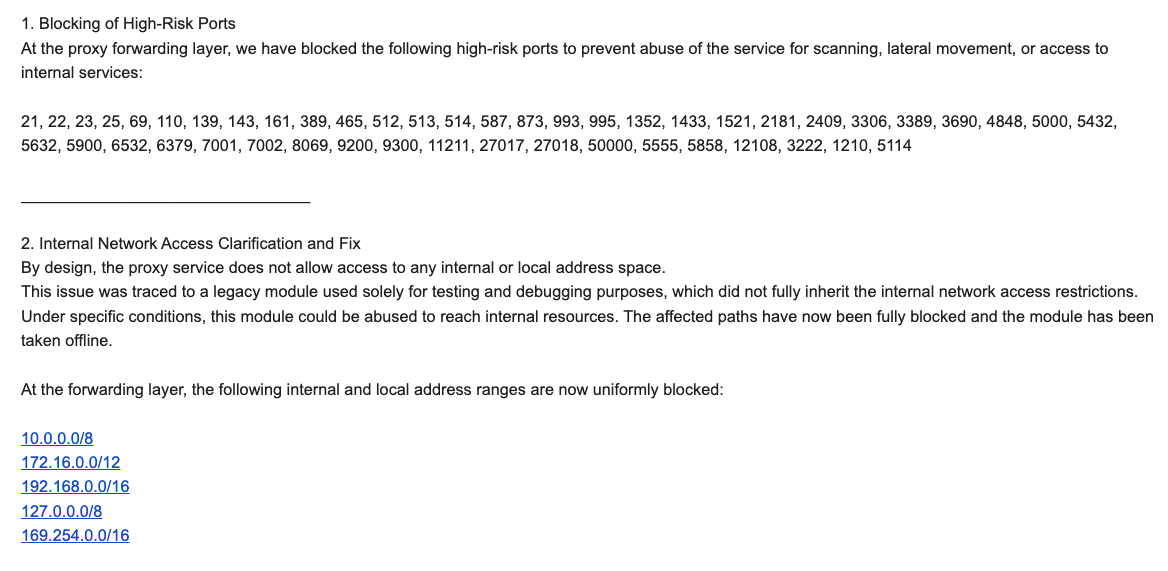
    An excerpt from an email sent by IPIDEA’s security officer in response to Brundage’s vulnerability notification. Click to enlarge.

    Brundage said IPIDEA appears to have successfully patched the vulnerabilities he identified. He also noted he never observed the Kimwolf actors targeting proxy services other than IPIDEA, which has not responded to requests for comment.

    Riley Kilmer is founder of Spur.us, a technology firm that helps companies identify and filter out proxy traffic. Kilmer said Spur has tested Brundage’s findings and confirmed that IPIDEA and all of its affiliate resellers indeed allowed full and unfiltered access to the local LAN.

    Kilmer said one model of unsanctioned Android TV boxes that is especially popular — the Superbox, which we profiled in November’s Is Your Android TV Streaming Box Part of a Botnet? — leaves Android Debug Mode running on localhost:5555.

    “And since Superbox turns the IP into an IPIDEA proxy, a bad actor just has to use the proxy to localhost on that port and install whatever bad SDKs [software development kits] they want,” Kilmer told KrebsOnSecurity.
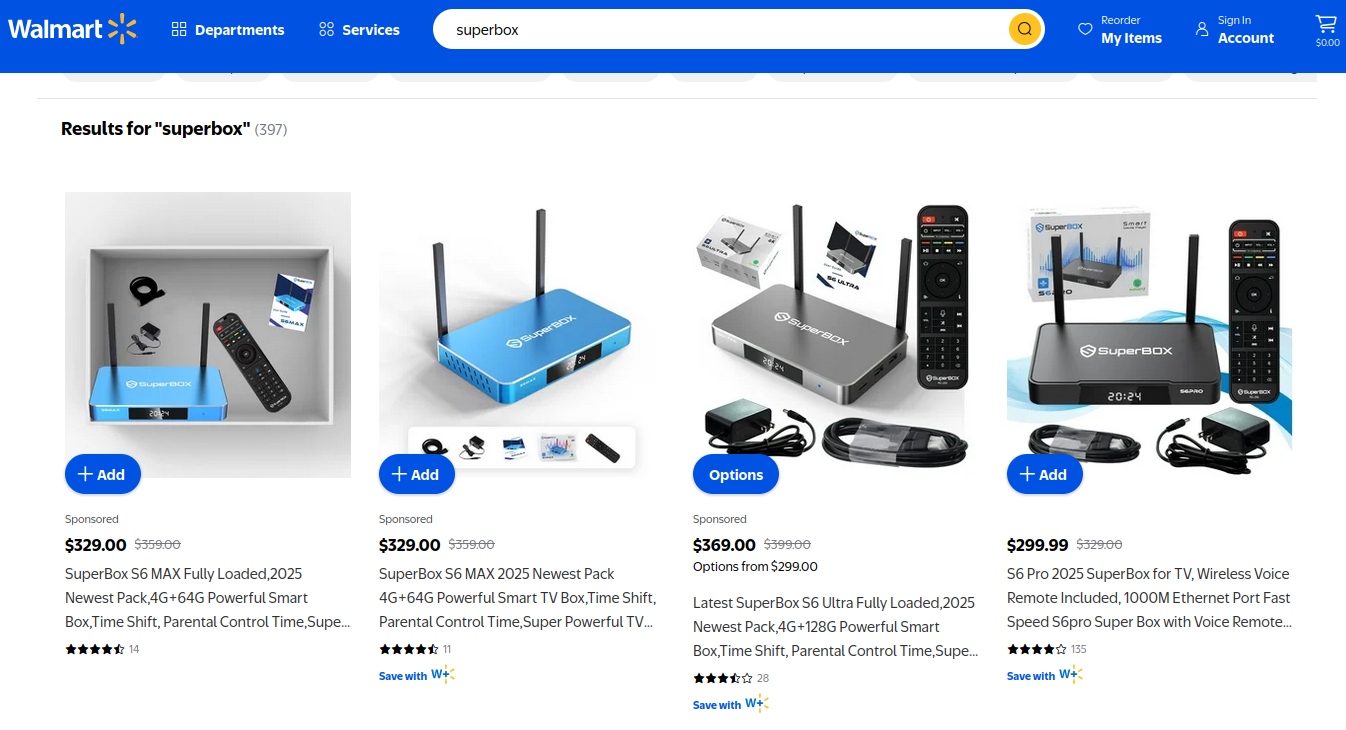
    Superbox media streaming boxes for sale on Walmart.com.

    ECHOES FROM THE PAST

    Both Brundage and Kilmer say IPIDEA appears to be the second or third reincarnation of a residential proxy network formerly known as 911S5 Proxy, a service that operated between 2014 and 2022 and was wildly popular on cybercrime forums. 911S5 Proxy imploded a week after KrebsOnSecurity published a deep dive on the service’s sketchy origins and leadership in China.

    In that 2022 profile, we cited work by researchers at the University of Sherbrooke in Canada who were studying the threat 911S5 could pose to internal corporate networks. The researchers noted that “the infection of a node enables the 911S5 user to access shared resources on the network such as local intranet portals or other services.”

    “It also enables the end user to probe the LAN network of the infected node,” the researchers explained. “Using the internal router, it would be possible to poison the DNS cache of the LAN router of the infected node, enabling further attacks.”

    911S5 initially responded to our reporting in 2022 by claiming it was conducting a top-down security review of the service. But the proxy service abruptly closed up shop just one week later, saying a malicious hacker had destroyed all of the company’s customer and payment records. In July 2024, The U.S. Department of the Treasury sanctioned the alleged creators of 911S5, and the U.S. Department of Justice arrested the Chinese national named in my 2022 profile of the proxy service.

    Kilmer said IPIDEA also operates a sister service called 922 Proxy, which the company has pitched from Day One as a seamless alternative to 911S5 Proxy.

    “You cannot tell me they don’t want the 911 customers by calling it that,” Kilmer said.

    Among the recipients of Synthient’s notification was the proxy giant Oxylabs. Brundage shared an email he received from Oxylabs’ security team on December 31, which acknowledged Oxylabs had started rolling out security modifications to address the vulnerabilities described in Synthient’s report.

    Reached for comment, Oxylabs confirmed they “have implemented changes that now eliminate the ability to bypass the blocklist and forward requests to private network addresses using a controlled domain.” But it said there is no evidence that Kimwolf or other other attackers exploited its network.

    “In parallel, we reviewed the domains identified in the reported exploitation activity and did not observe traffic associated with them,” the Oxylabs statement continued. “Based on this review, there is no indication that our residential network was impacted by these activities.”

    PRACTICAL IMPLICATIONS

    Consider the following scenario, in which the mere act of allowing someone to use your Wi-Fi network could lead to a Kimwolf botnet infection. In this example, a friend or family member comes to stay with you for a few days, and you grant them access to your Wi-Fi without knowing that their mobile phone is infected with an app that turns the device into a residential proxy node. At that point, your home’s public IP address will show up for rent at the website of some residential proxy provider.

    Miscreants like those behind Kimwolf then use residential proxy services online to access that proxy node on your IP, tunnel back through it and into your local area network (LAN), and automatically scan the internal network for devices with Android Debug Bridge mode turned on.

    By the time your guest has packed up their things, said their goodbyes and disconnected from your Wi-Fi, you now have two devices on your local network — a digital photo frame and an unsanctioned Android TV box — that are infected with Kimwolf. You may have never intended for these devices to be exposed to the larger Internet, and yet there you are.

    Here’s another possible nightmare scenario: Attackers use their access to proxy networks to modify your Internet router’s settings so that it relies on malicious DNS servers controlled by the attackers — allowing them to control where your Web browser goes when it requests a website. Think that’s far-fetched? Recall the DNSChanger malware from 2012 that infected more than a half-million routers with search-hijacking malware, and ultimately spawned an entire security industry working group focused on containing and eradicating it.

    XLAB

    Much of what is published so far on Kimwolf has come from the Chinese security firm XLab, which was the first to chronicle the rise of the Aisuru botnet in late 2024. In its latest blog post, XLab said it began tracking Kimwolf on October 24, when the botnet’s control servers were swamping Cloudflare’s DNS servers with lookups for the distinctive domain 14emeliaterracewestroxburyma02132[.]su.

    This domain and others connected to early Kimwolf variants spent several weeks topping Cloudflare’s chart of the Internet’s most sought-after domains, edging out Google.com and Apple.com of their rightful spots in the top 5 most-requested domains. That’s because during that time Kimwolf was asking its millions of bots to check in frequently using Cloudflare’s DNS servers.

    The Chinese security firm XLab found the Kimwolf botnet had enslaved between 1.8 and 2 million devices, with heavy concentrations in Brazil, India, The United States of America and Argentina. Image: blog.xLab.qianxin.com

    It is clear from reading the XLab report that KrebsOnSecurity (and security experts) probably erred in misattributing some of Kimwolf’s early activities to the Aisuru botnet, which appears to be operated by a different group entirely. IPDEA may have been truthful when it said it had no affiliation with the Aisuru botnet, but Brundage’s data left no doubt that its proxy service clearly was being massively abused by Aisuru’s Android variant, Kimwolf.

    XLab said Kimwolf has infected at least 1.8 million devices, and has shown it is able to rebuild itself quickly from scratch.

    “Analysis indicates that Kimwolf’s primary infection targets are TV boxes deployed in residential network environments,” XLab researchers wrote. “Since residential networks usually adopt dynamic IP allocation mechanisms, the public IPs of devices change over time, so the true scale of infected devices cannot be accurately measured solely by the quantity of IPs. In other words, the cumulative observation of 2.7 million IP addresses does not equate to 2.7 million infected devices.”

    XLab said measuring Kimwolf’s size also is difficult because infected devices are distributed across multiple global time zones. “Affected by time zone differences and usage habits (e.g., turning off devices at night, not using TV boxes during holidays, etc.), these devices are not online simultaneously, further increasing the difficulty of comprehensive observation through a single time window,” the blog post observed.

    XLab noted that the Kimwolf author shows an almost ‘obsessive’ fixation” on Yours Truly, apparently leaving “easter eggs” related to my name in multiple places through the botnet’s code and communications:

    Image: XLAB.

    ANALYSIS AND ADVICE

    One frustrating aspect of threats like Kimwolf is that in most cases it is not easy for the average user to determine if there are any devices on their internal network which may be vulnerable to threats like Kimwolf and/or already infected with residential proxy malware.

    Let’s assume that through years of security training or some dark magic you can successfully identify that residential proxy activity on your internal network was linked to a specific mobile device inside your house: From there, you’d still need to isolate and remove the app or unwanted component that is turning the device into a residential proxy.

    Also, the tooling and knowledge needed to achieve this kind of visibility just isn’t there from an average consumer standpoint. The work that it takes to configure your network so you can see and interpret logs of all traffic coming in and out is largely beyond the skillset of most Internet users (and, I’d wager, many security experts). But it’s a topic worth exploring in an upcoming story.

    Happily, Synthient has erected a page on its website that will state whether a visitor’s public Internet address was seen among those of Kimwolf-infected systems. Brundage also has compiled a list of the unofficial Android TV boxes that are most highly represented in the Kimwolf botnet.

    If you own a TV box that matches one of these model names and/or numbers, please just rip it out of your network. If you encounter one of these devices on the network of a family member or friend, send them a link to this story and explain that it’s not worth the potential hassle and harm created by keeping them plugged in.
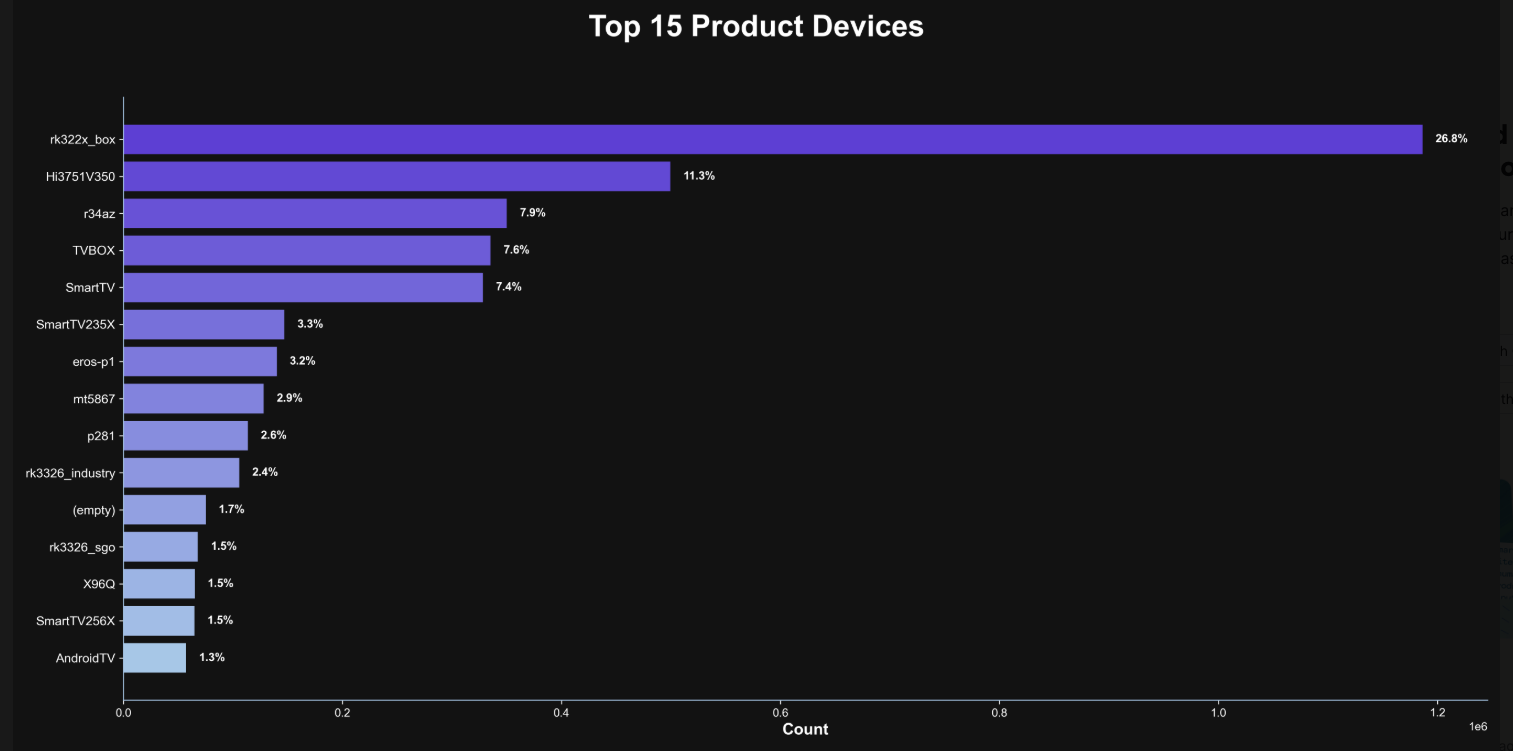
    The top 15 product devices represented in the Kimwolf botnet, according to Synthient.

    Chad Seaman is a principal security researcher with Akamai Technologies. Seaman said he wants more consumers to be wary of these pseudo Android TV boxes to the point where they avoid them altogether.

    “I want the consumer to be paranoid of these crappy devices and of these residential proxy schemes,” he said. “We need to highlight why they’re dangerous to everyone and to the individual. The whole security model where people think their LAN (Local Internal Network) is safe, that there aren’t any bad guys on the LAN so it can’t be that dangerous is just really outdated now.”

    “The idea that an app can enable this type of abuse on my network and other networks, that should really give you pause,” about which devices to allow onto your local network, Seaman said. “And it’s not just Android devices here. Some of these proxy services have SDKs for Mac and Windows, and the iPhone. It could be running something that inadvertently cracks open your network and lets countless random people inside.”

    In July 2025, Google filed a “John Doe” lawsuit (PDF) against 25 unidentified defendants collectively dubbed the “BadBox 2.0 Enterprise,” which Google described as a botnet of over ten million unsanctioned Android streaming devices engaged in advertising fraud. Google said the BADBOX 2.0 botnet, in addition to compromising multiple types of devices prior to purchase, also can infect devices by requiring the download of malicious apps from unofficial marketplaces.

    Google’s lawsuit came on the heels of a June 2025 advisory from the Federal Bureau of Investigation (FBI), which warned that cyber criminals were gaining unauthorized access to home networks by either configuring the products with malware prior to the user’s purchase, or infecting the device as it downloads required applications that contain backdoors — usually during the set-up process.

    The FBI said BADBOX 2.0 was discovered after the original BADBOX campaign was disrupted in 2024. The original BADBOX was identified in 2023, and primarily consisted of Android operating system devices that were compromised with backdoor malware prior to purchase.

    Lindsay Kaye is vice president of threat intelligence at HUMAN Security, a company that worked closely on the BADBOX investigations. Kaye said the BADBOX botnets and the residential proxy networks that rode on top of compromised devices were detected because they enabled a ridiculous amount of advertising fraud, as well as ticket scalping, retail fraud, account takeovers and content scraping.

    Kaye said consumers should stick to known brands when it comes to purchasing things that require a wired or wireless connection.

    “If people are asking what they can do to avoid being victimized by proxies, it’s safest to stick with name brands,” Kaye said. “Anything promising something for free or low-cost, or giving you something for nothing just isn’t worth it. And be careful about what apps you allow on your phone.”

    Many wireless routers these days make it relatively easy to deploy a “Guest” wireless network on-the-fly. Doing so allows your guests to browse the Internet just fine but it blocks their device from being able to talk to other devices on the local network — such as shared folders, printers and drives. If someone — a friend, family member, or contractor — requests access to your network, give them the guest Wi-Fi network credentials if you have that option.

    There is a small but vocal pro-piracy camp that is almost condescendingly dismissive of the security threats posed by these unsanctioned Android TV boxes. These tech purists positively chafe at the idea of people wholesale discarding one of these TV boxes. A common refrain from this camp is that Internet-connected devices are not inherently bad or good, and that even factory-infected boxes can be flashed with new firmware or custom ROMs that contain no known dodgy software.

    However, it’s important to point out that the majority of people buying these devices are not security or hardware experts; the devices are sought out because they dangle something of value for “free.” Most buyers have no idea of the bargain they’re making when plugging one of these dodgy TV boxes into their network.

    It is somewhat remarkable that we haven’t yet seen the entertainment industry applying more visible pressure on the major e-commerce vendors to stop peddling this insecure and actively malicious hardware that is largely made and marketed for video piracy. These TV boxes are a public nuisance for bundling malicious software while having no apparent security or authentication built-in, and these two qualities make them an attractive nuisance for cybercriminals.

    Stay tuned for Part II in this series, which will poke through clues left behind by the people who appear to have built Kimwolf and benefited from it the most.


  • A woman dies from cervical cancer every two minutes, UN says

    A flood of questions drowned Jeanette in thought after she was diagnosed with cervical cancer. Would she be unable to conceive a child? Would she have to enter menopause at the early age of 31? 
  • AI’s Imperial Agenda

    After OpenAI CEO Sam Altman launched ChatGPT in 2022, the race for dominance in the field of artificial intelligence hit warp speed. Silicon Valley has poured billions of dollars into developing AI, building data centers, and promising a future free from the chains of unfulfilling work across the globe.

    But in “Empire of AI: Dreams and Nightmares in Sam Altman’s OpenAI,” tech reporter Karen Hao pulls back the curtain, unveiling the human and environmental cost of artificial intelligence and the colonial ambitions undergirding Silicon Valley’s efforts to fuel the rise of AI.

    This week on The Intercept Briefing, host Jessica Washington speaks to Hao about her book and the dawn of the AI empire. “Empires similarly consolidate a lot of economic might by exploiting extraordinary amounts of labor and not actually paying that labor sufficiently or at all,” says Hao. “So that’s how they are able to amass wealth — because they’re not actually distributing it.”

    “The speed at which they’re constructing the infrastructure for training and deploying their AI models” is what shocks Hao the most, as “this infrastructure is actually not technically necessary, and … somehow the companies have effectively convinced the public and governments that it is. And therefore there’s been a lot of complicity in allowing these companies to continue building these projects.”

    “They have effectively been able to use this narrative of [artificial general intelligence] to accrue more capital, land, energy, water, data. They’ve been able to accrue more resources — and critical resources — than pretty much anyone in history,” Hao says, warning of “the complete aggressive and reckless” growth of AI infrastructure, but stresses that none of this is inevitable. “There is a very clear path for how to unlock the benefits of AI without accepting the colossal cost of it.”

    Listen to the full conversation of The Intercept Briefing on Apple Podcasts, Spotify, or wherever you listen.

    Transcript

    Jessica Washington: Welcome to The Intercept Briefing, I’m Jessica Washington.

    In 2022, Sam Altman’s company OpenAI launched ChatGPT, an AI chatbot that unleashed a wave of excitement over artificial intelligence. And it kickstarted a race for dominance in the field.

    Tech CEOs from Altman at OpenAI, to Mark Zuckerberg at Meta, and Alex Karp at Palantir have lauded artificial intelligence as the “future” of humanity.

    During a New York Times New Work Summit in 2019, years ahead of Open AI’s launch of ChatGPT, Altman predicted that artificial intelligence could “eliminate poverty.”

    Sam Altman: It can be great, we have the potential to eliminate poverty, solve climate change, cure a huge amount of human disease, like educate everyone in the world phenomenally well.

    JW: In a more recent CNBC interview, Palantir CEO Alex Karp claimed that AI made the United States the “dominant country in the world”:

    Alex Karp: AI makes America the dominant country in the world. So just start there. Every other country in the world — like, I spent half my life in Europe — they’re whining and crying. We have the right chips. We have the right software. We have the right engineers. We have the right culture. We have the right people.

    JW: And in a video posted to Facebook, unveiling Meta’s new AI research lab in July, Meta CEO Mark Zuckerberg promised to develop personal “superintelligence” that would free its users to focus on what truly matters.

    Mark Zuckerberg: Advances in technology have freed much of humanity to focus less on subsistence and more on the pursuits that we choose. And at each step along the way, most people have decided to use their newfound productivity to spend more time on creativity, culture, relationships, and just enjoying life. And I expect superintelligence to accelerate this trend even more.

    JW: Only — what if these utopic visions mask a far, darker reality?

    In “Empire of AI: Dreams and Nightmares in Sam Altman’s OpenAI,” Karen Hao exposes the underlying reality of the lofty promises made by Sam Altman and the tech industry. Hao reveals the human toll of artificial intelligence from its extreme water usage, to its exploitation of data laborers, to AI companies’ disturbing resemblance to the colonial empires that ravaged the planet for centuries.

    Joining me now to discuss “Empire of AI” and Silicon Valley’s grip on our world is Karen Hao.

    Karen, welcome to The Intercept Briefing.

    Karen Hao: Thank you so much for having me, Jessica.

    JW: Before we begin, we should start off by mentioning that The Intercept is a party in a lawsuit against OpenAI for allegedly using copyrighted materials to train ChatGPT.

    So, Karen, of all of the tech CEOs in the artificial intelligence rat race to profile, why Sam Altman, and why OpenAI?

    KH: So I actually didn’t set out to write an OpenAI book. I was trying to write a book about these parallels that I had been documenting for several years between the AI industry and colonialism. And I realized as I was putting together that idea, that in order to really illustrate how every single thing that we know about AI today in the public consciousness, like I had to trace the history of OpenAI, because those decisions were made within that company.

    So the fact that we associate AI in the public with large language models with ChatGPT, with these colossally consumptive technologies that need massive amount of data, massive amounts of data centers — those were all because OpenAI made certain choices. And Sam Altman was at the helm of the company when it made many of those choices. So yeah, it really is, I would say the book is not just a history of Open AI, it’s really a history of the modern-day AI boom.

    JW: As you’ve alluded to in the book, you masterfully, in my opinion, weave the promises of Silicon Valley against the backdrop of its impact on the communities that host its data centers and feed other parts of the AI machine. What made you want to tell these two stories alongside each other, instead of just a tech book, or instead of just a book about the impact?

    KH: I’ve always felt that the most important questions on people’s minds about technology or about AI is just: How is it going to affect their lives? And the only way to really tell that story is to ground it in the experiences of people that have already been affected by the development of the technology, because they are the canaries in the coal mines, so to speak, of how the rest of the world is going to experience it.

    And if you only tell the story from the perspective of San Francisco and from the tech companies themselves and the elites that run the companies at the top, you’re largely going to get a story about the technology working because it’s designed by these people for these people.

    But that’s not actually the real, full scope of the story. And so philosophically, in a lot of my reporting even before the book, I always believe that you really start to see where things fall apart when you go furthest away from Silicon Valley to the places that work fundamentally differently from SF, from the U.S., with people speaking fundamentally different languages who look different, who have a different history and culture.

    And that is actually more indicative of how the average person is going to ultimately be impacted by this technology because San Francisco’s a really weird place. It’s an extreme bubble. There’s an extraordinary amount of wealth that is pretty much not replicated anywhere else in the world. There’s an incredible amount of homogeneity.

    And so that’s why I wanted to interweave both the inside story and the ideology of these people and the decisions and the context in which they make these decisions, but then quickly expand to the far reaches of the empire, as I call it, to document really how it’s going to affect the vast majority of the world.

    JW: Yeah, I want to dive into the empire of it all. So the obvious through line of your book is colonialism and the ways in which these AI companies and tech companies have resembled these colonial empires of old. And I’m curious, how do you see the comparisons and where do they differ?

    KH: Yeah, I mean, there’s honestly so many comparisons. But I really focus on four in the book. The first one is that empires, they consolidate an extraordinary amount of wealth and power in part by just taking a lot of resources that are not their own. That refers to the intellectual property — as The Intercept knows well — that they take to just train their models without any creditor compensation. That’s also taking the private data of people that they might leave in places like a Flickr photo album that they never realized could get hoovered up into these image generation tools.

    Also, second parallel: Empires similarly consolidate a lot of economic might by exploiting extraordinary amounts of labor and not actually paying that labor sufficiently or at all. So that’s how they are able to amass wealth — because they’re not actually distributing it. And I talk in my book extensively about the ways that the industry does exactly the same thing with workers in Kenya or [who are] in crisis in Venezuela, who are doing some of the lifeblood data annotation tasks that the AI industry needs to thrive but who see only a couple dollars a day or even at all for that kind of work.

    The third parallel is that empires always engage in this kind of control of information flows in order to perpetuate their ability to continue expanding unfettered. And we see this in the industry as well, where most AI researchers today are either employed by the companies or bankrolled by the companies in some way. And so the entire research agenda and AI development agenda has been completely distorted by the empire’s agenda, and any research that reveals inconvenient truths is actively censored. So we don’t have a true scientific picture of the limitations and capabilities of these technologies.

    And then the final parallel is: Empire is engaged in this narrative that they have to exist because of a moral or existential imperative. So they are the “good” empire that’s on a civilizing mission to bring progress in modernity to all of humanity. And they’re competing with an evil empire that’s trying to bring the demise of humanity.


    Related

    OpenAI’s Pitch to Trump: Rank the World on U.S. Tech Interests


    And so in OpenAI’s history, there have been many examples of it framing “Google was the evil empire.” Now, Silicon Valley largely says, “China is the evil empire.” And the idea is that if the evil empire crosses the finish line, then we’re going to end up in an AI hell. And they say, AI could kill us all, or AI is going to lead to complete total authoritarianism in the wrong hands.

    Whereas when the good empire crosses the threshold first, we end up in this utopia — eliminating poverty, curing cancer, all of the things that you mentioned in the beginning are their common talking points.

    JW: Yeah. One thing that strikes me about tracking these empires as opposed to older, when you think of the British Empire, is the pace at which they’re moving and the pace at which things are changing.

    We’re in a vastly different landscape when it comes to AI than we were a year ago, or arguably even a month ago. Did you predict the pace at which this technology would proliferate and the kind of full-throated embrace of it from people in power really in both parties, or is there something that’s surprising you about where we’re at now?

    KH: I’m definitely really shocked at the pace. And you’re 100% right that one of the key differences of the classical empires of old and empires of AI is just the sheer speed. The British Empire moved at the pace of ships. And with the empires of AI, they’re moving at the pace of bits. They can make like 60 decisions in an hour that affect billions of people around the world.

    But the thing that has shocked me the most is the speed at which they’re constructing the infrastructure for training and deploying their AI models. Part of the shock is that this infrastructure is actually not technically necessary, and so I’ve been shocked that somehow the companies have effectively convinced the public and governments that it is and therefore there’s been a lot of complicity in allowing these companies to continue building these projects.

    “Sometimes I feel like that’s a strategy to get people so shocked or confused by these large numbers that they can’t even wrap their minds around that it allows the companies to continue doing what they’re doing.”

    But the other shock is just what they’re trying to do is insane. It is hard to explain just how baffling the scale is. Sam Altman has recently said that he aims to build 250 gigawatts of data centers by 2033, which he estimates would cost $10 trillion. And when you just think about that figure of just $10 trillion, that’s already insane. Like most people in the world have never encountered 10 trillion of anything, let alone dollars. And sometimes I feel like that’s a strategy to get people so shocked or confused by these large numbers that they can’t even wrap their minds around that it allows the companies to continue doing what they’re doing.

    But 250 gigawatts is also an insanely baffling number because New York City on average is 5.5 gigawatts of power. So what he’s talking about is constructing almost four dozen New York cities of data centers in the world to power and train his AI technologies.

    And Meta has talked about building supercomputers where the facilities are almost the size of Manhattan. And so like this is the largest infrastructure build-out that humanity has ever seen, and it’s being controlled by a tiny group of people that are aggressively trying to build this out in communities around the world, many of whom actually do not want this infrastructure. There’s huge protests that has started breaking out all around the world and all across the U.S. and so that’s the thing that has shocked me is just the complete aggressive and reckless nature of the growth.

    “ This is the largest infrastructure build-out that humanity has ever seen, and it’s being controlled by a tiny group of people.”

    JW: When you talk about the growth, the first thing that comes to mind for me is the impact of that growth and what that could mean. Your book gets into some of these direct environmental harms. When we’re talking about building out the kinds of infrastructure that Sam Altman is talking about, what are those harms?

    KH: So when talking about these data center facilities, one of the harms is the energy is coming from fossil fuels. Even Sam Altman has, when he was testifying in Congress, he admitted in the short term it would likely come from natural gas. From reporting we’ve also seen that it comes from coal. There are coal plants that were meant to be retired that are now having their lives extended because of the utilities needed to meet an energy demands that they cannot meet with any other energy source.

    And essentially we are starting to see the AI industry provide a lifeline for the fossil fuel industry. So it’s bringing extraordinary amounts of emissions into the air.

    “We are starting to see the AI industry provide a lifeline for the fossil fuel industry.”

    Those emissions are also pollutants. So it’s polluting working-class communities most often and rural communities. There has been phenomenal reporting on Memphis, Tennessee, hosting Colossus, the supercomputer that Elon Musk built to train Grok and it’s being powered by 35 methane gas turbines that is pumping toxins into that community’s air, which actually has a long history of environmental racism and inability to access the fundamental right to clean air.

    Then you have to talk about the fact that these data centers also require fresh water to cool the facilities. If they’re going to use water, it needs to be fresh water and even drinking water — because any other type of water would lead to corrosion of the equipment or to bacterial growth. And so you often see in proposals for data centers the request from the company to the local government for potable water — to connect directly to the city drinking water supply.

    And many of these facilities are being put in places that don’t have that drinking water to spare. There was a Bloomberg investigation that found that two-thirds of these data centers are going into already water-scarce areas. So there are communities that are actively competing with this computer infrastructure for life-sustaining resources. So it’s basically layer upon layer of environmental and public health crises that are already underway, that are being massively accelerated by this push.

    JW: With the Trump administration moving to massively deregulate a lot of environmental protections, do you expect these costs to grow?

    KH: I do, and it’s not just the deregulatory stance. The Trump administration and actually the Biden administration also had enabled data centers to be built on federal lands. So the federal government has been aggressively using all of the different mechanisms that they can to try to facilitate the recklessness of the tech industry.


    Related

    Trump’s Big, Beautiful Handout to the AI Industry


    And of course, Trump also signed an executive order that is trying to neuter state AI regulation as well. So not only deregulating federal laws, but also trying to prevent any states from stepping into the vacuum. And so all of the trends that we see, if the public did nothing about it — if there was no contestation, if there were no protests, and everyone was just laid back and allowed this trajectory to barrel forward — I absolutely think that it could get worse. But I also think that there is an incredible amount that people can in fact do in the absence of leadership at the top to show leadership from the bottom.

    Break

    JW: There’s been some public pushback to your water usage calculations, primarily from supporters of artificial intelligence. Andy Masley, executive Director of Effective Altruism DC published a Substack in November questioning some of your data around water usage, and you issued two changes to your book regarding the water footprint data recently. I wanted to just give you a moment to respond to that critique.

    KH: Yeah, for sure. So yeah, Andy brought up some very valid criticisms. One was on a particular data point that, after he brought up the criticisms, we investigated it and realized it was wrong. This was a data point that appears in Chapter 12 of my book, where we are describing a proposed Google data center in Cerrillos, Chile, outside of the outskirts of Santiago. And I was trying, in that particular case study, to explain the water impact that this facility would have within the community by comparing it to the water use of that community.

    And basically what happened was the government document that stated the water usage of the community had a unit error. And so instead of quoting the numbers in meters cubed as they should have, they quoted it in liters. One meter cubed is 1,000 liters, so they underestimated the water use of the community by a factor of 1,000, which meant that when I then divided the data center proposed water usage by what the document said was the water usage, my comparison was off by a magnitude of 1,000.

    And so the corrected statement is that this proposed Google data center could use more water than the population of the town — which is already substantially bad. But of course, in the error of the calculation, I had said that it was going to be more than 1,000 times what the town uses, which is just incorrect. And basically I worked with my Chilean collaborator to figure out, contacted the Chilean government agency that had issued the document to get to the bottom of it, confirmed that it was in fact a unit error. We issued the correction.

    The second change that I made, which is also based on Andy’s feedback, was that there was a part of my explanation or citation of a study about the overall water impact of AI that also used the wrong terminology. So I had used this term that AI was going to lead to this amount of “water consumption.” But there’s actually a technicality: “Water consumption” is not the same as “water use.” And I should have actually used the term “water use” because in consumption with data centers, it means that the water’s evaporated and it just disappears. Whereas “water use” means that it’s running through the system, but then it exits out the system. Not that it’s completely unchanged. It can have a lot more pollutants in that water, and it can have a higher temperature, and it might not actually be able to return safely to the environment, but it’s different from pure evaporation.

    So I made that change as well and added some more language to explain that the study was referring to the water impact of data centers — both in terms of the water used to cool the facilities, but also the water used to generate the electricity to power the facilities, because that is also a huge important part of the water footprint of data centers.

    So those changes will be made in the next reprint of the physical edition and will also be made in the digital and audiobook edition.

    JW: Thank you for explaining that. I want to switch gears to one of my favorite chapters of your book where you talk about the concept of intelligence and this kind of mythical idea of superintelligence. What is superintelligence, and is it just something that tech CEOs are saying to sound futuristic?

    KH: [Laughs] So superintelligence, colloquially, I guess refers to a theoretical point at which AI exceeds human intelligence. That’s why it’s called superintelligence. And the problem with this term is that there is no scientific consensus around what human intelligence is.

    There’s a long history of trying to define and quantify human intelligence. Much of it is a very dark history motivated by the desire to show through “scientific means” that certain races are superior to others. And we’ve never landed on one test that definitively proves that this is like the marker of intelligence.

    “Artificial general intelligence — which also, what does that mean?”

    And so superintelligence is just like a totally unmoored concept. And indeed, this is very useful for executives of companies where when they want to market themselves, because there is no definition around this term, they can just define it however they want. They do the same thing with the term artificial general intelligence — which also, what does that mean? It’s supposed to be the point right before superintelligence when the AI system theoretically matches human intelligence.

    And use see OpenAI define and redefine AGI constantly, based on what it wants to do at the next steps. So when Sam Altman is talking with consumers, he says AGI is going to be this amazing digital assistant that’s going to solve all your problems — because he wants those people to buy it. When he is talking with Microsoft, The Information reported at one point that Microsoft in the agreement between OpenAI and Microsoft, they define AGI as a system that can generate a $100 billion of revenue. When Altman is talking to Congress, he says AGI is going to cure cancer and eradicate poverty and so on and so forth to try and ward off the regulation.

    And so you can see that it just shape-shifts based on the audience that needs to be convinced in that moment for the company to just continue its agenda.

    JW: Speaking of promises made by the tech industry about AI, one of the biggest promises is that it’s going give people their time back to use on more fulfilling activities and that AI will eliminate the need to work essentially, since the expectation is that it’s going to take our jobs.

    How exactly is that going to help people who then lose their income? Is the government supposed to step in and sufficiently take care of people, or are the titans of this industry going to pay more taxes to take care of people? I guess, what is the promise and what are they saying we’re going to have in the future that’s supposed to be so great?

    KH: [Laughs] Right. The answer is, they promise whatever they need to promise to convince whoever they need to convince. So the promises keep shape-shifting, but generally, they fall in the line of, “There’s going to be so much abundance that we’re not going to have a competition for resources anymore. Everyone’s going to live wild and free and it’s going to be amazing, and, like, all science will be solved.” But the fine-grain details of this vision are not there.

    It’s interesting, in OpenAI’s early years they explored the idea of instituting some kind of tax structure upon which if an AI company had windfall profits, then there would be a ceiling to how much they could keep, and the rest of it would be redistributed as universal basic income to everyone. That’s as far as I’ve ever seen anyone in the industry go towards actually articulating a mechanism by which everyone gets a piece of the pie. But of course, this was like very early days in OpenAI, and we’ve never heard about this proposal since.

    And what we’re actually seeing instead is the complete opposite, right? We are currently seeing these companies get more and more and more and more wealthy, while the average American is struggling more and more with an affordability crisis, with inflation, with job loss — sometimes driven by AI.

    And we are in a moment right now where the economy is k-shaped. All of the AI-related stocks are flying, while everything else is going south. And so this, I think is the clearest signal that we have of the true tally that AI — in Silicon Valley’s conception of it — what it’s actually delivering us and will continue to deliver us if we allow the empires to continue on.

    JW: In that vein, there’s been this growing concern that we’re in an AI bubble that companies are overvalued and overspending on data centers, on microchips. What do you make of that concern and the way that tech leaders are responding to that concern?

    KH: I think we’re in a huge bubble, and I’m deeply worried about what might happen if that bubble pops, especially for the ripple effects that it’s going to have on average people, because the people at the top are going to be fine. Like, they are not going to be the ones that are suffering from the fallout that could happen with a market correction.

    But of course, the industry leaders are trying to project the fact that we’re not in a bubble. They’re trying to project continued confidence in the fact that their technology is going to lead to continued crazy GDP growth that will somehow get redistributed to the average person. But I think average Americans are starting to realize that this is totally not true.

    “They’re trying to project continued confidence in the fact that their technology is going to lead to continued crazy GDP growth that will somehow get redistributed to the average person.”

    And that’s why we’ve seen in the past few months the attitude towards the AI industry towards the way that these companies are developing AI in particular has really soured because people are actually experiencing their kids being harmed or having worries that their kids will be harmed. They’re seeing data centers pop up in their communities that could hike up their utility bills or potentially contaminate their water, and they didn’t have any say in that project.

    They’re seeing a shrinking job market where they might themselves have been laid off in part because an executive is saying that they’re engaging in an AI strategy. And so I think, as much as the executives are really trying to create this veneer that everything is fine, most people know that it’s not fine.

    JW: As you’ve mentioned throughout this conversation, we’ve been focusing on the effects of AI outside of Silicon Valley, but there are red flags, as you’ve mentioned in San Francisco, in the larger Bay Area in California, where wealth inequality has grown really exponentially as the tech industry has grown in the last 15 years. How do you view that, what we’ve seen as a microcosm in that region, against the backdrop of this kind of larger exploitation?

    KH: This is something that I think about all the time because I used to live in San Francisco. And part of the reason why I left the tech industry and ended up becoming a journalist was because I felt like what I was seeing in San Francisco was really a manifestation of the real ideology that undergirded the industry. And there is this extraordinary amount of wealth. Bloomberg reported at one point that the AI industry is minting billionaires faster than any other industry in history. It’s an extraordinary amount of wealth. And there’s been reporting talking about how this year, 2026, is going to see some massive IPOs that’s going to create even more extraordinary wealth generation than we’ve ever seen in this town.

    “It’s just so crazy to me that they can talk all these utopic lofty goals about solving science and eradicating poverty — when they haven’t eradicated poverty in their own town.”

    And yet at the same time, there’s rampant homelessness there. There’s a huge housing crisis in general, and there is just an obliviousness almost to the people who are within the industry to the things that happen at their very doorstep. And it’s just so crazy to me that they can talk all these utopic lofty goals about solving science and eradicating poverty — when they haven’t eradicated poverty in their own town. They haven’t done anything to solve the social ills within their own town, and in fact, they’ve only done things to make it worse.

    JW: On that point, what is their larger goal? What do these tech billionaires, maybe even soon to be, some of them trillionaires, what do they actually want? They have all this money, as you’ve said, they could spend on social welfare in the communities that they’re already in. What are they actually after?

    KH: The reason why I use the metaphor of empire is because … the revealed agenda is an imperial agenda. They have effectively been able to use this narrative of AGI to accrue more capital, land, energy, water, data. Like, they’ve been able to accrue more resources — and critical resources — than pretty much anyone in history. So that to me is what they’re after.

    But also, it’s complicated in the sense that there are also these, what I can only describe as quasi-religious movements that undergird the push for AGI as well. So there are some people that are more political actors that are seeing the opportunity to leverage these narratives about AGI to amass more and more power. But there are also genuine cohorts of people who believe in the myth of AGI or the religion of AGI, where they think that when the moment comes that AI actually matches or begins to surpass human intelligence, that it is somehow going to truly lead us, as I mentioned, like to an AI heaven, to an other worldly civilization 2.0, so to speak, where we finally unlock the next era of human evolution.

    “We actually have no idea how to define AGI, because we have no idea how to define human intelligence.”

    The reason why I call it quasi-religious is because it’s not actually backed in scientific reality. In 2025, there was a survey of researchers that found this — AI researchers — that found 75 percent of them do not think that we’re on the path to AGI, and this is still actually an open question of “Can we even reach AGI?” Because once again, we actually have no idea how to define AGI, because we have no idea how to define human intelligence. So people call themselves believers when they say that they’re AGI believers. They use this religious rhetoric of saying AGI is akin to an AI god, or the bad version of AGI might be akin to summoning the demon, as Elon Musk once said.

    And that is why in order to really understand what is truly motivating this industry, you can’t actually just view it through a capitalistic lens. You have to also view it through an ideological one. And once again, that returns us back to this is why it’s colonialism. Colonialism is the fusion of capital and ideology.

    JW: This has been fascinating, and I want to give you a chance to just share any final thoughts if you have anything you want to say.

    KH: I cannot stress enough that none of this is inevitable. I alluded to the fact that this scale is totally technically unnecessary. AI is actually a word that refers to such a wide array of different types of technologies.

    I think it’s very akin to the word “transportation.” Transportation can literally refer to anything from a bicycle to a rocket. Those are systems that all get you from point A to B, but have fundamentally different designs. They have fundamentally different cost-benefit trade-offs. And generally when we speak about transportation, we have a much more nuanced discussion of saying we need more public transit, rather than just saying we need more transportation in general.

    “The tech industry is able to manipulate public understanding by constantly selling the benefits of the bicycle version of AI, when they’re actually building the rocket version of AI.”

    And we are currently stuck in a moment where there isn’t that nuance with AI, and the tech industry is able to manipulate public understanding by constantly selling the benefits of the bicycle version of AI, when they’re actually building the rocket version of AI.

    And the reason I feel so strongly that none of this is inevitable is that there is a very clear path for how to unlock the benefits of AI without accepting the colossal cost of it. And that is just by simply shifting from building rockets to building bicycles.

    And even though there is no government willingness to hold the industry accountable, there are plenty of ways that individuals and communities can engage in collective action to hold the industry accountable themselves, and we are seeing remarkable movements of this already happening and already working.

    There have been, I believe, at this point, $60 billion-plus of data center projects that have been blocked because of protests. There have been lawsuits from families of victims who have suffered egregious mental health harms, including dying by suicide after extended uses of ChatGPT that has led to a massive momentum around shoring up the safety of these models. There has been litigation around copyright, intellectual property. There have been huge discussions sparked in schools about whether or not these tools should actually be actively adopted within schools.

    And I think all of this pushback is forcing the companies — even without regulation — to shift their practices, hopefully will force them to downsize away from empires to just being businesses that actually provide valuable products and services that are not built on extraordinary exploitation and extraction.

    I think that’s like the final message that I want to leave with people: Any single person that’s listening to this has an active role to play in shaping the future of AI development. And we absolutely can get to a point where we have the benefits of AI without any of the costs by just changing what types of AI systems we design.

    JW: Well, thank you so much. I really learned a lot reading your book and even more in this conversation. So appreciate you taking the time and thank you for joining me on The Intercept Briefing.

    KH: Thank you so much, Jessica.

    JW: That does it for this episode.

    This episode was produced by Andrew Stelzer. Laura Flynn is our supervising producer. Sumi Aggarwal is our executive producer. Ben Muessig is our editor-in-chief. Maia Hibbett is our managing editor. Chelsey B. Coombs is our social and video producer. Desiree Adib is our booking producer. Fei Liu is our product and design manager. Nara Shin is our copy editor. Will Stanton mixed our show. Legal review by David Bralow.

    Slip Stream provided our theme music.

    If you want to support our work, you can go to theintercept.com/join. Your donation, no matter the amount, makes a real difference. If you haven’t already, please subscribe to The Intercept Briefing wherever you listen to podcasts. And leave us a rating or a review, it helps other listeners to find us.

    If you want to send us a message, email us at podcasts@theintercept.com.

    Until next time, I’m Jessica Washington.

    The post AI’s Imperial Agenda appeared first on The Intercept.

  • 2025: The Year Big Tech Bent the Knee to Trump

    Over the past two decades, people have congregated online to celebrate and mourn the end of another year. Until recently, this ritual was conducted on platforms that presented themselves as broadly embodying liberal values. But Donald Trump’s return to office has changed all that. For many critics, 2025 is the year Big Tech fully bent the knee and began openly appeasing and collaborating with the radical right.

    Luckily, there remains ample opportunity to turn the tide.

    To understand the nature of Big Tech’s deference to the right, we need to review a little history. This will not only help us understand Silicon Valley’s recent right-wing shift away from liberal politics, but also why it may not last beyond the reign of Trump.

    The first decade of the 2000s was marked by the rise of the commercial internet and the entrenched dominance of several Big Tech giants: Google, Apple, Facebook, Amazon and Microsoft. While it may sound miraculous today, for most of the 2000s, these corporations were widely seen as “hip” champions of human rights and social justice. Google’s original motto, “Don’t Be Evil,” made sense for a company viewed as a progressive alternative to the usual evil corporations portrayed in series like “Mr. Robot.” Companies like Twitter were seen as enabling the revolution in the Middle East while Facebook was praised for connecting the masses.

    For critics during this period, the “Big Tech is progressive” image masked the predatory exploitation of the tech sector dating back to IBM and Microsoft. Yet within a matter of years, this facade came toppling down. The 2013 Snowden leaks exposed how Big Tech partners with the U.S. government to spy on the entire world, down to our every online interaction. In 2016, it was revealed that Trump’s presidential team hired a British consulting firm, Cambridge Analytica, to suck data out of Facebook and run targeted ads in support of his campaign. While heavily over-hyped — there is no good evidence the tactic propelled Trump to victory — the episode provided a convenient scapegoat for why liberals lost to Trump, prompting The Guardian to declare 2016 “the year Facebook became the bad guy.” The scope of distrust widened in 2017, deemed the year “the world turned on Silicon Valley,” thanks in large part to growing awareness about the monopoly power of tech giants.

    The “Big Tech is progressive” image masked the predatory exploitation of the tech sector.

    In the following years, the right wing countered the left, arguing that Big Tech censors their voices and promotes liberal causes. A battle over how to hate Big Tech ensued, with its image mapped onto the mainstream liberal-progressive vs. extremist-right divide. This confused a lot of people: For two decades, Big Tech leaned to the “left” on issues of identity and liberal politics, so they were deemed “left” by mainstream voices, which generally ignore class war. But tech giants had always put profits over people. With the return of Trump, their allegiances to accumulation and power became apparent for all to see.

    If 2017 was the year Americans turned against Big Tech, 2025 is the year it became Donald Trump’s plaything. The transition was quick: During Joe Biden’s tenure, the Democrats once again served Wall Street at the expense of Main Street, setting the stage for a resurgent Trump. In 2024, most tech capitalists spent more on Harris than Trump. On the right, Elon Musk tipped the donor scale to the right with his $260 million in donations to his preferred overlord in the White House.

    Even before the election, tech executives were lining up to kiss the ring. In July, Meta CEO Mark Zuckerberg went full-on simp, calling Trump’s fist pump “badass” following the Pennsylvania assassination attempt. Amazon’s founder and executive chair, Jeff Bezos, once a critic of Trump, spiked an editorial endorsing Harris for president at his newspaper, The Washington Post. Apple CEO Tim Cook cozied up in hopes of assistance against European regulators. Musk went all in on MAGA. And those already in good standing, such as Palantir’s Peter Thiel and Oracle’s Larry Ellison, deepened their ties to Darth Trump.

    After the election, several CEOs pumped millions into Trump’s inauguration, which famously spotted up-close seats for Zuckerberg, Bezos, Cook, Musk, Google cofounder Sergey Brin, and its CEO, Sundar Pinchai. The spectacle repeated in September, when Trump hosted a dinner with leading tech CEOs, who lavished praise on their boss in the White House for his “pro-business” policies (OpenAI CEO Sam Altman) and “incredible leadership” (Bill Gates). Tech giants also contributed to Trump’s lavish $300 million White House ballroom.

    What is new here is not Big Tech’s willingness to play ball with the right, which it navigated with success during the first Trump administration. Rather, it’s the willingness to openly embrace MAGA that has jarred the left.

    During the first Trump administration, leading tech oligarchs publicly criticized Trump’s position on immigration and climate change. This time around, they are not only mute, but many of them are endorsing “anti-woke” politics. In January, Zuckerberg announced that Meta would sever ties with third-party fact-checkers (said to exhibit bias against the MAGA right), while Palantir’s CEO, Alex Karp, who once called himself “progressive,” described his company as “completely anti-woke.”

    Even during Democratic administrations, Big Tech put profits over people and the planet. But the industry has completed a rightward shift that highlights three key points that should organize public understanding and action.

    This time around, they are not only mute, but many of them are endorsing “anti-woke” politics.

    No. 1: Big Tech has become a force multiplier for an extremist administration. Trump’s deal with Palantir to build immigration software is poised to supercharge the Trump administration’s ability to implement mass deportations. The Department of Homeland Security has set up a task force to surveil the online activities of foreign students for “thought crimes” (such as opposing Israeli genocide) and target them for deportation. Students, staff and faculty at our universities are increasingly under surveillance, a phenomenon that increases conformity to authority and the status quo. This year, Trump negotiated American control over TikTok’s content moderation, giving billionaire backers like Ellison the capacity to shape the flow of information on the popular platform. Ellison, a Trump ally, and his son David are rapidly building a MAGA media empire that incorporates Paramount Global (which includes CBS, whose news operation is now run by pro-Israel extremist Bari Weiss) and, if they get their way, Warner Bros. Discovery (which includes HBO and CNN). 

    Trump is also pushing to control the content of artificial intelligence models. In July, he issued an executive order, “Preventing Woke AI in the Federal Government”, that would prevent the government from procuring “models that sacrifice truthfulness and accuracy to ideological agendas.” This month, he issued an executive order banning state-based AI laws that conflict with federal policy, setting the stage for the administration to impose its vision of AI on the tech ecosystem.

    No. 2: The centrality of Big Tech to society is unprecedented, and it can no longer be treated as just another sector of the economy. As much as 92% of gross domestic product growth in the first half of 2025 came from AI and other tech-related spending, leaving just 0.1% growth outside of the tech sector (which would’ve been higher absent the AI boom). As of September, the “Ten Titans” of tech made up almost 40% of the S&P 500. Big Tech and AI are on everyone’s tongue, from young teens to the tech-unsavvy baby boomers. Because Big Tech chose to ally with the Trump administration, everyone is feeling it.

    No. 3: Kissing the ring of Trump challenges the popular notion that corporations simply run the show. Trump flipped the script, making sure everyone understands he’s the boss. When the world’s richest man, Elon Musk, publicly criticized Trump’s “One Big Beautiful Bill” in July, Trump threatened to cancel government contracts with Musk’s rocket company, SpaceX, and deport him. Although their relationship remains “fragile,” Musk responded by deleting some disparaging social media posts (e.g., suggesting Trump’s name was in the Epstein files) and issued a public statement of “regret” that his tweets “went too far.”

    Back in January, Meta agreed to pay Trump $25 million for suspending his social media accounts after the Jan. 6, 2021, riots. In August, Trump exempted Apple from a 100% semiconductor tariff after it announced a new $100 billion commitment to manufacturing in America, bringing its U.S. investment total to $600 billion over the next four years. Trump has also forced deals on tech giants like Nvidia and AMD, which agreed to pay the government 15% of their revenue from select chip sales to China. The Trump administration also obtained a 10% stake in the floundering chip giant Intel after calling for its CEO to resign.

    Billionaire tech bros like Bill Gates, the late Steve Jobs, Sundar Pinchai and Satya Nadella come across as relatively nice nerds. They can feign concern for human rights even as they ruthlessly pursue market domination and wealth. Trump, by contrast, portrays himself as a brute: He says immigrants “are not humans, they’re animals,” calls African countries “shithole countries,” likens Somali immigrants to “garbage,” rambles on without a care, and so on. Musk aside, it’s hard to imagine many Silicon Valley leaders making such vile remarks.

    It’s unlikely that tech giants prefer an unpredictable, vile authoritarian with a big ego and personal vendettas wielding power in the White House. Many of Trump’s policies are also antagonistic to Big Tech: He has slashed funding for scientific research and government science agencies, slapped $100,000 fees on foreign holders of H-1B visas (who comprise part of the skilled labor pool for tech), discouraged foreign researchers to join academia while pushing skilled Americans researchers to leave and is mindlessly politicizing timelines and expectations on entire fields of research through his “Genesis Mission” AI initiative. Democrats, by contrast, offer Silicon Valley predictability, stability, responsible statecraft and a humanitarian public image that arguably defangs the left.

    We should all recognize that Trump’s power is tenuous, and push the fight against Big Tech from the left.

    It’s also true that Big Tech is not fully under the thumb of Trump. They do not capitulate to his every demand, and they are leaving enough wiggle room to pivot back to the Democrats.

    Where does this leave us? Are we better off with a more openly right-wing Silicon Valley that takes the “mask off” than a successful “liberal” one that pushes fake humanitarianism?

    To this, I think there are two important responses. First, shifts to the right do not help anyone. Remember when some people said, “Let’s hope Trump gets elected so that the people will wake up and oppose the system”? That didn’t work out. The same is true for Big Tech: Attacks on diversity, government support for right-wing censorship and media mergers, setting new and regressive legal precedents in the courts and the like not only hurt people in the short run, they institutionalize right-wing inertia into the future. We should oppose such moves at all costs.

    Second, we should all recognize that Trump’s power is tenuous, and push the fight against Big Tech from the left. This includes weak liberal reforms. If we fail to challenge the norms of the past several decades, Democrats will come to the table and offer more of the same: a more pure capitalism (antitrust), mild regulations (AI safety measures, privacy laws) and some extra litigation. The digital ecosystem will still be a private, for-profit enterprise run by rich American billionaires.

    But there is a more principled movement against Big Tech, capitalism and U.S. imperialism simmering under the surface. You can see it with the working-class rejection of Trump and the billionaire class. You can see it on social media, where anti-capitalist, anti-Big Tech videos are going viral.

    Our task is to oppose the bipartisan, business-as-usual approach to Big Tech and generate a new vision for the digital economy. This could be something like a Digital Tech Deal that would democratize the means of computation and knowledge for all of humanity, in harmony with the planet. It will not be easy to materialize, but it’s absolutely essential.

    The post 2025: The Year Big Tech Bent the Knee to Trump appeared first on Truthdig.

  • Health advances marked 2025 as wars and funding cuts strained systems

    From eliminating deadly infections to expanding access to lifesaving vaccines, 2025 delivered meaningful progress for global health, according to the UN World Health Organization (WHO), offering cautious optimism at the close of a year marked by both breakthroughs and strain.
  • Does Walmart track customers even when they pay in cash? What we know

    Walmart gave Snopes a possible explanation for a customer being sent an email about a product he purchased with cash.
  • Game Over: The End of Financial Regulation as We Knew It

    This post concludes a series on the law and political economy of cryptocurrency. Read the rest of the posts here. ** ** ** Even today, many on the left remain in denial about the political power that the digital asset industry has won, viewing cryptocurrency operations as mere grift by bad actors: the pirates, the apes, the nerds, the fakes. Yet the crypto industry, and tech corporations more…

    Source

  • The Results of the Crypto Bro Elections

    In the 2022 and 2024 American elections, the crypto industry spent big. With all of the chaos in Trump 2.0, from ICE raids to exploding boats in the Caribbean to the longest government shutdown in history and fights over the release of the Epstein Files, the public can lose sight of a basic truth: The American president’s personal wealth is now inextricably linked to the viability of…

    Source

  • Framasoft in numbers, 2025 edition

    Framasoft in numbers, 2025 edition

    What tangible impact does our association have ? This is the question we like to explore at the end of each year (see our figures for 2016, 2018, 2022, 2023, and 2024). Looking at the numbers helps us better understand the real-world value of what we do. Welcome to Framastats 2025 !

    Thanks to your donations (66 % tax-deductible in France), Framasoft has been working for over 20 years to promote a more ethical, friendly, and human-centered web. Below, we highlight some of our actions in 2024.

    ➡️ Read all articles from this campaign (Nov. – Dec. 2025)

    Part of the traffic data comes from our self-hosted analytics tool, Matomo. As with many privacy-respecting analytics solutions, these figures tend to underestimate actual usage.

    Additional statistics are sourced directly from the software we run, or from manual SQL queries on our databases.

    Finally, data collection took place between December 8 and December 18, meaning that roughly two to three weeks of activity are missing (about 5 % of the year).

    Our online services at a glance

    More than 2 million people use Framasoft websites every month, roughly the population of a large European capital like Paris. It’s both humbling and energizing to realize how many people rely on the tools we maintain.

    De-google-ify the Internet – Illustration CC BY-SA by David Revoy


    So what does this look like, service by service ?

    🗓️ Framadate

    💪 One of the largest scheduling and polling platforms of its kind worldwide, with nearly 1.5 million polls created in 2025

    Framadate helps groups and communities find the right time to meet through simple, accessible polls. In 2025, we also rolled out a major redesign.

    In 2025 :

    • 1.4 million polls hosted across our infrastructure
    • 38.5 million visits over the year

    L'affichage classique des résultats, en ligne, est toujours disponible (et par défaut sur écrans larges)

    ☁️ Framaspace

    💪 To our knowledge, the world’s largest non-profit-operated Nextcloud ecosystem

    Framaspace provides collaborative digital workspaces for small non-profits, grassroots organizations, and informal collectives looking for alternatives to Big Tech platforms.

    In 2025 :

    • 2,502 organizations chose Framaspace instead of Google-based tools
    • 864 new Nextcloud instances were deployed
    • Over 7 million files stored across the platform


    Une licorne déguisée en cosmonaute (avec une passoire sur la tête) marche sur les nuages et souffle des bulles. Dans ces bulles, on retrouve des cubes symbolisant le travail en commun (dossiers, boite à outils, livres, machine à écrire, boulier, etc.).

    Tableau de bord de Framaspace

    Autres statistiques du tableau de bord Framaspace

    📝 Framaforms

    💪 A major player in online forms, with hundreds of thousands of new forms created every year

    Framaforms enables individuals, collectives and organizations to create online surveys and questionnaires without ads, tracking or data exploitation.

    In 2025 :

    • Over 15 million visits (+68 % compared to 2024)
    • Nearly 800,000 forms hosted in total
    • More than 217,000 new forms created during the year
    • Over 520,000 user accounts


    Chiffres du dashboard admin Framaforms

    Statistiques Framaforms (page vues et visites) depuis 2016


    📨 Framalistes & Framagroupes

    💪 Among the largest non-commercial mailing list services in operation today, outside of Big Tech platforms

    Framalistes and Framagroupes allow groups to create and manage email discussion lists, a simple but still essential communication tool.

    As the original Framalistes infrastructure reached its limits, Framagroupes was launched in 2023 to ensure continuity of this service.

    In 2025 :

    • About 1.4 million users
    • Nearly 70,000 active mailing lists
    • Roughly 440,000 emails sent every working day


    🗒️ Framapad

    💪 One of the largest Etherpad-based collaborative writing services worldwide

    Framapad allows multiple people to write together on the same document in real time, without requiring accounts or complex setup.

    In 2025 :

    • Nearly 5 million visits
    • More than 1 million active pads hosted at any given time
    • Hundreds of thousands of new pads created compared to the previous year


    Graphe du cumul de pad par serveur Etherpad et MyPads hébergés par Framasoft


    🧮 Framacalc

    💪 Possibly the largest EtherCalc deployment in the world, despite its spartan interface

    Framacalc provides collaborative online spreadsheets, often used for quick calculations, collective budgeting or shared data tables.

    In 2025 :

    • Nearly 5 million visits
    • Over 220,000 spreadsheets hosted

    Statistiques (visites et pages vues) depuis 2021 sur Framacalc.org


    💬 Framateam

    💪 One of the world’s largest Mattermost-based team chat instances

    Framateam is a team chat service that helps groups organize discussions into channels, without surveillance or advertising.

    In 2025 :

    • Almost 1.9 million visits (+30 % year-on-year)
    • Nearly 180,000 users, including several thousand daily active users
    • More than 200,000 discussion channels
    • Over 56 million messages exchanged in total

    Statistiques de Framateam, notre instance Mattermost


    🔀 Framagit

    💪 One of the largest non-commercial Git hosting platforms in France

    Framagit is a collaborative software forge where developers can publish code, manage issues and contribute to shared projects.

    In 2025 :

    • More than 84,000 hosted projects
    • Over 55,000 users
    • Tens of thousands of forks, issues and merge requests


    Capture écran du tableau d'accueil de FramagitCapture écran du tableau d'accueil de Framagit

    🗳️ Framavox

    Framavox is one of the largest existing instances of the Loomio decision-making software, with nearly 20,000 communities.

    Framavox enables collectives to meet, discuss and make decisions together in a single shared space.

    In 2025 :

    • 157,050 visits (+14 % compared to 2024)
    • 135,939 users, around 7,000 more than in 2024
    • 18,634 communities, including more than 5,000 created during the year


    Framavox - Illustration de David Revoy


    📍 Framacarte

    Framacarte allows users to create and share custom online maps for projects, events or collective initiatives.

    In 2025 :

    • 2,654,245 visits (-17 % compared to 2024)
    • 11,950,764 users (+3,186 in one year)
    • 216,750 hosted maps (+19,772 in one year)

    Graphique présentant l'évolution des visites sur Framacarte depuis 2021


    🗣️ Framatalk

    Framatalk allows users to create or join video-conferencing rooms without installing software or creating accounts.

    In 2025 :

    • 98,146 visits (+50 % compared to 2024)
    • 84,000 video-conferencing sessions hosted during the year
    • Sessions initiated by 15,800 users


    Graphique présentant l'évolution des visites sur Framatalk (remarquez cet énorme pic pendant l'année des confinements !)


    🧠 Framindmap

    Framindmap enables users to create mind maps online, individually or collaboratively.

    In 2025 :

    • 259,655 visits (-9 %)
    • 1,361,130 mind maps hosted in total
    • 223,000 new mind maps created during the year
    • 588,584 users, around 100,000 more than in 2023


    Graphique présentant l'évolution des visites sur Framindmap


    📅 Framagenda

    A large-scale Nextcloud-based calendar and contact service

    Framagenda allows users to manage calendars, events, contacts and collaborative tools online.

    In 2025 :

    • 200,536 visits
    • 314,000 calendars (about 15,000 more than in 2024)
    • More than 150,000 user accounts, including 33,000 active users during the year
    • 27 million events (including subscription events)
    • 2.6 million contacts
    • 1,558 teams
    • 20,000 decks (Kanban-style boards)
    • 66,600 discussion rooms

    📁 Framadrive

    Framadrive is a document storage and sharing service. While it is no longer open to new registrations, it remains fully operational.

    In 2025 :

    • 8.6 million files stored
    • 7,200 users, including 1,126 active users
    • 21,000 public link shares

    🧑‍🤝‍🧑 Mobilizon

    Mobilizon is a federated alternative to Facebook groups and events. In 2024, Framasoft handed over the codebase to the community, notably to the Kaihuri association.

    Across the Mobilizon network :

    • 366,136 events
    • 46,487 users (+63 % compared to 2024)
    • 86 instances (8 more than in 2024)
    • 5,341 groups (over 1,000 additional groups)

    For the instance operated directly by Framasoft (mobilizon.fr) :

    • 103,963 visits (+15 %)
    • 15,479 published events
    • 13,952 users
    • 2,329 groups


    Mobilizon - Illustration de David Revoy


    🐘 Framapiaf

    Framapiaf is Framasoft’s Mastodon instance. Although it is closed to new registrations, it remains very active.

    In 2025 :

    • 347,049 visits (+66 %)
    • 793 users who logged in during the last 30 days
    • 2,650,000 messages posted since the instance was launched

    🎮 Framagames

    Framagames is our little website, which brings together free games that you can play without leaving your browser. Framagames in figures :

    • 22 games (9 more than in 2024 !)
    • 255,000 visits in 2025


    Framasoft as a software publisher

    Despite maintaining a Framagit repository with nearly 35 software projects, Framasoft currently officially publishes a single flagship application : PeerTube (along with its mobile app).

    Dessin dans le style d'un jeu vidéo de combat, où s'affronte le poulpe de PeerTube et le monstre de YouTube, Twitch et Viméo.

    Drawing in the style of a fighting video game, where PeerTube’s octopus battles the monster of YouTube, Twitch, and Vimeo.

    📺 PeerTube

    💪 One of the rare, credible alternatives to centralized video platforms

    PeerTube is a decentralized alternative to platforms such as YouTube, Twitch, Dailymotion or Vimeo.

    Important note : our counting methodology has changed, making year-to-year comparisons unreliable. The statistics below only include data voluntarily reported by PeerTube instances.

    In 2025 :

    • 721,517 users, around 300,000 more than in 2024
    • Active accounts : 5,384 daily, 17,465 weekly, 38,897 monthly
    • 1,368,408 videos
    • 1,782 public instances
    • 384,742 comments posted on videos
    • 827,695,635 views (a view is counted after 10 seconds of playback)
    • We therefore expect to reach one billion views in 2026
    • 858 TB of video files stored
    • 345 issues resolved in 2024 (out of 5,257 issues handled overall)
    • 533,365 visits on JoinPeerTube.org (+8.5 % compared to 2024)
    PeerTube statistics for late 2025: instances, users, comments, videos, views and storage size

    PeerTube statistics for the last months of 2025 : instances, users, comments, videos, views and storage volume

    📱 PeerTube App

    We have been developing a mobile application for PeerTube (iOS and Android) for over two years.

    The latest version has just been released.

    • Total downloads : 110,448
      • iOS : 56,400
      • Android (Play Store) : 104,048
      • F-Droid : statistics not available

    The newcomers

    At the end of 2025, Framasoft launched several new services.

    Since these tools are still very recent, their figures are naturally more modest. Still, transparency matters to us, so here are the numbers !


    Dorlotons Dégooglisons – Illustration by David Revoy

    Dorlotons Dégooglisons – Illustration CC BY-SA by David Revoy


    ✍️ Framapetitions

    Framapetitions is our ethical alternative to platforms like Change.org or Avaaz.

    Although the project is still young, we are confident in its long-term relevance. You can read the announcement article for more context.

    In 2025 :

    • 59,232 visits
    • 60 petitions
    • 83 users

    📄 FramaPDF

    FramaPDF is a toolbox for working with PDF files (compressing, signing, adding, removing or rotating pages, and more).

    More details are available in the announcement article.

    In 2025 :

    • 48,712 visits
      • 21,502 visits on SignaturePDF
      • 27,210 visits on StirlingPDF

    💸 Framacount

    Framacount is our alternative to Tricount. A simple way to keep track of shared expenses and answer the question : “Who owes how much to whom ?”

    In 2025 :

    • 16,492 visits
    • 571 groups
    • 2,303 participants
    • 2,141 recorded expenses

    🛠️ FramaToolbox

    FramaToolbox is a kind of “digital Swiss army knife”, offering more than a hundred small tools to manipulate files or text (conversion, compression, formatting, etc.).

    In 2025 :

    • 13,285 visits

    🎙️➡️📝 Lokas

    Lokas is our prototype mobile application for audio transcription, designed with privacy in mind.

    Released at the end of 2024, it recorded the following figures in 2025 :

    • 12,329 visits (+308 % compared to 2024)
    • 4,919 downloads
      • iOS : 2,260
      • Android (Play Store) : 2,659
    • 8,000 transcriptions completed


    Support Framasoft’s services


    The association and cultural commons

    The online services we provide are only part of Framasoft’s work. Here are a few figures related to other activities we carried out in 2025.

    Illustration by David Revoy – License : CC-BY 4.0

    🎤🧑‍🏫 Internal activities


    🤝 Shared projects and partnerships

    • Framasoft mentioned in at least 29 French-language articles and 26 articles in other languages
    • 1,150 entries listed in the Framalibre directory
    • 54 service providers supporting non-profits in their digital emancipation, listed on emancipasso.org
    • Continued transfer of coordination after eight years of facilitating the CHATONS collective, now bringing together 86 alternative hosting providers
    • Ongoing contributions to many free software and commons-oriented projects, through code, documentation and financial support


    Support Framasoft’s actions


    🏗️ Technical infrastructure

    To our knowledge, Framasoft is the largest non-profit host of online services in the world.

    In 2025 :

    • 68 physical servers and 61 virtual machines hosting our services
    • 52 TB of inbound traffic and 119 TB of outbound traffic on the main network, plus 69 TB inbound and 399 TB outbound on subnets (excluding December 2025)
    • 0.7 tonnes of CO₂ equivalent for annual electricity consumption (our host, Hetzner, relies on renewable hydro and wind energy)
    • 1 full-time systems and network administrator, supported by two part-time contributors
    • 1 full-time support staff member

    – Anakin : “Framasoft has just shared the numbers for its technical infrastructure.” (68 dedicated servers, 61 virtual machines)
    – Padmé : “Impressive, you must have lots of system administrators ?”
    – Anakin looks at Padmé with a smirk. (Only 1 sysadmin at Framasoft)
    – Padmé, concerned : ”You must have lots of system administrators, right ? »
       — Meme Framamemes.org

    👥 Human resources (or rather, human wealth)

    Framasoft is :

    • An association of 35 members, including :
      • 26 volunteers involved in public outreach, communication, project management, governance and administration
      • 9 employees, covering support, development, system administration, coordination and management roles
    • A broader community of contributors helping with translations, forum support, public events and outreach
    • ❤️ Around 9,000 people providing financial support every year ❤️

    By supporting Framasoft, you help put technology back in its rightful place : at the service of people, not profit. You contribute to an Internet where culture and knowledge can circulate freely, where tools are shared rather than monetized, and where ethical digital services remain accessible to everyone.

    Donation banner as of December 21, 2025


    We estimate that we need to raise €250,000 by December 31 in order to continue and expand our actions in 2026. As of December 23, 2025, this leaves just a few days to mobilize and support us.

    By running this 2025 donation campaign, we are reaching out to everyone who refuses to remain a passive spectator of surveillance capitalism and the enshittification of the Internet. By donating, you choose the side of the commons and affirm that another digital future is possible.


    Support Framasoft


  • Warehouse Diaries: The Automated Ghost of Christmas Peak

    It was October, at the beginning of Amazon’s “peak season”— the long run-up to the holidays when package volume begins to swell. It was my second night working as a “jam breaker” in a facility known as PIT9, an automated sortation center located in the woods near Pittsburgh International Airport. I was standing alone on a mezzanine high above the warehouse floor, watching a robotic sorter direct thousands of packages through five induction stations, where packages emerged onto a conveyor belt that circled the facility, dropping boxes down chutes to be placed in bread carts and loaded back onto trucks. Nobody ever told me what I was supposed to be doing. My training had consisted of two half-shifts watching corporate videos about how to flirt with a co-worker without committing sexual harassment. Now I was alone, surrounded by loud machines and watching a stream of packages roll past.

    Occasionally, the boxes came through bunched too close together, causing the belt to briefly stop and reverse, dumping the packages into a large plastic bin. Since the bin seemed to exist for this purpose, I let them collect there. After an hour of staring at my phone, I grew bored and started placing the fallen boxes back onto the belt, which would whisk them away. It dawned on me that I had discovered a job function. 

    Two hours into my shift, the belt stopped completely. I waited. After 15 minutes, still nothing. Rather than risk being asked to do something else, I stayed put and kept quiet. My bottleneck was so dense that it had inhibited the upstream flow, forcing the line behind me to a standstill. Even the people unloading the truck had to stop. In the distance, I could see them standing around, shuffling their feet. The mechanical hum was now an eerie quiet, punctuated only by distant voices on walkie-talkies and the rhythmic beeping of jam alerts. Without trying, or even quite knowing how, I had brought the machine of holiday consumption in this corner of the country to a grinding halt.

    They are designed for human labor to be as minimal, and ultimately as unnecessary, as possible.

    This is not the first Christmas that I have turned to Amazon to supplement my income as a freelance journalist. A few years ago, I worked as a delivery driver for an Amazon courier contractor. We were encouraged to drive too fast, forgo seatbelts and — as you may have heard — use Vitamin Water bottles instead of restrooms. A few years before that, I worked at PIT5, one of Amazon’s “legacy” sortation centers, where humans did all the work. Unlike the automated wonderland of PIT9, my colleagues and I at PIT5 unloaded and scanned packages, built pallets and loaded everything onto trucks. This was the old Amazon of countless labor horror stories, of constant pressure and process assistants monitoring scan rates in real time. Time Off Task was the hammer. If you spent too long in the break room or stood idle for more than a few minutes, the system flagged you. Enough flags, and you were gone. The job demanded full attention and full effort, every minute of every shift. 

    The new generation of Amazon warehouses, however, is a very different beast. Modern sorting centers like PIT9 are not monuments to Taylorism, ruthlessly squeezing machine-like efficiency from human beings. Rather, they are designed for human labor to be as minimal, and ultimately as unnecessary, as possible. 

    The obviousness of this — of my intentional disposability, of my witness to the end of human warehouse labor — dawned on me as the shutdown I had caused dragged on. With the induct at a halt, I realized that my sense of superfluity was the product of intelligent design. 

    When a process assistant in his early 20s finally arrived to restart the system, he evinced no concern over my error or obvious lack of training. Honestly, he seemed surprised to find anybody standing at my station at all.  

    “Do you know how to reset this?” he asked. 

    “No,” I said. 

    Under his instruction, I pressed two buttons: “RESET” and “START.” The boxes started moving again.

    For years, analysts have been watching Amazon scale its automated logistics technology with an increasing sense of marvel. One layer of that system is what Amazon calls the “middle mile,” a stretch of its logistics network that sits between fulfillment centers and last-mile delivery. Greater Pittsburgh is a dense hub in that middle layer, home to multiple sortation centers as well as PIT10, an office focused on Alexa and machine learning, where the algorithms that govern Amazon’s next-generation warehouses are developed. My job at PIT9 gave me a front-row seat to how that system functions — and the future it heralds for seasonal labor in places where thousands of people have grown to depend on it.

    In the old “legacy” sortation centers, human beings would palletize packages by ZIP Code at the end of chutes. It was mind-numbing, repetitive and exhausting work. But it produced a lot of jobs. According to Marc Wulfraat, director of the logistics consulting firm MWPVL International, PIT5 employed 500 full-time workers and 200 seasonal employees. PIT9, by contrast, handles about 80% more volume with 323 full-time employees and 159 seasonal workers. 

    “What you’re seeing in PIT9 is the latest generation of sortation center technology,” says Wulfraat, who maintains a database of Amazon’s 3,000-plus facilities around the world. “Labor’s disposable. Just train them to do one thing. Don’t spend too much money or time.” 

    As one of those 159 seasonal workers, I was not necessarily complaining. The work is physically easier in the new, automated warehouse. At PIT5, my shifts were relentless because the system could not function without constant human input. At PIT9, labor is intermittent, because the system is designed to handle surges and gaps on its own. Excess capacity is baked into the workings of a warehouse built for peak volume. Humans are present mainly to scan odd-sized boxes, push carts, clear sporadic jams and press the occasional button. Training is deliberately minimal; turnover, no longer a concern. As Alessandro Delfanti writes in “The Warehouse: Workers and Robots at Amazon,” “Workers do not take care of the whole process.” Instead, they “perform individual tasks strictly dictated by algorithms.” 

    “Labor’s disposable. Just train them to do one thing. Don’t spend too much money or time.”

    Idleness at PIT9 is not a managerial failure, but a feature of the design. Humans do not work the machines so much as monitor them, in advance of a day when they won’t need monitoring at all. 

    Until then, most of the job is spent waiting for something to happen. On slow nights, packages arrive at PIT9 in bursts. You can stand around for minutes watching the HIPPO (High Input Parcel Process Operation) loop spin overhead, its carriers empty. If you’re standing near someone, you can talk. If you aren’t, you are free to wander around, perhaps over to another station to see if they have “volume.” But most likely, you just look at your phone, a way to pass the time that is technically against the rules, but generally tolerated. After weeks of this, some employees welcome the arrival of peak season, when more packages arrive and more jams occur — requiring more buttons to be pushed — which provides the illusion of doing something and alleviates the tedium.

    The absence of pressure is one of the most striking differences between the legacy PIT5 and the automated PIT9. At PIT5, you stayed visibly busy or got into trouble. At PIT9, I was explicitly told that “your time is your own.” A process assistant once thanked me for taking voluntary time off because it saved him from having to find something for me to do. The facility relies on unpaid time off as a buffer: If someone wants to knock off early, they do. As long as their balance doesn’t hit zero, no one intervenes. 

    One of my PIT9 co-workers, whom I’ll call “AB,” had been there long enough to understand and accept the “hurry up and wait” rhythm of the job. After being passed over for a union apprenticeship (too many skilled applicants, too few jobs) he came to Amazon to work five hours a night, four nights a week, and approached the job as we all did: as a low-commitment income stream. “It’s mindless,” he told me. “We’re just here to make sure the machines keep running.”

    Still, there is some room for initiative. When a station opens up, you can step in and volunteer. But nobody cares, and there’s no reward. You do it because standing around and doing nothing feels worse than working. In the context of so many grinding self-operating belts, this impulse feels touchingly human and incredibly sad. 

    It is easy to see employee indifference as another goal of PIT9’s design. As Amazon’s automated warehouses produce fewer jobs, they also generate less grievance. People show up, work when there is work to do and leave. They don’t organize or complain, because the jobs aren’t punishing enough to resent. Organizing requires friction — shared resentment, sustained contact, a sense that the job is asking something of you, taking something from you besides your time. But at facilities like PIT9, nothing holds you tightly enough to push back against. It is just a decent paycheck for observing machines do most of the work.

    Five years ago, I interviewed Chris Smalls during his effort to organize Amazon’s JFK8 warehouse on Staten Island. This was at a moment when the company still relied more heavily on human intensity, endurance and speed. Even then, Smalls described a system governed almost entirely by metrics. “The system runs strictly off the numbers,” he told me. “Everything they do is ran off of numbers.” When workers attempted to introduce friction into that system, the response was swift. After Smalls began warning co-workers about unsafe conditions in the early days of the COVID-19 pandemic, he was isolated and removed from the building. “They only decided to quarantine me,” he said. “To silence me.”

    Amazon’s wager is that a workforce with nothing invested will also have nothing to organize around.

    Smalls stayed. He continued organizing outside the facility, and two years later those efforts culminated in a narrow but historic victory: the first successful union election at an Amazon warehouse in the United States. It took extraordinary circumstances — public scrutiny, sustained worker anger, years of pressure and a historic pandemic — to overcome a labor model built around turnover, deskilling and replaceability.

    Facilities like PIT9 can be read as Amazon’s answer to JFK8. Automation here does not simply replace human labor; it redesigns the conditions under which labor exists at all. The work is intentionally thin, the shifts short, the relationships fleeting. Nothing accumulates: not skill, not attachment, not grievance.

    This is not the end of work, but it is the beginning of a very different kind of work. In the warehouse of the future, the human role is small enough to be interchangeable, temporary enough to remain politically inert. The system does not need to discipline workers aggressively if it can design jobs that never ask enough of them to provoke resistance. Amazon’s wager is that a workforce with nothing invested will also have nothing to organize around. 

    The hiring process at PIT9 was as frictionless as the job. My online application involved playing an Amazon video game that proved I knew the names of basic shapes and could read alphanumeric characters. An hour later, I received an automated email with an orientation date and a Zappos coupon for free steel-toed shoes. No human being interviewed me.

    Leaving the job, I learned, is just as seamless. I opened the Amazon A to Z app on my phone and searched for an option to resign. When I couldn’t find one, I asked the app’s AI chatbot: “How do I quit?”

    It replied that it was standard to give two weeks’ notice, defaulting to generic chatbot drivel because it didn’t know the answer. After arguing with it for a while, I gave up and drove to the warehouse, where I approached a human resources kiosk called PXT, a tortured initialism for “People, eXperience, and Technology.” Situated next to the break room on the warehouse floor, it was covered in plastic “jungle fauna,” an apparent reference to HIPPO, the automated, high-intensity conveyor belt/sorter that was both PIT9’s brain and arterial system.

    “Hi,” I told a guy in a safety vest. “I want to quit.”

    “Did you try the app?” he asked.

    He walked me through the procedure, which did, in fact, involve a “quit” option in some out-of-the-way menu. I got the impression that most people didn’t bother resigning officially; they just stopped coming to work. Either way, there is no exit interview, no form to sign, no offer to explain the separation process. The interaction took less than two minutes.

    After I turned in my badge, a security guard escorted me to the front door. I was allowed to keep my Zappos safety shoes.

    The warehouse economy does not need walkable streets or town squares.

    On the drive home along Route 60, I passed Three Rivers Studios, a state-of-the art movie studio on a bland stretch of state highway. In 2022, this was one of the filming locations for the Amazon Studios reboot of the hit movie “A League of Their Own.” Amazon has been shooting all over the region for years, drawn mostly for its authentic backdrop of post-industrial decay and old-school brick architecture that has been scrubbed from most larger cities. 

    The productions come here because western Pennsylvania still looks like mid-century America. The brick rowhouses, the steel bridges, the hills pressing in on narrow streets — the whole region is a standing set for period pieces and stories about decline. You can film 360-degree shots without seeing a glass skyscraper or a Whole Foods. When the steel mills closed in the ’80s, the younger generation fled, leaving the architecture intact.

    For its gritty police drama “American Rust,” Amazon built sets, hired local crews, invested in the region’s economy. It is a rare example of the company choosing the harder, more expensive path, because the result looks better. They want real rust, real brick, real light coming through the trees along the Monongahela River.

    It is ironic, then, that the America sought out by Amazon Studios, with its dense neighborhoods and corner bars, is the same country that Amazon, the logistics company, has done so much to erase. The warehouse economy — not the legacy version, and definitely not the nascent automated version — does not need walkable streets or town squares. It needs big boxes near highways and an increasingly disappearing labor force willing to work for $23 an hour and no benefits until the Christmas peak season is over. The company films here because the region looks like the America that people remember or want to believe in. It operates here because the same economic collapse that preserved the architecture also produced a workforce desperate enough to feed packages into machines for five hours a night.

    PIT9 will still be there next Christmas. A new group of people, although almost certainly a smaller one, will stand sentinel at the induct, and learn how to reset the belt when too many boxes trigger a jam. But for now, the machines need a watcher, just in case. Somebody has to stand there, scrolling their phone and watching the HIPPO go round and round.

    The post Warehouse Diaries: The Automated Ghost of Christmas Peak appeared first on Truthdig.