The Middle East war could cause the worst disruption to lifesaving humanitarian work since COVID, the UN World Food Programme (WFP) warned on Tuesday, as the UN chief again demanded an end to the widening conflict.


In September 2024, Apple removed the popular music streaming app Musi from its App Store, affecting millions of users.
Apple’s action wasn’t completely unexpected. Music industry groups had been trying to take Musi down for a long time, branding it a ‘parasitic’ app that skirts the rules.
Delisting from the App Store was an existential threat to Musi, which took the matter to court. Musi claimed that the App Store removal was the result of “backroom conversations” between Apple and key music industry players, including Sony, IFPI, and YouTube.
The app developer accused Apple of breach of contract and breach of the implied covenant of good faith and fair dealing. The company hoped that the court would agree and compel Apple to reinstate the app, but that did not happen.
In an order issued yesterday, Judge Eumi K. Lee of the U.S. District Court for the Northern District of California dismissed the case with prejudice, effectively ending the lawsuit.
In its defense, Apple has argued that the terms of the Apple Developer Program License Agreement (DPLA) allowed the company to delist apps “at any time, with or without cause.” That would be sufficient to remove Musi.
Musi has countered that, according to the same agreement, Apple needed to conduct a review to establish “reasonable belief” before an app would be removed from its platform. However, the court disagreed, stressing that there are no limitations to Apple’s removal rights.
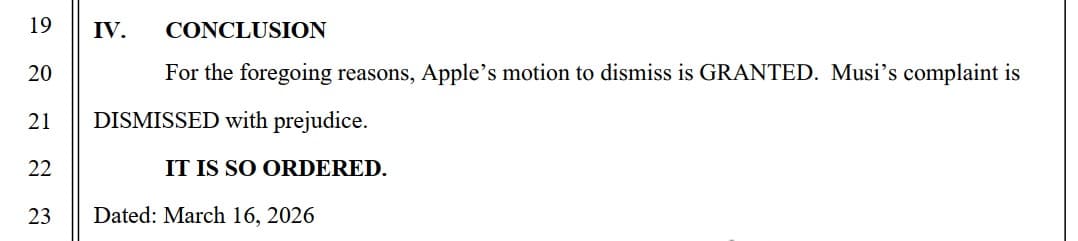
“There is simply no textual basis in the DPLA to construe a limitation on Apple’s right to cease offering an application, as long as Apple provided notice,” Judge Lee writes.
Musi’s argument that Apple breached an “implied covenant of good faith” under California law also failed. While Apple was contractually allowed to remove the app, the court notes that Apple did not solely act in response to the YouTube claim.
“[T]he complaint reflects that Apple was facing pressure from multiple music industry complaints. The letter from Sony expressly states that its trade organization (the IFPI) had already tried to resolve issues with Musi through the app dispute process, but Musi was not cooperating,” the order reads.
The court already granted Musi the option to amend its complaint previously and allowed two months of discovery, including access to over 3,500 documents and depositions from Apple officials, but that was not enough. Therefore, the court dismissed the case with prejudice, meaning that it can’t be refiled.
In a separate order issued the same day, the court granted Apple’s motion for Rule 11 sanctions in part, ruling that one allegation in Musi’s amended complaint was factually baseless.
Musi had alleged in the first paragraph of its amended complaint that Apple “knew that this ‘evidence’ was false, as it has since admitted.”
Judge Lee found that this admission did not appear anywhere in the provided evidence. Therefore, Musi’s claim that Apple had “admitted” to knowingly relying on false evidence is sufficient to warrant sanctions.
“Claiming that Apple ‘admitted’ that it knowingly relied on false evidence conveys that discovery yielded damning evidence,” the order states, “but it did not.”
The sanctions order effectively removed the offending phrase from the amended complaint and ordered Musi’s law firm, Winston & Strawn LLP, to pay Apple’s reasonable attorneys’ fees related to the sanctions motion.
The sanctions ruling was not the first time Musi’s honesty came under scrutiny in this case. In a motion filed in May 2025, Apple alleged that Musi had previously impersonated a Universal Music Group executive to get its app reinstated after an earlier removal.
Apple claimed that Musi founder Aaron Wojnowski forwarded a fabricated email to Apple purportedly from UMG’s Jason Miller, using the address jasonmiller@umusic.solar-secure.com, which is not a UMG address.
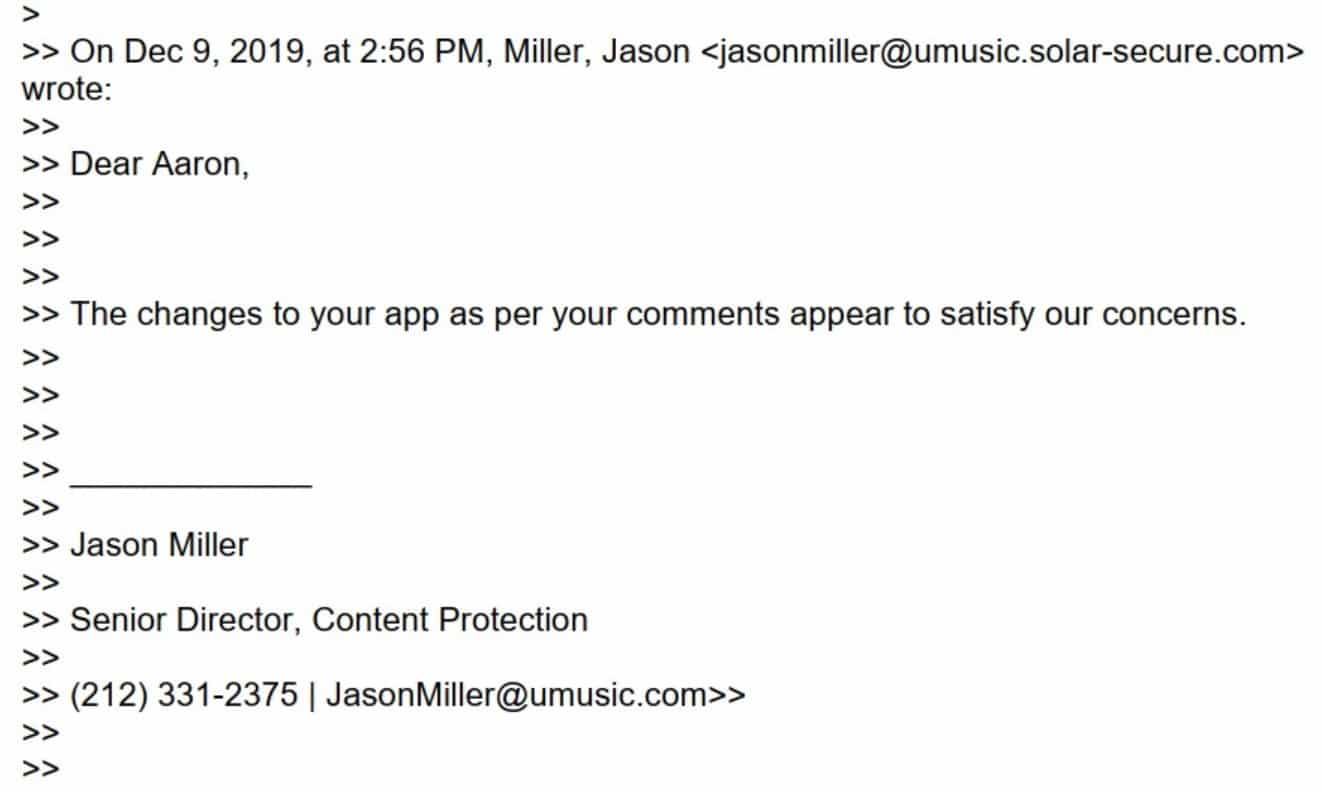
UMG later informed Apple the email was “fraudulent” and that Miller had no record of sending it. The same address was allegedly used to file a false copyright claim against a separate music streaming app, Yokee, in July 2020.
With the dismissal order now in place, the case is effectively closed. This means that the once very popular music app will not return to the App Store via this route. Musi still has the option to appeal, but whether it plans to do so is unclear. The company did not immediately return our request for comment.
—
A copy of Judge Eumi K. Lee’s order granting Apple’s motion to dismiss is available here (pdf). The order granting in part Apple’s motion for Rule 11 sanctions is available here (pdf).
From: TF, for the latest news on copyright battles, piracy and more.
This picture invariably brings tears to my eyes. It could be the logo, literally and metaphorically, for current health care policy.
The post Death Returns From Holiday first appeared on Science-Based Medicine.
While How to Fix the Internet is on hiatus, we wanted to share a great conversation with you from last week. EFF Executive Director Cindy Cohn spoke with bestselling novelist, journalist, and EFF Special Advisor Cory Doctorow about Cindy’s new book, “Privacy’s Defender: My Thirty-Year Fight Against Digital Surveillance” (MIT Press).




You can also listen to this episode on the Internet Archive or watch the video on YouTube.
Part memoir, part battle cry, “Privacy’s Defender” is the story of Cindy’s fights alongside the visionaries who looked at the early internet and understood that the legal and political battles over this new technology – the Crypto Wars, the NSA’s dragnet, the FBI gag orders – were really over the future of free speech, privacy, and power for all.
This conversation was recorded on Tuesday, March 10 in front of a packed house at San Francisco’s iconic City Lights Bookstore. For more about the book and Cindy’s national book tour – with stops in places including Seattle, Silicon Valley, Denver, Boston, Ann Arbor, Iowa City, Washington DC and New York City – check out https://www.eff.org/Privacys-Defender
And finally, stay tuned to this feed; we’re working on a special podcast series featuring key players and moments from the book!
Resources:
Imagine a newspaper publisher announcing it will no longer allow libraries to keep copies of its paper.
That’s effectively what’s begun happening online in the last few months. The Internet Archive—the world’s largest digital library—has preserved newspapers since it went online in the mid-1990s. The Archive’s mission is to preserve the web and make it accessible to the public. To that end, the organization operates the Wayback Machine, which now contains more than one trillion archived web pages and is used daily by journalists, researchers, and courts.
But in recent months The New York Times began blocking the Archive from crawling its website, using technical measures that go beyond the web’s traditional robots.txt rules. That risks cutting off a record that historians and journalists have relied on for decades. Other newspapers, including The Guardian, seem to be following suit.
For nearly three decades, historians, journalists, and the public have relied on the Internet Archive to preserve news sites as they appeared online. Those archived pages are often the only reliable record of how stories were originally published. In many cases, articles get edited, changed, or removed—sometimes openly, sometimes not. The Internet Archive often becomes the only source for seeing those changes. When major publishers block the Archive’s crawlers, that historical record starts to disappear.
The Times says the move is driven by concerns about AI companies scraping news content. Publishers seek control over how their work is used, and several—including the Times—are now suing AI companies over whether training models on copyrighted material violates the law. There’s a strong case that such training is fair use.
Whatever the outcome of those lawsuits, blocking nonprofit archivists is the wrong response. Organizations like the Internet Archive are not building commercial AI systems. They are preserving a record of our history. Turning off that preservation in an effort to control AI access could essentially torch decades of historical documentation over a fight that libraries like the Archive didn’t start, and didn’t ask for.
If publishers shut the Archive out, they aren’t just limiting bots. They’re erasing the historical record.
Making material searchable is a well-established fair use. Courts have long recognized it’s often impossible to build a searchable index without making copies of the underlying material. That’s why when Google copied entire books in order to make a searchable database, courts rightly recognized it as a clear fair use. The copying served a transformative purpose: enabling discovery, research, and new insights about creative works.
The Internet Archive operates on the same principle. Just as physical libraries preserve newspapers for future readers, the Archive preserves the web’s historical record. Researchers and journalists rely on it every day. According to Archive staff, Wikipedia alone links to more than 2.6 million news articles preserved at the Archive, spanning 249 languages. And that’s only one example. Countless bloggers, researchers, and reporters depend on the Archive as a stable, authoritative record of what was published online.
The same legal principles that protect search engines must also protect archives and libraries. Even if courts place limits on AI training, the law protecting search and web archiving is already well established.
The Internet Archive has preserved the web’s historical record for nearly thirty years. If major publishers begin blocking that mission, future researchers may find that huge portions of that historical record have simply vanished. There are real disputes over AI training that must be resolved in courts. But sacrificing the public record to fight those battles would be a profound, and possibly irreversible, mistake.
A story previously posted at this URL contained several factual errors. We’ve retracted it and apologize for the mistake.

Digital Restrictions Management (DRM), the “handcuffs” restricting how you can use most digital media, isn’t just an issue that affects files, formats, websites, and streaming (dis)services. It has consequences in the physical world, too. Perhaps none of them are more notorious than DRM-locked printer ink cartridges. You buy them, but arbitrary restrictions set by the manufacturer like specific page counts force you to toss them out prematurely, even if they can continue to work well for months or years more. Landfills needlessly grow, increasing the spread of microplastics and other harmful chemicals as these cartridges disintegrate, potentially even ending up in our food chain. All this simply because of software that restricts our freedom.
It’s been encouraging to see forward-thinking city councils like that of Los Angeles do the right thing and ban a kind of Digital Restrictions Management (DRM) so ubiquitous that we often forget it is DRM. Whether physical or not, the worst part about DRM isn’t the daily inconveniences it gives us. It’s how we collectively forget that things could be a different way.
Outside of aggressive industry lobbying, there’s no reason these limitations on using ink cartridges and any other forms of Digital Restrictions Management need to exist. In each and every case, they’re an artificial limitation placed on our technological freedom. When considering DRM, it’s important to remember that it is someone’s job to make a piece of technology or program malfunction. That limitation is intentionally designed by the corporation behind the product. In that sense, it is a “feature,” only one purposefully unhelpful, and what we’ve called an “anti-feature” in the past. In short, it’s defective by design
It doesn’t matter how widespread any one particular form of DRM is: we can still end it, whether with enough justified public outcry or concerted effort. The situation with ink cartridges isn’t so far removed from the “K-Cup debacle”. A decade ago, Keurig released the Keurig 2.0, which only accepted K-Cups with special, proprietary ink, and made it impossible to brew third-party grounds. After intense backlash from their customers and people around the globe — showing it’s a bad idea to put any kind of middleman between someone and their coffee — Keurig walked back the restriction. We can do this with ink cartridges, with Spotify, or any other form of DRM as well.
At the Defective by Design campaign and the FSF generally, our argument against DRM originates from the philosophical basis of our principles, a way of spelling out the basic rights and freedoms every computer user deserves. Simply wanting to minimize electronic waste is as good of a reason as any for rejecting DRM, and encouraging others to do the same.
If you want to encourage your (US) city council or board of aldermen to adopt a similar measure, we recommend writing a letter like the following:
Dear [Name],
I am writing to urge the city council to take action against ink cartridges restricted by Digital Restrictions Management (DRM) based on the extreme and unnecessary amount of electronic waste produced by these devices and the harm it does to customers and the environment.
As you know, modern printer cartridges artificially disable themselves according to arbitrary criteria set by the manufacturer, whether that’s a specific number of page counts, a “tripwire” signaling third-party maintenance has been done on the printer itself, or some specific date after first activation. The result is to often leave people no other option than to throw away perfectly good cartridges, regardless of their current level of ink.
This is just one way in which technology deprives us of basic freedoms we are all entitled to. The software that powers printers is no different than the software powering computers and cell phones: it should be free (as in freedom) for the community to study, share, and build for themselves.
I encourage the city to follow the example recently set by the Los Angeles City Council, which voted to cut down on electronic waste and protect their constituents from harmful practices in December 2025.
Sincerely,
[Your Name]
In the meantime, keep an eye on the Defective by Design campaign as we prepare for the next International Day Against DRM, which we’ve set for July 17, 2026. It’s our way of “commemorating” the most infamous event in the history of Digital Restrictions Management: Amazon’s remote deletion of copies of 1984 from their customer’s Swindles. Stand with us against DRM and for user freedom — we’ll see you in July.
“Canon PG-810 CL-811 ink cartridge” © 2011 by eFilm. This image is licensed under a Creative Commons Attribution 4.0 International license.
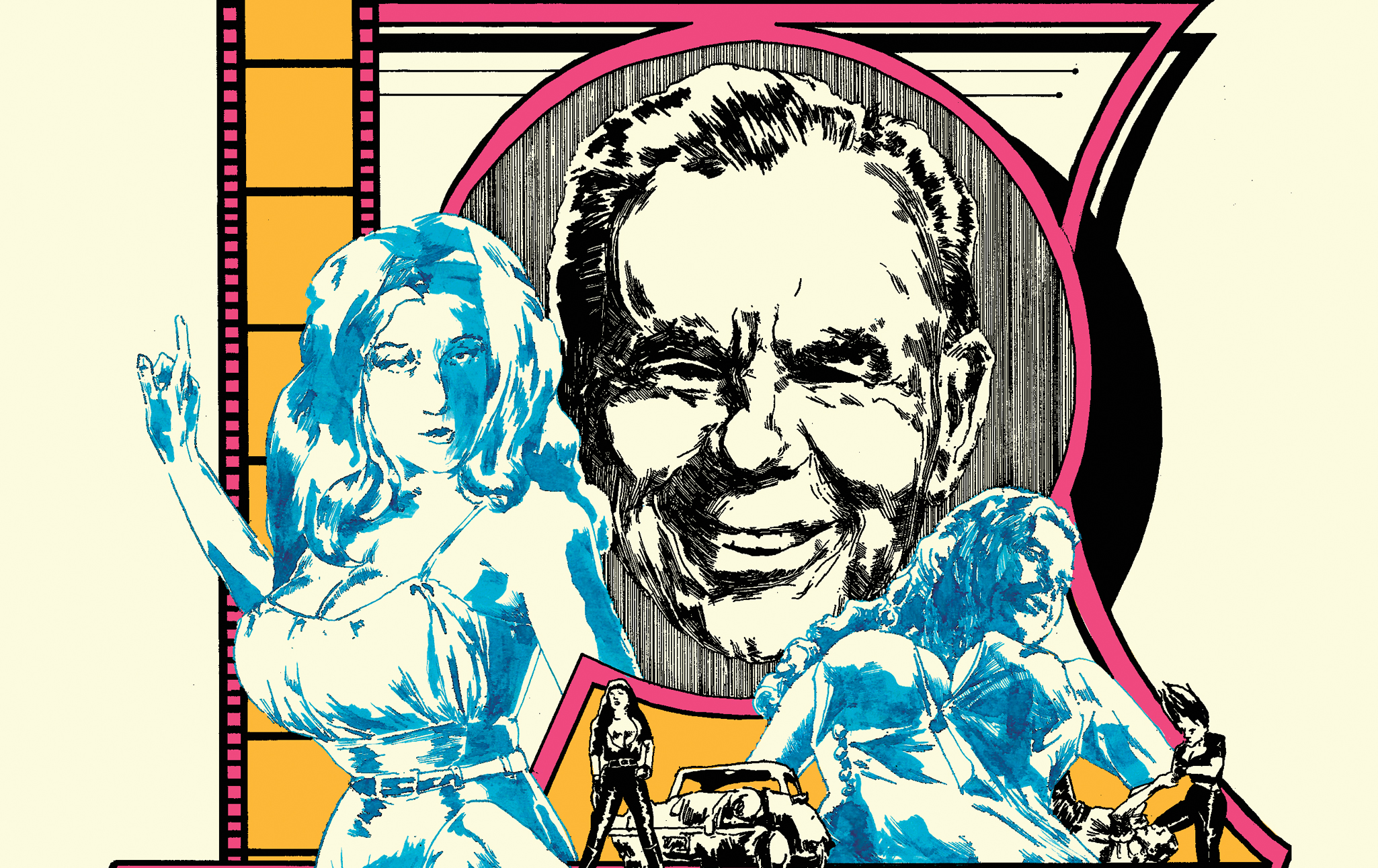
One of the most tiresome debates in online film discourse is whether there’s too much sex in movies, even as there is demonstrably less sex in movies than there has been in decades. It’s easy to blast as neo-Puritanism, but if it is, it’s a strange kind: people complain about sex scenes as tame as those in Oppenheimer or sexy popstar Sabrina Carpenter being a sexy popstar, but watch hardcore porn on their phones. It’s an odd reconstruction of the feminist sex wars of the 1980s and ’90s, simultaneously taking pro- and anti-sex positions by reifying the Madonna/whore complex: sexuality is degrading objectification for certain women, but not others. At least part of it is a reaction to the #MeToo era, which reorientated how we think about actresses taking off their clothes on screen. That squeamishness doesn’t extend to pornstars or OnlyFans models, maybe because “taking off clothes” is a core part of their job description, or because of their pervasive dehumanization. This discourse about the supposed gratuitousness of sex on screen is underpinned, as Madison Huizinga puts it at Café Hysteria, by an “inability to parse sex and sexuality from objectification… resulting in all mentions of sex often collapsing under one clumsily defined umbrella.”

Mamitiana Rajaonarison, an anti-corruption expert newly appointed as Madagascar’s prime minister, pledged on Monday to put himself “at the service” of the country in his first public address since taking the helm of the government.
Rajaonarison’s appointment was formalized on Sunday by transitional President Michaël Randrianirina at the state palace in Iavoloha. The move came just a week after Randrianirina abruptly dissolved the administration of the former prime minister, Herintsalama Rajaonarivelo.
The choice places a veteran financial investigator at the top of a government struggling to stabilize the island nation following severe political unrest last year.
In a video statement released Monday, Rajaonarison vowed to place himself entirely “at the service of Madagascar and the Malagasy people.”
While he has not yet laid out a detailed governing agenda, his résumé sends a clear political message at a volatile moment.
Since April 2021, Rajaonarison has served as the director general of SAMIFIN, Madagascar’s financial intelligence service, which is tasked with combating money laundering and the financing of terrorism. Prior to that role, he spent more than a decade at BIANCO, the country’s independent anti-corruption bureau, according to the local news outlet 2424.mg.
In a speech detailing the appointment, Randrianirina said he chose Rajaonarison “for his integrity” and explicitly directed him to lead the government “on the path of integrity” to restore public hope.
According to reports from 2424.mg, the transitional president urged the new premier to move quickly to form a cabinet, implement the government’s transitional program, and unite the country’s fractured “living forces.”
Official channels moved swiftly to codify the leadership change. The Foreign Ministry confirmed the March 15 appointment in a public statement, and official postings referenced Decree No. 2026-776, which formalized the presidential act.
For Randrianirina—who assumed power following last year’s upheaval—the appointment is a critical step in his promise to deliver structural reforms, draft a new constitution, and ultimately guide the country toward future democratic elections. Tapping a career anti-corruption official is a clear attempt to signal a definitive break from the political crises of the past.
In his first public video statement on Monday, Madagascar’s new prime minister and anti-corruption expert, Mamitiana Rajaonarison, said he was determined to place himself “at the service of Madagascar and the Malagasy people” after being appointed to lead the government.
Rajaonarison’s Rajaonarivelo. According to 2424.mg’s report on the appointment, Rajaonarison had served since April 2021 as director general of SAMIFIN, Madagascar’s financial intelligence service, which is responsible for fighting money laundering and terrorism financing. Before that, the outlet reported, he spent more than a decade at BIANCO, the country’s independent anti-corruption bureau.
In a separate 2424.mg article quoting the president’s speech, Randrianirina said he had chosen Rajaonarison “for his integrity” and wanted him to lead the government “on the path of integrity” to restore hope. He also urged the new premier to move quickly to form a cabinet, implement the transitional government’s program, and unite the country’s “living forces.”
Official government channels also moved quickly to formalize the decision. Madagascar’s Foreign Ministry said in a Facebook statement that Rajaonarison had been named prime minister and head of government on March 15. Other official and semi-official Facebook posts referenced Decree No. 2026-776, indicating the appointment had been formalized by presidential act the same day.
The choice puts an anti-corruption official at the center of a government facing political uncertainty. Randrianirina, who took power after last year’s unrest, has promised reforms and a path toward a new constitution and future elections. Rajaonarison has not yet laid out a detailed governing agenda publicly, but both his résumé and the president’s remarks suggest the appointment is being presented as a clean-government signal at a volatile moment for Madagascar.
