Two people have died following an outbreak of meningitis, including one student at the University of Kent.
Author: tio
-
Pluralistic: Tools vs uses (16 Mar 2026)
Today’s links
- Tools vs uses: Don’t fall for it.
- Hey look at this: Delights to delectate.
- Object permanence: Amazon coders x Amazon warehouse workers; Bruces’s ETECH speech; Steven King x unions; Tax-free S&P 500 companies; Make Pop Rocks; “Ain’t Misbehavin’”; “Car Hacker’s Handbook”; Pirates in Iceland.
- Upcoming appearances: Where to find me.
- Recent appearances: Where I’ve been.
- Latest books: You keep readin’ em, I’ll keep writin’ ’em.
- Upcoming books: Like I said, I’ll keep writin’ ’em.
- Colophon: All the rest.
Tools vs uses (permalink)
When you think of a legal loophole, you probably imagine a drafting error (or perhaps a sneaky insertion) that creates an advantage for a specific person or group of people.
For example: Trump’s 2017 “Big Beautiful Tax Cut” bill passed after its 479 pages were covered in hand-scrawled amendments and additions, which were not read or reviewed by lawmakers prior to voting:
But one change that was widely known was Senator Ron Johnson’s last-minute amendment to create deductions for “pass through entities.” Johnson announced that he would block the bill if his amendment didn’t go through. That amendment made three of Johnson’s constituents at least half a billion dollars: Uline owners Dick and Liz Uihlein and roofing tycoon Diane Hendricks (who collectively donated $20m to Johnson’s campaign).
All told, the Trump tax bill generated windfalls worth more than $1b for just 82 households, all of whom donated lavishly to the lawmakers who inserted incredibly specific amendments that benefited them, personally:
https://pluralistic.net/2021/08/11/the-canada-variant/#shitty-man-of-history-theory
Here’s another example: in 1999, a Congressional staffer named Mitch Glazier secured a last-minute, one-line amendment to the Satellite Home Viewer Improvement Act that took away musicians’ ability to claim back the rights to their sound recordings after 35 years through a process called “Termination of Transfer”:
https://en.wikipedia.org/wiki/Mitch_Glazier#Work_for_hire
This amendment whacked one group of musicians particularly hard: the Black “heritage acts” who had been coerced into signing unbelievably shitty contracts in the 1950s, 60s and 70s, who were increasingly using termination to get those rights back. For these beloved musicians, termination meant the difference between going hungry and buying a couple extra bags of groceries every month (if this sounds familiar, it might be because you read about it in my 2024 novel The Bezzle):
https://us.macmillan.com/books/9781250865892/thebezzle/
Glazier’s treachery was so outrageous that Congress actually convened a special session to repeal his amendment, and Glazier slunk out of Congress forever…so that he could take a job at $1.3m/year as CEO of the Recording Industry Association of America, where he squats to this day, insisting that he is fighting for musicians’ rights:
https://projects.propublica.org/nonprofits/organizations/131669037
These are the traditional loopholes – obscure codicils in legislation that allow their beneficiaries to enrich themselves at others’ expense. But there’s another, equally pernicious kind of loophole that gets far less attention: a loophole that neutralizes a beneficial part of a law, taking away a right that the law seems to confer.
I have spent most of my adult life fighting against one of these rights-confiscating reverse loopholes: the “exemptions” clause to Section 1201 of the Digital Millennium Copyright Act (DMCA 1201), which might just be the most dangerous technology law on the books:
https://pluralistic.net/2026/01/14/sole-and-despotic/#world-turned-upside-down
Under DMCA 1201, it’s a felony – punishable by a 5-year sentence and a $500k fine – to bypass an “access control” for a copyrighted work. This means that altering the software (that is, “a copyrighted work”) in a device you own – a car, a tractor, a hearing aid, a smart speaker, a printer, a phone, a console, etc, etc – is a crime, even if your alteration does not break any other laws.
For example: there is no law requiring you to buy your printer ink from the company that sold you your printer. However, the cartel of companies that control the inkjet market all use software that is designed to block generic ink. You could turn this code off, but that would be a felony under Section 1201 of the DMCA, which means that, in practice, it’s a felony to put generic ink in your printer. Jay Freeman calls it “felony contempt of business model.”
When the DMCA was being debated, lawmakers faced fierce criticism over this clause, so they inserted a “safety valve” into the law that was supposed to prevent the kind of abuse that allows printer companies to force you to pay $10,000/gallon for ink.
That escape valve is called the “triennial exemptions process.” Every three years, the US Copyright Office invites submissions for “exemptions” to DMCA 1201. They’ve granted lots of these – the right to circumvent access controls on video games for preservation purposes, on DVDs for film criticism, and on various kinds of electronics for repair.
This process may strike you as a little cumbersome – do you really have to wait up to three years to pay a lawyer to beg the government for the right to make a legal use of your own property? But this is a reverse loophole, and that means that this isn’t merely cumbersome, it’s farcical.
You see, the exemptions that the Copyright Office grants through the triennial process aren’t tools exemptions, they’re use exemptions. That means that when the Copyright Office grants an exemption giving you the right to jailbreak your car so that you can make sense of the manufacturer’s diagnostic codes and turn your “check engine” light into a specific, actionable diagnosis.
You have that right. Your mechanic does not have that right. You have the right to jailbreak your car and fix it.
But it’s worse than that: your right to jailbreak your car does not mean that anyone else gets the right to make a tool that allows you to make that use. You have a use exemption, but there is no tool exemption. That means that you, personally, must reverse-engineer the firmware in your car, identify a fault in the code, and leverage that to personally write software to turn the diagnostic codes into diagnoses. You are not allowed to talk to anyone else about this. You’re not allowed to publish your findings. You’re certainly not allowed to share the tool you create with anyone else.
This is true of all the exemptions the Copyright Office grants. If you’re a film professor who’s been given the right to jailbreak DVDs, you are expected to write your own DVD decrypting software, without help from anyone else, and if you manage it, you can’t tell anyone else how you did it. If you’re an iPhone owner who’s been granted the right to jailbreak your phone and install a different app store, then you, personally, must identify a vulnerability in iOS and develop it into an exploit that you are only allowed to use on your own devices. Every other iPhone owner has to do the same thing.
DMCA 1201 has been copy-pasted into law-books all over the world. In Europe, it came in through Article 6 of the 2001 EU Copyright Directive (EUCD6). When Norway implemented this law, lawmakers included a bunch of use exemptions in a bid to placate the fierce opposition they faced. One of these exemptions allowed blind people to jailbreak ebooks so they could be used with Braille printers, screen readers, and other assistive devices.
In 2003, I traveled to Oslo to debate the minister responsible for the bill. He proudly trumpeted this exemption, so I started asking him questions about it:
How do blind people get the software that jailbreaks their ebooks so they can make use of this exemption? Am I allowed to give them that tool?
No, the minister said, you’re not allowed to do that, that would be a crime.
Is the Norwegian government allowed to give them that tool? No. How about a blind rights advocacy group? No, not them either. A university computer science department? Nope. A commercial vendor? Certainly not.
No, the minister explained, under his law, a blind person would be expected to personally reverse-engineer a program like Adobe E-Reader, in hopes of discovering a defect that they could exploit by writing a program to extract the ebook text.
Oh, I said. But if a blind person did manage to do this, could they supply that tool to other blind people?
Well, no, the minister said. Each and every blind person must personally – without any help from anyone else – figure out how to reverse-engineer the ebook program, and then individually author their own alternative reader program that worked with the text of their ebooks.
https://pluralistic.net/2024/10/28/mcbroken/#my-milkshake-brings-all-the-lawyers-to-the-yard
I don’t know for sure how many blind Norwegians have managed to take advantage of this use exemptions, but I’m pretty certain it’s zero.
Canada’s anticircumvention law was passed in 2012 through Bill C-11, the Copyright Modernization Act. Like EUCD6, C-11 has all the defects of America’s anticircumvention law. In 2024, Parliament passed a national Right to Repair law (Bill C-244) and a national Interoperability law (Bill C-294). Both of them grant use exemptions to Bill C-11 – they allow Canadians to jailbreak their devices to fix them or extend their functionality with interoperable code and hardware. But neither bill has a tools exemption, which means that they are useless, since they only grant Canadians the individual, personal right to jailbreak, but they don’t allow Canadian businesses or tinkerers or user groups to make the tools that Canadians need to exercise the use rights that Parliament so generously granted:
https://pluralistic.net/2024/11/15/radical-extremists/#sex-pest
Reverse loopholes are incredibly wicked. They exist solely to muddy the waters, to trick people into thinking that problems have been solved while those problems continue to fester. Hardly a week goes without my hearing from someone who’s happened upon the use exemptions built into anticircumvention laws around the world and have come to the reasonable conclusion that if a law gives you the right to do something, it must also give other people the right to help you do it.
Lawmakers who pass these reverse loopholes know what they’re doing. They’re chaffing the policy airspace, ramming through unpopular legislation under cover of a blizzard of misleading legalese.
Hey look at this (permalink)

- Being a Luddite Is Cool and All, but Have You Seen the Hilarious Tapestries These New Looms Are Making? https://www.mcsweeneys.net/articles/being-a-luddite-is-cool-and-all-but-have-you-seen-the-hilarious-tapestries-these-new-looms-are-making
-
They Didn’t Want to Have C-Sections. A Judge Would Decide How They Gave Birth. https://www.propublica.org/article/florida-court-ordered-c-sections?utm_source=sailthru&utm_medium=email&utm_campaign=weekly-newsletter
-
F-Droid says Google’s Android developer verification plan is an ‘existential’ threat to alternative app stores https://thenewstack.io/f-droid-says-googles-android-developer-verification-plan-is-an-existential-threat-to-alternative-app-stores/
-
Meta to Shut Down Instagram End-to-End Encrypted Chat Support Starting May 2026 https://thehackernews.com/2026/03/meta-to-shut-down-instagram-end-to-end.html
-
The Removed DOGE Deposition Videos Have Already Been Backed Up Across the Internet https://www.404media.co/the-removed-doge-deposition-videos-have-already-been-backed-up-across-the-internet/
Object permanence (permalink)
#20yrsago Full text of Bruce Sterling’s ETECH speech from last week https://web.archive.org/web/20060406025248/http://www.viridiandesign.org/2006/03/viridian-note-00459-emerging.html
#20yrsago HOWTO build a glowing throne out of 4k AOL CDs https://web.archive.org/web/20060408174929/https://stupidco.com/aol_throne_intro.html
#20yrsago How Sweden’s “Pirate Bay” site resists the MPAA https://web.archive.org/web/20060423222220/https://www.wired.com/news/technology/1,70358-0.html
#15yrsago Stephen King sticks up for unions https://www.youtube.com/watch?v=x1vW1zPmnKQ
#15yrsago Largest Wisconsin protests ever: 85,000+ people in Madison’s streets https://web.archive.org/web/20110319152841/http://www.huffingtonpost.com/2011/03/12/wisconsin-protesters-refu_n_834927.html
#15yrsago Why Borders failed https://www.quora.com/Borders-Books/Why-is-Barnes-Noble-performing-well-as-a-business-while-Borders-has-filed-for-bankruptcy/answer/Mark-Evans-9
#15yrsago HOWTO make Pop Rocks https://www.instructables.com/Pop-Rocks/
#15yrsago Ain’t Misbehavin’: subject index to democratic parenting https://memex.craphound.com/2011/03/14/aint-misbehavin-subject-index-to-democratic-parenting/
#10yrsago 50 reasons the TPP is terrible beyond belief https://www.michaelgeist.ca/2016/03/the-trouble-with-the-tpp-day-50-the-case-against-ratifying-the-trans-pacific-partnership/
#10yrsago More high-profile resignations at Breitbart, after abused reporter thrown under Trump’s bus https://www.buzzfeednews.com/article/rosiegray/michelle-fields-ben-shapiro-resign-from-breitbart#.vlbZ4YxLe
#10yrsago If Iceland held its elections today, the Pirate Party would win https://torrentfreak.com/pirate-party-to-dominate-icelan-parliament-survey-finds-160314/
#10yrsago The Car Hacker’s Handbook: a Guide for Penetration Testers https://memex.craphound.com/2016/03/14/the-car-hackers-handbook-a-guide-for-penetration-testers/
#10yrsago USA uses TPP-like trade-court to kill massive Indian solar project https://web.archive.org/web/20160314085012/http://theantimedia.org/preview-of-the-tpp-america-just-blocked-a-massive-solar-project-in-india/
#10yrsago These 27 profitable S&P 500 companies paid no tax last year https://www.usatoday.com/story/money/markets/2016/03/07/27-giant-profitable-companies-paid-no-taxes/81399094/
#10yrsago Family: police high-fived after tasering our handcuffed relative to death https://web.archive.org/web/20160312165903/https://www.ajc.com/news/news/crime-law/family-of-victim-in-coweta-county-taser-death-seek/nqhcm/
#1yrago The future of Amazon coders is the present of Amazon warehouse workers https://pluralistic.net/2025/03/13/electronic-whipping/#youre-next
Upcoming appearances (permalink)

- Barcelona: Enshittification with Simona Levi/Xnet (Llibreria Finestres), Mar 20
https://www.llibreriafinestres.com/evento/cory-doctorow/ -
Berkeley: Bioneers keynote, Mar 27
https://conference.bioneers.org/ -
Montreal: Bronfman Lecture (McGill) Apr 10
https://www.eventbrite.ca/e/artificial-intelligence-the-ultimate-disrupter-tickets-1982706623885 -
London: Resisting Big Tech Empires (LSBU)
https://www.tickettailor.com/events/globaljusticenow/2042691 -
Berlin: Re:publica, May 18-20
https://re-publica.com/de/news/rp26-sprecher-cory-doctorow -
Berlin: Enshittification at Otherland Books, May 19
https://www.otherland-berlin.de/de/event-details/cory-doctorow.html -
Hay-on-Wye: HowTheLightGetsIn, May 22-25
https://howthelightgetsin.org/festivals/hay/big-ideas-2
Recent appearances (permalink)
- Do you feel screwed over by big tech? (Ontario Today)
https://www.cbc.ca/listen/live-radio/1-45-ontario-today/clip/16203024-do-feel-screwed-big-tech -
Launch for Cindy’s Cohn’s “Privacy’s Defender” (City Lights)
https://www.youtube.com/watch?v=WuVCm2PUalU -
Chicken Mating Harnesses (This Week in Tech)
https://twit.tv/shows/this-week-in-tech/episodes/1074 -
The Virtual Jewel Box (U Utah)
https://tanner.utah.edu/podcast/enshittification-cory-doctorow-matthew-potolsky/ -
Tanner Humanities Lecture (U Utah)
https://www.youtube.com/watch?v=i6Yf1nSyekI
Latest books (permalink)
- “Canny Valley”: A limited edition collection of the collages I create for Pluralistic, self-published, September 2025 https://pluralistic.net/2025/09/04/illustrious/#chairman-bruce
-
“Enshittification: Why Everything Suddenly Got Worse and What to Do About It,” Farrar, Straus, Giroux, October 7 2025
https://us.macmillan.com/books/9780374619329/enshittification/ -
“Picks and Shovels”: a sequel to “Red Team Blues,” about the heroic era of the PC, Tor Books (US), Head of Zeus (UK), February 2025 (https://us.macmillan.com/books/9781250865908/picksandshovels).
-
“The Bezzle”: a sequel to “Red Team Blues,” about prison-tech and other grifts, Tor Books (US), Head of Zeus (UK), February 2024 (thebezzle.org).
-
“The Lost Cause:” a solarpunk novel of hope in the climate emergency, Tor Books (US), Head of Zeus (UK), November 2023 (http://lost-cause.org).
-
“The Internet Con”: A nonfiction book about interoperability and Big Tech (Verso) September 2023 (http://seizethemeansofcomputation.org). Signed copies at Book Soup (https://www.booksoup.com/book/9781804291245).
-
“Red Team Blues”: “A grabby, compulsive thriller that will leave you knowing more about how the world works than you did before.” Tor Books http://redteamblues.com.
-
“Chokepoint Capitalism: How to Beat Big Tech, Tame Big Content, and Get Artists Paid, with Rebecca Giblin”, on how to unrig the markets for creative labor, Beacon Press/Scribe 2022 https://chokepointcapitalism.com
Upcoming books (permalink)
- “The Reverse-Centaur’s Guide to AI,” a short book about being a better AI critic, Farrar, Straus and Giroux, June 2026
-
“Enshittification, Why Everything Suddenly Got Worse and What to Do About It” (the graphic novel), Firstsecond, 2026
-
“The Post-American Internet,” a geopolitical sequel of sorts to Enshittification, Farrar, Straus and Giroux, 2027
-
“Unauthorized Bread”: a middle-grades graphic novel adapted from my novella about refugees, toasters and DRM, FirstSecond, 2027
-
“The Memex Method,” Farrar, Straus, Giroux, 2027
Colophon (permalink)
Today’s top sources:
Currently writing: “The Post-American Internet,” a sequel to “Enshittification,” about the better world the rest of us get to have now that Trump has torched America ( words today, total)
- “The Reverse Centaur’s Guide to AI,” a short book for Farrar, Straus and Giroux about being an effective AI critic. LEGAL REVIEW AND COPYEDIT COMPLETE.
-
“The Post-American Internet,” a short book about internet policy in the age of Trumpism. PLANNING.
-
A Little Brother short story about DIY insulin PLANNING

This work – excluding any serialized fiction – is licensed under a Creative Commons Attribution 4.0 license. That means you can use it any way you like, including commercially, provided that you attribute it to me, Cory Doctorow, and include a link to pluralistic.net.
https://creativecommons.org/licenses/by/4.0/
Quotations and images are not included in this license; they are included either under a limitation or exception to copyright, or on the basis of a separate license. Please exercise caution.
How to get Pluralistic:
Blog (no ads, tracking, or data-collection):
Newsletter (no ads, tracking, or data-collection):
https://pluralistic.net/plura-list
Mastodon (no ads, tracking, or data-collection):
Bluesky (no ads, possible tracking and data-collection):
https://bsky.app/profile/doctorow.pluralistic.net
Medium (no ads, paywalled):
https://doctorow.medium.com/
https://twitter.com/doctorowTumblr (mass-scale, unrestricted, third-party surveillance and advertising):
https://mostlysignssomeportents.tumblr.com/tagged/pluralistic
“When life gives you SARS, you make sarsaparilla” -Joey “Accordion Guy” DeVilla
READ CAREFULLY: By reading this, you agree, on behalf of your employer, to release me from all obligations and waivers arising from any and all NON-NEGOTIATED agreements, licenses, terms-of-service, shrinkwrap, clickwrap, browsewrap, confidentiality, non-disclosure, non-compete and acceptable use policies (“BOGUS AGREEMENTS”) that I have entered into with your employer, its partners, licensors, agents and assigns, in perpetuity, without prejudice to my ongoing rights and privileges. You further represent that you have the authority to release me from any BOGUS AGREEMENTS on behalf of your employer.
ISSN: 3066-764X
-
Guterres urges action against ‘rising tide of anti-Muslim hatred’
The UN chief on Monday urged countries to “work together” and eradicate a rising tide of anti-Muslim hate, calling for a rejection of “the narratives of fear and exclusion”. -
Middle East war’s ‘spiral of conflict’ drives mounting civilian toll
The widening war in the Middle East and its growing impact on civilians came under scrutiny at the UN in Geneva on Monday, as independent experts briefing the Human Rights Council warned of escalating violence following the onset of Israeli and US strikes on Iran and counterstrikes by Tehran and allied groups. -
‘Glimmer of hope’ in Haiti amid shifting gang frontlines
The liberation of territory from gangs and a more “motivated and visible” police presence has provided a “glimmer of hope” for Haiti as the Caribbean island nation continues to struggle with violence, insecurity and poverty. -
Alleged ‘Fake Prince’ Arrested in Nigeria as Another Apparent Victim of the Romance Scam Comes Forward
Within a week of the release of an OCCRP documentary exposing an online fraud operation, Nigerian authorities arrested a man allegedly involved in the scheme, while another apparent victim of the same scam came forward in Romania.
In last month’s documentary, Exposed: Fake ‘Dubai Prince’ Tracked to Nigeria, reporters identified Nzube Henry Ikeji, 31, who was afterwards taken into custody. Charges have not been filed, a spokesman for Nigeria’s Economic and Financial Crime Commission told OCCRP.
Ikeji’s arrest came nearly a week after the video revealed how he allegedly posed as the real-life Crown Prince of Dubai, cultivating a romance that defrauded $2.5 million from Laura, a Romanian businesswoman.
A second apparent victim of the scam came forward to OCCRP’s Romanian member center Context.ro after watching the documentary. Ana, who is also Romanian, presented Context.ro with documents indicating she was targeted by the same operation that left Laura in debt.
Both women were first contacted on LinkedIn by someone posing as the Crown Prince of Dubai, Sheikh Hamdan bin Mohammed bin Rashid Al Maktoum, and claiming to represent a humanitarian foundation affiliated with the royal family of the United Arab Emirates.
Communications provided by the women show that Ana first heard from the fake prince in October 2022, while he reached out to Laura a month later. Both were offered and accepted “an official vip humanitarian membership permit” for the sum of 7,748 UAE dirhams, which was paid out as 1,850 euros ($2,112).
It is common for romance scammers to impersonate the Crown Prince of Dubai in a variation of the classic romance scam, which involves an impersonator cultivating an online relationship with a victim with the goal of milking them for as much money as possible before they realize they’ve been swindled.
In the case of both Laura and Ana, identical email addresses with similar messages and fake royal membership cards were used, indicating they were victims of the same group of scammers. Laura is a first name and Ana is pseudonym, as both victims wish to remain anonymous out of embarrassment.
Ikeji could not be reached for comment on the latest allegations involving Ana. An email bounced back undelivered, while his previous lawyers did not respond to a request for comment. Message to his WhatsApp did not deliver. He previously told reporters that he did not scam Laura or anyone else, and alleged that OCCRP’s documentary was a “targeted plan” to destroy his reputation.
The woman whom Context.ro identifies as Ana said she was invited by the fake prince to apply for a job at Mohammed bin Rashid Al Maktoum Global Initiatives (MBRGI), the humanitarian foundation launched by the actual crown prince’s father and ruler of Dubai, Sheikh Mohammed bin Rashid Al Maktoum. Laura, meanwhile, was asked by a fake prince to help MBRGI invest millions of dollars in humanitarian aid in Romania.
Neither of the opportunities were real. After they paid 1,850 euros for “official vip humanitarian membership permit” cards, both received messages saying their cards had been granted, but required another payment to be activated. Ana paid another 10,550 euros ($12,045), while Laura paid 12,550 euros ($14,328).
A fake prince had earlier steered their communications to Skype and later to WhatsApp, where he cultivated romances with them.
He told Ana that he wanted to visit her in Romania, but it would require Ana transferring 42,000 euros ($47,951). When Ana refused to send more money that she did not have, the fake prince texted her: “Now you’ve lost me and the 13,000 euros you have paid.”
While Ana stopped at that point, Laura continued deeper into the scam, exchanging thousands of messages over two years with the fake prince and even meeting his “financial manager” in London to facilitate opening a bank account.
-
Afghan Volunteer Women‘s Association
The Afghan Volunteer Women‘s Association (AFV) is a humanitarian aid organization
that has been working towards peace and reconstruction in Afghanistan since 1992.
Our projects that are mainly in the rural areas, focus on supporting women and children.
Our strategy is help for self-help. -

Bankruptcy Court Clears Path for $100 Million Sale of Redbox’s Piracy Lawsuit Rights
In 2024, the video rental and streaming company Redbox shut down its service and filed for bankruptcy.
The service, owned by Chicken Soup for the Soul Entertainment (now CSS Entertainment), was running hundreds of millions in losses per year and no longer saw a path to profitability.
With hundreds of filings, the bankruptcy case is a complex one. While these types of proceedings typically don’t have much news value, a rather intriguing piracy-related filing caught our eye last fall.
Court Clears Path for $100 Million Piracy Litigation Deal
Last October, it was reported that a company called Grove Street Partners was offering at least $100 million for the copyright litigation rights of Redbox‘ bankrupt parent company.
However, before any deal could be signed and executed, the Delaware bankruptcy court first had to approve the sharing agreement that dictates how the proceeds of an eventual sale are shared. This happened earlier this month, when the agreement was formally approved by Judge Mary F. Walrath.
With the paperwork sorted, the rights to pursue copyright infringement claims of media titles once owned or controlled by CSS Entertainment and its subsidiaries, including Screen Media Ventures, can now be sold.
Grove Street remains the key candidate to take over the rights, which would allow the company to file lawsuits against Internet providers for turning a blind eye to piracy. This can potentially lead to hundreds of millions of dollars in damages, which would provide a decent return on investment.
Piracy lawsuits are familiar territory for Grove Street. In 2023, before Redbox went bankrupt, it announced a partnership with American Films and its subsidiary FACTERRA, to “provide data monitoring and record evidence” supporting copyright infringement cases.
Future ISP Piracy Lawsuits & the Supreme Court
During a hearing at the bankruptcy court a few days ago, the trustee confirmed that while they have reached an “agreement in principle” with Grove Street, the formal purchase agreement is still being drafted and has not been executed. This means that there is no final price tag, although $100 million has been cited as the minimum.
From the sharing agreement 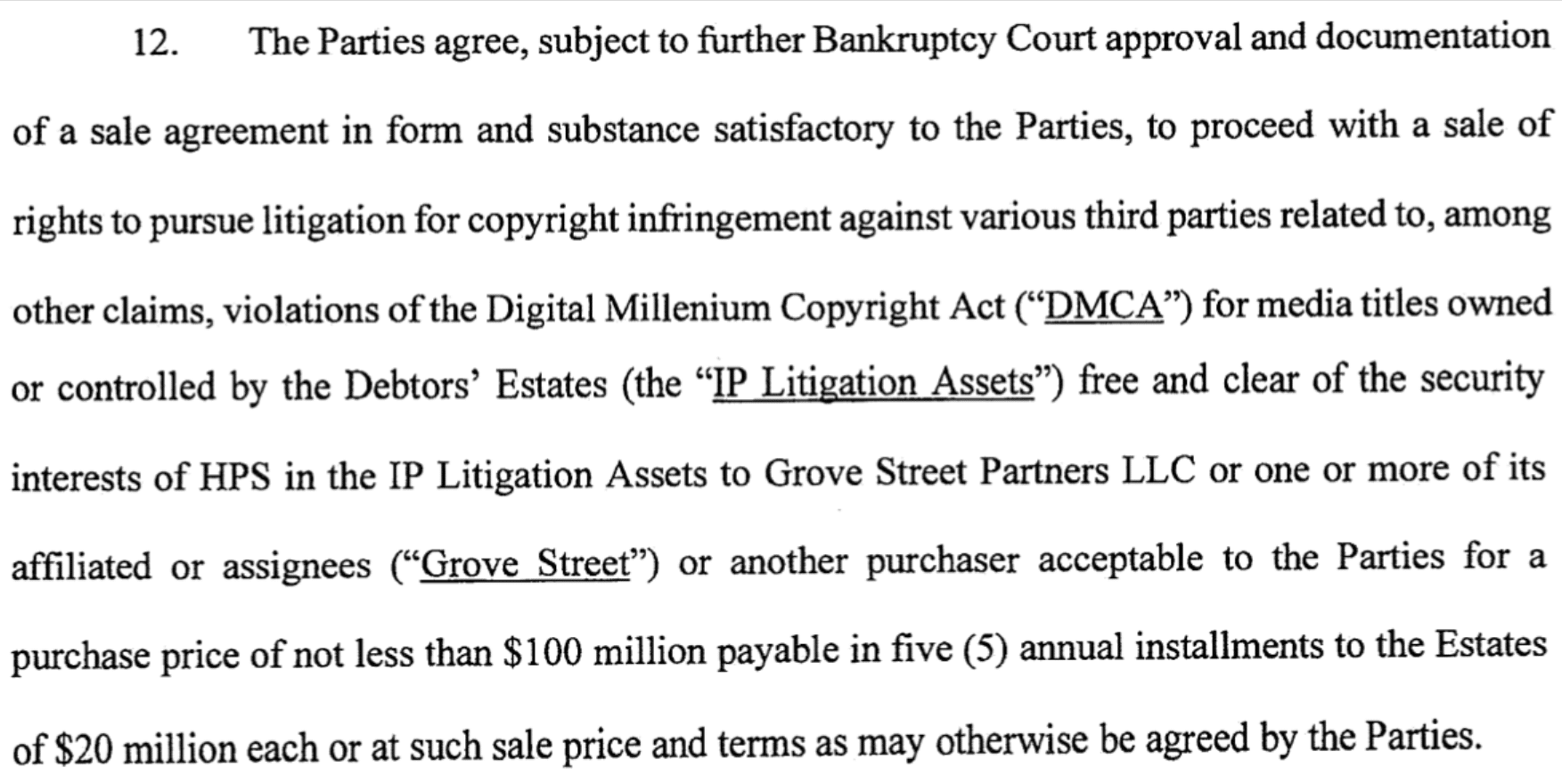
$100 million is a substantial amount, especially considering that these litigation rights don’t guarantee success in court. In fact, the value of those rights largely depends on a case currently before the U.S. Supreme Court.
This case, Cox Communications v. Sony Music Entertainment, asks the Court to define when an ISP can be held liable for the infringement of its subscribers.
Cox was previously hit with a $1 billion jury verdict for failing to terminate repeat infringers despite receiving millions of DMCA notices. This led to several appeals and eventually ended up at the Supreme Court, where the Internet provider found the U.S. government on its side.
The Supreme Court heard oral arguments in December 2025, and a final decision is expected to come in later this year. That decision could either cement the value of the rights at stake here, or make it much more challenging to recoup the investment.
Private Lenders Get Most Money
The approved sharing agreement governs how proceeds will be divided between the trustee, George L. Miller, and HPS Investment Partners, the primary secured lender owed at least $500 million in principal alone.
Under the terms of the deal, the buyer of the rights will pay at least $100 million in five annual installments of $20 million each. After the trustee’s administrative costs are covered, the first $100 million in net proceeds splits 80% to the lenders and 20% to the estate. Above $100 million, the lenders’ share increases to 85%, with the estate receiving 15%
During the proceedings, a secondary lender, MidCap Financial Trust, was added as a party by the court order, and it will receive a pro-rata share of the lender share, alongside HPS.
The court also specifically preserved the rights of unions, including DGA, SAG-AFTRA, and WGA West, to ensure their outstanding payment claims remain active. However, with various parties seeking hundreds of millions in secured debt, it seems unlikely that everyone is made whole.
A Web of Legal Troubles
Speaking with TorrentFreak, Grove Street CEO Thomas Murphy confirmed that the external funds to acquire the rights are still in place, without mentioning any financial partners by name. First, however, a purchase agreement must be finalized.
This agreement is also key for a separate lawsuit that was filed against the company by a former executive. As highlighted last October, Jamie Warren, the former CFO of both American Films and Grove Street Funding (which is linked to Grove Street Partners), sued both companies over unpaid salary in 2024.
In May, 2025, a Texas federal court entered a final judgment in favor of the former employee, granting her $525,000, plus attorneys fees and costs. Thus far, the judgment has not been paid, but that could change soon.
A day after the bankruptcy court approved the sale of litigation rights, Murphy informed the Texas court that a first payment toward the outstanding judgment will follow shortly, adding that the CSS deal is ‘the only way that reasonably happens.’
Whether the sale will eventually go through has yet to be seen, but it is clear that a lot is riding on it: for Grove Street, its former CFO, Internet providers, lawyers, movie producers, and all the claim holders in the bankruptcy proceeding.
And even if the sale goes through, the profitability of the deal will depend, in no small part, on what the Supreme Court decides in the Cox case in the months ahead.
—
A copy of the order of the Delaware Bankruptcy Court, approving the sharing agreement (pdf) that effectively greenlights the deal, is available here (pdf).
From: TF, for the latest news on copyright battles, piracy and more.
-

My impulsive father, and the hidden psychiatric side effects of dopamine-agonist drugs
My Dad was Captain Sensible. Logical, frugal, sceptical and risk-averse. A classic ‘Acts of Service’ father – struggled to talk about emotions but would happily pick me and my mates up from a nightclub at 3am. We always knew there was nothing he wouldn’t do for us.
He retired early in 2008, aged 54, after being diagnosed with Progressive Supranuclear Palsy (PSP). A year later his diagnosis was changed to Parkinson’s Disease. And for six years life was as good as it could be. He took the condition in his stride, kept active and socialising, and laughed at himself through his rigid face. He remained a protective and devoted father, helping care for my brother who was recovering from a traumatic brain injury.
Everything changed in 2015 when he was prescribed a dopamine-agonist called Rotigotine. Dopamine-agonists are a family of drugs that work by activating your brain’s dopamine receptors.
But he wasn’t told about the severe psychiatric side-effects – that 1 in 6 (some studies up to 1 in 3) Parkinson’s sufferers prescribed these drugs will develop an ‘Impulse Control Disorder’ (ICD), or what this means in practice. He wasn’t given the warnings academics have implored drug companies to provide for decades.
In 2016 I got the shock of my life. Dad was skint. Actually, he was more than skint. He’d lost his life-savings of £250k and about £50k of credit card debts. It had been ‘invested’ into gold and property in Ghana, on the orders of his ‘girlfriend’, ‘Sandy’. Sadly and obviously, all bogus. Captain Sensible had fallen for a romance scam.
I immediately took Dad to his GP. He tested for dementia, which Dad aced – slurring his reverse seven times tables perfectly. It would be a further two months of carnage before we made the connection with his medication. Lying, stealing, car-crashing, with a cold contempt that was just unrecognisable. It was like looking after his evil twin.
I wondered if this was some sort of breakdown, or a secret side of him finally revealing itself, but when he compromised my brother’s health, it was clear to me this was way outside of what could ever be naturally occurring behaviour.
Searching for answers, I opened his medication packet, unfolded the pamphlet, put on my reading glasses and went through the list of over 50 side-effects. Everything was there – weight loss, weight gain, high blood pressure, low blood pressure, insomnia, hypersomnia. Etc, etc, etc. Then ‘Impulse Control Disorder’. Once I Googled what this meant, it all made sense.
We take for granted our ability to assess, filter and reject the thousands of thoughts and impulses that enter our minds every day. People don’t realise you can lose that. That’s what impulsiveness looks like. You think it, you do it.
As I unravelled the scam, traced the communications and observed Dad in action, I realised he had absolutely no defence, no restraint. The impulsiveness, leading to hypersexuality, made Dad a romance scammer’s match made in heaven.
He was immediately taken off Rotigotine and put onto his old medication, and gratefully without changes to his physical symptoms. The side-effects subsided, mostly. The hypersexually left, which made life a lot easier! The impulsiveness remained but to a far lesser extent. But he was a shadow of himself for the next six years, until his death in 2022.
Sadly, my father’s story is far from unique.
Around 1.5 million people are prescribed dopamine-agonist medication each year in the UK alone – for Parkinson’s Disease, Restless Leg Syndrome, and other conditions. Globally, it’s about 10-12 million. Given the estimated prevalence rates, over a million people will experience an ICD each year, and the drugs have been prescribed for decades.
For patients on dopamine-agonist drugs, ICDs have led to porn and sex addictions, uncontrollable spending, pathological gambling. Often with disastrous consequences – relationship breakdown, financial ruin, homelessness, criminality, sexual violence (as offender and victim), suicide.
Researchers and whistle-blowers have long told the drug companies the likelihood and severity of these side-effects are significantly underestimated. Cases first go undetected as the drugs impair judgement. And many cases go unreported – due to the extraordinary stifling power of shame and embarrassment, and stigma around mental health and sex – particularly among the elderly.
And if you’re not sure about that, I want you to imagine how eager your parents might be to tell you about their sudden surge in libido, and how comfortable you might be in hearing that.
In the US, researchers urged drug companies to provide a ‘black box’ warning on all packaging, like you see on a packet of cigarettes. But these calls were rejected. The drug companies claim they are now being honest and transparent with patients. But I argue the current guidance is wholly inadequate.
When impulsiveness is listed amongst over 50 other side-effects, it reduces salience. It’s straightforward ‘information overload’, well understood to impair decision-making and increase deference to authorities. It means doctors and patients can’t prioritise, manage risks and make fully-informed decisions. Many practitioners just won’t raise these at all. It encourages the approach many take to medication of ‘well anything can happen here, so let’s just try and see how it goes, then we can always come off them’. But this strategy can completely fall apart when you are talking about addictive drugs with severe psychiatric side-effects that impair your judgement.
Whilst not providing prevalence rates, the drug companies do promote so-called risk factors – groups of people they say are more at risk – e.g., young men with a history of addiction. But the data just doesn’t stand up to scrutiny. Whilst these groups may be more likely to report impulsive behaviour, this doesn’t correspond to being more likely to experience it. Thought experiment – do you think women in their 80s are more or less likely to admit they’ve been watching porn all day than men in their 20s?
But the behavioural science is clear. People who fall outside these risk factors (the vast majority of patients) feel reassured, and downgrade and dismiss the risks. Even told not to worry. We are naturally wired to believe that bad things happen to other people, never us. The prospect of losing ourselves is an uncomfortable feeling. We look for reasons to disbelieve it. And it is human nature to favour information that makes us feel safe. The guidance plays on basic human normalcy, optimism and confirmation biases. This is behavioural science 101.
The simple truth is these side-effects happen to anyone, and do, frequently. But this isn’t made explicit.
But I’m hopeful awareness of these drugs will soon improve. And this is why I took part in the BBC4 docuseries, “Impulsive”, also available on Spotify, talking candidly about my father’s raging libido and terrible financial decisions. I want to help prevent these kinds of disasters going forward and help people join the dots of the past.
In the week after the podcast, hundreds of people have contacted the BBC to say ‘that’s me’ and ‘that’s my loved one’. Thousands more won’t have got in contact but would have thankfully made the connection. I expect this to continue, once the lid has been taken off and people realise their actions weren’t their fault, that there is nothing to be embarrassed about, that there is safety now in coming forward and talking about these things.
And hopefully this will lead to change in the future – honest information, stronger warnings, fit-for-purpose safeguarding and monitoring. But it may also help to reframe so many confusing and painful memories. I’ve read comments of ‘well that explains Mum’s behaviour before she died’, and many similar. I understand the pain of wondering who our loved ones really are, what this makes ourselves. I hope further awareness can bring some relief and solace to people.
I recommend giving the podcast a listen. And if considering these medications, please discuss specifically with your doctor and ask them for further information on the risks and approaches to monitoring and safeguarding
Thanks for reading.
****
Mad in the UK hosts blogs by a diverse group of writers. The opinions expressed are the writers’ own.
The post My impulsive father, and the hidden psychiatric side effects of dopamine-agonist drugs appeared first on Mad in the UK.
-
Using alternative medicine to treat cancer, even alongside conventional therapies, is still a bad idea
With the MAHA movement poised to introduce a lot more “integrative” or “complementary and alternative” treatments into oncology (and medicine in general), a new study shows the likely result.
The post Using alternative medicine to treat cancer, even alongside conventional therapies, is still a bad idea first appeared on Science-Based Medicine.


