Object permanence: Tentacle sphere; EU Venn; Obama v cryptography; Trump v protesters; Amazon coders x Amazon warehouse workers; Bruces’s ETECH speech; Steven King x unions; Tax-free S&P 500 companies.
An amazing thing happened this week: a whopping bipartisan Senate majority (89:10!) passed Elizabeth Warren’s housing bill, which severely limits private equity companies’ ability to buy single-family homes to turn into rental properties:
It’s a big deal. Since the Great Financial Crisis, US home ownership has fallen sharply, while corporate landlordism has skyrocketed. Rents are through the roof, and private equity bosses boast about gouging their tenants, with the CEO of Blackstone’s Invitation Homes ordering the lickspittles to “juice this hog” with endless junk fees and calculated negligence:
The corporate takeover of the housing market didn’t fall out of the sky. It was a policy of the Obama administration, which directed the mass selloff of homes (foreclosed on by bailed-out banks) to corporate buyers:
Sunsetting the American dream of home-ownership is the final straw. After all, once America killed off labor rights, the only path to wealth accumulation left for working people was assuming crippling debt to buy a house in hopes that its value would go up forever:
The affordability crisis isn’t solely a matter of high shelter costs (we see you, grocery greedflation, health care and education!), but housing costs are totally out of control. Mamdani’s earth-shaking mayoral campaign centered affordability, with housing taking center stage:
Trump – whose most important skill is his ability to sense vibe-shifts in his base – noticed, and started to make mouth sounds about tackling the affordability crisis, specifically blaming private equity landlords for high rents:
But this isn’t just a story about a stopped clock being right every now and again. It’s a story about boss-politics anti-corruption, in which anti-corruption is pursued to corrupt ends.
From 2012-2015, Xi Jinping celebrated his second term as the leader of China with a mass purge undertaken in the name of anti-corruption. Officials from every level of Chinese politics were fired, and many were imprisoned. This allowed Xi to consolidate his control over the CCP, which culminated in a rule-change that eliminated term-limits, paving the way for Xi to continue to rule China for so long as he breathes and wills to power.
Xi’s purge exclusively targeted officials in his rivals’ power-base, kneecapping anyone who might have blocked his power-grab. But just because Xi targeted his rivals’ princelings and foot-soldiers, it doesn’t mean that Xi was targeting the innocent. A 2018 paper by an economist (Peter Lorentzen, USF) and a political scientist (Xi Lu, NUS) concluded that Xi’s purge really did target corrupt officials:
The authors reached this conclusion by referencing the data published in the resulting corruption trials, which showed that these officials accepted and offered bribes and feathered their allies’ nests at public expense.
In other words, Xi didn’t cheat by framing innocent officials for crimes they didn’t commit. The way Xi cheated was by exclusively targeting his rivals’ allies. Lorentzen and Lu’s paper make it clear that Xi could easily have prosecuted many corrupt officials in his own power base, but he left them unmolested.
This is corrupt anti-corruption. In an environment in which everyone in power is crooked, you can exclusively bring legitimate prosecutions, and still be doing corruption. You just need to confine your prosecutions to your political enemies, whether or not they are more guilty than your allies (think here of the GOP dragging the Clintons into Epstein depositions).
14 years later, Xi’s anti-corruption purges continue apace, with 100 empty seats at this year’s National People’s Congress, whose former occupants are freshly imprisoned or awaiting trial:
I don’t know the details of all 100 prosecutions, but China absolutely has a corruption problem that goes all the way to the upper echelon of the state. I find it easy to believe that the officials Xi has targeted are guilty – and I also wouldn’t be surprised to hear that they are all supporters of Xi’s internal rivals for control of the CCP.
As the Epstein files demonstrate, anyone hoping to conduct a purge of America’s elites could easily do so without having to frame anyone for crimes they didn’t commit (remember, Epstein didn’t just commit sex crimes – he was also a flagrant financial criminal and he implicated his network in those crimes).
It’s not just Epstein. As America’s capital classes indulge their incestuous longings with an endless orgy of mergers, it’s corporate Habsburg jaws as far as the eye can see. These mergers are all as illegal as hell, but if you fire a mouthy comedian, you can make serious bank:
And once these crooks merge to monopoly, they embark on programs of lawlessness that would shame Al Capone, but again, with the right podcaster on your side, you can keep on “robbing them blind, baby!”
The fact that these companies are all guilty is a foundational aspect of Trumpism. Boss-politics antitrust – and anti-corruption – doesn’t need to manufacture evidence or pretexts to attack Trump’s political rivals:
“Red Team Blues”: “A grabby, compulsive thriller that will leave you knowing more about how the world works than you did before.” Tor Books http://redteamblues.com.
“Chokepoint Capitalism: How to Beat Big Tech, Tame Big Content, and Get Artists Paid, with Rebecca Giblin”, on how to unrig the markets for creative labor, Beacon Press/Scribe 2022 https://chokepointcapitalism.com
Currently writing: “The Post-American Internet,” a sequel to “Enshittification,” about the better world the rest of us get to have now that Trump has torched America (1035 words today, 49526 total)
“The Reverse Centaur’s Guide to AI,” a short book for Farrar, Straus and Giroux about being an effective AI critic. LEGAL REVIEW AND COPYEDIT COMPLETE.
“The Post-American Internet,” a short book about internet policy in the age of Trumpism. PLANNING.
A Little Brother short story about DIY insulin PLANNING
This work – excluding any serialized fiction – is licensed under a Creative Commons Attribution 4.0 license. That means you can use it any way you like, including commercially, provided that you attribute it to me, Cory Doctorow, and include a link to pluralistic.net.
Quotations and images are not included in this license; they are included either under a limitation or exception to copyright, or on the basis of a separate license. Please exercise caution.
“When life gives you SARS, you make sarsaparilla” -Joey “Accordion Guy” DeVilla
READ CAREFULLY: By reading this, you agree, on behalf of your employer, to release me from all obligations and waivers arising from any and all NON-NEGOTIATED agreements, licenses, terms-of-service, shrinkwrap, clickwrap, browsewrap, confidentiality, non-disclosure, non-compete and acceptable use policies (“BOGUS AGREEMENTS”) that I have entered into with your employer, its partners, licensors, agents and assigns, in perpetuity, without prejudice to my ongoing rights and privileges. You further represent that you have the authority to release me from any BOGUS AGREEMENTS on behalf of your employer.
The UN Secretary-General on Saturday called on the international community to intensify support for the Government and people of Lebanon, warning that the south of the country “risks being turned into a wasteland.”
Hosted on SourceHut open-source platform!
Private by Design. No data collection. No registration. Zero ads/tracking. Completely free. Anonymous. No Javascript. Privacy-conscious staff.
End-to-end encryption for secure conversations. Independently maintained. Simple, easy to use, and available on all platforms. No downloads required.
Trita Parsi is an Iranian-born foreign policy analyst, writer, and founder of the National Iranian American Council. He also co-founded the Quincy Institute For Responsible Statecraft, a think tank formed to move the U.S. “away from endless war” and toward the pursuit of international peace. Parsi joined Current Affairs to discuss the ongoing U.S.–Israel war with Iran and what Western media conveniently leaves out: from the devastating civilian toll to the decades of sanctions and covert operations that set the stage for the conflict. While the war may represent a strategic victory for Israel, he argues, it is a profound mistake for the United States.
Heavily armed Bolivian special forces descended early Friday morning on a residential neighborhood in Santa Cruz, capturing Sebastián Marset, a notorious Uruguayan drug lord who had evaded international law enforcement for years. Within hours, he was extradited to the United States.
Marset, considered one of the most powerful drug barons in the southern cone of South America, had a $2 million U.S. bounty on his head and is wanted by American authorities for laundering millions of dollars in illicit drug proceeds through U.S. banks.
At midday, Bolivian President Rodrigo Paz made the official announcement of the arrest and swift extradition.
“The capture of Marset marks a turning point in the fight against organized crime,” the president said, adding that the operation “reaffirms the position of the government in the fight against mafias.”
The operation began in the early hours of Friday in Las Palmas, a neighborhood situated near the Abasto market in Santa Cruz. Residents awoke to streets cordoned off by a heavy contingent of the Special Force Against Drug Trafficking (FELN) and the Prosecutor’s Office for Controlled Substances.
According to Government Minister Marco A. Oviedo, authorities simultaneously raided two properties: Marset’s primary residence and a separate “safe house.” Three other individuals were arrested alongside him. The minister confirmed that the high-stakes sweep was executed without a single casualty among law enforcement, suspects, or civilians.
The arrest highlights a rapid shift in regional geopolitical cooperation. It comes just two months after the U.S. Drug Enforcement Administration (DEA) resumed operations in Bolivia following a 17-year absence.
It also follows President Paz’s recent participation in an anti-narcotics summit of regional leaders convened by President Donald Trump on March 7, signaling a renewed, aggressive alignment between La Paz and Washington on combating transnational cartels.
The DEA had been officially tracking Marset since May 2025, elevating him to its top five most-wanted list, while the State Department issued the $2 million reward for information leading to his capture.
For years, Marset moved fluidly across Bolivia, Colombia, Uruguay, and Brazil. He frequently utilized a fraudulent Bolivian passport under the name Gabriel de Souza Beumer, a fake identity he used to weave a massive international network of drug trafficking and money laundering.
His criminal dossier is extensive and violent. Colombian President Gustavo Petro has repeatedly linked Marset to the May 2022 assassination of Marcelo Pecci, a prominent Paraguayan anti-mafia prosecutor who was murdered while on his honeymoon in the Colombian Caribbean.
Marset was also the primary target of Paraguay’s 2022 “A Ultranza PY” operation—the largest anti-narcotics sweep in the country’s history. That investigation dismantled a sprawling criminal enterprise, leading to the arrests of national politicians, prominent businessmen, and figures tied to local soccer clubs. Marset fled before he could be apprehended, and Paraguayan authorities have viewed his capture as the final missing piece of the operation.
His ties to Paraguayan organized crime run deep. In 2013, he was arrested in Uruguay while transporting marijuana on a light aircraft originating from Paraguay. Detained alongside him was Juan “Papacho” Viveros Cartes, the uncle of former Paraguayan President Horacio Cartes. Following his release in 2018, Marset relocated to Paraguay, aligning himself with the Insfrán crime syndicate—led by the brothers Miguel Ángel Insfrán, alias “Tio Rico,” and José Alberto Insfrán, alias “The Pastor,” both of whom are currently imprisoned in Asunción facing drug trafficking charges.
With his extradition to the United States complete, Marset now faces a sprawling federal indictment that threatens to unravel one of the continent’s most sophisticated financial laundering networks.
EFF is filing a new lawsuit against the Consumer Product Safety Council (CPSC) to ensure that the public has full access to the laws that govern us.
Our client Public.Resource.Org (Public Resource), a tiny non-profit founded by open records advocate Carl Malamud, has a mission that’s both simple and powerful: to make government information more accessible. Public Resource acquires and makes available online a wide variety of public documents such as tax filings, government-produced videos, and federal rules about safety and product designs. Those rules are initially created through private standards organizations and later incorporated into federal law. Such documents are often difficult to access otherwise, meaning the public cannot read, share, or comment on them.
Working with Harvard Law School’s Cyberlaw Clinic, Public Resource has been submitting Freedom of Information Act requests to the CPSC requesting copies of the legally binding safety codes for children’s products—an area of law of intense interest to child safety advocates and consumer advocates, not to mention the families who use those products. But CPSC says it can’t release the codes, because the private association that coordinated their initial development insists that it retains copyright in them even after they have been adopted into law. That’s like saying a lobbyist who drafted a new tax law gets to control who reads it or shares it, even after it becomes a legal mandate.
Faced with similar claims, some courts, including the Court of Appeals for the Fifth Circuit, have held that the safety codes lose copyright protection when they are incorporated into law. Others, like the D.C. Circuit (in a case EFF defended on Public Resource’s behalf), have held that even if the standards lose copyright once they are incorporated into law, making them fully accessible and usable online is a lawful fair use.
Now EFF has teamed up with the Cyberlaw Clinic to continue the fight. We’re asking a court to rule that copyright is no barrier to accessing and sharing the rules that are supposed to ensure the safety of our built environment and the products we use every day. With the rule of law under assault around the nation, it is more important than ever to defend our ability to read and speak the law, without restrictions.
On a chilly Monday just before Thanksgiving, residents of Archbald, Pennsylvania, hurried from work in the fading autumn light to snag seats in the old brick Borough Building for a 5 p.m. council meeting. After the roughly 50 seats quickly filled, people continued to pack the room, standing along the walls or wedging into the remaining floor space. Police officers manned the doors. Outside, latecomers huddled around a laptop in the 40-degree cold to watch proceedings on a hastily rigged livestream. On the sidewalk, someone waved a handmade sign saying “Boycott AI.”
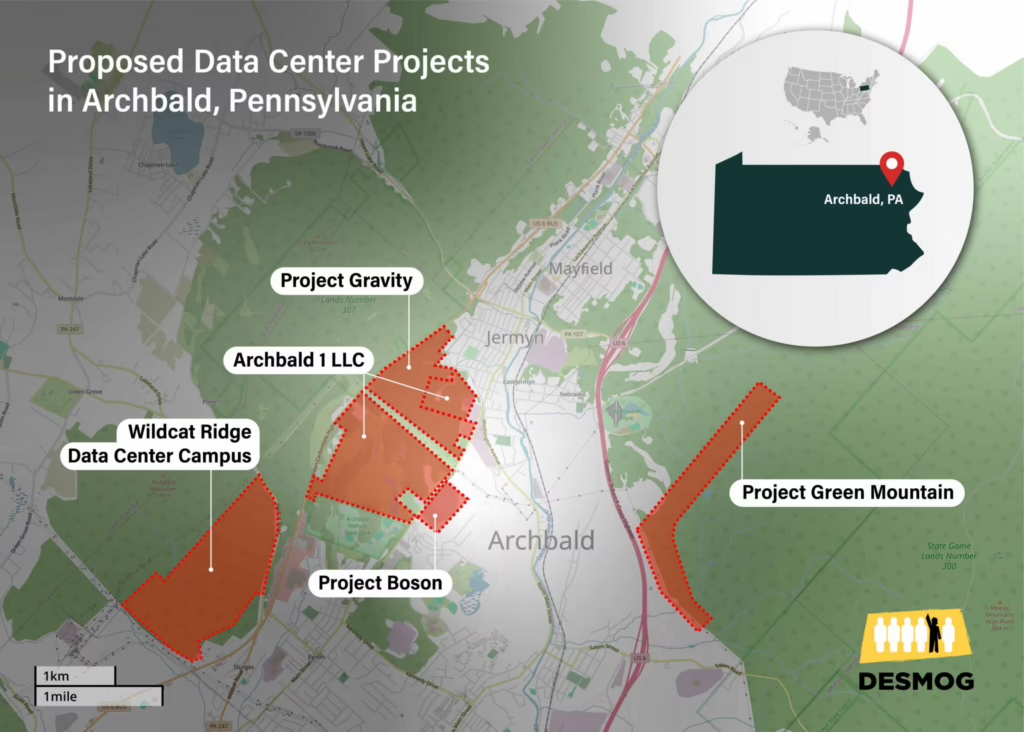
Since the launch of ChatGPT in November 2022 — an inflection point in the race to develop ever more powerful forms of artificial intelligence — developers have been scouring the United States for places to build the giant computing clusters needed to scale up the technology. Located nine miles northeast of the city of Scranton, and home to about 7,500 people, Archbald is facing plans to build five data center complexes across six sites, making it one of the most intensely contested areas for such projects in the country, if not the world.
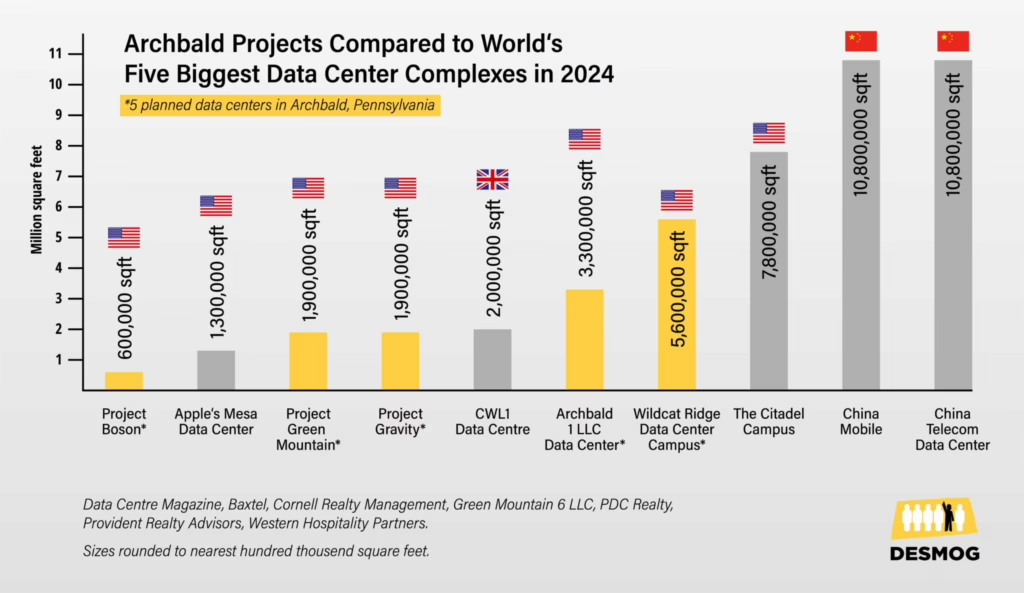
Backed by five real estate companies, along with the lawyers and lobbyists working on their behalf, the plans include a total of 51 data center buildings with a combined floor space of 13.4 million square feet — an area nine times the size of the U.S. Capitol. Worried residents fear the sheer scale of these mega-projects will turn their wooded Lackawanna River valley into an industrial maze buzzing with the sound of dump trucks, diesel generators and huge cooling machines.
“You are destroying our lives if you allow these data centers to come in. You are disrupting this entire community,” resident Carolyn Mizanty told Archbald’s seven borough council members, seated at a long wooden desk at the Nov. 24, 2025, meeting. In about an hour, the council was due to vote on whether to adopt proposed new zoning rules that would clear the way for several major projects.
(Credit: Sabrina Bedford/DeSmog)
Opponents of the plans say that a combination of behind-the-scenes lobbying, the prospect of enormous investments in the borough, and the promise of future tax dollars have turned elected officials against the people they represent.
“Here in Archbald, we are fighting against our local government,” said resident Tamara Misewicz-Healey from the podium. “Honestly, it’s broken my heart.”
It’s a scene playing out in town halls and county chambers across the country.
Because local zoning regulations often rule out projects as big as data centers, municipal governments more accustomed to dealing with applications to build housing developments and warehouses are now responsible for deciding the fate of the multibillion-dollar facilities at the heart of a global quest for AI supremacy.
The potential impacts on local communities, landscapes and electricity bills — which can surge due to the projects’ insatiable power demand — have been catalyzing local opposition movements that transcend traditional Democratic and Republican divides. The frenzied pace of development is also threatening to increase emissions of climate-heating carbon pollution, by driving demand for new natural gas-fired power plants, as well as extending the lives of coal-fired power plants in some states. Data centers could consume more than a tenth of the nation’s electricity by 2028, up from 4% in 2023, the U.S. Department of Energy projects.
(Credit: Sabrina Bedford/DeSmog)
Over four months of attending council meetings, filing public records requests, speaking with residents and interviewing borough officials, DeSmog built up a picture of the struggle playing out in Archbald among grassroots opponents, developers and elected officials that is emblematic of similar fights taking place nationwide.
The account that emerged showed how data center developers successfully leveraged access to borough officials to get key clauses inserted into the amended version of the zoning code put to a vote at the Nov. 24 hearing. Meanwhile, residents struggled to secure amendments to the new rules — or even to establish who was behind the plans.
Four of the five developers active in Archbald — Western Hospitality Partners, PDC Realty, Cornell Realty Management and Green Mountain 6 LLC — have no record of completing or operating data centers before, according to a DeSmog review of industry databases. The remaining developer — Provident Realty Advisors — has partnered with another company to start building its first multi-building data center complex in Texas.
None of these companies responded to requests for more information about their data center plans in Archbald, even as residents said they urgently need answers.
Residents struggled to secure amendments to the new rules.
Antoinette Merrifield has lived in the Valley View Estates trailer park, a quiet, tree-lined property on the Archbald Borough line with neighboring Jermyn, for almost 30 years. Merrifield, who shares her trailer with her father George, had not planned on leaving — until Western Hospitality Partners signed an agreement in October 2024 to buy the land under it for its Project Gravity data center project, according to Lackawanna County records.
Merrifield first heard about the sale from a news report. She said the current landlord gave the park’s roughly dozen households a tentative move-out date of this April, when the property will officially change ownership, but they have since received no further information.
“I need to know ahead of time,” said Merrified, who has neatly crossed out days on a wall calendar marking the passing time.
“It’s all messed up, isn’t it?” said George Merrifield, who is fighting cancer. “It’s greedy, you know.”
Tina Goble, a former Valley View Estates resident, said that current tenants, many living on low incomes and disability assistance, face an uncertain future. Her own recent inquiries about public housing led her to a five-year waiting list.
“What are these people supposed to do, to live in the streets for five years?” said Goble. ”You can’t just worry about the money, what about the people? … I guarantee they [who stand to profit] don’t have them [data centers] built in their backyard or in their neighborhood. … That’s disgusting to me that they would actually put people out like that.”
From coal to ‘compute’
In 1884, a coal miner named Patrick Mahon working for the Jones & Simpson Co. was detonating explosives underground to extend Archbald’s warren of mine shafts at the heart of the world’s biggest anthracite coal belt. An avalanche of stones and water came cascading down through the breach to reveal a remarkable natural feature: the world’s largest known glacial pothole, 38 feet deep and 42 feet in diameter at its widest point, chiseled out by a mammoth ice sheet during the last Ice Age.
The “Archbald Pothole” was fenced off, and mine boss Edward Jones went on to lead tours of the geological oddity. Other natural features in the area received less reverential treatment.
As Archbald’s coal mines fed the awakening industrial giant of the U.S. at the end of the 19th century, acid from mine operations leached into the Lackawanna River. Surrounding slopes were clear-cut in service of King Coal. Next to the mines, immigrant laborers and their families built neighborhoods with names like “Tipperary,” “Frog Town,” “Stump Field” and “Dark Valley.” Mining companies left behind a scarred landscape that took generations to clean up and revitalize. (Archbald’s last coal mine, the Gravity Slope Colliery, closed in 1955).
“Two of my great grandfathers were killed in the mines, many others were injured, and most suffered and died from illnesses related to their work,” Madonna Munley, an Archbald resident and retired school teacher, told a Nov. 5, 2025, Archbald Planning Commission meeting.
“When the mines ceased to be profitable,” she said, “the owners packed up and moved out. They never cared about the people or the town.”
Mining companies left behind a scarred landscape that took generations to clean up and revitalize.
Munley is one of the dozens of local residents who consistently showed up at weekly public meetings last fall, asking borough officials to implement zoning provisions that would protect Archbald from being engulfed by the growing infrastructure and resource demands of the AI boom.
To scale up their “compute” capabilities, tech companies need land for building sprawling multi-building “hyperscale” data centers that house tens to hundreds of thousands of specialized computing units in locations with access to the vast amounts of electricity needed to power them.
With its extensive natural gas and nuclear power resources, along with tax incentives, Pennsylvania is drawing an increasing number of AI investors. In Lackawanna County alone, new plans for large-scale data centers have been announced since 2024 in the communities of Blakely, Dickson City, Jessup, Olyphant, Clifton Township, Covington Township and Ransom Township, in addition to Archbald.
At a conference organized by Sen. Dave McCormick, R-Pa., in Pittsburgh last July, a group of energy, financial, real estate and tech companies announced $90 billion in statewide energy and AI investments. President Donald Trump — who signed executive orders in January 2025 and in December to fast-track AI infrastructure investments nationwide — attended the event alongside representatives from AI and tech companies including Anthropic, Google and Meta, private equity giant Blackstone, power utility PPL, natural gas company EQT, and Equinor, Norway’s state-owned energy company.
“Mr. President, this is the beginning of an economic renaissance for Pennsylvania and a huge step forward,” McCormick, seated next to Trump, told the conference.
But for all the big names on the stage in Pittsburgh, Archbald residents are still wondering which tech companies would be the ones operating the massive AI computing complexes near their homes — and who is writing the regulations that will decide whether those plans go ahead.
Changing the rules
Isaac Hager has been called “Brooklyn’s most mysterious dealmaker” by the Real Deal, a real estate trade publication, for his combination of a low public profile and high-stakes investments in hotels and condos in New York City. His company, Cornell Realty Management, is also at the heart of the biggest mystery in Archbald: How and why, exactly, did the borough come up with the zoning amendments easing the way for the planned data center buildout?
In December 2024, Cornell Realty Management approached Archbald Borough with its plans to build the Wildcat Ridge Data Center Campus on a roughly one-square-mile wooded tract then zoned for residential and conservation uses, according to public records. The project would need 1.6 gigawatts of electricity, according to its zoning application. This happens to be nearly equivalent to the generating capacity of Martins Creek Power Plant, which at 1.7 gigawatts is Pennsylvania’s largest natural gas-fired power plant, able to provide electricity for about 1.4 million homes.
Unusually for data centers, the 574-acre Wildcat Ridge project also features plans to add a retail shopping area, an office building and a grocery store, which Cornell Realty Management estimates will ultimately provide 593 permanent full-time jobs, out of a total of a projected 1,280 jobs for the development as a whole.
In February 2025, not long after Cornell Realty Management had presented its Wildcat Ridge project to a Jan. 8 council meeting, engineering firm LaBella Associates wrote to Archbald Borough on the company’s behalf. LaBella Associates was seeking clarification over the definition of “data centers” in the local zoning code, which had been added in 2023, when the council had opted to allow the facilities in areas already designated for commercial or industrial use.
Even if Cornell Realty Management could get the borough to flip the proposed Wildcat Ridge sites from their current residential or conservation status to commercial or industrial zoning, the borough’s data center rules would need to be rewritten to accommodate the huge project, due to size limits in the existing code. Specifically, the company wanted to build structures up to 120 feet tall — more than double the 55-foot height normally permitted in industrial zones.
Although zoning authority in Archbald rests with the council, the company’s hand was strengthened by a provision in Pennsylvania state law that allows developers to seek legal redress against municipalities if local codes block a proposed project. Known as a “curative amendment,” this mechanism means that towns whose budgets might only stretch to a single lawyer can find themselves embroiled in zoning disputes with developers fielding top-tier legal teams.
The borough’s data center rules would need to be rewritten to accommodate the huge project.
Archbald officials chose to work with Cornell Realty Management’s request. Borough manager Dan Markey told DeSmog that he asked the developer to cut a $30,000 check to Archbald Borough to cover costs related to its project application and amending the zoning code. Markey said the move spared taxpayers the fees, and allowed the borough to select Pennoni Inc., a Philadelphia-based engineering consultancy, to review the existing zoning rules, at a cost of $14,000.
“I said, I’m making you no promises and no guarantees because I don’t have a vote; the council votes,” Markey told Cornell Realty Management about its rezoning request, according to an account of the interaction Markey provided to DeSmog.
Unbeknownst to most Archbald residents, other companies were also starting to seek approvals. On Feb. 25, 2025, zoning officer Brian Dulay emailed Pennoni a summary indicating that eight potential data center developers were interested in building in Archbald, including Cornell Realty Management, according to the records.
At least three of those developers — PDC Realty (Project Boson), Western Hospitality Partners (Project Gravity) and Provident Realty Advisors (Archbald 1 LLC) — were eligible to obtain initial zoning approvals under the existing 2023 rules. Still, the regulations’ limits on building heights, noise and setbacks from homes put caps on their plans. As the year wore on, several developers wrote to borough officials to attempt to loosen those restrictions.
By March, the borough had decided to pass two separate zoning measures: an overall revision of the code related to data centers and a separate “data center overlay” map showing where data centers would be allowed, according to emails obtained via records requests. Proposed developments would still have to go before a special council vote to win final approval, giving it more say in zoning decisions, a process known as “conditional use.”
In mid-March 2025, Markey coordinated a meeting with Pennoni, borough staff, Cornell Realty Management and council President Dave Moran to discuss the zoning rules, the emails showed. A little over two weeks later — on March 27 — Archbald staff met with representatives of developer Western Hospitality Partners, the civil engineering firm Kimley-Horn and local construction contractor Jim Marzolino at the Archbald office of Marzolino’s Kriger Construction, according to the emails. The next day, a Kimley-Horn engineer, Justin Moceri, emailed Archbald officials offering to let them “pick my brain on insight into the data center overlay district text language given my experience.”
Two weeks later — on April 10 — borough staff and Pennoni were sharing a draft zoning ordinance. A section about proposed data center size requirements included a typed comment that seemed to favor developers by seeking to “verify these dimensions can still accommodate the application.”
By June 10, three developers — Cornell Realty Management, Dallas-based Provident Realty Advisors and a developer identified only as “Wolf” in an email — had submitted suggestions for the new data center zoning amendment, according to the records. Borough solicitor Jay O’Connor wrote Pennoni asking the consultancy to combine the proposed new data center rules and overlay district into a single zoning amendment. O’Connor further instructed Pennoni to integrate requests from the data center developers by using “classifications … addressing the proposals … from the potential applicants who have contacted the Borough.”
Unbeknownst to most Archbald residents, other companies were also starting to seek approvals.
Meanwhile, council President Moran asked borough officials to increase residential setbacks from 400 feet to 1,000 feet, but this request failed to get integrated into any draft ordinance found in the records, according to the emails. Instead, one developer sought to reduce that distance.
On July 18, Provident Realty Advisors, which had not yet publicly announced plans to build in Archbald, submitted additional recommendations for the data center zoning ordinance, including 200-foot setbacks from homes and looser noise restrictions, according to the records. Two weeks later, on July 30, borough manager Markey wrote to Pennoni asking for a revision in the proposed ordinance, reducing residential setbacks from data centers from 400 feet to 300 feet — a measure intended to satisfy developers.
“After speaking with some potential developers, this is the number that can potentially be agreed upon,” Markey wrote in the email. The request made it into the next draft of the ordinance.
Markey defended the borough’s oversight process to DeSmog, saying that officials had not simply accepted blanket provisions sought by developers, but had worked to find compromises. For example, Markey said, the 90-foot height limit included in the zoning amendment is lower than the 120 feet originally sought by developers. (A clause in the ordinance still allows developers to build higher than 90 feet if they get special permission).
Archbald officials presented a map of the proposed data center overlay, where the new zoning regulations would apply, to a public meeting on Aug. 1. Various smaller and medium-scale sites that had previously been opened up to data centers under the 2023 rules had been removed. But in four significant areas, the map favored the developers. The areas shaded over for data centers corresponded exactly to Cornell Realty Management’s proposed Wildcat Ridge Data Center Campus, Project Gravity, and the yet-to-be-announced Archbald 1 LLC and Project Green Mountain complexes.
On Sept. 9, Khaled Hassan, a Pennoni vice president who worked on the Archbald zoning amendment, wrote Markey asking him to “share with us how you established the marked boundaries” in the data center overlay. Markey responded: “Besides the I-1, I-2 [industrial] zones on the bottom of the map … the rest of the lines drawn were property lines of property owners looking to develop or sell to developers. They were all pretty much specific requests.”
Archbald officials rezoned residential and conservation areas to match proposed data center projects.
All five Archbald data center developers have yet to publicly announce who the end users for their proposed data center complexes will be. Very few companies worldwide operate AI data centers on the scale planned in Archbald, among them: Amazon, Google, Meta, Microsoft and Oracle.
“They’ve thrown around hints, like ‘You know this company, you probably use them every day’, and ‘You might have their app on your phone’,” Markey said, of the developers. “If they do them right and they are committed to be good community partners, then it [the identity of the end user] might be inconsequential.”
“Financially, this could be a complete game changer for Archbald. For Lackawanna County, not just Archbald,” Markey added. He estimated that one of the data center complexes would generate $4.3 million a year in local property taxes at current rates, which would amount to more than 60% of Archbald’s annual budget. “And that would be just one project.”
Final decision
Throughout the months of consultations between Archbald Borough and the developers, word of the enormous scale of the changes portended by the projects had been slow to filter out. But by fall, a nucleus of opposition had formed, with residents sharing their concerns on Facebook groups and at increasingly vocal public meetings.
When the Archbald Borough Council convened to vote on the proposed new zoning measures in the basement of St. Thomas Aquinas Church in early October, about a hundred people flooded the venue to demand more time for consultations, forcing the decision to be postponed, according to meeting minutes and reporting by the Scranton Times-Tribune.
By mid-month, the Archbald Neighborhood Association, a group leading local opposition to the data centers, had submitted a draft amendment to restrict the projects to a single industrial-zoned site.
During this time, Provident Realty Advisors submitted a zoning application for its data center plans under the name of Archbald 1 LLC. Moran, the council president, told the Scranton Times-Tribune at the time that the proposed new rules would protect Archbald from an even bigger influx of data centers by taking certain sites off the table.
By mid-November, Moran was appealing to residents to stop making so many right-to-know requests (Pennsylvania’s version of a freedom of information request) because, he said, they were overwhelming the borough’s capacity to respond.
The proposed new rules would protect Archbald from an even bigger influx of data centers.
At a Nov. 19 council meeting, Larry Moran, solicitor for the local Valley View School District, urged residents to support the proposed zoning amendment.
Citing his experience representing trade unions building data centers, as well as a property owner selling land for a project in nearby Covington Township, Moran said developers had told him that a single data center building could generate about $5 million in local yearly tax revenue.
This money could be used to repair leaking school roofs, eliminate shortfalls in special education for disabled children, and restore canceled programs. “It’s desperately needed money,” Moran said.
A shouting match then erupted between Moran and council member Owen, the panel’s leading opponent of the data centers, who questioned Moran’s claims that data centers could be built safely in the community. Onlookers joined Owen’s side as Moran repeatedly banged his gavel.
“They’re coming for our jobs!” a member of the crowd yelled in the direction of the school solicitor. “Get out!”
‘Sold your souls’
The crowd that swamped the borough chambers on Nov. 24 was focused on one agenda item: a council ballot on the hotly contested zoning amendment. If approved by a simple majority of four or more votes, the new code would open up two new swaths of land to data centers, and allow developers of two already-permitted areas to apply to build taller.
Many locals speculated that the council’s decision had already been made — and murmured that the overflow conditions and inconvenient 5 p.m. start time were a ploy to suppress public participation. Some said that the borough had ignored their written request to hold the meeting in a more spacious venue. After the recitation of the Pledge of Allegiance, Owen called the conditions “unacceptable” and a “safety hazard,” and asked for the meeting to be rescheduled to accommodate all residents.
Moran, the council president, denied her request. Owen stood in protest as public comments began.
Residents took turns at the podium to read off a litany of reasons for why they opposed building data centers in the borough, such as harmful air, light, and noise pollution, strains on the power grid, higher utility bills, lowered property values, destruction of wildlife habitat, depletion of water resources and climate-heating carbon pollution. In total, 18 Archbald residents spoke against the zoning amendment during the time allotted. None spoke in favor.
Many locals speculated that the council’s decision had already been made.
“I can understand how you are being cajoled and enticed by developers with deep pockets!” exclaimed Michael Pilch, to resounding cheers.
“I wish that the council had the decency to schedule a special hearing to hear questions about these data centers, address concerns, and work on the amendment together that actually protects the residents and natural resources of Archbald,” said Kaileigh Cornell, a member of the Archbald Neighborhood Association.
“Who put the wording in the zoning in 2023 that passed with the words ‘data center’?” asked resident Anita Mancuso. “Because it’s caused such a huge mess.”
Once public comments concluded, council member Marie Andreoli proposed a motion to vote on the data center amendment. Two council members voted against it, Owen and Laura Lewis, to almost unanimous cheers, and another, John Shnipes III, abstained. Four council members voted in favor: Andreoli, Moran, Richard Guman and Francis Burke.
Groans and shouts erupted from the crowd. “You should be ashamed of yourselves.” “Disgusting.” “Sold your souls!”
None of the four Archbald council members who voted in favor of the zoning amendment explained their reasons for adopting it during the meeting.
Asked afterward by DeSmog why he’d backed the measure, Moran cited the moves to restrict data centers to specific areas and increased clarity in the rules relative to the 2023 ordinance.
When asked why the council approved raising the allowed building height for data centers from 55 feet to 90 feet, Moran said that a committee of borough staff made the recommendation.
“No comment,” council member Guman said as he made his way out of the meeting when asked why he voted for the zoning changes. “No comment,” said council member Burke, who also voted in favor.
Political flashpoint
In his Feb. 3, 2026, annual budget address, Pennsylvania’s Democratic Gov. Josh Shapiro, widely tipped as a 2028 presidential hopeful, said, “the United States is locked in a battle for AI supremacy against China. … We are delivering the speed and certainty in our permitting process these massive projects require.”
Shapiro added, however, that “too many of these projects have been shrouded in secrecy, with local communities left in the dark about who is coming in and what they’re building.”
As Shapiro joins other Democratic and Republican leaders nationwide in promoting AI data centers, some local officials are siding with concerned residents. Lackawanna County Commissioner Bill Gaughan, a Democrat, is a sharp critic of the boom, calling it “one of the biggest environment and social threats of our generation.”
“Hundreds and hundreds and hundreds of people showed up on a weeknight in the middle of winter because they’re scared and they’re angry that it seems as if every available acre of land in our community will eventually be turned into a windowless box that hums 24/7 and sends most of its profits someplace else,” Gaughan told a Lackawanna County Commission meeting in February, referring to the groundswell of opposition to data centers in Archbald.
On Feb. 18, Gaughan joined Pennsylvania state lawmakers in calling for a three-year moratorium on data center development in the state, a bipartisan measure that state Sens. Katie Muth, a Democrat, and Rosemary Brown, a Republican, have co-sponsored in Harrisburg, the state capital.
Some local officials are siding with concerned residents.
Despite growing support for slowing the buildout, many fear the projects are picking up pace. In early March, Misewicz-Healey, the Archbald resident who had pleaded with the council to put tougher restrictions on data centers, posted an excerpt from an email on social media that appeared to be from Pennsylvania’s Office of Transformation & Opportunity, stating that Western Hospitality Partners’ Project Gravity was benefiting from accelerated permitting reviews under the PA Permit Fast Track Program, which seeks to streamline approvals in the state. The project does not appear on a list posted on the agency’s website of fast-tracked developments. The Office of Transformation & Opportunity did not respond to a request for comment.
Western Hospitality Partners has established a presence in Harrisburg through its subsidiary Archbald 25 Developer LLC, which paid $67,500 to lobbyists last year, according to state transparency records, with the subject listed as “real estate.”
With companies such as Amazon and Microsoft spending a combined hundreds of thousands of dollars per year on lobbying in Harrisburg, residents opposing the data center plans believe they have the best chance of blocking the projects at the local level. A recomposed Archbald Borough Council welcomed three new members in January, replacing Burke (who lost reelection), Lewis (who retired) and Shnipes (who resigned).
The council will vote on three final “conditional use” permits for data center projects in the coming months: the Wildcat Ridge Data Center Campus, Archbald 1 LLC and Project Green Mountain. Residents have packed the Valley View High School auditorium for several hearings held on the proposals since January.
Meanwhile, eight Archbald residents, using crowdsourced funds, have filed an appeal against the borough’s zoning amendment in the Lackawanna Court of Common Pleas. They allege that the borough council did not transparently advertise all zoning changes to residents prior to the Nov. 24 hearing, as required by law, and failed to make the meeting accessible to all residents by choosing a too-small venue, among other complaints.
Archbald Borough has denied the allegations, calling the lawsuit “frivolous” in a written response to the court and requesting that the plaintiffs be made to post a bond for the proceedings to continue. The developers behind the three conditional use applications — Cornell Realty Management, Provident Realty Advisors and Green Mountain 6 LLC — have petitioned the court to reject the case. A final ruling is pending.
Sounds of chainsaws at Western Hospitality Partners’ Project Gravity site have heightened local alarm. Images from a March 2 flyover by aerial photographer NEPA Drone show widespread land clearing and hundreds of recently felled trees, including near the border with the Valley View Estates trailer park. For worried residents, the AI boom has never felt nearer.
“We’re not giving up,” said Madonna Munley, who warned against bringing back polluting industries to Archbald. “Do or die, we’re not going down without a fight.”
Weeks after being sentenced to more than 126 years in prison for his role in a massive domestic wiretapping scandal, the founder of the commercial spyware company Intellexa has stated that his firm provides its surveillance technology exclusively to authorized government agencies.
Tal Dilian, a former Israeli intelligence officer, made the comments in a written statement to the Greek television program “MEGA Stories.”
Asked directly by the program whether Intellexa collaborated with state agencies or private individuals to surveil at least 87 Greek targets, Dilian distanced his company from the software’s deployment.
“We operate strictly under European and international export regulations, providing technology exclusively to authorized governments and law enforcement agencies,” Dilian said in the statement.
He added that Intellexa does not conduct the surveillance itself, noting that the responsibility for the lawful use of the technology “rests with the sovereign authorities that acquire and operate them.”
Dilian’s statement immediately reignited political outrage in Athens, where opposition leaders seized on his words as proof that Prime Minister Kyriakos Mitsotakis and his administration were directly behind the surveillance.
Nikos Androulakis, leader of the PASOK opposition party and a confirmed target of the Predator spyware, said the government’s narrative of rogue private actors operating the software has collapsed.
“Predator and illegal surveillance were the weapons of a deep state, set up by the prime minister and the Maximos Mansion,” Androulakis said, referring to the prime minister’s office. “Half of his cabinet, the heads of the armed forces, journalists, and state officials were illegally monitored. After Dilian’s cynical admission, the prime minister cannot pretend to be ignorant and misled.”
The Greek government swiftly rejected the accusations. Government spokesman Pavlos Marinakis dismissed Androulakis’ statements as a political distraction, pointing out that the Greek Supreme Court previously cleared state officials of criminal involvement in the scandal. He argued that the recent convictions of four private individuals proved there was no state cover-up.
“Even a kindergarten child understands that Mr. Androulakis is using the wiretaps as an attempt to distract from the huge internal political crisis he is having,” Marinakis told the SKAI television channel.
But other opposition figures echoed the outrage over Dilian’s admission. Sokratis Famellos, head of the Syriza party, called it a “profound institutional crisis,” stating that “Pandora’s box has been opened.” Gabriel Sakellaridis, secretary of the New Left party, added that the statement removes any doubt that the Greek government and the National Intelligence Service (EYP) were Intellexa’s clients.
The renewed political clash traces back to the February 26 court ruling, which found that Intellexa’s Predator software was used to surveil verified victims across Greek civil society, politics, and the military.
Dilian, Intellexa shareholder Felix Bitzios, business manager Sara Aleksandra Hamou, and supplier Giannis Lavranos each received sentences of 126 years and eight months. Under Greek law, the maximum time to be served for such misdemeanor convictions is capped at eight years. The defendants have the right to appeal.
During that trial, Prosecutor Dimitris Pavlidis argued that the evidence presented in court warranted further investigation into potential felony charges, including espionage.
The Intellexa consortium already faces international scrutiny. In 2024, the U.S. Treasury Department sanctioned the group for developing and distributing commercial spyware used to target Americans, including government officials and journalists.
Take a look at the four images below and tell me what you see.
If my life depended on it, I could not name a single one of the TV shows pictured here and, if you told me they were all taken from the same series I would believe you. The first thing that comes to mind is “Game of Thrones,” but we could just as easily be looking at one of the Peter Jackson Hobbit movies or any number of expensively produced high fantasy series that now pop up regularly on streaming services like Amazon Prime and Netflix. One imagines these shows have a feudal setting of some kind and maybe a dash of magic realism. There’s probably some violence, maybe even intense violence, but our heroes also get to enjoy a few laughs. I’d wager there’s a quest of some kind, and a bearded oaf whose deceptively grouchy manner in fact masks a more tender side that ultimately lies beneath. Does it matter? Even if you’ve never seen these shows, you almost certainly kind of have.
I’ve incidentally been revisiting “Star Trek: The Next Generation,” an older, less expensive show light years more imaginative than most of what’s on TV today. And, perhaps because it feels particularly germane in the age of AI, I’ve found myself thinking about the Holodeck.
The Holodeck, for the uninitiated, is a fictional device that was introduced in “TNG’s” pilot episode back in 1987. Essentially, it’s a big room inside the starship Enterprise that can create realistic 3D renderings of places and people — so realistic, in fact, that you can touch or handle things and they actually feel solid. The Holodeck characters themselves are also fully interactive, and so close to resembling actual people that they might easily be mistaken for them. In effect, it’s a virtual simulator through which basically any fantasy can be realized and explored — in some ways even more utopian as a concept than other Trek mainstays like the transporter or warp drive.
Technobabble explanations for how it actually works aside, the Holodeck still takes some significant leaps of imagination. For one thing, it’s a finite space but generally appears limitless once the characters are actually inside (a few early episodes flirted with the idea there’s an invisible “wall” of some kind you can bump up against, but this was eventually abandoned). It’s also amusing how much the fantasies of people who supposedly live in a scientifically advanced, cosmopolitan version of the 24th century seem to revolve around things people enjoyed in the 20th: baseball, Sherlock Homes, noir detective fiction, New Orleans jazz, Westerns, Robin Hood, ’50s sports cars, etc. And, needless to say, if such technology really existed it would also inevitably be used for less PG-rated downtime than what one sees in “Star Trek.”
Notwithstanding these caveats, the Holodeck is still an intriguing example of utopian science fiction and, like most things of its kind, clearly had as much to say about the present as it did about the future. In the fantasy life of late-20th century societies, few things loomed quite so large or seemed so compelling as the promise of virtual reality.¹ If traditional gaming allows us to experience discrete, prewritten fantasy worlds through a TV or computer screen, VR technology holds up the utopian prospect that literally any fantasy might one day be brought to life and immersively experienced at the push of a button.
VR technology holds up the utopian prospect that literally any fantasy might one day be brought to life.
Since the pilot episode of “Star Trek: The Next Generation,” the likes of computer-generated imagery and gaming technology have grown by leaps and bounds. VR headsets — once clunky, prohibitively expensive and available mostly as boutique objects — have become bona fide mass market products. And, thanks to huge improvements in computing hardware, they can now offer a three-dimensional gaming experience that at least graphically rivals their more conventional competitors. Much the same is true of other media (films, TV shows, etc.) too.
Broadly speaking, our technical capacity to render fantasy entertainment on a grand scale dwarfs that of previous generations, as do the resources (financial and otherwise) available to major developers and entertainment companies. Never in the whole of human history has so much technology and capital been invested in the production of movies, games and other fantasy worlds.
By and large, however, the result has not conformed to the expansive, utopian template reflected in something like the Holodeck. Instead, we are paradoxically living through an era where much of mass entertainment is increasingly derivative and homogenous and very little feels genuinely new.
In the world of gaming, masterpieces like FromSoft’s Sekiro or Rockstar’s Red Dead Redemption II are the exceptions, and for every one of them there are literally dozens of games featuring gigantic open worlds with absolutely nothing inside of them. The same is arguably even truer of TV, where ballooning budgets, A-list casting and sprawling multiseason arcs are more likely to yield mediocre tedium than the unforgettable experiences once offered by prestige pioneers like “The Sopranos,” “Deadwood” and “The Wire.” More imaginative efforts like “Severance” do exist but, again, they are the exception. No doubt this partly comes down to taste, but I have watched the last three seasons of “The Wire” exactly once and still remember their various arcs and characters quite well. The first season of Prime’s “The Rings of Power,” by contrast, is the single most expensive season of television ever produced and, despite having seen it much more recently, I could not tell you a single salient fact about it with a loaded firearm pointed squarely at my head.
Much of mass entertainment is increasingly derivative and homogenous.
In any case, the root causes of this malaise are hardly mystical. Thanks to financialization and deregulation, mass entertainment has become intensely concentrated and monopolistic: The relatively small number of major conglomerates behind games, TV and big-budget blockbusters alike increasingly shying away from anything new and favoring instead a franchise model from which they can wring endless value from existing intellectual property without ever having to take risks or innovate. Sometimes, as is the case with Marvel or Star Wars, this is quite literally the case (and here convoluted metaverses have become the favored device). Elsewhere, as testified by the images we began with, it manifests more indirectly in a constant churn of movies and shows that recycle well-worn visual motifs and narrative formulas to such an extent that some are nearly impossible to distinguish from one another.
Either way, the results are predictably as homogenous and derivative as the formulaic style now associated with AI, Mr Beast thumbnails and Trump-branded NFT collections: pastiches of copies of simulacra that look a thousand times more mass produced than the cultural products of the mid- or even late 20th century.
Not unreasonably, it was once assumed that increased technological capacity would expand rather than narrow the horizons of fantasy life. Today, in place of the Holodeck, we are paradoxically swimming in slop instead.