Author: tio

  • EFFecting Change: Privacy’s Defender

    Join EFF Executive Director Cindy Cohn in conversation with 404 Media Cofounder Jason Koebler to discuss Privacy’s Defender: My Thirty-Year Fight Against Digital Surveillance, Cindy’s personal story of standing up to the Justice Department, taking on the NSA, and tangling with the FBI to protect our right to digital privacy. The highly anticipated book asks the fundamental question: Can we still have private conversations if we live our lives online? Join the livestream for a live discussion followed by by Q&A.

    EFFecting Change Livestream Series:
    Privacy’s Defender
    Thursday, March 19th
    11:00 AM – 12:00 PM Pacific
    This event is LIVE and FREE!


    Accessibility

    This event will be live-captioned and recorded. EFF is committed to improving accessibility for our events. If you have any accessibility questions regarding the event, please contact events@eff.org.

    Event Expectations

    EFF is dedicated to a harassment-free experience for everyone, and all participants are encouraged to view our full Event Expectations.

    Upcoming Events

    Want to make sure you don’t miss our next livestream? Here’s a link to sign up for updates about this series: eff.org/ECUpdates. If you have a friend or colleague that might be interested, please join the fight for your digital rights by this link: eff.org/EFFectingChange. Thank you for helping EFF spread the word about privacy and free expression online.

    Recording

    We hope you and your friends can join us live! If you can’t make it, we’ll post the recording afterward on YouTube and the Internet Archive!

    About the Speakers


     Cindy Cohn 
    Cindy Cohn is the Executive Director of the Electronic Frontier Foundation. From 2000-2015 she served as EFF’s Legal Director as well as its General Counsel.  Ms. Cohn first became involved with EFF in 1993, when EFF asked her to serve as the outside lead attorney in Bernstein v. Dept. of Justice, the successful First Amendment challenge to the U.S. export restrictions on cryptography. Ms. Cohn has been named to TheNonProfitTimes 2020 Power & Influence TOP 50 list, honoring 2020’s movers and shakers.  In 2018, Forbes included Ms. Cohn as one of America’s Top 50 Women in Tech. The National Law Journal named Ms. Cohn one of 100 most influential lawyers in America in 2013, noting: “[I]f Big Brother is watching, he better look out for Cindy Cohn.” She was also named in 2006 for “rushing to the barricades wherever freedom and civil liberties are at stake online.”  In 2007 the National Law Journal named her one of the 50 most influential women lawyers in America. In 2010 the Intellectual Property Section of the State Bar of California awarded her its Intellectual Property Vanguard Award and in 2012 the Northern California Chapter of the Society of Professional Journalists awarded her the James Madison Freedom of Information Award.  

     Jason Koebler 
    Jason Koebler is a cofounder of 404 Media, a journalist-owned investigative tech publication. He reports on surveillance and privacy, the ways that artificial intelligence is changing the internet, labor, and society, and consumer rights. Before 404 Media, he was the editor-in-chief of Motherboard, VICE’s technology publication and an executive producer on Encounters, a Netflix documentary about the search for alien life.

  • Pluralistic: Billionaires are a danger to themselves and (especially) us (09 Mar 2026)

    Today’s links


    A king on a sumptuous, much elaborated throne; in one hand he holds a sceptre of office, in the other, the leashes for two fierce stone dogs that guard the throne. The king's head has been replaced with a character who was used as the basis for MAD Magazine's Alfred E Neumann. The new head sports a conical dunce cap. Behind the king is a large group of 1960s business men, seated and standing, in conservative suits. The background is the view from the 80th floor of World Trade Center 3. The floor has been carpeted in sumptuous tabriz from the Ottoman court.

    Billionaires are a danger to themselves and (especially) us (permalink)

    Even if rich people were no more likely to believe stupid shit than you or me, it would still be a problem. After all, I believe in my share of stupid shit (and if you think that none of the shit you believe in is stupid, then I’m afraid we’ve just identified at least one kind of stupid shit you believe in).

    The problem isn’t whether rich people believe stupid shit; it’s the fact that when a rich person believes something stupid, that belief can turn into torment for dozens, thousands, or millions of people.

    Here’s a historical example that I think about a lot. In 1928, Henry Ford got worried about the rubber supply chain. All the world’s rubber came from plantations in countries that he had limited leverage over and he was worried that these countries could kneecap his operation by cutting off the supply. So Ford decided he would start cultivating rubber in the Brazilian jungles, judging that Brazil’s politicians were biddable, bribeable or bludgeonable and thus not a risk.

    Ford took over a large area of old-growth jungle in Brazil and decreed that a town be built there. But not just any town: Ford decreed that the town of Fordlandia would be a replica of Dearborn, the company town he controlled in Michigan. Now, leaving aside the colonialism and other ethical considerations, there are plenty of practical reasons not to replicate Dearborn, MI on the banks of the Rio Tapajós.

    For one thing, Brazil is in the southern hemisphere, and Dearborn is in the northern hemisphere. The prefab houses that Ford ordered for Fordlandia had windows optimized for southern exposure, which is the normal way of designing a dwelling in the northern hemisphere. In the southern hemisphere, you try and put your windows on the other side of the building.

    Ford’s architects told him this, and proposed having the factory flip the houses’ orientation. But Ford was adamant: he’d had a vision for a replica of his beloved Dearborn plunked down smack in the middle of the Amazon jungle, and by God, that was what he would get:

    https://memex.craphound.com/2010/06/02/fordlandia-novelistic-history-of-henry-fords-doomed-midwestern-town-in-the-amazon-jungle/

    Fordlandia was a catastrophe for so many reasons, and the windows are just a little footnote, but it’s a detail that really stuck with me because it’s just so stupid. Ford was a vicious antisemite, a bigot, a union-buster and an all-round piece of shit, but also, he believed that his opinions trumped the axial tilt of the planet Earth.

    In other words, Henry Ford wasn’t merely evil – he was also periodically as thick as pigshit. Ford’s cherished stupidities didn’t just affect him, they also meant that a whole city full of people in the Amazon had windows facing the wrong direction. Like I said, I sometimes believe stupid things, but those stupid things aren’t consequential the way that rich people’s cherished stupidities are.

    This would be bad enough if rich people were no more prone to stupid beliefs than the rest of us, but it’s actually worse than that. When I believe something stupid, it tends to get me in trouble, which means that (at least some of the time), I get to learn from my mistakes. But if you’re a rich person, you can surround yourself with people who will tell you that you are right even when you are so wrong, with the result that you get progressively more wrong, until you literally kill yourself:

    https://www.scientificamerican.com/article/alternative-medicine-extend-abbreviate-steve-jobs-life/

    A rich person could surround themselves with people who tell them that they’re being stupid, but in practice, this almost never happens. After all, the prime advantage to accumulating as much money as possible is freedom from having to listen to other people. The richer you are, the fewer people there are who can thwart your will. Get rich enough and you can be found guilty of 34 felonies and still become President of the United States of America.

    But wait, it gets even worse! Hurting other people is often a great way to get even more rich. So the richer you get, the more insulated you are from consequences for hurting other people, and the more you hurt other people, the richer you get.

    What a world! The people whose wrong beliefs have the widest blast-radius and inflict the most collateral damage also have the fewest sources of external discipline that help them improve their beliefs, and often, that collateral damage is a feature, not a bug.

    Billionaires are a danger to themselves and (especially) to the rest of us. They are wronger than the median person, and the consequences of their wrongness are exponentially worse than the consequences of the median person’s mistake.

    This has been on my mind lately because of a very local phenomenon.

    I live around the corner from Burbank airport, a great little regional airport on the edge of Hollywood. It was never brought up to code, so the gates are really close together, which means the planes park really close together, and there’s no room for jetways, so they park right up against the terminal. The ground crews wheel staircase/ramps to both the front and back of the plane. That means that you can walk the entire length of the terminal in about five minutes, and boarding and debarking takes less than half the time of any other airport. Sure, if one of those planes ever catches fire, every other plane is gonna go boom, and everyone in the terminal is toast, but my sofa-to-gate time is like 15 minutes.

    Best of all, Burbank is a Southwest hub. When we moved here a decade ago, this was great. Southwest, after all, has free bag-check, open seating, a great app, friendly crews, and a generous policy for canceling or changing reservations.

    If you fly in the US, you know what’s coming next. In 2024, a hedge fund called Elliott Investment Management acquired an 11% stake in SWA, forced a boardroom coup that saw it replace five of the company’s six directors, and then instituted a top to bottom change in airline policies. The company eliminated literally everything that Southwest fliers loved about the airline, from the free bags to the open seating:

    https://www.reddit.com/r/SouthwestAirlines/comments/1ji79zt/elliott_management_is_dismantling_everything/

    The airline went from being the least enshittified airline in America to the most. Southwest is now worse than Spirit airlines – no, really. Southwest doesn’t just merely charge for seat selection, but if you refuse to pay for seat selection, they preferentially place you in a middle seat even on a half-empty flight, as a way of pressuring you to pay the sky-high junk fee for seat selection:

    https://www.reddit.com/r/SouthwestAirlines/comments/1rd2g0k/ngl_thought_yall_were_joking/

    Obviously, passengers who are given middle seats (and the passengers around them, who paid for window or aisle seats) don’t like this, so they try to change seats. So SWA now makes its flight attendants order passengers not to switch seats, and they’ve resorted to making up nonsense about “weight balancing”:

    https://www.reddit.com/r/SouthwestAirlines/comments/1roz1bg/you_can_change_to_an_empty_seatbut_only_until_we/

    Even without junk fees, Southwest’s fares are now higher than their rivals. I’m flying to San Francisco tomorrow to host EFF executive director Cindy Cohn’s book launch at City Lights:

    https://citylights.com/events/cindy-cohn-launch-party-for-privacys-defender/

    Normally, I would have just booked a SWA flight from Burbank to SFO or Oakland (which gets less fog and is more reliable). But the SWA fare – even without junk fees – was higher than a United ticket out of the same airport, even including a checked bag, seat selection, etc. Southwest is genuinely worse than Spirit now: not only does it have worse policies (forcing occupancy of middle seats!), and more frustrated, angrier flight crew (flight attendants are palpably sick of arguing with passengers), but SWA is now more expensive than United!

    All of this is the fault of one billionaire: Elliott Investment Management CEO Paul Singer, one of America’s most guillotineable plutes. This one guy personally enshittified Southwest Airlines, along with many other businesses in America and abroad. Because of this one guy, millions of people are made miserable every single day. Singer flogged off his shares and made a tidy profit. He’s long gone. But SWA will never recover, and every day until its collapse, millions of passengers and flight attendants will have a shitty day because of this one guy:

    https://www.wfaa.com/article/money/business/southwest-airlines-activist-investor-elliott-lower-ownership-stake/287-470b5131-ef1a-4648-a8ec-4cc017f7914c

    Even if Paul Singer were no more prone to ethical missteps than you or me, the fact that he is morbidly wealthy means that his ethical blind spots leave behind a trail of wreckage that rivals a comet. And of course, being as rich as Paul Singer inflicts a lasting neurological injury that makes you incapable of understanding how wrong you are, which means that Paul Singer is doubly dangerous.

    Billionaires aren’t just a danger when they’re trying to make money, either. One of the arguments in favor of billionaires is that sometimes, the “good” billionaires take up charitable causes. But even here, billionaires can cause sweeping harm. Take Bill Gates, whose charitable projects include waging war on the public education system, seeking to replace public schools with charter schools.

    Gates has no background in education, but he spent millions on this project. He is one of the main reasons that poor communities around the country have been pressured to shutter their public schools and replace them with weakly regulated, extractive charters:

    https://apnews.com/article/92dc914dd97c487a9b9aa4b006909a8c

    This was a catastrophe. A single billionaire dilettante’s cherished stupidity wrecked the educational chances of a generation of kids:

    https://dissidentvoice.org/2026/03/free-market-charter-schools-wreak-havoc-in-michigan/

    Gates was a prep-school kid, so it’s weird for him to have forceful views about a public education system he never experienced. In reality, it’s not so much that Gates has forceful views about schools – rather, he has forceful views about teachers’ unions, which he wishes to see abolished. Gates is one of America’s most vicious union-busters:

    https://teamster.org/2019/10/teamsters-union-and-allies-protest-bill-gates-and-cambridge-union-society/

    Gates’s ideology permeates all of his charitable work. We all know about Gates’s work on public health, but less well known is the role that Gates has played in blocking poor countries from exercising their rights under the WTO to override drug patents in times of emergency. In the 2000s, the Gates Foundation blocked South Africa from procuring the anti-retroviral AIDS drugs it was entitled to under the WTO’s TRIPS agreement. The Gates Foundation blocked the Access to Medicines WIPO treaty, which would have vastly expanded the Global South’s ability to manufacture life-saving drugs. And during the acute phase of the covid pandemic, Gates personally intervened to kill the WHO Covid-19 Technology Access Pool and to get Oxford to renege on its promise to make an open-source vaccine:

    https://pluralistic.net/2021/04/13/public-interest-pharma/#gates-foundation

    It’s not that Gates is insincere in his desire to improve public health outcomes – it’s that his desire to improve public health conflicts with his extreme ideology of maximum intellectual property regimes. Gates simply opposes open science and compulsory licenses on scientific patents, even when that kills millions of people (as it did in South Africa). Gates’s morbid wealth magnifies his cherished stupidities into weapons of mass destruction.

    Gates is back in the news these days because of his membership in the Epstein class. Epstein is the poster child for the ways that wealth is a force-multiplier for bad ideas. We can’t separate Epstein’s sexual predation from his wealth. Epstein spun elaborate junk-science theories to justify raping children, becoming mired in that most rich-guy coded of quagmires, eugenics:

    https://www.statnews.com/2026/02/24/epstein-cell-line-george-church-harvard-personal-genome-project/

    Epstein openly discussed his plans to seed the planet with his DNA, reportedly telling one scientist that he planned to fill his ranch with young trafficked girls and to keep 20 of them pregnant with his children at all times:

    https://www.nytimes.com/2019/07/31/business/jeffrey-epstein-eugenics.html

    We still don’t know where Epstein’s wealth came from, but we know that he was a central node in a network of vast riches, much of which he directed to his weird scientific projects. That network also protected him from consequences for his prolific child-rape project, which had more than 1,000 survivors.

    In embracing eugenics junk science, Epstein was ahead of the curve. Today, eugenics is all the rage, reviving an idea that went out of fashion shortly after the Fordlandia era. After all, Henry Ford didn’t just build a private city where his word was law – he also bought up media companies to promote his ideas of racial superiority:

    https://en.wikipedia.org/wiki/The_Dearborn_Independent

    Despite being too cringe to make it onto Epstein island, Elon Musk is the standard bearer for the dangers of billionaireism:

    https://people.com/emails-reveal-that-elon-musk-asked-jeffrey-epstein-about-visiting-his-island-11896842

    Like Henry Ford, he craves company towns where his word is law:

    https://www.texasmonthly.com/news-politics/inside-starbase-spacex-elon-musk-company-town/

    Like Ford, he buys up media companies and then uses them to push his batshit ideas about racial superiority:

    https://www.motherjones.com/politics/2025/01/eugenics-isnt-dead-its-thriving-in-tech/

    Like Paul Singer, he is a master enshittifier who never met a junk fee he didn’t fall in love with:

    https://edition.cnn.com/2022/11/01/tech/musk-twitter-verification-price

    And like Epstein, he wants to seed the human race with his babies, and has built a secret compound in the desert he plans to fill with women he has impregnated:

    https://www.realtor.com/news/celebrity-real-estate/elon-musk-compound-austin-children/

    Billionaires and their lickspittles will tell you that all of this is wrong: the market selects “capital allocators” by executing a vast, distributed computer program whose logic gates are every producer and consumer in The Economy (TM), and whose data are trillions of otherwise uncomputable buy and sell decisions.

    This is a tautology: the argument goes that only good people are made rich, and therefore all the rich people are good. If rich people had as many cherished stupidities as I claim, The Economy (TM) would relieve them of their wealth, and thus their power to allocate capital, and thus their potential to hurt people by being wrong, which means that they must be right.

    This is the stupidest (and most destructive) of all of billionaireism’s cherished stupidities: that we live in a meritocracy, which means that whatever the richest people want must be right. It’s a modern update to the doctrine of divine providence, which held that we can discern god’s favor through wealth. The more god loves you, the richer he makes you.

    This can’t be true, because every single economic cataclysm in the history of the world was the fault of rich people. Rich people gave us the 19th century’s bank panics. They gave us the South Seas bubble. They gave us the Great Depression, and the S&L Crisis, and the Great Financial Crisis. They invented greedflation and created the cost of living crisis. Today, they are teeing up an AI crash that will make 2008 look like the best day of your life:

    https://pluralistic.net/2025/12/05/pop-that-bubble/#u-washington

    The old left aphorism has it that “every billionaire is a policy failure.” That’s true, but it’s incomplete. Every billionaire is a machine for producing policy failures at scale.

    (Image: Aude, CC BY 4.0, modified)


    Hey look at this (permalink)


    A shelf of leatherbound history books with a gilt-stamped series title, 'The World's Famous Events.'

    Object permanence (permalink)

    #20yrsago Indie label uses heartfelt note instead of copy-restriction http://blog.resonancefm.com/archives/48

    #20yrsago Clay Shirky’s ETECH presentation on the politics of social software https://craphound.com/youshutupetech2006.txt

    #20yrsago Judge quotes Adam Sandler movie in decision blasting defendant https://www.thesmokinggun.com/documents/crime/motion-denied-because-youre-idiot

    #15yrsago Video game in your browser’s location bar web.archive.org/web/20110309212313/http://probablyinteractive.com/url-hunter

    #15yrsago Wondrous, detailed map of the history of science fiction https://web.archive.org/web/20110310152548/http://scimaps.org/submissions/7-digital_libraries/maps/thumbs/024_LG.jpg

    #15yrsago American Library Association task forces to take on ebook lending https://web.archive.org/web/20110310085634/https://www.wo.ala.org/districtdispatch/?p=5749

    #15yrsago Wisconsin capitol bans recording, flags, reading, balloons, chairs, bags, backpacks, photography, etc etc etc https://captimes.com/news/local/govt-and-politics/more-rules-released-for-state-capitol-visitors/article_f044044f-6183-5128-b718-d5dffbfdb573.html

    #15yrsago Librarians Against DRM logo https://web.archive.org/web/20110308170030/https://readersbillofrights.info/librariansagainstDRM

    #15yrsago Extinct invertebrates caught in a 40 million year old sex act https://web.archive.org/web/20110303234001/http://news.discovery.com/animals/40-million-year-old-sex-act-captured-in-amber.html

    #15yrsago Improvised toilets of earthquake-struck Christchurch https://web.archive.org/web/20110310044912/https://www.showusyourlongdrop.co.nz/

    #15yrsago Canadian MP who shills for the record industry is an enthusiastic pirate https://web.archive.org/web/20110310163136/https://www.michaelgeist.ca/content/view/5673/125/

    #15yrsago The Monster: the fraud and depraved indifference that caused the subprime meltdown https://memex.craphound.com/2011/03/07/the-monster-the-fraud-and-depraved-indifference-that-caused-the-subprime-meltdown/

    #15yrsago Self-destructing ebooks: paper’s fragility is a bug, not a feature https://www.theguardian.com/technology/2011/mar/08/ebooks-harpercollins-26-times

    #10yrsago Senior U.S. immigration judge says 3 and 4 year old children can represent themselves in court https://web.archive.org/web/20160304201631/http://www.thestar.com/news/world/2016/03/04/us-judge-says-3-and-4-year-olds-can-represent-themselves-in-immigration-court.html

    #10yrsago Crimefighting for fun and profit: data-mining Medicare fraud and likely whistleblowers https://www.wired.com/2016/03/john-mininno-medicare/

    #10yrsago Extensive list of space opera cliches https://www.antipope.org/charlie/blog-static/2016/03/towards-a-taxonomy-of-cliches-.html

    #10yrsago Verizon pays $1.35M FCC settlement for using “supercookies” https://web.archive.org/web/20160308111653/https://motherboard.vice.com/read/verizon-settles-over-supercookies

    #10yrsago Group chat: “an all-day meeting with random participants and no agenda” https://signalvnoise.com/svn3/is-group-chat-making-you-sweat/#.1chnl7hf4

    #10yrsago Less than a year on, America has all but forgotten the epic Jeep hack https://www.wired.com/2016/03/survey-finds-one-4-americans-remembers-jeep-hack/

    #10yrsago Racial justice organizers to FBI vs Apple judge: crypto matters to #blacklivesmatter https://theintercept.com/2016/03/08/the-fbi-vs-apple-debate-just-got-less-white/

    #1yrago Gandersauce https://pluralistic.net/2025/03/08/turnabout/#is-fair-play


    Upcoming appearances (permalink)

    A photo of me onstage, giving a speech, pounding the podium.


    A screenshot of me at my desk, doing a livecast.

    Recent appearances (permalink)


    A grid of my books with Will Stahle covers..

    Latest books (permalink)


    A cardboard book box with the Macmillan logo.

    Upcoming books (permalink)

    • “The Reverse-Centaur’s Guide to AI,” a short book about being a better AI critic, Farrar, Straus and Giroux, June 2026
    • “Enshittification, Why Everything Suddenly Got Worse and What to Do About It” (the graphic novel), Firstsecond, 2026

    • “The Post-American Internet,” a geopolitical sequel of sorts to Enshittification, Farrar, Straus and Giroux, 2027

    • “Unauthorized Bread”: a middle-grades graphic novel adapted from my novella about refugees, toasters and DRM, FirstSecond, 2027

    • “The Memex Method,” Farrar, Straus, Giroux, 2027


    Colophon (permalink)

    Today’s top sources:

    Currently writing: “The Post-American Internet,” a sequel to “Enshittification,” about the better world the rest of us get to have now that Trump has torched America ( words today, total)

    • “The Reverse Centaur’s Guide to AI,” a short book for Farrar, Straus and Giroux about being an effective AI critic. LEGAL REVIEW AND COPYEDIT COMPLETE.
    • “The Post-American Internet,” a short book about internet policy in the age of Trumpism. PLANNING.

    • A Little Brother short story about DIY insulin PLANNING


    This work – excluding any serialized fiction – is licensed under a Creative Commons Attribution 4.0 license. That means you can use it any way you like, including commercially, provided that you attribute it to me, Cory Doctorow, and include a link to pluralistic.net.

    https://creativecommons.org/licenses/by/4.0/

    Quotations and images are not included in this license; they are included either under a limitation or exception to copyright, or on the basis of a separate license. Please exercise caution.


    How to get Pluralistic:

    Blog (no ads, tracking, or data-collection):

    Pluralistic.net

    Newsletter (no ads, tracking, or data-collection):

    https://pluralistic.net/plura-list

    Mastodon (no ads, tracking, or data-collection):

    https://mamot.fr/@pluralistic

    Bluesky (no ads, possible tracking and data-collection):

    https://bsky.app/profile/doctorow.pluralistic.net

    Medium (no ads, paywalled):

    https://doctorow.medium.com/
    https://twitter.com/doctorow

    Tumblr (mass-scale, unrestricted, third-party surveillance and advertising):

    https://mostlysignssomeportents.tumblr.com/tagged/pluralistic

    When life gives you SARS, you make sarsaparilla” -Joey “Accordion Guy” DeVilla

    READ CAREFULLY: By reading this, you agree, on behalf of your employer, to release me from all obligations and waivers arising from any and all NON-NEGOTIATED agreements, licenses, terms-of-service, shrinkwrap, clickwrap, browsewrap, confidentiality, non-disclosure, non-compete and acceptable use policies (“BOGUS AGREEMENTS”) that I have entered into with your employer, its partners, licensors, agents and assigns, in perpetuity, without prejudice to my ongoing rights and privileges. You further represent that you have the authority to release me from any BOGUS AGREEMENTS on behalf of your employer.

    ISSN: 3066-764X

  • Remix, Reimagine, Record: Internet Archive Partners with WNYC for the 2026 Public Song Project

    Remix, Reimagine, Record: Internet Archive Partners with WNYC for the 2026 Public Song Project

    The 2026 Public Song Project is here — and for the first time, WNYC’s Public Song Project is partnering with the Internet Archive! ⁠

    ⁠Here’s what you need to know:

    Anyone can participate.⁠ You don’t need to be a professional musician. Voice memos welcome. Bedroom producers, shower singers, full bands — the public domain is for everyone.⁠

    What’s the public domain?⁠ It’s the vast commons of creative works not protected by copyright — meaning you’re free to enjoy, remix, adapt, and build on them. In the U.S., that includes creative works published in 1930 or earlier, sound recordings from 1925 or earlier, plus U.S. federal government works from any year.⁠

    What’s new this year?⁠ This year’s playlist will live not only with WNYC, but also on the Internet Archive, where millions can stream and share it.⁠

    Fun fact: The submission deadline (May 10) falls on the Internet Archive’s 30th birthday!⁠

    Learn more: Check out the rules and guidelines at https://www.wnyc.org/story/2026-public-song-project/

    ⁠Optional 2026 Bonus Prompt⁠

    This year marks:⁠

    • 250 years since America declared independence⁠
    • 50 years since the Copyright Act of 1976⁠

    Some ideas:⁠

    • Rewrite a public domain poem in your own language⁠
    • Highlight a historically marginalized artist⁠
    • Remix a government work (they’re all public domain!)⁠
    • Reimagine the national anthem⁠
    • Tell your family’s story through inherited songs⁠

    ⁠There’s no right or wrong way to do this. The public domain belongs to you. It’s a tool to celebrate, question, remix, critique, and create.⁠

  • Planet Palantir

    “I love the idea of getting a drone and having light fentanyl-laced urine spraying on analysts that tried to screw us,” said Alex Karp, the CEO of the emerging military tech firm Palantir. Far from an offhand outburst, his statement reflects a broader ethos taking hold in Silicon Valley’s military-tech sector, one that treats coercion as innovation, cruelty as candor and the unchecked application of technological power as both inevitable and desirable.

    Karp loves verbal combat as much as he likes running a firm that makes high-tech weaponry. His company has helped Israel increase the pace at which it has bombed and slaughtered Palestinians in Gaza, and its technology has helped ICE accelerate deportations, while also helping locate and identify demonstrators in Minneapolis. Not only is Karp unapologetic about the damage done by his company’s products, he openly revels in it.

    This February, he told a CNBC interviewer that, “if you are critical of ICE, you should be out there protesting for more Palantir. Our product actually, in its core, requires people to conform with Fourth Amendment data protections” (that amendment being the one that protects citizens from “unreasonable searches and seizures”). Yet Karp’s speculation hasn’t led him to ask ICE to stop using his software in its war on peaceful dissent, nor has it dissuaded him from accepting an open-ended, $1 billion contract with ICE’s parent agency, the Department of Homeland Security.

    Karp loves verbal combat as much as he likes running a firm that makes high-tech weaponry.

    In keeping with his full-throated support for repression at home and abroad, at the height of the Gaza war, Karp held a Palantir board meeting in Tel Aviv, proclaiming that “our work in the region has never been more vital. And it will continue.”

    In an interview with Maureen Dowd of The New York Times, he summed up his philosophy this way: “I actually am a progressive. I want less war. You only stop war by having the best technology and by scaring the bejabers — I’m trying to be nice here — out of our adversaries. If they are not scared, they don’t wake up scared, they don’t go to bed scared, they don’t fear that the wrath of America will come down on them, they will attack us. They will attack us everywhere.”

    Reality, however, is anything but that simple. Palantir’s technology has been used to kill tens of thousands of people in Gaza and beyond, including many who had nothing to do with Hamas, had no control over its actions, and often weren’t even alive when it won local elections in 2006 and began to administer Gaza.

    There should be no question that Hamas’ attack on Israel on Oct. 7, 2023, was unconscionable. Still, for Israel to react by killing more than 70,000 Palestinians in Gaza, a relatively conservative figure that even the Israeli government now acknowledges, constitutes a grossly disproportionate response that most independent experts define as genocide. The idea that such mass slaughter can be justified as a way of scaring the bad guys and reducing violence is intellectually unsupportable and morally obscene.

    So, welcome to the world of Alex Karp, one of the leaders of the new wave of techno-militarists in Silicon Valley.

    Militarizing AI, or techno-optimism run amok

    This is not your father’s military-industrial complex (MIC). The current stewards of the MIC — executives running industrial giants like Lockheed Martin, RTX (formerly Raytheon), Boeing, General Dynamics and Northrop Grumman — are far more circumspect than Karp in what they have to say. Their leaders may occasionally make a statement about how increased tensions in the Middle East or Asia could generate demands for their products among U.S. allies in those regions, but they would never engage in the sort of nakedly Orwellian rhetoric Karp seems to specialize in.

    Still, the MIC of the future augurs not just a change in technology or business practices, but — as Karp suggests — a potential culture shift in which militarism is openly celebrated, without the need for any cover language about promoting global stability or defending a “rules-based international order.” Think of the new MIC as a rugged individualist, high-tech version of philosopher Thomas Hobbes’ “war of all against all.” And those running it want us to believe that the only way to “win” a future war is by handing the keys to our political world to a clique of self-defined superior beings headed up by the likes of Karp; Peter Thiel, the founder of Palantir; Palmer Luckey, head of the defense technology firm Anduril; and the inimitable Elon Musk.

    This is not your father’s military-industrial complex.

    Karp has co-authored a book, “The Technological Republic: Hard Power, Soft Belief, and the Future of the West,” in which he articulates his vision of what it will supposedly take to make America globally dominant again. The book is a long lament about how most Americans have lost their sense of purpose and patriotism, frittering away their time in trivial pursuits like reality TV and video games. He and co-author Nicholas W. Zamiska call for a new unifying national mission to whip this nation of slackers into shape and restore the United States to its rightful place as the world’s unrivaled political and military power.

    Karp’s answer to what’s needed: a new Manhattan Project (which, in case you don’t remember, produced the atomic bomb to end World War II). This time, the focus would not be on developing nuclear weapons but on accelerating the military applications of artificial intelligence and giving the United States a permanent technological advantage over China. It’s hard to imagine a more impoverished or misguided vision of America’s future, or one more drained of basic humanity.

    Hawks, traditional realists and techno-militarists will, of course, deride any humanity-first approach to foreign and domestic policy as naive. But in reality, it’s the new wave militarists who are the truly naive ones. After squandering trillions of dollars and hundreds of thousands of lives on the wars of this century — wars that failed to reach their advertised objectives by a long shot (just as the most recent one in Iran is sure to do), while making the world a significantly more dangerous place — they still mouth platitudes about pursuing “peace through strength” and using U.S. military power to undergird a “rules-based international order.” Given the American losses in this century to far more poorly funded and less technologically sophisticated adversaries in Iraq and Afghanistan, such tired rhetoric is beginning to sound like a cruel joke, or indeed the gasps of the representatives of a declining empire.

    Will technowar be cheaper, and will it protect us?

    Putting ideology aside for a moment, there is the narrower question of whether the emerging tech firms can truly produce better systems of war-making for less money. Luckey, a protégé of Thiel, made headlines recently when he told an interviewer from CNBC that the U.S. could spend perhaps half of the current $1 trillion Pentagon budget and still have a more effective defense system if it simply stopped buying the “wrong things.”

    The idea that a weapons contractor would offer to do more for less seems almost revolutionary in an age where greed and corruption in the MIC continue to run rampant. The philosophy behind Luckey’s statement to CNBC is, in fact, encapsulated in a remarkable Anduril document titled “Rebooting the Arsenal of Democracy,” a scathing critique of the current business practices of the Pentagon and mammoth military contractors like Lockheed Martin.

    Luckey’s manifesto should be considered an assault on the top five arms conglomerates.

    Luckey’s manifesto should be considered an assault on the top five arms conglomerates — led by Lockheed Martin and RTX — that now receive one out of every three contract dollars doled out by the Pentagon. Those huge firms have had their day, the essay suggests, doing necessary and useful work in the long-gone Cold War years of the last century. “Why can’t the existing defense companies simply do better?” it asks. “These companies work slowly, while the best engineers relish working at speed .… These companies built the tools that kept us safe in the past, but they are not the future of our defense.”

    The document all but suggests that companies like Lockheed Martin should be given a lifetime achievement award and then shoved out of the way, so the likes of Thiel, Karp, Luckey and Musk can take the helm of the arms industry.

    But spending less on weapons — as useful as it would be given other urgent national priorities — can’t be the only goal of defense policy.  The most important question is whether purportedly cheaper, more nimble, more accurate AI-driven systems can, in fact, be deployed in a way that would promote peace and stability rather than yet more war. In reality, there is a danger that, if the United States thinks it can use such systems to intervene militarily on a routine basis while suffering fewer casualties, the temptation to go to war might actually increase.  

    Even given all of the above, the idea of breaking the stranglehold of the big contractors on the development and production of the U.S. arsenal is an attractive one. But the tech sector’s claims that it can do the job better for less remains to be proved. A drone is cheaper than an F-35 jet fighter for sure, but what about swarms of drones that are used in waves and must be replenished rapidly in the midst of a war, or unpiloted ships and armored vehicles that run on complex, unproven software that could well fail at crucial moments? And what if, as the tech sector and its growing cadre of lobbyists would prefer, the new age militarists are allowed to operate with little or no scrutiny, with a weakening of safeguards like independent testing and curbs on price gouging — safeguards that are already too weak to fully get the job done?

    When President Ronald Reagan negotiated arms control agreements with Soviet leader Mikhail Gorbachev in the last century, his motto was “trust but verify.” In the case of Palantir and its ilk, perhaps the motto should be “mistrust and verify.” We need to get beyond their marketing slogans and make them prove that their new tech can work as advertised and is indeed better than what came before. If so, then Palantir and Anduril should be treated as vendors and paid for their services, but with no right to attempt to shape our military budget or foreign policy, much less the fundamental workings of our already stumbling democracy.

    The military tech lobby: Disruptors on steroids

    Before the current surge of weapons development in the tech sector, there was a time when some Silicon Valley firms acted as if their products were so superior and affordable that they didn’t need to dirty their hands with traditional lobbying. Unrealistic as that might have been, Silicon Valley has now gone all-in on legalized corruption — from carefully targeted campaign contributions to hiring former government officials to do their bidding. Example No. 1 is, of course, Vice President JD Vance, who was employed, mentored and financed by — yes! — Palantir founder Peter Thiel during his rise to the Senate and then to the vice presidency. When he was selected for Donald Trump’s ticket in 2024, a flood of new money came in to the campaign from the military-tech sector, including tens of billions of dollars from Musk. Once on the ticket, one of Vance’s main jobs proved to be extracting even more donations from the Silicon Valley militarists.

    Silicon Valley has now gone all-in on legalized corruption.

    Then came Musk’s Department of Government Efficiency (DOGE), the organization that gave efficiency a dreadful name by cutting federal programs and personnel seemingly at random and gutting essential tools like the U.S. Agency for International Development (USAID) while leaving the Pentagon virtually untouched. Although USAID had its problems, it also funded essential development and public health efforts globally that sustained millions of people. An actual efficiency drive would have looked at what worked and what didn’t at that agency. Instead, Musk’s acolytes, who knew nothing about economic assistance, simply dismantled it.

    There are now significant numbers of Silicon Valley executives in key positions in the Trump administration, led by Vance but including dozens of others in key posts in the military, the top leadership of the Pentagon and across a range of domestic and foreign policy agencies. 

    Thiel and Karp clearly feel that what’s good for Palantir is good for America, but the vision of America they are promoting is both dangerous and dehumanizing.

    Coming down to earth (and reining in the technophiles)

    The problem with the new techno-militarists isn’t that they’re mistaken about technology’s power, but that they’re dangerously wrong about who should wield it, to what ends and under what constraints. Power without restraint is not innovation. It is recklessness dressed up as inevitability. A growing share of the tools that shape American foreign and domestic security policy is being designed, deployed and promoted by a small group of private actors whose incentives are aggressively financial, whose worldviews are profoundly militarized and whose accountability to the public is minimal at best.

    What this country needs is anything but a new priesthood of billionaire engineers to tell us that war is unavoidable, fear is the only path to peace and democracy must bend a knee to the superior wisdom of those who code algorithms and build weaponry. In reality, we’ve heard this story before — from Cold War nuclear strategists, Vietnam-era body count enthusiasts and the architects of the “shock and awe” doctrine that helped destroy Iraq. Each generation is promised that this technology (whatever it might be) will finally make war, American-style, clean, precise and decisive. Each time, the bodies pile up anyway.

    Power without restraint is not innovation. It is recklessness dressed up as inevitability.

    What makes today’s moment especially dangerous is the speed and opacity with which such systems are being developed and deployed. AI-enabled targeting tools, predictive surveillance platforms, autonomous weaponry and data-fusion systems are all being integrated into the military and domestic policing structures with minimal public debate, weak oversight and virtually no meaningful consent from the people who will live with — and die from — the consequences. The rhetoric of AI-driven disruption has become a convenient excuse for bypassing democratic processes altogether.

    The underlying premise of the techno-militarists is that permanent war is the natural state of our world and our only choice is how efficiently we decide to wage it. In reality, security is never produced by terrifying the rest of the planet into submission. It’s produced by diplomacy, restraint, adhering to international law and economic justice, and the slow, unglamorous work of building institutions that make mass violence less likely rather than more automated.

    Alex Karp and his peers may see themselves as realists, bravely saying what others don’t dare to say. In truth, theirs is a brittle, nihilistic worldview that mistakes domination for strength and innovation for wisdom. Humanity deserves more than an endless arms race run by men (and they are almost all men!) who believe that they alone are fit to decide whose lives are expendable. The brave new war machine’s version of Aldous Huxley’s “Brave New World” should frighten us all. 

    If technology is to shape the future of war (and it will), then society must shape the rules under which it operates. The alternative is to surrender our moral agency to a handful of self-anointed visionaries and hope they get it right. History suggests that is a gamble we can’t afford to take.

    The post Planet Palantir appeared first on Truthdig.

  • Kyrgyzstan’s Top Court Upholds ‘Extremist’ Label Against Investigative Outlet Kloop

    The Supreme Court of Kyrgyzstan on Monday rejected an appeal by the investigative outlet Kloop seeking to overturn a ruling that labeled the newsroom and its founder “extremist,” effectively closing the case against the award-winning media organization.

    Kloop’s lawyer, Nurbek Toktakunov, had asked the court to investigate the judges and prosecutors involved in the case, arguing that investigators refused to fully disclose the evidence used to justify the designation against the outlet and its founder, Rinat Tukhvatshin.

    According to Toktakunov, the lower court relied on the conclusions of experts who analyzed Kloop’s reporting provided on a damaged CD and a flash drive that was not listed in the official evidence file. As a result, it remained unclear which articles were examined or what specific content had been deemed extremist.

    “The courts will not see any violations investigators may commit in cases the president is interested in, so they can carry on violating with impunity,” Toktakunov said after the ruling.

    “Because judges follow orders from above that favor the ruling group, they are given the opportunity to profit from corruption and rob the people,” he added.

    In October 2025, authorities also designated two other investigative outlets — Temirov Live and Ait Ait Dese — along with their founder, Bolot Temirov, as extremist. Prosecutors argued that the projects showed “criminal communicative intent aimed at overthrowing the current government.”

    The decision comes amid a widening crackdown on independent journalism under President Sadyr Japarov, who took office in October 2020. The crackdown intensified over the past two years, when authorities arrested journalists, shut down independent media outlets and handed down prison sentences to reporters.

    The country’s deteriorating press climate has drawn international criticism. In 2024, Reporters Without Borders said Kyrgyzstan had fallen more than 50 places in its global press freedom rankings, while Freedom House and other groups have reported a sharp decline in media freedom.

  • New challenges bring increased risks in combating child sexual abuse, exploitation

    Despite some progress made globally, children around the world still face serious and evolving risks of being sold, sexually exploited and abused, the UN independent human rights expert on the sale, sexual exploitation and sexual abuse of children, Mama Fatima Singhateh, warned on Monday.
  • ‘No one should be a hibakusha’: Young Japanese activist’s mission to share atomic bomb survivor stories

    A Japanese peace activist is hoping to promote global nuclear disarmament by keeping alive the stories of the atomic bomb survivors through the creation of a mobile museum.
  • World News in Brief: Myanmar airstrikes worsen crisis, South Sudan fighting threatens Akobo, Afghan women shut out of justice

    Conflict continues to fuel suffering and drive humanitarian needs in Myanmar, the UN relief coordination office, OCHA, said in a bulletin on Monday.
  • LIVE: International Women’s Day and CSW70 at the United Nations

    Welcome to our live coverage of International Women’s Day 2026 and the opening of the 70th session of the Commission on the Status of Women at UN Headquarters in New York. Throughout the day, we will bring you updates, reactions and key moments from global leaders, diplomats and advocates gathering at the UN, alongside stories and reports from the field across the UN system, as communities around the world mark International Women’s Day and advance the theme “Rights. Justice. Action” for all women and girls. UN News app users can follow the coverage here.
  • Major Publishers Sue Anna’s Archive Over ‘Staggering’ Copyright Infringement, Seek Injunction

    Major Publishers Sue Anna’s Archive Over ‘Staggering’ Copyright Infringement, Seek Injunction

    Anna’s Archive has already faced its fair share of legal trouble and domain name problems this year.

    The popular shadow library was sued by Spotify and several major record labels in late December and lost many of its domain names.

    The site responded by adding new domain names. After losing its .LI domain last week, it added .VG,.PK, and .GD as new alternatives. However, this does not mean that the pressure is fading. Within a matter of days, the .VG domain was already suspended by the domain registrar.

    63 Million Pirated Books

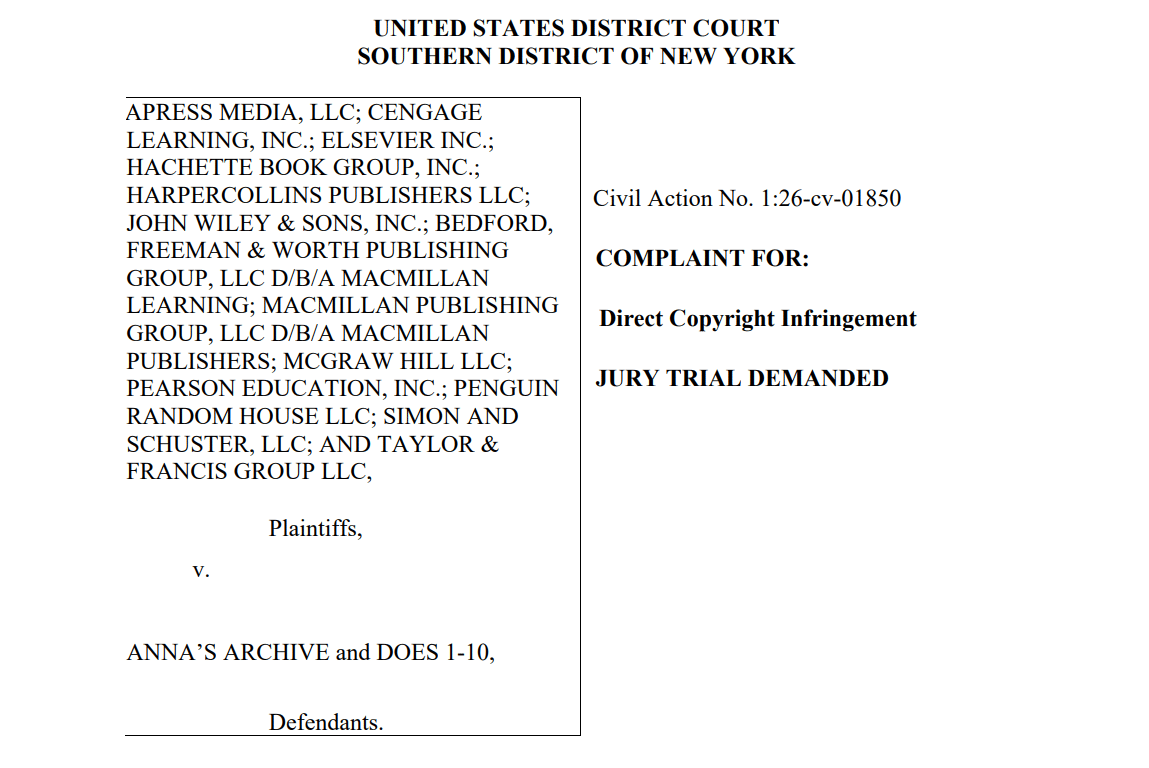
    After watching the music industry’s legal push, a group of thirteen major publishers has also sprung into action. In a complaint filed at a New York federal court last week, they accuse Anna’s Archive of staggering copyright infringement by hosting 63 million books and 95 million papers, most of which are pirated.

    The complaint

    the complaint

    “Defendants shamelessly describe themselves as a collection of ‘pirates’ not ‘bound by the law’,” the complaint reads.

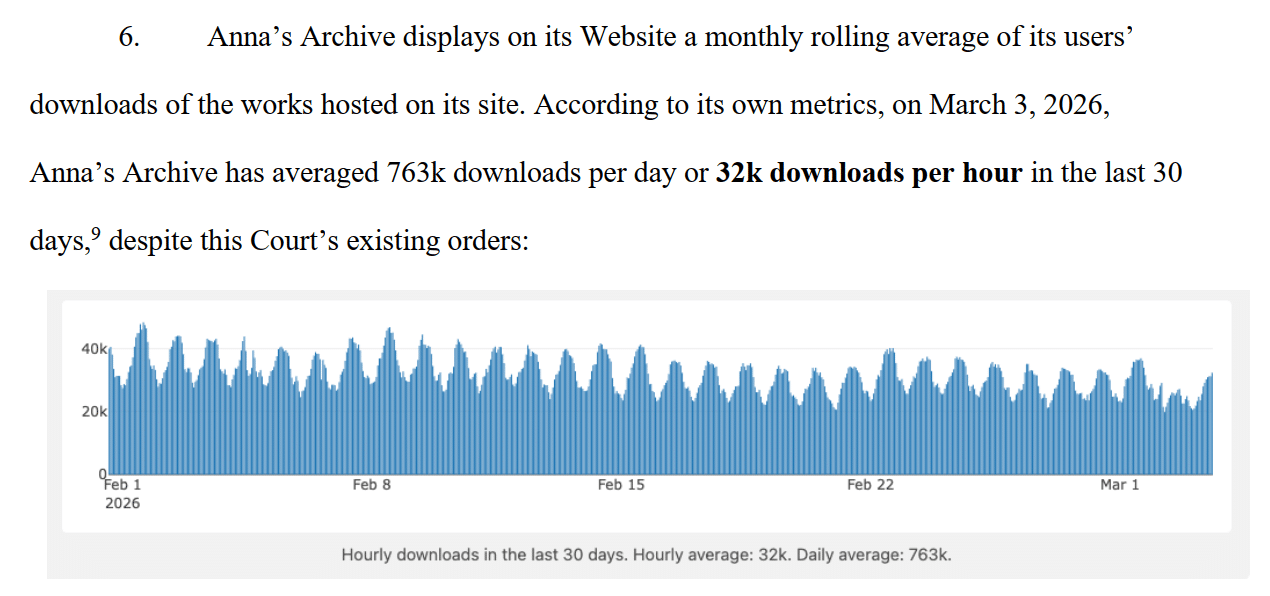
    The publishers highlight that the site facilitated 763,000 downloads per day last Tuesday, as reported by the site’s own statistics. These downloads are predominantly unauthorized, they add.

    “Plaintiffs are not aware that any of the copyright-protected works on Anna’s Archive are licensed or authorized by the copyright owners; to the contrary, their reproduction and distributions are blatantly illegal infringements,” the complaint notes.

    763,000 downloads

    stats

    The publishers also highlight the AI training angle. They note that the shadow library provided high-speed access to 140+ million texts to LLM developers in China, Russia, and elsewhere. This includes a blog post titled “If You’re an LLM, Please Read This” which specifically targets AI companies.

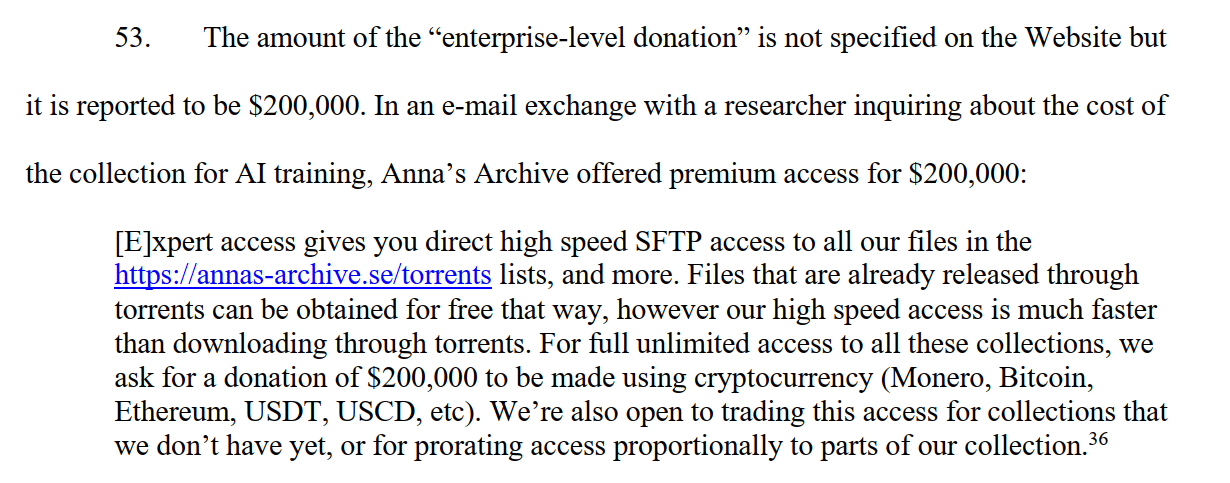
    The complaint alleged that Anna’s Archive reportedly charges significant fees for premium access, citing a LinkedIn post that mentioned a $200,000 donation.

    “The amount of the ‘enterprise-level donation’ is not specified on the Website but it is reported to be $200,000. In an e-mail exchange with a researcher inquiring about the cost of the collection for AI training, Anna’s Archive offered premium access for $200,000,” the complaint notes.

    Donation

    linkedin

    The Injunction is Key

    With 130 copyrighted works mentioned in the complaint, and damages up to $150,000 per infringed work, the publishers seek up to $19.5 million in compensation. However, with the site’s operators being unknown and unreachable, chances are slim that this amount will be paid.

    The publishers are aware of this. In fact, if we carefully read the framing of their complaint, it appears that the legal action is predominantly intended to target domain names and other technical infrastructure of Anna’s Archive.

    In recent weeks, the music industry injunction in the Atlantic/Spotify case has helped to take out several domain names. However, Anna’s Archive has since removed music-related content from the site. Therefore, the publishers now seek a similar injunction.

    “Were the Defendants to repost the contents of its illegal repository of stolen works without these audio files, the Atlantic Order would still be satisfied. Nor can the publisher Plaintiffs in this case enforce the Atlantic Order to protect their own copyrights,” the complaint reads.

    Injunction Targeting Hosts, Registrars, and Registries

    The publishers want to play their part in taking Anna’s Archive offline, and they therefore request an injunction to protect their copyrights. This proposed injunction requires the site and its operator to halt all infringing activity and destroy all pirated books and articles.

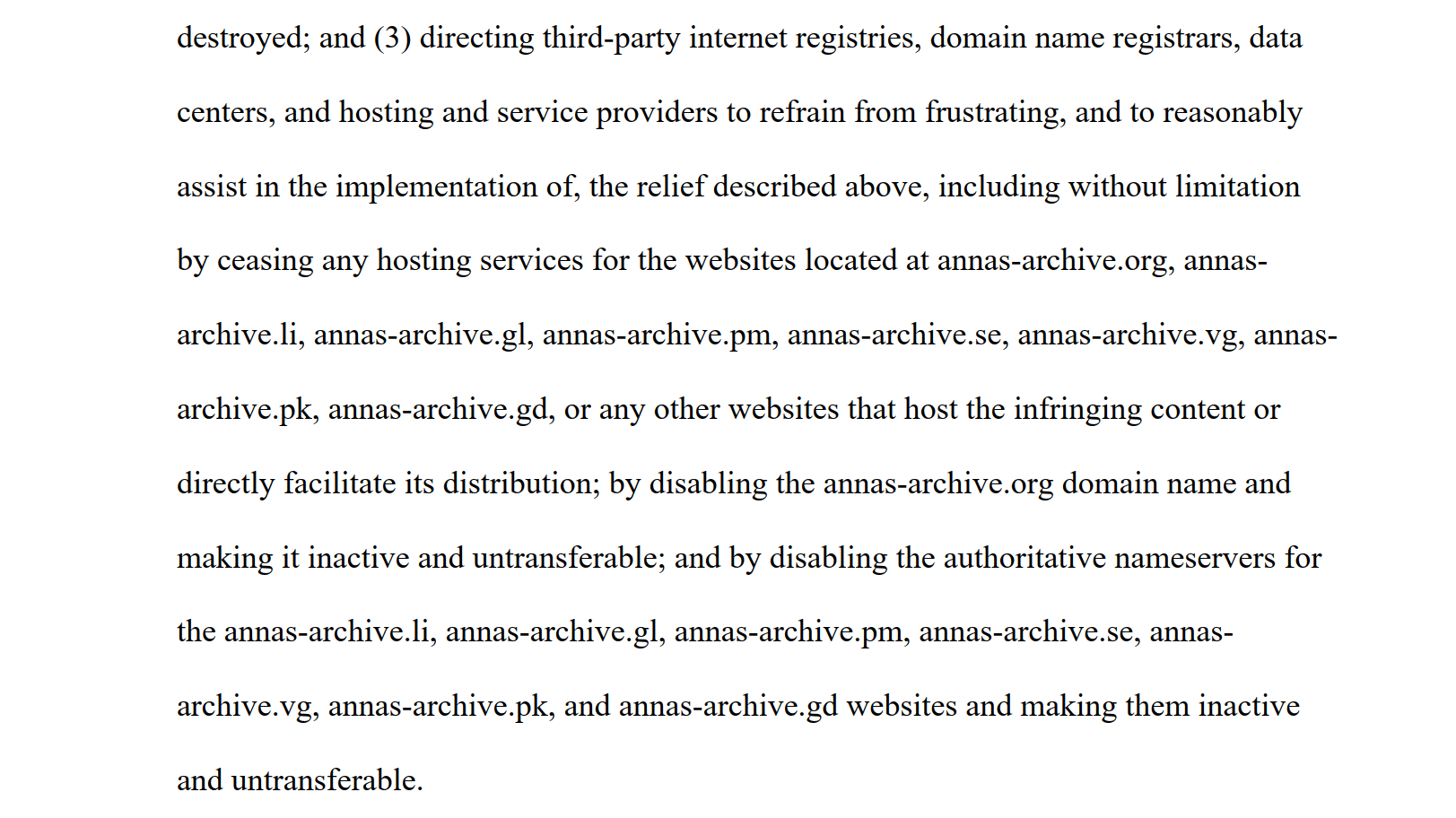
    More importantly, the injunction would also require third-party intermediaries to stop providing services to the shadow library. This applies to data centers, and hosting and service providers, domain registrars, and domain registries.

    Proposed injunctive relief

    injunction

    The proposed injunction would apply to all current domain names, as well as “any other websites that host the infringing content or directly facilitate its distribution.”

    At the time of writing, the court has yet to sign off on the requested injunction. Whether that order will be enough to keep Anna’s Archive offline for good, given its track record of quickly securing new domains, has yet to be seen.

    A copy of the complaint, filed at the U.S. District Court for the Southern District of New York, is available here (pdf). The exhibit listing works in suit can be found here (pdf).

    From: TF, for the latest news on copyright battles, piracy and more.