Author: tio

  • Pluralistic: Trump antitrust is dead (13 Feb 2026)

    Today’s links


    An altered version of a Gilded Age editorial cartoon titled 'Who controls the Senate?' which depicts the Senate as populated by tiny, ineffectual politicians ringed by massive, bloated, brooding monopolists. A door labeled 'people's entrance.' is firmly locked. A sign reads, 'This is a senate of the monopolists, by the monopolists and for the monopolists.' The image has been altered: an editorial cartoon of Boss Tweed, portrayed as a portly man in a business suit with a money-bag for a head, stands in the foreground. He is wearing a MAGA hat. On his shoulder perches a tiny, 'big stick' swinging FDR from another editorial cartoon. The logos of the monopolists in the background have been replaced with logos for Chevron, Coinbase, Google, Microsoft, WB, PGA, Apple, Comcast, Realpage and KKR.

    Trump antitrust is dead (permalink)

    Remember when the American right decided that it hated (some) big businesses, specifically Big Tech? A whole branch of the Trump coalition (including JD Vance, Matt Gaetz and Josh Hawley) declared themselves to be “Khanservatives,” a cheering section for Biden’s generationally important FTC commissioner Lina Khan:

    https://www.fastcompany.com/91156980/trump-vp-pick-j-d-vance-supports-big-tech-antitrust-crackdown

    Trump owes his power to his ability to bully and flatter a big, distrustful coalition of people who mostly hate each other into acting together, like the business lobby and the grievance-saturated conspiratorialists who hate Big Tech because they were momentarily prevented from calling for genocide or peddling election disinformation:

    https://pluralistic.net/2025/07/18/winning-is-easy/#governing-is-harder

    The best framing for the MAGA war on Big Tech comes from Trashfuture’s Riley Quinn, who predicted that the whole thing could be settled by tech companies’ boards agreeing to open every meeting with a solemn “stolen likes acknowledgment” that made repentance for all the shadowbanned culture warriors whose clout had been poached by soy content moderators.

    And that’s basically what happened. Trump’s antitrust agencies practiced “boss politics antitrust” in which favored courtiers were given free passes to violate the law, while Trump’s enemies were threatened with punitive antitrust investigations until they fell into line:

    https://pluralistic.net/2025/07/29/bondi-and-domination/#superjove

    Trump’s antitrust boss Gail Slater talked a big game about “Trump Antitrust” but was thwarted at every turn by giant corporations who figured out that if they gave a million bucks to a MAGA podcaster, they could go over Slater’s head and kill her enforcement actions. When Slater’s deputy, Roger Alford, went public to denounce the sleazy backroom dealings that led to the approval of the HPE/Juniper merger, he was forced out of the agency altogether and replaced with a Pam Bondi loyalist who served as a kind of politburo political officer in Slater’s agency:

    https://abovethelaw.com/2025/08/former-maga-attorney-goes-scorched-earth-with-corruption-allegations-in-antitrust-division/

    Bondi made no secret of her contempt for Slater, and frequently humiliated her in public. Now it seems that Bondi has gotten tired of this game and has forced Slater out altogether. As ever, Matt Stoller has the best analysis of how this happened and what it means:

    https://www.thebignewsletter.com/p/trump-antitrust-chief-ousted-by-ticketmaster

    Stoller’s main thesis is that the “conservative populist” movement only gained relevance by complaining about “censorship of conservatives” on the Big Tech platforms. While it’s true that the platforms constitute an existential risk to free expression thanks to their chokehold over speech forums, it was always categorically untrue that conservatives were singled out by tech moderators:

    https://pluralistic.net/2022/12/10/e2e/#the-censors-pen

    Conservative populists’ grievance-based politics is in contrast with the progressive wing of the anti-monopoly movement, which was concerned with the idea of concentrated power itself, and sought to dismantle and neuter the power of the business lobby and the billionaires who ran it:

    https://pluralistic.net/2022/02/20/we-should-not-endure-a-king/

    The problem with conservative populism, then, is that its movement was propelled by the idea that Big Tech was soy and cucked and mean to conservatives. That meant that Big Tech bosses had an easy path out of its crosshairs: climb into the tank for MAGA.

    That’s just what they did: Musk bought Twitter; Zuck ordered his content moderators to censor the left and push MAGA influencers; Bezos neutered his newspaper in the run up to the 2024 elections; Tim Cook hand-assembled a gold participation trophy for Trump live on camera. These CEOs paid a million dollars each for seats on Trump’s inauguration dais and their companies donated millions for Trump’s Epstein Memorial Ballroom.

    Slater’s political assassination merely formalizes something that’s been obvious for a year now: you can rip off the American people with impunity so long as you flatter and bribe Trump.

    The HP/Juniper merger means that one company now supplies the majority of commercial-grade wifi routers, meaning that one company now controls all the public, commercial, and institutional internet you’ll ever connect to. The merger was worth $14b, and Trump’s trustbusters promised to kill it. So the companies paid MAGA influencer Mike Davis (who had publicly opposed the merger) a million bucks and he got Trump to overrule his own enforcers. Getting your $14b merger approved by slipping a podcaster a million bucks is a hell of a bargain.

    HP/Juniper were first, but they weren’t the last. There was the Discover/Capital One merger, which rolled up the two credit cards that low-waged people rely on the most, freeing the new company up for even more predatory practices, price-gouging, junk-fees, and strong-arm collections. When the bill collectors are at your door looking for thousands you owe from junk fees, remember that it was Gail Slater’s weakness that sent them there:

    https://www.nytimes.com/2025/04/03/business/dealbook/capital-one-discover-merger.html

    Slater also waved through the rollup of a string of nursing homes by one of the world’s most notoriously greedy and cruel private equity firms, KKR. When your grandma dies of dehydration in a dirty diaper, thank Gail Slater:

    https://pluralistic.net/2023/05/09/dingo-babysitter/#maybe-the-dingos-ate-your-nan

    Slater approved the merger of Unitedhealth – a company notorious for overbilling the government while underdelivering to patients – with Amedisys, who provide hospice care and home health help:

    https://www.justice.gov/opa/pr/justice-department-requires-broad-divestitures-resolve-challenge-unitedhealths-acquisition

    The hits keep coming. Want to know why your next vacation was so expensive? Thank Slater for greenlighting the merger of American Express Global Business Travel and CWT Holdings, which Slater challenged but then dropped, reportedly because MAGA influencer Mike Davis told her to.

    Davis also got Slater to reverse her opposition to the Compass/Anywhere Real Estate merger, which will make America’s dysfunctional housing market even worse:

    https://www.wsj.com/us-news/law/real-estate-brokerages-avoided-merger-investigation-after-justice-department-rift-e846c797?gaa_at=eafs&gaa_n=AWEtsqdSXg4z1XPl2UpqdHR4V2-sNj9M7oDcWHscPIXuSU-5n0gtYEv8Q5XZG7qtzfY%3D&gaa_ts=698e44a6&gaa_sig=IO7tWGaHZSYER64YyUzyoiVtrOKR77ZsYMMOdwN1P7koRt9zXYRJ1hxw2oDU9cD40-aGgHHVfwMWg14olFwNaw%3D%3D

    It’s not just homebuyers whose lives are worse off because of Slater’s failures, it’s tenants, too. Slater settled the DoJ’s case against Realpage, a price-fixing platform for landlords that is one of the most culpable villains in the affordability crisis. Realpage was facing an existential battle with the DoJ; instead, they got away with a wrist-slap and (crucially) are allowed to continue to make billions helping landlords rig the rental market against tenants.

    So Slater’s defenestration is really just a way of formalizing Trump’s approach to antitrust: threaten and prosecute companies that don’t bend the knee to the president, personally…and allow companies to rob the American people with impunity if they agree to kick up a percentage to the Oval Office.

    But while Slater will barely rate a footnote in the history of the Trump administration, the precipitating event for her political execution is itself very interesting. Back in September, Trump posed with Kid Rock and announced that he was going after Ticketmaster/Live Nation, a combine with a long, exhaustively documented history of ripping off and defrauding every entertainer, fan and venue in America:

    https://www.pbs.org/newshour/nation/ftc-sues-ticketmaster-saying-it-uses-illegal-tactics-to-make-fans-pay-more-for-live-events

    At the time, it was clear that Trump had been prodded into action by two factors: the incredible success of the Mamdani campaign’s focus on “affordability” (Ticketmaster’s above-inflation price hikes are one of the most visible symptoms of the affordability crisis) and Kid Rock’s personal grievances about Ticketmaster.

    Kid Rock is the biggest-name entertainer in the Trump coalition, the guy Trump got to headline a MAGA halftime show that notably failed to dim Bad Bunny’s star by a single milliwatt. Trump – a failed Broadway producer – is also notoriously susceptible to random pronouncements by celebrities (hence the Fox and Friends-to-Trump policy pipeline), so it’s natural that Kid Rock’s grousing got action after decades of documented abuses went nowhere.

    Ticketmaster could have solved the problem by offering to exempt Trump-loyal entertainers from its predatory practices. They could have announced a touring Trumpapalooza festival headlined by Kid Rock, Christian rock acts, and AI-generated country singers, free from all junk fees. Instead, they got Gail Slater fired.

    Mike Davis doesn’t just represent HPE/Juniper, Amex travel, and Compass/Anywhere – he’s also the fixer that Ticketmaster hired to get off the hook with the DoJ. He’s boasting about getting Slater fired:

    https://x.com/gekaminsky/status/2022076364279755066

    And Ticketmaster is off the hook:

    https://prospect.org/2026/02/12/trump-justice-department-ticketmaster-live-nation-monopoly/

    What’s interesting about all this is that there were elements of the Biden coalition that also hated antitrust (think of all the Biden billionaires who called for Lina Khan to be fired while serving as “proxies” for Kamala Harris). And yet, Biden’s trustbusters did more in four short years than their predecessors managed over the preceding forty.

    Stoller’s theory is that the progressive anti-monopoly movement (the “Brandeisians”) were able to best their coalitional rivals because they did the hard work of winning support for the idea of shattering corporate power itself – not just arguing that corporate power was bad when it was used against them.

    This was a slower, harder road than dividing up the world into good monopolies and bad ones, but it paid off. Today the Brandeisians who made their bones under Biden are serving the like of Mamdani:

    https://pluralistic.net/2025/11/15/unconscionability/#standalone-authority

    And their ideas have spread far and wide – even to other countries:

    https://lewisforleader.ca/ideas/public-options-full-plan/

    They lit a fire that burns still. Who knows, maybe someday it’ll even help Kid Rock scorch the Ticketmaster ticks that are draining his blood from a thousand tiny wounds. He probably won’t have the good manners to say thank you.


    Hey look at this (permalink)


    A shelf of leatherbound history books with a gilt-stamped series title, 'The World's Famous Events.'

    Object permanence (permalink)

    #20yrsago Google Video DRM: Why is Hollywood more important than users? https://memex.craphound.com/2006/02/13/google-video-drm-why-is-hollywood-more-important-than-users/

    #20yrsago Phishers trick Internet “trust” companies https://web.archive.org/web/20060222232249/http://blog.washingtonpost.com/securityfix/2006/02/the_new_face_of_phishing_1.html

    #15yrsago With a Little Help: first post-publication progress report https://www.publishersweekly.com/pw/by-topic/columns-and-blogs/cory-doctorow/article/46105-with-a-little-help-the-early-returns.html

    #15yrsago Nokia’s radical CEO has a mercenary, checkered past https://web.archive.org/web/20100608100324/http://www.siliconbeat.com/2008/01/11/microsoft-beware-stephen-elop-is-a-flight-risk/

    #15yrsago Scientology’s science fictional origins: thesis from 1981 https://web.archive.org/web/20110218045653/http://digitalcommons.mcmaster.ca/opendissertations/126/

    #10yrsago I was a Jeopardy! clue https://memex.craphound.com/2016/02/13/i-was-a-jeopardy-clue/

    #10yrsago Liberated Yazidi sex slaves become a vengeful, elite anti-ISIS fighting force https://www.independent.co.uk/news/world/middle-east/isis-yazidi-sex-slaves-take-up-arms-for-mosul-fight-to-bring-our-women-home-a6865056.html

    #10yrsago Listen: a new podcast about science fiction and spectacular meals https://www.scottedelman.com/2016/02/10/the-first-episode-of-eating-the-fantastic-with-guest-sarah-pinsker-is-now-live/

    #10yrsago Politician given green-light to name developer’s new streets with synonyms for greed and deceit https://web.archive.org/web/20160213001324/http://www.capitalnewyork.com/article/city-hall/2016/02/8590908/staten-island-borough-president-gets-approval-name-new-streets-gre

    #5yrsago $50T moved from America’s 90% to the 1% https://pluralistic.net/2021/02/13/data-protection-without-monopoly/#inequality

    #5yrsago Broad Band https://pluralistic.net/2021/02/13/data-protection-without-monopoly/#broad-band

    #5yrsago Privacy Without Monopoly https://pluralistic.net/2021/02/13/data-protection-without-monopoly/#comcom

    #1yrago Premature Internet Activists https://pluralistic.net/2025/02/13/digital-rights/#are-human-rights


    Upcoming appearances (permalink)

    A photo of me onstage, giving a speech, pounding the podium.


    A screenshot of me at my desk, doing a livecast.

    Recent appearances (permalink)


    A grid of my books with Will Stahle covers..

    Latest books (permalink)


    A cardboard book box with the Macmillan logo.

    Upcoming books (permalink)

    • “The Reverse-Centaur’s Guide to AI,” a short book about being a better AI critic, Farrar, Straus and Giroux, June 2026
    • “Enshittification, Why Everything Suddenly Got Worse and What to Do About It” (the graphic novel), Firstsecond, 2026

    • “The Post-American Internet,” a geopolitical sequel of sorts to Enshittification, Farrar, Straus and Giroux, 2027

    • “Unauthorized Bread”: a middle-grades graphic novel adapted from my novella about refugees, toasters and DRM, FirstSecond, 2027

    • “The Memex Method,” Farrar, Straus, Giroux, 2027


    Colophon (permalink)

    Today’s top sources:

    Currently writing: “The Post-American Internet,” a sequel to “Enshittification,” about the better world the rest of us get to have now that Trump has torched America (1016 words today, 28750 total)

    • “The Reverse Centaur’s Guide to AI,” a short book for Farrar, Straus and Giroux about being an effective AI critic. LEGAL REVIEW AND COPYEDIT COMPLETE.
    • “The Post-American Internet,” a short book about internet policy in the age of Trumpism. PLANNING.

    • A Little Brother short story about DIY insulin PLANNING


    This work – excluding any serialized fiction – is licensed under a Creative Commons Attribution 4.0 license. That means you can use it any way you like, including commercially, provided that you attribute it to me, Cory Doctorow, and include a link to pluralistic.net.

    https://creativecommons.org/licenses/by/4.0/

    Quotations and images are not included in this license; they are included either under a limitation or exception to copyright, or on the basis of a separate license. Please exercise caution.


    How to get Pluralistic:

    Blog (no ads, tracking, or data-collection):

    Pluralistic.net

    Newsletter (no ads, tracking, or data-collection):

    https://pluralistic.net/plura-list

    Mastodon (no ads, tracking, or data-collection):

    https://mamot.fr/@pluralistic

    Medium (no ads, paywalled):

    https://doctorow.medium.com/

    Twitter (mass-scale, unrestricted, third-party surveillance and advertising):

    https://twitter.com/doctorow

    Tumblr (mass-scale, unrestricted, third-party surveillance and advertising):

    https://mostlysignssomeportents.tumblr.com/tagged/pluralistic

    When life gives you SARS, you make sarsaparilla” -Joey “Accordion Guy” DeVilla

    READ CAREFULLY: By reading this, you agree, on behalf of your employer, to release me from all obligations and waivers arising from any and all NON-NEGOTIATED agreements, licenses, terms-of-service, shrinkwrap, clickwrap, browsewrap, confidentiality, non-disclosure, non-compete and acceptable use policies (“BOGUS AGREEMENTS”) that I have entered into with your employer, its partners, licensors, agents and assigns, in perpetuity, without prejudice to my ongoing rights and privileges. You further represent that you have the authority to release me from any BOGUS AGREEMENTS on behalf of your employer.

    ISSN: 3066-764X

  • Discord Voluntarily Pushes Mandatory Age Verification Despite Recent Data Breach

    Discord has begun rolling out mandatory age verification and the internet is, understandably, freaking out.

    At EFF, we’ve been raising the alarm about age verification mandates for years. In December, we launched our Age Verification Resource Hub to push back against laws and platform policies that require users to hand over sensitive personal information just to access basic online services. At the time, age gates were largely enforced in polities where it was mandated by law. Now they’re landing in platforms and jurisdictions where they’re not required.

    Beginning in early March, users who are either (a) estimated by Discord to be under 18, or (b) Discord doesn’t have enough information on, may find themselves locked into a “teen-appropriate experience.” That means content filters, age gates, restrictions on direct messages and friend requests, and the inability to speak in “Stage channels,” which are the large-audience audio spaces that power many community events. Discord says most adults may be sorted automatically through a new “age inference” system that relies on account tenure, device and activity data, and broader platform patterns. Those whose age isn’t estimated due to lack of information or who are estimated to not be adults will be asked to scan their face or upload a government ID through a third-party vendor if they want to avoid the default teen account restrictions.

    We’ve written extensively about why age verification mandates are a censorship and surveillance nightmare. Discord’s shift only reinforces those concerns. Here’s why:

    The 2025 Breach and What’s Changed Since

    Discord literally won our 2025 “We Still Told You So” Breachies Award. Last year, attackers accessed roughly 70,000 users’ government IDs, selfies, and other sensitive information after compromising Discord’s third-party customer support system.

    To be clear: Discord is no longer using that system, which involved routing ID uploads through its general ticketing system for age verification. It now uses dedicated age verification vendors (k-ID globally and Persona for some users in the United Kingdom).

    That’s an improvement. But it doesn’t eliminate the underlying potential for data breaches and other harms. Discord says that it will delete records of any user-uploaded government IDs, and that any facial scans will never leave users’ devices. But platforms are closed-source, audits are limited, and history shows that data (especially this ultra-valuable identity data) will leak—whether through hacks, misconfigurations, or retention mistakes. Users are being asked to simply trust that this time will be different.

    Age Verification and Anonymous Speech

    For decades, we’ve taught young people a simple rule: don’t share personal information with strangers online.

    Age verification complicates that advice. Suddenly, some Discord users will now be asked to submit a government ID or facial scan to access certain features if their age-inference technology fails. Discord has said on its blog that it will not associate a user’s ID with their account (only using that information to confirm their age) and that identifying documents won’t be retained. We take those commitments seriously. However, users have little independent visibility into how those safeguards operate in practice or whether they are sufficient to prevent identification.

    Even if Discord can technically separate IDs from accounts, many users are understandably skeptical, especially after the platform’s recent breach involving age-verification data. For people who rely on pseudonymity, being required to upload a face scan or government ID at all can feel like crossing a line.

    Many people rely on anonymity to speak freely. LGBTQ+ youth, survivors of abuse, political dissidents, and countless others use aliases to explore identity, find support, and build community safely. When identity checks become a condition of participation, many users will simply opt out. The chilling effect isn’t only about whether an ID is permanently linked to an account; it’s about whether users trust the system enough to participate in the first place. When you’re worried that what you say can be traced back to your government ID, you speak differently—or not at all.

    No one should have to choose between accessing online communities and protecting their privacy.

    Age Verification Systems Are Not Ready for Prime Time

    Discord says it is trying to address privacy concerns by using device-based facial age estimation and separating government IDs from user accounts, retaining only a user’s age rather than their identity documents. This is meant to reduce the risks associated with retaining and collecting this sensitive data. However, even when privacy safeguards are in place, we are faced with another problem: There is no current technology that is fully privacy-protective, universally accessible, and consistently accurate. Facial age estimation tools are notoriously unreliable, particularly for people of color, trans and nonbinary people, and people with disabilities. The internet has now proliferated with stories of people bypassing these facial age estimation tools. But when systems get it wrong, users may be forced into appeals processes or required to submit more documentation, such as government-issued IDs, which would exclude those whose appearance doesn’t match their documents and the millions of people around the world who don’t have government-issued identity documents at all.

    Even newer approaches (things like age inference, behavior tracking, financial database checks, digital ID systems) expand the web of data collection, and carry their own tradeoffs around access and error. As we mentioned earlier, no current approach is simultaneously privacy-protective, universally accessible, and consistently accurate across all demographics. 

    That’s the challenge: the technology itself is not fit for the sweeping role platforms are asking it to play.

    That’s the challenge: the technology itself is not fit for the sweeping role platforms are asking it to play.

    The Aftermath

    Discord reports over 200 million monthly active users, and is one of the largest platforms used by gamers to chat. The video game industry is larger than movies, TV, and music combined, and Discord represents an almost-default option for gamers looking to host communities.

    Many communities, including open-source projects, sports teams, fandoms, friend groups, and families, use Discord to stay connected. If communities or individuals are wrongly flagged as minors, or asked to complete the age verification process, they may face a difficult choice: submit to facial scans or ID checks, or accept a more restricted “teen” experience. For those who decline to go through the process, the result can mean reduced functionality, limited communication tools, and the chilling effects that follow. 

    Most importantly, Discord did not have to “comply in advance” by requiring age verification for all users, whether or not they live in a jurisdiction that mandates it. Other social media platforms and their trade groups have fought back against more than a dozen age verification laws in the U.S., and Reddit has now taken the legal fight internationally. For a platform with as much market power as Discord, voluntarily imposing age verification is unacceptable. 

    So You’ve Hit an Age Gate. Now What?

    Discord should reconsider whether expanding identity checks is worth the harm to its communities. But in the meantime, many users are facing age checks today.

    That’s why we created our guide, “So You’ve Hit an Age Gate. Now What?” It walks through practical steps to minimize risk, such as:

    • Submit the least amount of sensitive data possible.
    • Ask: What data is collected? Who can access it? How long is it retained?
    • Look for evidence of independent, security-focused audits.
    • Be cautious about background details in selfies or ID photos.

    There is unfortunately no perfect option, only tradeoffs. And every user will have their own unique set of safety concerns to consider. Amidst this confusion, our goal is to help keep you informed, so you can make the best choices for you and your community.

    In light of the harms imposed by age-verification systems, EFF encourages all services to stop adopting these systems when they are not mandated by law. And lawmakers across the world that are considering bills that would make Discord’s approach the norm for every platform should watch this backlash and similarly move away from the idea.

    If you care about privacy, free expression, and the right to participate online without handing over your identity, now is the time to speak up.

    Join us in the fight.

  • Argentina Blocks Pirate Streaming Services Magis TV and Xuper TV, VPN Usage Skyrockets

    Argentina Blocks Pirate Streaming Services Magis TV and Xuper TV, VPN Usage Skyrockets

    In September 2024, we reported on an unprecedented anti-piracy measure handed down in Argentina.

    Judge Esteban Rossignoli required local ISPs to block 69 domains linked to the pirate IPTV service Magis TV. More controversially, the judge also ordered Google to remotely uninstall sideloaded Magis TV apps from all Android devices with Argentine IP addresses.

    “What was achieved is an unprecedented court order, which is in the process of being analyzed by Google – we understand that they cannot deny it – which is to uninstall, through the Android operating system update, the application on all devices that have an IP address in Argentina,” prosecutor Alejandro Musso said at the time.

    While the Magis TV crackdown has some effect, the brand wasn’t gone. New IPTV services continued to pop up, including an apparent rebrand: XuperTV. This week, these two services are both targeted in a new high-profile court order.

    70+ Domains Blocked, Apps Go Dark

    On February 10 and 11, thousands of Argentine users discovered that Magis TV and its successor Xuper TV had stopped working entirely. Channel lists wouldn’t load, connections timed out, and in some cases, the apps completely vanished from smart TVs and mobile devices.

    This is the result of Judge Rossignoli’s new court order, which covers more than 70 domains. The order requires ISPs to block domains and IP-addresses and, similar to the earlier version, orders Google to disable the applications on Android devices connecting from Argentina.

    Users attempting to open the apps are greeted with a blunt message:

    “Due to policy limitations, the account cannot be used in your area. Contact your retailer.”

    The court order is part of a broader enforcement action, led by Argentina’s Specialized Unit on Cybercrime (UFEIC) under prosecutor Musso. According to La Nación and Cadena 3, the investigation included raids and the seizure of hundreds of TV Boxes. Those identified as responsible face up to six years in prison.

    Before the full block hit, the platforms reportedly tried to limit their exposure by deleting all Argentine channels. However, that clearly didn’t work.

    Operación 404

    The Argentinian enforcement is part of Operación 404, an international anti-piracy operation led by Brazil’s Ministry of Justice that has previously coordinated raids and domain seizures across Latin America.

    TVs

    Coinciding with the Argentinian actions, Chile’s Department of Telecommunications ordered ISPs to block all sites using the brands Magis Tv, Flujo TV, Xuper TV or their variants. That includes “any domain, subdomain, IP address, link, redirect or mirror” that reproduces the content. The dynamic blocking order gives ISPs five days to comply.

    The Chilean action was triggered by a complaint from Warner Bros. Discovery. ISPs must display a notice stating the sites were blocked for intellectual property infringement.

    The Milei/Trump IP Agreement

    The timing of the anti-piracy actions might not be coincidental. On February 5, Argentina and the United States signed a trade and investment agreement that includes explicit commitments on intellectual property enforcement.

    Argentina committed to “establish a robust standard of protection for intellectual property” and to create “effective systems for enforcement in civil, criminal, and border areas” that “combat and deter the infringement or misappropriation of intellectual property, including in the digital environment.”

    The United States reportedly lodged more than 100 copyright-related demands in the negotiations. Article 1.10 specifically commits Argentina to “investigate and bring criminal proceedings against operators of Argentina-based websites that engage in commercial-scale copyright piracy.”

    That language goes well beyond Magis TV. It also targets sites like Fútbol Libre and Pelota Libre, which stream Argentine football without authorization.

    VPN Interest Spikes

    In addition to blocking pirate sites, the actions had an immediate side effect: a surge in VPN usage.

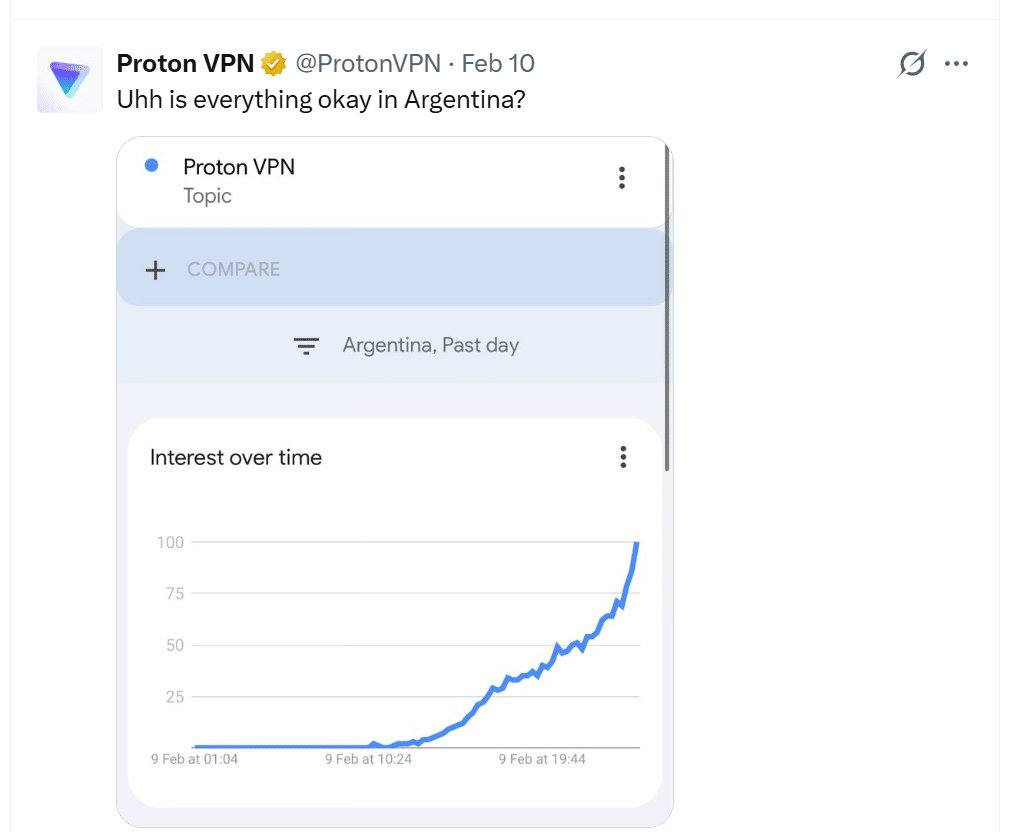
    On February 10, Proton VPN’s account on X posted a graph showing a sharp spike in Argentine connections, asking: “Is everything okay in Argentina?”

    Apparently, pirates quickly began sharing workarounds on social media. A common one involves installing ProtonVPN, connecting to a Mexican server, then reopening Magis TV or Xuper TV. In some cases, the apps work again via the VPN.

    Others are changing DNS settings on their smart TVs manually, though this is reportedly becoming less effective. According to FayerWayer, rights protection systems are now using AI to identify pirate IPTV traffic in real time, leaving users who reconnect with constant interruptions and degraded quality.

    What’s Next

    The search for workarounds in response to blocking efforts is not new. We have seen this countless times already, dating back more than a decade ago. It doesn’t only apply to users either; the operators of pirate services and apps also have to get creative.

    Whether Google actually complied with the removal order and, if so, what actions it took precisely remains an open question. Magis TV apps were distributed mostly as sideloaded APK files from third-party websites. For Google to remotely disable such an app, it would need to intervene on the users’ devices directly.

    App developers could likely find ways to work around it by rebranding again, simply continuing the game of whack-a-mole. But that’s nothing new, of course.

    From: TF, for the latest news on copyright battles, piracy and more.

  • Data Centers Are Scrambling to Power the AI Boom With Natural Gas

    This story was originally published by Grist. Sign up for Grist’s weekly newsletter here.

    Boom Supersonic wants to build the world’s first commercial supersonic airliner. Founded in 2014, the company set out to make air travel dramatically faster — up to twice the speed of today’s passenger jets — while also aiming for a smaller environmental footprint. For years, Boom has focused on developing the high-performance engine technology needed to sustain supersonic flight.

    Though the company has not yet debuted its revolutionary jet, last year it identified a new and potentially lucrative application for its novel technology: generating electricity for the data centers powering the artificial intelligence boom.


    Related


    The Ecological Cost of AI Is Much Higher Than You Think


    Many of these data centers want the kind of flexible, around-the-clock energy associated with combined-cycle natural gas turbines. These heavy-duty machines burn gas to spin turbines and generate electricity, then capture the associated heat and use it to spin the turbines some more. As far as fossil fuel generation goes, they are among the most efficient options for so-called dispatchable baseload power. But with demand for these turbines surging and supply increasingly tight, developers are turning to creative alternatives.

    The upshot of all this creativity is clear: Much of the data center build-out is poised to be powered by natural gas — and the climate consequences that come with it.

    Boom Supersonic inked a $1.25 billion agreement with a developer called Crusoe, which is building a suite of data centers for the artificial intelligence startup OpenAI. The turbine company agreed to provide Crusoe with 29 jet-engine gas turbines that the developer could position at data centers across the U.S. 

    The deal is just one example of developers and tech companies straining to find power sources for the data centers sprouting up nationwide. Meta’s data center in El Paso, Texas, will draw power from more than 800 mobile mini-turbines. Meanwhile, the construction equipment company Caterpillar has supplied gas engines to a data center in West Virginia. And the developer Crusoe used “aeroderivative” turbines based on airplane models for its massive Stargate data-center campus in Abilene, Texas, where power demand is a whopping 1.2 gigawatts. 

    The build-out could add as much as 44 million metric tons of carbon dioxide to the atmosphere by 2030.

    It’s not just the U.S. New proposed natural gas capacity has surged worldwide over the past year. The energy analysis firm Global Energy Monitor reports that projects totaling more than 1,000 gigawatts of gas-fired power are now in development worldwide — a roughly 31% jump in just the last year. The United States leads the pack, accounting for about a quarter of that pipeline. More than a third of the new U.S. capacity will power data centers. The analysis also notes that two-thirds of gas project developers in the U.S. have yet to identify who will manufacture their natural gas turbines.

    This rush to build out natural gas generation will have serious consequences for the climate. Early boosters of the data center boom suggested that new AI facilities would draw power from renewable sources such as solar and wind farms. While that has happened in some cases, developers are also rapidly locking in years of additional fossil fuel usage. An analysis from researchers at Cornell University found that the build-out could add as much as 44 million metric tons of carbon dioxide to the atmosphere by 2030, equivalent to the annual emissions of around 10 million passenger cars. 

    “This is a huge proposed build-out,” said Cara Fogler, deputy director of research, strategy and analysis at the Sierra Club, which has been tracking gas plant expansions by utilities. “Existing coal that’s not coming offline and planned gas that’s trying to come online are potentially boxing out clean energy.”

    As Silicon Valley’s AI boom drives demand for ever more computing power, data center developers have struggled to keep up, largely because securing the massive amounts of electricity needed to run these facilities has become so difficult. The rush has led to long wait times to secure power from traditional utilities. As a result, developers and tech companies are increasingly taking matters into their own hands by generating power on-site. According to an analysis by Cleanview, a data firm tracking the energy transition, at least 46 data centers with a combined capacity of 56 gigawatts — equivalent to that of roughly 27 Hoover Dams — are using this “behind-the-meter” approach, as it’s known in industry parlance.

    The chief executive of Bloom Energy, a startup that builds behind-the-meter fuel cells for data centers, said in a recent call with investors that the startup’s order backlog has more than doubled over the past year.

    “On-site power has moved from being a decision of last resort to a vital business necessity,” said company executive K.R. Sridhar. He noted that while most of the company’s previous business was in states like California with high electricity costs, now “states where we are growing fastest have robust natural gas infrastructure and favorable regulatory and policy frameworks for on-site power generation.”

    Texas Gov. Greg Abbott and Alphabet CEO Sundar Pichai lead a panel at a Google data center in Midlothian, Texas, on Nov. 14, 2025, where Google announced plans to invest $40 billion in new Texas data centers through 2027. (Getty Images via Grist/Ron Jenkins)

    One of those states is Texas, which is the epicenter of the build-out so far. Unconventional gas power will anchor campuses like that of Titus Low Carbon Ventures, which is building half a dozen data center parks across the Lone Star State. In September, the company signed a deal with power developer Gruppo AB to source Jennbacher gas generating engines, each of which provides just a few megawatts of power. The company will plug in hundreds of these boxy generators to provide baseload power alongside solar and wind.

    “We could’ve elected to go with gas turbines,” said Jeff Ferguson, the president of Titus, in an interview with Grist. Instead of sourcing traditional gas turbines, he opted to buy “reciprocating engines,” which are smaller gas-powered generators that are similar to passenger car engines.

    “We think that reciprocating engines are a better solution for data centers,” he said, adding that ”the difference is in the ability to manage transient loads,” or rapid fluctuations in power demand that are very common at the facilities.

    Not only is it unlikely that 200 generators will ever go offline all at once, but the engines are also much faster to start up and stop than turbines — they can come online in around a minute, as opposed to an hour for a traditional power plant. Ferguson likened it to the difference between accelerating in a Corvette and a jet plane.

    But experts say these substitute energy sources are even worse for the climate than traditional power plants, which use more efficient combined-cycle turbines that employ both gas and steam. The worst offenders are not turbines at all but rather internal-combustion engines like the ones in most automobiles.

    Experts say these substitute energy sources are even worse for the climate than traditional power plants.

    “Internal combustion [engines] have better ramp up/down time[s] but are less efficient when compared to a gas turbine,” said Jenny Martos, a researcher who runs the gas plant tracker for Global Energy Monitor. “All gas power technologies produce emissions, but generally engines produce more emissions than the others.”

    Texas has almost 58 gigawatts of natural gas power in various stages of planning and construction, according to the latest estimates from Global Energy Monitor. That’s more than the next four states combined, and more than every country on Earth except for China. Nearly half of the power plants under construction in Texas will provide power exclusively to data centers, without connecting to regional energy grids. These projects span the state, from OpenAI’s Stargate campus in central Abilene to Meta’s data center in El Paso, where the company has contracted with a Houston-based microgrid developer to set up 813 modular generators.

    The projects are also popping up in rural areas of the country with few other economic development prospects. A developer called BorderPlex is proposing a $165 billion data center campus called Project Jupiter in southern New Mexico, powered by two microgrids that operate on simple-cycle gas turbines, which just burn gas to generate energy without capturing and deploying their waste heat. The project’s 2,880 megawatts of generation are more than the entire generation capacity of central New Mexico’s main utility.

    “I’ve never seen something quite this big before, dollar-wise, scale-wise,” said Colin Cox, an attorney with the Center for Biological Diversity, which is opposing the project. “To call this a microgrid defies common sense.” Remaining behind the meter allows the project to avoid seeking approval from regulators who would enforce compliance with the state’s climate laws — even though Project Jupiter’s carbon emissions alone could outweigh the actions that New Mexico has taken to lower emissions over the past several years.

    The project’s developer has promised jobs and tax revenue to rural Doña Ana County, but the future is murky. It remains unclear whether demand for artificial intelligence products will keep up with the historic capital expenditures being made by companies like OpenAI. If the bubble were to pop, the state would be left with a gas turbine that didn’t serve any users — an asset that the state would not need and that, under its climate laws, it would not be allowed to use.

    “They’ll just be stranded assets,” said Cox. “You can’t do anything with a gas turbine besides run gas through it to make it spin.”

    The post Data Centers Are Scrambling to Power the AI Boom With Natural Gas appeared first on Truthdig.

  • Nurses and other NHS staff to get 3.3% pay rise

    Unions angry, but government says it demonstrates its commitment to workforce.
  • Trump vs. His China Hawks

    In the year since President Donald Trump returned to the White House, China hawks have started to panic. Leading lights on U.S. policy toward Beijing now warn that Trump is “barreling toward a bad bargain” with the Chinese Communist Party. Matthew Pottinger, a key architect of Trump’s China policy in his first term, argues that the president has put Beijing in a “sweet spot” through his “baffling” policy decisions.

    Even some congressional Republicans have criticized Trump’s approach, particularly following his decision in December to allow the sale of powerful Nvidia artificial intelligence chips to China. “The CCP will use these highly advanced chips to strengthen its military capabilities and totalitarian surveillance,” argued Rep. John Moolenaar, R-Mich., who chairs the influential Select Committee on Competition With China.

    From this wave of criticism, a mainstream narrative has started to emerge: By pursuing deals with Beijing, Trump is abandoning the bipartisan consensus on China that he ushered in during his first term. The president, in other words, has gone soft on China.

    The president is pursuing a realist, if disorganized, approach to Beijing.

    But the reality is more complex than this narrative claims. A close examination of Trump’s second-term policies toward China suggests that the president is pursuing a realist, if disorganized, approach to Beijing, according to realist foreign policy analysts who spoke with Responsible Statecraft. This may include some uncomfortable concessions, like reducing restrictions on AI chip sales and softening rhetoric about protecting Taiwan. But it doesn’t mean that Trump is poised to surrender Asia to Beijing’s sphere of influence, as some hawks now fear.

    The reasons for this apparent shift are varied. Part of it comes down to Trump’s long-standing preference for making deals, as well as his seeming respect for China’s economic dynamism. But another factor is a genuine change in geopolitical reality. China has amassed significant leverage over the U.S., and the Trump administration has chosen to accept that fact.

    By recognizing this reality, Trump has created an opportunity to pursue useful compromises with Beijing — and reduce the chances of a catastrophic conflict. “We’re talking about two nuclear superpowers,” said Lyle Goldstein, the director of the Asia program at the Defense Priorities think tank. “We want more interdependence, not less.”

    Hawks off to a rocky start

    When Trump started his second term, he seemed ready to double down on a hawkish approach to China. Days after taking office, the president imposed a 10% tariff on Chinese goods, which by April had ballooned to 145%.

    But then, something remarkable happened: China called Trump’s bluff. Chinese officials announced that they would restrict the export to the U.S. of rare earth minerals, which are crucial for making most modern technology. Soon, American executives started calling Trump in a panic, warning that the new Chinese restrictions would force them to shut down factories, as Ford and Suzuki soon did.

    “That might have been a very powerful lesson for the president,” Goldstein said. Trump seemed to be relying on advisers who believed the U.S. had “all the leverage” in the relationship with China, and that Beijing would fold under pressure. “I have to believe that the president started to have some doubts about the China advice he was getting,” Goldstein told RS.

    Soon after, the president began to reshape his foreign policy team. Trump sidelined hawks like former National Security Adviser Mike Waltz and his deputy, Alex Wong. And, as part of his overall restructuring of the national security bureaucracy, he fired career China hands on the National Security Council and at the State Department.

    “I have to believe that the president started to have some doubts about the China advice he was getting.”

    This recalibration appears to have empowered realist thinkers in Trump’s orbit. Undersecretary of Defense for Policy Elbridge Colby survived the culling and now argues that the U.S. must avoid “needless confrontation” and pursue a “stable, peaceful relationship” with China. Andy Baker, who is considered an ideological ally of Colby’s, took Wong’s place on the National Security Council. Andrew Byers, who wrote in 2024 that the U.S. should pursue a carefully calibrated “cold peace” with China, has maintained an influential role as the deputy assistant secretary of defense for South and Southeast Asia.

    With this restructured team in place, Trump has pursued a less confrontational approach. He announced that he would allow Nvidia to sell high-quality (albeit not top-of-the-line) AI chips to Chinese companies, so long as the U.S. government got a cut of the profits. The White House also slow-rolled a forced sale of TikTok and walked back its threat to cancel visas for Chinese students studying at American universities, which many hawks consider a national security threat. And Trump started hyping the possibility of a “big deal” with Beijing.

    China hardliners have interpreted these moves as a willingness to sell out key U.S. interests in East Asia. But their fears are overstated, according to John Mearsheimer, a prominent realist scholar at the University of Chicago. Trump “is bent on containing China,” he told RS. “That means he does not want China to dominate East Asia.”

    As evidence of this commitment, Mearsheimer pointed to Trump’s National Security Strategy and National Defense Strategy, both of which highlight the administration’s desire to deter a Chinese invasion of Taiwan, even if they focus first on U.S. interests in the Western Hemisphere. Trump is using “less confrontational rhetoric, which I believe is all for the good,” Mearsheimer added. “But if you look at the actual policy, nothing of any significance has changed.” (As Goldstein noted, Trump has not made any significant changes to America’s military posture in East Asia, which is largely designed to contain Chinese ambitions in the region.)

    Still, there is little doubt that Republican hawks are struggling to gain sway with Trump in his second term, said Paul Heer, the former lead U.S. intelligence officer for East Asia. As Heer put it, hardliners “have no idea yet, one year in, how strong their voice is within this administration.”

    A not-so-grand bargain

    China hawks have framed Trump’s willingness to deal with Beijing as evidence that he is pursuing a sort of grand bargain. In the worst case, they fear that the administration will abandon Taiwan in order to facilitate a broader detente with China. These concerns have only increased in the lead-up to Trump’s expected meeting with Chinese President Xi Jinping in April.

    But there is scant evidence that such a deal is in the offing. As Heer pointed out, a grand bargain would require extraordinary levels of patience and persistence — two qualities that few would ascribe to Trump.

    There is scant evidence that such a deal is in the offing.

    There is also a genuine divergence in American and Chinese interests in East Asia, which makes any sort of lasting detente unlikely, according to Mearsheimer. “If I were the national security adviser in Beijing, I would urge Xi Jinping to do everything he can to dominate East Asia,” he said.

    “Any sort of cooperative agreements that are worked out between Xi and Trump are certainly all for the good,” Mearsheimer continued. “But you always want to remember that any cooperative agreement takes place in the shadow of an intense security competition between these two states.”

    Even these limited deals can deliver concrete wins for U.S. interests. Following the Trump-Xi meeting in October of last year, for example, China agreed to crack down on the export of precursor chemicals that Mexican cartels use to make fentanyl. A continued cooling of tensions could open a path to deals that increase trade opportunities for American companies and expand channels for communication during potential crises.

    In order to facilitate this cold peace, Goldstein recommended that Trump and Xi should establish a regular series of meetings in which they can discuss key issues. “This summit that’s occurring in April is long overdue,” he said. “We should institutionalize a bilateral summit. This should be a very normal thing.”

    The post Trump vs. His China Hawks appeared first on Truthdig.

  • In “You Must Live,” Palestine’s Poets Speak

    In “You Must Live,” Palestine’s Poets Speak

    Dr. Refaat Alareer was killed in an Israeli airstrike on December 6, 2023, in northern Gaza. He died along with his brother, his sister, and four nephews, the children of his sister. The poet, writer, and professor of English literature—his doctoral dissertation was on John Donne—was 44 years old.

  • Chinese Crypto Scam Fugitive With St. Kitts Passport Owns Dubai Property

    Daren Li, a Chinese and Saint Kitts and Nevis national on the run from a 20-year United States prison sentence for his role in a large Cambodia-based cryptocurrency scam operation owns property in Dubai, real estate records show.

    Tenancy contract data shows that under his Saint Kitts passport, Li owns a five bedroom residential villa in Wadi Al Safa 7, a gated community in Dubai’s suburbs. 

    As of last year, this property was leased to a Chinese national, on a contract valid at least up until September 2025, which was generating AED250,000 ($68,000) in annual income for Li. Records also show he had leased it out to another Chinese national the previous year, on a similar contract basis.

    Li was sentenced in absentia on Monday to 20 years in federal prison by the Central District Court of California for his role in a cryptocurrency investment conspiracy that allegedly laundered more than $73 million stolen from U.S. citizens, said a statement by the U.S. Attorney’s Office.

    He pleaded guilty in November 2024 to one count of conspiracy to commit money laundering but is now a fugitive after cutting an electronic monitoring device from his ankle and absconding in December 2025, the U.S. attorney’s office said.

    Contacted by email this week after his sentencing, Li wrote to OCCRP that the U.S. verdict was “unjust,” that he had been “deceived and induced to plead guilty,” and that his legal team had filed an appeal. He did not answer OCCRP questions about his property in Dubai.

    .In his guilty plea, Li allegedly told U.S. authorities that he and co-conspirators established spoof domains and websites to dupe victims into investing in fraudulent cryptocurrency trading platforms. 

    The U.S. Attorney’s Office said in his plea he also admitted to laundering the proceeds of these scams by directly depositing the ill-gotten funds into U.S. shell companies which then opened bank accounts and eventually converted the money into cryptocurrencies.

    In announcing his April 2024 arrest at Atlanta’s international airport, the U.S. Secret Service alleged the money was converted from bank accounts in the Bahamas into the virtual asset USDT, or Tether.

    Li is among eight alleged co-conspirators who have pleaded guilty to the scheme. At least three other of his alleged co-conspirators have also been sentenced to prison.

  • 2026: State Legislatures as Vectors of Health Misinformation and Anti-Science

    Anti-science health legislation doesn’t just reflect misinformation; it institutionalizes it, cementing false beliefs into population-level risks.

    The post 2026: State Legislatures as Vectors of Health Misinformation and Anti-Science first appeared on Science-Based Medicine.

  • NHS waiting list at lowest level in three years

    Backlog drops below 7.3m for first time since 2023 in England, but concern over long A&E waits.