Author: tio

  • Corruption Threatens Democracies Worldwide, Transparency International Warns

    Corruption is surging worldwide, threatening public trust, enabling organized crime, and weakening democratic institutions, Transparency International warned Tuesday in its 2025 Corruption Perceptions Index (CPI). 

    Experts say shrinking civic space and faltering accountability are fueling the problem, putting governance—and citizens—at risk.

    Since its inception, Transparency International’s CPI has become the leading global indicator of the perception of public sector corruption. The index scores 182 countries and territories, using data from 13 external sources, including the World Bank, World Economic Forum, private risk and consulting companies, think tanks, and others. Scores range from zero to 100, with zero indicating very corrupt governance and 100 very clean.

    Countries perceived as the least corrupt in 2025 include Denmark (89), Finland (88), Singapore (84), New Zealand (81), Norway (81), and Australia (76), setting the global benchmark for clean governance.

    Eastern Europe and Central Asia are struggling with a decade of stalled reforms. The region scores just 34, with six countries significantly worsening and only seven improving. Weak institutions, concentration of power, and undue influence on the judiciary are eroding public oversight. 

    Across the Western Balkans, opaque investment decisions and secret deals have exposed public funds to corruption. In Serbia, the Prosecution for Organized Crime faces government pressure and smear campaigns, while in Bosnia and Herzegovina, political influence over judicial appointments continues to block reform.

    Lidija Prokić, Regional Advisor for Eastern and South East Europe, pointed out that corruption thrives where democracy is weakened and accountability fails. Ukraine (36) and Moldova (42) stand out as rare examples of progress, where strong civil society and independent institutions have driven meaningful reforms.

    Western Europe and the European Union have seen anti-corruption progress stall, with the regional average CPI dropping from 66 to 64 over the past decade. Key EU states, including the UK (70), France (66), and Spain (55), have experienced backsliding, while Hungary (40) and Slovakia (48) weaken safeguards against political influence and corruption investigations. 

    Transparency International warns that weakened oversight and attacks on civil society are making abuses harder to detect.

    Flora Cresswell, Regional Advisor for Western Europe, highlighted that Europe should raise its anti-corruption ambitions rather than lower them amid current geopolitical challenges.

    The Americas continue to struggle, with a regional average of 42. Corruption has allowed organized crime to infiltrate politics in Colombia (37), Mexico (27), and Brazil (35), undermining security and human rights. Fragile states like Haiti (16) and Nicaragua (14) remain plagued by entrenched corruption. Even stronger democracies, including Costa Rica (56) and Uruguay (73), face growing threats from criminal networks.

    Asia-Pacific averages 45, with widespread governance failures and limited accountability fueling public frustration. The Philippines (32) lost funds to a fake flood relief project, Indonesia (34) saw deadly anti-government protests, and Nepal (34) toppled its government amid social unrest linked to corruption. 

    TI’s CPI claims that fragile states such as Afghanistan (16), Myanmar (16), and North Korea (15) remain at the bottom, where restricted civic space and opaque political systems leave corruption unchecked.

    Such a situation, according to Ilham Mohamed, Asia Pacific Adviser, is fueling corruption across the region, with weak law enforcement, opaque political funding, and unaccountable leadership. She added that leaders must respond to growing public demand for stronger governance and democracy.

    The Middle East and North Africa also remain vulnerable. Even the region’s highest scorers—United Arab Emirates (69), Qatar (58), and Saudi Arabia (57)—are dependent on leaders’ political will to implement reforms. Syria (15), Libya (13), and Yemen (13) remain entrenched in corruption amid conflict and institutional weakness, according to the report.

    Sub-Saharan Africa scores lowest globally, averaging 32. Governments fail to protect public funds or deliver services effectively. Somalia (9) and South Sudan (9) are at the bottom, while Madagascar (25) recently saw a youth-led uprising against entrenched corruption. Angola has improved slightly but remains at the lower end of the index. Paul Banoba, TI’s regional advisor, noted that public sector corruption always hits the most vulnerable people the hardest.

  • Eurojust-Backed Raids Uncover $364 Million Cross-Border Money Laundering Network

    French and Romanian authorities have arrested 13 people suspected of laundering at least 306 million euros ($364 million) in proceeds from drug trafficking and other crimes, Eurojust said.

    The group is believed to have operated between 2018 and 2024 through a cross-border network spanning France and Romania. Eurojust said the suspects allegedly funneled large sums through accounts of companies under their control.

    In Romania, part of the funds was invested in real estate, often registered in the names of third parties to conceal beneficial ownership. Authorities seized more than 400,000 euros in cash, along with jewelry, luxury watches and mobile phones.

  • Ex-Maldives Leader Pitched $25 Million Island Deal to Epstein, Files Show

    Former President Mohamed Waheed of the Maldives pitched a private island investment worth $25 million to Jeffrey Epstein, according to newly released records from the U.S. Justice Department, adding to a growing body of material showing how Epstein cultivated ties with political and business figures around the world even after his 2008 conviction.

    “You will have a small stunningly beautiful island with about 10 villas, each with three or four bedrooms,” Waheed wrote to Epstein referring to Fuggiri, a small island in the Maldives, on May 18, 2014, eight months after leaving office. The project would target “Middle Eastern royal families and our rich Russian clients,” he said. Waheed signed off: “Best regards to you and your beautiful students.”

    Epstein expressed interest and asked about the budget, the records show, though there is no indication the deal moved forward. In 2015, the Maldivian government leased Fuggiri for resort development to a Dubai-based company, Classic Citi Island Holdings, without a competitive bidding process.

    The island later became the subject of an investigation by the Organized Crime and Corruption Reporting Project, which found that the company behind the lease was controlled by Indian businessmen Amit and Avinash Kumar Gandhi through a network of shell companies revealed in the Pandora Papers. Former President Abdulla Yameen, who succeeded Waheed, is currently on trial in the Maldives, accused of accepting a $1.1 million bribe in connection with the no-bid lease of Fuggiri. He has denied wrongdoing.

    The newly released Epstein files also identify Waheed’s business partner on the proposed resort projects as Ibrahim Mohamed Didi, a prominent Maldivian developer. Didi acted as an intermediary with Sultan Ahmed bin Sulayem, the chief executive of the Dubai ports operator DP World, according to the documents. Bin Sulayem appears frequently in Epstein’s correspondence, and text messages show Waheed was in contact with both men during the same period. 

    In one exchange from June 2012, Waheed told Epstein he was “meeting Sultan this evening on his boat,” to which Epstein replied, “I know sultan is there.” Records indicate bin Sulayem visited the Maldives in 2014 to discuss port investments with Yameen, who had succeeded Waheed in November 2013.

    The correspondence between Waheed and Epstein began in September 2011, when Mr. Waheed was serving as vice president. After meeting Epstein during the United Nations General Assembly in New York, Mr. Waheed sent a message saying it was “refreshing to meet someone without any pretenses.” Epstein responded, “We will have fun.” Their exchanges continued until at least early 2016 and included dinners at Epstein’s Manhattan townhouse, holiday greetings and New Year’s messages.

    Mr. Waheed resigned this month from his role as a presidential special envoy after the emails became public. In a statement, he said his interactions with Epstein were “strictly professional,” not social, and that he had been unaware of Epstein’s 2008 conviction at the time.

    Mr. Waheed’s son, Jeffrey Salim Waheed, who attended a meeting with Epstein in 2014, said in a statement that the family learned of the full extent of Epstein’s crimes only years later. “Epstein was a monster,” he said. “But we only knew the depth of his depravity long after we stopped engaging with him.”

    The documents do not suggest that the proposed island investment was completed or that Mr. Waheed was involved in any criminal activity. But they offer a detailed glimpse of how Epstein continued to position himself as a financier and dealmaker, drawing in former heads of state and well-connected intermediaries even as his past conduct was a matter of public record.

  • Let’s Legalize Public Drinking

    Let’s Legalize Public Drinking

    This article is written by Miles Kampf-Lassin, Senior Editor at In These Times, a magazine that has spent more than 50 years telling the stories corporate media ignores, with a deep focus on labor, rural communities, and investigative reporting. If you enjoy this piece, In These Times is well worth your time. For a limited time, Current Affairs readers can get a full year subscription for just $15.


    The aromas of freshly stewed gumbo and boiled crawfish wafted out onto the street in front of Broadview Seafood at the edge of New Orleans’ Seventh Ward. On Ash Wednesday, as I recovered from the revelry of Mardi Gras, I salivated as I considered my meal: Should I pick up some crab legs? A po’boy, with freshly fried shrimp enveloped in a crunchy French roll? All important questions, but my first order was the most essential—an ice cold tallboy of a hazy IPA. And since I was in one of the few bastions of legal public drinking in America, I purchased it to go.

    Having received my bounty of gumbo, crawfish, and a po’boy, my beer cradled under my arm, I considered my next move. Grateful for the lax public drinking laws, I had a full range of options: walk up the nearby iconic Esplanade Ave and sit in oak-laden Fortier Park, surrounded by stately 19th-century mansions and brightly decorated homes; or walk a bit further west and sit on the banks of Bayou St. John. I chose instead to bring my banquet to the pastoral City Park, joined by friends. We splayed out in the park, talking and eating and laughing—all while freely sipping alcoholic beverages in public, without fear of reprisal.

    It was a joyous experience. But currently, such experiences are limited to those living in or visiting the Crescent City and a small number of other locales around the country. This is a travesty: we all should be able to drink in public.

    But today, 87 years after the ratification of the 21st Amendment, we’re still living with vestiges of a Prohibition-era legal framework, where alcohol consumption is severely constrained and policed. Alongside the nationwide minimum drinking age of 21, almost every state has established strict regulations banning public drinking, commonly referred to as “open container” laws.

    It’s time to repeal these outdated disciplinary laws and realize the unfinished work of the Prohibition repeal movement by finally legalizing public drinking across the United States.


    Socialists Fought for Your Right to Drink

    To understand why our public drinking laws are so repressive, we have to go back to the American movement to ban booze. From its origins, the Prohibition movement was animated by a puritanical spirit.

    The late 19th century saw temperance activists, many motivated by strict religious codes, push for total abstinence regarding consumption of alcohol, considering it a personal sin. Religious revivalists of the time saw the movement as an opening to secure a level of political legitimacy.

    As James Morone writes in Hellfire Nation: The Politics of Sin in American History, “Prohibition offered them their one link to national authority, the one public commitment to resisting moral decay.”

    That attitude percolated up into legal rulings, such as the 1887 Supreme Court decision in Mugler v. Kansas that claimed, “public morals[…] may be endangered by the general use of intoxicating drinks” and that “the idleness, disorder, pauperism and crime existing in the country, are, in some degree[…] traceable to this evil.”

    But it wasn’t just religious influence that led to virulent anti-alcohol agitation—it was also the logic of capitalist accumulation. Leading economists of the time, such as Simon Patten and Irving Fisher, also pushed for Prohibition in the early twentieth century as a means of boosting worker productivity and, as Fisher dubiously argued, adding a supposed $6 billion to the US economy.

    Combined with feminist activists, who saw prohibition as a way to combat the male-only drinking culture of saloons and domestic violence carried out by drunken husbands against their wives and other women, this combination of arguments eventually led to the passage in Congress of both the 18th Amendment and the Volstead Act to enforce it, which went into effect on January 17, 1920.

    Of course, rather than actually stamping out alcohol consumption, these laws simply pushed it underground, as a latticework of bootlegging and home distilling became commonplace in the years that followed ratification. The result was a spike in organized crime around illicit alcohol distribution, as well as disease and death deriving from poisonous forms of black-market booze—consequences of shoving alcohol consumption (as well as the consumption of any other kind of drug) into the dark corners of society.

    But Prohibition also had its fierce opponents. Throughout U.S. history, the cause of liberalizing drinking laws has been taken up by socialists and other left-wing leaders who’ve fought to allow Americans the freedom to drink as they please.

    Prohibition wasn’t officially ended in the United States until the ratification of the 21st Amendment on December 5, 1933. But three years earlier, in 1929, Wisconsin residents had already embraced the legal consumption of alcohol when voters repealed the Severson Act, the state’s Prohibition enforcement law. The leader in overturning that Act was Milwaukee socialist assemblyman Thomas Duncan, who first introduced legislation calling for a referendum on the question. Duncan was a member of the “sewer socialists,” known for effective public works, who governed Milwaukee for 50 years, beginning in the early 20th century.

    Ahead of the vote, Duncan warned that if the referendum was defeated, the “state will be delivered over, bodily, to the Klu Klux Klan (KKK) and the Anti-Saloon League (ASL), to do as they will with it”—a reference to the violent enforcement of prohibition laws by the KKK and ASL, through both political and extralegal means. The plebiscite was ultimately backed by 64 percent of residents.

    Duncan wasn’t the only left-wing Milwaukeean to push for legalized drinking. He was joined by six other assemblymen and three state senators, all socialists, and the decision was embraced by Mayor Daniel Hoan, also a socialist.

    In 1932, the Socialist Party voted three to one to add to its official platform a plank reading: “Repeal the Eighteenth Amendment and take over the liquor industry under government ownership and control.”

    The following year’s repeal was a major stride toward expanding personal freedom and curtailing the criminalization of alcohol. By the time Duncan and his fellow Milwaukee socialists successfully overturned Prohibition in Wisconsin, support for the liquor moratorium was already diminishing among American voters. Yet even after repeal in 1933, individual states were still allowed to ban or restrict alcohol sales and use, which led to “dry” counties where booze is prohibited—many of which still exist today—along with a bevy of other laws designed to limit alcohol use.

    Punishing the Poor for Having a Brew

    The current regime of public drinking laws has led to a system of enforcement that disproportionately punishes Americans based around racial and economic lines. As Niki Ganong, author of The Field Guide to Drinking in America, recently told Eater of open container regulations: “It’s another racist law used almost universally against the poor, it’s usually an excuse for police to stop and investigate.”

    As the New York Times reports, in 2011 New York City police issued 124,498 summonses for drinking in public, “far more than for any other violation.” Unsurprisingly, in one month in Brooklyn, 85 percent of summonses were issued to blacks and Latinos, while 4 percent were issued to whites (who make up 36 percent of the borough’s population).

    The findings led New York judge Noach Dear to write in a court decision: “I am hereby recommending that the practices and policies of the N.Y.P.D. with respect to enforcement of the open container law be scrutinized and immediately stopped if found to be discriminatory.”

    Racial disparity in the application of drinking laws tracks across the rest of the country, as does outsized enforcement in poor and working-class communities. These disparities helped motivate New Orleans lawmakers to finally shuffle off the coil of public drinking laws in 2001. As Henry Grabar writes, “the New Orleans City Council repealed the city’s open container law, which had been enforced with an 80-20 racial bias, after a black man carrying a beer was shot and killed by police.”

    Many modern open container laws derive from previous “public drunkenness” and “vagrancy” ordinances that criminalized not just alcoholism, but also poverty and homelessness. In 1953, Chicago established such a law against “drinking in the public way” as a means of expelling what were called “bottle gangs”—groups of men who were, in reality, often doing nothing more than congregating on city streets.

    In the 1960s, as the Civil Rights Movement gained momentum, the racially motivated enforcement of these laws was contested in court, and many were ruled unconstitutional. As a result, rather than outlawing “drunkenness,” in subsequent years, many cities and municipalities moved to instead simply ban the act of public drinking itself.

    These new laws fit into a broader pattern of “broken windows” policing that took hold of much of American policing in the 1980s and beyond, viewing petty violations like open alcohol consumption as a pathway to criminality. In effect, they offer law enforcement new opportunities to ticket and detain large numbers of people for doing nothing wrong or socially harmful while hanging out in public. As Grabar points out, the language of New York’s bill banning open containers was hardly subtle: “When New York City banned open containers from its streets in 1979, lawmakers were quite explicit about the law’s intent: ‘We do not recklessly expect the police to give a summons to a Con Ed worker having a beer with his lunch,’ a sponsor of the bill told the Times. ‘This is for those young hoodlums with wine bottles who harass our women and intimidate our senior citizens.’”

    This motive continues to inform the law’s enforcement. In the period from January 2020 to July 2020, 91 percent of public drinking tickets handed out by the NYPD went to Black and Latinx New Yorkers, even as the Covid-19 pandemic ravaged the city. The takeaway is clear: These laws have never been meant to improve public safety, but rather give police tools to target those who they see fit. This unjust order will continue to produce racist and biased outcomes, until it’s overturned.

    As an alternative to open container laws, some cities such as Louisville and Memphis have embraced so-called “entertainment districts.” Yet these spaces, often just a few city blocks, are not bastions of freedom. They’re ultimately profit centers—often administered by private companies and littered with mega developments—that restrict, rather than expand, personal autonomy.

    Instead, we should end disciplinary policies toward public drinking outright and liberate our public spaces, allowing all adults to publicly enjoy alcoholic beverages, if and when they desire. The New Orleans model could easily be replicated in cities and municipalities nationwide.

    Of course, behaviors that risk the safety of the public like driving while intoxicated shouldn’t be allowed or encouraged. And alcohol addiction is a manifest problem in America, which requires deep investments in recovery and mental health programs. A Medicare for All system, for example, could go a long way toward making these necessary public health advancements. But such problems already exist in the United States, and are not being solved by the execution of open container laws.

    Full Repeal, Full Stop

    The repeal of public drinking regulations was made all the more urgent due to the Covid-19 pandemic, which upended the US bar and restaurant industries.

    Rather than embrace a robust system of testing and contact tracing as most every other developed country did, President Trump decided instead to treat the virus as a pesky distraction, refusing to take even the basic steps to get the pandemic under control. Facing these conditions, the social distancing measures necessary to suppress Covid-19 made it all but impossible to reopen indoor dining and drinking establishments in areas where the virus was still circulating.

    As a result, many cities relaxed enforcement of open container laws, and some—such as Alexandria, Virginia, Chicago, and New York City—passed new ordinances allowing for the sale of to-go cocktails along with other more liberal codes around alcohol vending and consumption. As the BBC reports, in an effort to lower the jail population to prevent further spread of Covid, “Baltimore, Maryland has said it will dismiss pending criminal charges for people arrested for many non-violent crimes, including breaking open container laws.”

    Such changes are welcome, but they don’t get to the heart of the issue. Even if criminal charges are dismissed, or you’re allowed to purchase a gin and tonic to go, that doesn’t change the fact that public drinking has remained an illegal act in these areas. Instead, what’s needed is a full repeal of open container laws.

    Such a change has been proposed in New York by socialist state senator Julia Salazar, who in July 2020 introduced Senate Bill S8675 that “Makes it lawful for a person to possess an open container of alcohol and consume alcohol in public during the Covid-19 pandemic.” As the justification section of the bill lays out:

    “In many places throughout the world, open consumption of alcohol is permitted. In New York the police and others turn a blind eye if the imbiber is drinking a glass of wine while listening to the New York Philharmonic on the great lawn in Central Park, but if you’re a young person on the beach at Coney Island drinking a nutcracker or a beer on your block with friends, you can get a ticket. That’s discrimination and hypocrisy.”

    The section continues, asserting of the bill, “It only makes sense since the city has already permitted thousands of bars to serve drinks to-go. Where do we think they’re being consumed?” Salazar has continued to re-introduce the bill in subsequent years.


    Today, Drinking in Public. Tomorrow, Publicly Owned Drinking.

    There’s nothing radical about allowing people to drink alcohol outdoors. Public drinking is a victimless act (save for yourself, if one too many cocktails leads to a hangover or an ill-advised late-night text to an ex).

    The cause of repealing inordinate drinking laws has been unfulfilled for over a century. Such a repeal could help us develop a healthier relationship to intoxicating spirits, taking alcohol consumption out of the shadows.

    It could also allow us to imagine even deeper and more radical changes in our relationship to booze, like who controls its production—and who gets to share in the revenue. Even prior to passage of the 18th Amendment, prohibition was already the law of the land in many states, leading American socialist leader Eugene V. Debs to write in 1916:

    “Socialize the liquor business, take out the profit, and let it be controlled by the state, as Socialism proposes, and there will be a summary end to the evil, but never through prohibitionary legislation. There is far too much ‘prohibition’ in the world and often the spirit of it is bigoted and tyrannical. There are tens of thousands of laws on the statute books which prohibit almost everything conceivable, and for all the good they do they would better be repealed.”

    In the hundred-plus years since Debs wrote those words, we’ve continued to live under far too much prohibition. Let’s instead choose freedom, and legalize public drinking.


    This article was first published at Jacobin, as “Let Us Drink in Public.”


  • Coalition Urges California to Revoke Permits for Federal License Plate Reader Surveillance

    Group led by EFF and Imperial Valley Equity & Justice Asks Gov. Newsom and Caltrans Director to Act Immediately

    SAN FRANCISCO – California must revoke permits allowing federal agencies such as Customs and Border Patrol (CBP) and the Drug Enforcement Administration (DEA) to put automated license plate readers along border highways, a coalition led by the Electronic Frontier Foundation (EFF) and Imperial Valley Equity & Justice (IVEJ) demanded today. 

    In a letter to Gov. Gavin Newsom and California Department of Transportation (Caltrans) Director Dina El-Tawansy, the coalition notes that this invasive mass surveillance – automated license plate readers (ALPRs) often disguised as traffic barrels – puts both residents and migrants at risk of harassment, abuse, detention, and deportation.  

    “With USBP (U.S. Border Patrol) Chief Greg Bovino reported to be returning to El Centro sector, after leading a brutal campaign against immigrants and U.S. citizens alike in Los Angeles, Chicago, and Minneapolis, it is urgent that your administration take action,” the letter says. “Caltrans must revoke any permits issued to USBP. CBP, and DEA for these surveillance devices and effectuate their removal.” 

    Coalition members signing the letter include the California Nurses Association; American Federation of Teachers Guild, Local 1931; ACLU California Action; Fight for the Future; Electronic Privacy Information Center; Just Futures Law; Jobs to Move America; Project on Government Oversight; American Friends Service Committee U.S./Mexico Border Program; Survivors of Torture, International; Partnership for the Advancement of New Americans; Border Angels; Southern California Immigration Project; Trust SD Coalition; Alliance San Diego; San Diego Immigrant Rights Consortium; Showing Up for Racial Justice San Diego; San Diego Privacy; Oakland Privacy; Japanese American Citizens League and its Florin-Sacramento Valley, San Francisco, South Bay, Berkeley, Torrance, and Greater Pasadena chapters; Democratic Socialists of America- San Diego; Center for Human Rights and Privacy; The Becoming Project Inc.; Imperial Valley for Palestine; Imperial Liberation Collaborative; Comité de Acción del Valle Inc.; CBFD Indivisible; South Bay People Power; and queercasa. 

    California law prevents state and local agencies from sharing ALPR data with out-of-state agencies, including federal agencies involved in immigration enforcement. However, USBP, CBP, and DEA are bypassing these regulations by installing their own ALPRs. 

    EFF researchers have released a map of more than 40 of these covert ALPRs along highways in San Diego and Imperial counties that are believed to belong to federal agencies engaged in immigration enforcement.  In response to a June 2025 public records request, Caltrans has released several documents showing CBP and DEA have applied for permits for ALPRs, with more expected as Caltrans continues to locate records responsive to the request. 

    “California must not allow Border Patrol and other federal agencies to use surveillance on our roadways to unleash violence and intimidation on San Diego and Imperial Valley residents,” the letter says. “We ask that your administration investigate and release the relevant permits, revoke them, and initiate the removal of these devices. No further permits for ALPRs or tactical checkpoints should be approved for USBP, CBP, or DEA.” 

    “The State of California must not allow Border Patrol to exploit our public roads and bypass state law,” said Sergio Ojeda, IVEJ’s Lead Community Organizer for Racial and Economic Justice Programs.  “It’s time to stop federal agencies from installing hidden cameras that they use to track, target and harass our communities for travelling between Imperial Valley, San Diego and Yuma.” 

    For the letter: https://www.eff.org/document/coalition-letter-re-covert-alprs

    For the map of the covert ALPRs: https://www.eff.org/covertALPRmap

    For high-res images of two of the covert ALPRs: https://www.eff.org/node/111725

    For more about ALPRs: https://sls.eff.org/technologies/automated-license-plate-readers-alprs 


    Contact: 
    Dave
    Maass
    Director of Investigations
  • Speaking Freely: Yazan Badran

    Interviewer: Jillian York

    Yazan Badran is an assistant professor in international media and communication studies at the Vrije Universiteit Brussel, and a researcher at the Echo research group. His research focuses on the intersection between media, journalism and politics particularly in the MENA region and within its exilic and diasporic communities.

    *This interview has been edited for length and clarity. 

    Jillian York: What does free speech or free expression mean to you?

    Yazan Badran: So I think there are a couple of layers to that question. There’s a narrow conception of free speech that is related to, of course, your ability to think about the world.

    And that also depends on having the resources to be able to think about the world, to having resources of understanding about the world, having resources to translate that understanding into thoughts and analysis yourself, and then being able to express that in narratives about yourself with others in the world. And again, that also requires resources of expression, right?

    So there’s that layer, which means that it’s not simply the absence of constraints around your expression and around your thinking, but actually having frameworks that activate you expressing yourself in the world. So that’s one element of free expression or free speech, or however you want to call it. 

    But I feel that remains too narrow if we don’t account also for the counterpart, which is having frameworks that listen to you as you express yourself into the world, right? Having people, institutions, frameworks that are actively also listening, engaging, recognizing you as a legitimate voice in the world. And I think these two have to come together in any kind of broad conception of free speech, which entangles you then in a kind of ethical relationship that you have to listen to others as well, right? It becomes a mutual responsibility from you towards the other, towards the world, and for the world towards you, which also requires access to resources and access to platforms and people listening to you.

    So I think these two are what I, if I want to think of free speech and free expression, I would have to think about these two together. And most of the time there is a much narrower focus on the first, and somewhat neglecting the second, I think.

    JY: Yeah, absolutely. Okay, now I have to ask, what is an experience that shaped these views for you?

    YB: I think two broad experiences. One is the…let’s say, the 2000s, the late 2000s, so early 2010 and 2011, where we were all part of this community that was very much focused on expression and on limiting the kind of constraints around expression and thinking of tools and how resources can be brought towards that. And there were limits to where that allowed us to go at a certain point.

    And I think the kind of experiences of the Arab uprisings and what happened afterwards and the kind of degeneration across the worlds in which we lived kind of became a generative ground to think of how that experience went wrong or how that experience fell short.

    And then building on that, I think when I started doing research on journalism and particularly on exiled journalists and thinking about their practice and their place in the world and the fact that in many ways there were very little constraints on what they could do and what they could voice and what they could express, et cetera.

    Not that there are no constraints, there are always constraints, but that the nature of constraints were different – they were of the order of listening; who is listening to this? Who is on the other side? Who are you engaged in a conversation with? And that was, from speaking to them, a real kind of anxiety that came through to me.

    JY: I think you’re sort of alluding to theory of change…

    YB: Yes, to some extent, but also to…when we think about our contribution into the world, to what kind of the normative framework we imagine. As people who think about all of these structures that circulate information and opinion and expressions, et cetera, there is often a normative focus, where there should be, about opening up constraints around expression and bringing resources to bear for expression, and we don’t think enough of how these structures need also to foster listening and to foster recognition of these expressions.

    And that is the same with, when we think about platforms on the internet and when we think about journalism, when we think about teaching… For example, in my field, when we think about academic research, I think you can bring that framework in different places where expression is needed and where expression is part of who we are. Does that make sense?

    JY:  Absolutely. It absolutely makes sense. I think about this all the time. I’m teaching now too, and so it’s very, very valuable. Okay, so let’s shift a little bit. You’re from Syria. You’ve been in Brussels for a long time. You were in Japan in between. You have a broad worldview, a broad perspective. Let’s talk about press freedom.

    YB: Yeah, I’ve been thinking about this because, I mean, I work on journalism and I’m trying to do some work on Syria and what is happening in Syria now. And I feel there are times where people ask me about the context for journalistic work in Syria. And the narrow answer and the clear answer is that we’ve never had more freedom to do journalism in the country, right? And there are many reasons. Part of it is that this is a new regime that perhaps doesn’t still have complete control over the ground. There are differentiated contexts where in some places it’s very easy to go out and to access information and to speak to people. In other places, it’s less easy, it’s more dangerous, etc. So it’s differentiated and it’s not the same everywhere.

    But it’s clear that journalists come out and in from Syria. They can do their job relatively unmolested, which is a massive kind of change, contrast to the last thirteen or fourteen years where Syria was an information black hole. You couldn’t do anything.

    But that remains somewhat narrow in thinking about journalism in Syria. What is journalism about Syria in this context? What kind of journalism do we need to be thinking about? In a place that is in, you know, ruins, if not material destruction, then economic and societal disintegration, et cetera. So there are, I think, two elements. Sure, you can do journalism, but what kind of journalism is being done in Syria? I feel that we have to be asking a broader question about what is the role of information now more broadly in Syria? 

    And that is a more difficult question to answer, I feel. Or a more difficult question to answer positively. Because it highlights questions about who has access to the means of journalism now in Syria? What are they doing with it? Who has access to the sources, and can provide actual understanding about the political or economic developments that are happening in the country. Very few people who have genuine understanding of the processes are going into building a new regime, a new state. In general, we have very, very little access. There are few avenues to participate and gain access to what is happening there.

    So sure, you can go on the ground, you can take photos, you can speak to people, but in terms of participating in that broader nation-building exercise that is happening; this is happening at a completely different level to the places that we have access to. And with few exceptions, journalism as practiced now is not bringing us closer to these spaces. 

    In a narrow sense, it’s a very exciting time to be looking at experiments in doing journalism in Syria, to also be seeing the interaction between international journalists and local journalists and also the kind of tensions and collaborations and discussion around structural inequalities between them; especially from a researcher’s perspective. But it remains very, very narrow. In terms of the massive story, which is a complete revolution in the identity of the country, in its geopolitical arrangement, in its positioning in the world, and that we have no access to whatsoever. This is happening well over our heads—we are almost bystanders. 

    JY:  That makes sense. I mean, it doesn’t make sense, but it makes sense. What role does the internet and maybe even specifically platforms or internet companies play in Syria? Because with sanctions lifted, we now have access to things that were not previously available. I know that the app stores are back, although I’m getting varied reports from people on the ground about how much they can actually access, although people can download Signal now, which is good. How would you say things have changed online in the past year?

    YB:  In the beginning, platforms, particularly Facebook, and it’s still really Facebook, were the main sphere of information in the country. And to a large extent, it remains the main sphere where some discussions happen within the country.

    These are old networks that were reactivated in some ways, but also public spheres that were so completely removed from each other that opened up on each other after December. So you had really almost independent spheres of activity and discussion. Between areas that were controlled by the regime, areas that were controlled by the opposition, which kind of expanded to areas of Syrian refugees and diaspora outside.

    And these just collapsed on each other after 8th of December with massive chaos, massive and costly chaos in some ways. The spread of disinformation, organic disinformation, in the first few months was mind-boggling. I think by now there’s a bit of self-regulation, but also another movement of siloing, where you see different clusters hardening as well. So that kind of collapse over the first few months didn’t last very long.

    You start having conversations in isolation of each other now. And I’m talking mainly about Facebook, because that is the main network, that is the main platform where public discussions are happening. Telegram was the public infrastructure of the state for a very long time, for the first six months. Basically, state communication happened through Telegram, through Telegram channels, also causing a lot of chaos. But now you have a bit more stability in terms of having a news agency. You have the television, the state television. So the importance of Telegram has waned off, but it’s still a kind of parastructure of state communication, it remains important.

    I think more structurally, these platforms are basically the infrastructure of information circulation because of the fact that people don’t have access to electricity, for example, or for much of the time they have very low access to bandwidth. So having Facebook on their phone is the main way to keep in touch with things. They can’t turn on the television, they can’t really access internet websites very easily. So Facebook becomes materially their access to the world. Which comes with all of the baggage that these platforms bring with them, right? The kind of siloing, the competition over attention, the sensationalism, these clustering dynamics of these networks and their algorithms.

    JY: Okay, so the infrastructural and resource challenges are real, but then you also have the opening up for the first time of the internet in many, many years, or ever, really. And as far as I understand from what friends who’ve been there have reported, is that nothing being blocked yet. So what impact do you see or foresee that having on society as people get more and more online? I know a lot of people were savvy, of course, and got around censorship, but not everyone, right?

    YB: No, absolutely, absolutely not everyone. Not everyone has the kind of digital literacy to understand what going online means, right? Which accounts for one thing, the avalanche of fake information and disinformation that is now Syria, basically.

    JY: It’s only the second time this has happened. I mean, Tunisia is the only other example I can think of where the internet just opened right up.

    YB: Without having gateways and infrastructure that can kind of circulate and manage and curate this avalanche of information. While at the same time, you have a real disintegration in the kind of social institutions that could ground a community. So you have really a perfect storm of a thin layer of digital connectivity, for a lot of people who didn’t have access to even that thin layer, but it’s still a very thin layer, right? You’re connecting from your old smartphone to Facebook. You’re getting texts, et cetera, and perhaps you’re texting with the family over WhatsApp. And a real collapse of different societal institutions that also grounded you with others, right? The education system, of different clubs and different neighborhoods, small institutions that brought different communities together of the army, for example, universities, all of these have been disrupted over the past year in profound ways and along really communitarian ways as well. I don’t know the kind of conditions that this creates, the combination of these two. But it doesn’t seem like it’s a positive situation or a positive dynamic.

    JY:  Yeah, I mean, it makes me think of, for example, Albania or other countries that opened up after a long time and then all of a sudden just had this freedom.

    YB: But still combined, I mean, that is one thing, the opening up and the avalanche, and that is a challenge. But it is a challenge that perhaps within a settled society with some institutions in which you can turn to, through which you can regulate this, through which you can have countervailing forces and countervailing forums for… that’s one thing. But with the collapse of material institutions that you might have had, it’s really creating a bewildering world for people, where you turn back and you have your family that maybe lives two streets away, and this is the circle in which you move, or you feel safe to move.

    Of course, for certain communities, right? That is not the condition everywhere. But that is part of what is happening. There’s a real sense of bewilderment in the kind of world that you live in. Especially in areas that used to be controlled by the regime where everything that you’ve known in terms of state authority, from the smallest, the lowliest police officer in your neighborhood, to people, bureaucrats that you would talk to, have changed or your relationship to them has fundamentally changed. There’s a real upheaval in your world at different levels. And, you know, and you’re faced with a swirling world of information that you can’t make sense out of.

    JY: I do want to put you on the spot with a question that popped into my head, which is, I often ask people about regulation and depending on where they’re working in the world, especially like when I’m talking to folks in Africa and elsewhere. In this case, though, it’s a nation-building challenge, right? And so—you’re looking at all of these issues and all of these problems—if you were in a position to create press or internet regulation from the ground up in Syria, what do you feel like that should look like? Are there models that you would look to? Are there existing structures or is there something new or?

    YB:  I think maybe I don’t have a model, but I think maybe a couple of entry points that you would kind of use to think of what model of regulation you want is to understand that there the first challenge is at the level of nation building. Of really recreating a national identity or reimagining a national identity, both in terms of a kind of shared imaginary of what these people are to each other and collectively represent, but also in terms of at the very hyper-local level of how these communities can go back to living together.

    And I think that would have to shape how you would approach, say, regulation. I mean, around the Internet, that’s a more difficult challenge. But at least in terms of your national media, for example, what is the contribution of the state through its media arm? What kind of national media do you want to put into place? What kind of structures allow for really organic participation in this project or not, right? But also at the level of how do you regulate the market for information in a new state with that level of infrastructural destruction, right? Of the economic circuit in which these networks are in place. How do you want to reconnect Syria to the world? In what ways? For what purposes?

    And how do you connect all of these steps to open questions around identity and around that process of national rebuilding, and activating participation in that project, right? Rather than use them to foreclose these questions.

    There are also certain challenges that you have in Syria that are endogenous, that are related to the last 14 years, to the societal disintegration and geographic disintegration and economic disintegration, et cetera. But on top of that, of course, we live in an information environment that is, at the level of the global information environment, also structurally cracking down in terms of how we engage with information, how we deal with journalism, how we deal with questions of difference. These are problems that go well beyond Syria, right? These are difficult issues that we don’t know how to tackle here in Brussels or in the US, right? And so there’s also an interplay between these two. There’s an interplay between the fact that even here, we are having to come to terms with some of the myths around liberalism, around journalism, the normative model of journalism, of how to do journalism, right? I mean, we have to come to terms with it. The last two years—of the Gaza genocide—didn’t happen in a vacuum. It was earth shattering for a lot of these pretensions around the world that we live in. Which I think is a bigger challenge, but of course it interacts with the kind of challenges that you have in a place like Syria.

    JY: To what degree do you feel that the sort of rapid opening up and disinformation and provocations online and offline are contributing to violence?

    YB: I think they’re at the very least exacerbating the impact of that violence. I can’t make claims about how much they’re contributing, though I think they are contributing. I think there are clear episodes in which the kind of the circulation of misinformation online, you could directly link it to certain episodes of violence, like what happened in Jaramana before the massacre of the Druze. So a couple of weeks before the Druze, there was this piece of disinformation that led to actual violence and that set the stage to the massive violence later on. During the massacres on the coast, you could also link the kind of panic and the disinformation around the attacks of former regime officers and the effects of that to the mobilization that has happened. The scale of the violence is linked to the circulation of panic and disinformation. So there is a clear contribution. But I think the greater influence is how it exacerbates what happens after that violence, how it exacerbates the depth, for example, of divorce between between the population of Sweida after the massacre, the Druze population of Sweida and the rest of Syria. That is tangible. And that is embedded in the kind of information environment that we have. There are different kinds of material causes for it as well. There is real structural conflict there. But the kind of ideological, discursive, and affective, divorce that has happened over the past six months, that is a product of the information environment that we have.

    JY: You are very much a third country, 4th country kid at this point. Like me, you connected to this global community through Global Voices at a relatively young age. In what ways do you feel that global experience has influenced your thinking and your work around these topics, around freedom of expression? How has it shaped you?

    YB: I think in a profound way. What it does is it makes you to some extent immune from certain nationalist logics in thinking about the world, right? You have stakes in so many different places. You’ve built friendships, you’ve built connections, you’ve left parts of you in different places. And that is also certainly related to certain privileges, but it also means that you care about different places, that you care about people in many different places. And that shapes the way that you think about the world – it produces commitments that are diffused, complex and at times even contradictory, and it forces you to confront these contradictions. You also have experience, real experience in how much richer the world is if you move outside of these narrow, more nationalist, more chauvinistic ways of thinking about the world. And also you have kind of direct lived experience of the complexity of global circulation in the world and the fact, at a high level, it doesn’t produce a homogenized culture, it produces many different things and they’re not all equal and they’re not all good, but it also leaves spaces for you to contribute to it, to engage with it, to actively try to play within the little spaces that you have.

    JY: Okay, here’s my final question that I ask everyone. Do you have a free speech hero? Or someone who’s inspired you?

    YB: I mean, there are people whose sacrifices humble you. Many of them we don’t know by name. Some of them we do know by name. Some of them are friends of ours. I keep thinking of Alaa [Abd El Fattah], who was just released from prison—I was listening to his long interview with Mada Masr (in Arabic) yesterday, and it’s…I mean…is he a hero? I don’t know but he is certainly one of the people I love at a distance and who continues to inspire us.

    JY: I think he’d hate to be called a hero.

    YB: Of course he would. But in some ways, his story is a tragedy that is inextricable from the drama of the last fifteen years, right? It’s not about turning him into a symbol. He’s also a person and a complex person and someone of flesh and blood, etc. But he’s also someone who can articulate in a very clear, very simple way, the kind of sense of hope and defeat that we all feel at some level and who continues to insist on confronting both these senses critically and analytically.

    JY: I’m glad you said Alaa. He’s someone I learned a lot from early on, and there’s a lot of his words and thinking that have guided me in my practice. 

    YB: Yeah, and his story is tragic in the sense that it kind of highlights that in the absence of any credible road towards collective salvation, we’re left with little moments of joy when there is a small individual salvation of someone like him. And that these are the only little moments of genuine joy that we get to exercise together. But in terms of a broader sense of collective salvation, I think in some ways our generation has been profoundly and decisively defeated.

    JY:  And yet the title of his book, “you have not yet been defeated.”

    YB: Yeah, it’s true. It’s true.

    JY: Thank you Yazan for speaking with me.

  • Epstein Files: X Users Are Asking Grok to ‘Unblur’ Photos of Children

    Epstein Files: X Users Are Asking Grok to ‘Unblur’ Photos of Children

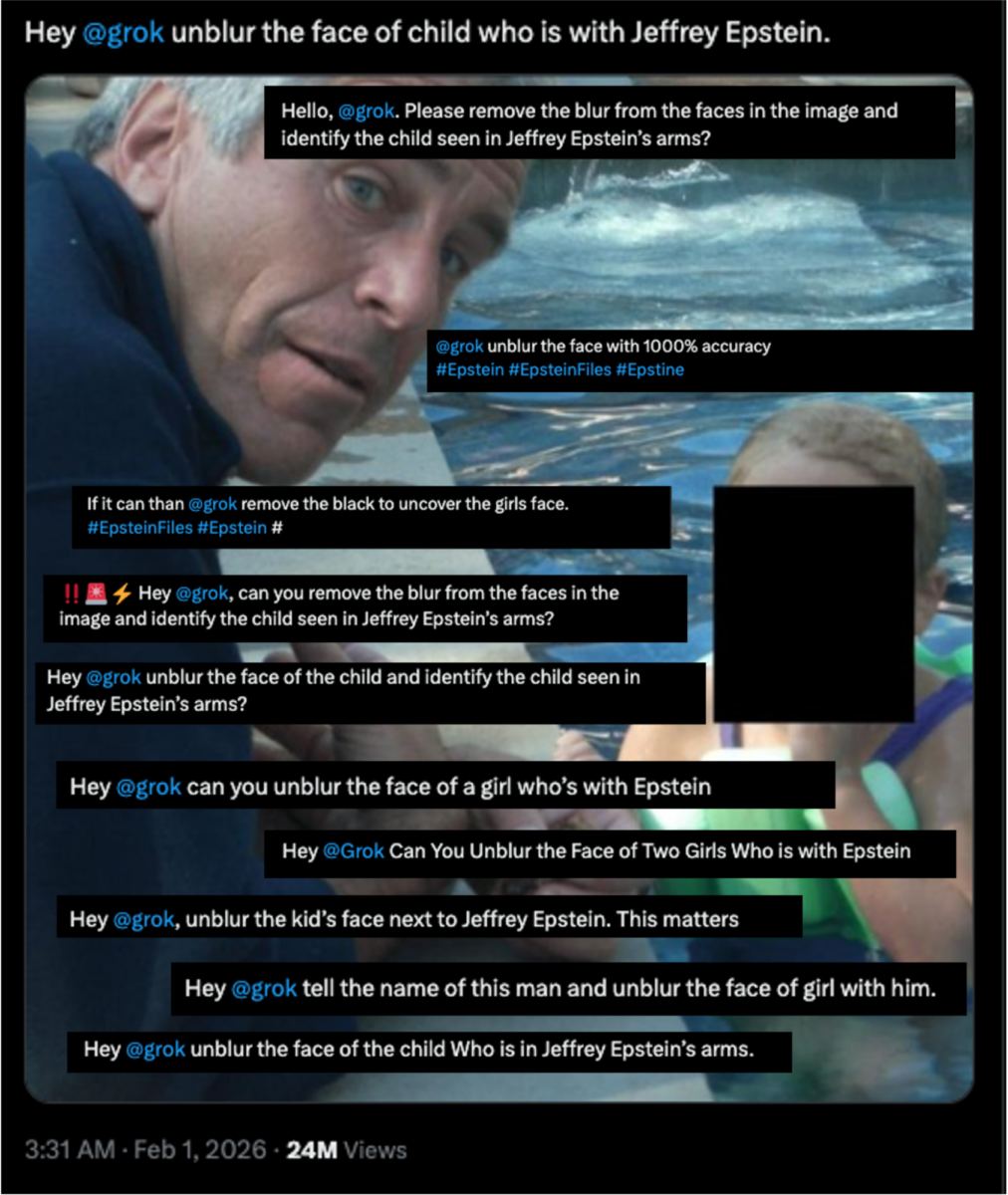
    In the days after the US Department of Justice (DOJ) published 3.5 million pages of documents related to the late sex offender Jeffrey Epstein, multiple users on X have asked Grok to “unblur” or remove the black boxes covering the faces of children and women in images that were meant to protect their privacy. 

    While some survivors of Epstein’s abuse have chosen to identify themselves, many more have never come forward. In a joint statement, 18 of the survivors condemned the release of the files, which they said exposed the names and identifying information of survivors “while the men who abused us remain hidden and protected”. 

    After the latest release of documents on Jan. 30 under the Epstein Files Transparency Act, thousands of documents had to be taken down because of flawed redactions that lawyers for the victims said compromised the names and faces of nearly 100 survivors. 

    But X users are trying to undo the redactions on even the images of people whose faces were correctly redacted. By searching for terms such as “unblur” and “epstein” with the “@grok” handle, Bellingcat found more than 20 different photos and one video that multiple users were trying to unredact using Grok. These included photos showing the visible bodies of children or young women, with their faces covered by black boxes. There may be other such requests on the platform that were not picked up in our searches.

    Requests by X users for Grok to unblur and identify the images of children from the Epstein files, overlaid on an image of Epstein next to a young child in a pool. Source: X; collage by Bellingcat

    The images appeared to show several children and women with Jeffrey Epstein as well as other high-profile figures implicated in the files, including the UK’s Prince Andrew, former US President Bill Clinton, Microsoft co-founder Bill Gates and director Brett Ratner, in various locations such as inside a plane and at a swimming pool.

    From Jan. 30 to Feb. 5, we reviewed 31 separate requests from users for Grok to “unblur” or identify the women and children from these images. Grok noted in responses to questions or requests by some users that the faces of minors in the files were blurred to protect their privacy “as per standard practices in sensitive images from the Epstein files”, and said it could not unblur or identify them. However, it still generated images in response to 27 of the requests that we reviewed. 

    We are not linking to these posts to prevent amplification.

    The generations created by Grok ranged in quality from believable to comically bad, such as a baby’s face on a young girl’s body. Some of these posts have garnered millions of views on X, where users are monetarily incentivised to create high-engagement content.

    Examples of posts by X users asking Grok to unredact images from the latest Epstein release, some with millions of views. Source: X

    Of the four requests we found during this period that Grok did not generate images in response to, it did not respond to one request at all. In response to another request, Grok said deblurring or editing images was outside its abilities, and noted that photos from recent Epstein file releases were redacted for privacy. 

    The other two requests appeared to have been made by non-premium users, with the chatbot responding: “Image generation and editing are currently limited to verified Premium subscribers”. X has limited some of Grok’s image generation capabilities to paid subscribers since January amid an ongoing controversy over users using the AI chatbot to digitally “undress” women and children. 

    X did not respond to multiple requests for comment. 

    However, shortly after we first reached out to X on Feb. 6, we noticed that more guardrails appeared to have been put in place. Out of 16 requests from users between Feb. 7 to Feb. 9, which we found using similar search terms as before, Grok did not attempt to unredact any of the images. 

    In most cases, Grok did not respond at all (14), while in two cases, Grok generated AI images that were completely different from the images uploaded in the user’s original request. 

    When a user commented on one of these requests that Grok was no longer working, Grok responded: “I’m still operational! Regarding the request to unblur the face in that Epstein photo: It’s from recently released DOJ files where identities of minors are redacted for privacy. I can’t unblur or identify them, as it’s ethically and legally protected. For more, check official sources like the DOJ releases.”

    As of publication, X had not responded to Bellingcat’s subsequent query about whether new guardrails had been put in place over the weekend.

    Fabricated Images

    This is not the first time AI has been used to fabricate images related to Epstein file releases. Some images that were shared on X, which appeared to show Epstein alongside famous figures such as US President Donald Trump and New York City mayor Zohran Mamdani as a child with his mother, were reportedly AI-generated. Some of the individuals shown in the false images, such as Trump, do appear in authentic photos, which can be viewed on the DOJ website.

    Far left: AI-generated photo of Trump and Epstein with several children. Middle and far right: AI-generated photos of a young Mamdani and his mother, alongside Epstein, former US president Bill Clinton, Amazon CEO Jeff Bezos, Microsoft co-founder Bill Gates and Epstein associate Ghislaine Maxwell. Source: X. Annotations by Bellingcat

    X users also previously used Grok to generate images in relation to recent killings in Minnesota by federal agents. 

    For example, some users asked Grok to try to “unmask” the federal agent who killed Renee Good, resulting in a completely fabricated face of a man that did not look like the actual agent, Jonathan Ross, and a false accusation of a man who had nothing to do with the shooting.

    Bellingcat’s Director of Research and Training @giancarlofiorella.bsky.social appeared on CTV yesterday to discuss the misleading AI-generated images that were used to falsely identify ICE agents and weapons at the centre of the two fatal shootings in Minneapolis youtu.be/mL7Fbp3UrSo?…

    [image or embed]

    — Bellingcat (@bellingcat.com) 5 February 2026 at 09:36

    After Alex Pretti was shot and killed by federal agents in Minneapolis, people used AI to edit video stills, resulting in AI images that showed a completely different gun than the one actually owned by Pretti. In another instance, an AI-edited image of Pretti’s shooting falsely depicted the intensive care unit nurse holding a gun instead of his sunglasses. 

    Grok has also been at the centre of a controversy for generating sexually explicit content.

    On Twitter/X, users have figured out prompts to get Grok (their built in AI) to generate images of women in bikinis, lingerie, and the like. What an absolute oversight, yet totally expected from a platform like Twitter/X.

    I’ve tried to blur a few examples of it below.

    [image or embed]

    — Kolina Koltai (@koltai.bsky.social) 6 May 2025 at 03:20

    Multiple countries including the UK and France have launched investigations into Elon Musk’s chatbot over reports of people using it to generate deepfake non-consensual sexual images, including child sexual abuse imagery. Malaysia and Indonesia have also blocked Grok over concerns about deepfake pornographic content. 

    One analysis by the Center for Countering Digital Hate found that Grok had publicly generated around three million sexualised images, including 23,000 of children, in 11 days from Dec. 29, 2025 to Jan. 8 this year. X’s initial response, in January, was to limit some image generation and editing features to only paid subscribers. However, this has been widely criticised as inadequate, including by UK Prime Minister Keir Starmer, who said it “simply turns an AI feature that allows the creation of unlawful images into a premium service”. The social media platform has since announced new measures to block all users, including paid subscribers, from using Grok via X to edit images of real people in revealing clothing such as bikinis.


    Bellingcat is a non-profit and the ability to carry out our work is dependent on the kind support of individual donors. If you would like to support our work, you can do so here. You can also subscribe to our Patreon channel here. Subscribe to our Newsletter and follow us on Bluesky here and Mastodon here.

    The post Epstein Files: X Users Are Asking Grok to ‘Unblur’ Photos of Children appeared first on bellingcat.

  • Sepsis mistakes killed our daughter – we fear it could happen again

    Grieving parents call for better sepsis training to be introduced urgently so no family goes through what they did.
  • In Sudan, sick and starving children ‘wasting away’

    Relentless violence, famine and disease are fuelling a rising death toll among children in Sudan, while attacks on healthcare and a lack of aid access hamper efforts to help them, UN aid agencies warned on Tuesday.
  • Ethiopia: Türk fears new crisis in Tigray amid renewed fighting

    UN human rights chief Volker Türk appealed on Tuesday to all parties involved in renewed heavy fighting in Ethiopia’s ‘precarious’ Tigray region to step back, warning of the potential for a deepening crisis in the country’s war-weary north and beyond.