Blog

  • A Businesswoman’s alleged ‘Black Flight’ From the Mountains of Papua New Guinea to Trial in Australia

    A prominent China-born businesswoman with ties to the highest levels of government in Papua New Guinea will stand trial in Australia for her alleged role in masterminding an audacious “black flight” plot to smuggle crystal methamphetamine across the Torres Strait.

    Mei Lin, 43, was committed on March 20 to stand trial in the Queensland Supreme Court following a four-day hearing at the Brisbane Magistrates Court. Australian prosecutors allege that Ms. Lin orchestrated the storage and transportation of more than 71 kilograms (about 156 pounds) of the drug, which was flown from a remote, mountainous airstrip in Papua New Guinea to Australia’s far north in a twin-engine propeller plane in 2023.

    Her arrest in Brisbane in early 2024 sent shockwaves through Papua New Guinea, where she had cultivated a sprawling corporate empire from her base in the port city of Lae. A 2024 investigation by OCCRP and Inside PNG revealed that her connections included the country’s former deputy prime minister, and that companies linked to her had even benefited from Australian government aid intended to support local development.

    The looming trial marks a significant step for law enforcement as they grapple with a surge of illicit narcotics trafficking through the Pacific Islands. Transnational criminal syndicates are increasingly utilizing the region as a staging ground, drawn by the highly lucrative drug markets in Australia and New Zealand. 

    Papua New Guinea—with its vast, rugged geography, developmental challenges, and pervasive corruption—has become an attractive waypoint. Traffickers frequently exploit the porous border to move drugs into Australia’s remote, tropical north before distributing them southward to major population centers like Sydney and Melbourne.

    The advancement of Lin’s case follows the reported convictions of at least four Australians, including the crew of the illicit flight.

    Meanwhile, the fallout continues in Papua New Guinea, where authorities have independently alleged that Lin was a central figure in the smuggling syndicate. Eight people—including a local police officer and a soldier—have been charged in the country and are currently awaiting trial.

  • Haiti’s freefall demands urgent global action as millions face hunger and violence

    Haiti is facing “one of the most severe and rapidly deteriorating humanitarian crises in the Western Hemisphere,” a senior UN aid official warned on Friday, underscoring the need for continued global attention to alleviate suffering there. 
  • Sudan: 14 million displaced; hunger and attacks on health continue as war enters fourth year

    As Sudan approaches the third anniversary of a brutal civil war, millions remain displaced and hungry while the health system lies in ruins, with no end to the violence in sight, UN agencies said on Friday.
  • Pluralistic: Canny Valley and Creative Commons (10 Apr 2026)

    Today’s links


    A mockup of Canny Valley, set into an oil painting of a pastoral scene.

    Canny Valley and Creative Commons (permalink)

    Last year, I ran a wildly successful Kickstarter campaign to pre-sell my ebooks, audiobooks and hardcovers of my book Enshittification, which went on to be an international bestseller, selling out 10 printings in the first 11 weeks:

    https://www.kickstarter.com/projects/doctorow/enshittification-the-drm-free-audiobook

    If you’d like an essay-formatted version of this thread to read or share, here’s a link to it on pluralistic.net, my surveillance-free, ad-free, tracker-free blog:

    https://pluralistic.net/2026/04/10/canny-valley#limited-edition

    The cover of the Canny Valley paperback, on a worn Persian rug in my office.

    I’ve done many of these Kickstarter campaigns now, and I always try to come up with something special for backers – some limited edition book or tchotchke that lets me scratch my own itch for making beautiful physical things, and also lets a few backers splash out on a truly special item. I’ve come up with some doozies, like:

    • A hand-copied manuscript for the original, never-before-seen ending for my novel Little Brother

    https://www.kickstarter.com/projects/doctorow/attack-surface-audiobook-for-the-third-little-brother-book/rewards

    • Hand-annotated pages making fun of Robert Bork’s The Antitrust Paradox, displayed in shadow boxes:

    https://www.kickstarter.com/projects/doctorow/chokepoint-capitalism-an-audiobook-amazon-wont-sell/rewards

    • A leather bound, extremely limited edition copy of Red Team Blues, with a secret miniature bound copy of the unedited manuscript for The Bezzle in a hidden cavity:

    https://www.kickstarter.com/projects/doctorow/red-team-blues-another-audiobook-that-amazon-wont-sell/rewards

    • And, for Enshittification, Canny Valley, a limited edition book of my collage illustrations from Pluralistic, made from Creative Commons and public domain sources, with an introduction by Bruce Sterling:

    https://www.kickstarter.com/projects/doctorow/enshittification-the-drm-free-audiobook/rewards

    I put 100 copies of Canny Valley up for sale in the Enshittification Kickstarter and all of them sold out in a matter of days. However, as promised at the time, there is a second chance to get a copy of the book, through the Creative Commons 25th anniversary fundraiser, which has just kicked off:

    https://mailchi.mp/creativecommons/were-turning-25-book-giveaway

    The whole print run for Canny Valley was limited to 500 copies, and it is the only run I will do for the book. 100 copies were sold to Kickstarter backers, I kept 25 for myself, and the remaining 375 are now available as a thank-you gift for people who make tax-deductible gifts to CC.

    I have been a great supporter of Creative Commons since its inception – literally, I was around when Aaron Swartz, Matt Haughey and Lisa Rein worked with Larry Lessig to design the data scheme and user interface to create, use and re-use Creative Commons licenses. My debut novel, Down and Out in the Magic Kingdom, was the first book ever released under a CC license:

    https://craphound.com/down/download

    Creative Commons arose out of the copyright wars of the early 2000s, in which the severe deficiencies of using copyright as the primary form of internet regulation were becoming ever clearer. Then – as now – the internet was filling up with material that everyday people produced together, incorporating one another’s work, as well as popular works that had meaning to them. Virtually all of this material violated copyright law, and bringing it into compliance would cost hundreds of billions of dollars in billable lawyer hours to draft, negotiate and sign all the licenses needed to avoid both criminal and civil liability.

    That’s where CC came in: a team of international lawyers standardized a set of legal licenses that did something new and necessary: facilitated sharing and remix, rather than restricting them. Simply apply a CC license to your work – say, a Wikipedia contribution, a Flickr photo, or a story on AO3 – and others would be able to reproduce, adapt and recombine that work with other CC licensed works. What’s more, thanks to the heroic efforts of the international CC team, these licenses were able to span borders, languages and legal systems, meaning that a Japanese animator can create a short based on a French story, using Australian 3D assets and a Croatian soundtrack:

    https://creativecommons.org/licenses/list.en

    It’s hard to overstate what a heroic feat of lawyering this is. Making a set of documents that allows creativity to spread freely across 45+ (often very different) legal systems is arguably the most ambitious piece of applied IP legal research ever undertaken. Today, tens of billions of works are CC licensed, including (to name just one example), all of Wikipedia.

    I rely heavily on CC licensed works to make the images that run over my posts on Pluralistic, my CC-licensed newsletter. I combine these with public domain images in the GIMP (a powerful free/open Photoshop replacement that runs GNU/Linux, MacOS and Windows) to make my collages, which you can download in high-rez (and freely re-use, thanks to the CC licenses I apply to each of them) from this Flickr set of 350+ items:

    https://www.flickr.com/photos/doctorow/albums/72177720316719208?sd

    Canny Valley collects 80 of my favorite collages in a beautiful book that was printed on 100lb Mohawk paper on an Indigo digital offset printer and bound with PVA glue that will last a century, at Pasadena’s Typecraft, a family-owned print shop that’s been in business for more than 100 years:

    https://www.typecraft.com/live2/who-we-are.html

    It was designed by the type legend John D Berry:

    https://johndberry.com/

    And the introduction was written by my friend and mentor, the cyberpunk pioneer and digital art impresario Bruce Sterling:

    https://en.wikipedia.org/wiki/Bruce_Sterling

    An unflattering collage depicting Elon Musk as a baby in a bathtub, from the interior of the Canny Valley paperback, on a worn Persian rug in my office.

    I published a long post that explained my creative process last year, including Bruce’s intro (which is also CC licensed). I’m going to reproduce Bruce’s intro below, but you can read the whole post here:

    https://pluralistic.net/2025/09/04/illustrious/#chairman-bruce

    I love these little books and I love that there’s a chance for a few more people to lay hands on their own – and I especially love that this will support Creative Commons, an organization that produces digital public goods for a new, good internet:

    https://mailchi.mp/creativecommons/were-turning-25-book-giveaway

    ==

    INTRODUCTION

    by Bruce Sterling

    In 1970 a robotics professor named Masahiro Mori discovered a new problem in aesthetics. He called this “bukimi no tani genshō.”

    The Japanese robots he built were functional, so the “bukimi no tani” situation was not an engineering problem. It was a deep and basic problem in the human perception of humanlike androids.

    A flayed human face with huge, staring eyes, held open with cruel calipers. The calipers' handles bear the 'As Seen On TV' logos. In the center of each pupil is an Amazon Prime logo. Behind this figure is a static-distorted title card for a K-Tel record of the month club ad.

    Humble assembly robots, with their claws and swivels, those looked okay to most people. Dolls, puppets and mannequins, those also looked okay.

    Living people had always aesthetically looked okay to people. Especially, the pretty ones.

    However, between these two realms that the late Dr Mori was gamely attempting to weld together — the world of living mankind and of the pseudo-man-like machine– there was an artistic crevasse. Anything in this “Uncanny Valley” looked, and felt, severely not-okay. These overdressed robots looked and felt so eerie that their creator’s skills became actively disgusting. The robots got prettier, but only up to a steep verge. Then they slid down the precipice and became zombie doppelgangers.

    The ruins of the Temple of Jupiter, taken in the late 18th century, overlooking a stretch Lebanon. It has been emblazoned with the 1970s-era logo for the University of Chicago Graduate School of Business. Before it stands a figure taken from an early 1900s illustrated bible, depicting a Hebrew priest making an offering to the golden calf at the foot of Mt Sinai. The priest's head has been replaced with the head of Milton Friedman. The calf has been adorned with a golden top-hat and a radiating halo of white light.

    That’s also the issue with the aptly-titled “Canny Valley” art collection here. People already know how to react aesthetically to traditional graphic images. Diagrams are okay. Hand-drawn sketches and cartoons are also okay. Brush-made paintings are mostly fine. Photographs, those can get kind of dodgy.

    A photo taken on the Space Shuttle, showing an astronaut pointing at a switch on a control panel. The photo has been altered. The astronaut's head has been replaced with a grinning, horned devil-woman's head. The switch has been replaced with a red-guarded toggle switch, labeled 'SELF-DESTRUCT!' The astronaut's arms have been colorized to match the brick-red skin of the demon head. The background has been slightly blurred. Mike (modified)/https://www.flickr.com/photos/stillwellmike/15676883261/CC BY-SA 2.0/https://creativecommons.org/licenses/by-sa/2.0/

    Digital collages that slice up and weld highly disparate elements like diagrams, cartoons, sketches and also photos and paintings, those trend toward the uncanny.

    The pixel-juggling means of digital image-manipulation are not art-traditional pencils or brushes. They do not involve the human hand, or maybe not even the human eye, or the human will. They’re not fixed on paper or canvas; they’re a Frankenstein mash-up landscape of tiny colored screen-dots where images can become so fried that they look and feel “cursed.” They’re conceptually gooey congelations, stuck in the valley mire of that which is and must be neither this-nor-that.

    A scythe-wielding, crook-backed Father Time bends low to stare into the face of a cherubic Baby New Year. Father Time wears a backwards baseball-cap with the Tiktok logo. Baby New Year is waving goodbye and holding a satchel decorated with the 'code waterfall' from the credit sequences of the Wachowskis' 'Matrix' movies. The background is a stormy sky, with a forked lightning striking between the two figures.

    A modern digital artist has billions of jpegs in files, folders, clouds and buckets. He’s never gonna run out of weightless grist from that mill.

    Why would Cory Doctorow — novelist, journalist, activist, opinion columnist and so on — want to lift his typing fingers from his lettered keyboard, so as to create graphics with cut-and-paste and “lasso tools”?

    An early 20th century editorial cartoon depicting the Standard Oil Company an a world-spanning octopus clutching the organs of state - White House, Capitol dome, etc - in its tentacles. It has been altered: to its left, curled within its tentacles, stands an early 20th century cartoon depicting Uncle Sam as a policeman with a billyclub, with a DOJ Antitrust Division crest on his chest. On its right, one of its tentacles clutches an early Google 'I'm Feeling Lucky' button. Its head has been colored in with bands in the colors of the Google logo, surmounted by the Chrome logo. Its eyes have been replaced with the eyes of HAL9000 from Kubrick's '2001: A Space Odyssey.' Nestled in one of its armpits is the Android robot. Cryteria (modified)/https://commons.wikimedia.org/wiki/File:HAL9000.svg/CC BY 3.0/https://creativecommons.org/licenses/by/3.0/deed.en

    Cory Doctorow also has some remarkably tangled, scandalous and precarious issues to contemplate, summarize and discuss. They’re not his scandalous private intrigues, though. Instead, they’re scandalous public intrigues. Or, at least Cory struggles to rouse some public indignation about these intrigues, because his core topics are the tangled penthouse/slash/underground machinations of billionaire web moguls.

    Cory really knows really a deep dank lot about this uncanny nexus of arcane situations. He explains the shameful disasters there, but they’re difficult to capture without torrents of unwieldy tech jargon.

    I think there are two basic reasons for this.

    The important motivation is his own need to express himself by some method other than words.

    I’m reminded here of the example of H. G. Wells, another science fiction writer turned internationally famous political pundit. HG Wells was quite a tireless and ambitious writer — so much so that he almost matched the torrential output of Cory Doctorow.

    An old woodcut of a disembodied man's hand operating a Ouija board planchette. It has been modified to add an extra finger and thumb. It has been tinted green. It has been placed on a 'code waterfall' backdrop as seen in the credit sequences of the Wachowskis' 'Matrix' movies.

    But HG Wells nevertheless felt a compelling need to hand-draw cartoons. He called them “picshuas.” These hundreds of “picshuas” were rarely made public. They were usually sketched in the margins of his hand-written letters. Commonly the picshuas were aimed at his second wife, the woman he had renamed “Jane.” These picshuas were caricatures, or maybe rapid pen-and-ink conceptual outlines, of passing conflicts, events and situations in the life of Wells. They seemed to carry tender messages to Jane that the writer was unable or unwilling to speak aloud to her. Wells being Wells, there were always issues in his private life that might well pose a challenge to bluntly state aloud: “Oh by the way, darling, I’ve built a second house in the South of France where I spend my summers with a comely KGB asset, the Baroness Budberg.” Even a famously glib and charming writer might feel the need to finesse that.

    A Soviet propaganda poster depicting two workers holding flags in front of a locomotive. The flags have been replaced with US flags. The locomotive's face has been replaced with the glaring red eye of HAL 9000 from Kubrick's '2001: A Space Odyssey.' The maxim below has been replaced with the lettering from a Walmart 'everyday low prices' sign. The background has been replaced with a posterized grocery aisle. Cryteria (modified)/https://commons.wikimedia.org/wiki/File:HAL9000.svg/CC BY 3.0/https://creativecommons.org/licenses/by/3.0/deed.en

    Cory Doctorow also has some remarkably tangled, scandalous and precarious issues to contemplate, summarize and discuss. They’re not his scandalous private intrigues, though. Instead, they’re scandalous public intrigues. Or, at least Cory struggles to rouse some public indignation about these intrigues, because his core topics are the tangled penthouse/slash/underground machinations of billionaire web moguls.

    Cory really knows really a deep dank lot about this uncanny nexus of arcane situations. He explains the shameful disasters there, but they’re difficult to capture without torrents of unwieldy tech jargon.

    A demonic figure cropped from the 'Hell' section of Hieronymus Bosch's 'Garden of Earthly Delights.' She is on all fours, looking over her shoulder. Her entire rectum has been removed, revealing smaller, industrious demonic figures at work inside her guts. Her open rectum has been limned in radioactive acid-green light. Atop her flat hat is an open box of radium suppositories, lid open to reveal (entirely inadequate) health warnings. The background is a dark, abstract damask wallpaper pattern.

    So instead, he diligently clips, cuts, pastes, lassos, collages and pastiches. He might, plausibly, hire a professional artist to design his editorial cartoons for him. However, then Cory would have to verbally explain all his political analysis to this innocent graphics guy. Then Cory would also have to double-check the results of the artist and fix the inevitable newbie errors and grave misunderstandings. That effort would be three times the labor for a dogged crusader who is already working like sixty.

    It’s more practical for him to mash-up images that resemble editorial cartoons.

    He can’t draw. Also, although he definitely has a pronounced sense of aesthetics, it’s not a aesthetic most people would consider tasteful. Cory Doctorow, from his very youth, has always had a “craphound” aesthetic. As an aesthete, Cory is the kind of guy who would collect rain-drenched punk-band flyers that had fallen off telephone poles and store them inside a 1950s cardboard kid-cereal box. I am not scolding him for this. He’s always been like that.

    A magnified image of the inside of an automated backup tape library, with gleaming racks of silver tape drives receding into the distance. In the foreground is a pile of dirt being shoveled by three figures in prisoner's stripes. Two of the figures' heads have been replaced with cliche hacker-in-hoodie heads, from which shine yellow, inverted Amazon 'smile' logos, such that the smile is a frown. The remaining figure's head has been replaced with a horse's head. Behind the figure is an impatiently poised man in a sharp business suit, glaring at his watch. His head has been replaced with the glaring red eye of HAL 9000 from Kubrick's '2001: A Space Odyssey.' Cryteria (modified)/https://commons.wikimedia.org/wiki/File:HAL9000.svg/CC BY 3.0/https://creativecommons.org/licenses/by/3.0/deed.en

    As Wells used to say about his unique “picshuas,” they seemed like eccentric scribblings, but over the years, when massed-up as an oeuvre, they formed a comic burlesque of an actual life. Similarly, one isolated Doctorow collage can seem rather what-the-hell. It’s trying to be “canny.” If you get it, you get it. If you don’t get the first one, then you can page through all of these, and at the end you will probably get it. En masse, it forms the comic burlesque of a digital left-wing cyberspatial world-of-hell. A monster-teeming Silicon Uncanny Valley of extensively raked muck.

    Sigmund Freud's study with his famous couch. Behind the couch stands an altered version of the classic Freud portrait in which he is smoking a cigar. Freud's clothes and cigar have all been tinted in bright neon colors. His head has been replaced with the glaring red eye of HAL9000 from Kubrick's '2001: A Space Odyssey.' His legs have been replaced with a tangle of tentacles

    There are a lot of web-comix people who like to make comic fun of the Internet, and to mock “the Industry.” However, there’s no other social and analytical record quite like this one. It has something of the dark affect of the hundred-year-old satirical Dada collages of Georg Schultz or Hannah Hoch. Those Dada collages look dank and horrible because they’re “Dada” and pulling a stunt. These images look dank and horrible because they’re analytical, revelatory and make sense.

    If you do not enjoy contemporary electronic politics, and instead you have somehow obtained an art degree, I might still be able to help you with my learned and well-meaning intro here. I can recommend a swell art-critical book titled “Memesthetics” by Valentina Tanni. I happen to know Dr. Tanni personally, and her book is the cat’s pyjamas when it comes to semi-digital, semi-collage, appropriated, Situationiste-detournement, net.art “meme aesthetics.” I promise that I could robotically mimic her, and write uncannily like her, if I somehow had to do that. I could even firmly link the graphic works of Cory Doctorow to the digital avant-garde and/or digital folk-art traditions that Valentina Tanni is eruditely and humanely discussing. Like with a lot of robots, the hard part would be getting me to stop.

    A painting of Ulysses tied to the mast, beset by flying sirens. The sirens' wings have been replaced with the Bluesky butterfly wing logo. On the deck of Ulysses' trireme is a giant poop emoji.

    Cory works with care on his political meme-cartoons — because he is using them to further his own personal analysis, and to personally convince himself. They’re not merely sharp and partisan memes, there to rouse one distinct viewer-emotion and make one single point. They’re like digital jigsaw-puzzle landscape-sketches — unstable, semi-stolen and digital, because the realm he portrays is itself also unstable, semi-stolen and digital. The cartoons are dirty and messy because the situations he tackles are so dirty and messy. That’s the grain of his lampoon material, like the damaged amps in a punk song. A punk song that was licensed by some billionaire and then used to spy on hapless fans with surveillance-capitalism.

    A photo of an orange Telemation acoustic coupler next to an avocado-green German 611 dial phone, whose receiver is socketed to the coupler in what Neal Stephenson memorably described as 'a kind of informational soixante-neuf.' The image has been modified to put a colorized version of Woody Guthrie's iconic 'THIS MACHINE KILLS FASCISTS' hand-lettered label on the side of the coupler. Felix Winkelnkemper (modified)/https://commons.wikimedia.org/wiki/File:Acoustic_Coupler.jpg/CC BY-SA 4.0/https://creativecommons.org/licenses/by-sa/4.0/deed.

    Since that’s how it goes, that’s also what you’re in for. You have been warned, and these collages will warn you a whole lot more.

    If you want to aesthetically experience some elegant, time-tested collage art that was created by a major world artist, then you should gaze in wonder at the Max Ernst masterpiece, “Une semaine de bonté” (“A Week of Kindness”). This indefinable “collage novel” aka “artist’s book” was created in the troubled time of 1934. It’s very uncanny rather than “canny, “and it’s also capital-A great Art. As an art critic, I could balloon this essay to dreadful robotic proportions while I explain to you in detail why this weirdo mess is a lasting monument to the expressive power of collage. However, Cory Doctorow is not doing Max Ernst’s dreamy, oneiric, enchanting Surrealist art. He would never do that and it wouldn’t make any sense if he did.

    A heavily armed and armored figure with the head of a foolishly grinning 19th century newsie. He stands in the atrium of a pink, vintage mall.

    Cory did this instead. It is art, though. It is what it is, and there’s nothing else like it. It’s artistic expression as Cory Doctorow has a sincere need to perform that, and in twenty years it will be even more rare and interesting. It’s journalism ahead of its time (a little) and with a passage of time, it will become testimonial.

    Bruce Sterling — Ibiza MMXXV


    Hey look at this (permalink)


    A shelf of leatherbound history books with a gilt-stamped series title, 'The World's Famous Events.'

    Object permanence (permalink)

    #20yrsago Al Franken wants a balanced war budget #15yrsago Fake-make: counterfeit handmade objects from big manufacturers https://web.archive.org/web/20110410125346/http://blog.makezine.com/archive/2011/04/untouched-by-human-hands.html

    #15yrsago Marketplace for hijacked computers https://krebsonsecurity.com/2011/04/is-your-computer-listed-for-rent/

    #15yrsago Fake-make: counterfeit handmade objects from big manufacturers https://web.archive.org/web/20110410125346/http://blog.makezine.com/archive/2011/04/untouched-by-human-hands.html

    #10yrsago Pope invites Bernie Sanders to Vatican to speak about “social, economic, and environmental” issues https://www.bbc.com/news/election-us-2016-35999269#sa-ns_mchannel=rss&ns_source=PublicRSS20-sa

    #10yrsago Baby sues US government for searching his diapers in racial profiling/War on Terror case https://arstechnica.com/tech-policy/2016/04/baby-who-had-his-diapers-searched-at-airport-is-part-of-class-action-suit/

    #10yrsago Tax investigators and bill collectors use Rich Kids of Instagram to uncover oligarchs’ hidden millions https://www.theguardian.com/technology/2016/apr/03/super-rich-discover-hidden-risks-instagram-yachts-jets

    #10yrsago The international art market is a money laundry whose details are in the Panama Papers https://web.archive.org/web/20160408024110/https://fusion.net/story/288515/panama-papers-leak-art-market/

    #10yrsago UK government warns people that copyright trolls are a scam https://torrentfreak.com/uk-govt-issues-advice-on-dealing-with-copyright-trolls-160408/?utm_source=feedburner&utm_medium=feed&utm_campaign=Feed%3A+Torrentfreak+(Torrentfreak)

    #10yrsago Why the rise of ransomware attacks should worry you https://arstechnica.com/information-technology/2016/04/ok-panic-newly-evolved-ransomware-is-bad-news-for-everyone/

    #5yrsago Howard Dean’s racist, genocidal pharma sellout https://pluralistic.net/2021/04/08/howard-dino/#the-scream

    #1yrago We CAN have nice things https://pluralistic.net/2021/04/08/howard-dino/#payfors


    Upcoming appearances (permalink)

    A photo of me onstage, giving a speech, pounding the podium.


    A screenshot of me at my desk, doing a livecast.

    Recent appearances (permalink)


    A grid of my books with Will Stahle covers..

    Latest books (permalink)


    A cardboard book box with the Macmillan logo.

    Upcoming books (permalink)

    • “The Reverse-Centaur’s Guide to AI,” a short book about being a better AI critic, Farrar, Straus and Giroux, June 2026 (https://us.macmillan.com/books/9780374621568/thereversecentaursguidetolifeafterai/)
    • “Enshittification, Why Everything Suddenly Got Worse and What to Do About It” (the graphic novel), Firstsecond, 2026

    • “The Post-American Internet,” a geopolitical sequel of sorts to Enshittification, Farrar, Straus and Giroux, 2027

    • “Unauthorized Bread”: a middle-grades graphic novel adapted from my novella about refugees, toasters and DRM, FirstSecond, 2027

    • “The Memex Method,” Farrar, Straus, Giroux, 2027


    Colophon (permalink)

    Today’s top sources:

    Currently writing: “The Post-American Internet,” a sequel to “Enshittification,” about the better world the rest of us get to have now that Trump has torched America. First draft complete. Second draft underway.

    • “The Reverse Centaur’s Guide to AI,” a short book for Farrar, Straus and Giroux about being an effective AI critic. LEGAL REVIEW AND COPYEDIT COMPLETE.
    • “The Post-American Internet,” a short book about internet policy in the age of Trumpism. PLANNING.

    • A Little Brother short story about DIY insulin PLANNING


    This work – excluding any serialized fiction – is licensed under a Creative Commons Attribution 4.0 license. That means you can use it any way you like, including commercially, provided that you attribute it to me, Cory Doctorow, and include a link to pluralistic.net.

    https://creativecommons.org/licenses/by/4.0/

    Quotations and images are not included in this license; they are included either under a limitation or exception to copyright, or on the basis of a separate license. Please exercise caution.


    How to get Pluralistic:

    Blog (no ads, tracking, or data-collection):

    Pluralistic.net

    Newsletter (no ads, tracking, or data-collection):

    https://pluralistic.net/plura-list

    Mastodon (no ads, tracking, or data-collection):

    https://mamot.fr/@pluralistic

    Bluesky (no ads, possible tracking and data-collection):

    https://bsky.app/profile/doctorow.pluralistic.net

    Medium (no ads, paywalled):

    https://doctorow.medium.com/

    Tumblr (mass-scale, unrestricted, third-party surveillance and advertising):

    https://mostlysignssomeportents.tumblr.com/tagged/pluralistic

    When life gives you SARS, you make sarsaparilla” -Joey “Accordion Guy” DeVilla

    READ CAREFULLY: By reading this, you agree, on behalf of your employer, to release me from all obligations and waivers arising from any and all NON-NEGOTIATED agreements, licenses, terms-of-service, shrinkwrap, clickwrap, browsewrap, confidentiality, non-disclosure, non-compete and acceptable use policies (“BOGUS AGREEMENTS”) that I have entered into with your employer, its partners, licensors, agents and assigns, in perpetuity, without prejudice to my ongoing rights and privileges. You further represent that you have the authority to release me from any BOGUS AGREEMENTS on behalf of your employer.

    ISSN: 3066-764X

  • MAHA Doctors Love Donald Trump

    Every day they show up to work, with sweet declarations of love for Trump pouring from their lips, they are further reaffirming their decision to bind themselves to everything he does.  

    The post MAHA Doctors Love Donald Trump first appeared on Science-Based Medicine.

  • HBO Obtains DMCA Subpoena to Unmask ‘Euphoria’ Spoiler Account on X

    HBO Obtains DMCA Subpoena to Unmask ‘Euphoria’ Spoiler Account on X

    HBO has a history of being plagued by high-profile leaks.

    Several Game of Thrones episodes leaked in the past, and the same applies to the sequel, House of the Dragon.

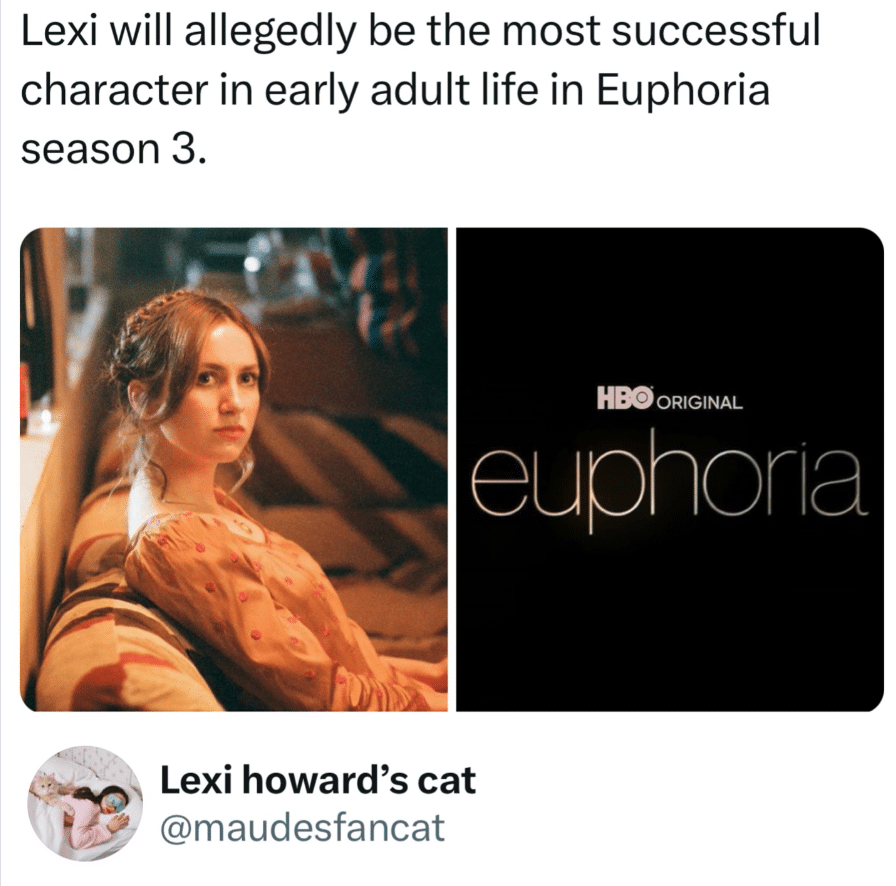
    With the long-awaited third season of HBO’s hit series Euphoria coming up this weekend, the company was on high alert. So, when it saw several ‘spoilers’ being posted by an X account operating under the name “Lexi howard’s cat”, it wasted no time to take action.

    Not the infringing tweet

    lexi

    The Lexi-inspired fan account has been around for a long time, sharing various Euphoria-related updates. However, a series of posts that were published in late March appeared to have hit too close to home.

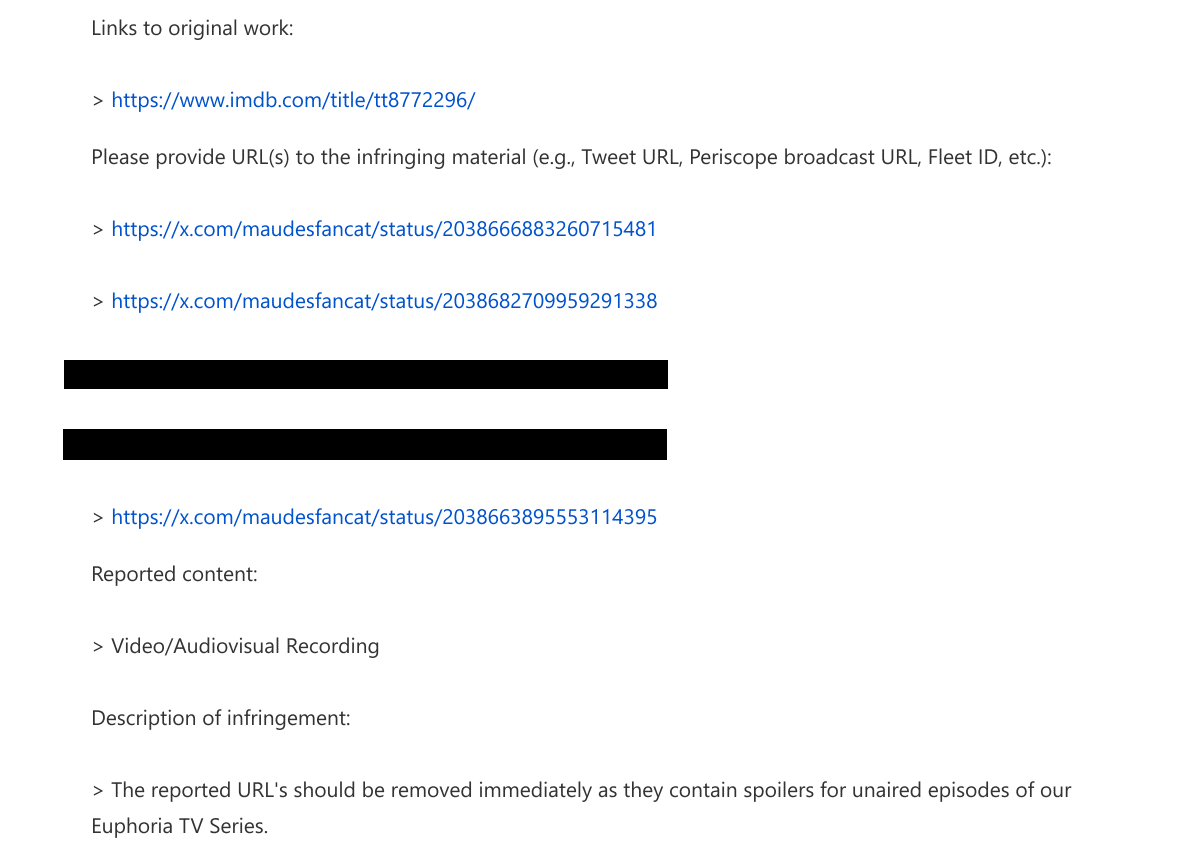
    On March 31, HBO’s parent company, Warner Bros. Discovery (WBD) sent a takedown notice to X, flagging several posts. According to Michael Bentkover, WBD’s Director of Worldwide Online Enforcement, these were “spoilers for unaired episodes of our Euphoria TV Series”.

    TorrentFreak was unable to find out what was posted exactly, but the DMCA notice identifies it as video/audiovisual recording.

    The DMCA notice

    takedown

    X confirmed receipt on the same day and presumably removed the posts. However, that was not the end of it. A week later, on April 7, the company requested a DMCA subpoena at a California federal court, with the goal to identify the person behind the @maudesfancat account.

    DMCA subpoenas are relatively easy to obtain, as they only require a court clerk to sign off, which indeed happened a day later.

    The issued subpoena requires X to share information sufficient to identify the person behind the account. This includes names, addresses, telephone numbers, email addresses, account numbers, IP addresses, and any other contact or billing records held by the platform.

    The signed subpoena

    subp

    Unlike the DMCA notice, where WBD used “video” to describe the content, the declaration to the court by Michael Bentkover classifies the infringing content as “summaries of unpublished, character, setting, and plots of a forthcoming series”.

    This distinction may matter, as a summary of a plot may not enjoy the same protection as a leaked video. Copyright generally protects the expression of a work, not the underlying ideas or plot descriptions.

    Then again, Bentkover also states that the user in question “posted access to HBO’s unpublished, copyright protected work from its forthcoming series,” which sounds substantial.

    For now, X Corp. has until April 23 to respond. Legally, both X and the account holder can challenge the subpoena, but no objections have been submitted in court yet. Meanwhile, the ‘Lexi howard’s cat’ account is no longer online.

    A copy of the subpoena, filed April 8 at the U.S. District Court for the Northern District of California, is available here (pdf). The notice of filing and supporting declaration can be found here (pdf).

    From: TF, for the latest news on copyright battles, piracy and more.

  • Psychiatric Force and Conversion Undermine Recovery2

    Psychiatric Force and Conversion Undermine Recovery2

    Instead of creating a sustainable environment for recovery, mainstream psychiatric practices often create more distress and reluctance. 

    Editor’s note: First published on Mad in America on March 28th 2026

    Recently, multiple blizzards have hit the Northeast, raising urgent questions about how to protect unhoused people exposed to dangerous winter conditions. In New York City, the usual response during extreme weather has often involved forcing people into shelters or hospitals, sometimes by use of police or other forms of coercion. The logic seems straightforward: if someone is vulnerable and refuses help, shouldn’t we step in and decide for them?

    This winter, however, the city tried something different. Instead of defaulting to force, officials expanded the number of options available to unhoused people, offering different types of shelter, warming spaces, and services. The mayor, Zohran Mamdani, spoke in a press conference about the impact of this process, suggesting that when they were given choices rather than ultimatums, homeless New Yorkers were more willing to accept support.

    For many psychiatric survivors, this shift represents something we have been advocating for years: agency and options. Not being labelled “non-compliant” for saying, “I don’t want to go to the hospital,” and not having distress interpreted as a justification for losing autonomy.

    Yet the assumption that people in distress must sometimes be coerced “for their own good” remains deeply embedded in mental health care. We often hear the same argument: wouldn’t someone experiencing suicidal thoughts, hallucinations, or intense distress be better off in a highly surveilled environment? And if they refuse, shouldn’t they be pressured or forced to accept treatment?

    But “better off” is a remarkably subjective standard. And despite how normalized it has become, coercion consistently undermines the very recovery it claims to protect.

    The recovery myth behind coercion

    Often, when I hear fellow psychiatric survivor stories, I hear a subtle questioning in their voices. They wonder whether what was experienced entailed coercion: “I was not forced or anything but I couldn’t get away.” “I wasn’t physically restrained, but I was given ECT without my consent.” We also hear it in instances of “well, I was not directly pressured or threatened, but it was the only option,” or “they told me it was the only thing that would help me.” These instances of what is called hidden coercion appear to eat away at people, washing away their confidence in themselves, little by little, instance by instance.

    Psychiatric coercion takes many forms, but it seems that many see it as crucial when dealing with psychiatrized people. The sounds of “it’s for their own good” echo in my head as I type this. The memories of being dismissed and discredited after having a psychiatric label slapped on me, the experience of becoming an invisible human.

    This “necessary” tool often has ripple effects, causing more harm directly or perpetuating cycles of harm and compounding distress. The deepening of harm often leads to more distress, which in turn leads to more coercive interventions, which in turn lead to more harm, and so on and on. This is not just something I experienced myself, but something I have witnessed as a psychology trainee. In many instances, it seemed like psychiatric treatment was the last thing a person needed, and it would have been best if they had psychosocial support instead.

    Forms of coercion in mental health settings

    Researchers have defined two modes of coercion employed in mental health settings: formal and informal coercion. Formal coercion is the most widely recognized: it’s the most visible, including the use of mechanical and chemical restraints, use of force, seclusion, and sometimes, involuntary hospitalization. By contrast, informal coercion takes on a subtle, less visible form, such as muddy consent that lacks transparency, weaponization of psychiatric diagnosis to suppress and contain, and “consent” under threat, including manipulative and paternalistic statements such as “it’s for your own good.” Psychiatric coercion is also used for the clinician to cover themselves from potential liability while knowing it is not a helpful tool for recovery.

    These practices are incredibly normalized in our society; it has been more and more ingrained. People seem to think that by normalizing “seeking help” we are destigmatizing mental health problems, but what I observe as a researcher and lived experience expert is exactly the contrary: we are creating more stigma, normalizing oppression and control of highly distressed people, and normalizing potential harm. We are corroding people’s agency and subjectivity slowly.

    In psychiatry, recovery is often defined by how productive an individual is in our society. Basically, if you’re not advancing the goals of capitalism, you are not meeting the optimal functioning expectations.

    However, if you ask those with lived experiences of the mental health system, recovery is a subjective continuum that depends on an individual’s own experiences, circumstances, desires, and choices. It could range from being able to attain a level of emotional stability to having a good quality of life to being able to regain control over one’s own experience and make decisions for oneself. This is why I often ask in my interviews with psychiatric survivors, “What does recovery mean to you?” Their answers often differ greatly from what mine would be.

    For many, recovery is contingent on relationships and safety. An important part of this is self-determination: the recognition that a person is able to make their own choices. The integration of shared decision-making approaches into mental health services attempts to honor this principle, but coercion and force are still prevalent despite these approaches. Coercion and force disempower people, show that their relationships are unsafe and disconnected, and thus prevent recovery. No one can heal in the environment that made them sick.

    Many people who come to receive mental health services arrive with a history that includes cumulative experiences of trauma, stress, or general adversity. Placing individuals in an environment that is not trauma-informed, but designed to gaslight, label, subdue, control, and contain at the cost of the individual and for the benefit of the system, will naturally create more adversity in a person’s life. Their needs are not being recognized or centered. This, in turn, will create more resistance towards help-seeking, more disengagement, fear, and distress. It makes people afraid of speaking out due to fear of being isolated, punished, and caged. So instead of creating a sustainable environment for recovery, traditional practices often create more distress and reluctance.

    How coercion has remained hidden

    In my work, I have interviewed many psychiatric survivors about their experiences. They often describe coercion and force. For instance, one psychiatric survivor described subtle and ambiguous forms of coercion occurring when seeking out services: “It’s the way you’re treated—when you’re seeking help, yet at times you can feel like a prisoner, like a criminal, like someone who is a problem, a burden. At times, they infantilize you or treat you as if you were part of the herd, so to speak—like sheep that need to be kept in line or herded along.”

    Listening to the experiences of people who sought out services at their most distressed, and instead found coercion, can be healing and reparative for many; it can help normalize their own experiences, and also help make meaning out of them. It can help people realize why the “care” they received did not feel good or necessarily helpful.

    Most people, although marked by their experiences with coercion in the mental health system, only spend a short amount of time in these settings. Therefore, if they achieve recovery and healing, it occurs outside of these settings and not within them. For many, this happens after finding alternatives, building community, leaving abusive households, and gaining housing or employment.

    Again, the root of healing is found in our relational and contextual world. That is why it is not rare that recovery occurs outside of these systems, and that these systems many times end up making the problems worse instead. To achieve this much-needed relational healing, however, trust is required, and building trust takes time and effort. People need to be treated with compassion and empathy, to have their needs valued and respected, and not the contrary of being coerced and condescended to.

    This has been identified in previous research: the language of having a chronic, lifelong illness leads to disempowerment. “Why try if this ‘disease’ is a part of me?” Psychiatric coercion feeds off that language of chronicity and the catastrophic prognosis without assuming responsibility for their own promotion of the status quo. The relationship has already been defined as one where the provider is the expert—the one who dominates, makes decisions, and serves as a seer, who can determine what someone’s future looks like based on how they act at their most vulnerable.

    Intersectional identities, power dynamics, and coercion

    These power dynamics extend into the identities of people experiencing psychological distress. The implicit and explicit biases of our mental health system can be unmasked based on how people’s ethno-racial, gender, and sexual identities are pathologized and oppressed within it. I must emphasize that our current mental health system is built upon the legacy of colonialism and genocide, as is our modern society. Consciously or unconsciously, otherness is not seen as beneficial to our society, neither in how people look and identify, nor in how they think.

    Minoritized people are often subjected to more restrictive, prescriptive, and violent forms of oppression. Ethno-racially minoritized people are restrained more often and for longer periods of time, and assigned highly stigmatized and personality-oriented psychiatric diagnoses. Meanwhile, LGBTQ+ folks are pathologized at high rates while ignoring factors such as discrimination and anti-LGBTQ+ policies. Women are often pathologized with personality disorders or viewed as delusional, and not believed when recounting their traumatic experiences. Homeless people often cycle in and out of hospitals, accumulating more and more debt, without being connected to psychosocial services in the ways that, when asked, they mention needing support. Moreover, poverty is often viewed through a pathological lens, weaponizing psychiatric labels on people who are in survival mode, trying to make ends meet. These examples make it clearer how coercion is about social control and punishment and not about care.

    What is there to lose when coercion in mental health settings is normalized?

    Many view psychiatric coercion as a necessary evil to which there is no alternative; this comes from a combination of stigmatizing beliefs, actual care for the person’s well-being, genuinely thinking of coercion as therapeutic, and safety concerns. In many cases, communities are in desperate need of support, but by normalizing coercion, relational ties and trust may be broken, while reluctance to seek out support or admit to distress might take their place.

    For many people, taking time to pause and be listened to can oftentimes be enough to reduce distress. In addition, community-based supports, including simple interventions such as “meal trains” where a different person volunteers to bring food to a household each day, may be essential to reducing distress and allowing time for recovery and processing. These sorts of approaches are rooted in dignity and care for the person, and centered around their own needs and choices.

    Nurturing communities create environments of care and healing, facilitating recovery and promoting prevention from further psychological distress. Prevention of further harm is crucial and life-saving for many individuals. Creating these types of environments takes time, just as recovering and healing do, but one cannot heal in an environment of manipulation or force. We cannot force or coerce people into recovery, which makes coercion incompatible with recovery.

    While mental health systems continue to perpetuate harm by engaging in coercion and utilizing coercive measures, these will not be recovery-oriented or centered around lived experience. There must be a shift in how help and care are defined within mental health. This needs to be accompanied by an ego deconstruction and a willingness to share equal power with people experiencing distress. This includes listening and believing their experiences, and actively working towards a paradigm shift. This shift includes partnering with community-based organizations, communities, and grassroots movements to provide sustainable support for people experiencing psychological distress.

    ****

    Mad in the UK hosts blogs by a diverse group of writers. The opinions expressed are the writers’ own.

    The post Psychiatric Force and Conversion Undermine Recovery2 appeared first on Mad in the UK.

  • Digital Preservationists at the After Violence Project and HMML Lend their Voices to the Our Future Memory Campaign

    Digital Preservationists at the After Violence Project and HMML Lend their Voices to the Our Future Memory Campaign

    Few organizations understand the moral imperative of digital preservation better than the Hill Museum & Manuscript Library (HMML) and the After Violence Project. That is why both have just endorsed Our Future Memory’s “Statement on Digital Rights,” joining a growing roster of organizations committed to preserving vulnerable archives and insisting on the four basic rights that they and other memory institutions need to do their critical work:

    1. COLLECT digital materials;
    2. PRESERVE those materials;
    3. PROVIDE CONTROLLED ACCESS; and
    4. COOPERATE with other memory institutions.

    HMML is a nonprofit engaged in photographing, cataloging, and providing free access to manuscripts housed in libraries around the world. Now celebrating over 60 years of operation, it was founded at Saint John’s University (SJU) in Minnesota when the threat of the Cold War loomed large. Father Colman Barry of the Order of Saint Benedict envisioned that SJU could provide a safe repository for microfilms of the Benedictine manuscripts held in European libraries. After that, HMML expanded its mission to preserve copies of manuscripts from different religious traditions in other regions. It now serves as a digital life raft for irreplaceable documents from Iraq, Ukraine, Gaza, and other war-torn areas, with an enormous collection of digitized manuscripts hosted in its online Reading Room.

    “HMML is delighted to join Our Future Memory in advocating the 4 Rights,” said Dr. Columba Andrew Stewart, CEO and Executive Director. “As an organization dedicated to digital preservation and online access, HMML regards its care for the handwritten voices of our ancestors as a moral imperative. We have promised communities in dozens of countries that we will keep their manuscript heritage safe forever in digital form, and they in turn have trusted us to share that heritage with the world. We encourage all institutions, organizations, and concerned individuals to stand with us in defending the power of open information.”

    The After Violence Project answered the same call in pursuit of its own archival mission. With roots in Austin, Texas, the organization is dedicated to documenting, preserving, and sharing the endangered knowledge of communities targeted by state-sanctioned violence and erasure. Its first oral history project, now called the After Violence General Collection, comprises reflections from individuals, family members, and activists about the effects that carceral and capital punishment have had on their lives. And in 2021, the After Violence Archive was created to retain interviews, correspondence, records, and all sorts of keepsakes from vulnerable and traumatized people. These projects enable everyone to bear witness to the pervasive social and psychological impacts of state violence—in defiance of concerted efforts to erase that testimony.

    “The state has always tried to destroy the records of its own violence,” explained Hannah Whelan, Associate Director of Programs and Strategy. “Today that threat is more organized and better resourced than ever, as we witness federally-funded knowledge initiatives being destroyed, libraries gutted, and public access to information under attack.”

    “This epistemic violence also comes from the slow monopolization of knowledge itself: platforms that lock up information behind paywalls, predatory contracts that strip memory institutions of their ability to collect, preserve, and share materials freely, and commercially-motivated systems that decide what gets remembered and what disappears. The state doesn’t just commit violence; it works hand in hand with these infrastructures to erase all evidence of how and why that violence functions.

    “We signed the Our Future Memory statement because the communities we work with, namely people impacted by police brutality, mass incarceration, and the death penalty, deserve archives that can collect thoughtfully, preserve carefully, and share their stories without interference. Protecting those rights is not a technical matter or a vague policy issue. It is a critical condition under which resistance becomes possible.”

    Needless to say, the Our Future Memory coalition is thrilled to welcome these distinct but complementary digital preservation efforts into the fold. With these and other signatories, the push to protect memory institutions’ traditional work keeps gaining momentum—at a time when that work is more urgent than ever before.

    Ready to Join?

    It’s easy! Your organization can join the movement and sign the Statement by going to the Our Future Memory website, downloading and signing the statement, and sending it back to campaigns@internetarchive.eu.

    Want to Learn More?

    ATTEND: If you’re in the Minneapolis area, register and attend HMML’s upcoming events, including workshops on Ethiopic manuscripts and a keynote by Dr. Stewart on its “Museum without Glass” ethos.

    LISTEN: To hear more about the origins of the Our Future Memory campaign, be sure to listen to the Future Knowledge podcast on the Four Digital Rights.

    WATCH: To see interviews with recent signatories from library world, watch the recording of February’s “Protect Our Future Memory” webinar.

    PARTICIPATE: Going to the Rare Book and Manuscript Section conference in Milwaukee? Stop by our workshop, “Protect Our Future Memory: Developing Digital Rights for Special Collections.”

  • Yikes, Encryption’s Y2K Moment is Coming Years Early

    Google moved up its estimated deadline for quantum preparedness in cryptography to 2029—only 33 months from now. That’s earlier than previous deadlines, and they proposed the new post-quantum migration deadline because of two new papers that comprise a big jump in the state of the technology. It’s ahead of schedule, but not altogether unexpected. Cryptographers and engineers have been working on this for years, and as the deadline gets closer, it’s not surprising to see more precise timeline estimates come up.

    The preparation for the Y2K bug is not a perfect analogy. Like Y2K, if systems are not updated in time, anyone with a powerful enough quantum computer will be able to more easily insert malware into the core systems of a computer and fake authentication to allow impersonation merely by observing network traffic. These are the threats whose mitigation timelines have been moved up.

    But unlike Y2K, there’s a second sort of attack that we already need to be prepared for: quantum computers will be able to decrypt years of captured messages sent over encrypted messaging platforms shared any time before those platforms updated to quantum-proof encryption. That type of attack has been the main focus of engineering efforts so far and mitigation is well on its way, since anything before the upgrade might eventually be compromised.

    Fortunately, not all cryptography is broken by quantum computers. Notably, symmetric encryption is quantum resistant. That means that if you have disk encryption turned on, you shouldn’t have to worry about quantum computers breaking into your phone, as long as your system’s keys are long enough. The problem is how you get the keys to do that encryption, and how you authenticate software on your device and in the cloud.

    Engineers: Time to Lock In

    For those whose work touches on any sort of cryptographic deployment, you’re hopefully already working on the post-quantum transition. If not, you really should be; there are quite a few relevant posts and updates with more information about what this news means for you. Your key agreement systems should be upgraded soon if they’re not already because of store-now-decrypt-later attacks. Now it’s time to prepare for authentication attacks on forged signatures as well.

    In some cases, you may need to wait on others to finish their work first. If you’re using NGINX to host websites on Ubuntu, for example, the security settings you need to upgrade key agreement were just released in version 26.04. Updates are rolling out, so keep checking in and upgrade your systems as soon as you’re able to.

    Users: Stay Updated, Check on Your Chats

    But if you’re not in any position to be updating software or hardware, there may be some additional steps you can take to make sure you’re as protected as possible. You’ll want to get the latest post-quantum protections as soon as they’re available, so if you don’t already have a habit of applying software updates in a timely manner, now’s a good time to start.

    If you want to know if the website you’re using or the encrypted messaging app you’re chatting over will leak its data in a few years to anyone storing traffic now, you can search for its name with the word “quantum.” The engineers are usually pretty proud of their work and have announced their post-quantum support (like what we’ve seen from Signal and iMessage). If you can’t find that information, you may want to have extra consideration for what you say over the internet, or switch the tools you’re using. Those are the big areas to worry about now, before quantum computers are actually here, because they could result in the mass leakage of old messages.

    The new deadline means that some technologies are simply not going to make it in time and will have to be left by the wayside, like trusted execution environments (TEEs), due to the slower speed of hardware deployments. TEEs are how companies do private processing on user data in the cloud, and they’re particularly relevant to AI offerings. 

    Even now, though they offer more protection than processing data in the clear, TEEs are not as secure as homomorphic encryption or doing the processing on device. Post-quantum, the security level gets much closer to computation on cleartext, and even with strong user controls, that makes it way too easy to accidentally backdoor your own encrypted chats. If you’re worried about the contents of messages in an encrypted chat being exposed, you’ll probably want to completely avoid using AI features that might leak that content, such as summarization of recent chat history and notifications, and reply composition assistance. 

    How’s the Transition Going So Far?

    The work to update the world to post-quantum is well on its way. NIST finalized the standards for post-quantum cryptographic algorithms back in 2024. The larger platforms, websites, and hosting providers have already updated their algorithms, so even now, you’re probably already using post-quantum algorithms to access some of the internet. Measurements vary pretty widely, but up to about 4 in 10 websites currently support a post-quantum key exchange.

    There’s still some work to be done in figuring out how to make the needed changes—for example, the way you find out a website’s private key to make HTTPS possible is being reworked to make room for larger signatures. Some technologies are just coming to market, like the post-quantum root of trust available now in some Chromebooks. In practice, this means that as you think about replacing your current devices in the next few years, you may want to check if you’re picking up hardware that has post-quantum support, if those specific protections are required for your threat model.

    For the areas that still need updating, how much can we expect to actually get ready by the new deadline? It’s likely that not every cryptographically-capable device and deployment will be ready in time, and hardware with hard-coded certificates will probably be the last to update. We saw that happen when SHA-1 was deprecated; Point of Sale systems in particular were late adopters. While governments and large companies with quantum computers may not be interested in stealing money from cash registers, they will be interested in accessing secrets about people’s private lives. That’s why it’s so important that everyone does their part to upgrade, to protect the details of private communications and browsing. 

    And there’s a good chance that older devices that won’t receive quantum-resistant updates were probably vulnerable to some other attack already. Quantum computation is just one type of attack on cryptography that’s notable for the scale of migration required, and how every public-key cryptosystem and authentication scheme has to do the work to prepare. That’s not a difference in kind, it’s a difference in scale, and some systems will inevitably be left behind.

    Quantum preparedness hits different industries and services in different ways, but services that handle communications and financial information are particularly susceptible to risk, and need to act quickly to protect the privacy and security of billions of people.