A new UN human rights report warns that expanding Israeli settlements are driving large-scale displacement of Palestinians across the occupied West Bank.

A sanctioned banker accused of financing Iran’s Revolutionary Guard owns a luxury villa in Marbella through the Spanish subsidiary of a U.K. company, records show.
The U.K. sanctioned Ali Ansari last year for allegedly “financially enabling the work of the Islamic Revolutionary Guard Corps (IRGC),” which has committed widespread abuses while enforcing the rule of Iran’s theocratic government.
Ansari’s lawyer, Roger Gherson, did not answer questions about Ansari’s villa in Marbella, a city on Spain’s southern Costa del Sol, but he dismissed accusations that his client had links to the IRGC.
“Mr Ansari, in response to damaging allegations in the international media, vehemently denies any financial relationship with Iran’s Islamic Revolutionary Guard Corps,” Gherson said in an emailed response to questions.
British authorities did not provide details in their sanctions notice supporting their allegation of Ansari bankrolling the IRGC.
In a March 12 public statement, Ansari noted that Iranian authorities had dissolved a bank he held shares in, and said he was now being unfairly targeted internationally.
“In the context of intensifying geopolitical tensions between Iran and the United States, efforts are underway in the United Kingdom and certain other countries to impose restrictions and sanctions against me without the presentation of credible evidence,” he said.
Ansari added that he had instructed his lawyers to “initiate formal proceedings” against sanctions imposed by the U.K.
British authorities allege that Ansari “funds the work of the IRGC,” which it called “one of the most powerful military organisations in Iran, reporting directly to the Supreme Leader.”
Aside from its military role, the IRGC has extensive business interests that have been widely reported and include telecommunications, transport, oil, and construction. An article published by the Center for Strategic & International Studies, a U.S. research institution, called the IRGC “the most powerful controller of all important economic sectors across Iran.”
While Gherson denied that his client had any links to the IRGC, Ansari said in his public statement that actions taken by Iranian authorities against him amounted to evidence that the British allegations are false.
Ansari cited the dissolution of Ayandeh Bank, which he held shares in. Iran’s Central Bank saved the lender from collapse in October 2025, ordering its merger with state-owned Melli Bank.
“I was subjected to extensive legal and regulatory pressures — a process that ultimately led to the bank’s dissolution,” he said. “It is self-evident that had there been any organized relationship or special political backing, such an outcome would not have occurred.”
In its decision to dissolve Ayandeh, Iran’s Central Bank pointed to years of mismanagement.
Ayandeh had racked up 5 quadrillion Iranian rials in debt (around $4.67 billion at the time), about double what it held in deposits, according to Hamidreza Ghaniabadi, Director General of Banking Supervision at the Central Bank. He spoke in a video statement published on October 23, 2025, by the state-affiliated Tasnim News Agency.
Ghaniabadi also told Iran’s state news agency, IRNA, that “more than 90 percent of Ayandeh Bank’s funds were allocated either to parties related to the bank or to projects managed by the bank itself.”
The failure of Ayandeh Bank was part of an economic crisis that sparked the most recent wave of mass protests in Iran.
Iranians began taking to the streets at the end of 2025 to demonstrate against soaring inflation and plummeting standards of living. Many protestors soon began calling for the government’s removal.
The IRGC and other security forces cracked down, carrying out mass arrests, as well as torturing and killing thousands of people, according to rights groups. OCCRP reported that families of people killed during the protests accused authorities of demanding payment to retrieve their bodies.
In October 2025 — the same month Ayandeh Bank was dissolved, and about two months before the protests erupted — the U.K. slapped sanctions on Ansari.
By that time, he had acquired an extensive property portfolio around Europe.
U.K. authorities have frozen more than 100 million British pounds ($134 million) worth of Ansari’s real estate in that country, according to public statements from government ministers. It is unknown if the frozen properties include a $52.8-million London mansion that OCCRP previously revealed.
In January, the Financial Times reported that Ansari had acquired hundreds of millions of euros’ worth of commercial real estate in several European countries.
OCCRP’s discovery of the luxury villa in Marbella adds yet another property to Ansari’s known holdings.
The Spanish villa is not directly owned by Ansari. Reporters had to dig through a chain of corporate links to determine his ownership.
Using a Cypriot passport, Ansari controls a London firm called Veritas Reales Investment Limited, according to Companies House, the U.K.’s corporate register. The firm was incorporated in 2019 by a U.K. property developer who has since divested. Companies House now lists Ansari as the sole “Person with Significant Control.”
In its corporate filings, Veritas Reales Investment is described as a company involved in the “buying and selling of own real estate” and the “receiving and lending of money.”
Records from the Spanish Business Registries show that the London firm controls a local subsidiary, Veritas Reales Marbella SL.
Veritas Reales Marbella owns the villa and land in Marbella’s exclusive gated community of Altos Reales, or “Royal Heights,” acquired for an undisclosed sum in 2020.
Ansari’s lawyer, Gherson, did not answer questions about the U.K. and Spanish firms.
Reporters were unable to determine the purchase price of the villa and its value today. But an archived webpage from a local real estate agency shows that the property was marketed in 2013 for 15 million euros (around $19.5 million) as an “Outstanding Residence with Spectacular Views.”
Photos in the accompanying sales brochure featured a six-bedroom villa with an imposing central tower framed by mountain peaks. A terrace overlooked an outdoor pool, and views of the Mediterranean Sea. Those views match images available on Google Earth 3D.
The 2013 listing also noted features including a chandelier “bought from a 15th century church,” as well as “temperature controlled wine cellars and comfortable staff quarters.”
According to the U.K.’s Companies House, Veritas Reales Investment Limited’s annual filings are overdue. The firm is facing the prospect of being forcibly dissolved within the next two months, “unless cause is shown to the contrary.”

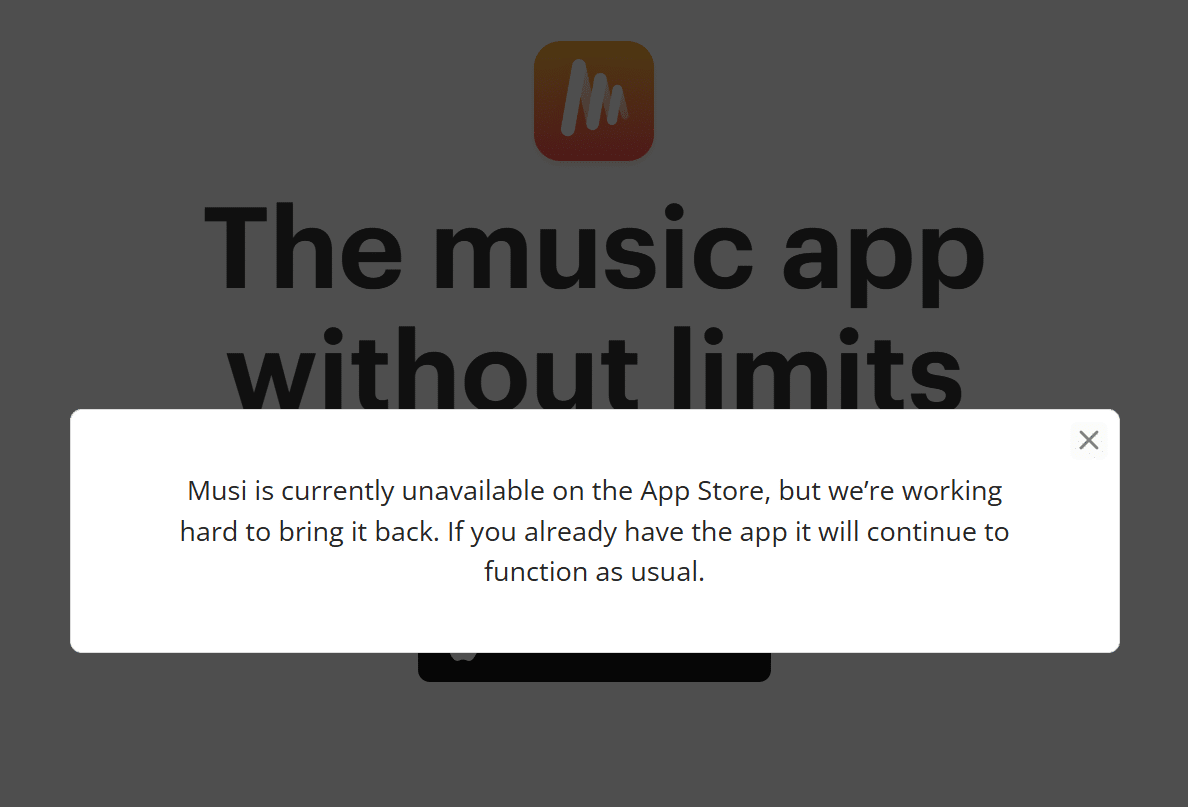
In September 2024, Apple removed the popular music streaming app Musi from its App Store, affecting millions of users.
Apple’s action wasn’t completely unexpected. Music industry groups had been trying to take Musi down for a long time, branding it a ‘parasitic’ app that skirts the rules.
Delisting from the App Store was an existential threat to Musi, which took the matter to court. Musi claimed that the App Store removal was the result of “backroom conversations” between Apple and key music industry players, including Sony, IFPI, and YouTube.
The app developer accused Apple of breach of contract and breach of the implied covenant of good faith and fair dealing. The company hoped that the court would agree and compel Apple to reinstate the app, but that did not happen.
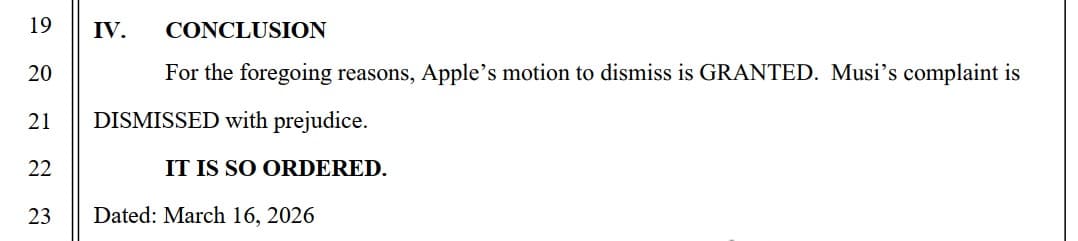
In an order issued yesterday, Judge Eumi K. Lee of the U.S. District Court for the Northern District of California dismissed the case with prejudice, effectively ending the lawsuit.
In its defense, Apple has argued that the terms of the Apple Developer Program License Agreement (DPLA) allowed the company to delist apps “at any time, with or without cause.” That would be sufficient to remove Musi.
Musi has countered that, according to the same agreement, Apple needed to conduct a review to establish “reasonable belief” before an app would be removed from its platform. However, the court disagreed, stressing that there are no limitations to Apple’s removal rights.
“There is simply no textual basis in the DPLA to construe a limitation on Apple’s right to cease offering an application, as long as Apple provided notice,” Judge Lee writes.
Musi’s argument that Apple breached an “implied covenant of good faith” under California law also failed. While Apple was contractually allowed to remove the app, the court notes that Apple did not solely act in response to the YouTube claim.
“[T]he complaint reflects that Apple was facing pressure from multiple music industry complaints. The letter from Sony expressly states that its trade organization (the IFPI) had already tried to resolve issues with Musi through the app dispute process, but Musi was not cooperating,” the order reads.
The court already granted Musi the option to amend its complaint previously and allowed two months of discovery, including access to over 3,500 documents and depositions from Apple officials, but that was not enough. Therefore, the court dismissed the case with prejudice, meaning that it can’t be refiled.
In a separate order issued the same day, the court granted Apple’s motion for Rule 11 sanctions in part, ruling that one allegation in Musi’s amended complaint was factually baseless.
Musi had alleged in the first paragraph of its amended complaint that Apple “knew that this ‘evidence’ was false, as it has since admitted.”
Judge Lee found that this admission did not appear anywhere in the provided evidence. Therefore, Musi’s claim that Apple had “admitted” to knowingly relying on false evidence is sufficient to warrant sanctions.
“Claiming that Apple ‘admitted’ that it knowingly relied on false evidence conveys that discovery yielded damning evidence,” the order states, “but it did not.”
The sanctions order effectively removed the offending phrase from the amended complaint and ordered Musi’s law firm, Winston & Strawn LLP, to pay Apple’s reasonable attorneys’ fees related to the sanctions motion.
The sanctions ruling was not the first time Musi’s honesty came under scrutiny in this case. In a motion filed in May 2025, Apple alleged that Musi had previously impersonated a Universal Music Group executive to get its app reinstated after an earlier removal.
Apple claimed that Musi founder Aaron Wojnowski forwarded a fabricated email to Apple purportedly from UMG’s Jason Miller, using the address jasonmiller@umusic.solar-secure.com, which is not a UMG address.
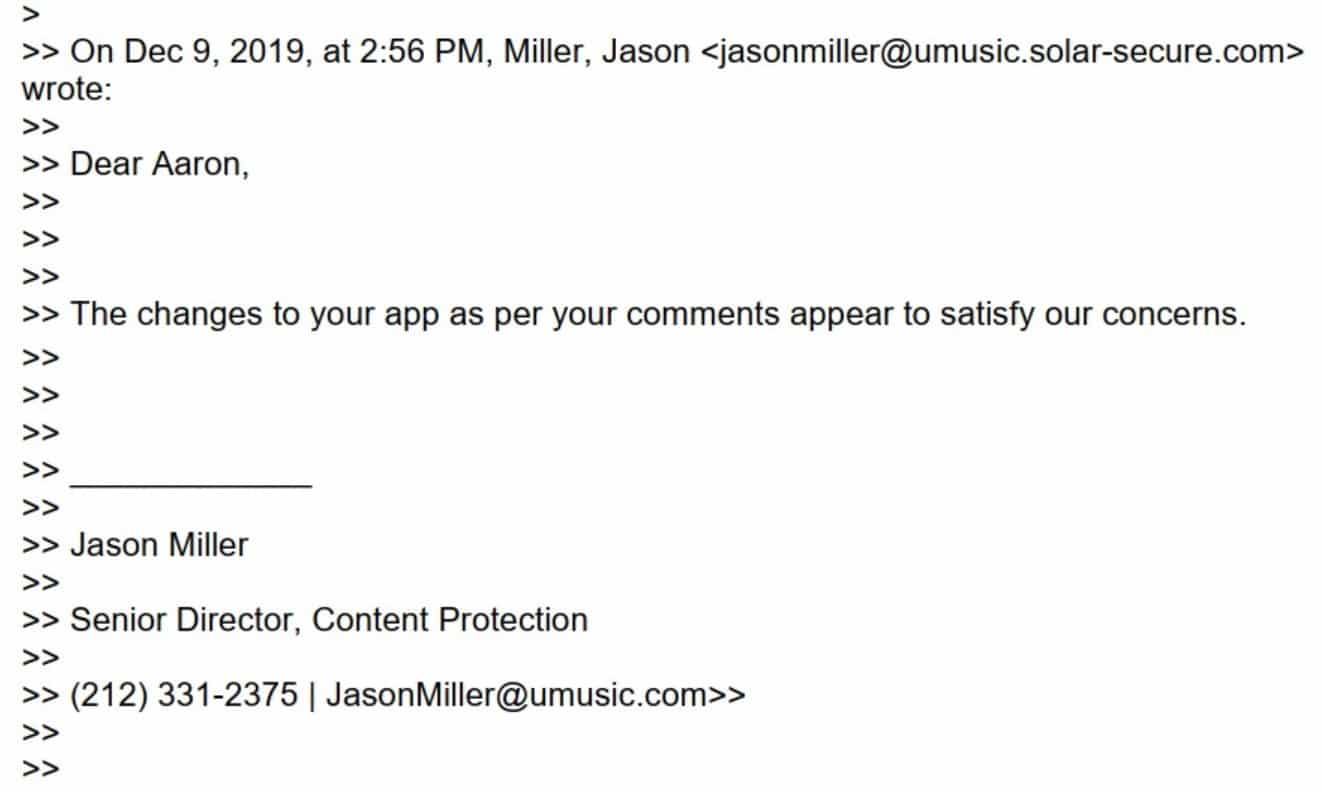
UMG later informed Apple the email was “fraudulent” and that Miller had no record of sending it. The same address was allegedly used to file a false copyright claim against a separate music streaming app, Yokee, in July 2020.
With the dismissal order now in place, the case is effectively closed. This means that the once very popular music app will not return to the App Store via this route. Musi still has the option to appeal, but whether it plans to do so is unclear. The company did not immediately return our request for comment.
—
A copy of Judge Eumi K. Lee’s order granting Apple’s motion to dismiss is available here (pdf). The order granting in part Apple’s motion for Rule 11 sanctions is available here (pdf).
From: TF, for the latest news on copyright battles, piracy and more.
This picture invariably brings tears to my eyes. It could be the logo, literally and metaphorically, for current health care policy.
The post Death Returns From Holiday first appeared on Science-Based Medicine.
While How to Fix the Internet is on hiatus, we wanted to share a great conversation with you from last week. EFF Executive Director Cindy Cohn spoke with bestselling novelist, journalist, and EFF Special Advisor Cory Doctorow about Cindy’s new book, “Privacy’s Defender: My Thirty-Year Fight Against Digital Surveillance” (MIT Press).




You can also listen to this episode on the Internet Archive or watch the video on YouTube.
Part memoir, part battle cry, “Privacy’s Defender” is the story of Cindy’s fights alongside the visionaries who looked at the early internet and understood that the legal and political battles over this new technology – the Crypto Wars, the NSA’s dragnet, the FBI gag orders – were really over the future of free speech, privacy, and power for all.
This conversation was recorded on Tuesday, March 10 in front of a packed house at San Francisco’s iconic City Lights Bookstore. For more about the book and Cindy’s national book tour – with stops in places including Seattle, Silicon Valley, Denver, Boston, Ann Arbor, Iowa City, Washington DC and New York City – check out https://www.eff.org/Privacys-Defender
And finally, stay tuned to this feed; we’re working on a special podcast series featuring key players and moments from the book!
Resources:
Imagine a newspaper publisher announcing it will no longer allow libraries to keep copies of its paper.
That’s effectively what’s begun happening online in the last few months. The Internet Archive—the world’s largest digital library—has preserved newspapers since it went online in the mid-1990s. The Archive’s mission is to preserve the web and make it accessible to the public. To that end, the organization operates the Wayback Machine, which now contains more than one trillion archived web pages and is used daily by journalists, researchers, and courts.
But in recent months The New York Times began blocking the Archive from crawling its website, using technical measures that go beyond the web’s traditional robots.txt rules. That risks cutting off a record that historians and journalists have relied on for decades. Other newspapers, including The Guardian, seem to be following suit.
For nearly three decades, historians, journalists, and the public have relied on the Internet Archive to preserve news sites as they appeared online. Those archived pages are often the only reliable record of how stories were originally published. In many cases, articles get edited, changed, or removed—sometimes openly, sometimes not. The Internet Archive often becomes the only source for seeing those changes. When major publishers block the Archive’s crawlers, that historical record starts to disappear.
The Times says the move is driven by concerns about AI companies scraping news content. Publishers seek control over how their work is used, and several—including the Times—are now suing AI companies over whether training models on copyrighted material violates the law. There’s a strong case that such training is fair use.
Whatever the outcome of those lawsuits, blocking nonprofit archivists is the wrong response. Organizations like the Internet Archive are not building commercial AI systems. They are preserving a record of our history. Turning off that preservation in an effort to control AI access could essentially torch decades of historical documentation over a fight that libraries like the Archive didn’t start, and didn’t ask for.
If publishers shut the Archive out, they aren’t just limiting bots. They’re erasing the historical record.
Making material searchable is a well-established fair use. Courts have long recognized it’s often impossible to build a searchable index without making copies of the underlying material. That’s why when Google copied entire books in order to make a searchable database, courts rightly recognized it as a clear fair use. The copying served a transformative purpose: enabling discovery, research, and new insights about creative works.
The Internet Archive operates on the same principle. Just as physical libraries preserve newspapers for future readers, the Archive preserves the web’s historical record. Researchers and journalists rely on it every day. According to Archive staff, Wikipedia alone links to more than 2.6 million news articles preserved at the Archive, spanning 249 languages. And that’s only one example. Countless bloggers, researchers, and reporters depend on the Archive as a stable, authoritative record of what was published online.
The same legal principles that protect search engines must also protect archives and libraries. Even if courts place limits on AI training, the law protecting search and web archiving is already well established.
The Internet Archive has preserved the web’s historical record for nearly thirty years. If major publishers begin blocking that mission, future researchers may find that huge portions of that historical record have simply vanished. There are real disputes over AI training that must be resolved in courts. But sacrificing the public record to fight those battles would be a profound, and possibly irreversible, mistake.
A story previously posted at this URL contained several factual errors. We’ve retracted it and apologize for the mistake.