On Monday, Ruthy Gourevitch and Jacob Udell explained why landlords nationwide are scrambling to repay their investors, and why confronting this growing financial distress is the first step toward solving our national housing nightmare. On Wednesday, Alaa Hajyahia and Helen Zhao traced the Jones Act’s colonial origins, described its ongoing economic harms, and explained how this law…
Author: tio
-
Dr. Jay Bhattacharya, Who Claims He “Would Have” Perfectly Controlled COVID In 2020, Can’t Even Fix A Few Broken Windows Today
Trust in MAHA leaders has justifiably collapsed, and the sycophants who previously glorified Dr. Jay Bhattacharya have mysteriously vanished, unwilling to even acknowledge what they helped unleash on us all.
The post Dr. Jay Bhattacharya, Who Claims He “Would Have” Perfectly Controlled COVID In 2020, Can’t Even Fix A Few Broken Windows Today first appeared on Science-Based Medicine.
-

Can we build crisis care outside the broken mental health system?
Being violently locked away and forcibly drugged made my mental health crisis many times worse – an experience shared by far too many people who have been subjected to standard NHS crisis “care”. Yet the mental health system seems to resist change like a train with no brakes…
…But what if we didn’t have to wait for change within a broken mainstream system that’s sustained by vested interests? What if communities could construct services to care for each other at times of need – outside the psychiatric system?
It is incredibly exciting to be involved in Soteria London’s project to plan and build community support for people experiencing a mental health crisis… The kind of real help I wish I’d had!
Soteria’s first step has been researching successful projects outside the medical model of ‘mental health’ that are already helping transform lives. We heard from the inspirational people running a Crisis Café, led by those with their own experience of mental health crisis, and providing a safe non-clinical space with people to simply talk to. The way those who have used this service describe it shows how completely this approach contrasts with the prison-like cells of mainstream crisis services: “It’s the community I never had”, “It’s a quiet safe space run by people who just understand and listen!!”, “It’s my safe haven”.
Another really exciting initiative we looked at is a ‘foster-care’ programme placing people in mental health crisis with families who are supported to care for them through the Shared Lives Mental Health Crisis Scheme in South East Wales . Again the help comes in the form of human connection, treating the person in crisis as an individual not a patient, and carefully matching them with a family that they are happy to stay with. The warm relationships and belief in full recovery evident in interviews with those experiencing the scheme is heartwarming.
Risk assessment and management is a collaborative and consensual process, and risks are largely avoided thanks to the calm and non-coercive environment, which doesn’t trigger the kind of reactions that often lead to physical restraint or sedation being used on psychiatric wards. It is the ordinary moments of home life which form the building blocks of recovery, just as in a similar scheme in Sweden for people experiencing psychosis called Healing Homes, that was documented in a fascinating film by American therapist Daniel Mackler available online.
This Shared Lives approach costs 5 times less than inpatient beds, saving over £2500 per week for each person who avoids a psychiatric ward. And with evidence of better outcomes too (which will be unsurprising to anyone familiar with the traumatic and dehumanising treatment that is commonplace in psychiatric inpatient facilities!). Shared Lives was even featured in the World Health Organisation’s Guidance on Community Mental Health Services alongside some other inspirational examples of communities across the globe organising to look after each other outside the medical model of mental health.
Our Soteria London community also discussed models of care that provide support in people’s own homes, working collaboratively with the person in crisis and their family and friends, like the increasingly well-known Open Dialogue approach pioneered in Finland (and documented in another inspiring online film. This revolutionary approach first developed in the 1980s in Western Lapland has resulted in radically improved outcomes. Rates of complete and sustained recovery from psychosis in the Finnish Open Dialogue programme have been consistently above 80% with data spanning more than a decade suggesting that the approach even reduced the incidence of severe mental health problems in the population, as the collaborative and consensual approach empowered communities and facilitated early help which actually prevented problems progressing. In our Soteria London planning meeting we discussed the idea of having ‘Compassionate Crews’ of volunteers and staff, on standby to go out to people’s homes and provide support to families at times of crisis.
And of course we couldn’t forget the original Soteria House run by the pioneering psychiatrist Loren Mosher in the US in the 1970s and 80s, caring for people in psychosis in a home-like environment supported by non-medical staff (described in Mosher’s book ‘Soteria: Through Madness To Deliverance’) and since emulated by other Soteria Houses with similar success.
A local example of truly trauma-informed residential care that we heard about is the Drayton Park Women’s Crisis House which provides a women-only environment (unlike women’s psychiatric wards that are staffed by men as well as women). At Drayton Park staff routinely do something revolutionary (yet rather obvious to anyone not indoctrinated in the disease model of mental health) and actually ask every woman who comes if there a history or current experience of abuse – and the majority do indeed disclose. We also heard about a community service hosting people experiencing suicidal thoughts and feelings in a home-like environment supported by volunteers, also right here in London, called the Maytree Respite Centre.
Another idea we discussed came from the approach taken by some organisations working to support people out of homelessness by providing personalised budgets to fund the specific help that the individual actually needs and wants. As someone who was blessed to be able to pay privately for some of the help I personally needed to survive and recover from my own prolonged mental health crisis I thought this was an incredibly powerful idea. For instance if I hadn’t had the money to pay for help with cleaning and childcare whilst in crisis I’m certain I would have faced huge pressure and stress from long-term social services involvement. Being able to pay a private psychiatrist enabled me to withdraw from the debilitating psychiatric drugs I’d been forced to take by mental health services. And accessing body-based therapies like floatation tanks and massage made a huge difference in my recovery from trauma. Such life-transforming help shouldn’t be reserved for those who can pay! And empowering individuals to tap into their own knowledge of their needs and take charge of their own recovery is also a powerful way to support healing, especially after experiencing disempowering and infantilising state services.
Soteria London has built a community of those with lived experience of distress and altered mental states, family members and supporters through the regular events the organisation holds. This enables us to tap into invaluable collective expertise, and some common themes emerged from our discussions in terms of the elements that people felt were important for any form of crisis service. A vital point that multiple people made was that often a crisis may actually be due to adverse reactions to psychiatric drugs or to severe withdrawal symptoms from abruptly stopping or changing the dose. Therefore any service should be fully aware of the role that prescription drugs may be playing in an individual’s problems and able to share accurate independent information about these psychoactive “medications” and about safer gradual approaches to withdrawal. Equally with psychiatric coercion being so common people in crisis may need advocacy support in order to safeguard their autonomy.
It also seemed evident when evaluating the strengths and weaknesses of the various models of care that ideally we need to develop flexible services that offer a variety of approaches tailored to individual needs, rather than a one-size-fits-all model. But thankfully there are successful blueprints that a social enterprise like Soteria can turn to rather than reinventing the wheel, and Intentional Peer Support has even published a ‘Peer Respite Handbook:
‘A Guide to Understanding, Supporting and Building Peer Respites’, available online.It’s no easy task for a social enterprise to set up support structures for people in such severe crisis that they’d otherwise end up locked up under the Mental Health Act… But everyone involved in Soteria London knows from bitter first-hand experience as ex-patients or family members how urgent and important it is to get on with building our own support systems outside the broken mental health system (even the term “crisis” triggered traumatic associations for many of us who have been subjected to Crisis Team treatment!). Being part of Soteria’s project felt for me like an antidote to all those negative experiences. And the energy, enthusiasm and optimism infusing these exciting discussions around building positive “crisis care” made clear that our growing community of mutual support has huge potential to make these ideas a reality for those at the sharp end of mental health crises in our local communities.
Soteria London is planning an online follow up meeting on 23rd April 2026 6.30-8 pm to present our next steps to build our models of crisis support – please email londonsoteria@gmail.com if you are interested.
****
Mad in the UK hosts blogs by a diverse group of writers. The opinions expressed are the writers’ own.
The post Can we build crisis care outside the broken mental health system? appeared first on Mad in the UK.
-
Despite European Extradition Requests, Guinea Keeps Convicted Robber in Prison
Ibrahim Akhlal is a fugitive from Belgium where he was sentenced to 21 years in prison for a series of armed robberies. He is also wanted by the Netherlands where he faces charges related to a gold heist of “exceptional brutality,” which involved a car chase and shootout with police.
Despite an extradition request from Belgium, and another one from the Netherlands, Akhlal remains in prison in the West African nation of Guinea.
Akhlal, who is a citizen of both Belgium and Morocco, was sentenced in Guinea for escaping prison there after his conviction for using a fraudulent passport. But his term expired more than a year ago.
Guinea has no extradition treaty with either Belgium or the Netherlands, but under the law, authorities can honor such a request if they choose to. Guinean officials declined to comment on the extradition requests, and would not explain why Akhlal is still incarcerated.
“Ibrahim Akhlal is being illegally and arbitrarily detained in the Central Prison,” said his lawyer, Mory Doumbouya.
In an interview in his office, behind the overcrowded prison in the Guinean capital of Conakry where Akhlal is held, Doumbouya described his client as a “hostage of the Guinean judicial system.”
Guinean court files accessed by OCCRP confirm that Akhlal has served his sentence.
Speaking anonymously as they were not authorised to talk to journalists, three Guinean officials — from the legal, law enforcement, and prison sectors — confirmed that Akhlal is still incarcerated in Conakry.
Akhlal appears to be stuck in a diplomatic standoff, according to Kars de Bruijne of Clingendael, a research institute in The Hague.
“He is really caught between a rock and a hard place,” he said after reviewing Akhlal’s situation.
“According to the Guinean law he should be released,” said de Bruijne, who is the institute’s programme lead for West Africa and the Sahel. However, if the Guineans release Akhal without extraditing him, “they could get in trouble with the Netherlands and Belgium.”
Jailbreak and a Gold Heist
At just 30 years old, Akhlal already has a series of criminal master strokes under his belt.
In March 2020, he escaped St. Gilles prison in Brussels where he was awaiting judgement on cases involving armed robbery, forgery, theft and organized crime — charges that later resulted in multiple convictions amounting to a 21-year prison sentence.
While on the run, Akhlal allegedly took part in an attack on an armored truck transporting precious metals in Amsterdam. Seven men involved in the robbery were convicted. Akhlal has been indicted and charged, but still needs to go to trial.
Official statements from the Amsterdam Court of Justice and the Public Prosecutor’s Office describe the heist — and what happened next.
At least eight men, allegedly including Akhlal, had targeted the premises of Schöne Edelmetaal, a precious metals dealer and processor in a northern suburb of the Dutch capital in May 2021. As a new transport arrived, the men were waiting outside in two Audis and a Porsche Cayenne. They broke into the warehouse, using one of the cars as a battering ram.
Armed with automatic weapons and wearing balaclavas, the attackers tied up employees and loaded gold and other precious metals worth an estimated $16 million into the cars. Then they fled the scene.
A high-speed car chase followed, with the suspects — allegedly including Akhal — shooting at pursuing police vehicles. Some suspects were cornered in a cow field near a hamlet where one was shot and killed. Police arrested six men.
But the car carrying Akhlal and another suspect took a different turn and escaped. The loot in their vehicle — worth about $4.7 million, according to the Amsterdam Court of Justice — was not recovered.
Akhlal resurfaced a year-and-a-half later, thousands of miles away in West Africa. In what was hailed as a success of “effective international cooperation,” by the Belgian Federal Police, he was tracked to the Republic of Guinea and arrested there.
In a letter addressed to the Guinean Attorney General seven days after the arrest, then-Minister of Justice Alphonse Charles Wright specified that Akhlal had entered Guinea on September 22, 2022.
“In order to hide his identity, he fraudulently obtained administrative documents, notably a passport of the Republic of Guinea,” he wrote in the letter.
Following the arrest, Belgian police issued a statement saying that authorities were “actively in contact with their Guinean counterparts in order to proceed with the extradition of the former fugitive as soon as possible.”
More than three years later, Belgium’s extradition request is still pending while Akhlal remains imprisoned in Conakry.
In the Netherlands, the Amsterdam Court of Appeal last year convicted seven men, with sentences ranging from nine to 15-and-a-half years for robbing the transport vehicle carrying precious metals.
The Amsterdam Court of Justice described the robbery as one of “exceptional brutality” with “excessive violence.”
Akhlal still faces a string of charges in the Netherlands related to the robbery. They include theft and “attempted aggravated manslaughter of police officers… [by] multiple shots with (automatic) firearms,” as well as arson and property damage.
Unanswered Questions
Motorcycle taxis wind through the bustling streets of Kaloum, Conakry’s business district, zipping past street vendors and taxis carrying loads of bananas on their roofs. All activity comes to a frequent halt to make way for military convoys escorting the president from the palace to his residence.
Amid the hustle is Conakry’s Court of First Instance. In a dimly lit room stacked with files and notebooks, a clerk retrieved books containing Akhlal’s sentences inscribed in blue and red ink.
The records show that on January 8, 2023, shortly after his arrest, Akhlal was sentenced to two years in prison, with one year suspended. The charges were “forgery and use of forged documents in public records” related to his possession of a Guinean passport under a false identity.
In June 2023, he escaped prison. Wright, the justice minister at the time, later said “armed men” were complicit in the escape. In an interview with the Belgian broadcaster VRT, Wright later condemned the “flagrant complicity” in the escape of several guards and prison employees.
Several weeks after his escape, Akhlal was apprehended in the northern Mauritanian city of Nouadhibou. The city lies near the border of Western Sahara, a former Spanish colony largely controlled by Morocco, but considered a disputed territory, where the Polisario Front launched an armed independence campaign in 1973.
A Mauritanian police officer told OCCRP that Akhlal stayed in the town for several days in the pink-painted Hotel Sahel, where he asked staff to turn off security cameras. He was arrested in the Grand Mosque, not far from the hotel, with several phones, large stashes of money and was “very skinny and stressed.”
Akhlal was brought back to Guinea, where he was convicted over the prison escape. Court records show that the prison sentence expired on January 3, 2025.
The Attorney General at the Court of Appeal of Conakry, Fallou Doumbouya — a common name in Guinea, which he shares with Akhlal’s lawyer — declined to comment.
“I have absolutely nothing to tell you,” he said to a reporter in his office in December. He did not respond to a detailed list of questions subsequently sent to him.
Meanwhile, Akhlal’s lawyer insists that his client’s detention has no legal basis. Akhlal remains behind bars “for reasons that are beyond our understanding,” added the lawyer, Mory Doumbouya.
Also a mystery is Guinea’s decision not to extradite Akhlal. Although the West African nation does not have an official treaty with either Belgium or the Netherlands, Guinea’s Code of Criminal Procedure allows extradition upon the discretion of authorities.
The Guinean ministries of justice and foreign affairs did not respond to requests for comment on the Belgian and Dutch requests.
De Bruijne of the Clingendael Institute said extraditions are tricky even with countries in the region that have such treaties.
“It is a big problem,” he said, pointing to the Netherlands’ failure to persuade Sierra Leone to extradite Jos Leijdekkers, a cocaine kingpin on Europol’s most wanted list.
Leijdekkers was sentenced in absentia by a Rotterdam court to 24 years in prison for large-scale cocaine trafficking, ordering a murder, and involvement in a violent robbery. He has also been convicted in Belgium in separate drug-related cases.
“To be honest, it is always a bit of guesswork, also on my part, on what the reason is that countries refuse to extradite people with a clear criminal profile,” said de Bruijne.
The Dutch Public Prosecution Service offered no explanation as to why Akhlal was still being held in Guinea despite the extradition requests.
The Belgian Embassy in Conakry, and the Federal Public Service Justice, a state body that plays a key role in international judicial cooperation, both declined to comment.
The Belgian Federal Police said their rule was to “not communicate about ongoing cases.”
-
Weakening Speech Protections Will Punish All of Us—Not Just Meta
Recently, a California Superior Court jury found that Meta and YouTube harmed a user through some of the features they offered. And a New Mexico jury concluded that Meta deceived young users into thinking its platforms were safe from predation.
It’s clear that many people are frustrated by big tech companies and perhaps Meta in particular. We too have been highly critical of them and have pushed for years to end their harmful corporate surveillance. So it’s not surprising that a jury felt like Mark Zuckerberg and his company, along with YouTube, needed to be held accountable.
While it would be easy to claim that these cases set a legal precedent that should make social media companies fearful, that’s not exactly true. And that’s actually a good thing for the internet and its users.
These jury trials were just an early step in a long road through the court system. These cases will now go up on appeal, where the courts’ rulings about the First Amendment and immunity under Section 230 will likely get reconsidered.
As we have argued many times before, the First Amendment protects both user speech and the choices platforms make on how to deliver that speech (in the same way it protects newspapers’ right to curate their editorial pages as they see fit). Features on social media sites that are designed to connect users cannot be separated from the users’ speech, which is why courts have repeatedly held that these features are indeed protected.
So while it may be tempting to celebrate these juries’ decisions as a “win” against big tech, in fact the ramifications of lowering First Amendment and immunity standards on other speakers—ones that members of the public actually like, and do not want to punish—are bad. We can’t create less protective speech rules for Meta and Google alone just because we want them held accountable for something else.
As we have often said, much of the anger against these companies arises from people rightfully feeling that these companies harvest and exploit their data, and monetize their lives for crass economic reasons. We therefore continue to urge Congress to pass a comprehensive national privacy law with a private right of action to address these core concerns.
-
A Baseless Copyright Claim Against a Web Host—and Why It Failed
Copyright law is supposed to encourage creativity. Too often, it’s used to extract payouts from others.
Higbee & Associates, a law firm known for sending copyright demand letters to website owners, targeted May First Movement Technology, accusing it of infringing a photograph owned by Agence France-Presse (AFP). The claim was baseless. May First didn’t post the photo. It didn’t even own the website where the photo appeared.
May First is a nonprofit membership organization that provides web hosting and technical infrastructure to social justice groups around the world. The allegedly infringing image was posted years ago by one of May First’s members, a human rights group based in Mexico. When May First learned about the copyright complaint, it ensured that the group removed the image.
That should have been the end of it. Instead, the firm demanded payment.
So EFF stepped in as May First’s counsel and explained why AFP and Higbee had no valid claim. After receiving our response, Higbee backed down.
This outcome is a reminder that targets of copyright demands often have strong defenses—especially when someone else posted the material.
Hosting Content Isn’t the Same as Publishing It
Copyright law treats those who create or control content differently from those who simply provide the tools or infrastructure for others to communicate.
In this case, May First provided hosting services but didn’t post the photo. Courts have long recognized that service providers aren’t direct infringers when they merely store material at the direction of users. In those cases, service providers lack “volitional conduct”—the intentional act of copying or distributing the work.
Copyright law also recognizes that intermediaries can’t realistically police everything users upload. That’s why legal protections like the Digital Millennium Copyright Act safe harbors exist. Even outside those safe harbors, courts still shield service providers from liability when they promptly respond to notices.
May First did exactly what the law expects: it notified its member, and the image came down.
A Claim That Should Have Been Withdrawn Much Sooner
The troubling part of this story isn’t just that a demand was sent. It’s that Higbee and AFP continued to demand money and threaten litigation after May First explained that it was merely a hosting provider and had the image removed.
In other words, the claim was built on shaky legal ground from the start. Once May First explained its role, Higbee should have withdrawn its demand. Individuals and small nonprofits shouldn’t need lawyers just to stop aggressive copyright shakedowns.
Statutory Damages Fuel Copyright Abuse
This isn’t an isolated case—it’s a predictable result of copyright law’s statutory damages regime.
Statutory damages can reach $150,000 per work, regardless of actual harm. That enormous leverage incentivizes firms like Higbee to send mass demand letters seeking quick settlements. Even meritless claims can generate revenue when recipients are too afraid, confused, or resource-constrained to fight back.
This hits community organizations, independent publishers, and small service providers that don’t have in-house legal teams especially hard. Faced with the threat of ruinous statutory damages, many just pay what is demanded.
That’s not how copyright law should work.
Know Your Rights
If you receive a copyright demand based on material someone else posted, don’t assume you’re liable.
You may have defenses based on:
- Your role as a hosting or service provider
- Lack of volitional conduct
- Prompt removal of the material after notice
- The statute of limitations
- The copyright owner’s failure to timely register the work
- The absence of actual damages
Every situation is different, but the key point is this: a demand letter is not the same as a valid legal claim.
Standing Up to Copyright Trolls
May First stood its ground, and Higbee abandoned its demand after we explained the law.
But the bigger problem remains. Copyright’s statutory damages framework enables aggressive enforcement tactics that targets the wrong parties, and chills lawful online activity.
Until lawmakers fix these structural incentives, organizations and individuals will keep facing pressure to pay up—even when they’ve done nothing wrong.
If you get one of these demand letters, remember: you may have more rights than it suggests.
-

Israel’s New Lynching Law Is its Most Heinous Yet
The Israeli Knesset passed a new law this week, championed by National Security Minister Itamar Ben-Gvir, that mandates the death penalty for Palestinians convicted of murder—but not Israelis. The law is specifically crafted to discriminate along ethnic lines. On paper, it punishes “terrorists who have carried out murderous terror attacks,” but the wording is carefully chosen so that it only applies to crimes committed “with the aim of negating the existence of the State of Israel.” This means that Israelis who kill Palestinians, with the intent to promote or defend Israel, are excluded by definition. As the New York Times delicately puts it, the law “almost certainly cannot be applied to Jewish extremists convicted of similar crimes.”

-
Print Blocking Won’t Work – Permission to Print Part 2
This is the second post in a series on 3D print blocking, for the first entry check out: Print Blocking is Anti-Consumer – Permission to Print Part 1
Legislators across the U.S. are proposing laws to force “print blockers” on 3D printers sold in their states. This mandated censorware is doomed to fail for its intended purpose, but will still manage to hurt the professional and hobbyist communities relying on these tools.
3D printers are commonly used to repair belongings, decorate homes, print figurines, and so much more. It’s not just hobbyists; 3D printers are also used professionally for parts prototyping and fixturing, small-batch manufacturing, and workspace organization. In rare cases, they’ve also been used to print parts needed for firearm assembly.
Many states have already banned manufacturing firearms using computer controlled machine tools, which are called “Computer Numerical Control or CNC machines,” and 3D printers without a license. Recently proposed laws seek to impose technical limitations onto 3D printers (and in some cases, CNC machines) in the hope of enforcing this prohibition.
This is a terrible idea; these mandates will be onerous to implement and will lock printer users into vendor software, impose one-time and ongoing costs on both printer vendors and users, and lay the foundation for a 3D-print censorship platform to be used in other jurisdictions. We dive more into these issues in the first part of this series.
On a pragmatic level, however, these state mandates are just wishful thinking. Below, we dive into how 3D printing works, why these laws won’t deter the printing of firearms, and how regular lawful use will be caught in the proposed dragnet.
How 3D Printers Work
To understand the impact of this proposed legislation, we need to know a bit about how 3D printers work. The most common printers work similarly to a computer-controlled hot glue gun on a motion platform; they follow basic commands to maintain temperature, extrude (push) plastic through a nozzle, and move a platform. These motions together build up layers to make a final “print.” Modern 3D printers often offer more features like Wi-Fi connectivity or camera monitoring, but fundamentally they are very simple machines.
The basic instructions used by most 3D printers are called Geometric Code, or G-Code, which specify very basic motions such as “move from position A to position B while extruding plastic.” The list of commands that will eventually print up a part are transferred to the printer in a text file thousands-to-millions of lines long. The printer dutifully follows these instructions with no overall idea of what it is printing.
While it is possible to write G-Code by hand for either a CNC machine or a 3D printer, the vast majority is generated by computer aided manufacturing (CAM) software, often called a “slicer” in 3D printing since it divides a 3D model into many 2D slices then generates motion instructions.
This same general process applies to CNC machines which use G-Code instructions to guide a metal removal tool. CNC machines have been included in previous prohibitions on firearm manufacturing and file distribution and are also targeted in some of these bills.
There are other types of 3D printers such as those that print concrete, resin, metal, chocolate and other materials using slightly different methods. All of these would be subject to the proposed requirements regardless of how unlikely doing harm with a gun made out of chocolate would be.
Simple rectangular 3D model for test fit
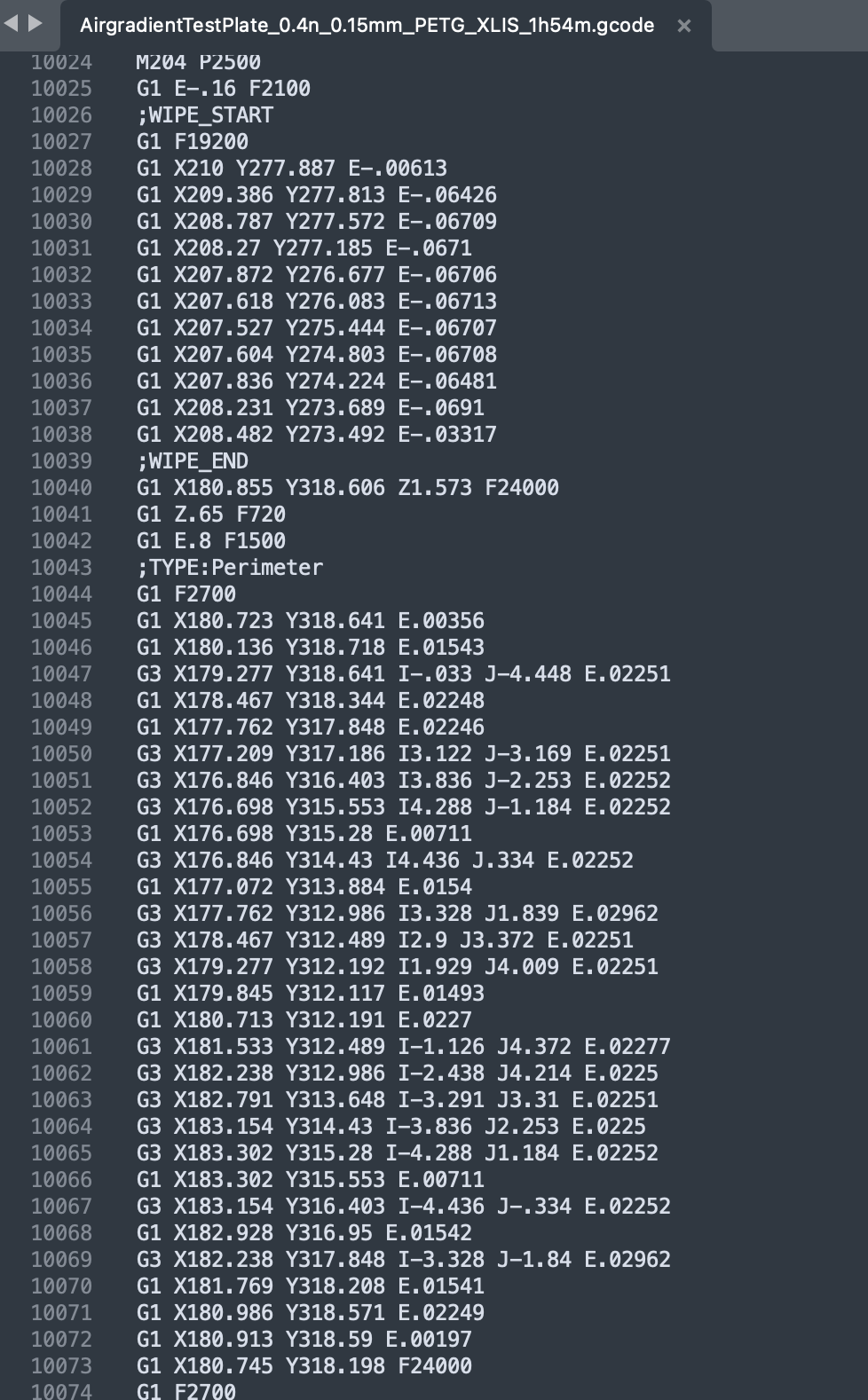
Part of a 173490 line long G-Code file produced by slicer for simple rectangular model.
Part of a 173,490 line long G-Code file for a simple rectangular part.
How is Firearm Detection Supposed to Work?
Under these proposed laws, manufacturers of consumer 3D printers must ensure their printers only work with their software, and implement firearm detection algorithms on either the printer itself or in a slicer software. These algorithms must detect firearm files using a maintained database of existing models. Vendors of printers must then verify that printers are on the allow-list maintained by the state before they can offer them for sale.
Owners of printers will be guilty of a crime if they circumvent these intrusive scanning procedures or load alternative software, which they might do because their printer manufacturer ends support. Owners of existing noncompliant 3D printers in regulated states will be unable to resell their printers on the secondary market legally.
What Will Actually Happen?
While the proposed laws allow for scanning to happen on either the printer itself or in the slicer software, the reality is more complicated.
The computers inside many 3D printers have very limited computational and storage ability; it will be impossible for the printer’s computer to render the G-Code into a 3D model to compare with the database of prohibited files. Thus the only way to achieve this through the machine would be to upload all printer files to a cloud comparison tool, creating new delays, errors, and unacceptable invasions of privacy.
Many vendors will instead choose to permanently link their printers to a specific slicer that implements firearm detection. This requires cryptographic signing of G-Code to ensure only authorized prints are completed, and will lock 3D printer owners into the slicer chosen by their printer vendor.
Regardless of the specifics of their implementation, these algorithms will interfere with 3D printers’ ability to print other parts without actually stopping manufacture of guns. It takes very little skill for a user to make slight design tweaks to either a model or G-Code to evade detection. One can also design incomplete or heavily adorned models which can be made functional with some post-print alterations. While this would be pioneered by skilled users—like the ones who designed today’s 3D printed guns—once the design and instructions are out there anyone able to print a gun today will be able to follow suit.
Firearm part identification features also impose costs onto 3D printer manufacturers, and hence their end consumers. 3D printer manufacturers must develop or license these costly algorithms and continuously maintain and update both the algorithm and the database of firearm models. Older printers that cannot comply will not be able to be resold in states where they are banned, creating additional E-waste.
While those wishing to create guns will still be able to do so, people printing other functional parts will likely be caught up in these algorithms, particularly for things like film props, kids’ toys, or decorative models, which often closely resemble real firearms or firearm components.
What Are The Impacts of These Changes?
Technological restrictions on manufacturing tools’ abilities are harmful for many reasons. EFF is particularly concerned with this regulation locking a 3D printer to proprietary vendor software. Vendors will be able to use this mandate to support only in-house materials, locking users into future purchases. Vendor slicer software is often based on out-of-date, open source software, and forcing users to use that software deprives them of new features or even use of their printer altogether if the vendor goes out of business. At worst, some of these bill will make it a misdemeanor to fix those problems and gain full control of your printer.
File-scanning frameworks required by this regulation will lay the foundation for future privacy and freedom intrusions. This requirement could be co-opted to scan prints for copyright violations and be abused similar to DMCA takedowns, or to suppress models considered obscene by a patchwork of definitions. What if you were unable to print a repair part because the vendor asserted the model was in violation of their trademark? What if your print was considered obscene?
Regardless of your position on current prohibitions on firearms, we should all fight back against this effort to force technological restrictions on 3D printers, and legislators must similarly abandon the idea. These laws impose real costs and potential harms among lawful users, lay the groundwork for future censorship, and simply won’t deter firearm printing.
-
Print Blocking is Anti-Consumer – Permission to Print Part 1
This is the first post in a series on 3D print blocking, for the next entry check out Print Blocking Won’t Work – Permission to Print Part 2
When legislators give companies an excuse to write untouchable code, it’s a disaster for everyone. This time, 3D printers are in the crosshairs across a growing number of states. Even if you’ve never used one, you’ve benefited from the open commons these devices have created—which is now under threat.
This isn’t the first time we’ve gone to bat for 3D printing. These devices come in many forms and can construct nearly any shape with a variety of materials. This has made them absolutely crucial for anything from life-saving medical equipment, to little Iron Man helmets for cats, to everyday repairs. For decades these devices have been a proven engine for innovation, while democratizing a sliver of manufacturing for hobbyists, artists, and researchers around the world.
For us all to continue benefiting from this grassroots creativity, we need to guard against the type of corporate centralization that has undermined so much of the promise of the digital era. Unfortunately some state legislators are looking to repeat old mistakes by demanding printer vendors install an enshittification switch.
In the U.S, three states have recently proposed that commercial 3D-printer manufacturers must ensure their printers only work with their software, and are responsible for checking each print for forbidden shapes—for now, any shape vendors consider too gun-like. The 2D equivalent of these “print-blocking” algorithms would be demanding HP prevent you from printing any harmful messages or recipes. Worse still, some bills can introduce criminal penalties for anyone who bypasses this censorware, or for anyone simply reselling their old printer without these restrictions.
If this sounds like Digital Rights Management (DRM) to you, you’ve been paying attention. This is exactly the sort of regulation that creates a headache and privacy risk for law-abiding users, is a gift for would-be monopolists, and can be totally bypassed by the lawbreakers actually being targeted by the proposals.
Ghosting Innovation
“Print blocking” is currently coming for an unpopular target: ghost guns. These are privately made firearms (PMFs) that are typically harder to trace and can bypass other gun regulations. Contrary to what the proposed regulations suggest, these guns are often not printed at home, but purchased online as mass-produced build-it-yourself kits and accessories.
Scaling production with consumer 3D printers is expensive, error-prone, and relatively slow. Successfully making a working firearm with just a printer still requires some technical know-how, even as 3D printers improve beyond some of these limitations. That said, many have concerns about unlicensed firearm production and sales. Which is exactly why these practices are already illegal in many states, including all of the states proposing print blocking.
Mandating algorithmic print-blocking software on 3D printers and CNC machines is just wishful thinking. People illegally printing ghost guns and accessories today will have no qualms with undetectably breaking another law to bypass censoring algorithms. That’s if they even need to—the cat and mouse game of detecting gun-like prints might be doomed from the start, as we dive into in this companion post.
Meanwhile, the overwhelming majority of 3D-printer users do not print guns. Punishing innovators, researchers, and hobbyists because of a handful of outlaws is bad enough, but this proposal does it by also subjecting everyone to the anticompetitive and anticonsumer whims of device manufacturers.
Can’t make the DRM thing work
We’ve been railing against Digital Rights Management (DRM) since the DMCA made it a federal crime to bypass code restricting your use of copyrighted content. The DRM distinction has since been weaponized by manufacturers to gain greater leverage over their customers and enforce anti-competitive practices.
The same enshittification playbook applies to algorithmic print blockers.
Restricting devices to manufacturer-provided software is an old tactic from the DRM playbook, and is one that puts you in a precarious spot where you need to bend to the whims of the manufacturer. Only Windows 11 supported? You need a new PC. Tools are cloud-based? You need a solid connection. The company shutters? You now own an expensive paperweight—which used to make paperweights.
It also means useful open source alternatives which fit your needs better than the main vendor’s tools are off the table. The 3D-printer community got a taste of this recently, as manufacturer Bambu Labs pushed out restrictive firmware updates complicating the use of open source software like OrcaSlicer. The community blowback forced some accommodations for these alternatives to remain viable. Under the worst of these laws, such accommodations, and other workarounds, would be outlawed with criminal penalties.
People are right to be worried about vendor lock-in, beyond needing the right tool for the job. Making you reliant on their service allows companies to gradually sour the deal. Sometimes this happens visibly, with rising subscription fees, new paywalls, or planned obsolescence. It can also be more covert, like collecting and selling more of your data, or cutting costs by neglecting security and bug fixes.
With expensive hardware on the line, they can get away with anything that won’t make you pay through the nose to switch brands.
Indirectly, this sort of print-blocking mandate is a gift to incumbent businesses making these printers. It raises the upfront and ongoing costs associated with smaller companies selling a 3D printer, including those producing new or specialized machines. The result is fewer and more generic options from a shrinking number of major incumbents for any customer not interested in building their own 3D printer.
Reaching the Melting Point
It’s already clear these bills will be bad for anyone who currently uses a 3D printer, and having alternative software criminalized is particularly devastating for open source contributors. These impacts to manufacturers and consumers culminate into a major blow to the entire ecosystem of innovation we have benefited from for decades.
But this is just the beginning.
Once the infrastructure for print blocking is in place, it can be broadened. This isn’t a block of a very specific and static design, like how some copiers block reproductions of currency. Banning a category of design based on its function is a moving target, requiring a constantly expanding blacklist. Nothing in this legislation restricts those updates to firearm-related designs. Rather, if we let proposals like this pass, we open the door to the database of forbidden shapes for other powerful interests.
Intellectual property is a clear expansion risk. This could look like Nintendo blocking a Pikachu toy, John Deere blocking a replacement part, or even patent trolls forcing the hand of hardware companies. Repressive regimes, here or abroad, could likewise block the printing of “extreme” and “obscene” symbols, or tools of resistance like popular anti-ICE community whistles.
Finally, even the most sympathetic targets of algorithmic censorship will result in false positives—blocking 3D-printer users’ lawful expression. This is something proven again and again in online moderation. Whether by mistake or by design, a platform that has you locked in has little incentive to offer remedies to this censorship. And these new incentives for companies to surveil each print can also impose a substantial chilling effect on what the user chooses to create.
While 3D printers aren’t in most households, this form of regulation would set a dangerous precedent. Government mandating on-device censors which are maintained by corporate algorithms is bad. It won’t work. It consolidates corporate power. It criminalizes and blocks the grassroots innovation and empowerment which has defined the 3D-printer community. We need to roundly reject these onerous restraints on creation.
-
Nepal Arrests Alleged Power Broker Deepak Bhatta in Money Laundering Probe
Nepalese police arrested alleged high-level power broker and businessman Deepak Bhatta in Kathmandu on Thursday on money laundering charges.
Bhatta, who chairs Infinity Holdings, has long faced scrutiny for allegedly leveraging political and bureaucratic connections to secure lucrative government contracts, operating with perceived impunity under multiple administrations.
Additional Inspector General Manoj Kumar K.C., head of the police’s Central Investigation Bureau, confirmed the arrest in Kathmandu’s Naxal Gairidhara neighborhood.
“We have arrested him and sent him to the Department of Money Laundering Investigation for further investigations,” K.C. told OCCRP.
Following the transfer, the Kathmandu District Court granted the department a 10-day remand on Thursday to detain and investigate Bhatta.
The arrest follows an escalating probe by investigators into Bhatta’s finances. Earlier this week, immigration authorities barred him from leaving the country after records showed frequent travel to the U.S., Thailand and the United Arab Emirates.
Authorities are examining multiple suspicious transactions linked to Bhatta. In June 2021, Nepal’s central bank flagged a 450 million Nepalese rupee ($3.02 million) transfer from Jagadamba Steel to Bhatta’s personal account—a transaction omitted from the steel company’s audit report. Investigators allege Bhatta then funneled the money through Infinity Holdings into Himalayan Reinsurance Co. Ltd., where he is a promoter.
Additionally, the DMLI asked the Nepal Insurance Authority last month to investigate Bhatta’s 3.81 billion rupees ($25.6 million) purchase of secondary market shares in Nepal Reinsurance Co. Ltd. and other entities. Investigators allege Bhatta misappropriated these funds for personal stock purchases through a local brokerage firm.
Police said the ongoing investigation targets Bhatta, his affiliated companies and his personal assets.
The crackdown aligns with a renewed anti-graft push in the country. The Office of the Prime Minister and Council of Ministers recently directed all government agencies to aggressively tackle financial crimes.
“The recently formed government has placed high priority on ending policy-level, institutional and procedural corruption in public bodies,” the prime minister’s directive read. “It is necessary for all agencies to take the required initiative to end corruption.”