Messages are circulating attempting to warn people about a text message scam that doesn’t appear to exist.
Author: tio
-
DOGE Cuts “Unexpectedly and Significantly Impacted” Critical Pentagon Unit
Efforts to gut the federal workforce by Elon Musk’s so-called Department of Government Efficiency significantly derailed operations at a Pentagon tech team with a key U.S. military role, according to materials reviewed by The Intercept.
Beginning nearly a year ago, DOGE embarked on an aggressive and legally dubious effort to gut the administrative state by unilaterally shuttering programs, pushing out personnel, and terminating contracts. Its effort to downsize the government leaned on the Office of Personnel Management’s “Deferred Resignation Program,” essentially a voluntary buyout plan that offered nearly 2 million federal employees the option of entering administrative leave rather than working under the second Trump administration. In the ensuing HR chaos, the Washington Post reported that “the employees who have resigned amount to about 6.7 percent of the government’s civilian workforce of 2.3 million people.”
Defenders of DOGE, including Musk, have claimed the project solely ferreted out fraud, waste, and abuse. But according to a December 2025 contracting memo from the Defense Information Systems Agency, DOGE’s tactics caused major problems at the Pentagon’s IT office — which is core to the operation of the U.S. military.
The memo describes how DISA’s Command, Control, Communications, and Computers Enterprise Directorate, known as J6, was hobbled by DOGE cuts to such an extent that it was unable to obtain necessary software. This unit is responsible for maintaining secure channels that keep the Pentagon connected to military assets around the world, including nuclear capabilities.
“During calendar year 2025, the DISA/J6 program office has been unexpectedly and significantly impacted by Government programs that incentivized personnel separation or extended periods of leave,” the memo reads, “e.g., Deferred Resignation Program, Voluntary Early Retirement Authority, Voluntary Separation Incentive Payments, Paid Parental Leave.”
A second DISA memo notes that the Deferred Resignation Program resulted in the departure of an officer responsible for an important Pentagon cloud-computing contract, resulting in that contract expiring entirely. The DOGE-induced staffing shortage resulted in a situation, according to the memo, where DISA’s systems faced “extreme risk for loss of service” across the Department of Defense.
While DISA operates behind the scenes, its globe-spanning networks are critical to the armed forces, explained DISA J6’s then-director Sharon Woods in a Pentagon-produced June 2025 interview: “Command, Control, Communications, and Computers — it is what underlies everything and the department’s ability to communicate with itself.” Asked what would happen on a day where DISA J6 couldn’t operate, Woods replied, “In my mind, it cripples the Department [of Defense]… This is really a mission where failure is not an option.”
DISA is not the only arm of the Pentagon hindered by Musk’s cuts. Stars and Stripes reported last week that Fort Greely, an intercontinental ballistic missile interception facility in Alaska, was struggling to feed its personnel because of “the government’s loss of essential civilian positions due to the Deferred Resignation Program (DRP), retirements and the federal hiring freeze.”
A recent procurement memo from the U.S. military academy at West Point, New York, reviewed by The Intercept stated the school was similarly facing a “potential disruption in food service operations resulting from the Government’s loss of 26 positions due to the Deferred Resignation Program (DRP), retirements, and the hiring freeze.”
At a May 2025 conference hosted by U.S. Army Mission Installation Contracting Command, an official acknowledged that “We have been cut significantly” due to the Deferred Resignation Program.
DISA did not respond to a request for comment.
The post DOGE Cuts “Unexpectedly and Significantly Impacted” Critical Pentagon Unit appeared first on The Intercept.
-
RFK Jr. is definitely coming for your vaccines (part 6): Liability, ethics, and policy-based evidence making
As 2026 dawns, look for HHS Secretary Robert F. Kennedy Jr. to ramp up his assault on vaccines using policy-based evidence making and altering Vaccine Court standards.
The post RFK Jr. is definitely coming for your vaccines (part 6): Liability, ethics, and policy-based evidence making first appeared on Science-Based Medicine.
-
As Insurance Prices Spike, Families Puzzle Over Options
New York-based performer Cynthia Freeman, 61, has been trying to figure out how to keep the Affordable Care Act health plan that she and her husband depend on.
“If we didn’t have health issues, I’d just go back to where I was in my 40s and not have health insurance,” she said, “but we’re not in that position now.”
Freeman and her husband, Brad Lawrence, are freelancers who work in storytelling and podcasting.
In October, Lawrence, 52, got very sick, very fast.
“I knew I was in trouble,” he said. “I went into the emergency room, and I walked over to the desk, and I said, ‘Hi, I’ve gained 25 pounds in five days and I’m having trouble breathing and my chest hurts.’ And they stopped blinking.”
In January, the cost of the couple’s current “silver” plan rose nearly 75%, to $801 a month.
Doctors diagnosed him with kidney disease, and he was hospitalized for four days.
Now Lawrence has to take medication with an average cost without insurance of $760 a month.
In January, the cost of the couple’s current “silver” ACA plan rose nearly 75%, to $801 a month.
To bring in extra cash, Freeman has picked up a part-time bartending gig.
Millions of middle-class Americans who have ACA health plans are facing soaring premium payments in 2026, without help from the enhanced subsidies that Congress failed to renew. Some are contemplating big life changes to deal with new rates that kicked in on Jan. 1.
It often falls to women to figure out a family’s insurance puzzle.
Women generally use more health care than men, in part because of their need for reproductive services, according to Elizabeth Tobin-Tyler, a professor at Brown University’s School of Public Health.
Women also tend to be the medical decision-makers for the family, she said, especially for the children.
“There’s a disproportionate role that women play in families around what we think of as the mental load,” said Tobin-Tyler, and that includes “making decisions around health insurance.”
Before the holidays, Congress considered a few forms of relief for the premium hikes, but nothing has materialized, and significant deadlines have already passed.
Going uninsured?
As the clock ticked down on 2025, B. agonized over her family’s insurance options. She was looking for a full-time job with benefits, because the premium prices she was seeing for 2026 ACA plans were alarming.
In the meantime, she decided she and her husband would drop coverage and insure only their kids. But it would be risky.
“My husband works with major tools all day,” she said, “so it feels like rolling the dice.”
National Public Radio and KFF Health News, partners in this report, are identifying B. by her middle initial because she believes her insurance needs could affect her ongoing search for a job with health benefits.
“I don’t have an additional $900 lying around in my family budget to pay for this.”
The family lives in Providence, Rhode Island. Her husband is a self-employed woodworker, and she worked fulltime as a nonprofit manager before she lost her job last spring.
After she lost her job, she turned to the ACA marketplace. The family’s “gold” plan cost them nearly $2,000 a month in premiums.
It was a lot, and they dug into retirement savings to pay for it while B. kept looking for a new position.
Because Congress failed to extend enhanced subsidies for ACA plans, despite ongoing political battles and a lengthy government shutdown over the issue, B.’s family plan would have cost even more in 2026 — almost $3,000 a month.
“I don’t have an additional $900 lying around in my family budget to pay for this,” she said.
B. had already pulled $12,000 out of retirement funds to pay her family’s 2025 premiums.
Unless she finds a new job soon, the family’s projected income for 2026 will be less than 266% of the federal poverty level, the threshold that will allow the children to qualify for free coverage through Medicaid.
So B. decided to buy a plan on the ACA marketplace for herself and her husband, paying premiums of $1,200 a month.
“The bottom line is none of this is affordable,” she said, “so we’re going to be dipping into savings to pay for this.”
Postponing a wedding
The prospect of soaring insurance premiums put a pause on Nicole Benisch’s plans to get married.
Benisch, 45, owns a holistic wellness business in Providence. She paid $108 a month for a zero-deductible “silver” plan on Rhode Island’s insurance exchange.
But the cost in 2026 more than doubled, to $220 a month.
“We have some tough decisions to make.”
She and her fiance had planned to marry on Dec. 19, her late mother’s birthday. “And then,” she said, “we realized how drastically that was going to change the cost of my premium.”
As a married couple, their combined income would exceed 400% of the federal poverty level and make Benisch ineligible for financial help. The premium for her current plan would jump to more than $700 a month.
Benisch considered a less expensive “bronze” plan, but it wouldn’t cover vocal therapy, which she needs to treat muscle tension dysphonia, a condition that can make her voice strain or give out.
If they get married, there’s another option: switch to her fiance’s health plan in Massachusetts. But that would mean losing all her Rhode Island doctors, who would be out of the Massachusetts network.
“We have some tough decisions to make,” she said, “and none of the options are really great for us.”
KFF Health News is a national newsroom that produces in-depth journalism about health issues and is one of the core operating programs at KFF — an independent source for health policy research, polling and journalism.
The post As Insurance Prices Spike, Families Puzzle Over Options appeared first on Truthdig.
-
Five Shots in Five Minutes: Analysing One Federal Agent’s Use of Less-Lethal Launcher in Minneapolis
This investigation is part of a collaboration between Bellingcat and Evident Media. You can watch Evident’s video here.
The fatal shooting of Renee Nicole Good by Immigration and Customs Enforcement (ICE) agent Jonathan Ross in Minneapolis on Jan. 7 sparked nationwide protests, with often violent clashes breaking out between protesters and federal agents. Some of the most intense protests took place in Minneapolis itself, with an agent using a less-lethal launcher in ways that experts told Bellingcat were “punitive” and “questionable at best”.
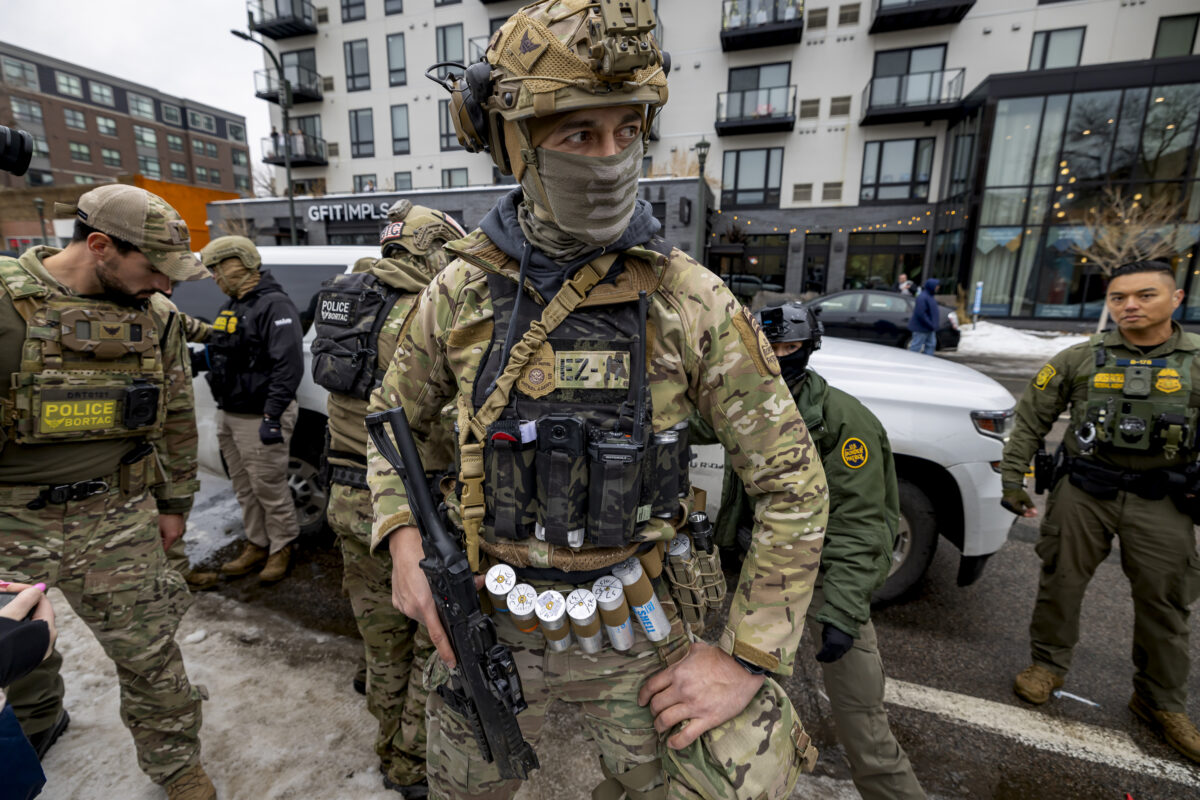
This agent, an elite Border Patrol officer who was masked but identifiable through the uniform number patch EZ-17, was captured on camera firing his B&T GL06 40mm less-lethal launcher at protesters five times in five minutes as he travelled down a street adjacent to where Good was killed.
EZ-17 on the streets of Minneapolis on Jan. 8. Source: Michael Nigro/Sipa USA via Reuters Connect While “less-lethal” weapons are not designed to kill, they can still result in serious injuries and even death when misused. In California, a protester said he was permanently blinded in one eye after he was shot with a less-lethal weapon at a protest on Jan. 13. Footage shows a DHS officer firing a PepperBall gun at his face at close range, causing him to bleed.
Last year, a judge in Illinois ordered an injunction limiting federal agents’ use of force in the state due to what she described as aggressive use of force against peaceful protesters that “shocks the conscience”. However, Bellingcat found multiple examples of force and riot control weapons being used during immigration raids and in apparent violation of that order in the weeks immediately after.
Experts told Bellingcat that most of the less-lethal shots fired by EZ-17 after arriving at the site of Good’s shooting with Border Patrol Commander Gregory Bovino on Jan. 7, also appear to breach CBP’s use-of-force policy.
Bellingcat analysed videos from news outlets and social media and mapped out all five shots the agent fired.

Five shots EZ-17 fired in five minutes near the location of Good’s shooting, numbered by the order they occurred with approximate locations. The general path of travel of EZ-17 and the location of where Renee Good was shot and killed is marked. Sources: Status Coup News, Dymanh and Google Earth. Graphic: Evident Media / Jennifer Smart Four of these shots appeared to be aimed directly at protesters’ faces at close range, while a fifth was fired from a distance towards a crowd after tear gas had already been deployed. A sixth shot, captured at another location on the same day, also shows EZ-17 firing a shot from the same launcher at someone at head-level.
As of publication, DHS had not responded to Bellingcat’s requests for comment.
The Agent
In footage captured by independent news outlet Mercado Media, EZ-17 is seen inside the crime scene tape perimeter, standing near Bovino, with eight 40mm munitions on his belt.

EZ-17 with eight visible munitions on his belt, including a 40mm CS “Muzzle Blast” (red box), and three sponge-nosed direct impact munitions (blue box) approximately 30 minutes before he fires his first shot. Annotations by Bellingcat. Source: Mercado Media @ 36:28 Annotations by Bellingcat These included three sponge-nose impact rounds, which are designed for “pain compliance” through the direct force of impact, and five cylindrical munitions that can be filled with different payloads and chemical irritants. “BLAST” in blue text is visible on one munition, indicating a “Muzzle Blast” munition with a CS gas fill – commonly known as tear gas. At least three additional 40mm munitions are visible in his plate carrier.
Another video by independent news network Status Coup News showed uninterrupted footage capturing five shots from the time the agent exited the crime scene perimeter (at 5:02) shortly before firing the first shot, to when he left in a truck with other agents (9:23) immediately after firing the fifth shot.
The back of EZ-17’s vest shows that he belongs to CBP’s Border Patrol Tactical Unit (BORTAC). BORTAC is a specialised and highly trained unit that, according to the CBP, has a selection process “designed to mirror aspects of the US Special Operations Forces’ selection courses”.

The patch on the back of EZ-17’s vest (centre) shows that he belongs to BORTAC. Source: Status Coup News Members of BORTAC have regularly accompanied Bovino as he leads Trump’s immigration raids, including EZ-17 and EZ-2, another CBP agent that was frequently seen beside EZ-17 in the footage from Jan. 7. Both agents have continued to accompany Bovino on raids in Minnesota in subsequent days.
EZ-17 was also spotted alongside Bovino at an incident in Illinois, where a CBP agent in front of him appeared to shoot a protester at close range.

Five shots EZ-17 fired in five minutes near the location of Good’s shooting, numbered by the order they occurred. Sources: Status Coup News and Dymanh First Shot
In the Status Coup Media video, EZ-17, and three other CBP agents, including EZ-2, can be seen leaving the crime scene tape perimeter set up after Good’s death, pushing protesters who are physically blocking them. Snowballs are thrown at the CBP agents.
EZ-17 and EZ-2 push a man to the ground who is blocking them. The video shows a clear view of his belt, and the eight munitions visible on his arrival at the scene are still loaded at this point.

EZ-17’s belt is visible after he and EZ-2 push a man who was physically blocking them to the ground, seconds before EZ-17 fires his first shot, at 5:15. Source: Status Coup News EZ-17 initially aims at the man he had pushed to the ground, but then turns and aims at the face of another nearby protester who did not appear to be involved in any previous physical contact with the agents. As EZ-17 aims at the face of this protester, the man raises his arms to shield himself before EZ-17 fires.

EZ-17 fires his first shot, at 5:19. Source: Status Coup News. Blurring by Bellingcat The large cloud of chemical irritant appears to disperse from the barrel immediately on firing for this shot as well as the next three shots EZ-17 fires.
This is consistent with the “Muzzle Blast” 40mm munitions produced by Defense Technology, which were seen in images of the agent’s belt. Defense Technology says in its product specifications for 40mm “Muzzle Blast” munitions that these rounds provide “instantaneous emission” of a chemical agent in the immediate area (30 feet) of the person shooting them.
Second Shot
Seconds later, after EZ-17 is hit by a snowball, he turns and fires towards the face of a man who is filming in the direction the snowball came from. It is unclear if this man is the intended target or someone else in the crowd behind him.

EZ-17 firing the second shot. This shot can be heard and partially seen at 5:37 in the Status Coup News video. Left: Screenshot before firing. Centre and Right: Screenshots taken after firing. Source: Dymanh/TikTok at 0:22 Third Shot
The third shot is at a man who was seen on video throwing a snowball that hits EZ-2.

Man throwing snowballs at CBP agents after the second shot. Source: Mercado Media; annotation by Bellingcat EZ-17 and EZ-2 chase this man, with EZ-2 spraying him in the face with Oleoresin Capsicum (OC) spray, also known as pepper spray or mace. EZ-2, when leaving the perimeter, can be seen carrying a Vexor Professional-branded canister.
Vexor exclusively produces various types of OC spray, and does not list any chemical irritant sprays that do not contain OC on its website.

Top: EZ-2 visibly deploys at least two streams of OC spray at the man. Bottom: EZ-2 is seen leaving the crime scene tape perimeter earlier with a “Vexor Professional” branded canister. Vexor manufactures various OC spray products. Source: Status Coup News. Annotations by Bellingcat The man slowly walks closer to the agents, saying that he has been maced. EZ-17 pushes the man, then aims at the man’s face and fires.
The seals that keep the chemical irritant inside the 40mm canister before it is fired can be seen hitting the man in this shot, with the smoke surrounding his face.

Seals from the 40mm Muzzle Blast munition. Source: Dymanh Chhoun. Annotations by Bellingcat Fourth Shot
After the third shot, an unmarked white CBP truck turns off the street and tries to drive down an alley. Protestors begin physically blocking the vehicle, throwing snowballs and other objects at it. The windshield gets cracked, and the back window gets broken. EZ-17 and EZ-2 physically push the protesters blocking the truck out of the way, with EZ-2 also deploying what appears to be a canister of OC spray.
A person begins banging on the windows of the truck, and EZ-17 rushes around the truck to fire his launcher towards this person’s face.

EZ-17 is seen firing his fourth shot at a person who was banging on the truck windows at 9:02. Source: Status Coup News University of St. Thomas School of Law professor Rachel Moran, who reviewed the videos at Bellingcat’s request, said that of the six shots we identified as being fired by EZ-17 this one appeared to be “the most reasonably related to carrying out the duty of helping the vehicle evacuate” as the person targeted was “still pounding aggressively” on the vehicle when EZ-17 fired the shot.
Fifth Shot
After EZ-17’s fourth shot, EZ-2 deploys a tear gas grenade, and the CBP truck moves down the alley, away from protesters.

EZ-2 deploying a tear gas grenade at 9:09. Source: Status Coup News EZ-17 can be seen reloading next to EZ-2, who is holding a canister that appears to be OC spray, and another CBP agent holding a PepperBall gun.

EZ-17 (in red box) reloading the 40mm launcher at 9:18. Source: Status Coup News. Annotations by Bellingcat The CBP agent with the PepperBall gun appears to cross over to the other side of the truck, and EZ-2 appears to begin to enter the vehicle.

CBP agent with PepperBall gun (yellow box) walking to the opposite side of the truck, EZ-2 standing in front of EZ-17 (red box) at 9:20. Source: Status Coup News. Annotations by Bellingcat As soon as the back right door on the truck closes, gas from the muzzle can be seen from where EZ-17 was standing.

Visible gas exiting the muzzle at 9:22. Source: Status Coup News This fifth shot appears to be “skip-fired” or aimed towards the ground before ricocheting upwards, at close range, resulting in three visible projectiles going towards the crowd of people, narrowly missing some.
Although the footage is blurry with the tear gas from the grenade EZ-2 threw still clouding the air, EZ-17 appears to be the only agent who could have fired this: EZ-2 was not armed with a projectile launcher, and PepperBall guns like the one carried by the other CBP agent do not have munitions that release multiple projectiles with a single shot.

Three different projectiles visible after the muzzle gas, at 9:22. Source: Status Coup News Chemical irritant smoke was seen being released by the projectiles from this last shot as it travelled through the air.

One projectile visibly emits chemical irritants as it travels through the air, at 9:23. Source: Status Coup News The multiple projectiles are consistent with the 40mm “SKAT Shell” by Defense Technology, which ejects four separate submunitions upon firing, each dispensing chemical irritants. In one of the videos, a SKAT Shell is seen in EZ-17’s belt.

EZ-17’s belt before firing the second shot, with a visible SKAT-SHELL SAF-SMOKE to the right of the direct impact munitions on his belt. Source: Dymanh/TikTok at 0:21 Roosevelt High School
In another video from the same day, EZ-17 was filmed again alongside Bovino when CBP showed up at Roosevelt High School in Minneapolis at dismissal time.
This video showed EZ-17 again firing his B&T GL06, apparently towards someone’s head, this time someone who threw a snowball at a CBP agent.

EZ-17 after firing his B&T GL06 launcher at a high school student’s face. Source: Matthew Moore/Facebook ‘Punitive and Unlawful’
Patrick Wilcken, Amnesty International’s Researcher on Military, Security and Policing issues, said that while the overall situation shown in the videos was tense, with “verbal abuse, some shoving/throwing of snowballs and the attempted obstruction of a vehicle”, there did not seem to be any substantial physical threat to the agents that would have justified the use of less-lethal weapons.
Wilcken, who reviewed the videos of all six shots fired by EZ-17 at Bellingcat’s request, said the actions of agents shown in these videos – pursuing fleeing protesters and in some instances firing at protesters who appeared to be trying to protect themselves – were “punitive and unlawful”.
CBP’s use-of-force policy states that weapons such as 40mm launchers are only authorised for use against subjects offering “active” or “assaultive” resistance. Similarly, DHS’ use-of-force policy guidance says agents may use force “only when no reasonably effective, safe and feasible alternative appears to exist”, and may only use the level of force “objectively reasonable in light of the facts and circumstances” that they face at the time force is applied.
“Officers should only resort to less lethal weapons when faced by a serious physical violence posing a threat to themselves or others that is not possible to diffuse in any other way,” Wilcken said. “They must exercise force with restraint, to the minimum extent possible while respecting and enabling the right to peaceful assembly.”
University of St. Thomas School of Law professor Rachel Moran agreed that whether the use of less-lethal weapons is justified largely depends on the level of threat or aggression the agent faces from the person targeted. Although she said the fourth shot could be justified in helping the CBP vehicle evacuate, Moran said the justification for the other shots was “questionable at best” based on the footage.
For example, Moran noted that although the man in the third shot had thrown a snowball at another officer, any threat had dissipated by the time EZ-17 shot him because the man had already run away and clearly had his hands up with nothing in them. “The shot appears to be more retaliatory than defensive”, she said.
Similarly, for the incident at Roosevelt High School, Moran noted that EZ-17 did not appear to be in any danger from the snowball, as the person who threw it was already retreating before the agent fired.
Moran said that if EZ-17 was carrying a B&T GL06 40mm launcher, he did appear to violate CBP policy by directly aiming at people’s faces.

The weapon used by EZ-17 is visible as he points it towards a protester. Source: Status Coup News. Blurring by Bellingcat CBP’s use-of-force policy states that agents using munitions launchers, including 40mm launchers “shall not intentionally target the head, neck, groin, spine, or female breast”. However, Bellingcat’s analysis of the six shots fired by EZ-17 showed that he appeared to be aiming at the head of targets in five of these cases.
Travis Norton, a retired police lieutenant and use-of-force consultant, told Bellingcat that standard training and manufacturer guidance for 40mm launchers recommended aiming at “large muscle groups of the lower body” while avoiding “prohibited target areas” like the head, neck, chest, spine and groin. This helps to reduce the risk of significant injury, Norton said.
Norton said that 40mm launchers are not intended for random or area fire: “Their use is limited to clearly identified individuals who are engaging in violent or dangerous behaviour and cannot be safely addressed by other means.”
Although he declined to comment on specific incidents based solely on video footage, Norton said that skip-firing – which was used in the fifth shot identified by Bellingcat, and the only shot where a person did not appear to be targeted at head-level – was generally not a standard or recommended practice in most law-enforcement training programs.
“Because ground conditions, angles, and projectile behaviour are unpredictable, skip-firing reduces accuracy and control and increases the risk of unintended injury,” Norton said.
Pooja Chaudhuri contributed research to this piece.
Bellingcat is a non-profit and the ability to carry out our work is dependent on the kind support of individual donors. If you would like to support our work, you can do so here. You can also subscribe to our Patreon channel here. Subscribe to our Newsletter and follow us on Bluesky here and Mastodon here.
The post Five Shots in Five Minutes: Analysing One Federal Agent’s Use of Less-Lethal Launcher in Minneapolis appeared first on bellingcat.
-
The Art of Selling Psychedelics
Olivia Marcus, a medical anthropologist with training in public health, grew up in the San Francisco Bay Area with parents who meditated every day. Family vacations often involved going to silent retreats. She noticed the tactics that retreat centers used to market themselves: They promised enlightenment and well-being.
Her academic work has focused on how people seek out health care, and how clinics integrate different therapies. She was recently a postdoctoral fellow in New York University’s Behavioral Sciences Training in Drug Abuse Research program and worked on the Ayahuasca Treatment Outcome Project, a study of an addiction rehabilitation center in Peru. But her early interest in how medicine and healing get advertised never went away.
Psychedelic drugs and services used to be on the fringes, but they’re now widely marketed on social media and even on billboards, sometimes using similar catchphrases and buzzwords that Marcus saw when she was younger. Now, she is researching the language and themes in direct-to-consumer advertising of psychedelic treatments and services, alongside the ads on social media that are algorithmically delivered to consumers. She presented on the topic of the ethics of direct-to-consumer advertising at the Hopkins-Oxford Psychedelics Ethics conference in summer 2024 and is currently working on an academic paper on psychedelic marketing.
The Microdose talked to Marcus about how psychedelic advertisements fit into the legacy of pharmaceutical marketing, and the repeating themes she sees in psychedelics ads.
You did your doctoral fieldwork in Peru in 2015, a time when many ayahuasca retreat centers were opening up to foreigners there. When did you first start to pay attention to the ways psychedelics were being advertised?
Definitely early on. It was a lot of word-of-mouth hyperbolizing — people trying to get people into their retreats by talking about how ayahuasca was like meeting Jesus and the Buddha in the same three-to-five-hour experience. There were these very big claims about what was going to happen, how it was going to be so beautiful, and you were going to heal all your wounds and your traumas.
Those are the things that I remember as far back as 2015 from my fieldwork. From the beginning, there were the claims that ayahuasca was worth 10 years of therapy in one night. By 2015, people were starting to put that on their websites.
It was a lot of word-of-mouth hyperbolizing.
I also noticed in that time span of that year, 2015 to 2016, a lot of the websites started to get updated and modernized. You had people who would come to retreats, have a really good experience, and they had web design skills. They created websites for local practitioners who didn’t have much of a media presence.
Before, a lot of centers and people offering services had these rudimentary websites, looking like the late 1990s and early 2000s; I found them very charming. I liked that basic look. The websites began changing, getting updated by foreigners with web design skills. Or, new centers emerged that had a design focus from the beginning. They would add in these very, to me, bland, cookie-cutter statements.
What are the common themes or catchphrases that you see in the psychedelic marketing landscape as it exists now?
To back up a bit, in the mid-2000s there were already a few really promising early studies that got people excited. You had the MAPS [Multidisciplinary Association for Psychedelic Studies] psychedelic science conferences that started, and the Horizons conference. At those conferences, there were always booths with people selling stuff, selling ideas or advertising psychedelics for this and that. But it all felt very cottage industry. And it all felt very contained.
Then around 2015 to 2017, a lot of organizations began to up their game with brochures, modernized web design and more proactive marketing techniques on social media — which brings us up to today. Now we have social media targeted advertising. We have templated patterns of websites. In these, people are smiling really brightly while getting a ketamine IV, or jumping in the air — the same kind of stuff you see in other pharmaceutical advertisements. They look meditative, they have a peace of mind, or they’re pensive.
Advertising outside a ketamine clinic includes often-repeated buzzwords. (Courtesy of Olivia Marcus) They’ll use buzzwords targeting the kinds of things people are concerned about: trauma, PTSD, burnout, being stuck in your life, conquering feelings of helplessness, pursuing your goals, clarity, reclaiming your life, moving beyond your path, breaking the cycle and rediscovering joy.
A lot of these advertisements, whether they’re physical media or social media, use the same word clouds: breakthrough, empowerment, mind-altering, innovative, neuroplasticity, revelation and empowerment. Experience healing beyond the surface, go deeper, go to the root. A lot of my participants in my research — that’s what they wanted to do. They wanted to go to the root causes of their issues. That’s a very reasonable thing to want to do, but it’s used as part of the marketing allure.
Every country in the world prohibits direct-to-consumer prescription pharmaceutical advertising, with the exception of the U.S. and New Zealand. There is a long and sometimes sordid history in America of marketing drugs to treat mental health issues. If the Food and Drug Administration were to approve a psychedelic drug, consumers will likely see ads for that drug. How do you see psychedelic advertising fitting into this larger history of drug marketing?
I like to look at older advertisements. Some of them are just from 20 to 30 years ago. Like, imagery of the housewife being imprisoned and needing something to feel free, while advertising [the anti-anxiety drug] Serax. Going back even further, there’s all sorts of perfumes and medicinal waters that were advertised as being able to help animate the spirit and ward off infections.
[Psychedelics] have become an industry, with corporations and businesses, and we know that the commercial and corporate determinants of health are extremely deleterious. From formula milk companies derailing progress on breastfeeding education, to the opioid epidemic, tobacco industry, and alcohol industry. If we want to be responsible, we have to really consider: Are we developing anything good here if we’re engaging in this form of misleading information, or are we just outright snake oil salesmen?

A 1967 ad for Serax. (Courtesy of Olivia Marcus) This idea that there’s some paradigm that we’re changing, whereas, we’re really squarely fitting psychedelics into an existing paradigm. The “paradigm shift” is a marketing technique.
I find social media ads the most unsettling. How do you think direct-to-consumer advertising influences what people do or don’t know about psychedelics?
This might sound extreme to some people, but I think it’s incredibly toxic. Marketing is all about behavioral economics, right? You’re trying to get someone’s attention and keep it. The one that really got under my skin was this Field Trip advertisement, where they do the unboxing of Field Trip’s at-home ketamine kit, and they had a cute white girl, young with a beanie. She’s so stoked to get her box, and she’s doing an unboxing video.
It’s like she’s opening up shoes. It’s uncanny that we’re talking about unboxing something in the way that you might unbox a new toaster, but it’s a potent substance that people tend to not know anything about.

An online ad for at-home ketamine program. (Courtesy of Olivia Marcus) I’ve spoken with people who used ketamine companies where they got mailed stuff. They didn’t really know what it was. They were just desperate for something to help with their depression. The only instructions were to take this with a friend nearby your first couple times.
What is your prediction for the next five years of advertising and marketing of psychedelics?
In some ways, we already have the future mapped out for us in terms of what we’ve seen in any other pharmaceutical or health or wellness industry domain. A lot of current proponents of psychedelic want it to be more like pharma. They want to be normalized in that way, so that it can become accessible. There’s another interesting phenomenon that’s happening, which is that the wellness industry is trying to emulate the pharmaceutical industry with “evidence-based” claims, and similarly, the pharmaceutical industry is trying to pick up on the cache of the wellness industry by saying a pharmaceutical will bring you a sense of peace and wellness. There’s a lot of cross-contamination going on, and maybe one day it’ll all just be the same thing. To think that psychedelics may play out any differently would require, I think, a monumental shift in priorities on multiple levels within our country.
All of this is, unfortunately, the proverbial race to the bottom.
There was a 2022 study of marketing strategies by cannabis companies in four U.S. states, and they demonstrated that businesses do not comply with regulations. To no surprise, they’re aggressively using social media to target younger and more vulnerable populations, as well as sharing misinformation and not reporting risks or contraindications.
Another study by a group in 2023 was on news media reporting about ketamine. A lot of the positive aspects were being reported, and there was an underreporting of risks and making unsubstantiated claims about ketamine — which we see is rampant on almost every ketamine or esketamine website.
All of this is, unfortunately, the proverbial race to the bottom. Everyone is trying to stay afloat in their business and their practice, and if they need to say the things that get people in the door, then that’s what they say.
That’s what I saw in my experience in Peru among ayahuasca retreat centers. I would look at these websites, and I would be horrified by what people were saying. I would go to talk to the owners, and ask, “Why are you saying this?” And they would say, “We know it’s ridiculous, but that’s what people expect us to say.” They may have good intentions, but still feel like they need to play into this economy of lies or misinformation.
This interview has been edited for clarity and length.
The post The Art of Selling Psychedelics appeared first on Truthdig.
-
Patch Tuesday, January 2026 Edition
Microsoft today issued patches to plug at least 113 security holes in its various Windows operating systems and supported software. Eight of the vulnerabilities earned Microsoft’s most-dire “critical” rating, and the company warns that attackers are already exploiting one of the bugs fixed today.
January’s Microsoft zero-day flaw — CVE-2026-20805 — is brought to us by a flaw in the Desktop Window Manager (DWM), a key component of Windows that organizes windows on a user’s screen. Kev Breen, senior director of cyber threat research at Immersive, said despite awarding CVE-2026-20805 a middling CVSS score of 5.5, Microsoft has confirmed its active exploitation in the wild, indicating that threat actors are already leveraging this flaw against organizations.
Breen said vulnerabilities of this kind are commonly used to undermine Address Space Layout Randomization (ASLR), a core operating system security control designed to protect against buffer overflows and other memory-manipulation exploits.
“By revealing where code resides in memory, this vulnerability can be chained with a separate code execution flaw, transforming a complex and unreliable exploit into a practical and repeatable attack,” Breen said. “Microsoft has not disclosed which additional components may be involved in such an exploit chain, significantly limiting defenders’ ability to proactively threat hunt for related activity. As a result, rapid patching currently remains the only effective mitigation.”
Chris Goettl, vice president of product management at Ivanti, observed that CVE-2026-20805 affects all currently supported and extended security update supported versions of the Windows OS. Goettl said it would be a mistake to dismiss the severity of this flaw based on its “Important” rating and relatively low CVSS score.
“A risk-based prioritization methodology warrants treating this vulnerability as a higher severity than the vendor rating or CVSS score assigned,” he said.
Among the critical flaws patched this month are two Microsoft Office remote code execution bugs (CVE-2026-20952 and CVE-2026-20953) that can be triggered just by viewing a booby-trapped message in the Preview Pane.
Our October 2025 Patch Tuesday “End of 10” roundup noted that Microsoft had removed a modem driver from all versions after it was discovered that hackers were abusing a vulnerability in it to hack into systems. Adam Barnett at Rapid7 said Microsoft today removed another couple of modem drivers from Windows for a broadly similar reason: Microsoft is aware of functional exploit code for an elevation of privilege vulnerability in a very similar modem driver, tracked as CVE-2023-31096.
“That’s not a typo; this vulnerability was originally published via MITRE over two years ago, along with a credible public writeup by the original researcher,” Barnett said. “Today’s Windows patches remove agrsm64.sys and agrsm.sys. All three modem drivers were originally developed by the same now-defunct third party, and have been included in Windows for decades. These driver removals will pass unnoticed for most people, but you might find active modems still in a few contexts, including some industrial control systems.”
According to Barnett, two questions remain: How many more legacy modem drivers are still present on a fully-patched Windows asset; and how many more elevation-to-SYSTEM vulnerabilities will emerge from them before Microsoft cuts off attackers who have been enjoying “living off the land[line] by exploiting an entire class of dusty old device drivers?”
“Although Microsoft doesn’t claim evidence of exploitation for CVE-2023-31096, the relevant 2023 write-up and the 2025 removal of the other Agere modem driver have provided two strong signals for anyone looking for Windows exploits in the meantime,” Barnett said. “In case you were wondering, there is no need to have a modem connected; the mere presence of the driver is enough to render an asset vulnerable.”
Immersive, Ivanti and Rapid7 all called attention to CVE-2026-21265, which is a critical Security Feature Bypass vulnerability affecting Windows Secure Boot. This security feature is designed to protect against threats like rootkits and bootkits, and it relies on a set of certificates that are set to expire in June 2026 and October 2026. Once these 2011 certificates expire, Windows devices that do not have the new 2023 certificates can no longer receive Secure Boot security fixes.
Barnett cautioned that when updating the bootloader and BIOS, it is essential to prepare fully ahead of time for the specific OS and BIOS combination you’re working with, since incorrect remediation steps can lead to an unbootable system.
“Fifteen years is a very long time indeed in information security, but the clock is running out on the Microsoft root certificates which have been signing essentially everything in the Secure Boot ecosystem since the days of Stuxnet,” Barnett said. “Microsoft issued replacement certificates back in 2023, alongside CVE-2023-24932 which covered relevant Windows patches as well as subsequent steps to remediate the Secure Boot bypass exploited by the BlackLotus bootkit.”
Goettl noted that Mozilla has released updates for Firefox and Firefox ESR resolving a total of 34 vulnerabilities, two of which are suspected to be exploited (CVE-2026-0891 and CVE-2026-0892). Both are resolved in Firefox 147 (MFSA2026-01) and CVE-2026-0891 is resolved in Firefox ESR 140.7 (MFSA2026-03).
“Expect Google Chrome and Microsoft Edge updates this week in addition to a high severity vulnerability in Chrome WebView that was resolved in the January 6 Chrome update (CVE-2026-0628),” Goettl said.
As ever, the SANS Internet Storm Center has a per-patch breakdown by severity and urgency. Windows admins should keep an eye on askwoody.com for any news about patches that don’t quite play nice with everything. If you experience any issues related installing January’s patches, please drop a line in the comments below.
-
Analysing Footage of Minneapolis ICE Shooting
To stay up to date on our latest investigations, join Bellingcat’s WhatsApp channel here
On Jan. 7 Renee Good, a 37-year-old mother of three, was shot and killed by a federal agent on Portland Avenue in Minneapolis, Minnesota. The incident was captured on several separate videos and spread rapidly on social media. The videos were soon accompanied by competing analysis and narratives as to what had happened.
Bellingcat looked at five videos filmed during the incident, including one apparently from the phone of Jonathan Ross, the ICE agent who shot and killed Good.
While each video alone provides valuable information, the five together provide a fuller picture of the situation as it unfolded.
Synced Overview
One of the ways to visualise the full incident was by tracking the movements of the key players on an overview map, which Bellingcat did shortly after the incident on Jan. 7.
Using eyewitness video shared by Daniel Suitor on Bluesky we tracked the movements of federal agents at the scene – including Ross as he moved around the street. The video also captured the position and movements of Good’s vehicle before, during and after the shots were fired.
We’ve also updated our animated map of the positions of agents and vehicles during the incident here with new footage published by @cnn.com that shows the shooter closer to a white SUV prior to the shootingbsky.app/profile/bell…
— Bellingcat (@bellingcat.com) Jan 8, 2026 at 18:38
Close-Up View
Another video, filmed by a bystander and later shared by the Minnesota Reformer, shows a closer view of Ross’ movements in the moments immediately before the shooting.
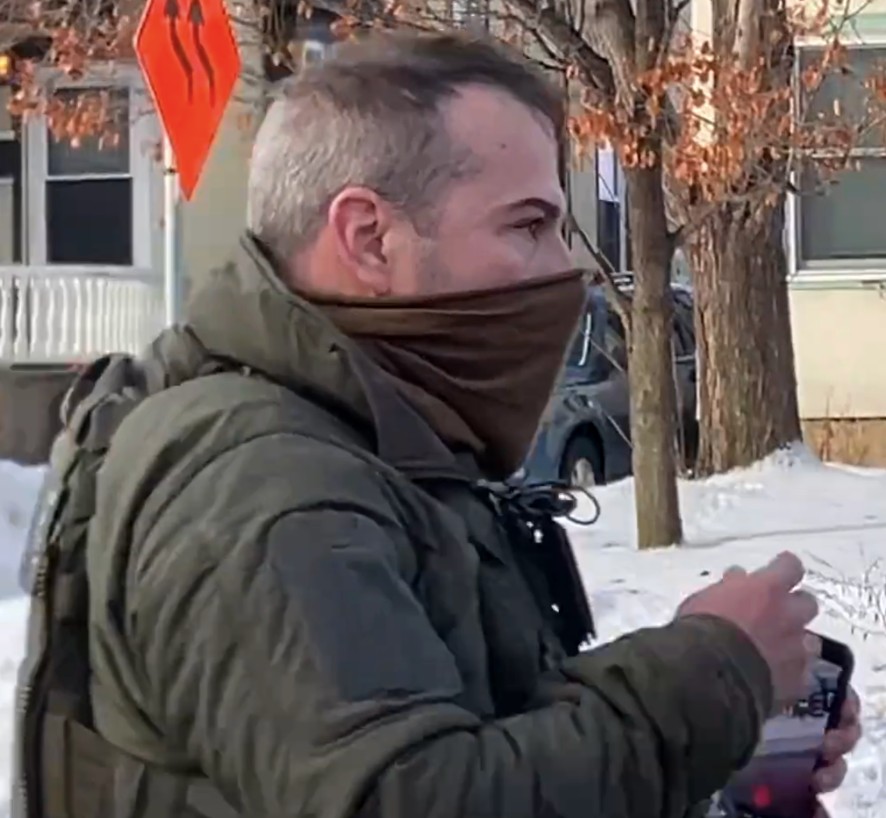
In the video, Ross can be seen with his phone in his left hand filming Good before he pulls his gun out of its holster with his right hand. Roughly one second elapses before he fires the first round through Good’s front window. Two more shots follow.
A still from that same video captures Ross as he walks past in the seconds after the shooting. A camera app appears open on his phone.
A still image in a video published by the Minnesota Reformer. A video app can be seen open in the federal agent’s phone. Agent’s Phone
On Jan. 9, a video filmed by Ross was published on X by a conservative news outlet called Alpha News.
By syncing this video up with the other four available videos, it was possible to observe more of what occurred, including from Ross’ rough perspective. However, it is important to note that Ross was holding the phone slightly away from his body, so what appears in the video would be marginally different to what would have been his line of sight.

Support Bellingcat
Your donations directly contribute to our ability to publish groundbreaking investigations and uncover wrongdoing around the world.
In the footage, Good can be seen backing up before veering to the right as Ross and the camera move to her left. It is not clear from this footage exactly how close the car came to Ross, as the cellphone points up and away as the vehicle moves forward. Someone can be heard saying “whoa” before gunshots are heard.
An angle captured from down the street (middle lower right in the synchronised video below and in full view here) – which some have suggested shows Ross being hit by the vehicle – does appear to show the vehicle pass close to the agent as he fires. However, the close-up video shared by the Minnesota Reformer (middle top and in full view here) shows Ross moving out of the way and to the side of the vehicle as he fires.
Another video published by CNN (middle lower left) shows a head-on view of the incident from surveillance footage.
New footage from the ICE agent’s phone who shot at Renee Nicole Good in Minneapolis has emerged, posted by AlphaNews on X. We’ve placed that footage in a synced timeline with the other currently available footage.
— Bellingcat (@bellingcat.com) Jan 9, 2026 at 21:23
Almost one week after the incident, protests have been held in Minneapolis and other cities in the US.
US President, Donald Trump, and Department of Homeland Security, Kristi Noem, initially said that Good had tried to run over an ICE officer after blocking the road, labelling her a “domestic terrorist”. However, the Democratic mayor of Minneapolis, Jacob Frey, said that version of events was “garbage” and disproven by the video footage.
On Monday Jan. 12, Noem, told FOX News that more ICE agents would be sent to Minnesota.
Individual links to each of the five videos detailed above can be found here, here, here, here and here.
Bellingcat is a non-profit and the ability to carry out our work is dependent on the kind support of individual donors. If you would like to support our work, you can do so here. You can also subscribe to our Patreon channel here. Subscribe to our Newsletter and follow us on Bluesky here and Mastodon here.
The post Analysing Footage of Minneapolis ICE Shooting appeared first on bellingcat.