Author: tio

  • Top DOJ Official Halts Crypto Enforcement While Holding Over $150,000 in Crypto Assets

    This story was originally published by ProPublica.

    Before Todd Blanche could be confirmed as the second-highest official at the Justice Department, he had to satisfy the concerns of ethics officials.

    Blanche, President Donald Trump’s personal attorney during his New York criminal trial last year, was a cryptocurrency investor with holdings of between $159,000 and $485,000, records show.

    To prevent possible violations of the federal conflicts of interest statute, Blanche promised to dump his digital assets no later than 90 days after his Senate confirmation as deputy attorney general in March, according to his government ethics agreement. He also pledged not to participate in any matter that could have a “direct and predictable effect on my financial interests in the virtual currency” until his bitcoin and other crypto-related products were sold.

    But about a month into the job — before divesting — Blanche issued a memo that ordered an end to investigations into crypto companies, dealers and exchanges launched during President Joe Biden’s term. He also eliminated an enforcement team dedicated to looking for crypto-related fraud and money-laundering schemes. And his memo said the Justice Department would assist Trump’s crypto working group of experts and Cabinet members that went on to issue a list of recommendations aimed at making the United States the global leader in digital currency.

    Blanche’s directives, while he still owned significant crypto investments, violated the conflicts of interest law and his ethics agreement, legal experts and former federal ethics officials told ProPublica.

    Blanche promised to dump his digital assets no later than 90 days after his Senate confirmation in March.

    “If you are invested in that industry and now making a decision that could affect whether or not the DOJ is gonna pursue prosecutions, that’s an obvious conflict of interest,” said Virginia Canter, who served as an ethics lawyer at the White House, Treasury Department and Securities and Exchange Commission during the presidencies of George H.W. Bush, Bill Clinton, George W. Bush and Barack Obama.

    Even when he did ultimately divest his crypto interests, Blanche’s ethics records show he did so by transferring them to his adult children and a grandchild, a move the experts said is technically legal but at odds with the spirit and intent of the law.

    Blanche’s actions illustrate the ethical problems posed as the Trump administration relaxes regulation of digital money to make good on the president’s vow to make the U.S. “the crypto capital of the world.” In less than a year, Trump has nominated at least 216 political appointees who owned — either by themselves or with their spouses — cryptocurrency investments worth between $175 million and $340 million at the time of their nomination, a ProPublica review of federal financial disclosure records found. By contrast, in the first two years of his presidency, Biden appointed about two dozen people who, combined, held less than $7 million in crypto investments.

    Trump’s crypto-friendly appointees include several who head agencies with regulatory authority over the industry.

    Among them is Commerce Secretary Howard Lutnick. Until this year, Lutnick was CEO of Cantor Fitzgerald, a financial services firm with billions in crypto investments. The firm is also the primary banker for Tether, among the world’s largest issuers of stablecoins — a type of crypto pegged to the dollar or another asset to avoid wild swings in value. 

    After signing an ethics agreement, Lutnick transferred his stake in Cantor Fitzgerald to his children, including his two adult sons who now run the firm. The transfer was completed in October. By then, Lutnick had taken several pro-crypto steps — announcing that Trump would create a bitcoin strategic reserve, having his department take part in the president’s crypto working group and publishing economic data on nine key blockchains, a move designed to foster more trust in the digital market. (The blockchain is a digital ledger that underlies cryptocurrencies like bitcoin.)

    A Commerce Department spokesperson noted that Lutnick was given a limited waiver from the White House allowing him to work on general issues that could affect Cantor Fitzgerald while the transfer of his stake in the firm was pending. The waiver was dated July 8, nearly five months after he was sworn in. The spokesperson said Lutnick “fully complied with the terms of his ethics agreement” and did not have any “economic gains or losses associated” with the transfer of his stake in the firm. 

    Another crypto-friendly appointee is Paul Atkins, chair of the SEC, whose ethics records show he owned stakes of up to $6 million in crypto-related businesses before his confirmation in April. Since Trump took office, Atkins’ agency has dropped or settled enforcement cases with crypto companies.

    Atkins signed an ethics agreement promising to sell a crypto investment fund and equity in two crypto companies. He has since filed paperwork saying he complied with the agreement and listed millions of dollars worth of investments he sold, but those do not mention any crypto-related sales. An SEC spokesman said Atkins complied with his ethics obligations but would not say when he sold his crypto-related assets. 

    A staffer for Blanche said he and the Justice Department would not comment.

    “The conflicts of interest in this administration are blatant and hugely against the public interest.”

    Trump has led the way on ethical conflicts connected to crypto. During last year’s election campaign, he pledged to the crypto industry that he would end Biden’s strict approach toward regulation. In turn, the industry heavily bet on Trump, spending millions to support his election and those of other Republican candidates.

    On the eve of the election, Trump promised he would be America’s “crypto president” if he won a second term. He and his sons launched their own cryptocurrency business, World Liberty Financial, and after his election victory, Trump and his wife, Melania, issued a pair of meme coins, allowing anyone to use crypto to enrich the incoming president. Within days of taking office in January, Trump signed a presidential action promoting the growth of digital assets and started nominating government officials to fulfill his goal.

    James Thurber, a former congressional staffer who worked on federal ethics reforms and is now professor emeritus at American University, characterized the Trump administration’s disregard of traditional government ethics as unprecedented. He contrasted Trump’s sale of crypto coins to the example set by President Jimmy Carter, who announced he was putting his peanut farm into a blind trust when he took office.

    Thurber noted that Obama and Biden required their appointees to comply with an ethics pledge to avoid conflicts of interest. On the day of his inauguration in January, Trump rescinded Biden’s ethics pledge requirements for appointees.

    “The conflicts of interest in this administration are blatant and hugely against the public interest.” Thurber said.

    Trump’s press secretary, Karoline Leavitt, said in a statement to ProPublica that the “administration is fulfilling the President’s promise to make the United States the crypto capital of the world by driving innovation and economic opportunity for all Americans.”

    “Neither the President nor his family have ever engaged, or will ever engage, in conflicts of interest,” she added.

    Tonya Evans, a former professor at Penn State Dickinson Law who now consults on the digital economy, said the increase in crypto investors serving in the executive branch under Trump is a measure of the industry’s success in taking over regulatory bodies that were previously hostile to them. She compared the industry’s newfound power to how Goldman Sachs alums — such as Treasury Secretary Steven Mnuchin during Trump’s first term or Biden’s SEC chair, Gary Gensler — held prominent government positions and were able to exert outsized influence on shaping financial policy.

    “My concern is not so much that people who understand crypto are in leadership positions,” she wrote in an email to ProPublica, “but that ethics frameworks may not yet meet this critical fork in the road of development, especially if ‘divestiture’ takes the form of passing to family. We are a long way from President Carter’s peanut farm!”

    Crypto Conflicts

    Blanche rose to prominence in recent years as Trump’s main defender in criminal court.

    A former federal prosecutor for the Southern District of New York, Blanche, 51, was Trump’s lead attorney in the Manhattan trial that resulted in his being convicted of 34 felonies stemming from his hush-money payment to a pornographic actress, Stormy Daniels. Blanche also defended Trump against criminal charges accusing him of conspiring to subvert the 2020 election and retaining highly classified documents. (Those two cases were dropped after Trump was reelected president.)

    Since gaining Senate confirmation on March 5, Blanche has helped lead a massive remaking of the Department of Justice, shifting the emphasis from long-standing priorities, like the protection of civil rights. Thousands of employees have been terminated or resigned as the new administration ended police misconduct prosecutions, environmental abuse lawsuits and abortion access cases. Blanche has pushed for tougher border control enforcement and the use of fraud statutes to prosecute institutions with diversity- and inclusion-related policies. As news of Trump’s ties to the disgraced financier Jeffrey Epstein gained momentum this year, it was Blanche who personally interviewed Ghislaine Maxwell, Epstein’s longtime confidante now serving a 20-year prison sentence for helping him sexually abuse underage girls.

    Blanche has pushed for tougher border control enforcement.

    When Blanche issued the sweeping memo ending the department’s Biden-era crypto enforcement approach, he effectively ended a three-year effort aimed at penetrating the shadowy world of transnational criminals.

    The agency’s National Cryptocurrency Enforcement Team, as it was called, had won the conviction of a man who defrauded crypto investors out of $110 million; a guilty plea from a Russian man who processed more than $700 million through an online marketplace for drug trafficking, money laundering and other crimes; and the conviction of a cryptocurrency exchange operator that helped launder billions from hackers, ransomware attacks, identity theft schemes and narcotics distribution rings.

    The team also assisted a multiagency probe of Binance, the world’s largest cryptocurrency exchange. The investigation found, among other things, that Binance failed to report and prevent suspicious financial transactions for Hamas, al-Qaida and other terrorist organizations. Federal prosecutors charged the company’s founder, Changpeng Zhao, with violating U.S. laws against money laundering; to settle the case, Zhao pleaded guilty, resigned as company chief executive and served a four-month prison sentence. He also agreed to pay the U.S. $4.3 billion in penalties. (Trump pardoned Zhao in October. Months earlier, Binance had used a stablecoin developed by the Trump-owned World Liberty Financial to fund a $2 billion deal.)  

    In his April 7 memo with the subject line “Ending Regulation By Prosecution,” Blanche scoffed at the Biden Justice Department’s approach toward crypto, calling it “a reckless strategy of regulation by prosecution, which was ill conceived and poorly executed.” He said the agency would now target only the terrorists and drug traffickers who illicitly used crypto, not the platforms that hosted them. He announced the disbanding of the National Cryptocurrency Enforcement Team.

    “The digital assets industry is critical to the Nation’s economic development and innovation,” Blanche wrote. “President Trump has also made clear that ‘[w]e are going to end the regulatory weaponization against digital assets.’”

    The market reacted favorably; crypto trading spiked.

    At the time, Blanche hadn’t relinquished his bitcoin assets worth between $100,000 and $250,000, nor his investments in the cryptocurrencies solana and ethereum or his stock holdings in Coinbase. Blanche should have recused himself from the decision, experts told ProPublica.

    Under the federal conflicts of interest statute, government officials are forbidden from taking part in a “particular matter” that can financially benefit them or their immediate family, unless they have a special waiver from the government. The penalties range from up to one year in jail or a civil fine of up to $50,000 all the way to as much as five years in prison if someone willfully violates the law.

    Blanche’s wide-ranging memo benefited the industry broadly, including his own investments, ethics experts said.

    At the time, Blanche hadn’t relinquished his Bitcoin worth between $100,000 and $250,000.

    In an ethics filing he electronically signed in June, Blanche said his bitcoin and other cryptocurrency investments — including solana, cardano and ethereum —  “were gifted in their entirety to my grandchild and adult children.” Financial disclosure records don’t provide exact amounts but instead a broad range for the worth of a government official’s investment. At that point, Blanche’s records show his transfers to his family members were worth between $116,000 and $315,000. He said he sold additional crypto-related investments worth between $5,000 and $75,000. The divestment took place in late May and early June, the ethics filing said.

    Legal experts noted that the federal conflict-of-interest law prohibits government officials from using their position in a way that would financially benefit a spouse or a minor child; it does not mention adult children or grandchildren.

    Still, even if legal, giving assets like these to a relative doesn’t satisfy the ethical concern that a government official could act in a way that helps their family financially, they said.

    “The purpose of the law is to eliminate even the appearance that an official’s decisions are influenced by their financial interests,” said Kedric Payne, a former deputy chief counsel for the Office of Congressional Ethics who is senior ethics director at the Campaign Legal Center. “That purpose is defeated when an official simply gives conflicted assets to adult children.”

    The post Top DOJ Official Halts Crypto Enforcement While Holding Over $150,000 in Crypto Assets appeared first on Truthdig.


  • Inside the Failure to Regulate Stablecoins

    It’s 2025. Stablecoins are embedded in global payment systems. Public debates over digital dollars have stalled. Financial surveillance is rising. And with Project 2025 reshaping Washington, the regulatory foundations to address these issues are under threat. Having worked on Capitol Hill drafting stablecoin legislation, and later contributing to digital payments policy at the U.S. Treasury…

    Source

  • waterwaymap

    A unique, topological, view on rivers & waterways in OpenStreetMap, showing how they are connected. Find mistakes and make better maps.

  • The New German War Machine

    Germany’s transformation into a military power is in full swing: confidential government documents reveal plans to channel billions into ammunition and controversial weapons systems. Is the country prepared for the consequences?
  • Azerbaijan: The Price of Victory and the Silence of Dissent

    In this article series, we take a second look at current events in countries that often remain only briefly spotlighted in German reporting. Together with local experts, we ask: What political and social developments lie behind the current events that we see in the news? What does this mean for democracy and media freedom? With our exile expertise, we want to reveal global connections and understand what we can learn from this for free, democratic coexistence.
    In this episode, Azerbaijani journalist Fatima Karimova writes about the repression of media workers in her homeland and why the European Union repeatedly turns a blind eye to it.
  • Publish your videos with PeerTube for mobile!

    Publish your videos with PeerTube for mobile!

    The PeerTube mobile app continues to grow and now includes a creator mode!

    Let’s take this opportunity to review the latest developments and the improvements we will be making in the future.

    Publish your videos wherever you are

    This was our commitment during last May’s crowdfunding campaign: to add a “creator mode” to the PeerTube app so you can upload your videos wherever you are, directly from your smartphone!

    You will now find a “Creator” page in the app. From there, you can manage your channels and videos!

    At the top of this page, you can access to your different channels to view and edit their information, or add a new channel.

    The page My channels
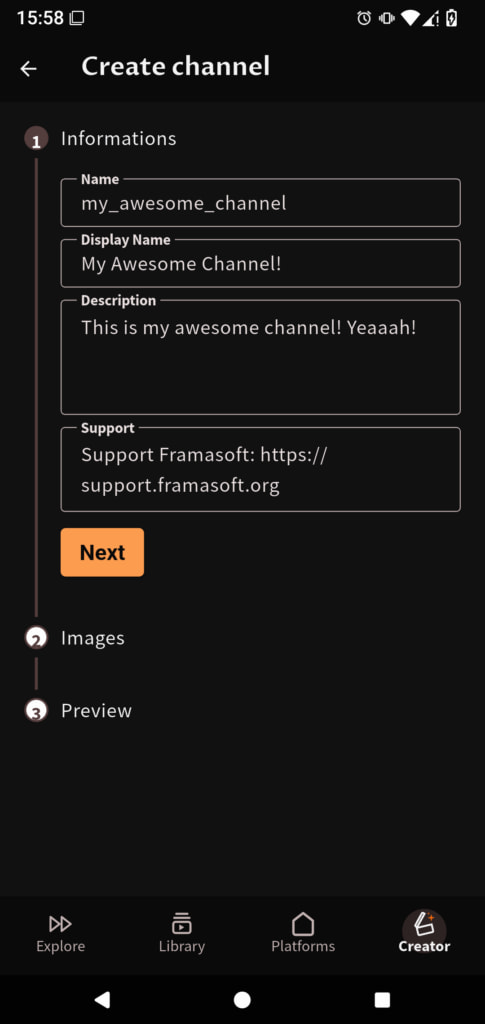
    The page to add a new channel

    In the middle of the page is a list of all your videos. Each video has a menu that allows you to perform actions on it. From there, you can edit the video information, download the video, add it to a playlist, or delete it.

    Finally, at the bottom of the page, you will find the “Publish” button, which allows you to… publish a new video. (Which is surprising, indeed! 🙃)

    When you click on it, a menu will pop, allowing you to choose a file from your phone or record a new video directly through the app.

    Live streaming and importing from a URL are two options that are currently unavailable, but we plan to work on them in the future.

    After selecting the video, you will be able to preview its content.

    Then, all you have to do is select the channel where you want to publish your video and start uploading!

    You will then receive a notification that your video is uploading in the background. While you wait, you can do something else in the PeerTube app or elsewhere on your smartphone. The upload will continue even if you are using another app!

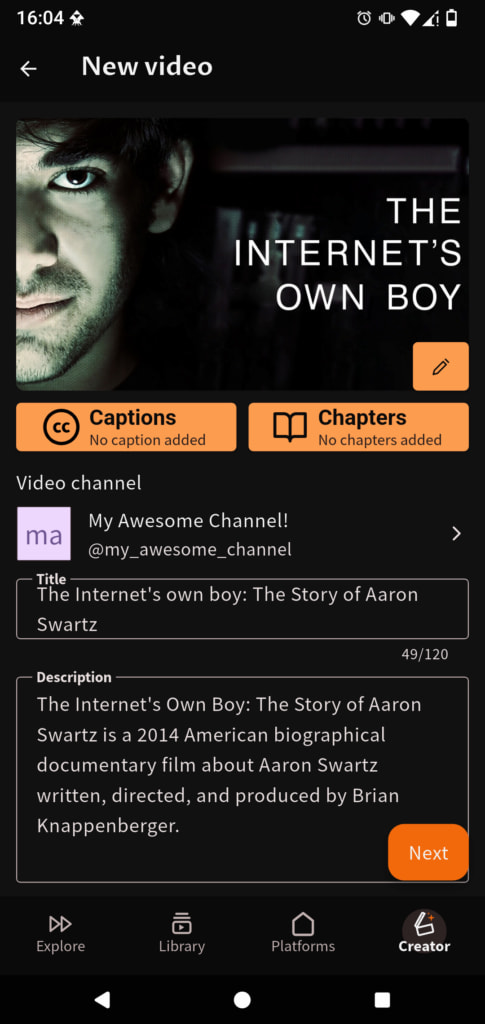
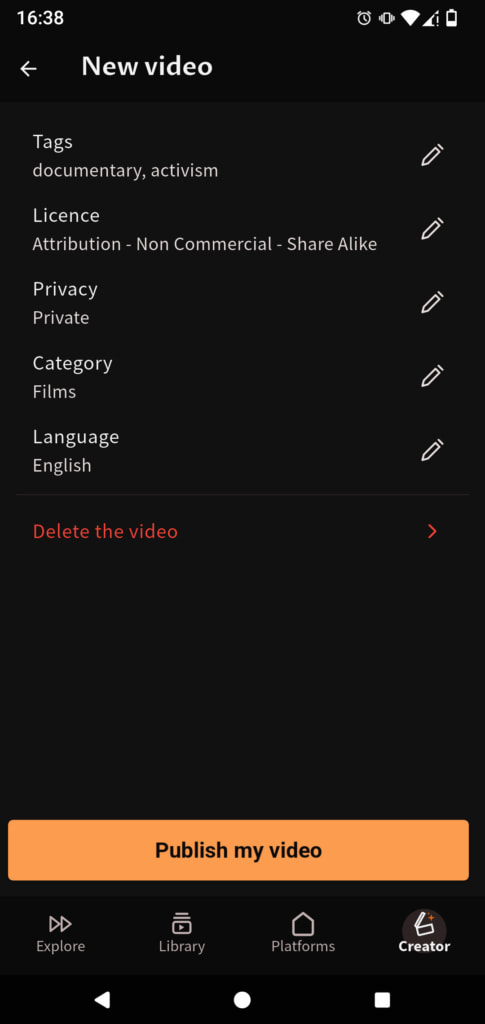
    Finally, on the last two pages, you can edit your video’s information: thumbnail, subtitles, chapters, description, etc.

    As with PeerTube for the Web, the mobile app lets you enter all the necessary information!

    The first screen for adding a new video
    The second screen for adding a new video

    After clicking on “Publish my video”, you will be redirected to the “Creator” page. There, you will find your new video and the upload status, if it is not yet complete.

    As you can see, it’s quick and easy to upload a video with the PeerTube app!

    Of course, we can (and want to) improve the process even more. The paint is still wet, so we expect a few minor bugs. We will spend the next few weeks fixing them.

    We also plan to add several new features. These include live streaming and the PeerTube studio, for example. There are two other major features, but they require a lot of work.

    In any case, we are thrilled to finally allow you to upload your videos within the app. We look forward to continuing our work to improve your experience with PeerTube on mobile!

    A year of improvements

    Last year, we announced the release of our official PeerTube mobile app. Thanks to your support and that of the NLnet Foundation, we were able to hire Wicklow, a junior developer who had just completed an internship with us, to develop the app.

    From the beginning, our plan was to move forward in stages. We focused on the main building blocks first, gradually adding new features and improving the app based on community feedback.

    Developing a widely accessible application for PeerTube is no easy task. Its decentralized and federated nature of the platform is difficult for many people to grasp because they are accustomed to the centralized applications of Big Tech companies.

    That’s why we chose to work with La Coopérative des Internets. They designed the application to ensure its “decentralized” aspect causes minimal friction.

    Thus, each new element added to the application is preceded by discussions and mock-ups created by a designer. We are delighted to have been able to integrate this process into the project!

    This decentralized aspect of PeerTube not only poses a challenge in terms of user experience, but also presents a real headache when it comes to getting past the restrictions imposed by Google and Apple’s app stores. For this reason, the list of available platforms in the app was limited for several months after its launch.

    Needless to say, these restrictions were as frustrating for you as they were for us. Fortunately, we were able to publish an unrestricted version on F-Droid (although publishing on F-Droid was no easy task either, for other reasons… 😅).

    Wicklow shared his experience in developing the app in two articles: Part 1 and Part 2.

    Despite the many difficulties encountered during this journey, the PeerTube application is making steady progress! Since the beginning of the year, we have added the following features:

    • the ability to log in to your own account;
    • the ability to comment on and read comments on videos;
    • the ability to receive notifications related to their account activity;
    • enjoy playlists;
    • report problematic videos;
    • access your viewing history;
    • download videos (on platforms that allow it);
    • use gestures to change the volume and brightness;
    • as well as many other diverse and varied improvements…

    All these improvements were made possible thanks to your support! Thanks to crowdfunding in May, we raised the necessary funds to continue developing the application.

    However, it is also the year-round donations made to Framasoft that finance the PeerTube project as a whole and allow us to look forward to the future of PeerTube with confidence.

    If you can and want to contribute to PeerTube’s robustness, consider making a donation and sharing our support page!

    More to come…

    Among the recent improvements to the app (including creator mode), several were part of our May commitments.

    However, we haven’t delivered everything yet! Several features are still in the pipeline and will arrive in the coming months.

    These include, as mentioned above, the ability to play videos in the background (so you can turn off your screen while listening to a podcast), the ability to broadcast live directly via the app, and the release of a tablet-friendly version of the app.

    PeerTube is an ambitious project.

    Creating software that allows users to build alternative video platforms to those of the digital giants, centered around users (rather than the financial interests of a company), is a monumental challenge.

    However, after ten years of development, more and more organizations recognize PeerTube as a reliable solution for distributing their videos.

    Our solidarity-based economic model has given us a considerable advantage, allowing us to develop software we are proud of, without pleasing investors and submitting to their endless quest for quick returns.

    You are our compass. Thanks to your feedback, we are developing PeerTube to best meet your needs.

    The PeerTube mobile app follows the same model as the web app: we are building our vision of a digital world designed for everyone, brick by brick.

    Admittedly, there is still a long way to go… but the path is Free!

    Let’s build the robustness of PeerTube and Framasoft

    Framasoft (and therefore PeerTube) relies on your donations for funding!

    By supporting our solidarity-based model, you are not only ensuring a secure, commercial-free future for PeerTube. You are also enabling Framasoft to provide 23 alternative, free services to more than 2 million users!

    To achieve this, we need to raise €250,000 by the end of the year.
    Thanks to over 3,000 donors, we have already raised around €150,000! 🥳

    Help strengthen Framasoft by making a donation (66% of which is tax-deductible for French taxpayers) and spreading the word to your friends and family!

    Together, let’s prove that a non-commercial digital world accessible to all is possible!

    The illustrations were designed by David Revoy and are licensed under CC-BY 4.0.

  • PeerTube v8 : manage your videos with your team!

    PeerTube v8 : manage your videos with your team!

    We’re thrilled to announce the release of PeerTube v8!

    This version features a redesigned video player, an improved experience for importing videos and the ability to share channel management with other accounts!

    A brand new video player

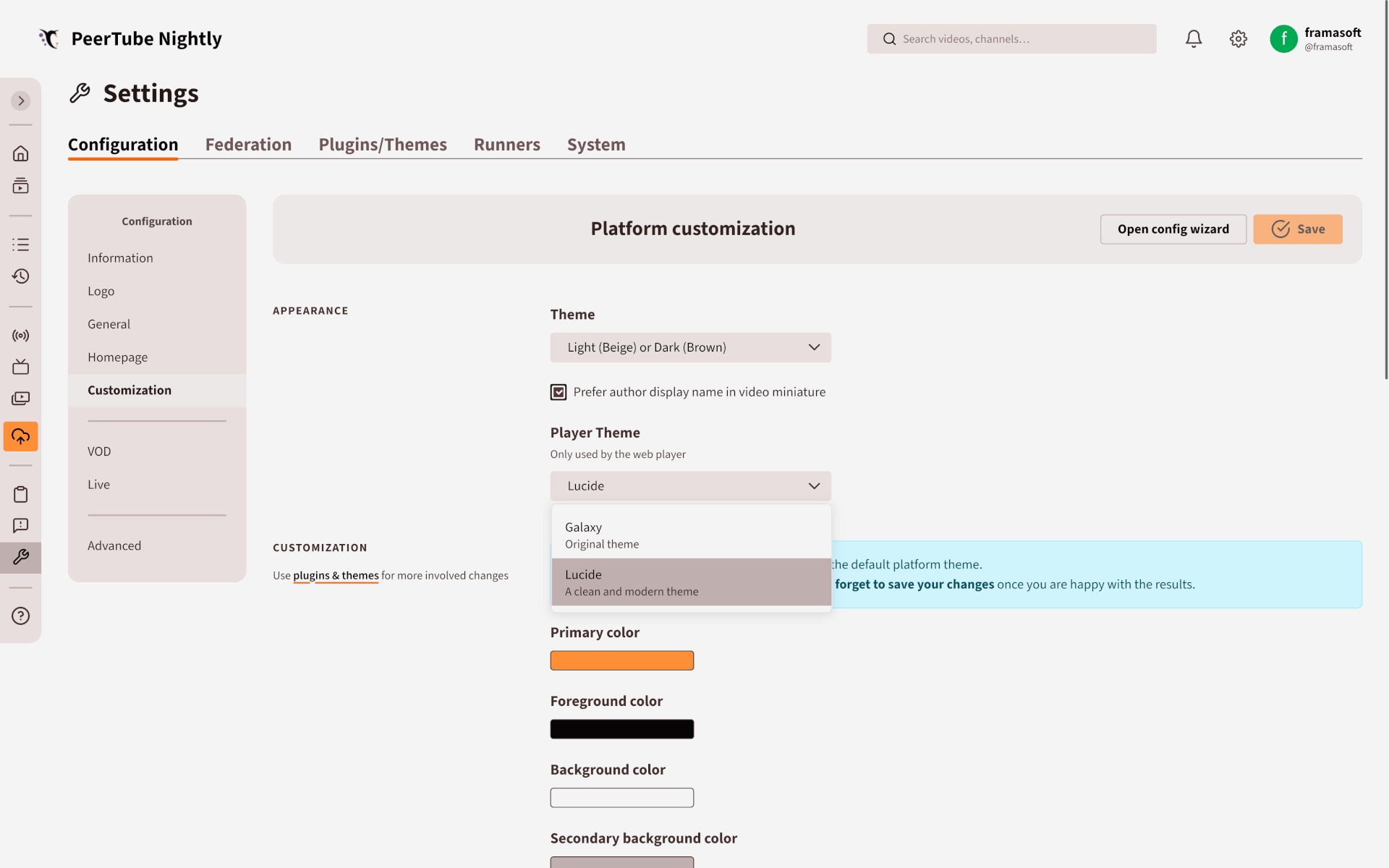
    We created a new theme for the video player for the first time since the beginning of PeerTube development!

    This new theme is named Lucide, in reference to the new icons used. It has been designed to be cleaner in order to better highlight the content.

    Instead of bold, imposing icons, we opted for a more discreet style with finer lines on the buttons.

    We also reworked the volume adjustment button to hide the volume state by default.

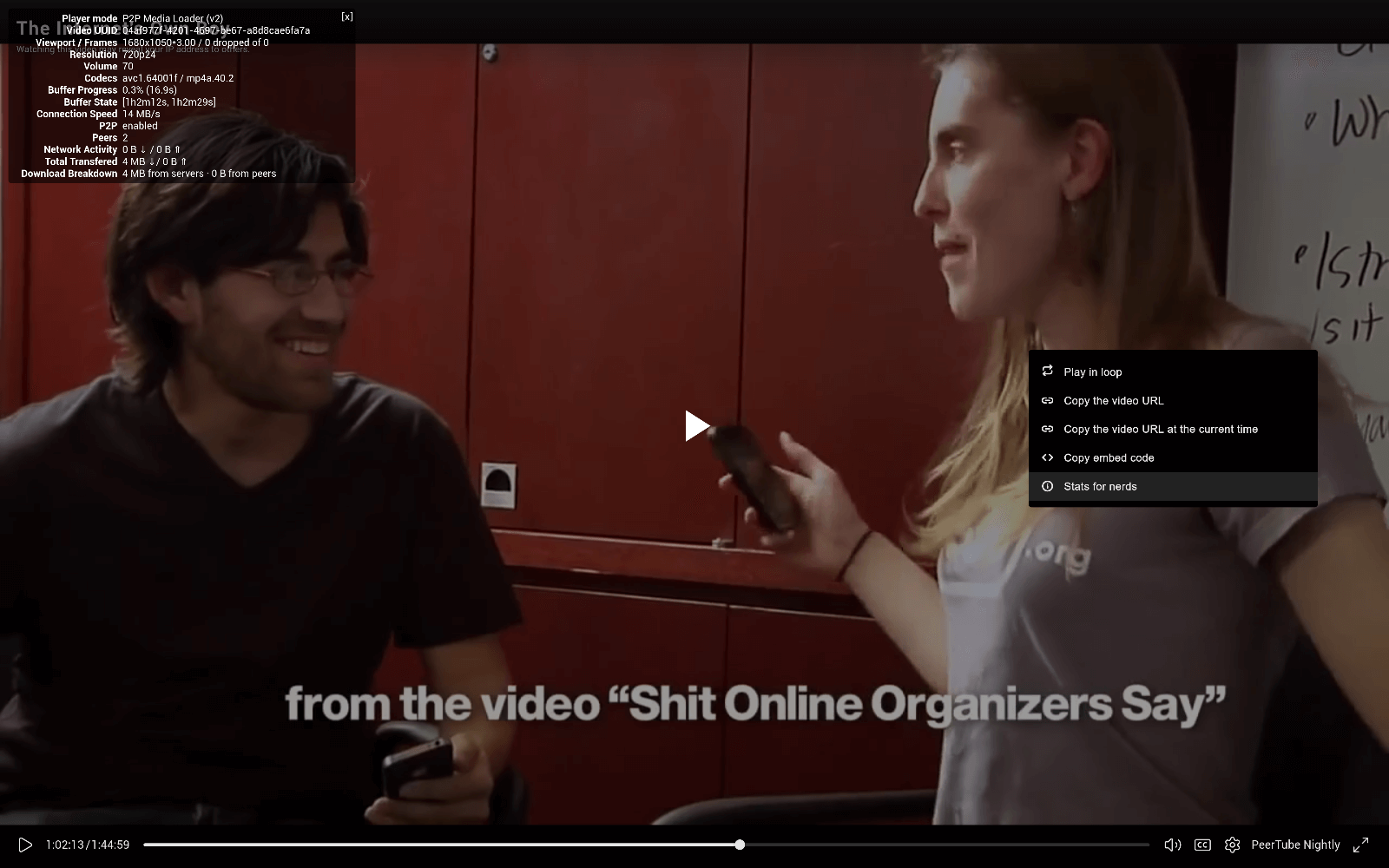
    Finally, we moved the peer-to-peer information to the “Stats for nerds” menu, which is accessible by right-clicking on the player.

    These few improvements breathe new life into PeerTube, giving it a more modern and professional look. They accomplish this by limiting the displayed information to what is strictly necessary. Less is more, as they say!

    If you prefer the old theme, don’t worry, it’s still available! You can choose the player theme at the platform, channel, or video level.

    These changes are in line with all the design improvements we’ve made this year. With each update, PeerTube becomes more customizable, allowing you to create a video platform that reflects your personality!

    Manage your channels as a team

    Since PeerTube’s inception, many have asked us to add the ability to collaboratively manage a channel. This is, by the way, one of the most requested feature on our platform dedicated to idea suggestions!

    Although use cases can very, it is often a critical need for organizations where several people are responsible for uploading new videos.

    We are therefore delighted to announce that the collaborative channel management is now possible with PeerTube! 🥳

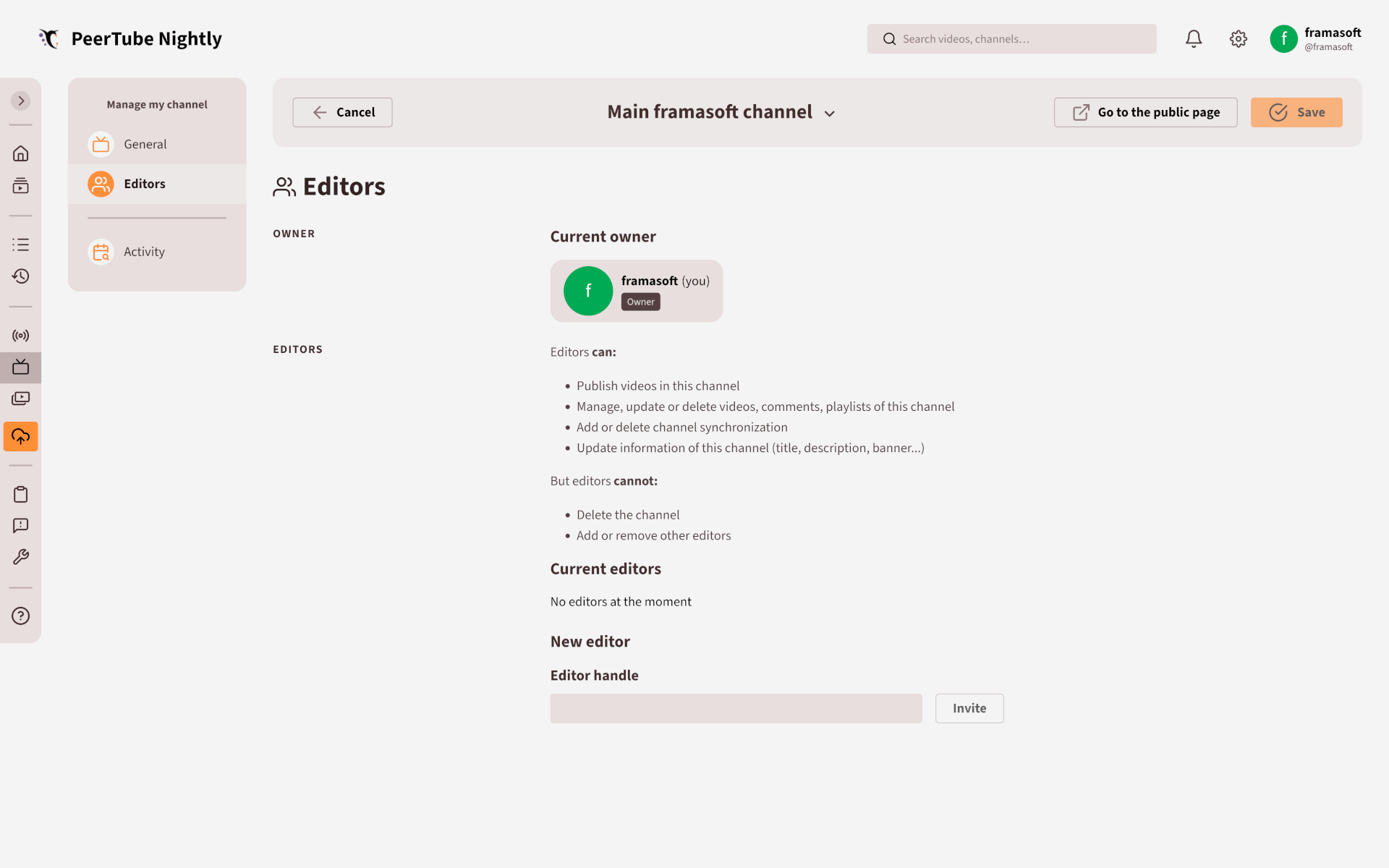
    Thanks to this new feature you can now designate other members of your platform as editors.

    Thus, a channel editor will be able to publish new videos, update or delete videos, playlists and comments, as well as add or delete synchronizations and update channel information!

    Please note that editors cannot add or remove other editors, or delete the channel.

    And more…

    Of course, as with each new major version, many other improvements have been made.

    Some are invisible to the general public, such as ilfarpro’s contribution, which adds the ability to generate storyboards (you know, the thumbnails that display the different images from a video when you hover over the progress bar) through a remote runner instead of the PeerTube server.

    Others, however, are much more visible!

    For example, this is the case with the improvements made to the system for importing videos and channels from other platforms.

    It is now possible to manually rerun a failed import. Also, in the case of a channel synchronization, PeerTube will try to run again a failed import after some time (at the next verification for synchronization, which interval, being 1h by default, is configurable by the platform’s admin).

    Finally, information about the status of a video import is now available in the video management page.

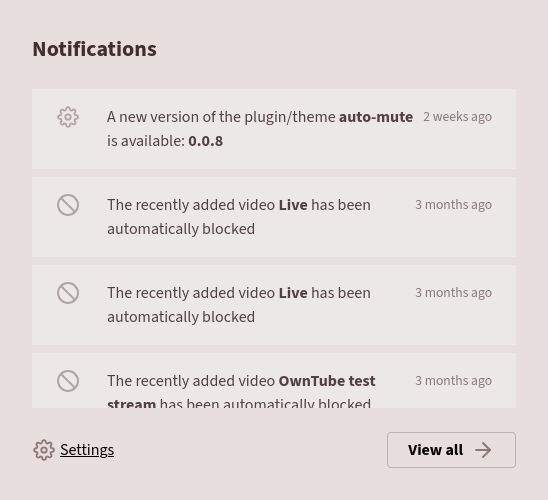
    Another new improvement is that we have redesigned the appearance of notifications to better match PeerTube’s overall theme!

    A complete list of all changes made in this version is available in the dedicated changelog.

    Looking back on a year of PeerTube

    The year 2025 was marked by numerous advancements for the PeerTube project as a whole.

    In total, we will have released four versions of PeerTube, all of which adhere to the guiding principle of making PeerTube easier for organizations to use.

    Indeed, thanks to an NLnet grant, we were able to incorporate important features for this type of audience into the updates.

    Keeping this in mind, we improved PeerTube’s design this year and made it easier to customize. Previous versions included the ability to translate PeerTube emails, a redesigned the “About” and “Video Management” pages, and an improved interface for easier batch batch action management (e.g. deleting videos)!

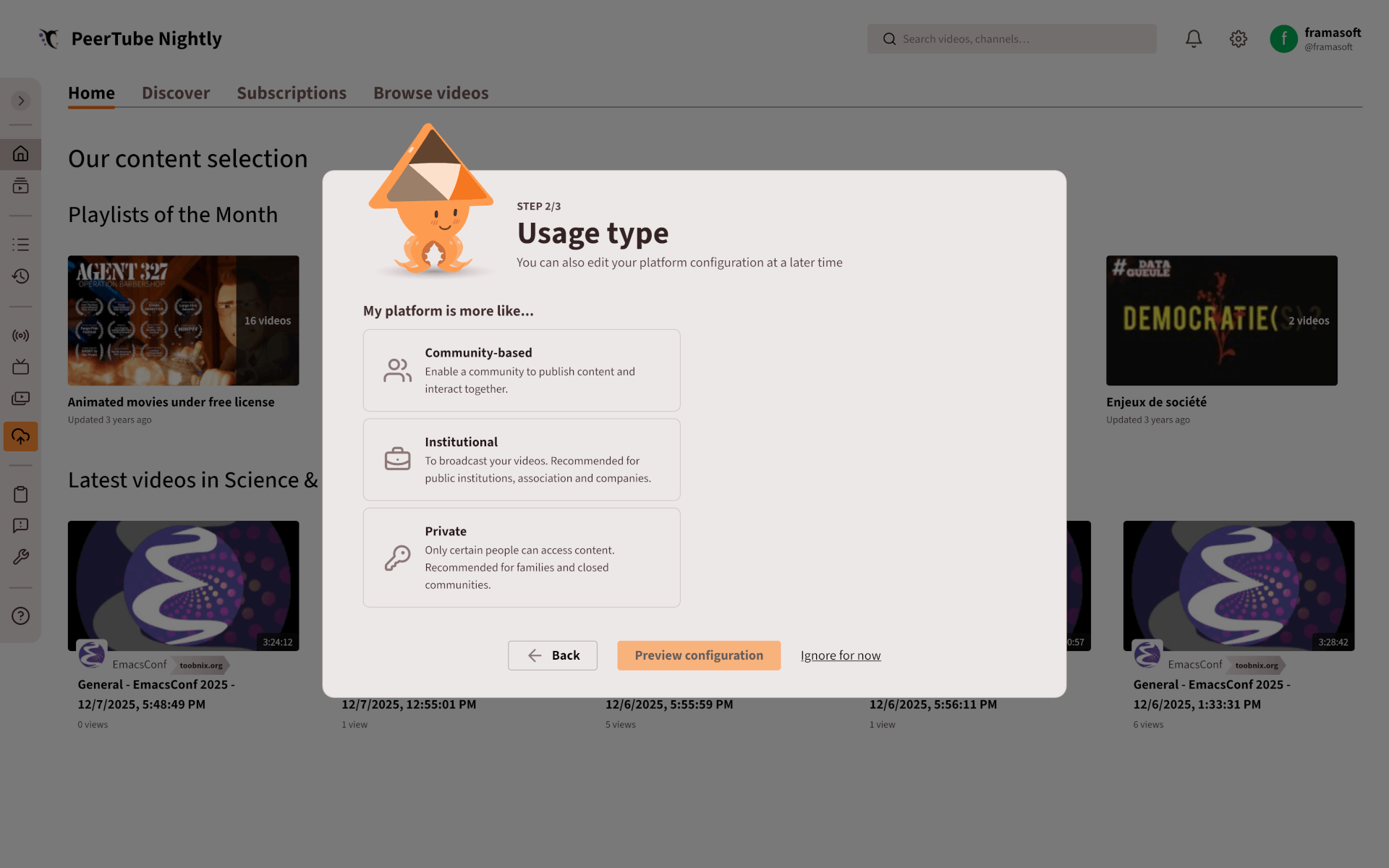
    We also added — and this was the big feature in version 7.3! — a configuration wizard to help admins set up their platform according to their profile (institution, community, or individual).

    Among other major improvements this year, we can also mention a new moderation tool that allows you to monitor certain words, making it much easier to track comments on your videos or platform!

    Finally, thanks to a previous NLnet grant, but also because it was important to us: we completely redesigned the management of sensitive content.

    We have long known that people’s sensitivity to a subject varies greatly and that the old system was too simplistic to truly meet the needs of video creators and their audiences.
    That’s why we collaborated with La Coopérative des Internets to design system that is more complex (but not more complicated) yet more true to reality!

    Institutional recognition and adoption

    In addition to technical improvements, the entire PeerTube ecosystem is making steady progress. Notably PeerTube was recognized as a digital public good by the DGPA (Digital Public Goods Alliance).

    This recognition reinforces our confidence in the choices (both technical and political) we have made to ensure that PeerTube is a project that serves everyone.

    When platforms like YouTube seem to continue to enshittify daily, more and more organizations (particularly medias outlets and institutions) are contacting us to make PeerTube their backup or even primary solution for hosting their videos.

    We’re really proud to see that PeerTube truly meets the needs of all these organizations allowing them to create a video platform that they control and that respects their viewers.

    What PeerTube has in store for you in 2026…

    First, regarding the mobile app, we aim to finalize the features promised during the crowdfunding campaign , including background video playback, live streaming, and TV apps.

    If all goes well, background video playback should be available in early 2026!

    Spoiler alert: The app’s video maker mode will be available in a few days… 🤫

    Regarding the PeerTube project as a whole, we would like to improve the experience for newcomers by reducing the effort required to find their first PeerTube platform!

    The project is still in the planning stages and we still have a lot of work before it can happen. However, our ambitions could have a serious impact on the PeerTube ecosystem and we can’t wait to get started!

    Early next year, we will publish the PeerTube project’s traditional roadmap. There, you will find more details about our vision for PeerTube in 2026. We are shaping this vision based on your ideas, so please feel free to share your suggestions on our dedicated platform!

    To keep up with all our news (roadmap announcements, new projects, upcoming updates, etc.), you can subscribe to our social media channels and our newsletter.


    PeerTube is developed by Framasoft, a french non-profit association raising awareness about digital issues. Framasoft is currently running a fundraising campaign to finance the year 2026.

    At the time of writing, there are just over three weeks left to reach our goal of €250,000. However, we have only raised 24% of this target so far.

    So if you appreciate PeerTube and would like to support its development, please consider making a donation (66% tax deductible for French residents) and help build a bright future for PeerTube!

  • „White Gold“: Debris and Deception

    Crooked deals with waste are just as lucrative to drug deals – only easier to conceal. An investigation by CORRECTIV.Europe shows how two companies from Germany and Czechia are making hundreds of thousands of tonnes of debris disappear just behind the border.
  • Russia declares CORRECTIV an “undesirable organization”

    The Russian Prosecutor General’s Office has designated CORRECTIV as an “undesirable foreign organization.” With this move, the Russian state is placing our journalistic work under blanket threat of punishment—while simultaneously demonstrating that our reporting is effective. Independent investigations are to be made impossible in Russia.
  • Despite sanctions: Putin‘s war waged with European machinery

    Without machines from abroad, Russia’s weapons factories would grind to a halt. This analysis of Russian import data shows German and European companies supplied goods with potential dual-use applications over 28,000 times in the lead-up to the invasion. How this has impacted the war is often overlooked.