Author: tio

  • The $5 Million Shadow Bank: California Man Admits to Funneling Cybercrime Cash

    A California man pleaded guilty to operating an unlicensed money-transmitting business that funneled more than $5 million across international borders, spotlighting the critical role shadow networks play in the global cybercrime ecosystem. 

    By acting as an illicit intermediary between fraud victims and the ultimate beneficiaries, operations like his deliberately obscure the financial paper trail, making illicit transactions significantly harder for law enforcement to detect while laundering hundreds of thousands of dollars in stolen funds.

    The man, Ifeanyi Emmanuel Ugwu, 49, of Bakersfield, admitted in federal court to deliberately bypassing the licensing requirements mandated by United States law to track financial flows and combat money laundering.

    From December 2020 to August 2023, Ugwu operated the illicit network through his company, Franklin Finance Inc., according to the United States Attorney’s Office for the Eastern District of California. Court records detail an elaborate effort to evade detection, claiming Ugwu opened and controlled 20 accounts across nine banks and financial institutions, relying on false statements to deceive bank officials and customers alike about the true nature of his enterprise to keep the operation running.

    Over the nearly three-year period, Ugwu received funds from more than 100 people across the United States, systematically transferring the money to recipients in countries including China and Nigeria. Prosecutors stated that approximately $580,000 of the total sum was traced directly to victims of various fraud and cybercrime schemes, though authorities did not elaborate on the specific nature of the underlying scams.

    Ugwu is scheduled to be sentenced in July and faces a maximum penalty of five years in prison and a fine of up to $250,000. 

  • Romania Lifts Judicial Control on Tate Brothers

    A Romanian court has lifted all preventive judicial control measures, including mandatory police check-ins, against internet personality Andrew Tate and his brother, Tristan, according to The Telegraph. The final, unappealable ruling removes the remaining pre-trial restrictions stemming from the dual U.S.-British citizens’ December 2022 arrest on human trafficking and rape charges, which defense lawyer Eugene Vidineac said confirms the case was built on “questionable evidence.”

    The brothers, who deny all wrongdoing, still face a second Romanian criminal investigation involving allegations of trafficking minors and money laundering, as well as pending extradition to Britain. In an exclusive statement to the British newspaper, Tristan Tate accused Romanian authorities of corruption and said he and his brother are currently in Uzbekistan, adding that he had faced various forms of detention for more than three years while prosecutors “were left holding absolutely nothing.”

  • The Iran War Is Changing How People Cook — and What They Eat

    This story was originally published by Grist. Sign up for Grist’s weekly newsletter here.

    About a decade ago, India’s government began subsidizing the purchase of liquid petroleum gas, or LPG, to promote greater adoption among its lower-income citizens. Switching to the gas was considered a safer and more reliable alternative to burning wood and coal for cooking at home, which families in resource-strapped rural areas were still doing en masse. Ever since, the fuel has become ubiquitous. The bulk of Indian households prepare most of their food with it, and typically use a few cylinders of LPG every year, an amount that varies depending on whether they are in rural or urban communities. 

    In all that time, Subhash Kapoor hadn’t had much trouble securing cooking gas. Kapoor, who works as a driver in Noida, on the outskirts of New Delhi, lives with his wife and three children. A single gas cylinder would cost about Rs. 900 (about $10) and last about 40 days for the family. The process to secure one had become painless and routine: Every couple of months or so, he would place a call to a nearby gas agency, and the cylinders would be delivered to his home. In January, Kapoor did just that and received two cylinders, the maximum a household is allowed to keep at any given time.

    “I had no issues getting a cylinder in January,” said Kapoor, speaking in Hindi. “I thought the cylinders were easily available. Whenever I called, they would send them home.”

    “I had no issues getting a cylinder in January.”

    That changed in early March. As the U.S.-Israel war with Iran took off, the Middle Eastern country shut down the Strait of Hormuz, a key channel for the flow of oil and, in particular, liquified petroleum gas, which more than 2 billion people across Asia and Africa rely on for cooking. 

    With the flow of trade through the Strait halted due to the conflict, a cooking gas shortage has swept across the country. India is particularly vulnerable because it is the world’s second largest importer of LPG. Last year, imports accounted for roughly 60 percent of India’s supply, 90 percent of which came from the Middle East. 

    Panic set in among those dependent on LPG for cooking. Out of the blue, Kapoor received a text message saying that he’d picked up his allotment of cylinders for March — even though he hadn’t. When he called the agency, he says he was told he wouldn’t be able to get another cylinder until the end of the month. Kapoor suspects that the agency sold his allotment off in the black market, where prices were surging.

    People began hoarding gas cylinders, and in the Delhi area, prices skyrocketed by 600 percent. Some people stood in line for three or four days to get LPG cylinders. 

    With his own supply running low, Kapoor had little choice but to turn to the black market. About three weeks ago, he purchased a cylinder for Rs. 3,600 (about $39), more than three times what he usually pays. Kapoor’s been able to schedule another delivery from the gas agency for April, and he’s hoping he won’t have to rely on the black market again.

    Supporters of a local party in Kolkata march to protest the gas shortage in March 2026. Rupak De Chowdhuri / NurPhoto / Getty Images via Grist

    The shortage has forced restaurants across the country to close, while others have stripped staple meals like butter chicken and dosa that require more gas to prepare from menus. Everywhere from hospital kitchens to corporate businesses and school cafeterias have reported shortfalls. In Mumbai, street food vendors who serve chaat, vada pav, and other snacks that school children and day laborers rely on, are closing up shop, drastically altering their menus, or securing cylinders from the black market but hiding them in gunny sacks for fear of discovery. University students living on campus have also seen their dining options scaled back, with some colleges allowing students to cook in their dorm common areas.  

    For those who can afford it, induction stoves have become a popular option. The electric, plug-in stovetops sell for the equivalent of $20 to $30, and they’ve been flying off shelves. The demand for these stoves is so high that some manufacturers are running out of stock. But the stoves are only a possibility for those who can afford the upfront cost and live in homes with reliable electricity. Lower-income rural communities are much more likely to revert to burning wood and coal, said Dawit Guta, an economist at the University of Northern British Columbia who has studied the clean energy transition in India. 

    “Rural areas, they don’t have any other option,” he said. “This is the biggest challenge the sector is facing.” 

    When cooking gas becomes scarce or unaffordable, households begin making impossible choices, according to Chelsea Marcho, a senior director for research and policy at the Food Security Leadership Council and former USAID official under Biden. Many households throughout India are reverting to burning firewood, charcoal, even food scraps — a regression that carries its own serious health costs. The indoor air pollution generated by these practices puts families, particularly women and children who are most often home during food preparation, at heightened risk of heart disease, respiratory illness, and other harmful health conditions.

    For those who can afford it, induction stoves have become a popular option.

    Some families may even skip meals, according to Marcho. And people’s diets are likely to shift away from nutritious staples that require longer cooking times toward faster-cooking foods or nonperishables that need no preparation at all. The tradeoffs, she said, are as much nutritional as they are economic.

    The crisis has not yet tipped into a full-blown humanitarian emergency, but it is already disrupting everyday life and food access in tangible ways. Manufacturers that rely on LPG are also feeling the squeeze, meaning the damage extends well beyond restaurants and home kitchens. “We sometimes forget that food systems, and energy systems are deeply interconnected. So a disruption in one of these can quickly affect other parts of the system. We’re seeing this unfold in real-time right now,” said Marcho. “Cooking gas feels like a small piece of this puzzle,” she added, “but when you’re thinking about food systems broadly, and how everything’s connected, it can make a big impact on global food security.” 

    Meanwhile, the global food system is straining on all fronts. Fertilizer costs are spiking in tandem with fuel prices, making agricultural inputs more expensive. Packaging and shipping costs are rising, too. Every pressure point along the food supply chain, Marcho said, is getting more expensive — and all at once.

    Economists predict that other nations with thinner margins that rely on LPG imports through the Persian Gulf could see similar cooking gas shortage patterns in the near future — among those in Asia are Thailand, Sri Lanka, Pakistan, the Philippines, and Indonesia. Countries with relatively strong economic growth and ongoing industrialization, such as Vietnam, Japan, South Korea, and Taiwan, are also likely to face significant access challenges. These countries don’t depend on the Middle East for fuel to prepare food, but they do depend on the region for a stable energy supply, which, when disrupted, can show up in escalating grocery costs.

    A man cooks using a coal-fired oven amid a shortage of commercial LPG cylinders in Kolkata, India, in March 2026. Debajyoti Chakraborty / NurPhoto / Getty Images via Grist

    But that’s just the near-term picture. If the Strait’s closure persists well into the rest of the year, Chris Barrett, an agricultural and development economist at Cornell, warns we could see it exacerbate the food accessibility crisis across multiple African nations, too. Those that are heavily reliant on LPG and food imports and already among the most food-insecure — such as Senegal, Zimbabwe, Malawi, Côte d’Ivoire, Zambia, and Mozambique — are highly vulnerable. Others, such as Nigeria, Ghana, and Tanzania, have been shifting to domestic production of LPG, which offers some buffer, but because of fertilizer shortfalls and rising food prices, no part of the continent is insulated. Global food commodity prices rose in March for the second month in a row, due largely to energy inflation from the U.S.-Israel war with Iran, according to the Food and Agriculture Organization of the United Nations, or FAO. If the conflict stretches beyond 40 days and high input costs persist, pronounced effects on global food supply and commodity costs are expected through the rest of the year and all of 2027

    Further down the line, Barrett argues that the war’s fallout could very well prop up the clean energy transition in some of the regions facing the more pronounced consequences. Some world leaders are already calling for a rapid transition amid skyrocketing oil prices as they enact emergency measures to protect supplies and slow inflation. South Korea’s president Lee Jae Myung even recently urged the country to rapidly shift to renewable energy while confessing the situation is “so severe even I can’t sleep at night.”  

    “I suspect that this is most likely to generate a bit of a slowdown in, for example, installation of new solar capacity across big parts of the low and middle income world,” said Barrett. “But once you get beyond the present pressing financial constraints, the incentives to move more rapidly to solar, in particular, or to a lesser degree, geothermal or wind, are massive. I mean, this is really illustrating the hazards of being dependent upon hydrocarbon shipped from halfway around the world, where the supply chain is very easily disrupted.” 

    Global food commodity prices rose in March for the second month in a row.

    Others, like Seungki Lee, an agricultural economist at Ohio State University, aren’t so sure. Because of the economic strain created by the conflict, nation-level progress toward the U.N.’s sustainable development targets, for example, are more likely to see at least a short-term regression on the aim to transition billions of households away from using coal, kerosene, or solid biomass as primary cooking fuels, according to Lee.

    For now, Lee warns that if disruptions to the Persian Gulf’s flow of trade continue, no region will go unscathed. 

    In a televised address to the American people on Wednesday night, President Donald Trump stated that talks with Iran are ongoing, but did not clarify when he expects the war to end. “We are going to hit them extremely hard over the next two to three weeks,” said Trump. “We’re going to bring them back to the Stone Ages, where they belong.” Over the weekend, the president vowed to target Iran’s power plants and bridges, warning that the country would be “living in Hell” if the Strait isn’t reopened by Tuesday. Iran, for its part, has refuted the president’s claim of direct discussions.

    Even nations in the Western Hemisphere, including the U.S., “are not immune” to the downstream effects on the global food system, Lee said. “Eventually, it’s a matter of time. Everybody will be directly, or indirectly, affected by this.” 

    The post The Iran War Is Changing How People Cook — and What They Eat appeared first on Truthdig.

  • Trump’s Pledge: Cut Medicare and Medicaid To Pay for War

    No one ever accused the Democrats of being competent at politics, but with Trump leading the opposition, it shouldn’t take much competence to win. Ordinarily, politicians look to twist their opponents’ words to put them in a more negative light. But Trump has done that job for them.

    Last week, Trump said:

    “It’s not possible for us to take care of day care, Medicaid, Medicare, all these individual things. They can do it on a state basis. You can’t do it on a federal. We have to take care of one thing: military protection. We have to guard the country.”

    This is both an absurd statement — we have been paying for Medicare and Medicaid for six decades — and runs directly counter to Trump’s most fundamental campaign promise of putting America first. Trump insisted he would not get involved in foreign wars, especially in the Middle East, and defend these programs that more than 100 million people depend on. 

    Now, Trump has flipped 180 degrees on putting America first. He says he only wants to pay for his wars and forget about people’s health care. 

    And just to drive home the point, there was a reason Trump made this promise. Medicare and Medicaid are hugely popular; wars in the Middle East, and especially wars of choice, are not. Trump’s comments should be the reddest of red meat for Democrats looking to challenge Republican candidates this fall.

    Trump’s Military Buildup is Real Money

    It is also important to realize that Trump is proposing to use huge sums for his military. The media have made a practice of having deliberately uninformative budget reporting. They routinely report huge numbers in the millions, billions, and trillions, without any contextknowing that almost none of their readers have any comprehension of their meaning. 

    But Trump’s budget request is real money, by any standard. The military budget for 2025 was $862 billion. Adjusting that up by 6 percent for inflation would put it at $914 billion in 2027. Instead, Trump is asking for $1,500 billion, a difference of $584 billion, an increase of 64 percent. 

    And to be clear, this is for a single year. If this is summed over a decade, as is common in budget debates, it would be $5.8 trillion, far more than the huge tax bill Trump pushed through last summer (the “One Big Beautiful Bill). It swamps everything else that becomes a huge debate topic in Washington.

    Yes, I did use this graph a couple of weeks ago, but that was when the issue was just the $200 billion that Trump was going to ask for his war in Iran. Now we’re looking at an even bigger military request. And I didn’t forget to include the bars for the Minnesota fraud that Trump constantly hypes, or the nixed funding for the Corporation for Public Broadcasting. They are too small to see next to Trump’s military spending request. 

    And just to be 100 percent clear, this demand for more military spending is entirely coming out of Donald Trump’s dementia. This is like when he said that he had to deploy National Guard troops to Washington, DC, because people were scared to go out to restaurants. I lived in DC for more than a quarter century and still know plenty of people there. This was lunacy. There are some high-crime areas (mostly poor and Black), but most of the city is very safe, and the restaurant industry was thriving.

    The vast majority of people would rather see their tax dollars go to something useful.

    Similarly, Trump was insisting that he needed to deploy National Guard troops to Portland last summer and fall because the city was burning down. He said the stores had all closed down or were boarded up because people kept breaking the windows. This would be news to anyone in Portland, which is a beautiful, peaceful city with plenty of stores with big windows.

    Trump’s big military request is more of this nonsense, but with a hugely larger price tag. Who are the enemies that we need to spend so much money to protect against, Russia, with an economy less than one quarter the size of ours? 

    China does have an economy that is one-third larger than ours, but until recently it was our largest trading partner, not an enemy. It is more than a bit crazy that Donald Trump is looking to make enemies around the world so that he can demand absurd amounts of military spending and then tell us we can’t afford to pay for healthcare and childcare. 

    This is not a tough question. Congress needs to tell Trump that he can’t have another $580 billion for unnecessary wars and an endless supply of big weapons for him and Pete Hegseth to play with. The vast majority of people would rather see their tax dollars go to something useful.

    The post Trump’s Pledge: Cut Medicare and Medicaid To Pay for War appeared first on Truthdig.

  • When Satellite Imagery Goes Dark: New Tool Shows Damage in Iran and the Gulf

    When Satellite Imagery Goes Dark: New Tool Shows Damage in Iran and the Gulf

    Access to open source visuals of the current Iran conflict, which has spread to many parts of the Middle East, continues to be sporadic. Videos and photos from within Iran trickle out on social media as the Iranian internet blackout hinders the flow of digital communication. 

    In past conflicts, satellite imagery has provided a vital overview of potential damage to both military and civilian infrastructure, especially when there are digital black spots or obstacles to on-the-ground reporting. But imagery from commercial providers is becoming increasingly restricted, leaving even those who have access to the most expensive imagery in the dark. 

    Shortly after the war in Gaza began in 2023, Bellingcat introduced a free tool authored by University College London lecturer and Bellingcat contributor, Ollie Ballinger, that was able to estimate the number of damaged buildings in a given area. This helped monitor and map the scale of destruction across the territory as Israel’s military operation progressed. 

    Bellingcat is now introducing an updated version of the open source tool — called the Iran Conflict Damage Proxy Map — focused on destruction in Iran and the wider Gulf region. 

    It can be accessed here.

    How it Works

    The tool works by conducting a statistical test on Synthetic Aperture Radar (SAR) imagery captured by the European Space Agency’s (ESA) Sentinel-1 satellite. SAR sends pulses of microwaves at the earth’s surface and uses their echo to capture textural information about what it detects. 

    The SAR data for the geographic area covered by the tool is put through the Pixel-Wise T-Test (PWTT) damage detection algorithm, which was also developed by Ollie Ballinger. It takes a reference period of one year’s worth of SAR imagery before the onset of the war and calculates a “normal” range within which 99% of the observations fall. It then conducts the same process for imagery in an inference period following the onset of the war, and compares it to the reference period. The core idea is that if a building has become damaged since the beginning of the war, then the “echo” (called backscatter) from that pixel will be consistently outside of the normal range of values for that particular area. Investigators can then further probe potential damage around this highlighted area.

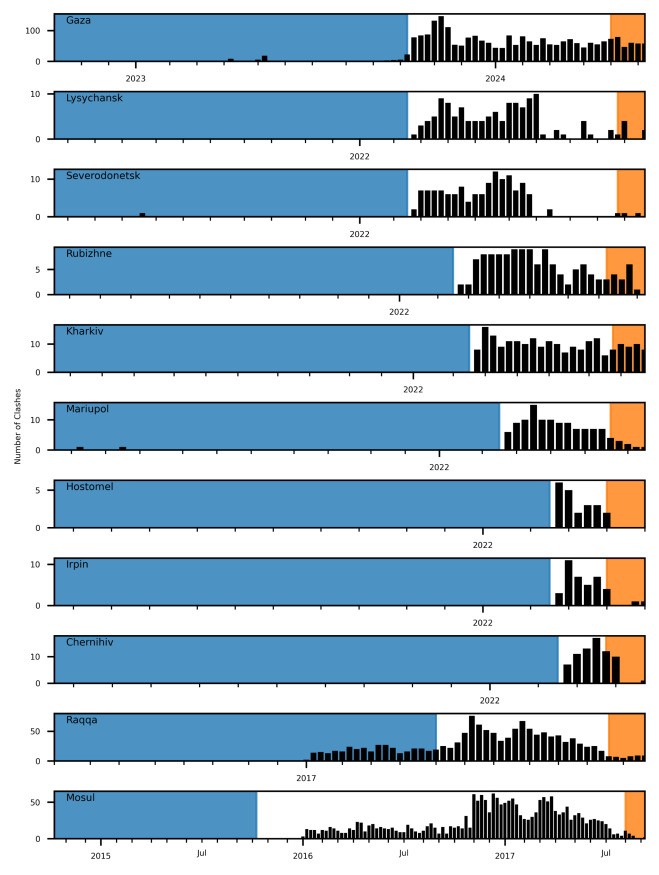
    The plot below shows how the process was applied to Gaza and several Syrian, Iraqi and Ukrainian cities. The bars represent the weekly total number of clashes in each place, sourced from the Armed Conflict Location Event (ACLED) dataset. The pre-war reference periods are shaded in blue, spanning one year before the onset of each conflict. The one month inference periods after the respective conflicts  began are shaded in orange. The blue and orange areas are what the tool compares. 

    The plot below shows an area with a number of warehouses in Tehran’s southwest. Some of the buildings show clear damage in optical Sentinel-2 imagery (something that has to be accessed outside of the tool via the Copernicus Browser). 

    Clicking on the map within the tool generates a chart displaying that pixel’s historical backscatter; the red dotted lines denote a range within which 99% of the pre-war backscatter values fall. In this example, we can see that from March 14 onwards, the backscatter values over this warehouse begin to consistently fall outside of their historical normal range. This could signal that damage has been detected in the area.

    Two important aspects of this workflow are that it utilises free and fully open access satellite data, as opposed to commercial satellite services; the second is that it overcomes some key limitations of AI in this domain, the most serious of which is called overfitting. This is where a model trained in one area is deployed in a new unseen area, and fails to generalise. Because we’re only ever comparing each pixel against its own historical baseline, we don’t run into that problem. 

    Accuracy

    The PWTT has been published in a scientific journal after two years of review.  Its accuracy was  assessed using an original dataset of over two million building footprints labeled by the United Nations, spanning 30 cities across Gaza, Ukraine, Sudan, Syria, and Iraq. Despite being simple and lightweight, the algorithm has been recorded achieving building-level accuracy statistics (AUC=0.87 in the full sample) rivaling state of the art methods that use deep learning and high resolution imagery. The plot below compares building-level predictions from the PWTT against the UN damage annotations in Hostomel, Ukraine. True positives (PWTT and United Nations agree on damage) are shown in red, true negatives are shown in green, false positives in orange, and false negatives in purple. The graphic shows the accuracy of the tool, while also emphasising that further checks on what it highlights should be conducted to draw full conclusions.  

    It is important to note that just because the tool may show a high probability of a building or buildings being damaged or destroyed, that doesn’t make it definite. 

    It is best to check with any other available imagery — either open source photos and videos that’ve been geolocated by a group such as Geoconfirmed or Sentinel-2 as well as other commercial satellite imagery if it’s up-to-date for the area. At time of publication, Sentinel-2 satellite imagery still offers coverage over the area that the tool focuses on. Other commercial satellite imagery providers have limited their coverage.

    What the tool excels at is highlighting and narrowing down areas so that further corroboration or further confirmation can be sought.

    Testing the Tool

    Using the Iran Conflict Damage Proxy Map, we can spot some of the larger areas of potential damage or destruction that have occurred since the Iran war started. 

    Starting from a zoomed-out view of Tehran, there are a few spots that appear with large clusters of high damage probability. Cross-referencing these locations with open source map data from platforms like OpenStreetMap or Wikimapia, we can start finding sites that would make for likely targets – such as military sites.

    One example of a potentially damaged site visible in the tool is the Valiasr Barracks in central Tehran, which was struck in the first week of the war. By going to the Copernicus Browser and reviewing the area with optical Sentinel-2 imagery, we can see clear indications of damage at the barracks.

    IRGC Valiasr Barracks in Tehran:

    Below: Sentinel-2 comparison of February 20 and March 17.

    A large Islamic Revolutionary Guard Corps (IRGC) compound near Isfahan is another example of military infrastructure that is readily visible in both the Iran Conflict Damage Proxy Map as well as Sentinel-2 imagery. 

    IRGC Ashura Garrison in Isfahan:

    Below: Sentinel-2 comparison of February 20 and March 17.

    Air bases have also been a frequent target for U.S.-Israeli strikes in Iran. The Fath Air Base just outside of Tehran, near the city of Karaj, shows the signature of potential damage when using the tool. Checking Sentinel-2 imagery shows damage to multiple large buildings on the northern side of the base.

    Fath Air Base in Karaj:

    Below: Sentinel-2 comparison of February 20 and March 17.

    The U.S. has stated that destroying Iran’s “defense industrial base” is also a goal, which makes large areas like the Khojir missile production complex east of Tehran a good location to search with this tool. The tool suggests large clusters of damage on both the eastern and western sides of the complex — near areas where solid propellant is reportedly produced and where other fuel components are reportedly made.

    Khojir Missile Production Complex outside of Tehran:

    Below: Sentinel-2 comparison of February 20 and March 17.

    Usage in the Gulf Region

    While useful for providing a sense of damaged areas in Iran, the Iran Conflict Damage Proxy Map can also be used to see damage outside of Iran, particularly at sites in the region which Iran has been targeting with drones and missiles.

    In the below example at Al Udeid Air Base in Qatar, which hosts U.S. Central Command’s Combined Air Operations Center, there is a notable indication of damage over a warehouse-like building at 25.115647, 51.333125. Checking the same location in Sentinel-2 imagery shows that there does appear to be damage at that warehouse — represented by a large blackened area on the white roof. According to Qatar’s Ministry of Defense, at least one Iranian ballistic missile struck the base in early March.

    Al Udeid Air Base in Qatar:

    Below: Sentinel-2 comparison of February 22 and March 14.

    Civilian sites struck by Iranian drones or missiles are also visible in the tool — though the damage has to be fairly large in order to be picked up. Something like damage to the sides of high rise buildings from an Iranian drone attack doesn’t readily appear in the tool. Sites that do appear are places like oil refineries, such as a fuel tank at Fujairah port in the United Arab Emirates. 

    Fuel tanks at Fujairah Port, UAE:

    Below: Sentinel-2 comparison of March 3 and March 28.

    Accessing the Tool

    It’s important to keep in mind that the data for the Iran Conflict Damage Proxy Map is updated approximately one or two times per week as new satellite data is collected by the Sentinel-1 satellite, so it’s not meant to be a representation of real-time damage to buildings. 

    Still, it can be useful for researchers to quickly gain an overview of damage throughout Iran and the Gulf where suspected strikes may have taken place and when there is no other open source information available.

    You can access the Iran Conflict Damage Proxy Map here.

    Similar tools using the same methodology to assess damage in Ukraine following Russia’s full-scale invasion and Turkey following the 2023 earthquake can be found here. The Gaza Damage Proxy Map can be found here


    Bellingcat’s Logan Williams contributed to this report.

    Bellingcat is a non-profit and the ability to carry out our work is dependent on the kind support of individual donors. If you would like to support our work, you can do so here. You can also subscribe to our Patreon channel here. Subscribe to our Newsletter and follow us on Bluesky here, Instagram here, Reddit here and YouTube here.

    The post When Satellite Imagery Goes Dark: New Tool Shows Damage in Iran and the Gulf appeared first on bellingcat.

  • Why Timor-Leste is at Risk of Becoming a Scammers’ Paradise

    Online scam operations uncovered in a remote exclave, a national ID program reportedly infiltrated by cybercriminals, tales of bags of cash arriving on private planes. The tiny Southeast Asian country of Timor-Leste is battling the scourge of transnational fraud syndicates. And according to some in its government, it is at risk of an existential defeat. 

    In an extraordinary “manifesto” posted on social media in September, the minister with oversight over the country’s intelligence agency, Agio Pereira, warned that foreign criminals have corrupted the country’s legal system, co-opted regulatory bodies, and bought its politicians.

    “These foreign criminals came not as conquerors with armies, but as corruptors with suitcases full of dirty money,” wrote Pereira. “Will we be a sovereign nation governed by democratic laws and institutions, or will we become a criminal state possessed by foreign mafia syndicates?”

    Southeast Asia has been hit by a cyber-fraud crime wave of epic proportions over the past decade. In countries like Cambodia, Myanmar, and the Philippines, industrial-scale scam operations have targeted victims around the world, stealing as much as $64 billion annually, according to a United Nations report this year.

    A former Portuguese colony with a population of 1.4 million located on the far eastern fringe of Southeast Asia, Timor-Leste was largely overlooked by the powerful cyber-fraud gangs, until now.

    “What is currently being observed in Timor-Leste shares stark similarities to what was seen in the early stages of the current scam centre crisis in Mekong countries and the Philippines,” the United Nations Office on Drugs and Crime (UNODC) said in a threat alert released in September.  

    The fears of a looming crisis provide the backdrop to an investigation by OCCRP and Guardian Australia that found three people sanctioned by the U.S. government last October for alleged ties to the Cambodia-based Prince Group — the world’s largest alleged cyber-fraud syndicate — had been involved in a proposed luxury cryptocurrency resort project in Timor-Leste. 

    The Prince Group says it “categorically rejects that it or its founder, Chen Zhi, has engaged in any unlawful activity.” The sanctioned individuals involved in the Timor-Leste resort project were dismissed or withdrew their investments after the U.S. sanctions were announced.

    Experts say Timor-Leste has traits that make it attractive to transnational crime syndicates, and a magnet for money-launderers.

    The country is one of the most oil-dependent in the world, its productive petroleum reserves are dwindling, and it desperately needs foreign investment as it seeks to diversify its economy. It has porous borders and poorly equipped police. It also has a cash-based economy and, much like prominent online scam hub Cambodia, Timor-Leste uses the U.S. dollar. This makes it easier for criminals based in the country to shift funds internationally, Timor-Leste’s central bank governor, Helder Lopes, told OCCRP. 

    “It’s very easy for the cross-border transaction,” he explained in an interview. “If their money is dirty somewhere else and they would like to clean it, they come to here. If they happen to go into our system and clean it, then it can go anywhere.”

    Damien Kingsbury, an Australian academic and longtime analyst of Timor-Leste, said poverty and a lack of job opportunities for its predominantly young population was another factor that made the country vulnerable. Its many youth gangs could potentially be co-opted by organized crime groups, Kingsbury said.

    The youth gangs “have made inroads into the police force and military, which makes detecting and prosecuting their criminal behavior more difficult,” he added. Kingsbury said that corruption in Timor-Leste is already commonplace. 

    “It is not so bad as to undermine the whole fabric of political society but is bad enough to ensure that government projects in particular lack oversight, suffer from heavily padded contracts and have embedded a culture of nepotism and political favor,” he said.   

    Scam Centers and Gambling Shops

    The first clear sign that something was going wrong in Timor-Leste came during a raid last August in Oecusse, a small exclave nestled on three sides by Indonesian territory.

    When police entered the exclave’s Oe-Upu Hotel, they uncovered a scene that was reminiscent of established scam centers elsewhere in Southeast Asia: rows of desks covered in computer monitors and discarded water bottles, staffed by a startled workforce that, according to local media, comprised mostly women from Indonesia, China, Malaysia, and Singapore. SIM cards and Starlink satellite devices were seized, and six low-level staff arrested.

    One mid-level staff member of the scam operation, who spoke to OCCRP on the basis of anonymity for fear of retribution, said he recruited local scammers to target mostly female Brazilians and Indonesians. The scammers purported to sell goods online such as beauty products, but kept the money without ever sending customers the purchases. 

    The employee was not arrested and the fate of all those arrested in the raids is unknown. A police spokesperson did not respond when telephoned for comment.

    The employee said his bosses — many of them ethnic Chinese from Malaysia — asked if he wanted to work in scam centers in Cambodia, offering $1,000 a month, about four times average monthly earnings in Timor-Leste. It was an offer he rejected, but he said he helped some of his colleagues after they were arrested in the raids in Oecusse. 

    “They were found guilty but then they have to pay money and they can go home straight away,” he said, adding each paid $10,000 to the court.

    In the wake of the raids, Timor-Leste’s government has launched a plan to combat organized crime by tackling online gambling, and gathered support from international anti-crime agencies. 

    In a separate case in Oecusse last year, a company chaired by a convicted cybercriminal was hired by officials to manage the regional government’s contract for a national ID project, according to the 2025 UNODC threat alert. The company’s chairman had earlier been convicted in Singapore for conspiring to acquire stolen personal data, reportedly for use in online scams and gambling operations, the UNODC said. 

    After the scam center and ID project controversy were exposed, the head of Oecusse’s special administrative region, Rogerio Lobato, was replaced with no explanation in October. 

    That same month, the government revoked the first online gambling license it had issued only six months earlier, citing “risks to the country’s security, social stability, economic integrity, and international reputation.” Although the government has not given further detail about the reasons for that decision, online gambling has long been linked to organized crime, scams, and money laundering across Southeast Asia.

    The country’s prime minister, meanwhile, personally supervised the shutdown of a lottery office known as the Grand Dragon in the capital’s main mall. The lottery operation reportedly shares ownership with the company that lost its online gambling license, Grand River Universe (GRU). In a statement on its website, GRU said it “respected the sovereign decision of Timor-Leste” to cancel its online gambling license, noting it had “not conducted any active business in the gaming sector in Timor-Leste.” 

    Spotlight on Passports 

    In the cases of alleged organized crime uncovered in Timor-Leste last year, those implicated carried multiple passports and entered the country “using documents issued by states other than their actual nationality,” according to the UNODC. 

    Multiple passports help criminals by making it difficult for authorities to track them as they cross borders, open bank accounts, and establish companies and businesses, the U.N. agency said.

    “Such tactics undermine global efforts to combat transnational organized crime, particularly when criminals use FDI [foreign direct investment] to legitimize their presence and launder illicit funds,” it said.

    Disquiet about Timor-Leste’s passport administration extends to the issuing of diplomatic passports to foreigners.  

    In a September letter to Timor-Leste’s prime minister, local civil society groups called for the review and cancellation of diplomatic passports issued to non-citizens.

    The letter’s signatories said they had “serious concerns regarding Timor-Leste’s sovereignty, constitutional order, and adherence to the rule of law — foundational principles shaped by the sacrifices of its people.”

    Only an accredited diplomat who holds a diplomatic passport gets immunity from prosecution in the country in which they are posted, but the document can smooth travel across borders for other holders, said Don Rothwell, an expert in international law at the Australian National University.

    “In many instances, it will be effectively visa-free travel,” he said. “They will probably be exempt from luggage checks.”

    Timor-Leste’s president Jose Ramos-Horta — who can request the prestigious travel documents be issued and appoint foreigners as special advisers — defended the practice, noting he could cancel a passport at any time. Holders could be checked at customs, he added. Moreover, he said, recipients could attract investment to the country and spur development.

    “We don’t pay them anything,” he told reporters in an interview. “So the least we can do is [offer] some status, which they like.”

    The president, a Nobel Peace Prize laureate and Timor-Leste independence hero, said the country was vulnerable to “sophisticated” offshore crime gangs and must be “unforgiving and ruthless” in combating them. 

    Even so, he dismissed  senior minister Pereira’s depiction of widespread corruption and a nation-state at risk of being captured by organized crime. “Nonsense. Exaggerated,” he said.

    “There is corruption,” he added. ”Mostly petty corruption at the mid-level.”

  • Ethiopian Authorities Dismantle Brutal East African Smuggling Ring

    Ethiopian authorities have arrested the suspected mastermind behind a sprawling human trafficking network accused of smuggling thousands of migrants and subjecting them to severe violence and extortion en route to Europe. The network is accused of killing more than 100 people and sexually assaulting at least 50 women.

    The ringleader, identified by the Ethiopian Federal Police as Yitbarek Dawit, was apprehended alongside nine accomplices. Investigators say the criminal syndicate has been operating since 2018 and is responsible for smuggling more than 3,000 young people from across East Africa, explicitly targeting victims in Ethiopia, Sudan, Eritrea, Djibouti, Kenya, and Somalia.

    Migrants were systematically transported to detention centers in Libya—a notorious and perilous transit hub for those attempting to cross the Mediterranean Sea. Once there, they were held captive and tortured to extract ransom payments from their desperate families. Authorities noted that these grim details have been corroborated by testimonies from over 100 survivors and their relatives.

    The arrests are part of a sweeping, nationwide crackdown on human smuggling operations. Ethiopian authorities have so far identified more than 70 suspected traffickers and successfully tracked down 10 individuals, including Dawit.

    The suspected traffickers have been formally transferred to the Ethiopian Justice Ministry to face prosecution, according to the state-run Ethiopian News Agency.

  • From misdiagnosis to medical bias: Why women are living longer but not better

    For 25 years, the world has made significant progress in advancing women’s right to health, particularly in sexual and reproductive care. Women are living longer than ever before – but they are not living better.
  • Supreme Court Wipes Piracy Liability Verdict Against Grande Communications

    Supreme Court Wipes Piracy Liability Verdict Against Grande Communications

    In late 2022, several of the world’s largest music companies, including Warner Bros. and Sony Music prevailed in their lawsuit against Internet provider Grande Communications.

    The record labels accused the Astound-owned ISP of not doing enough to stop pirating subscribers. Specifically, they alleged that the company failed to terminate repeat infringers.

    The trial lasted more than two weeks and ended in a resounding victory for the labels. A Texas federal jury found Grande liable for willful contributory copyright infringement, and the ISP was ordered to pay $47 million in damages to the record labels. The copyright infringement verdict was confirmed by the Fifth Circuit Court of Appeals, though the Fifth Circuit ordered a new trial on damages.

    The verdict was not the final word yet, as Grande petitioned the Supreme Court last year, urging the justices to take up the case and review the Fifth Circuit’s decision.

    Grande’s petition centered on the crucial question of ISP liability in cases of contributory copyright infringement. Grande framed the issue as an “exceptionally important question under the Copyright Act,” highlighting a “nationwide litigation campaign by the U.S. recording industry” to hold ISPs liable for copyright violations carried out by their customers.

    The central question is as follows:  

    “Whether an ISP is liable for contributory copyright infringement by (i) providing content-neutral internet access to the general public and (ii) failing to terminate that access after receiving two third-party notices alleging someone at a customer’s IP address has infringed.”

    Knowledge is Not Intent

    The case and the questions are similar to the Cox v. Sony case, which the Supreme Court decided in favor of the Internet provider last month. In a 7-2 decision, it concluded that an ISP cannot be held contributorily liable for copyright infringement merely because it kept providing service to subscribers that were flagged for piracy.

    In Cox, the Supreme Court stated that contributory liability requires proof that the provider intended its service to be used for infringement. That intent can only be shown in one of two ways. Either the provider actively induced infringement, or the service is one that has no substantial non-infringing uses.

    “Under our precedents, a company is not liable as a copyright infringer for merely providing a service to the general public with knowledge that it will be used by some to infringe copyrights. Accordingly, we reverse,” Justice Thomas wrote in the opinion last month.

    The Court also directly countered the Fourth Circuit’s reasoning, which held that supplying a product with “knowledge” of future infringement was enough to establish liability.

    Supreme Court Sends Grande v. UMG Back to Fifth Circuit

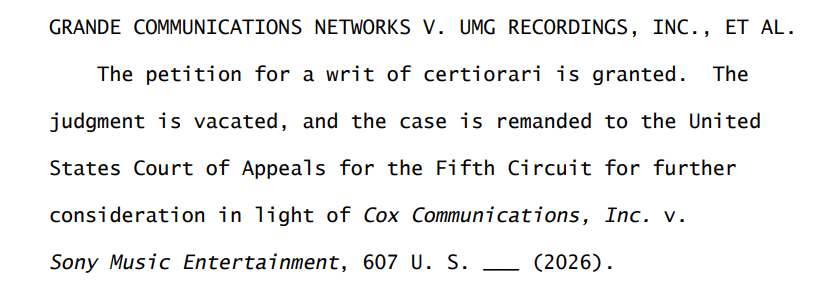
    With Cox v. Sony now settled, the Supreme Court turned its attention to Grande’s pending petition. Rather than taking up the case on the merits, the Court issued a GVR order, granting the petition, vacating the Fifth Circuit’s judgment, and remanding the case for reconsideration under the Cox standard.

    The order effectively removes the case from the Supreme Court docket, urging the Fifth Circuit Court of Appeals to take another look at its decision in light of the new ruling.

    The order

    the order

    Given the similarities between the two cases, it is no surprise that the Supreme Court came to this conclusion.

    It is now up to the Fifth Circuit to revisit whether Grande’s conduct meets the intent threshold that was established in Cox. That is a significantly higher bar than the one applied in the original verdict, which found that continuing to provide service to known infringers was enough to establish material contribution.

    The music companies previously said they sent over a million copyright infringement notices, but that Grande failed to terminate even a single subscriber account in response. However, without proof of active inducement, these absolute numbers carry less weight now.

    Whether this translates into a win for Grande on remand remains to be seen. For now, however, the original $47 million verdict is further away than ever.

    This week’s GVR order is just one of the many ripple effects of the Sony ruling on other contributory infringement cases. Last week, we reported how X already asked the court to dismiss its liability battle with several music publishers. Meanwhile, the ruling will also directly impact Verizon’s repeat infringer battle with the music industry.

    From: TF, for the latest news on copyright battles, piracy and more.

  • Legislative Alchemy: Licensing reflexologists and other practitioners of pseudoscience

    State legislatures are considering bills that would legitimize pseudoscience like reflexology and reiki by recognizing their practitioners as health care professionals.

    The post Legislative Alchemy: Licensing reflexologists and other practitioners of pseudoscience first appeared on Science-Based Medicine.