Author: tio

  • Pluralistic: Switzerland’s Goldilocks fiber (07 Apr 2026)

    Today’s links

    • Switzerland’s Goldilocks fiber: Public provision is a layered question.
    • Hey look at this: Delights to delectate.
    • Object permanence: EU appoints henhouse fox (copyright); Emacs x Tron: Legacy; Spammer v dead man’s AOL account; Scott Walker’s pork fountain; “No toilets, try Amazon”; Iceland falls (x Panama Papers); Rooms in Milanese sewers; China bans Panama Papers; “Parent Hacks”; “The Nameless City”; Phishing the world’s top breach expert.
    • Upcoming appearances: Toronto, Montreal, Toronto, San Francisco, London, Berlin, NYC, Hay-on-Wye, London.
    • Recent appearances: Where I’ve been.
    • Latest books: You keep readin’ em, I’ll keep writin’ ’em.
    • Upcoming books: Like I said, I’ll keep writin’ ’em.
    • Colophon: All the rest.


    A vintage idyllic picture-postcard view of Lucerne, Switzerland; it features an impressive lakeside building and two elegant span bridges, with snow-capped Alps in the background. The image has been altered: a 'code waterfall' effect (as seen in the credit sequences of the Wachowskis' 'Matrix' movies) cascades down over the mountains and streaks across the water of the lake. Three massive fiber optic bundles rear up out of the harbor, their cut tips glowing white. The Swiss flag atop the lakeside building is haloed with radiant glowing streaks.

    Switzerland’s Goldilocks fiber (permalink)

    If you live in Switzerland you can get a 25Gbit fiber link to your home. That’s 25Gbit symmetrical – upload and download. On a dedicated connection that’s yours and yours alone. From multiple providers. And you can switch providers with the click of a mouse. It’s the ne plus ultra, magnifico, wunderschön:

    https://www.init7.net/de/internet/fiber7/

    In a fascinating blog post, Stefan Schüller unpacks how this came to pass, in Switzerland, a country known for its impassable mountains and its impossible national telco (Swisscom):

    https://sschueller.github.io/posts/the-free-market-lie/

    Schüller describes the Swiss system as a kind of Goldilocks approach that’s midway between two failed systems: the American “free market” system and the German state provision system.

    Most people in the US can’t get fiber at all, and if you can get it, it’s probably 1Gbit, and available from a single provider (that’s nearly my situation in Los Angeles, where I can buy 2Gbit symmetrical fiber from AT&T, who run a shared connection on old Worldcom fiber they’ve lit up). Some (very foolish) people say that Starlink represents a competitive alternative to fiber. This is nonsense – first, because Starlink is another natural monopoly (how many competing satellite constellations can we cram into stable orbits before they start smashing into each other?), and second, because satellite is millions of times slower than fiber:

    https://www.somebits.com/weblog/tech/bad/starlink-nov-2022-data-caps.html

    In Germany, most people also have a single fiber provider, and the connection they get is shared, and caps out at 1-2Gbit.

    Meanwhile, the Swiss can get connections that are far faster, and cheaper. How did they do it?

    For starters, the Swiss recognized what any Simcity player knows: fiber is a “natural monopoly.” It doesn’t make any sense to build multiple, competing fiber networks – any more than it would make sense to build multiple, competing sewer systems or electric grids.

    In the US, private fiber providers get city permits to dig up the roads and lay their network. If you have two competing networks, they dig up the road twice.

    You’d think that the (more regulated) Germans would lay a single network, but they, too, have multiple, competing networks. German regulators have a complex set of priorities and constraints: to encourage competition, they promote the idea of competing networks in competing trenches, often just meters apart (rather than on competing services running over the same fiber and/or fiber run through the same conduit – pipe – laid in a single trench).

    This makes setting up fiber extremely capital-intensive, so Germany backstops this system with “essential facilities sharing” – a rule that requires the incumbent (formerly state-owned, now partially state-owned) Deutsche Telekom to offer space in its conduit to smaller ISPs that want to thread their own fiber from their data-centers to their customers’ homes. This is a good idea in theory – but in practice, DT has largely captured its regulators and so it is free to place all kinds of administrative hurdles in the paths of competitors seeking to use its lines.

    The result is that Germans can get fiber from multiple, heavily capitalized network providers who overbuilt redundant systems under the city streets, squandering capital digging trenches that they could have spent on providing faster and/or cheaper connections.

    Meanwhile, in the US, they leave this all up to “the market” (though, of course, there’s no way “the market” could get fiber laid down without public participation, because the clearing price for privately negotiated licenses to dig up every street in town is “infinity”). The US is dominated by a cartel of massive incumbents: there’s AT&T (formerly a regulated monopoly that was so entangled with the US government that it was effectively a for-profit state enterprise) and the cable giants, Comcast and Charter, who divide up the country into exclusive territories like the Pope dividing up the “New World.”

    These companies generally enjoy regional monopolies, which means they’re less interested in making profits (money you get by mobilizing capital) than they are from extracting rent (money you get from sweating assets). For example, when Frontier went bankrupt in 2020, we got to look at its internal bookkeeping system, and learned that the company treated 1m customers who had no alternative carriers as special assets because it could charge them more for worse service and poor maintenance:

    https://pluralistic.net/2022/12/15/useful-idiotsuseful-idiots/

    This means that US fiber networks tend to be underbuilt (the opposite of Germany’s overbuilt networks), meaning that even if you’re buying “gigabit” fiber, you’re probably sharing that one gig connection with your whole block or neighborhood, so you only get your nominal throughput at weird hours when all the other subscribers aren’t streaming Netflix.

    (Note that there are cities in the US with a better situation; particularly cities served by Ting, which is owned by Hover, the amazing domain registry. Ting operates an excellent mobile carrier and a fiber networks in many cities. If you are lucky enough to have Ting as an option, then you should treasure that option.)

    So, that’s Germany and America. What did they do in Switzerland?

    For starters, they ran a four-strand, dedicated line (an insulated wire with four separate strands of fiber in it) to every house. That wire terminates at your wall with a “neutral, open hub.” Any carrier can provide service over those four strands: Swisscom (the incumbent, majority state-owned carrier); Init7 or Salt (national, commercial carriers); or a local ISP.

    Each of the strands in your neutral hub operate independently. That means that you can switch from one carrier to another with a click. You can also run two or more carriers’ signal through your hub, meaning that you can try out a new carrier before canceling your old one. The carriers compete on price, speed and customer service – but they don’t compete on who can actually connect your home to the internet.

    The origins of this excellent system are in 2008, when Switzerland’s Federal Communications Commission convened a roundtable to determine the future of the country’s broadband. Incredibly, it was Swisscom that pushed for the multi-strand, dedicated fiber system, on the grounds that anything less would lead to monopolization.

    I say “incredibly,” because in all my travels over the past three decades, a single encounter with Swisscom stands out as the most absurd and backwards run-in I ever experienced with a telco.

    It was while I was working as EFF’s delegate to the United Nations in Geneva, as part of an infinitesimal coalition of digital rights group convened by James Love and Manon Ress of Knowledge Ecology International. Geneva is not a forgiving city for someone working for a cash-strapped NGO: it’s a city where everyone (except you) is on a lavish expense account courtesy of a national government, or (better still) an industry body that lobbies the UN.

    My usual daggy two-star hotel (which cost as much as a four-star in London) didn’t have its own wifi: instead, you signed on through Swisscom, which did not offer its own payment processing. To get onto the Swisscom wifi, you had to buy a scratch-off prepaid card that was good for a certain number of hours or minutes. The hotel was always sold out of these cards.

    So my normal ritual upon my arrival in Geneva was to scour the tobacco shops around the train station for scratch-off cards. Normally, this would take four or five tries – the shops would either be completely sold out, or would only have the two-hour cards (needless to say, these were a lot more expensive on a per-hour basis than the one-day and multi-day cards).

    On one trip, though, all the shops were sold out of these cards, so I skipped breakfast the next morning to wait outside the doors of the Swisscom offices, which opened five minutes late (the only business in Switzerland that wasn’t achingly prompt!). The clerk let me in eventually, but when I approached his counter, he made me trudge to the opposite end of the room to take a number (I was the only person in the shop).

    After an ostentatious delay, the clerk called out “Numero un!” and I went up to his counter and asked for a three-day card. No dice, he was sold out. Two-day cards? Nope. One-day? Uh-uh. He only had two-hour cards, too. Literally, the Swiss national telco had run out of integers.

    This incident stuck with me so durably that I wrote it into my third novel, Someone Comes To Town, Someone Leaves Town. You can hear me read that passage here:

    https://pluralistic.net/2020/08/17/aura-of-benevolence/#sctt-slt

    So it’s frankly amazing to me to learn that Swisscom – who will forever be synonymous in my mind with the most catastrophically stupid internet delivery system imaginable – demanded this anti-monopoly fiber rollout.

    But – as Schüller points out – Swisscom’s foray into uncharacteristic reasonableness was short-lived. By 2020, the company had regressed to its mean, and was demanding an end to the neutral, four-strand, point-to-point system, petitioning for regulatory permission to switch to a cheaper, slower, shared hub-and-spoke system. This system wouldn’t just be slower – it would also require all of Swisscom’s rivals to rent access to its fiber, with Swisscom having the final say over who could compete with it and how.

    This went all the way to the Swiss federal courts, who ruled that Swisscom had failed to demonstrate “sufficient technological or economic grounds” for the change and fined the company CHF18m for wasting everyone’s time with this stupid idea (that is, “violating Swiss competition law”). And so it is that, in 2026, you can get 25Gbit symmetrical fiber throughout Switzerland. Wunderschön!

    Schüller closes out his piece with a set of recommendations for countries hoping to replicate Switzerland’s broadband miracle: open access to physical infrastructure; point-to-point service; neutral fiber standards; municipal fiber; and strong antitrust enforcement to keep the incumbent carriers in line.

    These are great recommendations; they address the contradiction of regulated monopoly telcoms provision. On the one hand, these networks are natural monopolies, and they can only exist with extensive government intervention (at a minimum, to clear the way for poles, trenches and conduit for the physical fiber).

    On the other hand, telcoms (especially broadband) play an important role in the political realm, because broadband connections are essential to civic and political engagement. You can’t turn people out for a protest, or run an election campaign, a referendum, a ballot initiative, a regulatory notice-and-comment campaign, or even a campaign to get people to a public meeting or listening session without broadband.

    This means that state-provided broadband is an incredibly tempting target for political corruption and regulatory capture. Think of all the terrible things that governments are doing with broadband regulation today, like Trump demanding that service providers turn over the identities and locations of his political enemies so that ICE can hunt them down and kidnap or murder them; or “age verification” systems that accumulate mountains of easily raided personal information on adults and children.

    Do you want Trump’s FCC chairman Brendan Carr setting content moderation policies for your internet connection? The guy who wants to pull TV and radio stations’ broadcast licenses if they criticize Trump and Israel’s catastrophic Iran war?

    https://www.techdirt.com/2026/03/17/brendan-carr-pretends-to-be-tough-demands-broadcasters-support-disastrous-war/

    Do you want your local ISP being run by your mayor? I mean, sure, there are some reasonable mayors out there, but imagine if your ISP was managed by Eric Adams, Boris Johnson…or Rob Ford:

    https://www.patreon.com/posts/rob-ford-part-1-111985831

    Saying that broadband should be run “like a utility,” raises more questions than it answers. I, too, want broadband run “like a utility,” but that doesn’t mean that I want the whole show to be provided solely by my federal or municipal government. A “utility” model for broadband should mean running conduit to every home in town, with point-to-point connections that deliver broadband via a municipally owned network – but not just that.

    The municipal network should also offer “essential facilities sharing” in two forms: first, they should allow anyone to set up an ISP by renting shelf-space in the municipal data-center and installing their own switches that can provide internet to anyone in town. This would let large and small companies set up ISPs, as well as co-ops and nonprofits, or even tinkerers wanting to provide access to a group of friends. Beyond that, the city should rent space in the conduit itself, to support point-to-point links beyond those offered by the city – for example, between a university campus and an offsite supercomputing center, or two buildings owned by the same company, or even as a parallel set of fiber connections run by someone who’s fed up with getting their internet service from Eric Adams.

    This is a “pluralized” utility model: one that involves the city in providing infrastructure at several layers, as well as a “public option” – but which doesn’t allow a city that’s in thrall to Moms For Liberty to decide what you can say on the internet.

    This principle generalizes beyond internet provision, too. Many people have observed that social media, with its strong “network effects” (meaning its value increases as more people use it), could be a “natural monopoly” and want a social media “utility.” I can see the reasoning there, but if there’s one thing we’ve learned from zuckermuskian legacy social media, it’s that centralized control over speech forums is a moral hazard and an attractive nuisance. It’s a political prize beyond measure, and it attracts all sorts of skullduggerous bids to suborn it and harness it to some political faction.

    But there’s a pluralized utility model for social media, too, thanks to modern, federated social media systems like Mastodon and Bluesky. These are open platforms that can support multiple, interconnected servers that all talk to one another. Unlike, say, Twitter, where you can only talk to other Twitter users, federated social media allows you to talk with anyone on any server, provided they want to talk with you.

    As with fiber, a “utility” model for federated social media would feature public intervention at multiple layers of the system. Governments could (should!) run their own servers, providing the canonical source of government information. They can also provide turnkey cloud services for people who want to start their own services – and they can spin out the code that goes into these services into free/open source projects that others can use (and contribute to). Governments could support people who are trying to migrate off of legacy social media (for example, through library workshops and helplines), and pay to label and tag media (for example, media that is compliant with the public education curriculum). Governments could also offer public servers where you could sign up to get online – and because federated social media makes it easy to move your account from one server to another, it would be easy to move from that server to one run by a nonprofit, a co-op or a business:

    https://pluralistic.net/2025/06/25/eurostack/#viktor-orbans-isp

    Think of this pluralized utility model as being something like your city’s roads. It’s great for your city to provide roads, and great for them to run buses on those roads, and to create bike lanes and bike parking spots and other infrastructure. For roads to be “public,” it does not follow that everything on them be licensed and operated by the municipal government: we can still have private bikes, bikeshares, regulated taxis and licensed private motor vehicles. The roads are still “public” but Boris Johnson doesn’t get to decide where you can go.

    A utility model needn’t be all-or-nothing. As the Swiss have demonstrated, public provision of various layers of the system, combined with strong regulation, combined with a public option, can deliver a best-of-all-worlds solution.


    Hey look at this (permalink)


    A shelf of leatherbound history books with a gilt-stamped series title, 'The World's Famous Events.'

    Object permanence (permalink)

    #15yrsago Recording industry lobbyist appointed head of copyright for European Commission https://arstechnica.com/tech-policy/2011/04/top-music-industry-lawyer-now-eu-copyright-chief/

    #15yrsago How emacs got into Tron: Legacy https://web.archive.org/web/20110407224426/http://jtnimoy.net/workviewer.php?q=178

    #15yrsago Dead man’s AOL account hijacked by spammer https://ip.topicbox.com/groups/ip/T274c51b2ba843fb0-Mb6bf8853b1ed34a26b07ce44/deceasesd-father-in-law-spamming-friends-and-family-two-years-on

    #15yrsago Scarring Party: megaphone songs, sea chanteys and dark vaudeville tunes https://web.archive.org/web/20110406044523/http://www.avclub.com/milwaukee/articles/the-scarring-party-losing-teeth%2C43871/

    #15yrsago Snaggly table made out of computer junk https://web.archive.org/web/20110406044521/http://brcdesigns.com/furniture/binary-low-table

    #15yrsago Scott Walker gives cushy $85.5K/year government job to major donor’s young, underqualified son https://web.archive.org/web/20110406040138/https://thinkprogress.org/2011/04/04/scott-walker-hires-dropout/

    #15yrsago Closing down Borders sign: “No toilets, try Amazon” https://web.archive.org/web/20110406044522/https://consumerist.com/2011/04/sign-at-borders-store-closing-in-chicago-tells-customers-where-to-find-a-restroom.html

    #15yrsago What is legitimate “newsgathering” and what is “piracy”? https://zunguzungu.wordpress.com/2011/04/05/why-arianna-huffington-is-bill-kellers-somali-pirate/

    #10yrsago Iceland’s Prime Minister asks to dissolve Parliament https://www.bbc.co.uk/news/world-europe-35966412

    #10yrsago Artist installs rooms beneath Milan’s sewer entrances https://web.archive.org/web/20160406132425/https://www.biancoshock.com/borderlife.html

    #10yrsago Banned on China’s Internet: all discussion of the Panama Papers https://www.bbc.co.uk/news/world-asia-china-35957235

    #10yrsago Google reaches into customers’ homes and bricks their gadgets https://arlogilbert.com/the-time-that-tony-fadell-sold-me-a-container-of-hummus-cb0941c762c1#.srp9ym34a

    #10yrsago Middle class housing projects are the Bay Area’s future https://www.newyorker.com/culture/cultural-comment/welcome-to-the-future-middle-class-housing-projects

    #10yrsago Pollster explains how Chamber of Commerce can steamroller empathetic execs into opposing progressive policies https://web.archive.org/web/20160406190524/https://gawker.com/business-execs-support-progressive-policies-but-the-ch-1768898477

    #10yrsago How to write about scientists who are women https://www.doublexscience.org/the-finkbeiner-test/

    #10yrsago Garden: XKCD’s latest maddening, relaxing webtoy https://xkcd.com/1663/#3978da67-1ead-45e1-a293-9c8e4918a147

    #10yrsago Parent Hacks: illustrated guide is the best kind of parenting book https://memex.craphound.com/2016/04/05/parent-hacks-illustrated-guide-is-the-best-kind-of-parenting-book/

    #10yrsago The Nameless City: YA graphic novel about diplomacy, hard and soft power, colonialism, bravery, and parkour https://memex.craphound.com/2016/04/05/the-nameless-city-ya-graphic-novel-about-diplomacy-hard-and-soft-power-colonialism-bravery-and-parkour/

    #5yrsago How Facebook will benefit from its massive breach https://pluralistic.net/2021/04/05/zucks-oily-rags/#into-the-breach

    #1yrago How the world’s leading breach expert got phished https://pluralistic.net/2025/04/05/troy-hunt/#teach-a-man-to-phish


    Upcoming appearances (permalink)

    A photo of me onstage, giving a speech, pounding the podium.


    A screenshot of me at my desk, doing a livecast.

    Recent appearances (permalink)


    A grid of my books with Will Stahle covers..

    Latest books (permalink)


    A cardboard book box with the Macmillan logo.

    Upcoming books (permalink)

    • “The Reverse-Centaur’s Guide to AI,” a short book about being a better AI critic, Farrar, Straus and Giroux, June 2026 (https://us.macmillan.com/books/9780374621568/thereversecentaursguidetolifeafterai/)
    • “Enshittification, Why Everything Suddenly Got Worse and What to Do About It” (the graphic novel), Firstsecond, 2026

    • “The Post-American Internet,” a geopolitical sequel of sorts to Enshittification, Farrar, Straus and Giroux, 2027

    • “Unauthorized Bread”: a middle-grades graphic novel adapted from my novella about refugees, toasters and DRM, FirstSecond, 2027

    • “The Memex Method,” Farrar, Straus, Giroux, 2027


    Colophon (permalink)

    Today’s top sources:

    Currently writing: “The Post-American Internet,” a sequel to “Enshittification,” about the better world the rest of us get to have now that Trump has torched America. First draft complete. Second draft underway.

    • “The Reverse Centaur’s Guide to AI,” a short book for Farrar, Straus and Giroux about being an effective AI critic. LEGAL REVIEW AND COPYEDIT COMPLETE.
    • “The Post-American Internet,” a short book about internet policy in the age of Trumpism. PLANNING.

    • A Little Brother short story about DIY insulin PLANNING


    This work – excluding any serialized fiction – is licensed under a Creative Commons Attribution 4.0 license. That means you can use it any way you like, including commercially, provided that you attribute it to me, Cory Doctorow, and include a link to pluralistic.net.

    https://creativecommons.org/licenses/by/4.0/

    Quotations and images are not included in this license; they are included either under a limitation or exception to copyright, or on the basis of a separate license. Please exercise caution.


    How to get Pluralistic:

    Blog (no ads, tracking, or data-collection):

    Pluralistic.net

    Newsletter (no ads, tracking, or data-collection):

    https://pluralistic.net/plura-list

    Mastodon (no ads, tracking, or data-collection):

    https://mamot.fr/@pluralistic

    Bluesky (no ads, possible tracking and data-collection):

    https://bsky.app/profile/doctorow.pluralistic.net

    Medium (no ads, paywalled):

    https://doctorow.medium.com/

    Tumblr (mass-scale, unrestricted, third-party surveillance and advertising):

    https://mostlysignssomeportents.tumblr.com/tagged/pluralistic

    When life gives you SARS, you make sarsaparilla” -Joey “Accordion Guy” DeVilla

    READ CAREFULLY: By reading this, you agree, on behalf of your employer, to release me from all obligations and waivers arising from any and all NON-NEGOTIATED agreements, licenses, terms-of-service, shrinkwrap, clickwrap, browsewrap, confidentiality, non-disclosure, non-compete and acceptable use policies (“BOGUS AGREEMENTS”) that I have entered into with your employer, its partners, licensors, agents and assigns, in perpetuity, without prejudice to my ongoing rights and privileges. You further represent that you have the authority to release me from any BOGUS AGREEMENTS on behalf of your employer.

    ISSN: 3066-764X

  • Disruption expected as six-day doctors’ strike begins

    The NHS is advising patients in England to only use emergency services when necessary but attend any confirmed appointments.
  • “The Cruelty is Staggering”: Jasper Nathaniel on Reporting from the West Bank

    “The Cruelty is Staggering”: Jasper Nathaniel on Reporting from the West Bank

    In January of 2024, during his winter break at New York University—and having never yet written for an outside publication—reporter Jasper Nathaniel decided to travel to the West Bank. As a Jewish-American, he knew he could easily enter the region, and with Israeli settler violence increasing dramatically since the Oct. 7 attacks, there was no time to wait for an official assignment. 

  • “Bitter Root” Grapples with the Horror of American Racism

    “Bitter Root” Grapples with the Horror of American Racism

    The boys were fighting again. Not all three, just the six-year-old and the four-year-old, tussling over an action figure one had snuck into the convention center. The two-and-a-half-year-old pulled me in the other direction. He wanted everything. Every vendor table held another treasure to grab, another shiny thing that should be his. I watched him like a hawk.

  • Georgia Deports Azerbaijani Journalist, Bypassing European Court Ruling

    The Georgian government deported an Azerbaijani journalist, forcibly returning him to his home country despite an explicit interim ruling by Europe’s top human rights court designed to halt his transfer.

    Afgan Sadigov, the editor-in-chief of the independent YouTube news channel Azel TV, fled to Georgia with his family following a severe crackdown on independent media and activists by the Azerbaijani government in December 2023. But his search for a safe haven unraveled after he published a Facebook post earlier this month criticizing Georgian law enforcement.

    “Wherever there is a dictatorship, police officers are ready to sell and trample everything for a salary and a police uniform, and they do it with love, dedication, and pride,” Sadigov wrote.

    He was detained on the night of April 4. The Georgian Interior Ministry later confirmed his deportation on Facebook, stating that Sadigov had been found guilty of insulting the police. A Georgian court handed him a 2,000 lari ($743) fine and a three-year ban on re-entering the country.

    The swift deportation appears to be the culmination of a months-long, cross-border legal battle. In August 2024, Sadigov was arrested in Georgia on extortion charges levied by Azerbaijani authorities—accusations that he and his supporters have consistently dismissed as politically motivated. 

    A Georgian court initially ordered his extradition. However, Sadigov’s legal team successfully appealed to the European Court of Human Rights (ECHR) in Strasbourg, which granted an injunction the following year to halt the transfer.

    To justify the sudden April 5 deportation, the Georgian Interior Ministry stated it had learned “a few days ago” that Azerbaijani authorities had halted their prosecution of Sadigov on the extortion charges. Because the extradition request was theoretically dropped, Georgian authorities argued that the Strasbourg court’s injunction was no longer relevant.

    Sadigov’s lawyer, Mariam Kvelashvili, vehemently rejected that legal maneuvering. Speaking to Monitori, the Georgia-based member center of the Organized Crime and Corruption Reporting Project (OCCRP), she argued that even if local proceedings in Azerbaijan were terminated, the European court’s interim measure did not automatically expire.

    “This is a kind of bypass—a formal bypass of the court’s decision—and of course, the European court will evaluate this as a violation,” Kvelashvili said. She emphasized that the ECHR “must deliberate separately on the termination or cancellation” of the order.

    “Furthermore, nowhere in the interim measure document is it stated that this issue is tied to the completion of the extradition case; on the contrary, the transfer itself is prohibited,” she added.

    The deportation has cast a chilling effect over the community of exiled dissidents in the Caucasus. Upon arriving in Baku, Azerbaijan’s capital, Sadigov was briefly freed, quickly detained by police again, and then released once more, according to a Facebook post by his wife, Sevinj.

    “In light of these events, there are sufficiently serious grounds for me to be concerned,” she wrote.

    The Georgian Charter of Journalistic Ethics, a Tbilisi-based nongovernmental organization dedicated to media integrity, issued a public statement condemning the government’s actions and expressing solidarity with the expelled editor.

    “The case of Afgan Sadygov shows how effectively authoritarian governments can cooperate against critically minded journalists to trample human rights and suppress freedom of expression,” the statement read.

    The timing of the deportation has also raised intense geopolitical questions. The day after the journalist was handed over to Azerbaijani authorities, Azerbaijan’s President Ilham Aliyev and First Lady Mehriban Aliyeva arrived in Tbilisi for an official visit.

  • Music Publishers Ask Court to Dismiss X’s ‘Weaponized DMCA’ Antitrust Suit

    Music Publishers Ask Court to Dismiss X’s ‘Weaponized DMCA’ Antitrust Suit

    Last week, X asked a federal court in Tennessee to dismiss a music piracy lawsuit, arguing that the Supreme Court’s ruling in Cox v. Sony, rendered the music companies’ contributory infringement theory futile.

    The music publishers, meanwhile, were busy in a different court, asking a Texas judge to throw out X’s antitrust complaint against them with similar finality.

    The motion to dismiss, filed in the Northern District of Texas, argues that X’s lawsuit doesn’t hold up and the music companies want all eight counts dismissed with prejudice.

    A Conspiracy Built on One Word

    X filed its antitrust complaint in January, accusing the National Music Publishers’ Association (NMPA) and a coalition of major music publishers, including Sony, Universal, and Warner Chappell, of coordinating a “weaponized” DMCA takedown campaign to coerce X into industry-wide licensing deals.

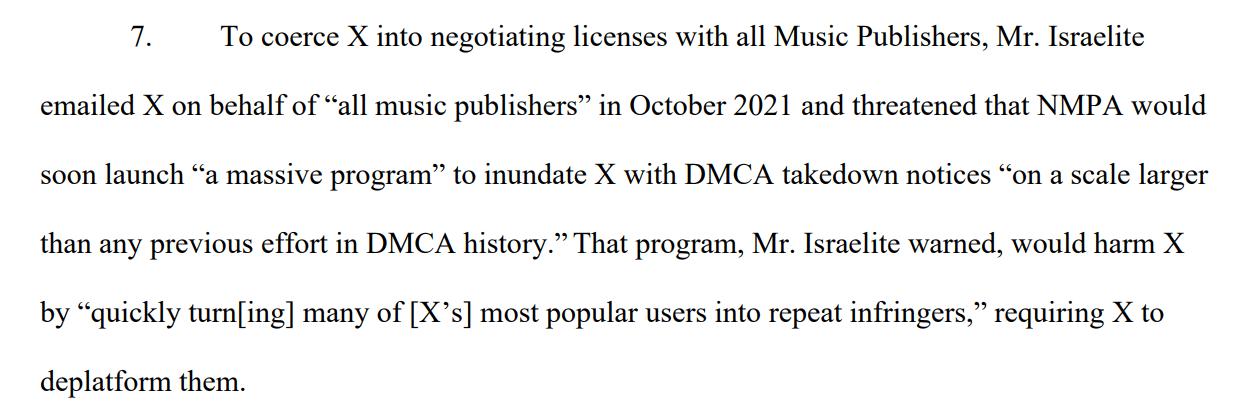
    The conspiracy claim rested heavily on a pre-litigation email sent by NMPA President David Israelite to Twitter in October 2021. X alleged that Israelite threatened a “massive program” of DMCA notices on a scale “larger than any previous effort in DMCA history” if X did not agree to a partnership.

    From X’s January complaint

    massive

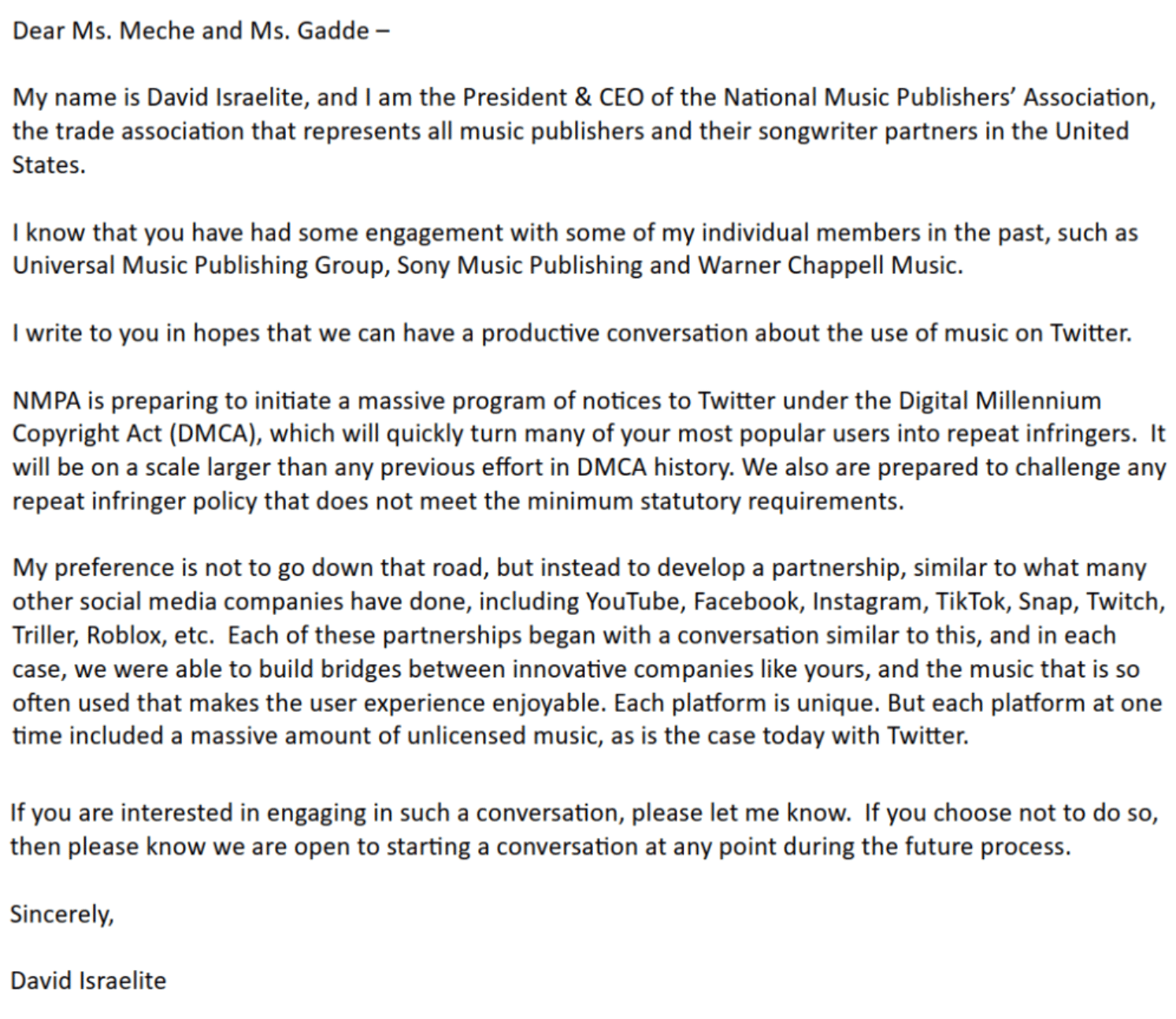
    However, the publishers have now submitted the full email chain to the court, arguing that X’s complaint “selectively crops, paraphrases, and misconstrues” it. They note that the complete exchange tells a more nuanced story.

    In his October 6 email, Israelite warned Twitter that the NMPA was preparing a “massive program” of DMCA notices, adding that his “preference is not to go down that road, but instead to develop a partnership.” He closed by writing (emphasis added): “If you are interested in engaging in such a conversation, please let me know. If you choose not to do so, then please know we are open to starting a conversation at any point during the future process.”

    The first email

    email

    The publishers argue that X’s conspiracy theory rests almost entirely on that final word.

    “X argues that by using the word ‘we,’ NMPA meant that X could only deal with the Music Publishers collectively for a license and that no individual Music Publisher would negotiate separately. That inference is not only implausible, it is completely devoid of factual basis or allegation. An antitrust claim cannot rest on such a tenuous thread.”

    Same Judge, Same Problem

    One of the key reasons for a dismissal is the argument that there can be no antitrust injury, as X and the music publishers do not compete. The music companies argue that antitrust law requires a competitor to be involved in a refusal-to-deal claim.

    The argument has already succeeded once against X, in the same courthouse, before the same judge. In February, District Judge Jane Boyle dismissed X’s antitrust lawsuit against the World Federation of Advertisers with prejudice, finding that X had failed to allege antitrust injury because no competitor was involved in the alleged boycott.

    The publishers quote that ruling extensively and argue the present case is largely similar.

    “Specifically, X does not allege that any participant in the alleged conspiracy is its competitor, a necessary requirement for antitrust injury to flow from an alleged refusal to deal,” the motion states.

    The proposed order submitted alongside the motion has Judge Boyle’s name pre-filled.

    Retaliation, Not Antitrust

    The music publishers take their motion to dismiss beyond simply refuting X’s claims. They also suggest that X filed the antitrust suit as leverage in the copyright infringement case the music companies filed in the Tennessee federal court.

    “The paucity of factual allegations supporting an antitrust claim is no accident. X’s motivation in filing suit was different: retaliation and leverage for the copyright suit the Music Publishers filed against it, which is currently pending in Tennessee federal court,” the motion notes.

    X argues that the music companies sent a flood of “baseless” DMCA notices, targeting over 200,000 posts and suspending 50,000 users. However, the music publishers motion counters that none of the takedown notices was objectively baseless.

    The Sham Exception

    The music companies argue that their takedown campaign was a First Amendment-protected pre-litigation activity. They invoke the Noerr-Pennington doctrine, which shields things such as pre-litigation notices and cease-and-desist letters from antitrust liability.

    DMCA takedown notices, they argue, fall in the same category, especially since these were used as key evidence in the the copyright lawsuit currently pending in Tennessee.

    This type of protection does not apply if the notices themselves are “baseless” or a “sham,” which X argued is the case here. The original complaint pointed to several examples, including a takedown notice targeting a video where the non-commercial use of background music was flagged as copyright infringement.

    The music companies, however, counter that X does and cannot claim that any notices were baseless. This includes the background music example: this may qualify for fair use defense, but the publishers add that “infringing use of incidental background music is still infringing.”

    All in all, the motion to dismiss concludes that the music companies used the DMCA as Congress intended, and that it is not an antitrust violation. The complaint should therefore be dismissed with prejudice on all counts.

    It is now up to Judge Boyle to decide whether the antitrust case can continue or whether it should be dismissed outright. The same is true for the Nashville case, where X asked the court to completely dismiss the music companies’ copyright infringement lawsuit.

    A copy of the motion to dismiss, filed April 2, 2026 at the U.S. District Court for the Northern District of Texas, is available here (pdf). The supporting memorandum can be found here (pdf).

    From: TF, for the latest news on copyright battles, piracy and more.

  • Politically Connected Crypto Project Pursued Resort With Alleged Scam Syndicate Figures

    Last November, a new blockchain network known as AB announced it had partnered with a company with an impeccable political pedigree: World Liberty Financial, a booming cryptocurrency firm co-owned by the family of U.S. President Donald Trump.

    The collaboration, which gave AB the right to carry on its online ledger one of the Trump family company’s signature products, a “stablecoin” pegged to the U.S. dollar, was just the latest in a string of bold announcements that associated the emerging AB network with high-profile figures from around the world.

    Launched just early last year, AB publicly touted a former president of Serbia as its “blockchain moderator.” Its philanthropic arm, an Irish-registered nonprofit foundation, lists about two dozen current and former world leaders as its advisers.  

    Until recently, AB also promoted online what it called a “flagship project” — a “blockchain theme resort” in Timor-Leste, a small and impoverished country in Southeast Asia. 

    Stretching out into the sea near Timor-Leste’s capital, Dili, the 300,000-square-meter development was billed as a place where the brightest minds in crypto would gather in luxury. The nonprofit would receive between five and 10 percent of its future profits.

    In a now-deleted online statement, the former Serbian leader Boris Tadić extolled AB’s resort as a future “worldwide nexus for industry collaboration and talent exchange.”

    An OCCRP and Guardian Australia investigation, however, has found that the planned resort involved three people who were later sanctioned by the U.S. Treasury in a crackdown on the Prince Group, a Cambodia-based conglomerate that it alleges is one of the world’s largest online scam syndicates.  

    The Prince Group has been accused by the U.S. of being part of an illicit industry that steals tens of billions of dollars from victims every year while operating massive scam compounds in converted hotels, office parks, and casinos across Southeast Asia. In what it dubbed its “largest forfeiture action” against online scammers, the U.S. government last year seized $15 billion worth of bitcoin from Prince Group’s CEO, Chen Zhi. (The Prince Group has said that it “categorically rejects the notion that it or its Chairman has engaged in any unlawful activity.”)

    There is no evidence that AB is directly connected to the Prince Group, or that illicit funds flowed into the resort project. The three sanctioned people involved with the resort have not been charged with any crime, and were removed from the Timor-Leste project shortly after the sanctions were announced, corporate documents and interviews show. 

    There is no suggestion that World Liberty, Tadić, or any other political figures were aware of sanctioned people’s prior involvement. 

    However, the revelations come amid concerns that Timor-Leste, a small country of just 1.4 million people located between Indonesia and Australia, is becoming a new target for scam syndicates. Tens of billions of dollars are believed to be stolen every year by the syndicates, who often operate out of large compounds in converted casinos, resorts, and office parks across Southeast Asia.

    According to a statement posted on one of AB’s websites on March 4, the Timor-Leste resort project was the result of a June memorandum of understanding between its “core entities” and a separate Timor-Leste-registered company, and was canceled in November before it reached “a substantive implementation stage.”

    “The MoU was only a preliminary intention and did not produce any substantive legal or financial consequences,” the statement said.

    Lawyers for World Liberty said the company is “committed to responsible practices and compliance.” They said World Liberty carried out due diligence on AB and was not made aware of the resort or people behind it.

    “Claims attempting to link World Liberty Financial with sanctioned individuals are unfounded and untrue,” they said. “[World Liberty] has no relationship or association with any of these sanctioned individuals or the Timor-Leste project.”

    Longtime Friends

    For much of its roughly year-long history, the corporate architecture behind the AB network has been cloaked in mystery. 

    OCCRP and Guardian Australia spent four months analyzing corporate records, flight manifests, text messages and photographs to identify key figures behind AB’s digital veneer. 

    As reporters began reaching out to people connected to the Timor-Leste project, promotional material for the resort was removed from AB’s websites and social media accounts. In its March post, published after reporters began their inquiries, AB for the first time clarified what it says is its structure. AB now describes itself as a “decentralized” ecosystem consisting of two companies that exist in the real world: an Irish nonprofit, and a foundation registered in the Cayman Islands, a secrecy jurisdiction that does not disclose directors or beneficial owners. 

    AB also purports to include two separate entities that are entirely virtual: an open-source blockchain, and a “decentralized autonomous organization” called AB DAO, which is governed by holders of its native cryptocurrency token.

    Reporters, however, were able to identify two ethnic Chinese businessmen who, after being contacted, described themselves as leading figures in separate parts of AB’s network. Neither of them appeared on AB’s publicity materials or on publicly available corporate documents. 

    One of them is Sui Chenggang, a Chinese software developer. After being contacted by reporters, Sui said that he was the “initiator of the AB ecosystem” and the beneficial owner of its financial arm, the Cayman Islands company AB Foundation. 

    Sui’s Caymans company was a formal party to the now-canceled agreement to pursue the Timor-Leste resort, according to documents obtained by reporters. A photograph obtained by reporters shows that the businessman, who goes by the name Jacky Sui, met World Liberty executives — including Donald Trump Jr. and Zach Witkoff, the son of Trump’s peace envoy — on the sidelines of a crypto conference in Singapore last October. 

    Sui’s “longtime friend” and another pivotal figure in the AB resort project in Timor-Leste is Lin Xiaofan, an enigmatic Guangdong-born entrepreneur who travels the world on a passport from the Caribbean nation of St. Kitts and Nevis.

    Reached by OCCRP and Guardian Australia, Lin confirmed that he played a leading role in the Timor-Leste resort project, and denied any connection to the Prince Group.

    “I have always despised those who run scam compounds,” he said.

    Reporters found that Lin facilitated some of AB’s connections to influential people, including Timor-Leste’s president. Lin said he served as an adviser to Tadić, the former Serbian leader. (In response to questions Tadić confirmed Lin served in this role. He said he was a supporter of the Timor-Leste resort, but had no role in it and was not aware of any involvement by sanctioned individuals.)

    Lin also said he was the “initiator” of AB’s Irish nonprofit, which is chaired by the country’s former leader, Bertie Ahern. (Ahern acknowledged to reporters that he met Lin and chairs the nonprofit. He said he had no knowledge of the resort project.)

    Lin denied playing any role in AB’s blockchain network. Lin did, however, say that it was he who introduced Sui to World Liberty executives.

    ‘Too Secretive’

    Timor-Leste is an unlikely setting for a cutting-edge crypto-themed property development.

    The country’s capital, Dili, is in many ways a throwback to earlier times. Battered mini buses trawl its dusty streets for passengers. Internet and mobile phone service is patchy, and power cuts are commonplace. Almost all day-to-day business in the country is done with paper U.S. dollars, the young country’s only legal currency. 

    In 2024, the digital future landed via a private jet.

    Lin, who often goes by the English name Frank, arrived with an entourage that included Fan Bingbing, a Chinese actress whose disappearance in 2018 made global headlines. (Fan reappeared in public several months later that year, reportedly posting a lengthy statement online apologizing for tax fraud and praising the Chinese Communist Party.)

    Once in Timor-Leste, Lin made a beeline for members of the local elite, including President Jose Ramos-Horta, a Nobel Peace Prize Laureate and hero of the country’s quarter-century independence struggle against occupation by Indonesia.

    Speaking to reporters, Ramos-Horta described Lin as at times “too secretive” but well-connected. Lin appeared to be a “huge innovator” who was clearly in control during meetings, he said. 

    During an early meeting, Lin came bearing a gift of surveillance cameras and night vision equipment. On a subsequent visit, Lin and his entourage pitched their resort idea. 

    “They met with me and showed me the video. Very nice,” Ramos-Horta said.

    The president said he accepted an invitation from Lin to serve as an adviser to the AB’s nonprofit alongside his friend, the former Serbian leader Tadić.

    The resort concept was ambitious. According to mockups Lin shared with Timorese officials, the development was to be built next to Dili’s airport. Luxury overwater villas with private swimming pools would stretch out into the sea alongside a yacht club and “Sea Plaza.” 

    Last June, the Irish nonprofit, named AB Foundation Company Limited by Guarantee, and Sui’s Caymans company, AB Foundation, signed a memorandum of understanding to develop the project with a newly established Timorese company, AB Digital Technology Resort Lda.

    The following month, AB’s Irish nonprofit publicly announced a $500,000 donation to a local charity run by President Ramos-Horta. The money came directly from Lin.

    (Ahern, the nonprofit’s chair, said the organization has “no bank accounts or funds” and so its board never formally authorized the payment.)

    Later on that month, Ramos-Horta signed a letter recommending Lin be granted a Timorese diplomatic passport and given the title of special adviser to the president for economic and commercial affairs. The passport was issued that very same day, according to a copy of the document obtained by reporters.

    Ramos-Horta told reporters he gained no personal benefit from the donation to his charity and gave the passport to Lin in order to generate new “clean” investment for Timor-Leste. 

    “In a private conversation, [Lin] said he would like to move his business to Timor,” Ramos-Horta said. “And if his businesses are legitimate, as appear in some of his formal presentations, blockchain, high-tech, all of that. Yes, we would like to have that.”

    When reporters from OCCRP and Guardian Australia visited the resort’s proposed site — a sandy, weed-strewn lot near Dili’s airport — in February, there were no signs of construction. 

    Lin told reporters the project was still active. He was finalizing the resort’s design and recruiting a new general manager, he added.

    Lin also told reporters that AB is no longer part of the project and provided a copy of a November 27 letter terminating the agreement. (AB also stated in its March announcement that the MoU for the project was canceled last November, the month after the U.S. sanctions came out.)

    ‘Casual Dinner and Cigar Time’

    The link between the Timor-Leste resort and people sanctioned by the U.S. came via the local company set up last June to develop the project, AB Digital Technology Resort.

    Corporate records show the majority shareholder of the company, which was established with $10 million in capital, was Yang Jian, a Cyprus citizen of Chinese origin who was sanctioned by the U.S. in October for allegedly working with Prince’s CEO, Chen Zhi, to build a separate resort in the Pacific island nation of Palau. The project was described by the U.S. Treasury as a “predatory investment.”

    Yang Jian, who OCCRP recently revealed owns at least $17 million worth of London property, did not respond to questions.

    Lin provided documents showing a business agreement with Yang Jian was terminated on October 17, three days after the Prince Group sanctions were announced by the U.S. Treasury. Also on October 17, Yang Jian’s shareholding was transferred to a man Lin described as his “close friend” Ye Chengzhong, according to corporate records he provided.  

    “Yang Jian appeared as a nominee shareholder in the company registration documents … during the project’s preparation stage, but he never contributed any funds to the company,” Lin said.

    Two other people who were sanctioned alongside Yang Jian over the same Palau project also worked on the Timorese resort project, documents and interviews show.

    Yang Yanming, also known as Kimi Yang, represented himself as the resort company’s manager and carried a business card identifying himself as a director of AB Digital Technology Resort, according to a photograph obtained by reporters. He also traveled by private jet with Lin from Timor-Leste to Hong Kong last July, according to the flight manifest. 

    “I have no association whatsoever with the Prince Group,” Kimi Yang told reporters. He said he had met the Prince Group boss Chen Zhi two or three times but “just for casual dinner and cigar time.”

    Kimi Yang identified Shih Ting-yu, a sanctioned Taiwanese national also known as Vivian Shih, as working for him on the project. He said she was dismissed from the company after the sanctions came out.

    Reached by phone, Shih, who is currently under separate investigation in Taiwan over her alleged ties to the Prince Group, denied any knowledge of the Timorese resort project or any connection to the Prince Group. 

    “I don’t know about anything,” she said. “I just want to go back to my normal life.”

    While the three sanctioned people were quickly removed from AB Digital Technology Resort, records show the company continued to be 38-percent owned until mid-December by a Cyprus passport holder, Zhao Chen, who, according to records from the Mediterranean island country, became a citizen in 2018 as the wife of Hu Xiaowei. Hu, also known as Chen Xiao’er, is a sanctioned alleged Prince Group affiliate who, according to Taiwanese media, has been labeled by prosecutors there as Prince Group’s alleged “second in command.”

    Zhao also signed a cooperation agreement that kick-started the resort project. But Lin told OCCRP and Guardian Australia he did not know who Zhao was and had never been in contact with her. 

    Zhao and Hu, who have not been charged, did not respond to questions. 

    Timorese corporate records show Zhao was replaced as shareholder on December 11 by Hong Kong citizen Ching Ho Leung. Leung told reporters he was a relative of Lin’s friend Ye and provided a document showing that he was holding his shares in the company on behalf of Ye.

    Although Lin said he did not know Zhao, he confirmed to reporters that he was acquainted with Hu, the purported Prince Group number two.

    Lin initially told reporters that he had only met Hu once at a karaoke bar in London in 2022. But when pressed about a flight manifest and other evidence that indicated the two men had flown on a private jet out of Manila the following year, Lin confirmed he had “happened to run into” Hu in the Philippines. Flight records show the plane departed Manila airport on February 13, and stopped over in Dubai before continuing to St. Mortitz in Switzerland. The flight was the subject of an inquiry by the Philippines Senate after it emerged that Hu had been able to slip out of the country without being recorded in the original manifest. 

    “I took his aircraft as a courtesy ride,” Lin said, adding he was going to the European nation for a medical check-up.

    ‘The Testing Phase’

    Another aspect of the AB network’s business that remains prominently displayed online is its collaboration with World Liberty Financial, which was founded in 2024 by partners including companies affiliated with the Trump and Witkoff families. 

    The company is reported to have earned the two families roughly $1.4 billion since then, including through the adoption of its USD1 stablecoin. World Liberty’s deals, including an agreement to sell nearly half of its shares for half a billion dollars to an Emirati official with ties to the country’s intelligence apparatus, have raised criticisms from ethics and political experts that the first family could be putting the national interest at risk with its foreign partnerships.

    Both World Liberty and the White House have said that President Trump and Steve Witkoff, a longtime friend of the president who is now serving as his peace envoy, have no role in the company’s decision-making.

    Sui, the beneficial owner of AB’s Cayman Islands company, said he signed an MoU with World Liberty on September 17 last year after he was introduced to its executives by Lin. He refused to provide reporters with a copy of the document, citing its confidentiality provisions.

    “With respect to the specific transaction terms, the cooperation constitutes a normal commercial agreement between the two parties and includes standard provisions relating to technical cooperation and ecosystem collaboration,” Sui said, adding that it “does not involve any form of personal benefit transfer or hidden arrangements.”

    On October 14, a fortnight after Sui was photographed with Trump Jr. and the younger Witkoff, the U.S. announced its sanctions against the Prince Group. By the time AB and World Liberty announced their partnership, on November 12, the resort project remained on AB’s websites and social media accounts but the three sanctioned people had already been removed from the Timorese company, AB Digital Technology Resort.

    Sui said: “To the best of my recollection, the Timor-Leste resort project was not discussed” during conversations with World Liberty. 

    Although it is still in effect, the collaboration between AB and World Liberty has resulted in little increased uptake for USD1. Just over $3 million worth of the stablecoin is currently held by users of AB DAO’s main blockchain, a low volume that Sui attributes to the integration being “currently still in the testing phase.” 

    This pales in comparison to the more than $4.4 billion worth of USD1 currently circulating across all blockchains, part of an aggressive push by World Liberty for the adoption of the cryptocurrency over other stablecoins, such as the industry leader Tether.

    On the sidelines of a glitzy crypto forum the company hosted at the family resort in Mar-a-Lago on February 18, Trump Jr. and his brother, Eric, told media outlet CNBC that one goal of their stablecoin is to help maintain the dominance of the U.S. dollar in global finance.

    Another reason, Eric Trump said, was revenge for family members being dropped by traditional banks in the aftermath of the January 6, 2021 riot in the U.S. Capitol.

    “We’re the most canceled people in the world in 2020, 2021,” he said.

    “And it’s really great to almost have this retribution, where all of a sudden we start pushing an agenda, our agenda is to modernize finance to [make sure] that can never, ever happen to anybody again.”

  • Greek Premier Reshuffles Government Amid EU Subsidy Scandal

    Scrambling to contain the political fallout from a sprawling agricultural fraud investigation, Greek Prime Minister Kyriakos Mitsotakis reshuffled his government and urged European Union prosecutors to name lawmakers who are facing charges over allegations that his country has siphoned millions in EU subsidies for phantom livestock and ineligible farmland.

    The reshuffle is the latest development in a scandal centering on the European Public Prosecutor’s Office (EPPO) allegations that Greek stockbreeders have, since at least 2018, defrauded at at least 23 million euros ($27 million) by exploiting loopholes in the EU’s Common Agricultural Policy to claim subsidies for non-existent livestock or land that failed to meet eligibility requirements. 

    The inquiry escalated in October 2025 following the detention of 37 members of an organized criminal group accused of defrauding the EU’s agricultural subsidy system of more than 19.6 million euros ($22.6 million).

    EU prosecutors then announced last week that they are investigating current and former MPs over their alleged involvement in the scheme, according to a statement by the European Public Prosecutor’s Office (EPPO). The EPPO said it has referred information to the Hellenic Parliament regarding the potential involvement of also a former minister and a former deputy minister in the fraud scheme.

    A number of ministers resigned on Friday and new ministers were sworn in over the weekend. Margaritis Schinas, a former European Commission vice president, has been appointed as the new agriculture minister, said government spokesman Pavlos Marinakis, in a televised statement.

    The EPPO also requested that the Hellenic Parliament lift the parliamentary immunity of 11 members, adding that it is already investigating five former MPs. 

    Mitsotakis urged on Monday the European Public Prosecutor’s Office to “quickly” decide which of the accused Greek lawmakers will face prosecution.

  • Cuba energy crisis: Humanitarian needs remain despite fuel supplies

    The UN has issued an urgent call for international support as Cuba grapples with a ‘worsening’ humanitarian crisis fuelled by a prolonged energy blockade and the lingering devastation caused by Hurricane Melissa last year.
  • World News in Brief: ‘Skyrocketing’ needs outpace Sudan funding, Ukraine strikes update, global water security

    The UN is significantly scaling up its presence in the Sudanese capital, Khartoum, to expand life-saving operations as the conflict between rival militaries approaches its third year.