In 1938, Congress passed the Fair Labor Standards Act (FLSA), the federal law that currently regulates wages and hours for most employees nationwide. Among other aims, the FLSA attempted to reduce work hours by establishing a standard forty-hour work week and requiring employers to pay workers time-and-a-half for overtime. Last summer, Congress further increased the value of overtime pay through…
Author: tio
-
Pluralistic: The Nuremberg Caucus (10 Feb 2026)
Today’s links
- The Nuremberg Caucus: What do Democrats have to lose?
- Hey look at this: Delights to delectate.
- Object permanence: Bradbury x LA monorails; Red Cross vs first aid kits; Wyden on CIA Senate spying; Coates x Sanders; Nerdy Valentines; Duke U, trademark troll; “The Murder Next Door.”
- Upcoming appearances: Where to find me.
- Recent appearances: Where I’ve been.
- Latest books: You keep readin’ em, I’ll keep writin’ ’em.
- Upcoming books: Like I said, I’ll keep writin’ ’em.
- Colophon: All the rest.
The Nuremberg Caucus (permalink)
America’s descent into authoritarian fascism is made all the more alarming and demoralizing by the Democrats’ total failure to rise to the moment:
https://www.youtube.com/watch?v=KADW3ZRZLVI
But what would “rising to the moment” look like? What can the opposition party do without majorities in either house? Well, they could start by refusing to continue to fund ICE, a masked thug snatch/murder squad that roams our streets, killing with impunity:
That’s table stakes. What would a real political response to fascism look like? Again, it wouldn’t stop with banning masks for ICE goons, or even requiring them to wear QR codes:
https://gizmodo.com/dem-congressman-wants-to-make-ice-agents-wear-qr-codes-2000710345
Though it should be noted that ICE hates this idea, and that ICE agents wear masks because they fear consequences for their sadistic criminality:
This despite the fact that the (criminally culpable) Vice President has assured them that they have absolute impunity, no matter who they kill:
https://edition.cnn.com/2026/01/08/politics/ice-immunity-jd-vance-minneapolis
The fact that ICE agents worry about consequences despite Vance’s assurances suggests ways that Dems could “meet the moment.”
I think Dems should start a Nuremberg Caucus, named for the Nazi war-crimes trials that followed from the defeat of German fascists and the death of their leader:
https://en.wikipedia.org/wiki/Nuremberg_trials
What would this caucus do? Well, it could have a public website where it assembled and organized the evidence for the trials that the Democrats could promise to bring after the Trump regime falls. Each fresh outrage, each statement, each video-clip – whether of Trump officials or of his shock-troops – could be neatly slotted in, given an exhibit number, and annotated with the criminal and civil violations captured in the evidence.
The caucus could publish dates these trials will be held on – following from Jan 20, 2029 – and even which courtrooms each official, high and low, will be tried in. These dates could be changed as new crimes emerge, making sure the most egregious offenses are always at the top of the agenda. Each trial would have a witness list.
The Nuremberg Caucus could vow to repurpose ICE’s $75b budget to pursue Trump’s crimes, from corruption to civil rights violations to labor violations to environmental violations. It could announce its intent to fully fund the FTC and DoJ Antitrust Division to undertake scrutiny of all mergers approved under Trump, and put corporations on notice that they should expect lengthy, probing inquiries into any mergers they undertake between now and the fall of Trumpism. Who knows, perhaps some shareholders will demand that management hold off on mergers in anticipation of this lookback scrutiny, and if not, perhaps they will sue executives after the FTC and DoJ go to work.
While they’re at it, the Nuremberg Caucus could publish a plan to hire thousands of IRS agents (paid for by taxing billionaires and zeroing out ICE’s budget) who will focus exclusively on the ultra-wealthy and especially any supernormal wealth gains coinciding with the second Trump presidency.
Money talks. ICE agents are signing up with the promise of $50k hiring bonuses and $60k in student debt cancellation. That’s peanuts. The Nuremberg Caucus could announce a Crimestoppers-style program with $1m bounties for any ICE officer who a) is themselves innocent of any human rights violations, and; b) provides evidence leading to the conviction of another ICE officer for committing human rights violations. That would certainly improve morale for (some) ICE officers.
Critics of this plan will say that this will force Trump officials to try to steal the next election in order to avoid consequences for their actions. This is certainly true: confidence in a “peaceful transfer of power” is the bedrock of any kind of fair election.
But this bunch have already repeatedly signaled that they intend to steal the midterms and the next general election:
ICE agents are straight up telling people that ICE is on the streets to arrest people in Democratic-leaning states (“The more people that you lose in Minnesota, you then lose a voting right to stay blue”):
The only path to fair elections – and saving America – lies through mobilizing and energizing hundreds of millions of Americans. They are ready. They are begging for leadership. They want an electoral choice, something better than a return to the pre-Trump status quo. If you want giant crowds at every polling place, rising up against ICE and DHS voter-suppression, then you have to promise people that their vote will mean something.
Dems have to pick a side. That means being against anyone who is for fascism – including other Dems. The Nuremberg Caucus should denounce the disgusting child abuse perpetrated by the Trump regime:
https://www.propublica.org/article/life-inside-ice-dilley-children
But they should also denounce Democrats who vote to fund that abuse:
The people of Minneapolis (and elsewhere) have repeatedly proven that we outnumber fascists by a huge margin. Dems need to stop demoralizing their base by doing nothing and start demonstrating that they understand the urgency of this crisis.
Hey look at this (permalink)

- Prescription: Social Media https://www.youtube.com/watch?v=k7_GTts4XTY&t=114s
-
ENIAC Day Celebration https://www.helicoptermuseum.org/event-details/eniac-day-celebration
-
Matrix is quietly becoming the chat layer for governments chasing digital sovereignty https://www.theregister.com/2026/02/09/matrix_element_secure_chat/
-
The Children of Dilley https://www.propublica.org/article/life-inside-ice-dilley-children
-
Martin Shkreli Had a Point https://lpeproject.org/blog/martin-shkreli-had-a-point/
Object permanence (permalink)
#20yrsago Ray Bradbury: LA needs monorails! https://www.latimes.com/archives/la-xpm-2006-feb-05-op-bradbury5-story.html
#20yrsago How statistics caught Indonesia’s war-criminals https://web.archive.org/web/20060423232814/https://www.wired.com/news/technology/1,70196-0.html
#20yrsago Canadian Red Cross vows to sue first aid kits, too https://memex.craphound.com/2006/02/10/canadian-red-cross-vows-to-sue-first-aid-kits-too/
#20yrsago Sports announcer traded for Walt Disney’s first character https://web.archive.org/web/20060312134156/http://sports.yahoo.com/nfl/news?slug=ap-nbc-michaels&prov=ap&type=lgns
#15yrago Government transparency doesn’t matter without accountability https://www.theguardian.com/technology/blog/2011/feb/10/government-data-crime-maps
#10yrsago Hackers stole 101,000 taxpayers’ logins/passwords from the IRS https://arstechnica.com/tech-policy/2016/02/irs-website-attack-nets-e-filing-credentials-for-101000-taxpayers/
#10yrsago CIA boss flips out when Ron Wyden reminds him that CIA spied on the Senate https://www.techdirt.com/2016/02/10/cia-director-freaks-out-after-senator-wyden-points-out-how-cia-spied-senate/
#10yrsago Ta-Nehisi Coates will vote for Bernie Sanders, reparations or no reparations https://www.youtube.com/watch?v=mSJmxN-L300
#10yrsago Gmail will warn you when your correspondents use unencrypted mail transport https://blog.google/products-and-platforms/products/gmail/making-email-safer-for-you-posted-by/
#10yrsago Detoxing is (worse than) bullshit: high lead levels in “detox clay” https://www.statnews.com/2016/02/02/detox-clay-fda-lead/
#10yrsago Nerdy Valentines to print and love https://www.evilmadscientist.com/2016/valentines-4/
#5yrsago A criminal enterprise with a country attachedhttps://pluralistic.net/2021/02/10/duke-sucks/#openlux
#5yrsago Tory donors reap 100X return on campaign contributions https://pluralistic.net/2021/02/10/duke-sucks/#chumocracy
#5yrsago Duke is academia’s meanest trademark bully https://pluralistic.net/2021/02/10/duke-sucks/#devils
#5yrsago Crooked cops play music to kill livestreams https://pluralistic.net/2021/02/10/duke-sucks/#bhpd
#1yrago Hugh D’Andrade’s “The Murder Next Door” https://pluralistic.net/2025/02/10/pivot-point/#eff
Upcoming appearances (permalink)

- Salt Lake City: Enshittification at the Utah Museum of Fine Arts (Tanner Humanities Center), Feb 18
https://tanner.utah.edu/center-events/cory-doctorow/ -
Montreal (remote): Fedimtl, Feb 24
https://fedimtl.ca/ -
Victoria: 28th Annual Victoria International Privacy & Security Summit, Mar 3-5
https://www.rebootcommunications.com/event/vipss2026/ -
Berkeley: Bioneers keynote, Mar 27
https://conference.bioneers.org/ -
Berlin: Re:publica, May 18-20
https://re-publica.com/de/news/rp26-sprecher-cory-doctorow -
Berlin: Enshittification at Otherland Books, May 19
https://www.otherland-berlin.de/de/event-details/cory-doctorow.html -
Hay-on-Wye: HowTheLightGetsIn, May 22-25
https://howthelightgetsin.org/festivals/hay/big-ideas-2
Recent appearances (permalink)
- America’s Enshittification is Canada’s Opportunity (Do Not Pass Go)
https://www.donotpassgo.ca/p/americas-enshittification-is-canadas -
Everything Wrong With the Internet and How to Fix It, with Tim Wu (Ezra Klein)
https://www.nytimes.com/2026/02/06/opinion/ezra-klein-podcast-doctorow-wu.html -
How the Internet Got Worse (Masters in Business)
https://www.youtube.com/watch?v=auXlkuVhxMo -
Enshittification (Jon Favreau/Offline):
https://crooked.com/podcast/the-enshittification-of-the-internet-with-cory-doctorow/ -
Why Big Tech is a Trap for Independent Creators (Stripper News)
https://www.youtube.com/watch?v=nmYDyz8AMZ0
Latest books (permalink)
- “Canny Valley”: A limited edition collection of the collages I create for Pluralistic, self-published, September 2025
-
“Enshittification: Why Everything Suddenly Got Worse and What to Do About It,” Farrar, Straus, Giroux, October 7 2025
https://us.macmillan.com/books/9780374619329/enshittification/ -
“Picks and Shovels”: a sequel to “Red Team Blues,” about the heroic era of the PC, Tor Books (US), Head of Zeus (UK), February 2025 (https://us.macmillan.com/books/9781250865908/picksandshovels).
-
“The Bezzle”: a sequel to “Red Team Blues,” about prison-tech and other grifts, Tor Books (US), Head of Zeus (UK), February 2024 (thebezzle.org).
-
“The Lost Cause:” a solarpunk novel of hope in the climate emergency, Tor Books (US), Head of Zeus (UK), November 2023 (http://lost-cause.org).
-
“The Internet Con”: A nonfiction book about interoperability and Big Tech (Verso) September 2023 (http://seizethemeansofcomputation.org). Signed copies at Book Soup (https://www.booksoup.com/book/9781804291245).
-
“Red Team Blues”: “A grabby, compulsive thriller that will leave you knowing more about how the world works than you did before.” Tor Books http://redteamblues.com.
-
“Chokepoint Capitalism: How to Beat Big Tech, Tame Big Content, and Get Artists Paid, with Rebecca Giblin”, on how to unrig the markets for creative labor, Beacon Press/Scribe 2022 https://chokepointcapitalism.com
Upcoming books (permalink)
- “The Reverse-Centaur’s Guide to AI,” a short book about being a better AI critic, Farrar, Straus and Giroux, June 2026
-
“Enshittification, Why Everything Suddenly Got Worse and What to Do About It” (the graphic novel), Firstsecond, 2026
-
“The Post-American Internet,” a geopolitical sequel of sorts to Enshittification, Farrar, Straus and Giroux, 2027
-
“Unauthorized Bread”: a middle-grades graphic novel adapted from my novella about refugees, toasters and DRM, FirstSecond, 2027
-
“The Memex Method,” Farrar, Straus, Giroux, 2027
Colophon (permalink)
Today’s top sources:
Currently writing: “The Post-American Internet,” a sequel to “Enshittification,” about the better world the rest of us get to have now that Trump has torched America (1007 words today, 25708 total)
- “The Reverse Centaur’s Guide to AI,” a short book for Farrar, Straus and Giroux about being an effective AI critic. LEGAL REVIEW AND COPYEDIT COMPLETE.
-
“The Post-American Internet,” a short book about internet policy in the age of Trumpism. PLANNING.
-
A Little Brother short story about DIY insulin PLANNING

This work – excluding any serialized fiction – is licensed under a Creative Commons Attribution 4.0 license. That means you can use it any way you like, including commercially, provided that you attribute it to me, Cory Doctorow, and include a link to pluralistic.net.
https://creativecommons.org/licenses/by/4.0/
Quotations and images are not included in this license; they are included either under a limitation or exception to copyright, or on the basis of a separate license. Please exercise caution.
How to get Pluralistic:
Blog (no ads, tracking, or data-collection):
Newsletter (no ads, tracking, or data-collection):
https://pluralistic.net/plura-list
Mastodon (no ads, tracking, or data-collection):
Medium (no ads, paywalled):
Twitter (mass-scale, unrestricted, third-party surveillance and advertising):
Tumblr (mass-scale, unrestricted, third-party surveillance and advertising):
https://mostlysignssomeportents.tumblr.com/tagged/pluralistic
“When life gives you SARS, you make sarsaparilla” -Joey “Accordion Guy” DeVilla
READ CAREFULLY: By reading this, you agree, on behalf of your employer, to release me from all obligations and waivers arising from any and all NON-NEGOTIATED agreements, licenses, terms-of-service, shrinkwrap, clickwrap, browsewrap, confidentiality, non-disclosure, non-compete and acceptable use policies (“BOGUS AGREEMENTS”) that I have entered into with your employer, its partners, licensors, agents and assigns, in perpetuity, without prejudice to my ongoing rights and privileges. You further represent that you have the authority to release me from any BOGUS AGREEMENTS on behalf of your employer.
ISSN: 3066-764X
-
The ICEmen Cometh
The potential effects of the current ICE actions on public health
The post The ICEmen Cometh first appeared on Science-Based Medicine.
-
Epstein Made Efforts to Free the Son of Senegal’s Former President After Corruption Conviction
The urgent email came from Senegal. The son of the former president desperately needed help. He’d been sentenced for corruption and needed lobbying in the U.S. to get the matter in front of key lawmakers and diplomats.
“Sorry but who are you,” was the initial response from a puzzled Jeffrey Epstein.
A woman named Elisabeth Feliho replied, explaining that she worked for Karim Wade, a former Senegalese government minister whose portfolio included air transport and energy. He was also the son of Abdoulaye Wade, who served as Senegal’s president from 2000 to 2012.
By the time the email from Feliho landed, Wade and Epstein had shared years of correspondence, according to files released by the U.S. Justice Department. Before, during and after his corruption case — which ended in a conviction in 2015 — Epstein assisted Wade.
After he was sentenced, Wade leaned on Epstein to help win back his freedom, and clean his reputation. In her email, Feliho asked Epstein to send a payment to a firm that could lobby influential figures in the U.S. and at the United Nations.
“Total cost for 3 months would be 100,000 USD and they are ready to start today,” she wrote in September 2015, a few months after her boss had been sentenced.
The newly released files pull back the curtain on the global business and political network of contacts curated by Epstein, who died in a New York jail cell in August 2019. The chain of emails shows that Wade befriended Epstein, who then introduced him to his network of global finance powerbrokers.
Wade was a man of some influence himself. During his father’s administration, he was so powerful in Senegal that he was nicknamed the “minister of heaven and earth.”
OCCRP sent questions to the email address Wade had used in correspondence with Epstein, but did not receive a response. There was no response from the address used by Feliho at the time. The lawyer who represented Wade in his corruption case, who still practices in Senegal, did not respond to questions.
A Budding Friendship
The emails included in the files released by the U.S. Justice Department trace the relationship between Wade and Epstein back to late 2010.
“The President of Senegal is sending his son to see me in paris,” Epstein wrote in November 2010 to a contact.
Five months later, the emails show, Epstein was planning a trip across West Africa with stops in Senegal, Sierra Leone, Mali, Morrocco, and Gabon.
Epstein’s travelling companions were to be Wade and Sultan Ahmed bin Sulayem.
Bin Sulayem is chairman and CEO of DP World, a company based in the United Arab Emirates with interests in cargo logistics, free trade zones and ports. Bin Sulayem did not respond to a request for comment sent to his media team about his friendship with Epstein.
The emails show that Wade and Epstein also got comfortable with each other around the time they planned the Africa trip. One email shows that Epstein had been coveting a palace in Morocco, and Wade had suggestions.
“Do not forget in the house the harem part,” Wade cracked to Epstein in November 2011. “Happy to manage it.”
Managing Change
In March 2012, Wade’s father lost re-election. Facing life outside of government, the younger Wade turned to Epstein for advice.
Emails show the two men discussing business strategies, including a suggestion by Epstein to create a Special Purpose Acquisition Company (SPAC). Sometimes called a “blank check company,” a SPAC involves an “empty” firm listed on a stock exchange. The firm merges with or acquires an existing company.
A perk, Epstein said, is no Initial Public Offering. SPACs face lesser regulatory scrutiny than a private company offering initial shares to the public. But Wade and associates then discussed a more conventional limited liability company to invest in projects across Africa.
A few days later, Epstein received an email referencing a power point presentation called “Project Pearl.” The U.S. Justice Department didn’t include the Project Pearl attachment in its release of files. But Senegalese investigative records from the same period identify a Hong Kong entity called Pearl Capital Investments Ltd, which involved the same associate who messaged Epstein. Several other men were the account’s beneficiaries.
It’s unclear what further role Epstein played in Wade’s business affairs.
Corruption Conviction
Wade was arrested in April 2013 and charged with illicit enrichment. He remained in detention as authorities built their case against him, which finally went to trial in 2015.
As Wade sat in jail, Epstein received a bill for legal services from Wade’s lawyer in Senegal. An invoice dated May 29, 2014, shows a Wade attorney billing Southern Trust Company, Epstein’s consulting and investment firm.
The invoice shows Wade’s lawyer asking for $500,000 for “fees relating to legal assistant in the follow up of operations and investments.”
Less than a year after that invoice was dated, Wade was sentenced to six years in prison in March 2015.
In July 2015, Epstein sought advice from Thorbjorn Jagland, a Norwegian who at the time headed the Council of Europe, the continent’s leading human rights body. Epstein appeared to be asking about the possibility of filing a suit at the European Court of Human Rights challenging Wade’s conviction.
Also in 2015, a UN Human Rights Council body declared Wade’s detention arbitrary.
Other emails show Epstein receiving updates on efforts to pressure Senegal to release Wade. These included one from a lawyer who was involved in lobbying efforts directed at Senegal’s president, Macky Sall, who was elected after Wade’s father.
“My contact is working behind the scenes to help put pressure on Macky Sall and his administration,” Robert Crowe, a partner at Nelson Mullins, wrote to Epstein in April 2016 after a meeting at the U.S. State Department. “Our ambassador is helping.”
Crowe, who now has his own lobbying firm, did not respond to a request for comment.
Freedom and Exile
In June 2016, the Senegalese government pardoned Wade, and he went into exile in Qatar.
“Karim was released from jail last night,” read a June 24, 2016, email to Epstein from bin Sulayem.
“Thank you for everything you have done for him!!!!,” wrote Nina Keita, a former fashion model who was involved in Epstein’s efforts to free Wade.
Emails show Keita had, a few years earlier, connected Epstein to her uncle Alassane Ouattara, the long-ruling president of Côte d’Ivoire. Keita told OCCRP she did “not wish to comment.”
Months after Wade’s release, Epstein tried to bolster Wade by proposing a meeting in the Qatari capital of Doha for him with Larry Summers, the influential former U.S. Treasury Secretary. Summers did not respond to a request from OCCRP for comment sent to his spokesperson.
“Who is the guy you have set me up with,” Summers asked Epstein in a November 2016 email.
In his response, Epstein dismissed Wade’s criminal conviction as political, and sang his praises.
“He is the most charismatic and rational of all the africans and has theire respect,” Epstein wrote.
-
Could this spider’s silk help repair nerves?
Scientists are developing nerve repairing surgical devices from the silk of spiders. -

Nintendo Piracy: NXBrew and NSWPedia Targeted in European Blocking Efforts
Pirate site blocking is a common practice in dozens of countries around the world, and the Netherlands and Germany are no exceptions.
The neighboring countries rely on court-ordered blocking decisions, with a twist; ISPs in both countries voluntarily agreed to honor orders against other providers. At the start of this year, this applied to two Nintendo-related pirate sites.
Dutch Dynamic ‘NXBrew’ Blocking Order
In the Netherlands, the Rotterdam District Court granted a blocking order requested by Dutch anti-piracy group BREIN. Last week, the court ordered local ISP Delta Fiber to block access to NXBrew.net, a popular platform that reportedly links to more than 12,000 pirated Nintendo Switch games.
This is the first site blocking order against a gaming-related site in the Netherlands.
The order includes a dynamic blocking provision, requiring Delta Fiber to also block future domains, subdomains, proxies, and mirrors. This means if NXBrew shifts to new domains to evade the blockades, BREIN can add them without returning to court. For now, however, only the .net domain is targeted.
NXBrew 
Delta Fiber made an appearance in the Dutch court, but it offered no substantive defense. The court subsequently granted BREIN’s requests in full, adding NXBrew to the national blocklist.
Nintendo was not directly involved in the legal proceeding; instead, its rights were represented by BREIN, which is the primary driver behind Dutch blocking requests.
ISPs and Google Cooperate
While Delta Fiber was the only targeted ISP, other major Dutch Internet providers have agreed to follow suit under the site-blocking covenant that was signed in October 2021.
In addition to broadening the ISP blockades, the covenant also requires BREIN to complete a step-by-step plan before taking legal action. This includes trying to contact the site operators or urging the respective hosting companies to take action. A blocking order should be used as the last resort.
In addition to notifying all ISPs, BREIN says that it also sent Google a copy of the ruling requesting removal of NXBrew links from its search results. While not part of the covenant, the search engine is known to voluntarily comply with ISP blocking orders, even when the company itself is not named. That further increases the scope of the injunction.
German Court Blocks NSWPedia
The Dutch order is not the only Nintendo-linked blocking action this year. On January 27, Cologne Regional Court in Germany ruled that NSWPedia, another piracy site, must be blocked by German ISPs.
German ISPs also agreed to cooperate through the CUII (Clearing Body for Copyright on the Internet) framework, which coordinates blocking efforts between rightsholders and ISPs. Under this system, one court order triggers voluntary blocks across participating providers, similar to the Dutch scheme.
NSWPedia was classified as a “structurally copyright-infringing website.” Through a representative random sample, the court determined that between 94.4% and 99.8% of the content was infringing.
NSWPedia 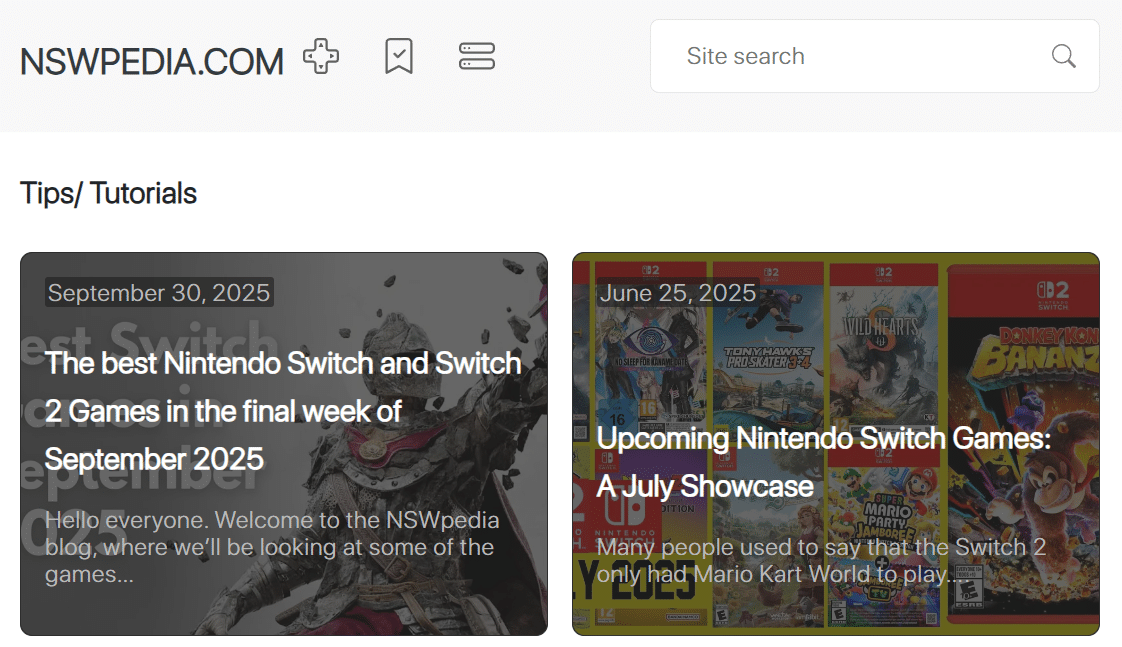
CUII’s implementation order doesn’t mention the rightsholder and the underlying court order was not immediately available. However, we expect that Nintendo (or their affiliate) is the complainant.
Transparency Concerns
While both systems rely on judicial oversight, transparency remains a concern for some, especially when ISPs don’t substantially push back in court proceedings.
Transparency is particularly limited in Germany, where there is no official public blocklist. This lack of openness led a German developer named Lina to create CUIILliste.de, an unofficial monitoring site that has exposed several blocking errors.
In the Netherlands, some ISPs offer more transparency. This includes Delta Fiber, which provides a list of all blocked domain names. The list, which includes piracy and Russian propaganda blocks, is currently a few hundred entries long and publicly accessible on the company’s website.
—
A copy of the CUII blocking implementation statement on NSWPedia, referencing the Cologne court order, is available here (pdf). TorrentFreak has seen a copy of the NXBrew ruling issued by the Rotterdam Court, but it has not been published publicly yet.
From: TF, for the latest news on copyright battles, piracy and more.
-

What 776 ECT Recipients Want You to Know
Editor’s note: co-published with Mad in America
After more than 15 years of researching electroconvulsive therapy (ECT) and a decade of participating in and moderating a private, international support group explicitly created for ECT recipients, the chasm between peer-reviewed ECT research authored by ECT providers and private conversations amongst ECT recipients is growing wider. ECT provider-authored research contains closed-ended, fixed questions designed to elicit answers fitting the hypothesis that ECT is a “gold-standard,” “safe and effective” procedure. What would happen if ECT recipients from community settings (outside clinical trials) were given the opportunity to respond to two open-ended statements without “leading the witness”?
The largest international survey of ECT experiences ever conducted chose to give that opportunity to ECT recipients. It posed two open-ended, fill-in-the-blank type statements: ‘Please name up to three positive effects of your ECT, if any’ and ‘Please name up to three negative effects of your ECT, if any’. Spontaneous responses to these two statements were entered into the survey immediately after gathering recipient demographics and prior to posing close-ended questions to understand ECT experiences. The resulting responses came from 41 countries; the large majority having received ECT in the United States (73%). More than half the respondents had ECT in the previous 10 years (2015-2024). Results, newly published in the Journal Of Affective Disorders, highlight a vast dichotomy between ECT clinical trial research presented in the informed consent discussions and community setting outcomes. (1)
Reported Benefits: Present, but limited
When asked to identify positive ECT effects, only positive ECT effects were identified by a staggering minority (3.2%) of 776 respondents. A larger minority could identify only one positive effect (48.8%). The most reported positive effects were (reported by more than 3.1% of respondents): varying degrees of ‘Improved mood’ (23%), varying degrees of ‘reduced suicidality’ (13%), and varying degrees of reduced psychosis (3.1%).
Here are some of the benefits in their own words, shared proportionately as reported:
“Brief improvement in mood.” -31 f Sweden
“Slightly improved mood.” -31 f Canada
“I came rocketing out of extreme depression.” -33 m USA
“Elimination of suicidal ideation.” -61 m USA
“Less suicidal thoughts.” -33 f Belgium
“For a couple weeks after I was less suicidal.” -59 f Australia
“Decrease of auditory hallucinations.” -31 f S Korea
“Small amount of relief.” -56 f USA
“Slightly worked for a little while.” -35 m USA
“I like being given an anaesthetic because it felt like dying peacefully and being totally free of my pain for a short time.” -42 f UK
Reported Costs: Present, and overwhelming
When asked to identify negative ECT effects, 96.9% spontaneously reported one or more negative effects. Only negative effects were reported by more than half of the respondents (51.2%). Mixed results were reported by 45.6% of respondents. The most spontaneously reported negative effects included Memory problems (81.6%), cognitive problems (29%), feeling abused, violated, and/or traumatized (8%), and ‘impaired relationships’ (5%).
I found it most revealing that “the average number of positive outcomes reported per person was 0.96, compared to a mean of 2.48 for negative outcomes.” In looking at the frequency of negatives compared to positives, it begs the question, what was the cost of these benefits?
Here are some of the “costs” in their own words (proportionate to those reported):
“I lost 19 years of memory including my children growing up.” -37 f USA
“Lost 4 years of long term memories completely. It is as if those years of my life did not happen.” -20 f Australia
“I could not teach any more, as I had forgotten whole chunks of information that had been garnered over 30 plus years.” -46 f USA
“Memories of significant events with my children permanently erased. Hard to remember much at all about their early lives, birthdays, first days at school, activities … I also don’t remember my wedding.” -42 f UK
“Can’t do math or any of the things I have studied.” -30 f USA
“Forced to resign from working as a registered nurse due to loss of cognition.” –24 f USA
“Struggled with memory loss and poor concentration for years after, and memory/intelligence had always been an important part of my identity, so identity loss.” –27 f Australia
“Loss of job, permanent SSA disability, brain changes per several MRIs.” -35 f USA
“Years of memories of academic and biographical content are gone.” -19 m USA
“Even years later, I still cannot recognize people I’ve known for years when I see them.” -35 f USA
“My IQ level has dramatically declined, university graduate having to relearn basic English and math.” -25 f Australia
“Cannot think nor process information.” -57 m USA
“Debilitating loss in executive function, especially concentration.” -64 m USA
“Terrible and frequent migraines.” -46 f USA
“My PTSD got much worse.” -44 m Norway
“Retraumatised. Held down and body ‘done to’ against my will.” -50 f UK
“Fear and terror at having things done to me which reminded me of childhood assault and made my symptoms worse.” 36 non-binary Australia
“As someone with a history of childhood abuse and rape, knowing I was given ECT so many times without proper facts and other options for addressing the cause of my depression, self-harm and suicidality, feels like being raped all over again.” -42 f UK
“I felt violated in a way that shouldn’t be possible. Our memories should be inviolable. Over time I came to see that this was just another rape, but of my mind. Part of me was stolen, violently. ECT was abuse.” -35 f Australia
“I live in fear of this happening to me again. Just 2 years ago I narrowly missed being detained by psychiatry and my GP was saying she thought I should have ECT. I was terrified.” –31 f Australia
“Lost who I was and it affects all my relationships.” –36 f USA
“Even years later, I still cannot recognize people that I’ve known very well for years when I see them until they remind me of their name AND how we know each other.” –35 f USA
“Relationships are established by shared experiences, shared interests and shared memories–wipe the memories and the relationship no longer exists.” -34 f USA
“Inability to hold a job for two years.” –26 m Brazil
“Severe memory loss causing loss of job & career as health care professional.” -48 f Canada
“Loss of my career as a medical doctor.” –35 f Canada
“I had to teach myself how to learn new things again, which affected my work and university greatly. This caused huge career and financial effects.” -20 f Australia
“Confused.” –36 m N Zealand
“Inability to focus.” -40 f USA
“Struggle with emotional connection and maintaining healthy relationships.” -19 f UK
“Social stigma, feeling like a “freak” who had her brain fried.” –40 f USA
“Loss of trust in family and in almost any doctor.” –21 f USA
“I lost trust in my family and most people and of course the medical system.” –26 f Egypt
“Unable to experience any joy.” -38 f Canada
“Emotionally void for years afterwards.” –47 f UK
What stands out about the self-reporting negatives is the amount of consistency between individuals’ experiences. Most of the costs were lasting, life-altering consequences.
Open-ended statements allowed ECT recipients to define what they felt was evidence of their ECT experience. Data collected in the ECT recipients’ own words gives voice to their most pressing ECT benefits and costs—many of which had not previously been captured in large studies of ECT experiences. These open-ended questions captured how recipients felt ECT impacted their lives. The information was volunteered, uninfluenced by the research team. That said, in general, people are more likely to be candid with others who have similar experiences and the research team was very open about having three ECT recipients.
Yes, this is a convenience sample, gathered from English speaking ECT recipients worldwide. We didn’t have means to translate it. Some may be tempted to question whether ECT experiences in the words of those who had it are valid. Whose voices should be counted in ECT evidence? It’s the recipients not the providers that live with the procedures’ effects.
My co-author, Lisa Morrison, an ECT recipient, commented:
“Patients harmed by ECT have been ignored and silenced for decades. There is no monitoring of the effects beyond the end of treatment nor access to rehabilitation for debilitating and permanent life-altering consequences. Why are psychiatrists with the power and influence to change this, ignoring or undermining those of us harmed? Why do public regulatory bodies allow this to continue? These are human rights failings in plain sight.”
Another co-author, and former physician until ECT made it impossible for her to continue adds:
“This research acknowledges the lived reality of ECT patients by giving a voice to both the positive and negative experiences of patients. ECT psychiatrists repeatedly state that ECT cannot cause brain damage. But I was diagnosed by a neuropsychologist as having ECT brain injury.”
Lead author, Dr John Read, Professor of Clinical Psychology at the University of East London, commented:
“This overwhelmingly negative appraisal of ECT, by the largest international sample of patients to date, suggests that psychiatrists are misleading patients and relatives when they tell them it is safe and effective.
How is it possible to have such benefits vs costs disparities?
Historical ECT research demonstrated eight hospitals within the same geographic region had a spectrum of outcomes ranging from improved to grossly cognitively impaired six months after treatment course.(2) A vast outcome spectrum for a procedure touted as “safe and effective.” What can we expect from a procedure without performance measure protocols?
At a minimum, these spontaneous self-reported effects should cause each member of the public to question what they’ve been told about electroconvulsive therapy. Who holds the authority of describing how ECT affects human lives? Those giving it, or those who received it?
These results humanize the real-world consequences of ECT in community settings, giving empirical weight to what I learned the hard way: ECT is neither reliably safe nor reliably effective—though our doctors promised it was. After nearly a century of ECT research, psychiatry has yet to determine a standardized approach that routinely optimizes clinical benefit while consistently limiting injury. While I celebrate the small percentage who feel they benefited, I intimately understand and mourn with those who reported devastating neurological consequences, breaking of familial and social relationships, career loss, and a litany of other grossly underestimated negative outcomes. I especially mourn with family members who’s loved ones were killed. This study demonstrates a profound need for patient registries to track immediate and longer-term outcomes, comprehensive assessments, and appropriate rehabilitation intervention development to improve quality life after ECT. (Results reported in a separate article revealed almost half (49.1%) of respondents felt ECT worsened quality of life; some recipients said ECT made their life “much worse” (21.6%), others felt ECT made life “very much worse” (27.5%).(3)
Now that ECT recipients have been given a voice, is the general public prepared to listen? Devastating costs and inconsistent, unreliable benefits lead me to wonder what must we do to protect vulnerable fellow humans desperate for “safe and effective” treatment because what was once considered a “gold-standard” now seems like pyrite.
- Read J, Cunliffe S, Hancock S, Harrop C, Johnstone L, Morrison L. The self-reported positive and negative effects of electroconvulsive therapy: an international survey. Journal of Affective Disorders Reports. 2026;24:101008.
- Sackeim HA, Prudic J, Fuller R, Keilp J, Lavori PW, Olfson M. The cognitive effects of electroconvulsive therapy in community settings. Neuropsychopharmacology. 2007;32(1):244-54.
- Read J, Johnstone L, Hancock SP, Harrop C, Morrison L, Cunliffe S. A Survey of 1144 ECT Recipients, Family Members and Friends: Does ECT Work? International Journal of Mental Health Nursing. 2025;34(4):e70109.
****
Mad in the UK hosts blogs by a diverse group of writers. The opinions expressed are the writers’ own.
The post What 776 ECT Recipients Want You to Know appeared first on Mad in the UK.
-
Using AI for medical advice ‘dangerous’, study finds
Oxford researchers find that using AI to make medical decisions presents a risk to patients. -
Deaf patients condemn lack of NHS interpreters
Members of Hull’s deaf community say they are “misunderstood” and face regular delays to treatment. -

EFFecting Change: Get the Flock Out of Our City
Flock contracts have quietly spread to cities across the country. But Flock ALPR (Automated License Plate Readers) erode civil liberties from the moment they’re installed. While officials claim these cameras keep neighborhoods safe, the evidence tells a different story. The data reveals how Flock has enabled surveillance of people seeking abortions, protesters exercising First Amendment rights, and communities targeted by discriminatory policing.
This is exactly why cities are saying no. From Austin to Cambridge to small towns across Texas, jurisdictions are rejecting Flock contracts altogether, proving that surveillance isn’t inevitable—it’s a choice.
Join EFF’s Sarah Hamid and Andrew Crocker along with Reem Suleiman from Fight for the Future and Kate Bertash from Rural Privacy Coalition to explore what’s happening as Flock contracts face growing resistance across the U.S. We’ll break down the legal implications of the data these systems collect, examine campaigns that have successfully stopped Flock deployments, and discuss the real-world consequences for people’s privacy and freedom. The conversation will be followed by a live Q&A.
EFFecting Change Livestream Series:
Get the Flock Out of Our City
Thursday, February 19th
12:00 PM – 1:00 PM Pacific
This event is LIVE and FREE!
Accessibility
This event will be live-captioned and recorded. EFF is committed to improving accessibility for our events. If you have any accessibility questions regarding the event, please contact events@eff.org.
Event Expectations
EFF is dedicated to a harassment-free experience for everyone, and all participants are encouraged to view our full Event Expectations.
Upcoming Events
Want to make sure you don’t miss our next livestream? Here’s a link to sign up for updates about this series: eff.org/ECUpdates. If you have a friend or colleague that might be interested, please join the fight for your digital rights by forwarding this link: eff.org/EFFectingChange. Thank you for helping EFF spread the word about privacy and free expression online.
Recording
We hope you and your friends can join us live! If you can’t make it, we’ll post the recording afterward on YouTube and the Internet Archive!


