Once again, everything old is new again. The circle of disinformation is complete.
The post MAHA Leaders Are Recycling COVID Myths to Minimize Measles first appeared on Science-Based Medicine.
Once again, everything old is new again. The circle of disinformation is complete.
The post MAHA Leaders Are Recycling COVID Myths to Minimize Measles first appeared on Science-Based Medicine.

In November 2015, Federal Police in Brazil launched Operation Blackbeard, a coordinated action to take down Latin America’s most popular pirate site: MegaFilmesHD.net.
Launched in 2010 and mainly catering to the Portuguese-speaking market, the movie portal had been pulling in a reported 60 million monthly visits.
At the time, the site offered a type of convenience that most legal services couldn’t match. In addition to the free and unrestricted access to content, this also included localized features such as Portuguese subtitles or dubbing.
This reign ended when police made several arrests, including the site’s presumed operators, and seized several cars, cash, and bank accounts. These actions were welcomed by Hollywood’s Motion Picture Association (MPA), which had reported the site to the U.S. Trade Representative a month earlier.

Today, more than a decade has passed since MegafilmesHD’s demise, and online piracy is arguably a much bigger problem. Popular piracy brands such as Cuevana, Redecanais, and FlujoTV are a magnet for many millions of people
This doesn’t mean that the original shutdown has no effect whatsoever. At the time, large local pirate sites were a novelty in the region, and, being the largest site by far, MegafilmesHD clearly stood out above the rest. When this went offline, many people had to scramble for alternatives, legal or illegal.
Ideally, rightsholders would like to see pirates flocking to legal services when these types of shutdowns occur. That is similar to the desired response to piracy site blocking. And indeed, in some instances, this appears to be true.
For example, the “Gone in 60 Seconds” study found that the shutdown of Megaupload in 2012 resulted in a 6 to 10% increase in digital movie revenues for two major Hollywood studios.
However, a similar study on the demise of the German streaming portal Kino.to revealed something quite different. The “Catch Me If You Can” paper found that this shutdown had no measurable increase in legal consumption. Instead, people simply switched to new pirate sites and continued their habit.
These seemingly conflicting findings come together in a new study on the MegafilmesHD shutdown. While the associated paper doesn’t have a title inspired by a Hollywood blockbuster, it might as well have been titled “The Equalizer“.
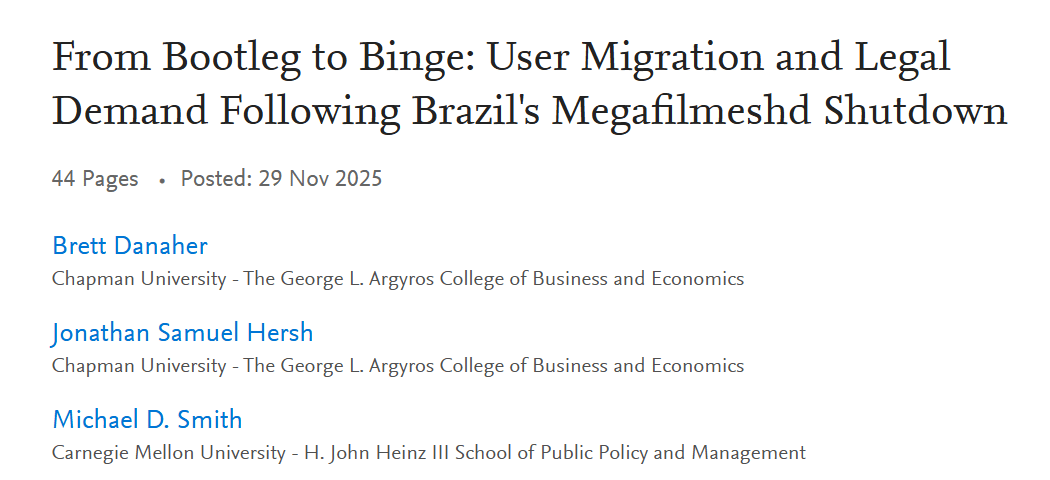
The paper in question, published by researchers of Chapman University and Carnegie Mellon University, takes a detailed look at how the online activities of Brazilian users were affected by MegafilmesHD. To do so, they examined six months worth of clickstream data of thousands of Internet users, provided by Netquest.
The data included browsing patterns before and after the shutdown, and it included a wide variety of respondents, ranging from hardcore pirates to people who never visited MegafilmesHD at all.
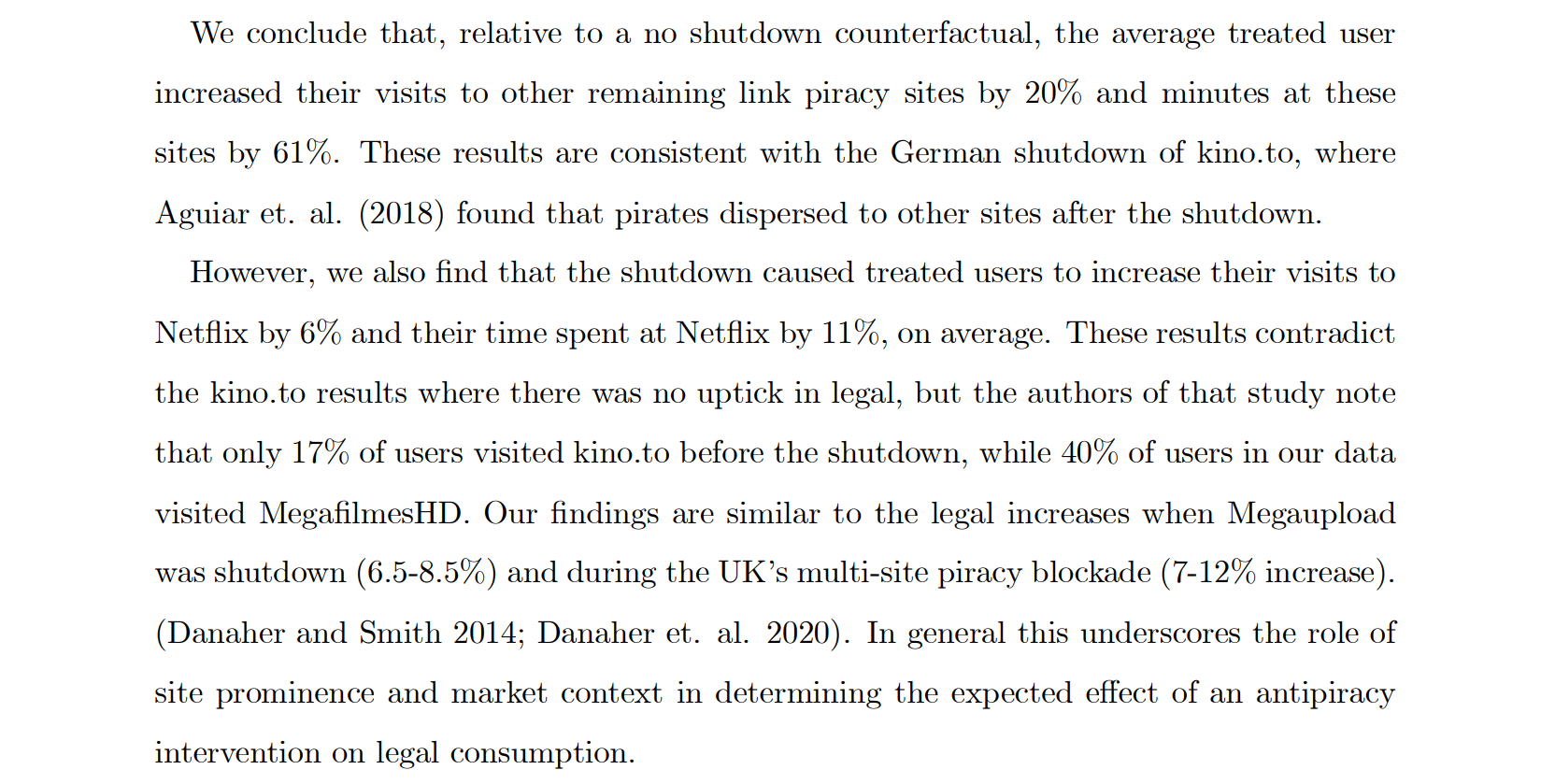
After analyzing all data, the researchers found that pirates who previously used MegafilmesHD increased their visits to other pirate sites by 20% on average. Even more striking was the increase in engagement, as time spent on these alternative pirate sites surged by 61%.
This effectively confirms that high-profile shutdowns divert traffic to other pirate sites and services. This makes sense, as a single shutdown can’t realistically make all piracy go away.
However, the findings don’t end there. Additionally, the researchers also find a boost in legal use. Specifically, the data showed a 6% increase in visits to Netflix and an 11% increase in time spent on the platform among MegafilmesHD users.
Crucially, this uptick wasn’t simply caused by existing Netflix subscribers watching more content. The researchers found a causal link between high MegafilmesHD usage and the probability of someone becoming a new Netflix subscriber in the months following the raid.
While these findings may all seem logical, the most compelling part of the research covers which people switched to legal options and who remained pirates. It appears that “The Equalizer” effect was not felt equally across all demographics.
Since costs play an important role, it makes sense that there’s a wealth factor involved. And indeed, the research found that students and unemployed individuals were less likely to sign up for Netflix, likely because price remains a primary barrier to entry.
Interestingly, gender also plays a key role. The researchers found that women were more likely to stop piracy altogether following the shutdown. Men, on the other hand, were more likely to persist, often “doubling down” by searching for new illegal sources.
It is these types of nuances that reveal the complexity of online piracy and the effectiveness of enforcement actions.
Ultimately, the researchers conclude that while a single-site shutdown can generate measurable legal gains, those gains are in part limited to users who can afford the alternative.
For rightsholders and policymakers, the “take-home” message is that enforcement is only half the battle. Without appealing and affordable legal alternatives, even the most successful police operation may be nothing more than another round of whack-a-mole, driving traffic from one pirate site to the next one.
—
Danaher, B, Hersh, J, and Smith, MD. 2025. “From Bootleg to Binge: User Migration and Legal Demand Following Brazil’s MegafilmesHD Shutdown”. Review of Economics Research on Copyright Issues, Vol 22, pp 1-32.
Note: This research was conducted as part of Carnegie Mellon University’s Initiative for Digital Entertainment Analytics (IDEA), which receives unrestricted funding from the Motion Picture Association (MPA). The authors note that all findings and any errors remain entirely their own.
From: TF, for the latest news on copyright battles, piracy and more.
What if there was a way for a business to transform any conduct it disliked into a felony, harnessing the power of the state to threaten anyone who acted in a way that displeased the company with a long prison sentence and six-figure fines?
Surprise! That actually exists! It’s called Section 1201 of the Digital Millennium Copyright Act, the “anticircumvention” clause, which establishes five-year sentences and $500k fines for anyone who bypasses an “effective access control” for a copyrighted work.
Let’s unpack that: every digital product has a “copyrighted work” at its core, because software is copyrighted. Digital systems are intrinsically very flexible: just overwrite, augment, or delete part of the software that powers the device or product, and you change how the product works. You can alter your browser to block ads; or alter your Android phone to run a privacy-respecting OS like Graphene; or alter your printer to accept generic ink, rather than checking each cartridge to confirm that it’s the original manufacturer’s product.
However, if the device is designed to prevent this – if it has an “access control” that restricts your ability to change the software – then DMCA 1201 makes those modifications into crimes. The act of providing someone with a tool to change how their own property works (“trafficking in circumvention devices”) is a felony.
But there’s a tiny saving grace here: for DMCA 1201 to kick in, the “access control” must be “effective.” What’s “effective?” There’s the rub: no one knows.
The penalties for getting crosswise with DMCA 1201 are so grotendous that very few people have tried to litigate any of its contours. Whenever the issue comes up, defendants settle, or fold, or disappear. Despite the fact that DMCA 1201 has been with us for more than a quarter of a century, and despite the fact that the activities it restricts are so far-reaching, there’s precious little case law clarifying Congress’s vague statutory language.
When it comes to “effectiveness” in access controls, the jurisprudence is especially thin. As far as I know, there’s just one case that addressed the issue, and boy was it a weird one. Back in 2000, a “colorful” guy named Johnny Deep founded a Napster-alike service that piggybacked on the AOL Instant Messenger network. He called his service “Aimster.” When AOL threatened him with a trademark suit, he claimed that Aimster was his daughter Amiee’s AOL handle, and that the service was named for her. Then he changed the service’s name to Madster, claiming that it was also named after his daughter. At the time, a lot of people assumed he was BSing, but I just found his obituary and it turns out his daughter’s name was, indeed, “Amiee (Madeline) Deep”:
https://www.timesunion.com/news/article/Madster-creator-Cohoes-native-who-fought-record-11033636.php
Aimster was one of the many services that the record industry tried to shut down, both by filing suit against the company and by flooding it with takedown notices demanding that individual tracks be removed. Deep responded by “encoding” all of the track names on his network in pig-Latin. Then he claimed that by “decoding” the files (by moving the last letter of the track name to the first position), the record industry was “bypassing an effective access control for a copyrighted work” and thus violating DMCA 1201:
https://abcnews.go.com/Entertainment/story?id=108454&page=1
The court didn’t buy this. The judge ruled that pig Latin isn’t an “effective access control.” Since then, we’ve known that at least some access controls aren’t “effective” but we haven’t had any clarity on where “effectiveness” starts. After all, there’s a certain circularity to the whole idea of “effective” access controls: if a rival engineer can figure out how to get around an access control, can we really call it “effective?” Surely, the fact that someone figured out how to circumvent your access control is proof that it’s not effective (at least when it comes to that person).
All this may strike you as weird inside baseball, and that’s not entirely wrong, but there’s one unresolved “effectiveness” question that has some very high stakes indeed: is Youtube’s javascript-based obfuscation an “effective access control?”
Youtube, of course, is the internet’s monopoly video platform, with a commanding majority of video streams. It was acquired by Google in 2006 for $1.65b. At the time, the service was hemorrhaging money and mired in brutal litigation, but it had one virtue that made it worth nine figures: people liked it. Specifically, people liked it in a way they didn’t like Google Video, which was one of the many, many, many failed internally developed Google products that tanked, and was replaced by a product developed by a company that Google bought, because Google sucks at developing products. They’re not Willy Wonka’s idea factory – they’re Rich Uncle Pennybags, buying up other kids’ toys:
https://www.theatlantic.com/ideas/archive/2023/02/google-ai-chatbots-microsoft-bing-chatgpt/673052/
Google operationalized Youtube and built it up to the world’s most structurally important video platform. Along the way, Google added some javascript that was intended to block people from “downloading” its videos. I put “downloading” in scare-quotes because “streaming” is a consensus hallucination: there is no way for your computer to display a video that resides on a distant server without downloading it – the internet is not made up of a cunning series of paper-towel rolls and mirrors that convey photons to your screen without sending you the bits that make up the file. “Streaming” is just “downloading” with the “save file” button removed.
In this case, the “save file” button is removed by some javascript on every Youtube page. This isn’t hard to bypass: there are dozens of “stream-ripping” sites that let you save any video that’s accessible on Youtube. I use these all the time – indeed, I used one last week to gank the video of my speech in Ottawa so I could upload it to my own Youtube channel:
https://www.youtube.com/watch?v=iZxbaCNIwg8
(As well as the Internet Archive, natch):
https://archive.org/details/disenshittification-nation
Now, all of this violates Youtube’s terms of service, which means that someone who downloads a stream for an otherwise lawful purpose (like I did) is still hypothetically at risk of being punished by Google. We’re relying on Google to be reasonable about all this, which, admittedly, isn’t the best bet, historically. But at least the field of people who can attack us is limited to this one company.
That’s good, because there’s zillions of people who rely on stream-rippers, and many of them are Youtube’s most popular creators. Youtube singlehandedly revived the form of the “video essay,” popularizing it in many guises, from “reaction videos” to full-fledged, in-depth documentaries that make extensive use of clips to illuminate, dispute, and expand on the messages of other Youtube videos.
These kinds of videos are allowed under US copyright law. American copyright law has a broad set of limitation and exceptions, which include “fair use,” an expansive set of affirmative rights to access and use copyrighted works, even against the wishes of the copyright’s proprietor. As the Supreme Court stated in Eldred, the only way copyright (a government-backed restriction on who can say certain words) can be reconciled with the First Amendment (a ban on government restrictions on speech) is through fair use, the “escape valve” for free expression embedded in copyright:
https://en.wikipedia.org/wiki/Eldred_v._Ashcroft
Which is to say that including clips from a video you’re criticizing in your own video is canonical fair use. What else is fair use? Well, it’s “fact intensive,” which is a lawyer’s way of saying, “it depends.” One thing that is 100% true, though, is that fair use is not limited to the “four factors” enumerated in the statute and anyone who claims otherwise has no idea what they’re talking about and can be safely ignored:
https://pluralistic.net/2024/06/27/nuke-first/#ask-questions-never
Now, fair use or not, there are plenty of people who get angry about their videos being clipped for critical treatment in other videos, because lots of people hate being criticized. This is precisely why fair use exists: if you had to secure someone’s permission before you were allowed to criticize them, critical speech would be limited to takedowns of stoics and masochists.
This means that the subjects of video essays can’t rely on copyright to silence their critics. They also can’t use the fact that those critics violated Youtube’s terms of service by clipping their videos, because only Youtube has standing to ask a court to uphold its terms of service, and Youtube has (wisely) steered clear of embroiling itself in fights between critics and the people they criticize.
But that hasn’t stopped the subjects of criticism from seeking legal avenues to silence their critics. In a case called Cordova v. Huneault, the proprietor of “Denver Metro Audits” is suing the proprietor of “Frauditor Troll Channel” for clipping the former’s videos for “reaction videos.”
One of the plaintiff’s claims here is that the defendant violated Section 1201 of the DMCA by saving videos from Youtube. They argue that Youtube’s javascript obfuscator (a “rolling cipher”) is an “effective access control” under the statute. Magistrate Judge Virginia K DeMarchi (Northern District of California) agreed with the plaintiff:
https://torrentfreak.com/images/Cordova-v.-Huneault-25-cv-04685-VKD-Order-on-Motion-to-Dismiss.pdf
As Torrentfreak reports, this ruling “gives creators who want to sue rivals an option to sue for more than just simple copyright infringement”:
https://torrentfreak.com/ripping-clips-for-youtube-reaction-videos-can-violate-the-dmca-court-rules/
Remember, DMCA 1201 applies whether or not you infringe someone’s copyright. It is a blanket prohibition on the circumvention of any “effective access control” for any copyrighted work, even when no one’s rights are being violated. It’s a way to transform otherwise lawful conduct into a felony. It’s what Jay Freeman calls “Felony contempt of business model.”
If the higher court upholds this magistrate judge’s ruling, then all clipping becomes a crime, and the subjects of criticism will have a ready tool to silence any critic. This obliterates fair use, wipes it off the statute-book. It welds shut copyright’s escape valve for free expression.
Now, it’s true that the US Copyright Office holds hearings every three years where it grants exemptions to DMCA 1201, and it has indeed granted an exemption for ripping video for critical and educational purposes. But this process is deceptive! The exemptions that the Copyright Office grants are “use exemptions” – they allow you to “make the use.” However, they are not “tools exemptions” – they do not give you permission to acquire or share the tool needed to make the use:
https://pluralistic.net/2024/10/28/mcbroken/#my-milkshake-brings-all-the-lawyers-to-the-yard
Which means that you are allowed to rip a stream, but you’re not allowed to use a stream-ripping service. If Youtube’s rolling cipher is an “effective access control” then all of those stream-ripping services are wildly illegal, felonies carrying a five-year sentence and a $500k fine for a first offense under DMCA 1201.
Under the US Copyright Office’s exemption process, if you want to make a reaction video, then you, personally must create your own stream-ripper. You are not allowed to discuss how to do this with anyone else, and you can’t share your stream-ripper with anyone else, and if you do, you’ve committed a felony.
So this is a catastrophic ruling. If it stands, it will make the production of video essays, reaction videos, and other critical videos into a legal minefield, by giving everyone whose video is clipped and criticized a means to threaten their critics with long prison sentences, fair use be damned. The only people who will safely be able to make this kind of critical video are skilled programmers who can personally defeat Youtube’s “rolling cipher.” And unlike claims about stream-ripping violating Youtube’s terms of service – which can only be brought by Youtube – DMCA 1201 claims can be brought by anyone whose videos get clipped and criticized.
Is Youtube’s rolling cipher an “effective access control?” Well, I don’t know how to bypass it, but there are dozens of services that have independently figured out how to get around it. That seems like good evidence that the access control is not “effective.”
When the DMCA was enacted in 1998, this is exactly the kind of thing experts warned would happen:
https://pluralistic.net/2025/05/13/ctrl-ctrl-ctrl/#free-dmitry
And here we are, more than a quarter-century later, living in the prison of lawmakers’ reckless disregard for evidence and expertise, a world where criticism can be converted into a felony. It’s long past time we get rid of this stupid, stupid law:
https://pluralistic.net/2026/01/01/39c3/#the-new-coalition
(Image: Electronic Frontier Foundation, CC BY 4.0)

The Finance Industry Is a Grift. Let’s Start Treating It That Way. https://www.nytimes.com/2026/02/06/opinion/capitalism-industry-financialization.html?unlocked_article_code=1.KFA.Vslp.8Xqe7KWGEwRu&smid=nytcore-ios-share
Ron Wyden Only Talks Like This When The Spies Do Something Real Bad https://www.forever-wars.com/ron-wyden-only-talks-like-this-when-the-spies-do-something-real-bad/
Hollywood Is Losing Audiences to AI Fatigue https://www.wired.com/story/hollywood-is-losing-audiences-to-ai-fatigue/
Waymo Exec Admits Remote Operators in Philippines Help Guide US Robotaxis https://eletric-vehicles.com/waymo/waymo-exec-admits-remote-operators-in-philippines-help-guide-us-robotaxis/
#25yrsago Bellsouth phases out pay-phones https://web.archive.org/web/20010211165636/http://dailynews.yahoo.com/h/ap/20010202/bs/bellsouth_pay_phones_1.html
#20yrsago Man who shattered museum vases asked not to come back http://www.chinadaily.com.cn/english/doc/2006-02/07/content_517885.htm
#20yrsago Dozens of Web 2.0 companies’ logos https://flickr.com/photos/torrez/95124293/
#20yrsago Did Nvidia hire an army of message-board sock-puppets? https://web.archive.org/web/20060208045150/https://www.consumerist.com/consumer/evil/did-nvidia-hire-online-actors-to-promote-their-products-152874.php
#15yrsago Sarah Palin Circle-R wants a trademark on her name https://www.loweringthebar.net/2011/02/sarah-palin-tm-having-trouble-with-registration.html
#10yrsago Love Picking: Locksport meets love locks https://toool.us/love-locks/
#10yrsago Superb investigative report on the fake locksmith scam https://www.nytimes.com/2016/01/31/business/fake-online-locksmiths-may-be-out-to-pick-your-pocket-too.html?_r=1
#5yrsago Klobuchar wants to bust her some fuckin’ trusts https://pluralistic.net/2021/02/06/calera/#fuck-bork

Montreal (remote): Fedimtl, Feb 24
https://fedimtl.ca/
Victoria: 28th Annual Victoria International Privacy & Security Summit, Mar 3-5
https://www.rebootcommunications.com/event/vipss2026/
Berkeley: Bioneers keynote, Mar 27
https://conference.bioneers.org/
Berlin: Re:publica, May 18-20
https://re-publica.com/de/news/rp26-sprecher-cory-doctorow
Berlin: Enshittification at Otherland Books, May 19
https://www.otherland-berlin.de/de/event-details/cory-doctorow.html
Hay-on-Wye: HowTheLightGetsIn, May 22-25
https://howthelightgetsin.org/festivals/hay/big-ideas-2
How the Internet Got Worse (Masters in Business)
https://www.youtube.com/watch?v=auXlkuVhxMo
Enshittification (Jon Favreau/Offline):
https://crooked.com/podcast/the-enshittification-of-the-internet-with-cory-doctorow/
Why Big Tech is a Trap for Independent Creators (Stripper News)
https://www.youtube.com/watch?v=nmYDyz8AMZ0
Enshittification (Creative Nonfiction podcast)
https://brendanomeara.com/episode-507-enshittification-author-cory-doctorow-believes-in-a-new-good-internet/
“Enshittification: Why Everything Suddenly Got Worse and What to Do About It,” Farrar, Straus, Giroux, October 7 2025
https://us.macmillan.com/books/9780374619329/enshittification/
“Picks and Shovels”: a sequel to “Red Team Blues,” about the heroic era of the PC, Tor Books (US), Head of Zeus (UK), February 2025 (https://us.macmillan.com/books/9781250865908/picksandshovels).
“The Bezzle”: a sequel to “Red Team Blues,” about prison-tech and other grifts, Tor Books (US), Head of Zeus (UK), February 2024 (thebezzle.org).
“The Lost Cause:” a solarpunk novel of hope in the climate emergency, Tor Books (US), Head of Zeus (UK), November 2023 (http://lost-cause.org).
“The Internet Con”: A nonfiction book about interoperability and Big Tech (Verso) September 2023 (http://seizethemeansofcomputation.org). Signed copies at Book Soup (https://www.booksoup.com/book/9781804291245).
“Red Team Blues”: “A grabby, compulsive thriller that will leave you knowing more about how the world works than you did before.” Tor Books http://redteamblues.com.
“Chokepoint Capitalism: How to Beat Big Tech, Tame Big Content, and Get Artists Paid, with Rebecca Giblin”, on how to unrig the markets for creative labor, Beacon Press/Scribe 2022 https://chokepointcapitalism.com
“Enshittification, Why Everything Suddenly Got Worse and What to Do About It” (the graphic novel), Firstsecond, 2026
“The Memex Method,” Farrar, Straus, Giroux, 2026
“The Reverse-Centaur’s Guide to AI,” a short book about being a better AI critic, Farrar, Straus and Giroux, June 2026
Today’s top sources:
Currently writing: “The Post-American Internet,” a sequel to “Enshittification,” about the better world the rest of us get to have now that Trump has torched America (1010 words today, 24701 total)
“The Post-American Internet,” a short book about internet policy in the age of Trumpism. PLANNING.
A Little Brother short story about DIY insulin PLANNING

This work – excluding any serialized fiction – is licensed under a Creative Commons Attribution 4.0 license. That means you can use it any way you like, including commercially, provided that you attribute it to me, Cory Doctorow, and include a link to pluralistic.net.
https://creativecommons.org/licenses/by/4.0/
Quotations and images are not included in this license; they are included either under a limitation or exception to copyright, or on the basis of a separate license. Please exercise caution.
Blog (no ads, tracking, or data-collection):
Newsletter (no ads, tracking, or data-collection):
https://pluralistic.net/plura-list
Mastodon (no ads, tracking, or data-collection):
Medium (no ads, paywalled):
Twitter (mass-scale, unrestricted, third-party surveillance and advertising):
Tumblr (mass-scale, unrestricted, third-party surveillance and advertising):
https://mostlysignssomeportents.tumblr.com/tagged/pluralistic
“When life gives you SARS, you make sarsaparilla” -Joey “Accordion Guy” DeVilla
READ CAREFULLY: By reading this, you agree, on behalf of your employer, to release me from all obligations and waivers arising from any and all NON-NEGOTIATED agreements, licenses, terms-of-service, shrinkwrap, clickwrap, browsewrap, confidentiality, non-disclosure, non-compete and acceptable use policies (“BOGUS AGREEMENTS”) that I have entered into with your employer, its partners, licensors, agents and assigns, in perpetuity, without prejudice to my ongoing rights and privileges. You further represent that you have the authority to release me from any BOGUS AGREEMENTS on behalf of your employer.
ISSN: 3066-764X

I don’t wish happiness for you.
I don’t wish for your life to be easy.
I want you to be able to keep going.
I don’t want the weight of the world to break you.
I want you to get up and look to be adding more weight day by day.
Build resilience.
Be ready.
When you do fall and you will fall.
You will know how to stand again.
Maybe not right away but you will.
Maybe you will have to crawl for a bit.
Maybe take a breath.
You may wish at a point for it to be easier.
Be humble
Remember life is always going to be tough.
Good thing, as are you.
It’s your choice to stay down
Or
To stand back up
Both are tough decisions
But it’s your decision
Don’t be afraid.
Keep going
Don’t give up
****
Mad in the UK hosts blogs by a diverse group of writers. The opinions expressed are the writers’ own.
The post Don’t wish for happiness appeared first on Mad in the UK.
The Trump administration’s move to give deportation officials access to Medicaid data is putting hospitals and states in a bind as they weigh whether to alert immigrant patients that their personal information, including home addresses, could be used in efforts to remove them from the country.
Warning patients could deter them from signing up for a program called Emergency Medicaid, through which the government reimburses hospitals for the cost of emergency treatment for immigrants who are ineligible for standard Medicaid coverage.
But if hospitals don’t disclose that the patients’ information is shared with federal law enforcement, they might not know that their medical coverage puts them at risk of being located by Immigration and Customs Enforcement.
“If hospitals tell people that their Emergency Medicaid information will be shared with ICE, it is foreseeable that many immigrants would simply stop getting emergency medical treatment,” said Leonardo Cuello, a research professor at Georgetown University’s Center for Children and Families. “Half of the Emergency Medicaid cases are for the delivery of U.S. citizen babies. Do we want these mothers avoiding the hospital when they go into labor?”
For more than a decade, hospitals and states have assured patients that their personal information, including their home addresses and immigration status, would not be shared with immigration enforcement officials when they apply for federal health care coverage. A 2013 ICE policy memo guaranteed the agency would not use information from health coverage applications for enforcement activities.
“Do we want these mothers avoiding the hospital when they go into labor?”
But that changed last year, after President
Of those that responded, none said they were directly warning patients that their personal information may be shared with ICE when they apply for Medicaid coverage.
“We do not provide legal advice about federal government data-sharing between agencies,” Aimee Jordan, a spokesperson for M Health Fairview, a Minneapolis-based hospital system, said in an email to KFF Health News. “We encourage patients with questions about benefits or immigration-related concerns to seek guidance from appropriate state resources and qualified legal counsel.”
Some states’ Emergency Medicaid applications specifically ask for a patient’s immigration status — and still assure people that their information will be kept secure and out of the hands of immigration enforcement officials.
For example, as of Feb. 3, California’s application still included language advising applicants that their immigration information is “confidential.”
“We only use it to see if you qualify for health insurance,” states the 44-page form, which the state’s Medicaid program, known as Medi-Cal, posted on social media in January.
California Department of Health Care Services spokesperson Anthony Cava said in a statement that the agency, which oversees Medi-Cal, will “ensure that Californians have accurate information on the privacy of their data, including by revising additional publications as necessary.”
Until late January, Utah’s Medicaid website also claimed its Emergency Medicaid program did not share its information with immigration officials. After KFF Health News contacted the state agency, Kolbi Young, a spokesperson, said Jan. 23 that the language would be taken down immediately. It was removed that day.
Oregon Health & Science University, a hospital system based in Portland, offers immigrant patients a Q&A document developed by the state Medicaid program for those with concerns about how their information might be used. The document does not directly say that Medicaid enrollees’ information is shared with ICE officials.
Hospitals rely on Emergency Medicaid to reimburse them for treating people who would qualify for Medicaid if not for their citizenship status — those in the country illegally as well as lawfully present immigrants, such as those with a student or work visa. The coverage pays only for emergency medical and pregnancy care. Typically, hospital representatives help patients apply while they are still in the medical facility.
Some states’ Emergency Medicaid applications specifically ask for a patient’s immigration status.
The main Medicaid program, which covers a much broader range of services for over 77 million low-income and disabled people, does not cover people living in the country illegally.
Examining Emergency Medicaid enrollment is the most obvious way, then, for deportation officials to identify immigrants, including those who might not reside in the U.S. lawfully.
HHS spokesperson Rich Danker said in an email that the CMS — which oversees Medicaid, a joint state-federal program — is sharing data with ICE after the judge’s ruling. But he would not answer how the agency is ensuring it is sharing information only about people who are not lawfully present, as the judge required.
With ICE now getting direct access to the personal information of millions of Medicaid enrollees, hospitals — while “definitely in a tough position” — should be up-front about the changes, said Sarah Grusin, an attorney at the National Health Law Program, an advocacy group.
“They need to be telling people that the judge has permitted sharing of information, including their address, for people who are not lawfully residing,” she said. “Once this information is submitted, you can’t protect it from disclosure at this point.”
Grusin said she advises families to weigh the importance of seeking medical care against the risk of having their information shared with ICE.
“We want to give candid, honest information even if it means the decision people have to make is really hard,” she said.
Those who have previously enrolled in Medicaid or can easily search their address online should assume that immigration officials already have their information, she added.
Emergency Medicaid coverage was established in the mid-1980s, when a federal law began requiring hospitals to treat and stabilize all patients who show up at their doors with a life-threatening condition.
Federal government spending on Emergency Medicaid totaled nearly $4 billion in 2023, or about 0.4% of total federal spending on Medicaid.
States send monthly reports to the federal government with detailed information about who enrolls in Medicaid and what services they receive. The judge’s ruling in December limited what the CMS can share with ICE to only basic information, including addresses, about Medicaid enrollees in the 22 states that sued over the data-sharing arrangement. ICE officials are not supposed to access information about the medical services people receive, per the judge’s order.
The judge also prohibited the agency from sharing the data of U.S. citizens or lawfully present immigrants from those states.
Deportation officials have access to personal Medicaid information of all enrollees in the remaining 28 states.
Medicaid experts say it would be nearly impossible for the agency to separate the data.
The federal health agency has not clarified how it is ensuring that certain states’ information on citizens and legal residents is not shared with ICE. But Medicaid experts say it would be nearly impossible for the agency to separate the data, raising questions about whether the Trump administration is complying with the judge’s order.
The Trump administration’s efforts to deport immigrants living in the country illegally have had implications for immigrant families seeking care. About one-third of adult immigrants reported skipping or postponing health care in the past year, according to a KFF/New York Times poll released in November. (KFF is a health information nonprofit that includes KFF Health News.)
Bethany Pray, the chief legal and policy officer at the Colorado Center on Law and Policy, warned that sharing Medicaid data directly with deportation officials will force even tougher decisions upon some families.
“This is very concerning,” Pray said. “People should not have to choose between giving birth in a hospital and wondering if that means they risk deportation.”
KFF Health News is a national newsroom that produces in-depth journalism about health issues and is one of the core operating programs at KFF — an independent source for health policy research, polling and journalism.
The post With ICE Using Medicaid Data, Hospitals and States Are in a Bind appeared first on Truthdig.